




 JCMAH Home



Biochemical Effects of Yoga
Gökhan Doğukan Akarsu1* and Rukiye Höbek Akarsu2
1Department of Pharmacy Services, Vocational School of Health Services, Turkey
2Department of Nursing, Yozgat Bozok University, Faculty of Health Sciences, Turkey
Submission: July 11, 2023; Published: October 05, 2023
*Corresponding author: Yozgat Bozok University, Department of Pharmacy Services, Vocational School of Health Services, Email: gokhan_dogukan_akarsu@hotmail.com
How to cite this article: Gökhan Doğukan A, Rukiye Höbek A. Biochemical Effects of Yoga. J Complement Med Alt Healthcare. 2023; 12(3): 555836. DOI: 10.19080/JCMAH.2023.12.555836
Abstract
Aim: It is aimed to examine the experimental studies carried out in 2022 to explore the bıochemıcal effects of yoga.
Methods: Science Direct, Web of Science, SCOPUS, Springer Link, Networked Digital Library of Theses & Dissertations, Ovid, CINAHL, Pubmed, Cochrane Library, Proquest databases were made by searching English articles published between January 2022 and January 2023. “Yoga, Biochemistry, Biological Effect of Yoga, Yoga With Change Of Biology” etc. words and combinations are used. The summaries of 251 studies that formed the universe published between January 1, 2022 and January 15, 2023 were systematically examined, and then 18 studies that were suitable for the purpose of the study and that caused biochemical changes in yoga formed the sample of the research.
Results: In the studies reviewed, it has been reported that yoga reduces blood CRP, LDL, triglyceride, cholesterol, fasting and postprandial blood sugar, IL-6, HBA1c, D-Dimer, oxidative stress markers, HOMA-IR and leukocyte counts. It has also been reported to increase HDL levels.
Conclusion: It can be stated that yoga improves biochemical parameters as well as spiritual well-being, and makes significant contributions to health with its cost-free and space-free practice.
Keywords: Yoga; Yoga effect; Complementary Medicine; Health
Introduction
Yoga is a form of therapy in Indian culture that helps to heal the soul and body through meditation. There are many studies examining the effects of yoga on health. The first article on yoga published in 1978 was written by Tandon. With the new information added to the literature as a result of research conducted today, the limits of the benefits of yoga to human health have not been determined yet. As research continues, new information emerges [1]. Yoga is an ancient mind-body practice that originated in India around 5000 BC. In the classical Indian language Sanskrit, the word “yoga” means “to subjugate” or “to unite”, so the aim of yoga is the unification of mind, body, and spirit [2].The holistic approach of yoga involves promoting mental and physical health through lifestyle guidelines [3].
Before yoga spread globally as a physical exercise system, it was conceived for the purpose of healing in improving health. It was believed that the beginning of healing started with improving the mental state of the person doing yoga [4]. Information obtained from current studies accepts the relationship of stress with the immune system and other diseases [5]. Acute and chronic stress, mainly through the hypothalamic-pituitary-adrenal axis and sympathetic nervous system, increases the risk of developing diseases due to immune weakness [6].
Some physiological effects of yoga are
• Induces stress-induced autonomic nervous system balance
• Lowers heart rate and blood pressure
• Respiratory rate decreases and respiratory efficiency increases
• Increase in parameters such as tidal volume, vital capacity and breath-hold time.
• α waves increase in EEG. At various stages of meditation, β, δ, θ waves also increase
• Cardiovascular capacity is strengthened
• Improvement is observed in gastrointestinal function and endocrine functions. Weight balance improves.
• The excretory system functions are improved
• Musculoskeletal flexibility and capacity increase
• Posture improves
• Sleep improves
• The immune system is strengthened [7]
The aim of this article is to summarize clinical studies to understand the biochemical effects of yoga.
Materials and Methods
Type of Research
This study is a systematic review prepared according to the PRISMA checklist and Cochrane guideline (Higgins et al. (2019); Moher et al. (2009)).
Research Strategy
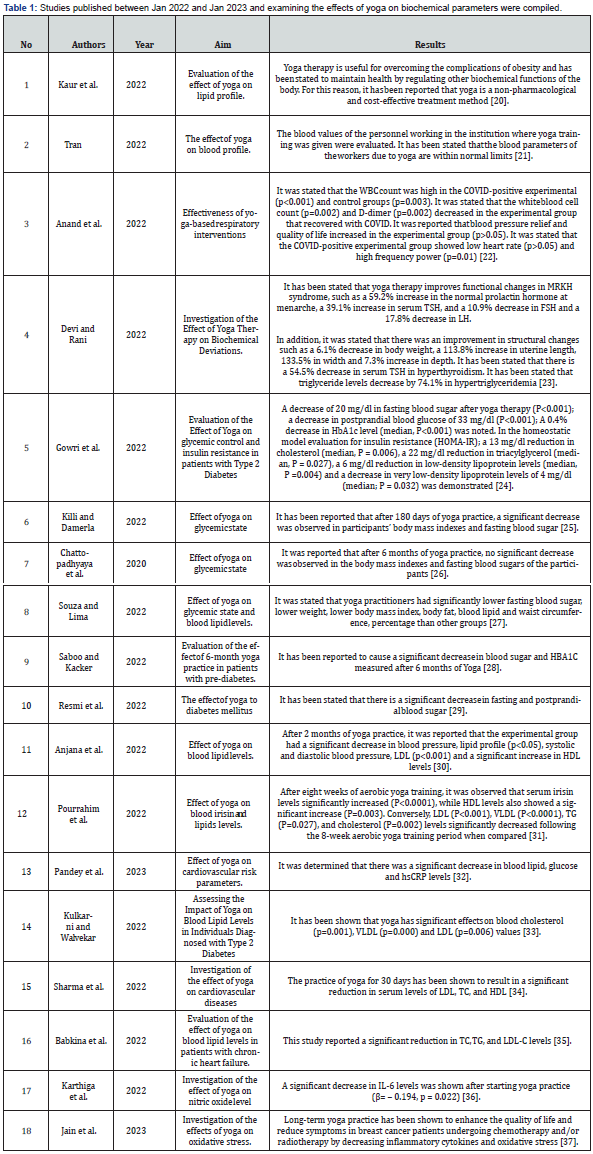
It is stated that yoga therapy improves one’s soul and body. It will lead to changes in some biochemical parameters of physical and mental well-being. The aim of the study is to determine whether yoga causes changes in biochemical parameters, if so, what these changes are and what effects they cause. Science Direct, Web of Science, SCOPUS, Springer Link, Networked Digital Library of Theses & Dissertations, Ovid, CINAHL, Pubmed, Cochrane Library, Proquest databases were made by scanning English articles published between January 2022 since January 2023. “Yoga, Biochemistry, Biological Effect of Yoga, Yoga With Change Of Biology” etc. words and combinations are used. The summaries of 251 studies, which were published between 1 Jan 2022 and 15 Jan 2023, were systematically examined, and then 18 studies that were suitable for the purpose of the study and that caused biochemical changes in yoga formed the sample of the research (Table 1). Although all searches were done by a single reviewer, full-text review and data abstraction were done in duplicate. While scanning the articles, clinical studies on the effect of yoga on biochemical parameters were included. The effects of other therapy models on biochemical parameters are not included.
Inclusion criteria
• Full text accessible
• In the field of Yoga
• About biochemistry effect of Yoga therapy
• Studies published in the Science Direct, Web of Science, SCOPUS, Springer Link, Networked Digital Library of Theses & Dissertations, Ovid, CINAHL, Pubmed, Cochrane Library, Proquest database center between January 2022 since January 2023 were included.
1.1. In this study, PICOS
• (P: Population): People who do and do not do yoga
• (I: Intervention): People who practice yoga
• (C: Comparison): People who do not practice yoga
• (O: Outcomes): The results of doing yoga in biochemical parameters.
• (S: Study design): Experimental yoga studies were included.
Limitation of the Study
Reviews that were not included in the Science Direct, Web of Science, SCOPUS, Springer Link, Networked Digital Library of Theses & Dissertations, Ovid, CINAHL, Pubmed, Cochrane Library, Proquest database and were not registered in the system could not be reached. The limitations of the study are research on the effects of yoga therapy on biochemical parameters, accessing the same compilations with different keywords, and the low number of accessed articles. Other meditation studies are not included.
Ethical Aspect of Research
Ethical permission was not obtained because reviews were open to access were used in this systematic review. Reviews were selected by the researchers considering the PRISMA checklist.
Analysis of data
The data were evaluated using the data summary form prepared by the researchers. The data summary form includes the author, consultant, purpose of the study, duration of yoga therapy, sample size, research type/method, data collection tools, and results of the studies. Data summary forms were evaluated independently by the researchers and filled with consensus.
Results
Yoga, Biochemistry, Biological Effect of Yoga, Yoga With Change Of Biology etc. all.
Discussion
There are many sources in the literature on the effects of yoga meditation on both spiritual and blood biochemical markers. The aim of this study is to collect the most recent researches conducted in 2022 and later, experimentally, pre-test and post-test measurements on yoga. Yoga can be considered as a form of applied treatment that has come from the past to the present and aims to heal with meditation and the serenity of the soul. As a result of the development of the scientific world, the dissemination of new upto- date information and the directing of researches with existing resources, we have reached the knowledge of situations that can cause diseases today. All researchers and medical doctors know this, that the biggest disease-causing factor is stress. In today’s lifestyles, it has become almost impossible to sit and rest, listen to our own inner voice while resting, and stop and take a short break. However, giving ourselves a “Time Break” is necessary and necessary for health.
Today, with many situations such as sitting down, controlling robotic or automatic systems, and changing lifestyles, we quickly adapt to the sedentary order. As a result, increased high-fat diets, high-sugar foods, continuous and unlimited energy taken without consuming led to the observation of tremendous changes in blood parameters. The most obvious examples of this are increased fasting and postprandial blood values, increased blood LDL, cholesterol and triglyceride levels, decreased HDL levels, and increased waist circumference. These cause cardiovascular diseases, heart diseases, hypertension, type 2 diabetes, hepatic steatosis and cancer [8-15]. Eating disorders are one of the most common disorders today. It can be stated that the biggest reason for this is the lack of mental well-being. Mental well-being is an important infrastructure for the prevention of eating disorders. Since yoga is known to contribute to mental well-being, it can both treat eating disorders and prevent weight gain and other related diseases.
Long-term high blood cholesterol, triglyceride and LDL levels can lead to plaque formation in the vessels, resulting plaque rupture and vascular damage. It has been stated that yoga leads to a decrease in blood lipid levels in studies 1, 5, 8, 11, 12, 13, 14, 15, and 16 in the table. It has been observed that this situation has improved as a result of training given from 8 weeks to 6 months, those who did not have yoga before in their lives, had high blood lipid levels. The same is true for blood sugar. In the studies 5, 6, 7, 9, 10, 13 in the table, it has been reported that it lowers blood sugar, especially fasting blood sugar. In addition, excessive blood sugar due to increased insulin after meals can also damage vessels and tissues. The absence of a sudden rise in postprandial blood sugar indicates that insulin is produced adequately and in its molecular form without damage. This result actually explains the pancreatic condition and reveals its curative and regulatory effect.
In the light of the information in the table, in the study no. 4, hormones affect the regulation of the levels, in the publication no. 13 it decreased the level of C-reactive protein, in the study no. 17 it reduced IL-6, which is an indicator of inflammation, and in the study no. 18 it was found that the largest cognitive, cardiovascular diseases and oncogenic diseases. It has been shown to be effective in reducing oxidative stress, which we know to cause diseases.
Conclusion
With the information obtained from the studies shown above, we can mention that mental well-being actually plays a key role in the prevention of many diseases. Because we know that oxidative stress causes neurocognitive disorders [16-19]. It would be little information to limit mental well-being biochemically to only oxidative stress. Increased cortisol synthesis, stress-related scars and hair loss are just a few of them.
Our aim in this study has shown that yoga, which is used to provide spiritual well-being, serves this purpose and improves biochemical parameters. Maybe other meditation practices may show the same effects. The main issue explained here is that stopping and resting in the intensity of life and taking time for oneself will be beneficial in correcting the deteriorated homeostasis. Yoga is a method whose principles have been determined here, has been practiced for thousands of years and there is no evidence that it is harmful.
Limitations of the Study
The study is limited to the information obtained as a result of the search with keywords. Studies conducted in languages other than English and whose full text could not be reached were not included. The research was examined on biochemical parameters, not specific to the disease.
References
- Tandon MK (1978) Adjunct treatment with yoga in chronic severe airways obstruction. Thorax33(4): 514-517.
- Feuerstein G (2011) The path of yoga: An essential guide to its principles and practices. Shambhala Publications .
- Basavaraddi I V (2015) Yoga: Its origin, history and development. Public Diplomacy, 1.
- Desikachar K, Bragdon L, Bossart C (2005) The yoga of healing: Exploring yoga's holistic model for health and well-being. International Journal of yoga therapy15(1): 17-39.
- Pariante CM (2015) Psikonöroimmünoloji mi, immünopsikiyatri mi? Lancet Psikiyatrisi2(3): 197-199.
- Bower JE, Irwin MR (2016) Mind–body therapies and control of inflammatory biology: A descriptive review. Brain, behavior, and immunity51: 1-11.
- Bhavanani AB (2014) Yoga: A new integrative therapy. Nisargopachar Varta 6(5): 13-15.
- Hariharan R, Odjidja EN, Scott D, Shivappa N, Hébert JR, et al. (2022) The dietary inflammatory index, obesity, type 2 diabetes, and cardiovascular risk factors and diseases. Obesity Reviews, 23(1): e13349.
- Jesuthasan A, Zhyzhneuskaya S, Peters C, Barnes AC, Hollingsworth KG, (2022) Sex differences in intraorgan fat levels and hepatic lipid metabolism: implications for cardiovascular health and remission of type 2 diabetes after dietary weight loss. Diabetologia 65(1): 226-233.
- Muzurović E, Peng CCH, Belanger MJ, Sanoudou D, Mikhailidis DP, et al. (2022) Nonalcoholic fatty liver disease and cardiovascular disease: a review of shared cardiometabolic risk factors. Hypertension79(7): 1319-1326.
- Goncalves MD, Hopkins BD, Cantley LC (2019) Dietary fat and sugar in promoting cancer development and progression. Annual Review of Cancer Biology3(1): 255-273.
- Yuan C, Joh HK, Wang QL, Zhang Y, Smith Warner SA, et al. (2022) Sugar-sweetened beverage and sugar consumption and colorectal cancer incidence and mortality according to anatomic subsite. The American Journal of Clinical Nutrition115(6): 1481-1489.
- Malik VS, Hu FB (2022) The role of sugar-sweetened beverages in the global epidemics of obesity and chronic diseases. Nat Rev Endocrinol18(4): 205-218.
- Nestel PJ, Mori TA (2022) Dairy Foods: Is Its Cardiovascular Risk Profile Changing?. Curr Atheroscler Rep 2022 24(1): 33-40
- Yoo JY, Sniffen S, McGill Percy KC, Pallaval VB, Chidipi B (2022) Gut Dysbiosis and Immune System in Atherosclerotic Cardiovascular Disease (ACVD). Microorganisms 10(1): 108.
- Akarsu GD, Çetin A (2022) The Effect of Thymoquinone on Oxidative Stress Parameters and Apolipoprotein E in Alzheimer Model in Rats. Dement Geriatr Cogn Disord 51(4): 297-309.
- Akarsu GD, Akarsu RH Effectıveness of Thymokıno In Alzheımer’s Dısease: A Systematıc Revıew In Rat Models.
- Rummel NG, Butterfield DA (2022) Altered metabolism in Alzheimer disease brain: Role of oxidative stress. Antioxidants & Redox Signaling 36(16-18): 1289-1305.
- Bai R, Guo, J, Ye, X Y, Xie Y, Xie T (2022) Oxidative stress: The core pathogenesis and mechanism of Alzheimer’s disease. Ageing Res Rev 77: 101619.
- Kaur N Association Of BMI And Lipid Profile In Overweight Young Adults After 3 Months Of Yoga Practice.
- Tran P (2022) The realıty of yoga practıce at yoga centers ın tuyen quang cıty. Scıentıfıc journal of tan trao unıversıty 8(4).
- Anand A, Rain M, Puri GD, Bhalla A, Avti P, et al. (2022) Efficacy of yoga-based breathing intervention in COVID-19 positive, post-covid and health care workers: a randomized clinical trial. Psychosomatic Medicine A7-A7.
- Devi CR, Rani NJ (2022) Impact of Yoga Therapy on Biochemical Deviations-Case Studies. Journal of Positive School Psychology 6(3): 863-873.
- Gowri MM, Rajendra, J, Srinivasan AR, Bhavanani AB, Meena R (2022) Impact of an Integrated Yoga Therapy Protocol on Insulin Resistance and Glycemic Control in Patients with Type 2 Diabetes Mellitus. Rambam Maimonides Medical Journal 13(1): e0005.
- Killi A, Damerla UR (2022) Effectiveness of yoga practice on the glycemic status and body mass index in pre-diabetic individuals. National Journal of Physiology, Pharmacy and Pharmacology13(6): 0-0.
- Chattopadhyay K, Mishra P, Singh K, Harris T, Hamer M, et al. (2020) Yoga programme for type-2 diabetes prevention (YOGA-DP) among high risk people in India: a multicentre feasibility randomised controlled trial protocol. BMJ open10(9): e036277.
- Souza LCE, Lima AA (2022) Anthropometric, biochemical and clinical parameters in climacteric yoga practitioners. Climacteric 25(3): 293-299.
- Saboo N, Kacker S(2022) Effect of a 6-month yoga intervention on heart rate variability among pre-diabetics. International Journal of Health Sciences 16(6): 32-38.
- Resmi KK, Kavita MB, Yalagachin G (2022) Add on Hypoglycemic effect of customized Yoga module in diabetes mellitus: A case report. Journal of Ayurveda Case Reports5(4): 163.
- Anjana K, Archana R, Mukkadan JK (2022) Effect of om chanting and yoga nidra on blood pressure and lipid profile in hypertension–A randomized controlled trial. Journal of Ayurveda and Integrative Medicine13(4): 100657.
- Pourrahim Ghouroghchi A, Ghayyem Alaee N, Anoushiravani S (2022) The effect of eight weeks of aerobic-yoga training on serum Irisin level, lipid profile and body composition of obese women. Metabolism and Exercise.
- Pandey A, Pandey A, Pandey AS, Bonsignore A, Auclair A, et al. (2023) Impact of Yoga on Global Cardiovascular Risk as an Add-On to a Regular Exercise Regimen in Patients With Hypertension. Can J Cardiol39(1): 57-62.
- Kulkarni R, Walvekar P (2022) Effectiveness of Yoga Versus Exercise on Lipid Profile, BMI, And Blood Pressure Among Patients with Type II Diabetes Mellitus-A Community Based Randomised Control Trial. National Journal of Community Medicine 13(10): 698-704.
- Sharma K, Basu Ray I, Sayal N, Vora A, Bammidi S, et al. (2022) Yoga as a Preventive Intervention for Cardiovascular Diseases and Associated Comorbidities: Open-Label Single Arm Study. Front Public Health 10: 843134.
- Babkina TM, Smyrnova GS, Mykhailenko LA, Kozarenko TM, Globa MV, et al. (2022) The effect of yoga practice on lipid profiles in patients with chronic heart failure.
- Karthiga K, Pal GK, Dasari P, Nanda N, Velkumary S, et al. (2022) Effects of yoga on cardiometabolic risks and fetomaternal outcomes are associated with serum nitric oxide in gestational hypertension: a randomized control trial. Sci Rep 12(1): 11723.
- Jain M, Mishra A, Yadav V, Shyam H, Kumar S, Mishra K, et al. (2023) Long-Term Yogic Intervention Improves Symptomatic Scale and Quality of Life by Reducing Inflammatory Cytokines and Oxidative Stress in Breast Cancer Patients Undergoing Chemotherapy and/or Radiotherapy: A Randomized Control Study. Cureus 15(1): e33427.

























