




 JAICM Home



Abstract
Background and objectives: Preoperative anemia in cardiac surgery is associated with an increased risk of acute kidney injury (AKI), however it remains unclear whether the adverse events are directly attributable to hemoglobin (Hb) levels or secondary to other factors. This study evaluates the association between preoperative anemia and the development of AKI.
Methods: Adults (≥18 years old) undergoing cardiac surgery were included. Binary logistic regression was applied to assess the relationship between Hb and AKI.
Results: Among 275 patients, 33.1% developed postoperative AKI. Preoperative anemia was identified in 49.4% and was associated with a higher AKI risk. Each 1 g/dL increase in hemoglobin was associated with a 1.24-fold increase in the odds of avoiding AKI.
Conclusion: This study identified preoperative anemia as an independent risk factor for postoperative AKI in cardiac surgery. Preoperative hemoglobin optimization may play a role in mitigating renal complications.
Keywords:Anemia; Acute Kidney Injury; Cardiac Surgery, Hemoglobin; Postoperative Complications
Abbreviations:AKI: Acute Kidney Injury; AKIN: Acute Kidney Injury Network; ANOVA: Analysis of Variance; CABG: Coronary Artery Bypass Graft; CI: Confidence Interval; CPB: Cardiopulmonary Bypass; Hb: Hemoglobin; OR: Odds Ratio; SD: Standard Deviation; VS: Valvular Surgery; WHO: World Health Organization
Introduction
Preoperative anemia is a common condition associated with an increased risk of adverse clinical outcomes in cardiac surgery, including acute kidney injury (AKI), infections, and cardiovascular events. These complications contribute to prolonged hospital stays and increased healthcare costs. AKI following cardiac surgery has been linked to elevated long-term mortality, with a heightened risk persisting even in patients who experience full recovery from the kidney injury [1,2]. It remains uncertain whether these adverse events are directly attributable to low hemoglobin (Hb) levels or if they are secondary to other risk factors prevalent in this patient population, including the need for blood transfusions [1]. However, current evidence suggests that the incidence of AKI may be more strongly associated with anemia itself rather than being mediated by transfusion [3]. This study aims to evaluate the predictive value of preoperative Hb levels as a risk factor for the development of AKI in the postoperative period of cardiac surgery at University Hospital Onofre Lopes.
Methods
This retrospective cohort study was conducted between July 2023 and May 2024. The research protocol was reviewed and approved by the Research Ethics Committee, with certification number 68199623.4.0000.5292.
Study Population
The study included patients aged 18 years or older who underwent cardiac surgery between January 2020 and September 2022. Patients with preoperative creatinine levels ≥2 mg/dL were excluded, as they were considered to have potential pre-existing renal impairment.
Data Collection
Data were collected from both electronic and physical medical records archived at University Hospital Onofre Lopes. The following variables were extracted: sex, age, type of surgical procedure, comorbidities (e.g., diabetes mellitus, systemic arterial hypertension, pulmonary arterial hypertension), preoperative Hb levels (g/dL), and creatinine levels (mg/dL). The cardiac surgeries were categorized into five groups: coronary artery bypass graft (CABG), valvular surgery (VS), combined coronary artery bypass graft and valvular surgery (CABG+VS), aortic aneurysm repair, and other procedures. Anemia was defined according to the World Health Organization (WHO) criteria: hemoglobin <13 g/dL in males and <12 g/dL in females.
Acute kidney damage was classified by patients’ serum creatinine, using the AKIN criteria4. Patients who had a primary change in creatinine >0.3 mg/dL or an increase of 150-200% of the previous measurement were classified as stage 1; patients with an increase of 200 to 300% were classified as stage 2; patients who presented an increase ≥ 300% in relation to the initial value or primary change > 4 mg/dL with acute elevation ≥ 0.5 mg/dL were classified as stage 3. Data regarding serum creatinine were collected in two different moments: pre-surgery and three days after surgery.
Statistical Analyses
All statistical analyses were performed using STATA software version 14 (StataCorp LP, College Station, TX, USA) for Windows. Descriptive statistics were used to summarize the data. Measures of central tendency (mean) and dispersion (standard deviation) were calculated for continuous variables, while frequency distributions were applied for nominal and ordinal variables. To compare preoperative hemoglobin levels across the different Acute Kidney Injury (AKI) groups post-cardiac surgery, analysis of variance (ANOVA) with Bonferroni correction for multiple comparisons was used. Binary logistic regression was employed to assess the association between preoperative hemoglobin levels and the occurrence of AKI following cardiac surgery. The dependent variable was dichotomized into two groups: patients without AKI and patients with AKI, regardless of the AKI stage. The logistic regression model was adjusted for sex and age. Odds ratios (ORs) with 95% confidence intervals (CIs) were calculated, and a p-value <0.05 was considered statistically significant for all two-tailed tests.
Results
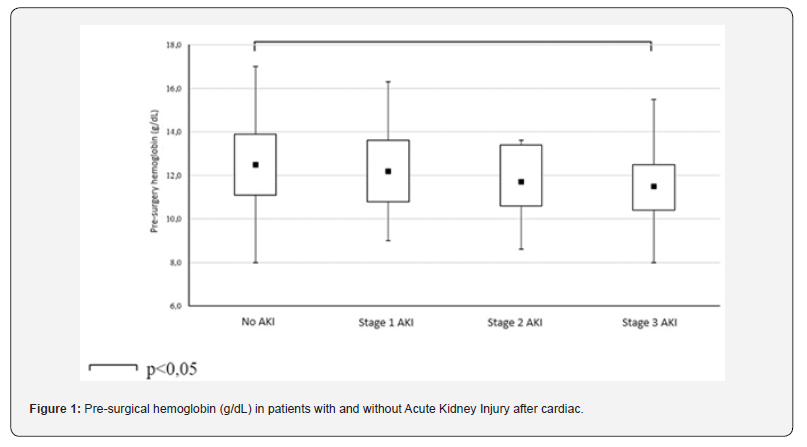
A total of 275 patients were included, with a mean age of 55.9 years (±13.5), and 61.8% (n=170) were female. All patients underwent cardiac surgery, including CABG, VS, aortic aneurysm repair, and other procedures. Preoperative anemia was identified in 49.4% of the patients. Among the anemic patients, 46.4% were women and 53.6% were men, with 38.4% undergoing CABG and 40.8% undergoing VS. Overall, 33.1% of the patients developed AKI, of which 58.2% were classified as mild, 7.7% as moderate, and 34.1% as severe (Table 1). Evaluation of preoperative Hb levels and the development of AKI following cardiac surgery revealed that patients with severe postoperative AKI (stage 3) had significantly lower mean preoperative Hb levels compared to patients without AKI, with values of 11.5 (SD ± 1,6) g/dL versus 12.5 (±1,7) g/dL, respectively (p < 0.05) (Figure 1). No statistically significant difference in preoperative Hb levels was observed between patients without AKI and those with mild or moderate AKI (Figure 1).
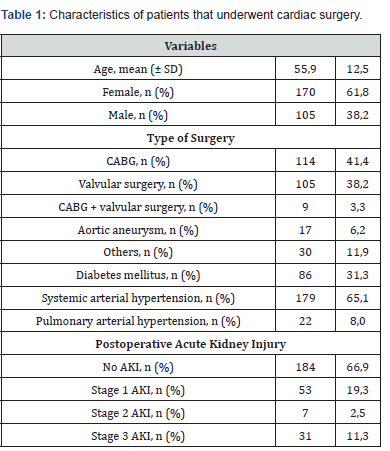
Data is presented in mean ± SD or Percentage n (%). CABG = Coronary artery bypass graft; AKIN = Acute Kidney Injury Network. SD = standard deviation.
Further analysis indicated that each 1 g/dL increase in preoperative Hb was associated with a 1.24-fold increase in the odds of not developing AKI (OR: 1.24; 95% CI: 1.07-1.45) (Table 2). When evaluating the relationship between preoperative Hb levels and the development of AKI following cardiac surgery, it was observed that patients with severe postoperative AKI (stage 3) had significantly lower mean preoperative Hb levels compared to those without AKI (11.5 g/dL vs. 12.5 g/dL, p < 0.05) (Figure 1). However, no statistically significant differences were found between the preoperative Hb levels of patients without AKI and those with mild or moderate AKI (Figure 1). In the multivariate analysis of the association between preoperative Hb levels and AKI, adjusted for age and sex, patients with mild, moderate, or severe AKI were collectively classified as having AKI. The analysis suggested that patients with preoperative anemia were 2.16 times more likely to develop AKI compared to those without anemia (OR: 2.16; 95% CI: 1.23-3.80) (Table 2).
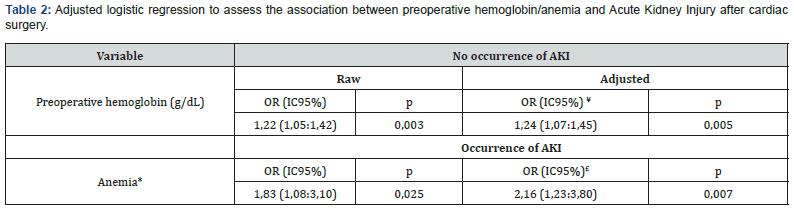
¥Model 1 = Preoperative hemoglobin adjusted for sex and age
£Model 2 = Anemia adjusted for sex and age
*Anemia was considered hemoglobin lower than 13 g/dL for males and lower than 12 g/dL for females
Discussion
Previous studies have demonstrated a strong association between preoperative anemia and adverse complications in cardiac surgery [1,3-8]. In our study, which evaluated adults undergoing various types of cardiac surgeries, this association was reflected in the lower mean preoperative Hb levels in patients who developed AKI during hospitalization. Our findings suggest that for every 1 g/dL increase in Hb, the likelihood of developing AKI in the postoperative period is reduced by 1.24 times. Moreover, patients with preoperative anemia were found to be 2.16 times more likely to develop AKI. These results underscore the importance of addressing anemia during preoperative preparation, as it could lower the risk of postoperative complications, leading to better patient outcomes and reduced healthcare costs [1].
In general, low intraoperative Hb concentrations have been linked to increased morbidity and mortality during cardiac surgery. Notably, special attention should be given to acute reductions in Hb from a known baseline. A single-center study involving 11,508 patients undergoing cardiac surgery with normal preoperative Hb levels (12.0-16.0 g/dL in women, 13.0-18.0 g/dL in men) found that a reduction of at least 50% from baseline Hb during surgery significantly increased the risk of adverse events, even if the absolute Hb level remained above the transfusion threshold of 7.0 g/dL in that study [9].
Regarding the relationship between preoperative anemia and the development of AKI, spinal hypoxia is thought to be a key factor in postoperative AKI in cardiac surgery. Animal models of anemia induced during cardiopulmonary bypass have shown significant and sustained reductions in renal cortical and medullary oxygenation, with more pronounced impairments observed in the renal medulla. During CPB, renal hypoxia results from marginal oxygen supply and the high metabolic demands of the medullary thick ascending limb, which is especially susceptible to ischemic injury. Experimental studies suggested that the combination of anemia and CPB leads to a compensatory increase in renal blood flow, however this fails to prevent a significant reduction in tissue oxygen tension, particularly in the medulla. This deficit results in sustained hypoxia, exacerbating vulnerability to ischemic damage, which demonstrates the relation between anemia, hypoxia and CPB [10].
Our study has several limitations. First, we did not analyze other variables that may be related to the development of AKI in the context of cardiac surgery, as our objective was specifically focused on the impact of preoperative hemoglobin levels. Additionally, due to the limited sample size, we lacked the statistical power to include more adjustment variables beyond the exposure variable and two covariates (sex and age). Furthermore, the exclusion criterion of a creatinine value above 2 mg/dL may have inadvertently included some patients with a mild degree of chronic kidney disease. Lastly, our results are derived from a single institution, which may limit their generalizability, as variations in practices and healthcare settings could influence external validation.
Conclusion
In this post hoc analysis, preoperative anemia emerged as a significant risk factor for postoperative AKI following cardiac surgery. Furthermore, it was identified that, regardless of the diagnosis of anemia, higher Hb levels were associated with a reduced risk of developing AKI in the immediate postoperative period of cardiac surgery. These findings support the importance of optimizing hemoglobin levels before surgery to reduce the incidence of renal complications.
Consent for Publication
Written informed consent for publication was obtained from the patient’s legal guardian.
References
- Padmanabhan H, Siau K, Curtis J, Ng A, Menon S, et al. (2019) Preoperative Anemia and Outcomes in Cardiovascular Surgery: Systematic Review and Meta-Analysis. The Annals of Thoracic Surgery 108(6): 1840-1848.
- Hobson CE, Yavas S, Segal MS, Schold JD, Tribble CG, et al. (2009) Acute Kidney Injury Is Associated with Increased Long-Term Mortality After Cardiothoracic Surgery. Circulation 119(18): 2444-2453.
- Warner MA, Hanson AC, Schulte PJ, Sanz JR, Smith MM, et al. (2024) Preoperative Anemia and Postoperative Outcomes in Cardiac Surgery: A Mediation Analysis Evaluating Intraoperative Transfusion Exposures. Anesthesia & Analgesia 138(4): 728-737.
- Mehta RL, Kellum JA, Shah SV, Molitoris BA, Ronco C, et al. (2007) Acute Kidney Injury Network: report of an initiative to improve outcomes in acute kidney injury. Crit Care 11(2): R31.
- Ripoll JG, Smith MM, Hanson AC, Schulte PJ, Portner ER, et al. (2021) Sex-Specific Associations Between Preoperative Anemia and Postoperative Clinical Outcomes in Patients Undergoing Cardiac Surgery. Anesthesia & Analgesia 132(4): 1101-1111.
- Ranucci M, Di Dedda U, Castelvecchio S, Menicanti L, Frigiola A, et al. (2012) Impact of Preoperative Anemia on Outcome in Adult Cardiac Surgery: A Propensity-Matched Analysis. The Annals of Thoracic Surgery 94(4): 1134-1141.
- Karkouti K, Wijeysundera DN, Beattie WS (2008) Risk Associated with Preoperative Anemia in Cardiac Surgery: A Multicenter Cohort Study. Circulation 117(4): 478-484.
- Kulier A, Levin J, Moser R, Rumpold-Seitlinger G, Tudor IC, et al. (2007) Impact of Preoperative Anemia on Outcome in Patients Undergoing Coronary Artery Bypass Graft Surgery. Circulation 116(5): 471-479.
- Hogervorst E, Rosseel P, Van Der Bom J, Bentala M, Brand A, et al. (2014) Tolerance of intraoperative hemoglobin decrease during cardiac surgery. Transfusion 54(10pt2): 2696-2704.
- Darby P, Kim N, Hare G, Tsui A, Wang Z, et al. (2013) Anemia increases the risk of renal cortical and medullary hypoxia during cardiopulmonary bypass. Perfusion 28(6): 504-511.

























