




 IJESNR Home




Ants of Sudan II: Myrmicinae a Faunal/Taxonomic List
Awatif K Omer¹, Muna A Mohamed2, Brian Taylor3 and Zuheir N Mahmoud4*
1Department of Biology, Faculty of Education, Nile Valley University, Sudan
2Department of Biology, Faculty of Science, Taibah University, Kingdom of Saudi Arabia, and Institute of Environmental Studies, University of Khartoum, Sudan
311Grazingfield, Wilford, Nottingham, United Kingdom
4Department of Zoology, Faculty of Science, University of Khartoum, Sudan
Submission: October 01, 2026;Published: October 26, 2026
*Corresponding author: Zuheir N Mahmoud, Department of Zoology, Faculty of Science, University of Khartoum, Sudan
How to cite this article: Awatif K O, Muna A M, Brian T, Zuheir N M. Ants of Sudan II: Myrmicinae a Faunal/Taxonomic List. Int J Environ Sci Nat Res. 2026; 37(5): 556471. DOI: 10.19080/IJESNR.2026.37.556471
Abstract
The study synthesized a list of Sudanese ant diversity by integrating historical records, and recent surveys. Historical records from Magretti, Weber, Karavaiev, Werner and Ebner, Sweeney, Trägårdh, and others establish a baseline for assessing temporal and spatial changes in ant distributions. These data correspond with existing Sudanese faunal compilations, including the Ants of Africa database. Recent datasets provide an integrated framework for evaluating Sudanese ant diversity, distribution, community structure, and ecological change. The list documented 19 Myrmicinae genera, 116 species and 12 subspecies from 74 locations across14 major ecological zones. The list was validated based on AntCat, antmaps.org and AntWiki, Key platforms. The measurements of a potentially new Monomorium species from Al Musawarat 16⁰21'32.66"N, 33⁰19'46.71"E; was given.
Keywords: Sudan; Myrmicinae; Biodiversity; Checklist; New records;Richness
Abbreviations: HR/Sudan= Historical Record for Sudan; AM/Sudan= Additional Material from Sudan; S-Eba= Sudan-Eritrea Border Area
Introduction
Myrmicinae is a subfamily of Formicidae ants, with about 140 extant genera (Bolton 2014) [1]; their distribution is cosmopolitan except in arctic and antarctic regions [2]. According to Boudinot [3] 139 valid genera and 6,500 valid myrmicine species are described. Based on both the number of genera and the number of species, this is the largest ant subfamily in Sudan [4]. Nests can be found in almost any suitable location from deep in the soil, in rotting wood, under stones, to the upper branches of [5].
The diagnosis and phylogenetic framework of the subfamily Myrmicinae have been extensively developed and refined through successive contributions by Hölldobler & Wilson [6], Bolton [1], Urbani [7], Ward et al. [8], Fisher & Bolton (2016), and Prebus & Rabeling [9]. These studies provide basis for understanding of Myrmicinae taxonomy, and systematic diversity, providing foundation for myrmecological research and phylogenetic investigations.
Myrmicinae ants range approximately from 1-10mm in length [1,10]. They are characterized by a distinct postpetiole, in which abdominal segment III is separated from segment IV by a pronounced constriction, and the workers typically possess a well-developed clypeus positioned between the antennal sockets, relatively anterior antennal insertions, and frontal lobes that partially conceal these insertions [1,10]. The pronotum is rigidly integrated with the mesosoma, resulting in a weak or indistinct promesonotal suture, and the metapleural gland opening is generally a dorsal to posterodorsal slit or narrow crescent [8]. Abdominal segment IV is not strongly reduced or down-curved, while postpygidial glands are absent [1,8,10].
Myrmicinae are important in ecosystem functioning through feeding, soil modification, recycling and regulate populations of insects [11]. Many myrmicine ants disperse, harvest, or prey upon seeds thus reducing competition near parent plants [12], thereby affecting plant abundance and [13].
Sudan historical myrmecological literature, include collections by Weber, Santschi, Sweeny, Viehmeyer, Karavaiev, Magretti, Werner and Ebner, and others. Recent surveys by Mathews [14], Omer & Mahmoud [15], Magboul et al. [16], Omer (2017) [4], Eisawi et al. [17,18], Ibrahim et al. [19], and Mahmoud & Tahir [20] added recent data on species distributions.
This study aims to investigate the taxonomic diversity, species composition, distribution, and ecological associations of the subfamily Myrmicinae in Sudan; and to establish baseline data that can support future studies on biogeography, ecology, and monitoring of myrmicines in Sudan.
Material and Methods
Myrmicinae ants (Hymenoptera L 1758: Formicidae Latreille 1809) specimens were collected from different habitats across Sudan, representing 14 major ecological zones (Table 1).
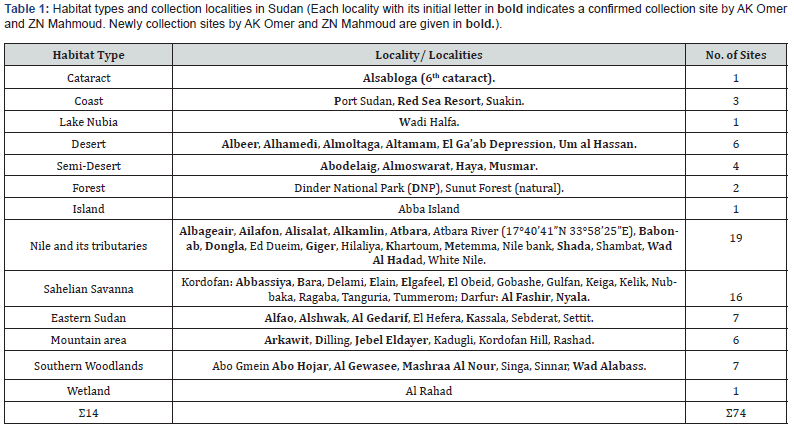
Each ant specimen was collected, using a strip of paper, dropped in a stoppered veil containing 70% alcohol to which few drops of glycerol were added. All material from each location site were kept in a labeled one glass container before laboratory investigation.
Identification
Specimens were identified using taxonomic keys of Agosti & Collingwood [21] and Bolton [22,23]. Nomenclature followed Bolton [24]. Dr. Brian Taylor verified the identification of the collected specimens. The authorship of subfamilies, genera, species and subspecies followed AntWiki [2].
Quantification of the data
As appropriate the following indices were derived:

Where: C= No. of shared species, S1=No. of species in site 1, S2=No. of species in site 2.
Depository
All specimens were curated in the Taylor Ant Collection in the Oxford University Museum of Natural History, Oxford, United Kingdom.
Results
The encountered Myrmicinae included 116 species, together with 12 subspecies distributed among 19 genera and 74 locations.
List of Subfamily: Myrmicinae Lepeletier de Saint-Fargeau, 1835.
Genus: Atopomyrmex André, 1889.
Atopomyrmex mocquerysi André, 1889; HR/Sudan Kelik; collectors: RHC Sweeny; material: workers. AM/Sudan, workers from Rashad by Eisawi et al. [17].
Genus: Calyptomyrmex Emery, 1887
Calyptomyrmex brevis Weber, 1943; AM/Sudan workers from Rashad by Eisawi et al. [17], and from DNP by Eisawi et al. [18].
Calyptomyrmex piripilis Santschi, 1923; AM/Sudan workers from Rashad by Eisawi et al. [17], and from DNP by Eisawi et al. [18].
Genus: Cardiocondyla Emery, 1869.
Cardiocondyla elegans Emery, 1869; HR/Sudan Khartoum, Port Sudan; collectors: NA Weber, 1922; AM/Sudan, workers from Sunnt Forest by Magboul et al. [16].
Cardiocondyla emeryi Forel, 1911; HR/Sudan workers fron H Werner and R Ebner, V Karavaiev; Khartoum, Port Sudan; collectors: NA Weber, V Karavaiev. AM/Sudan, workers from Sunnt Forest, by Magboul et al. [16] and from Rashad by Eisawi et al. [17]; material: workers, and from Abo Hojar, Al Gewasee, Mashraa Al Nour by AK Omer and ZN Mahmoud.
Cardiocondyla fajumensis Forel, 1913; HR/Sudan Wadi Halfa; collectors: A Schatzmayr et al; material: workers. AM/Sudan, workers from DNP by Eisawi et al. [18].
Cardiocondyla mauritanica Forel, 1890; AM/Sudan workers from Rashad by Eisawi et al. [17].
Cardiocondyla nilotica Weber, 1952; HR/Sudan Ed Dueim; collector: NA Weber; material: holotype worker.
Genus: Carebara Westwood, 1840.
Carebara bartrumi Weber, 1943; AM/Sudan workers from Rashad by Eisawi et al. [17].
Carebara santschii Weber, 1943; AM/Sudan workers from Rashad by Eisawi et al. [17].
Carebara sicheli Mayr, 1862; HR/Sudan White Nile; collector:?; material: queen.
Carebara sudanensis Weber, 1943; AM/Sudan, workers from Rashad by Eisawi et al. [17].
Carebara sudanica Santschi, 1933; HR/Sudan Type locality Delami; collector: W Ruttledg; material: male and queen. AM/Sudan, workers from Rashad by Eisawi et al. [17].
Carebara xynera Fisher, 2025. This is the valid classification of Carebara polita Santschi, 1914; AM/Sudan, workers from Rashad by Eisawi et al. [17].
Carebara vidua Smith, 1858; AM/Sudan workers from Rashad by Eisawi et al. [17].
Genus: Cataulacus F. Smith, 1853.
Cataulacus intrudens Smith, 1876; AM/Sudan workers from Rashad by Eisawi et al. [17].
Cataulacus pygmaeus André, 1890; AM/Sudan workers from Rashad by Eisawi et al. [17].
Cataulacus traegaordhi Santschi, 1914; AM/Sudan workers from Rashad by Eisawi et al. [17].
Genus: Crematogaster Lurnd, 1831.
Crematogaster aegyptiaca Mayr, 1862; HR/Sudan Port Sudan; collector: H Werner and R Ebner, V Karavaiev; material: workers. AM/Sudan, workers from Rashad by Eisawi et al. [17] and from Abo Hojar, Al Gewasee, Mashraa Al Nour by AK Omer and ZN Mahmoud.
Crematogaster aegyptiaca robusta Emery, 1877; HR/Sudan Bara, Kadugli, Kordofan hills, Sinnar; collectors: H Werner and R Ebner; material: workers. AM/Sudan, workers from Rashad by Eisawi et al. [17].
Crematogaster africana polymorphica Weber, 1943; AM/Sudan, workers from Rashad by Eisawi et al. [17].
Crematogaster antaris Forel, 1894; HR/Sudan Bara, El Obeid; collectors: H Werner and R Ebner; material: workers.
Crematogaster chiarinii Emery, 1881; HR/Sudan Khartoum; collector: V Karavaiev; material: workers. AM/Sudan, workers from Rashad by Eisawi et al. [17].
Crematogaster chlorotica Emery, 1899; AM/Sudan workers from Rashad by Eisawi et al. [17].
Crematogaster depressa fuscipennis Emery, 1899; AM/Sudan workers from Rashad by Eisawi et al. [17].
Crematogaster flaviventris Santschi, 1910; AM/Sudan workers from DNP by Eisawi et al. [18].
Crematogaster gambiensis André, 1889; HR/Sudan Dilling; collector: H Werner and R Ebner; material: workers. AM/Sudan, workers from DNP by Eisawi et al. [18].
Crematogaster gambiensis transversiruga Santschi, 1914; AM/Sudan workers from Rashad by Eisawi et al. [17].
Crematogaster inermis Mayr, 1862; HR/Sudan Port Sudan; collector: V Karavaiev; material: workers. AM/Sudan, workers from DNP by Eisawi et al. [18].
Crematogaster lango Weber, 1943; AM/Sudan workers from DNP by Eisawi et al. [18].
Crematogaster latuka Weber, 1943; AM/Sudan workers from DNP by Eisawi et al. [18].
Crematogaster lotti Weber, 1943; AM/Sudan workers from DNP by Eisawi et al. [18].
Crematogaster menilekii suddensis Weber, 1943; AM/Sudan workers from DNP by Eisawi et al. [18].
Crematogaster mimosae Santschi, 1914; AM/Sudan workers from Sunnt Forest, by Magboul et al. [16], and workers from DNP by Eisawi et al. [18].
Crematogaster nigriceps Emery, 1879; HR/Sudan Dilling, Ragaba; collectors: H Werner and R Ebner; material: workers. AM/Sudan, workers from DNP by Eisawi et al. [18].
Crematogaster pseudinermis Viehmeyer, 1923; HR/Sudan Gulfan, Keiga, Nubbaka, Tummero; collectors: H Werner and R Ebner; material: workers. AM/Sudan, workers from DNP by Eisawi et al. [18].
Crematogaster pseudinermis muellerianus Finzi, 1939; AM/Sudan, workers from DNP by Eisawi et al. [18].
Crematogaster senegalensis Roger, 1863; HR/Sudan Metemma, Nubbaka, Omdurman, Sebderat, Suakin, Sungikia; collectors: Jaegerskiold, H Werner and R Ebner, P Magretti; material: workers. AM/Sudan, from DNP by Eisawi et al. [18].
Crematogaster sewellii marnoi Mayr, 1895; AM/Sudan workers from DNP by Eisawi et al. [18].
Crematogaster sjostedti Mayr, 1907; AM/Sudan workers from DNP by Eisawi et al. [18].
Crematogaster sordidula molongori Weber, 1943; AM/Sudan workers from DNP by Eisawi et al. [18].
Crematogaster zonacaciae Weber, 1943; AM/Sudan workers from DNP by Eisawi et al. [18].
Genus: Melissotarsus Emery, 1877.
Melissotarsus emeryi Forel, 1907; AM/Sudan, workers from Rashad by Eisawi et al. [17].
Genus: Meranoplus Smith, 1853.
Meranoplus inermis Emery, 1895; HR/Sudan Kadugli; collector: C W Sweeney; material: workers. AM/Sudan, workers from Rashad by Eisawi et al. [17].
Meranoplus magrettii André, 1884; HR/Sudan: Suakin; collector: P Magretti; material: workers. AM/Sudan, workers from DNP by Eisawi et al. [18].
Genus: Messor Forel, 1890.
Messor sp. Forel, 1890; morphospecies/unidentified taxa. AM/Sudan, workers from Elain, Elgafeel, El Obeid by Ibrahim et al., 2023 and from El Ga’ab Depression by ZN Mahmoud and YF Tahir, 2025.
Messor aegyptiacus Emery, 1878; HR/Sudan:?; collector: P Magretti; material: workers.
Messor angularis Santschi, 1928; AM/Sudan, workers from Giger, Wad Al Hadad; collectors: AK Omer and ZN Mahmoud.
Messor arenarius Fabricius, 1787; AM/Sudan workers from DNP by Eisawi et al. [18].
Messor barbarus Linnaeus, 1767; HR/Sudan several; collector: P Magretti; material: workers.
Messor galla Mayr, 1904; HR/Sudan Khartoum, several; collectors: Jaegerskiold, H Werner and R Ebner. V Karavaiev; material: workers; ground nest described by Traegardh. AM/Sudan, workers from DNP by Eisawi et al. [18], from Elain, Elgafeel by Ibrahim et al., 2023; and from Arkawit, Al Gadarif, Nyala by AK Omer and ZN Mahmoud.
Messor ruginodis Stitz, 1916; AM/Sudan, workers from Al Gadarif; by AK Omer and ZN Mahmoud.
Genus: Monomorium Mayr, 1855.
Monomorium n sp ?; location: Al Musawarat 16⁰21'32.66"N, 33⁰19'46.71"E; collectors: AK Omer and ZN Mahmoud; material worker. HW 0.84, HL 1.02, CI 89, SL 0.79, SI 84; postpetiole wider than petiole.
Monomorium abeillei André, 1881; AM/Sudan, workers from DNP by Eisawi et al. [18].
Monomorium abyssinicum Forel,1894; HR/Sudan Dilling, Kadugli; collectors: C W Sweeney, H Werner and R Ebner; material: workers and male.
Monomorium afrum André, 1884; HR/Sudan Atbara; collector: P Magretti; material: workers. AM/Sudan, workers from DNP by Eisawi et al. [18], and Abodelaig, Ailafon, Albageair, Alisalat, Alkamlin by AK Omer and ZN Mahmoud.
Monomorium arboreum Weber, 1943; AM/Sudan, workers from Rashad by Eisawi et al. [17].
Monomorium areniphilum Santschi, 1911; HR/Sudan Khartoum; collectors: J Cloudsley-Thompson, R Cottam; material: workers. AM/Sudan, workers from Sunnt Forest by Magboul et al., 2013; from DNP by Eisawi et al. [18]; from Elain, Elgafeel, El Obeid, by Ibrahim et al., 2023 and from El Ga’ab Depression by Z N Mahmoud and Y F Tahir. 2025 and from Abodelaig, Al Rahad, Babonab, Dongla, Giger, 6th Cataract Haya Musmar, Red Sea Resort, Um Saeed by AK Omer and ZN Mahmoud,
Monomorium bicolor Mayr, 1877; HR/Sudan Atbara, Ed Dueim, Kadugli, Khartoum, Metemma, Shambat, Suakin; collectors: C Sweeney, G Muller, JE Mellor, NA Weber, R Cottam; material: workers. AM/Sudan, workers from Sunnt Forest, by Magboul et al., 2013, from DNP by Eisawi et al. [18], from Elain, Elgafeel, El Obeid by Ibrahim et al., 2023, from El Ga’ab Depression by ZN Mahmoud and YF Tahir, 2025andfrom Al Shwak by AK Omer and ZN Mahmoud.
Monomorium clavicorne André, 1881; M/Sudan Aworkers from Rashad by Eisawi et al. [17].
Monomorium hercules Viehmeyer, 1923; HR/Sudan Atbara, Bara, El Obeid; collector: H Werner and R Ebner; material: workers. AM/Sudan,
workers from DNP by Eisawi et al. [18] and from Al Musawarat by AK Omer and ZN Mahmoud.
Monomorium kineti Weber, 1943; AM/Sudan workers from DNP by Eisawi et al. [18].
Monomorium madecassum Forel, 1892; AM/Sudan workers from Rashad by Eisawi et al. [17].
Monomorium mictilis Forel, 1910; AM/Sudan workers from Rashad by Eisawi et al. [17].
Monomorium niloticum Emery, 1881; AM/Sudan, workers from Abbasiya, Al Musawarat, Atbara River, DNP, Wadi Halfa;by AK Omer and ZN Mahmoud; material: workers. AM/Sudan.
Monomorium nitidiventre Emery, 1893; HR/Sudan Gobashe, Kadugli, Keiga, Khartoum, Nubakka, Sungikia, Tummero; collector: H Werner and R Ebner, V Karavaiev; material: workers. AM/Sudan, workers from DNP by Eisawi et al. [18].
Monomorium pallidipes Forel, 1910; HR/Sudan Khartoum; collector: V Karavaiev; material: workers and 1 queen. AM/Sudan, workers from DNP by Eisawi et al. [18].
Monomorium parvinode Forel, 1894; HR/Sudan Hilaliya; collector: CW Sweeney; material: workers. AM/Sudan, workers from DNP by Eisawi et al. [18].
Monomorium pharaonic Linnaeus, 1758; HR/Sudan Khartoum, Nile bank; collectors: HW Bedford, H Werner and R Ebner, P Magretti; material: workers. AM/Sudan, workers from DNP by Eisawi et al. [18].
Monomorium salomonis Linnaeus, 1758; HR/Sudan Omdurman, Port Sudan; collectors: G Muller, Jaegerskiold, P Magretti; material: workers. AM/Sudan, workers from DNP by Eisawi et al. [18]. El Ga’ab Depression by Z N Mahmoud and Y F Tahir, 2025, and Al Fashir, Atbara, Al Hamedi, Al Moltaga, Um al Hassan, Al Beer, Al Tamam by AK Omer and ZN Mahmoud.
Monomorium subopacum Smith, 1858; AM/Sudan, workers from Shada by AK Omer and ZN Mahmoud.
Genus: Myrmicaria Saunders, 1842.
Myrmicaria opaciventris congolensis Forel, 1909; AM/Sudan, workers from DNP by Eisawi et al. [18].
Genus: Nesomyrmex Wheeler, 1910.
Nesomyrmex angulatus Mayr, 1862; AM/Sudan, workers from DNP by Eisawi et al. [18].
Genus: Ocymyrmex Emery, 1886.
Ocymyrmex celer Weber, 1943; AM/Sudan, workers from Rashad by Eisawi et al. [17].
Genus: Pheidole Westwood, 1839.
Pheidole sp. Westwood, 1839; morphospecies/unidentified taxa. AM/Sudan, workers from Bara, Elain, El Obeid by Ibrahim et al. [19].
Pheidole aeberlii Mayr,1904; HR/Sudan Omdurman; collector: I Tragardh; material: workers.
Pheidole crassinoda ruspolii Emery, 1897; AM/Sudan workers from DNP by Eisawi et al. [18].
Pheidole decarinata Santschi, 1929; AM/Sudan, workers from Rashad by Eisawi et al. [17] and from DNP by Eisawi et al. [18].
Pheidole jordanica Saulcy, 1874; HR/Sudan Khartoum, Port Sudan; collector: V Karavaiev; material: soldiers and workers. AM/Sudan, workers from Rashad by Eisawi et al. [17], and from DNP by Eisawi et al. [18].
Pheidole megacephala Mayr, 1904; HR/Sudan Abba Island; collectors: I Tragardh, Jaegerskiold; material: workers. AM/Sudan, workers from Rashad by Eisawi et al. [17], and from DNP by Eisawi et al. [18].
Pheidole megacephala impressifrons Wasmann, 1905; HR/Sudan El Obeid; by H Werner and R Ebner; material: workers and soldiers.AM/Sudan, workers from DNP by Eisawi et al. [18].
Pheidole punctulata Mayr, 1866; AM/Sudan workers from DNP by Eisawi et al. [18].
Pheidole rugaticeps Emery, 1877; HR/Sudan El Hefera, Settit; collector: P Magretti; material: workers; AM/Sudan, workers from DNP by Eisawi et al. [18]. From Dilling, Singa by AK Omer and ZN Mahmoud.
Pheidole rugaticeps arabs Emery, 1881; HR/Sudan El Obeid, Nubbaka; collectors: H Werner and R Ebner; material: workers and soldiers; workers from DNP by Eisawi et al. [18].
Pheidole sculpturata Mayr, 1866; AM/Sudan workers from Rashad by Eisawi et al. [17].
Pheidole sinaitica Mayr, 1862; HR/Sudan Atbara, Sebderat; collector: P Magretti; material: workers. AM/Sudan, workers from Rashad by Eisawi et al., from DNP by Eisawi et al. [18], from Wad Al Abbas by AK Omer and ZN Mahmoud.
Pheidole speculifera Emery, 1877; AM/Sudan, workers from Rashad by Eisawi et al. [17], and from DNP by Eisawi et al. [18].
Pheidole termitophila Forel, 1904; AM/Sudan, workers from Rashad by Eisawi et al. [17], AM/Sudan, and from DNP by Eisawi et al. [18].
Genus: Pristomyrmex Mayr, 1866.
Pristomyrmex africanus Karavaiev, 1931; AM/Sudan workers from Rashad by Eisawi et al. [17].
Genus: Solenopsis Westwood, 1840.
Solenopsis orbula Emery, 1875; AM/Sudan workers from DNP by Eisawi et al. [18].
Solenopsis punctaticeps Weber, 1943; AM/Sudan workers from DNP by Eisawi et al. [18].
Genus: Strumigenys Smith, 1860.
Strumigenys serrula Santschi, 1910; AM/Sudan, workers. AM/Sudan workers from Rashad by Eisawi et al. [17], and from DNP by Eisawi et al. [18].
Genus: Temnothorax Mayr, 1861.
Temnothorax megalops Hamann and Klemm, 1967; HR/Sudan Wadi Halfa; collectors: Hamann and Klemm; material: Holotype and 1 paratype worker; AM/Sudan, workers from Rashad by Eisawi et al. [17].
Genus: Tetramorium Mayr, 1855.
Tetramorium altivagans Santschi, 1914; AM/Sudan, workers. AM/Sudan, workers from DNP by Eisawi et al. [18].
Tetramorium angulinode Santschi, 1910; AM/Sudan workers from DNP by Eisawi et al. [18].
Tetramorium boltoni Hita Garcia, Fischer and Peters, 2010; AM/Sudan, workers from DNP by Eisawi et al. [18].
Tetramorium brevispinosum Stitz, 1910; AM/Sudan, workers from DNP by Eisawi et al. [18].
Tetramorium caldarium Roger, 1857; AM/Sudan, workers from Rashad by Eisawi et al. [17].
Tetramorium cristatum Stitz, 1910; AM/Sudan workers collected from Abo Gmein (Blue Nile) by J. Mathews (vouchers JM 384, JM 385, JM 390) via pyrethrum fogging of Senegalia senegal. This species is widely distributed across sub-Saharan Africa, extending south to Angola and Zimbabwe.
Tetramorium delagoense Forel, 1894; AM/Sudan workers from Rashad by Eisawi et al. [17].
Tetramorium eminii Weber, 1943; AM/Sudan, workers from DNP by Eisawi et al. [18].
Tetramorium gabonense André, 1892; AM/Sudan workers from DNP by Eisawi et al. [18].
Tetramorium ghindanum Forel, 1910; HR/Sudan Port Sudan; collector: H Werner and R Ebner; material: queen; AM/Sudan workers from DNP by Eisawi et al. [18].
Tetramorium kestrum Bolton, 1980; AM/Sudan workers from DNP by Eisawi et al. [18].
Tetramorium laevithorax Emery, 1895; AM/Sudan workers from DNP by Eisawi et al. [18].
Tetramorium minusculum Santschi 1914; AM/Sudan workers from DNP by Eisawi et al. [18].
Tetramorium sericeiventre Emery, 1877; HR/Sudan Kadugli, Khartoum; Shambat; collectors: C Sweeny, JEM Meller, HW Bedford, Karavaiev; material: AM/Sudan workers from Elain, Elgafeel, El Obeid by Ibrahim et al., 2023, workers from Al Maseid, Wad Al Hadad by AK Omer and ZN Mahmoud.
Tetramorium setigerum Mayr, 1901; HR/Sudan Kadugli; collector: CW Sweeney; material: workers.
Tetramorium simillimum Smith, 1851; HR/Sudan Khartoum, Omdurman; collectors: I Tragardh, V Karavaiev; material: workers
Tetramorium uelense Santschi, 1923; AM/Sudan, workers from DNP by Eisawi et al. [18].
Tetramorium viticola Weber, 1943; AM/Sudan, workers from DNP by Eisawi et al. [18].
Tetramorium weitzeckeri Emery, 1895; AM/Sudan workers from Rashad by Eisawi et al. [17]. Tetramorium zonacaciae Weber, 1943; AM/Sudan, workers from Jebel El Dayer by AK Omer and ZN Mahmoud; material: workers.
Genus: Trichomyrmex Mayr, 1865.
Trichomyrmex abyssinicus Forel, 1894; AM/Sudan, workers from Jebel El Dayer by AK Omer and ZN Mahmoud.
Trichomyrmex destructorJerdon, 1851; HR/Sudan El Hefera, Kassala, Khartoum, Settit; collectors: P Magretti, V Karavaiev; material: workers.
Trichomyrmex mayri Forel,1902; HR/Sudan Khartoum; collectors: J Cloudsley-Thompson, R Cottam; material: workers. AM/Sudan, from Port Sudan by AK Omer and ZN Mahmoud.
Trichomyrmex oscaris Forel, 1894; HR/Sudan workers from Tanguria by H Werner and R Ebner.
A preliminary distributional assessment of Hymenoptera fauna of Sudan
The above list indicates:
1) The dataset represents a remarkably diverse ant assemblage, spanning 20 genera, including Crematogaster, Monomorium, Pheidole, Tetramorium, Carebara, Messor, and Cardiocondyla. This suggests biogeographical heterogeneity across the surveyed Sudanese localities.
2) Rashad and DNP account for a large proportion of species records. This may indicate high local diversity and/or unequal sampling effort.
3) Many taxa are recorded only from DNP in the supplied dataset. On the other hand, M. areniphilum, M. bicolor, M. salomonis, M. galla, C. senegalensis, and T. sericeiventre occur across multiple localities and have broader distributions. This indicates relatively high ecological tolerance and adaptation to contrasting environmental conditions. Moreover, some taxa appear highly localized in the present dataset. For example, C. nilotica is listed only from Ed Dueim, T. cristatum from Abo Gmein, and T. zonacaciae and T. abyssinicus from Jebel El Dayer.
4) The records extend from Port Sudan and Suakin on the Red Sea coast to Wadi Halfa in the north and Jebel El Dayer, Kadugli, Rashad, and other inland localities. This geographic spread encompasses markedly different environments, suggesting that Sudan supports ant communities structured by gradients in climate, vegetation, elevation, and habitat availability.
5) Several entries include subspecies or historical taxonomic combinations, for example C. a. robusta, C. g. transversiruga, C. p. muellerianus, and P. r. arabs.
6) The patterns of documented richness that the DNP has the highest recorded richness (60 taxa), followed by Rashad (39 taxa), whereas Khartoum, El Obeid and Port Sudan each contain fewer than 10 recorded taxa. Despite their high richness, DNP with 60 species and Rashad with 41 species share only 10 taxa. DNP with 60 species and Rashad with 41 species and 10 shared species: The quantify of the data produced a Jaccard similarity of 0.1099 (10.99%) and a Sørensen similarity of 0.198 (19.80%). These low indices indicate limited taxonomic overlap and considerable ecological differentiation between DNP and Rashad.
7) The Nile and its tributaries with 25 species and the Sahelian Savanna with 22 species share only 10 taxa. The analysis of the data yielded a Jaccard similarity of 0.270 (27.03%) and a Sørensen similarity of 0.425 (42.55%). The higher Sørensen value relative to Jaccard is expected because Sørensen's index places greater emphasis on shared taxa.
8) The records provide evidence of substantial ant diversity across Sudan and highlight both widespread and geographically restricted taxa.
Habitat-associated variation in Myrmicinae richness across
The list indicatespronounced habitat-associated variation in Myrmicinae species richness, as evidenced by the following patterns:
1) The forest habitat has the highest reported richness (47 species), followed by mountain areas (43 species), whereas cataract, island, and wetland habitats each have only one recorded species. This pattern is consistent with the expectation that structurally complex and environmentally heterogeneous habitats provide more nesting sites, food resources, microclimates, and vegetation associations, thereby supporting more ant taxa.
2) The Nile and its tributaries (25 species) and Sahelian savanna (22 species) also show relatively high richness, indicating that riparian and savanna environments can support diverse ant assemblages. In contrast, coastal habitats (11 species) and eastern Sudan (7 species) show intermediate richness. The repeated occurrence of species such as Monomorium areniphilum, M. bicolor, M. niloticum, M. salomonis, Crematogaster senegalensis, Cardiocondyla emeryi, Pheidole jordanica, and P. megacephala across several habitats suggests that these taxa may have comparatively broad ecological tolerances and/or distributions.
3) A particularly notable observation is the occurrence of Trichomyrmex destructor in both the Nile and its tributaries and eastern Sudan. Its presence across distinct habitat categories may indicate ecological flexibility.
4) Importantly, species richness can be strongly influenced by sampling effort and the number of locations surveyed.
Pattern of species richness
The pattern is given in Table 2. It is apparent from the Table that:
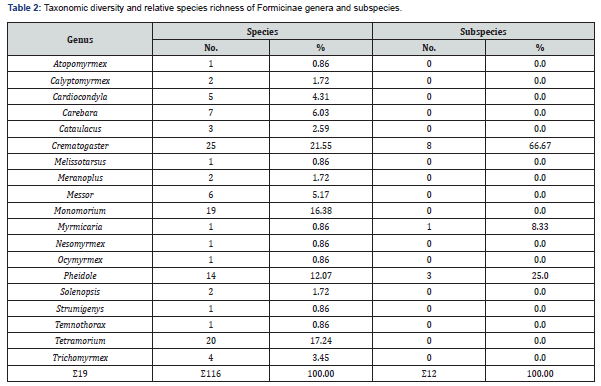
1) Nineteen ant genera, 116 species and, 12 subspecies were recorded.
2) At the genus level, Crematogaster was the most abundant, with 25 records (21.55%), followed by Tetramorium (20; 17.24%), Monomorium (19; 16.38%), and Pheidole (14; 12.07%). Together, these four genera accounted for approximately 68.17% of all genus-level records, indicating that the ant collection was strongly dominated by a relatively small number of genera.
3) Carebara (7; 6.09%), Messor (6; 5.22%), and Cardiocondyla (5; 4.35%) represent additional moderately diverse genera. Whereas, several genera, Atopomyrmex, Melissotarsus, Myrmicaria, Nesomyrmex, Ocymyrmex, Strumigenys, Temnothorax, and Tetrasodium, are represented by only one species each (0.87%), suggesting low observed richness in the sampled material.
4) At the subspecies level, only three genera contributed records: Crematogaster had 8 records (66.67%), Pheidole had 3 records (25.00%), and Myrmicaria had 1 record (8.33%). Thus, Crematogaster was also clearly dominant among the subspecies-level records.
7. Discussion
The current study covered 14 ecological zones and encountered 19 genera 116 species, with 12 subspecies Myrmicinae distributed among and 74 locations. The occurrence of subspecies within only a limited number of genera suggests that intraspecific taxonomic differentiation was concentrated in particular lineages, although conclusions concerning evolutionary or ecological differentiation would require morphological, molecular, or population-level analyses.
Of special significance is the collection of workers of Monomorium from: Al Musawarat 16⁰21'32.66"N, 33⁰19'46.71"E. Its measurements HW 0.84, HL 1.02, CI 89, SL 0.79, SI 84; postpetiole wider than petiole, suggest a potentially new species.
Eisawi et al. [17] reported workers from Rashad as Tetrasodium aculeatum (Mayr, 1866). However, Tetrasodium is a chemical term, not an ant genus, whereas aculeatum is a valid species within Myrmicinae [2]. Thus, the name used by Eisawi et al. [17] is likely a misspelling of Tetramorium aculeatum (Mayr, 1866) and should be regarded as non-accepted.
Eisawi et al. [17] count C. emeryi mahdii Karavaiev, 1911 as separate species. This should normally be treated under: Cardiocondyla emeryi Forel, 1881 because C. e, mahdii is currently regarded as a junior synonym of C. emeryi. The synonymy was established by Bolton (1982) is now a junior synonym of Tetramorium eminii.
Fisher (2025) explicitly gives Carebara xynera (Fisher, 2025) as a replacement name (nom. nov.) of Carebara polita Santschi, 1914.
Carebara sicheli Mayr, 1862 is a valid species, and historical literature has already associated the species with the White Nile/Sudan. The original species was described from a queen; a modern worker identification should ideally be supported by a taxonomic revision or comparison with authenticated material. Therefore, a new specimen from the White Nile would be a confirmation or additional Sudan.
Monomorium mayri karawajewi Wheeler, 1922; workers collected from Khartoum by: H Werner and R Ebner, V Karavaiev; is now recognized by AntWiki [2] as Trichomyrmex mayri (Forel, 1902).
According to AntWiki [2] Tetramorium sericeiventre hori (Santschi, 1918), collected by C Sweeny, JEM Meller, HW Bedford, Karavaiev; is not a valid name because it is a junior synonym of Tetramorium sericeiventre (Emery, 1877); and Monomorium oscaris despecta (Viehmeyer, 1923) workers collected by H Werner and R Ebner, is as a junior synonym of Trichomyrmex oscaris (Forel, 1894).
DNP (60 species) and Rashad (41 species) shared only 10 taxa, yielding low Jaccard (10.99%) and Sørensen (19.80%) similarities, indicating strong taxonomic and ecological differentiation. In contrast, the Nile and its tributaries (25 species) and Sahelian Savanna (22 species) shared 10 taxa, producing higher Jaccard (27.03%) and Sørensen (42.55%) similarities. These differences suggest greater ecological affinity and species overlap between the latter ecosystems.
This pattern may be associated with differences in habitat characteristics, and/or spatial separation between the sites. The higher Sørensen value relative to Jaccard is expected because Sørensen's index places greater emphasis on shared taxa.
The Myrmicinaecollection in Sudan is dominated by Crematogaster with 25 species, followed by Tetramorium (20 species), Monomorium (19 spices), and Pheidole (14 species). According to Ward [25] the predominance of Myrmicinae in Africa is Crematogaster, Pheidole, Tetramorium, and Messor.
A notable ecological association was observed between ants and canopy fogging of Senegalia senegal [14]. Species frequently collected included C. acaciae, C. mimosae, C. senegalensis, and T. sericeiventre. Conservation of these woodlands may contribute to the maintenance of specialized ant communities and the ecosystem services they provide.
Species richness varied considerably among habitats, with a strong positive relationship observed between habitat complexity and ant diversity, consistent with global ecological patterns [26]. Riverine and cultivated habitats supported the most diverse ant assemblages, likely due to the availability of varied microhabitats and food resources.
The recorded fauna reflects Sudan's position as a biogeographical crossroads. Saharo-Sahelian elements included Calyptomyrmex brevis, C. fajumensis, C. mauritanica, C. nilotica. and M. areniphilum. Afrotropical savanna species included Atopomyrmex mocquerysi, Carebara bartrumi, C. santschii, C. sudanensis and C. sudanica. Pantropical species such Cardiocondyla emeryi, C. elegans, C. vidua, C. sicheli and C. xynera were also represented (https://www.antwiki.org/wiki/Sudan) [27].
Future research should focus on: (1) molecular phylogenetic; (2) long-term monitoring of ant communities in protected areas; and (3) assessment of the impacts of invasive species if any.
Conclusion
This list provides a comprehensive taxonomic account of Sudanese myrmicines ants, documenting 116 taxa across 19 genera. By integrating historical records with newly generated field data, an important baseline information for biodiversity research in Northeast Africa is established. The documentation of a potentially new Monomorium species from Al Musawarat demonstrates the value of sustained fieldwork and taxonomic collaboration. Further exploration of Sudan's under-sampled regions and the application of these data to biodiversity conservation plans, particularly in threatened habitats by land-use, and application of GIS are recommended.
Acknowledgement
Thank are due to Oxford University Museum of Natural History for curating the specimens, and to J. H. Mathews for sharing information.
Ethics
Approval and consent to participate, human and animal rights, consent for publication, availability of data and materials are not applicable. This research did not receive any kind of grant. The authors declare no conflict of interest, financial or otherwise.
Dedication
To the memory of Dr. Brian Taylor, who verified the identification of the collected specimens, reviewed an earlier draft and approved the inclusion of his name as a co-author. He died before this manuscript was finalized.
References
- Bolton B (2003) Synopsis and classification of Formicidae. Mem Amer Entomol Inst.71: 1-370.
- AntWiki (2026) https://www.antwiki.org›wiki›Myrmicinae.
- Boudinot BE (2015) Contributions to the knowledge of Formicidae (Hymenoptera, Aculeata): a new diagnosis of the family, the first global male-based key to subfamilies, and a treatment of early branching lineages. European Journal of Taxonomy 120: 1-62.
- Omer AK (2017) Ant Fauna of Sudan: diversity and bionomics. Ph. D., Thesis, Department of Zoology, Faculty of Science, University of Khartoum, Sudan.
- Goulet H, Huber JT (1993) Hymenoptera of the world: an identification guide to families. Agriculture Canada. p. 224.
- Hölldobler B, Wilson EO (1990). The Ants. Harvard University Press.
- Urbani CB (2005) Phylogeny and biogeography of the ant subfamily Prionomyrmecinae (Hymenoptera, Formicidae). Annali del Museo civico di storia naturale Giacomo Doria 96: 581-595.
- Ward PS, Brady SG, Fisher BL, Schulez TR (2015) The evolution of myrmicine ants: phylogeny and biogeography of a hyperdiverse ant clade (Hymenoptera: Formicidae). Systematic Zoology 40(1): 61-81.
- Prebus M, Rabeling C (2025) Phylogenomics Resolve the Systematics and Biogeography of the Ant Tribe Myrmicini and Tribal Relationships within the Hyperdiverse Ant Subfamily Myrmicinae. Syst Biol 74(4): 526-544.
- Ward PS (2014) The phylogeny and evolution of ants. Annual Review of Ecology, Evolution, and Systematics 45(1): 23-43.
- Del TI, Ribbons RR, Pelini SL (2012) The little things that run the world revisited: a review of ant-mediated ecosystem services and disservices (Hymenoptera: Formicidae). Myrmecological News 17: 133-146.
- Penn HJ, Crist TO (2018) From dispersal to predation: a global synthesis of ant–seed interactions. Ecology and Evolution 8(18): 9122-9138.
- MacMahon JA, Mull JF, Crist TO (2000) Harvester ants (Pogonomyrmex): their community and ecosystem influences. Annual Review of Ecology and Systematics 31: 265-291.
- Mathews HJ (2006) Assemblages of plants and arthropods associated with Acacia senegal inside and outside plantations. Ph. D. Thesis, University of Oxford, UK.
- Omer AK, Mahmoud ZN (2012) New records of ants from Sudan. In: B Taylor (Ed.), The ants of Africa.
- Magboul R, Khider A, Idris E, Alam TH (2013) Ant diversity at Sunut Forest, Khartoum, Sudan. Egypt. Acad J Biolog Sci 6(1): 43-46.
- Eisawi KE, Subedi IP, Abdalla OM, He H (2021) Ant diversity and abundance in pasture system and two agricultural land uses in the Rashad district, Southern Sudan.
- Eisawi KE, Subedi IP, Yasin EE, Yode CD, He H (2022) Variation in the rates of biomass removal by soil macro-fauna in different land uses at Rashad, South Kordofan, Sudan. Travaux du Muséum National d’HistoireNaturelle ‘Grigore Antipa’ 65: 173-197.
- Ibrahim MAM, Ahmed BMA, Mohamed NA, Omer AK (2023) Diversity of Ants in North Kordofan, Sudan. Journal of Entomology and Zoology Studies 11(5): 94-100.
- Mahmoud ZN, Tahir YF (2025) Ants of the Sudan: Formicidae of El Ga'ab Depression. Journal of The Faculty of Science and Technology 10: 137-145.
- Agosti D, Collingwood CA (1987) A provisional list of the Balkan ants (Hym. Formicidae) with a key to the worker caste. II. Key to the worker caste, including the European species without the Iberian. Mitteilungen der Schweizerischen Entomologischen Gesellschaft 60: 51-62.
- Bolton B (1994) Identification Guide to the Ant Genera of the World. Harvard University Press, Cambridge, MA, p. 222.
- Bolton B (1995) A New General Catalogue of the Ants of the World. Harvard University Press, Cambridge, Massachusetts, p. 504.
- Bolton B (2023) Catalogue of Ants of the World.
- Ward HG (2013) Afrotropical ants (Hymenoptera: Formicidae): taxonomic progress and estimation of species richness. Journal of Hymenoptera Research 9: 71-84.
- Andersen AN (1995) A classification of Australian ant communities, based on functional groups which parallel plant life-forms in relation to stress and disturbance. Journal of Biogeography 22(1): 15-29.
- https://www.antwiki.org/wiki/Sudan (2026).