




 IJESNR Home



Effect of Cutting Diameter and Pot Size on Production of Rooted Poplar and Willow Plants
I R McIvor*, D Hedderley and R Ward
Bioeconomy Science Institute, New Zealand
Submission: February 09, 2026; Published: October 14, 2026
*Corresponding author: I R McIvor, Scientist, Bioeconomy Science Institute, Private Bag 11600. Manawatu Mail Centre, Palmerston North, New Zealand
How to cite this article:I R McIvor, D Hedderley, R Ward. Effect of Cutting Diameter and Pot Size on Production of Rooted Poplar and Willow Plants. Int J Environ Sci Nat Res. 2026; 37(3): 556468. DOI: 10.19080/IJESNR.2026.37.556468
Abstract
Poplars and willows serve as bioengineering tools in New Zealand for stabilising soil in pastoral areas and along waterways. Planting material is typically provided as 3 m poles. Because smaller planting material is less expensive and easier to produce, it has the potential to reduce costs and increase planting rates. This study examined survival and growth over one season for three poplar cultivars and one willow cultivar grown from vegetative 20 cm cuttings with diameters of 7, 10, 14 and 17mm in containers of 0.33 L, 0.5L, 1L, 1.8L and 2.5L, and assessed the cost effectiveness of varying cutting diameter and container volume for producing rooted stock for field planting. The hypotheses tested were that 1) larger cutting diameter and 2) larger container volume would increase survival and growth of poplar and willow planting stock, and that 3) cost effectiveness would rise with increasing container volume. Survival of poplar cuttings was high across all diameter classes and pot sizes. Willow survival was high in the larger containers. Lower willow survival in the smaller containers was attributed to shading by the taller, more heavily leafed poplar plants. Shoot height and basal diameter were higher in containers with greater volume. Overall, container volume was more influential than the initial cutting diameter in determining shoot height and shoot basal diameter at the end of the growing season. The results supported hypothesis 2 but not hypothesis 1. In this trial, cost effectiveness did not increase with container volume; instead, it increased as container volume decreased, assuming that the rigid containers can be recycled. Production costs for rooted poplars and willow plants raised from cuttings are much lower compared with 3 m poles. A more accurate assessment of relative production costs will require survival and growth rates in an uncultivated field setting.
Keywords: Poplar; Willow; Cutting; Propagation; Container size; Field trial
Introduction
Poplars and willows have a long history of domestication benefitting from the ease with which both species can be propagated vegetatively [1]. Vegetative propagation of poplars and willows is used to retain desirable features, increase clonal planting stock. Approaches to propagation involve variable cutting parameters (length, diameter, age of parent material) and propagation techniques from direct planting of unrooted planting stock into open ground to growing cuttings in containers and transplanting as rooted material into open ground, which may or may not be cultivated [2-4]. Vegetative propagation is very simple and convenient because of pre-formed root primordia on stem nodes [5]. Previous studies growing poplar cuttings varying in diameter and/or length in pots/containers differing in volume with the intention of replanting the rooted material in open ground [6-8] showed that shoot height and diameter were significantly proportional to pot volume and initial cutting size. Pot volumes ranged up to 470mL and cutting diameters from 2.5mm – 12.5mm. Height growth after 155-175 days was less than 50cm [8] and < 80cm for bare-rooted and <40cm for containerised plants [7]. Growth rates in these size containers were considered insufficient for direct transplant into the field. Longer cuttings (10cm rather than 5cm) and pre-soaking in water for 2 days improved root formation and growth in the greenhouse [9] but the resulting planting stock were not planted in open ground and evaluated for survival and growth. There is close relationship between early root and shoot growth and development and cutting survival [2] and planting of rooted stock might increase survival over unrooted cuttings [10]. In a phytoremediation study in previously arable land open-ground rooted poplar planting stock had higher survival rate than unrooted planting stock, but a similar survival rate to unrooted willow planting stock [11]. What is apparent from previous studies is that both poplars and willows are versatile species able to produce suitable planting material from vegetative stock under the simplest of propagation methods [6]. Cutting sizes used in field plantings of willow for biomass range in length from 20-30cm and in a diameter from 10-25cm [5,12]. Additional data on cutting size, pot volume and growth rates may enable more creativity in how and where these plants can be used and increase application of the knowledge.
It is proposed that growing and planting rooted cuttings for soil stabilisation may be more cost effective than growing and planting poles. Benefits in the nursery are saving in growing time (one season compared with 2 or 3 growing seasons), saving in ground space, and saving in management costs (weed and pest control, irrigation, machinery running costs). Benefits in the field are ease of transport and speed of planting. Possible deterrents in the nursery are that the planted material does not grow large enough in the single season to cope with field conditions. A deterrent in the field is that rooted material grown from cuttings needs extra protection from browsing stock and competing vegetation, which adds work and cost. Extra protection may be less significant where domestic stock is excluded e.g. fenced off waterways, shelterbelts, riverbanks.
There are a range of opinions regarding the appropriate stem-cutting size for the vegetative propagation of poplars and willows [13] depending on whether they will be planted into pots, cultivated or uncultivated ground. In a pot study of Salix nigra cuttings with diameter 10mm, 50mm or 100mm in well-watered, flooded and drought conditions survival was best for the smallest diameter cuttings though the largest cuttings had greatest stem height, root mass, leaf number and weight [14]. The authors proposed that using smaller diameter cuttings may increase survival rates in streambank restoration projects. In contrast, in another willow study selecting the best diameter cuttings for low-cost plantings, of cuttings with diameters 10mm, 25mm and 35mm, the thicker cuttings had the higher tree survival. Other studies have used 20-cm long cuttings processed from whips after one season of growth as planting material in cultivated soil [10,11]. Smaller diameter cuttings are available in greater quantities and at an earlier age so further investigation of cutting size is warranted and over a narrower range of diameter sizes.
This study investigated survival and growth of three poplar cultivars and one willow cultivar grown from vegetative cuttings varying in diameter in containers of increasing volume from 0.33L to 2.5L to evaluate cost effectiveness in producing rooted stock for field planting. Hypotheses being tested were that larger cutting diameter and container size will increase poplar and willow planting stock survival and growth, and that cost effectiveness will increase with container size.
Methods
Trials were designed to evaluate the influence of cutting diameter and pot size on the survival and growth of poplar and willow cuttings.
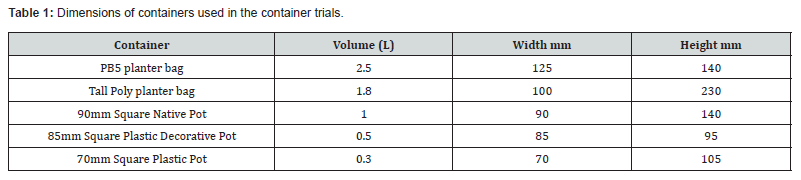
We evaluated four cutting diameter sizes (7mm, 10mm, 14mm and 17mm) and five container sizes (Table 1) for one poplar cultivar Populus xeuramericana ‘Veronese’ and one willow cultivar Salix matsudana × alba ‘Moutere’. To compare poplar cultivars, we included two additional poplar cultivars P. nigra × maximowiczii ‘Shinsei’ and P. deltoides × yunnanensis ‘Kawa’ but with two container sizes only. The three selected poplar cultivars are the most widely planted cultivars on New Zealand. The willow cultivar ‘Moutere’ is the favoured willow for river protection works in New Zealand. Cuttings were prepared from one-year shoots collected from stools at Horizons Regional Council poplar and willow nursery in Woodville. All planted cuttings were 20cm in length.
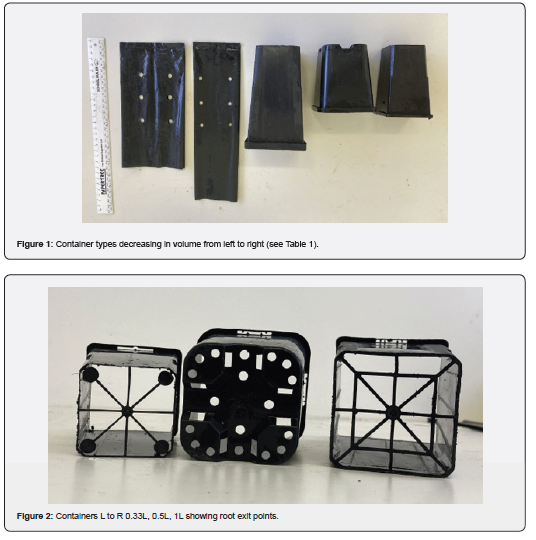
For Populus xeuramericana ‘Veronese’ and Salix matsudana × alba ‘Moutere’ one of ten cuttings of each diameter and for each cultivar were planted in each sized container (Figure 1 & 2) making a total of 200 cuttings per cultivar. The planting mix comprised 30% coco-fibre and 70% pumice, with Osmocote 9-month slow-release fertilizer added (1kg/m3).
For the additional poplar cultivars four cutting diameters were used (7mm, 10mm, 14mm, 17mm) and two container sizes (0.5L, 1.8L). making a total of 80 cuttings per cultivar and 560 cuttings in all.
Each cutting was double colour-coded, on the top of the cutting with the diameter colour, and on the side with the cultivar colour.
The cuttings were grown within a 20cm high wooden frame in an open environment on slightly sloping ground. We lined the frame with black polythene and added a 2-3cm layer of sheep wool to hold moisture under the containers. and provide space for any roots emerging from the pots The same-sized containers were grouped together within the frame. The cuttings were flood irrigated, as necessary. The wool had a water storage role and provided a medium for roots to extend into from the bottom of the containers. Excess water from rainfall drained off through perforations at the lower end of the polythene. A 3-wire fence with additional crosswires around the wooden frame during the growing season supported the plants in windy conditions.
Cuttings were planted in late Spring (October) and leaf fall finished by the following June. Cutting survival and height of the dominant shoot were recorded on 21 December (H1), 29 March (H2), 06 June (H3) and 27 June (H4). We measured cutting diameter and collar diameter of the tallest shoot for each live cutting on 28 June and 2 July respectively.
Statistical Analyses
Survival proportions were analysed using a binomial generalized linear model, with factors for clone, cutting diameter and container size, and their interactions. The height and collar diameter measures were analysed using unbalanced ANOVA, with a similar set of factors. They were tested using ‘type 2’ conditional tests, so adjusted for the effect of other factors. Genstat (version 22, 2022, VSNI Ltd, UK) was used for analysis.
Since ‘Moutere’ willow growth was unduly disadvantaged by the more vigorous poplar growth, a separate group of analyses were done for the poplar clones only.
Results
Cutting survival
Overall cutting survival at the end of the growing season was 93%, 59%, 91% and 88% for ‘Veronese’, ‘Moutere’, Kawa’ and ‘Shinsei respectively. Mortality was higher among the 14 mm and 17 mm diameter cuttings (Table 2 & Figure 3) but not consistently so. Overall poplar cutting survival was similar in all pot sizes, while increasing with pot size for ‘Moutere’ willow.
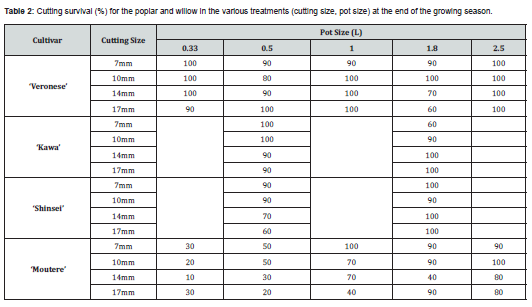
‘Moutere’ survival on the first assessment date, 21 December, was 92%, decreasing to 85%, and 76% in subsequent assessment dates and 59% at the end of the growing season. Taller shoots and larger leaves of the poplar plants shaded the willow plants and contributed to the lower willow survival in the smaller, more crowded containers (Table 2). ‘Moutere’ survival was similar to that of poplar cultivars in the larger containers (Table 2).
Cutting survival was significantly affected by clone, container volume and cutting diameter (Table 3), of which clone and container volume were most influential. Cutting survival declined with container volume (Table 3).
Shoot growth
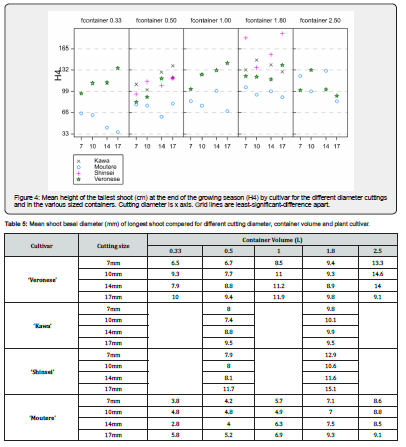
The tallest shoots exceeded 2m at the end of the growing season. Maximum shoot height for the different cutting diameters of ‘Shinsei’ was 224cm (17mm), 203cm (14mm), 203cm (10mm) and 198cm (7mm). Maximum shoot height of ‘Shinsei’ in the different containers was 224cm (1.8L) and 152cm (0.5L). Maximum shoot height for the different cutting diameters of ‘Veronese’ was 171cm (17mm), 174cm (14mm), 211cm (10mm) and 171cm (7mm). Maximum shoot height of ‘Veronese’ in the different containers was 211 (2.5L), 176 cm (1.8L), 166 cm (1.0L), 167 cm (0.5L) and 176 (0.33L). Of the 476 (85%) poplar and willow plants surviving to the end of the growing season 74% exceeded 1m in height. Of the surviving poplars 85% exceeded 1m in height, compared with 51% for willows.
All three factors, cutting diameter, clone and container volume significantly influence shoot height at the end of the growing season (Figure 4). Clone and container size were the most influential factors (Table 4). ‘Moutere’ and ‘Shinsei’ plants in bigger containers grew taller shoots, ‘Veronese’ shoot height was less affected by container size.
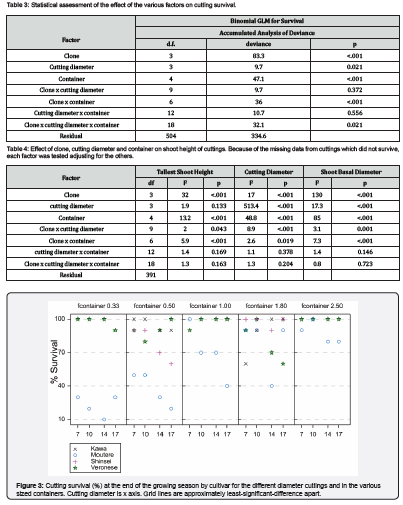
For shoot basal diameter (Table 5), the biggest influences were clone and container size. ‘Veronese’ had bigger shoots than ‘Moutere’, and plants in bigger containers grew longer shoots with larger diameters. Stem growth was initially faster from cuttings of ‘Veronese’ in the 1.8L and 2.5L containers, but by mid-season 40-45% of plants experienced stem dieback, whereas ‘Moutere’ plants experienced much lower dieback (~20%). Stem dieback was less frequent in plants growing in pots <1.8L and lower in the other two poplar clones (5-15%). Stem dieback reduced mean height of live shoots at the end of the growing season for ‘Veronese’ and ‘Moutere’ (Figure 4).
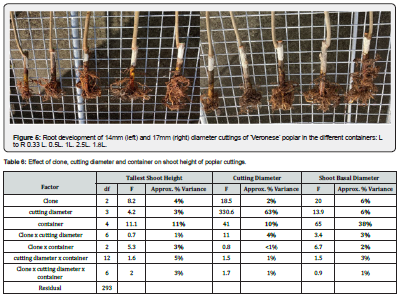
The relative size of the F statistics (Table 6) suggests that for shoot height and shoot basal diameter container volume was the most influential factor; the 1.8L containers produced the biggest plants, although that was more noticeable with ‘Shinsei’. Plants in bigger containers grew more and the basal diameter of the dominant shoot was greater. On average cuttings grew 2-5mm in diameter, with differences in initial cutting diameter remaining. For example, ‘Moutere’ and ‘Veronese’ mean diameters of 7, 10, 14 and 17mm cuttings were 10.8, 13.5, 16.6 and 20.5mm and 11.3, 14.0, 16.1 and 19.7mm respectively at the end of the growing season.
There is not as clear a measure of importance for binomial models but looking at the deviance of the effects divided by their degrees of freedom, clone and container size were the highest (Table 6). The poplars mostly survived; but larger Veronese cuttings in 1.8L pots didn’t do as well as smaller cuttings.
Shoot dieback was observed in 21% of ‘Veronese’ cuttings with 15% occurring in the larger containers (2.5L, 1.8L) and 6% in the smaller containers. Shoot dieback frequency declined with container size and cutting diameter size though not significantly.
Root development
‘Veronese’ poplar root development was visually greater in larger containers though not necessarily as cutting diameter increased (Figure 5). ‘Moutere’ willow root system included more finer roots than that of ‘Veronese’ poplar (Figure 6). No measurements of root mass were taken as all live plants were needed for the field trial.
Cost of production
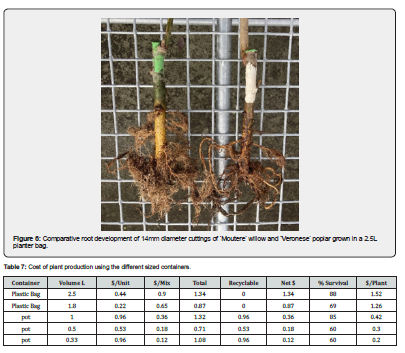
Plastic pots were more expensive than plastic bags (Table 7). However, the unit price per live plant decreased as the pot volume decreased when recycling the plastic pots. Cuttings were collected from prunings off nursery stools. The cost was labour only and considered independent of cutting diameter, i.e. cost of each cutting was the same.
When the cross-sectional area of each container is considered the number of containers accommodated per m2 is 64, 200, 123, 138 and 204 for the 2.5L, 1.8L bag, 1L, 0.5L and 0.33L containers respectively. Where ground area becomes a significant cost factor this needs to be added to the data in Table 7.
Discussion
We investigated survival and growth of poplar and willow planting material grown from cuttings varying in diameter and in containers ranging from 0.3L to 2.5L. Our main findings were that cutting survival in the various sized containers exceeded 87% for poplar clones, but was lower for willow (59%) particularly in the smaller size pots. This was similar to survival rates in an earlier study with variable diameter poplar cuttings [8] though the cutting length was 9cm compared with 20cm in this study and the container volume range of 125 - 336ml barely overlapped with volumes in this study. They reported lower survival rates at initial cutting diameter of < 7.5cm, below the smallest diameter selected in this study, but the upper diameter was not stated in their study. The lower survival of willow cuttings was considered to be contributed by competition for light with the more vigorous single leader, large-leafed poplar cuttings [13] suppressing growth where the willow cutting had multiple leaders. We suggest that willow cuttings grown separately under the same conditions would have maintained the high survival rates of >80% demonstrated at the first measurement. Height growth for the container plants was significantly influenced by clone, cutting diameter and container size, of which container size and clone were most influential. Both survival and plant height were lower in the smaller volume containers, consistent with other studies [8,9]. In general, collar diameter increased with container volume but not with cutting diameter, suggesting that resources needed for shoot growth are soon independent of resources contained within the initial cutting. More of those resources (space, nutrients, water) were available in the greater pot volume. The root mass visually increased with container volume (Figure 5). Poplar plants grown from cuttings of smaller initial diameters were able to achieve high survival and height growth when crowded with larger diameter material. Plants grown in the 1.8L and 2.5L plastic bags grew longer stems but during the growing season stem dieback was more frequent for plants growing in these containers. Reasons for this were unclear though it may be due the inability of the young root system to supply the stem water requirements.
Cuttings were closer to each other in the smaller containers (0.33L, 0.5L) and there was more competition between adjacent plants for light. Shoots of poplar cuttings outgrew shoots of willow cuttings which likely contributed to the greater mortality and lower shoot height of willow plants in the container trial. The larger leaves of the poplar reduce light availability to shorter plants creating a much shadier environment. Survival of poplar cuttings, regardless of clone, cutting diameter and container volume remained ~90% to the end of the growing season, whereas survival of willow cuttings steadily declined from 85% after two months to 59% at the end of the growing season (Figure 3). Willow leaves became infected with rust disease which, though it did not warrant fungicide application, may have reduced shoot growth without affecting survival. From previous experience in growing poplar and willow plants from cuttings it was thought that the earlier budbreak of the willow would enable them to compete with poplar plants through the whole season. Our recommendation based on this trial is to propagate willow and poplar plants in separate beds to avoid light competition. There was no shoot dieback with ‘Kawa’ and ‘Shinsei’ cuttings so shoot dieback may be more typical of ’Veronese’ cultivar rather than poplar cultivars in general. This may be attributed to different physiological mechanisms to manage water stress [15].
As reported in other studies viable plants suitable for direct planting into pastoral land can be grown from a range of cutting diameters and in a range of container sizes [8,12,16]. Our study confirms these findings and also proposes that container sizes >1L do not increase cutting survival and growth, possibly allow conditions that favour stem dieback and do not warrant the extra cost in media and bed-space. It is possible that the stem heights achieved by 7mm diameter cuttings are sufficient to compete with other vegetation but survival and growth in an uncultivated situation such as pasture remains to be tested. Where plants are root-pruned prior to planting in field conditions the extra root mass of plants in larger column containers will not benefit the plant and may favour plants with smaller stems and fewer leaves when it comes to survival. The relationship between cutting diameter and plant survival was inconsistent and did not support the hypothesis that plant survival will increase with cutting diameter for the diameters tested in this experiment. Stem dieback was more prevalent for plants grown in larger volume containers, negating some of the initial advantages conferred by the container volume.
Our hypothesis that plant growth would increase as container volume increased was not well supported across the range of volumes tested.
The cost of producing poplar and willow plants from rooted cuttings assumed that plastic pots were recyclable and plastic bags were not recyclable (Table 7), and that plants were sold as bare-rooted plants. The larger plant size may justify the added cost of the larger volume of mix + fertiliser on some field applications. If this is not the case, production of rooted cuttings in a smaller volume recyclable container is more cost-effective. Typical price range of a commercially grown two-year-old 3m willow or poplar pole in New Zealand is $12-15, 10-60 x the cost of the rooted cuttings grown in this trial. Any lower survival rates of one -year-old rooted plants grown from cuttings in the field will be more than compensated by the lower unit cost of each plant and the ease with which it can be replaced in the field. The addition of protection from animal browsing may change the cost dynamics so limiting sites where rooted cuttings are the most suitable option. We rejected our hypothesis that cost effectiveness of producing rooted poplar and willow plants from cuttings will increase with container size.
When the containerised plants are planted as bare rooted material into uncultivated open ground assessment of, in particular, survival in the 1-2 seasons following field planting may modify the conclusions presented from this study. Cost effectiveness in a commercial nursery will vary with cost of nutrient mix, plant containers and recycling practices rather than cost of cuttings provided a poplars and willow stool bed is maintained.
Conclusion
This study investigated survival and growth of three poplar cultivars and one willow cultivar grown from vegetative cuttings varying in diameter from 7mm to 17mm in containers of increasing volume from 0.33L to 2.5L to evaluate cost effectiveness in producing rooted stock for field planting.
Initial survival of poplar and willow cuttings was high for all diameter classes and in all pot sizes. A decline in survival of willow plants in the various-sized containers was considered due to competition for light with the taller and larger leafed poplar plants. We rejected the hypothesis that plant survival would increase with either larger cutting diameter or with larger container volume. Shoot height and basal diameter were greater for cuttings grown in containers with greater volume. The container volume was more significant than the original cutting diameter in determining shoot height and basal diameter at the end of the growing season. Our hypothesis that shoots growth would increase with cutting diameter was rejected, but there was support for the hypothesis that shoot growth will be greater for cuttings grown in larger volume containers. Unit cost of plants decreased as the size of the container decreased, though mean height of the plants was significantly less. The cost effectiveness assessment may need to be adjusted if field survival proves to be lower with smaller rooted plants.
Acknowledgement
The study was funded by New Zealand Poplar & Willow Research Trust Contract No. 38333.
References
- Dickmann D (2006) Silviculture and biology of short-rotation woody crops in temperate regions: Then and now. Biomass & Bioenergy 30(8-9): 696-705.
- Branislav K, R Savo, M Dragana, I Petar, K Marina (2009) Early shoot and root growth dynamics as indicators for the survival of black poplar cuttings. New Forests 38(2): 177-185.
- Mc Carthy R, L Rytter, K Hjelm (2017) Effects of soil preparation methods and plant types on the establishment of poplars on forest land. Annals of Forest Science 74(2).
- Hjelm K, R Mc Carthy, L Rytter (2018) Establishment strategies for poplars, including mulch and plant types, on agricultural land in Sweden. New Forests 49(6): 737-755.
- Shang K, M Labrecque, V Gilles, W Nissim (2024) A comprehensive review of planting approaches used to establish willow for environmental applications. Ecological Engineering 204.
- Bohlenius H, R Overgaard (2014) Effects of Direct Application of Fertilizers and Hydrogel on the Establishment of Poplar Cuttings. Forests 5(12): 2967-2979.
- Bohlenius H, R Overgaard (2016) Impact of seedling type on early growth of poplar plantations on forest and agricultural land. Scandinavian Journal of Forest Research 31(8): 733-741.
- Thomas BR, SG Schreiber, DP Kamelchuk (2016) Impact of planting container type on growth and survival of three hybrid poplar clones in central Alberta, Canada. New Forests 47(6): 815-827.
- Desrochers A, BR Thomas (2003) A comparison of pre-planting treatments on hardwood cuttings of four hybrid poplar clones. New Forests 26(1): 17-32.
- Block RMA, JD Knight, NWH Booth, KCJ Van Rees (2009) Nursery stock type, nitrogen fertilization and shoot pruning effects on the growth of juvenile hybrid poplar in Saskatchewan. Canadian Journal of Plant Science 89(2): 289-301.
- Zalesny RS, EO Bauer (2019) Genotypic variability and stability of poplars and willows grown onnitrate-contaminated soils. International Journal of Phytoremediation 21(10): 969-979.
- Manzone M, S Bergante, G Facciotto, P Balsari (2017) A prototype for horizontal long cuttings planting in Short Rotation Coppice. Biomass & Bioenergy 107: 214-218.
- Pollock A, K Grant, A Schoonmaker (2025) Size Influences on the Survival of Willow Cuttings Under Operational Field Conditions. Ecology and Evolution 15(1): e70835.
- Greer E, S Pezeshki, F Shields (2006) Influences of cutting diameter and soil moisture on growth and survival of black willow, Salix nigra. Journal of Soil and Water Conservation 61(5): 311-323.
- Jones T, I McIvor, M McManus (2016) Drought tolerance and water-use efficiency of five hybrid poplar clones. 'Integrated nutrient and water management for sustainable farming' Fertiliser and Lime Centre, Massey University, Massey University, New Zealand Occasional Report No. 29, p.13.
- Sulaiman Z, P Kemp, G Douglas (2005) Effects of stem diameter and planting depth on survival and early growth of field-planted willow and poplar. Agronomy N Z 35: 104-117.