




 IJESNR Home



Keywords: Saiga population; Infectious disease; Climatic factors; Ecosystem; Environmental conditions; Veterinary services; Animal mortality; Parasitic diseases
Opinion
The Republic of Kazakhstan is currently home to more than 95% of the world's saiga population and is represented by three populations: the Betpak-Dala, Ural, and Ustyurt populations.
The size of the saiga population periodically changes, both decreasing and increasing. Population declines are most often associated with biotic factors, namely the emergence and spread of infectious diseases. In recent years, mass mortality of the Ural saiga population due to infectious diseases occurred in the West Kazakhstan Region: approximately 12,000 animals died in 2010, and about 500 animals died in 2011. In 2015, as a result of the emergence and spread of an infectious disease, more than 150,000 saigas of the Betpak-Dala population died.
As a result of the mass mortality, the number of saigas in the Ural population decreased to a critical level of 21,000 individuals in 2011. From the second half of 2011, the State Program for the Protection of Wild Animals continued to be implemented, and with our participation, a program was developed and introduced to eliminate the causes of and prevent the development of diseases among saigas.
Subsequently, a rapid increase in the population was observed, and by 2025 its number exceeded 3 million animals. Such a rapid recovery of the saiga population is associated with the high viability of these “living fossils,” high fertility, the biological characteristics of their maternal instinct, i.e., females are always ready to nurse offspring that are not their own, and their adaptability to unfavorable natural and climatic factors. Since saigas belong to the category of transboundary animals, they are capable of covering considerable distances and crossing water barriers, thereby contributing to the spread of transboundary diseases.
It should be emphasized that the uncontrolled growth of the Ural saiga population has caused dissatisfaction and protests among both farmers and owners of private subsidiary farms in areas traditionally inhabited by and along the migration routes of saigas, including the Zhangalinsky, Kaztalovsky, Zhanybeksky, and Bokeyorda districts of the West Kazakhstan Region.
The excessive growth of the Ural saiga population predictably became a cause of the emergence and spread of infectious and parasitic diseases common to livestock, non-livestock domestic animals, and saigas, as occurred in 2026. The following factors contribute to this situation:
a) Changes in the Ethological Characteristics of Saigas
The saiga population is currently increasing almost in arithmetic progression. However, the laws governing ecosystem functioning indicate that no population can grow in arithmetic progression indefinitely. Sooner or later, this leads to a shortage of environmental resources, including food and space, degradation of environmental conditions, epizootics, and other adverse consequences of overpopulation.
Excessive population size and density are unfavorable for all populations and ecosystems without exception. They lead to depletion of environmental resources, degradation of environmental conditions, and an overall weakening of ecosystems.
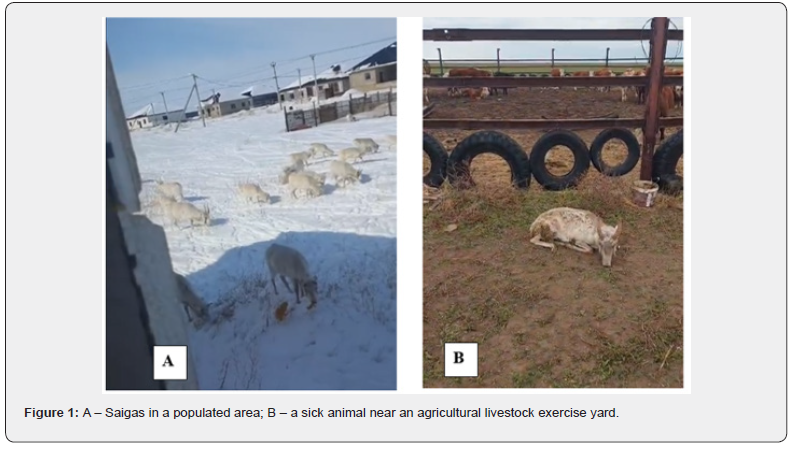
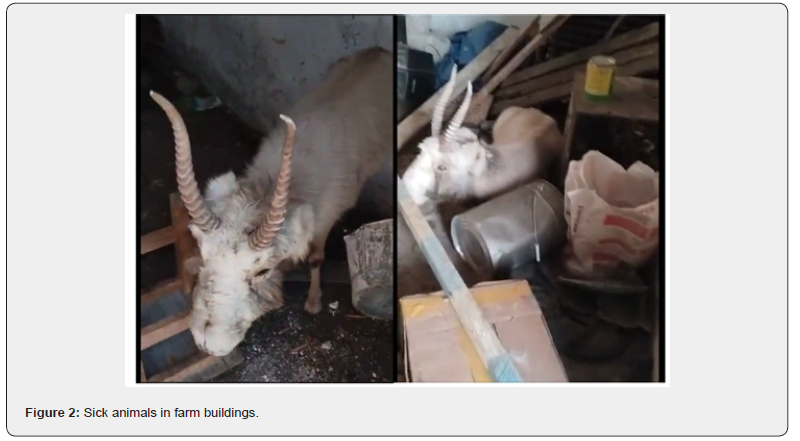
The excessive increase in the number of saigas, due to shortages of food and water resources, has contributed to the loss of their characteristic fearfulness and caution. Regardless of the season, they enter populated areas in search of food. This results in close contact between saigas and domestic animals, both on pastures near settlements and directly inside livestock facilities and animal exercise areas (Figure 1 & 2).
b) Unfavorable Epizootic Situation among Domestic Animals
The epizootic situation among agricultural and non-livestock animals, particularly dogs, is also unfavorable. In areas inhabited by and along the migration routes of saigas, domestic animals are affected by diseases such as brucellosis, pasteurellosis, rabies, coenurosis, echinococcosis, clostridial diseases, blood-parasitic diseases, sporadic cases of foot-and-mouth disease, and anthrax.
This situation occurs due to shortcomings in the work of local veterinary services and the irresponsible attitude of animal owners toward veterinary welfare, including failure to notify veterinary services about animal migration, incorrect registration and identification of animals, and failure to report cases of clinical disease and animal mortality.
Thus, saigas become a vector for the spread of infectious and parasitic diseases both within their own species and among livestock and other domestic animals.
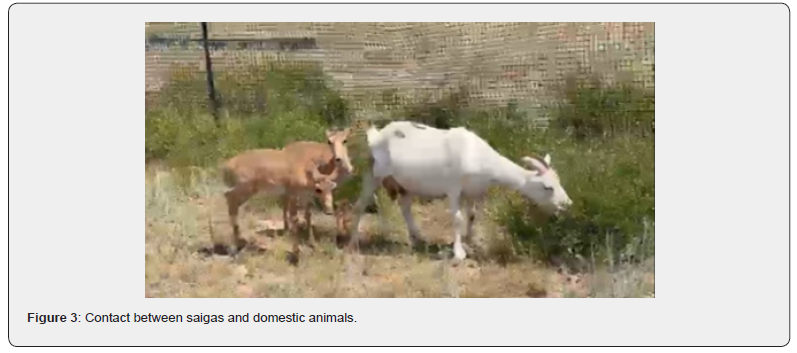
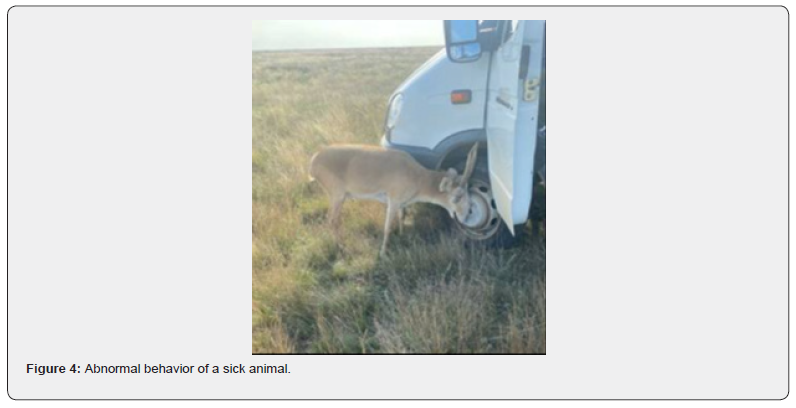
Sick saigas and the carcasses of dead animals become prey for stray dogs in populated areas and contribute to maintaining the parasitic cycle of common infectious and invasive diseases. Sick saigas lose their natural fearfulness and vigilance and approach human structures and other unfamiliar objects closely (Figure 3 & 4).
c) Transboundary Spread of Foot-and-Mouth Disease
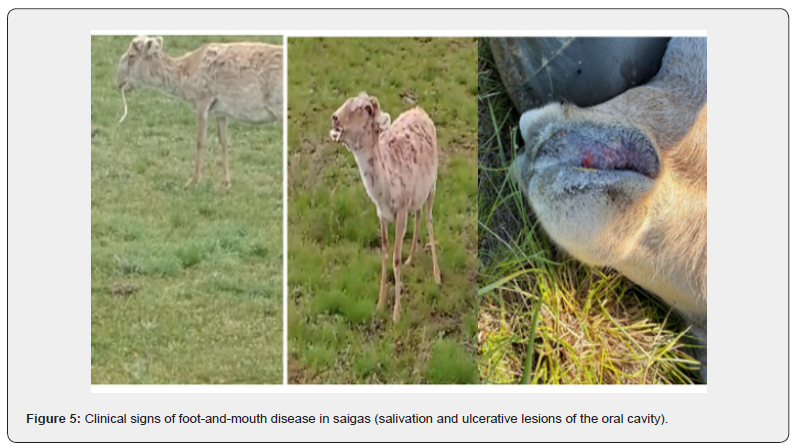
In 2025–2026, the transboundary and particularly dangerous viral disease, foot-and-mouth disease, became widespread in countries both near and far from Kazakhstan. Outbreaks of this disease have been recorded in Russia, Kyrgyzstan, Kazakhstan, China, and Mongolia.
In the current year, this disease became widespread among saigas and demonstrated a transboundary character. As a result, saigas became a source of infection for cattle and small ruminants in the districts of the West Kazakhstan Region (Figure 5).
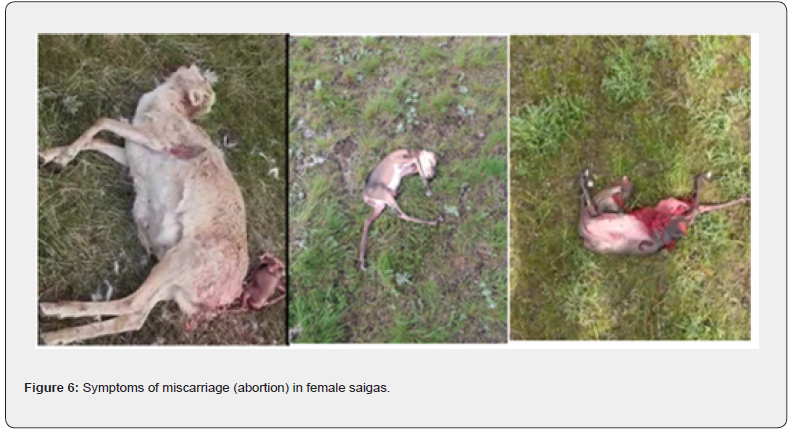
During the spring period, when saigas traditionally reproduce, numerous cases of miscarriage (abortion) and stillbirth were observed in the population, which are symptoms associated with brucellosis (Figure 6).
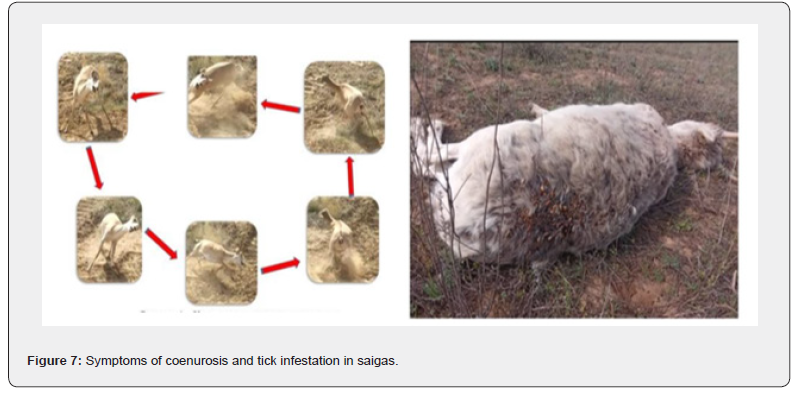
Parasitic diseases such as echinococcosis and coenurosis, as well as infestation by blood-sucking ticks, should also not be excluded.
During the migration and calving period of saigas, both natural mortality and mortality caused by diseases occur. As a result, animal carcasses become prey for wild predators, birds, and village dogs, thereby contributing to the maintenance of the biological cycle of parasite development (Figure 7).
Conclusion
In short, in 2026, a process of “self-regulation” of the Ural saiga population occurred. Its population decreased significantly, and a relatively low rate of offspring production was also recorded—only 17%, compared with the usual 40-50%.
Infectious diseases among both saigas and agricultural animals have not disappeared. They develop according to their own epizootic patterns, and as long as the epizootic chain exists, the disease can persist indefinitely.
Wild fauna, particularly saigas, can also serve as a source of diseases among agricultural animals in rural areas where saigas live and migrate. A multispecies biocenosis consisting of domestic and wild animals creates highly favorable conditions for the persistence and spread of bacterial, viral, and parasitic pathogens in the natural environment.