




 IJESNR Home



Abstract
Ants are ecologically important insect groups. This checklist and distributional assessment of Sudanese Formicinae ants is based on historical records, and recent field surveys. A total of 72 taxa belonging to 10 genera, with 14 recognized subspecies were documented. Camponotus is the most species-rich genus, accounting for 29 species(40.2)and 6 subspecies, followed by Lepisiota with 18 species (25.0%) and Cataglyphis with 14 species (18.4%) and 4 subspecies each. These three genera contribute 60 species, indicating that Sudanese Formicinae diversity is strongly concentrated in a small number of genera. Species richness was highest in riverine and cultivated habitats, supporting a positive relationship between habitat complexity and ant diversity. Cataglyphis bombycinica, exhibited restricted habitat preferences. Canopy fogging of Senegalia senegal revealed a distinct arboreal ant assemblage, emphasizing the ecological importance of this economically valuable tree species. Sudanese Formicinae fauna reflects the country's position as a biogeographical crossroads, containing Saharo-Sahelian, Afrotropical savanna, and pantropical elements. These findings provide an updated baseline for future taxonomic, ecological, and conservation studies of ants in Sudan.
Keywords: Formicinae; Sudan; Biodiversity; Records
Abbreviations: FR Sudan= first record to Sudan; sp. vov.= new species; subsp.=subspecies; S/E B= Sudan- Eritrea border area. Throughout, each locality with the first letter given in bold means confirmed collection site by AK Omer and ZN Mahmoud; when the first two letters are given in bold that means new collection site by AK. Omer and ZN Mahmoud
Introduction
Formicinae is a diverse subfamily of ants comprising over 50 diverse genera and ≈3, 600 spp., the most diverse Formicine ant genus is Camponotus (carpenter ants), which contains over 1,000 described species worldwide [1,2], making it one of the largest ant genera in Formicidae family. This subfamily is valuable component of terrestrial ecosystems as they play important ecological roles by improving soil structure, dispersing seeds, recycling nutrients, and regulating populations of other insects [3,4]. Their nests improve soil aeration and nutrient availability [5]. Formicinae ants contributes to recycling of matter by their diverse and flexible feeding strategies, ranging from liquid-resource exploitation to predation and scavenging [3,6-10].
The earliest Formacidae records from Sudan were attributed to P Magretti who collected during 1883-1984, six Camponotus spp., two Lepisiota spp., and Cataglyphis bicolor viaticus, V Karavaiev (1910-1912) two Camponotus spp.,three Cataglyphi spp., three Lepisiota spp., and Paratrechina longicornis F Werner & R Ebner (1914)from other locations confirmed the findings of P Magretti and V Karavaiev, and added Anoplolepis pernix, Camponotus diplopunctatus subconvexus, Camponotus flavomarginatus, Cataglyphis albicans Cataglyphis bicolor Cataglyphis bombycinus and Lepisiota canescens. NA Weber & JG Myers (1939) added six Camponotus spp., two Lepisiota spp., and three Cataglyphis spp.
Following these early efforts, several contributions with traits were made. Mathews [11] studied ant association with Acacia senegal. Magboul et al. [12] listed Camponotus maculatus, Cataglyphis desertorum and Lepisiota gracilicornis in their ant diversity at Sunut forest, Khartoum. Omer [13] studied ant diversity in Sudan. The soil macro-fauna in Rashad, South Kordofan was studied by Eisawi et al. [14] and of the Dinder National Park by Eisawi et al. [15]. Ibrahim et al. [16] investigated ant diversity in North Kordofan (Al Ain, Abu Gaida, El Gafeel, El Basheery, El Obeid, El Taweel, El Rahad, Jebel El Dayer, Khor Tagat, Tandalti), and Mahmoud & Tahir [17] studied Formicidae of El Ga'ab Depression.
This study on Formicinae anta species from Sudan aimed to document their distributional records and ecological associations
Material and Methods
Ant specimens were collected from different habitats across Sudan, representing 14 major ecological zones. Each ant specimen was collected, using a strip of paper, a dropped in a stoppered veil containing 70% alcohol to which few drops of glycerol were added. All material from each location site were kept in a labeled one glass container.
Identification
Specimens were identification and nomenclature followed Diamé et al. [18]; Bolton [1]. Dr. Brian Taylor verified the identification of the collected specimens. All specimens were curated in the Taylor Ant Collection in the Oxford University Museum of Natural History, Oxford, United Kingdom. The authorship of subfamilies, genera, species and subspecies followed AntWiki [9].
Results
The encountered Formicinae (Formacide, Hymenoptera), were arranged alphabetically by genera.
Subfamily: Formicinae (Latreille, 1809)
Anoplolepis pernix sp. nov., Viehmeyer, 1923; location: Gobashe; collector: H Werner and R Ebner; material: workers.
Axinidris acholli Weber, 1941; workers from DNP by Eisawi et al. [15] is FR Sudan.
Camponotus sp. Mayr, 1861; workers from El Ga’ab Depression by ZN Mahmoud and YF Tahir, 2025.
Camponotus acvapimensis Mayr, 1862; workers from Rashad as FR Sudan by Eisawi et al. [14] and from DNP by Eisawi et al. [5]
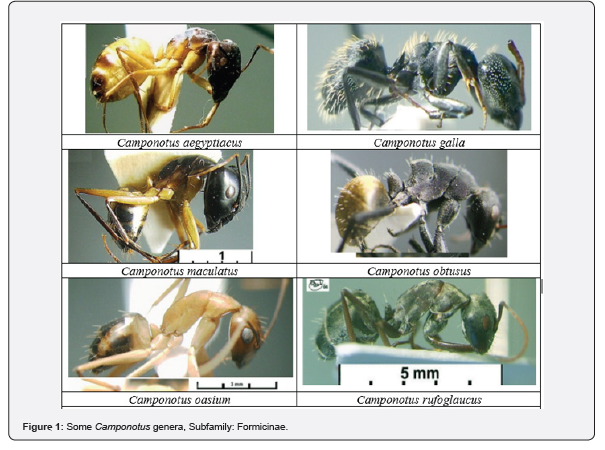
Camponotus aegyptiacus Emery, 1915; locations: Ed Dueim, Khartoum, Wadi Halfa; collector: A Schatzmayr et al., N A Weber; material: soldiers; workers from Rashad by Eisawi et al. [14]and from DNP by Eisawi et al. [15], Plate 1.
Camponotus bayeri Forel, 1913; workers from Rashad by Eisawiet al. [14]. FR Sudan and also from DNP by Eisawi et al. [15]
Camponotus brutus Forel, 1886; workers from DNP by Eisawi et al. [15]. FR Sudan.
Camponotus carbo Emery, 1877; workers from DNP by Eisawi et al. [15]. FR Sudan.
Camponotus chapini Wheeler, 1922; workers from Rashad by Eisawi et al. [14] as FR Sudan and from DNP by Eisawi et al. [15].
Camponotus chapini ganzii Weber, 1943; workers from DNP by Eisawi et al. 2022 [15]. FR Sudan.
Camponotus cinctellus Gerstaecker, 1859; location: Khartoum, Sinnar; collector: H Werner and R Ebner, V Karavaiev; Sinja and Wad Alaziz; collectors AK. Oner and ZN Mahmoud; material: minor and major workers; workers also from Rashad by Eisawi et al. [14].
Camponotus cognatocompressus sp. nov., Forel,1879; location: S/E B; collector: P Magretti; material: workers, queen.
Camponotus diplopunctatus subconvexus subsp., Emery, 1915; location: Sinnar; collector: H Werner and R Ebner; material: workers. Also workers from DNP by Eisawi et al. [15].
Camponotus etiolipes Latreille, 1798; workers from Rashad as FR Sudan by Eisawi et al. [14]
Camponotus fellah Dalla Torre, 1893; workers from DNP by Eisawi et al. [15]. FR Sudan.
Camponotus flavomarginatus Viehmeyer, 1932; location: Dilling, Ragaba; collector: H Werner and R Ebner; material: workers.
Camponotus foraminosus Andre, 1884; location: ?; collector: P Magretti; material: workers; wrongly identified as C. niveosetosus but corrected by Emery, 1886.
Camponotus galla Forel, 1894; locations: Khartoum, Sinnar; collector: H W Bedford, H Werner and R Ebner, V Karavaiev; material: workers. Also workers from Abo Hojar, Al Gewasee, Gadarif, Mashraa Al Nour, Selima Oasis by AK Omer and ZN Mahmoud and from DNP by Eisawi et al. [15]. Plate 1.
Camponotus hapi Weber, 1943; workers from Rashad by Eisawi et al. [14] as FR Sudan.
Camponotus kersteni Gerstäcker, 1871; workers from Rashad by Eisawi et al. [14]. FR Sudan.
Camponotus maculatus Fabricius, 1782; locations: Metemma, Sebderat; collectors: F Werner, H Werner and R Ebner, P Magretti, V Karavaiev; material: workers, queen. Also workers from Abba Island, Abo Gabra, AllAKareem, Al Deain, Al Fashir, Algitaina, Alhamidi, Alkawa, Alkhandag, Almaseed, Almoltaga, Almoswarat, Alsabloga, Balila, Dilling, Dongola, Gablain, Gilass, Hadida, Heglig, Kareema, Khartoum, Khashm El Girba, Khor Altimit, Mango, Rigl AL Fola, Jebal Awlia, Kassala, Sinkat, Sinnar, Sulb, Toshka, Um al Hassan, Wadi Halfa by AK Omer and ZN Mahmoud; and from Sunnt forest, by Magboul et al., 2013; from DNP by Eisawi et al., 2022; from Abugaida, Bara, Elain, Elbasheery, Elgafeel, El Obeid, Eltaweel by Ibrahim et al. [16] and El Ga’ab Depression by ZN Mahmoud and YF Tahir, 2025, Plate 1.
Camponotus maculatus cognatus Andre, 1884; locations: Khor Langhebb, Suakin; collector: P Magretti; material: workers.
Camponotus niveosetosus Magretti, 1884; location: S/E B; collector: P Magretti, and Abugaida, Elbasheery, Eltaweel; collector: Ibrahim et al. [16]; material: workers.
Camponotus oasium Forel, 1890 workers from Abugaida, Bara, Elbasheery, Elgafeel, Eltaweel by Ibrahim et al. [16]; as FR Sudan, and from Al Maseid, Singa by AK Omer and ZN Mahmoud; Plate 1.
Camponotus obtusus Emery, 1911; location: Salom; collector: H Eriksson; material: soldiers. Workers from Arkawit, Haya, Musmer, Sinkat, by AK Omer and ZN Mahmoud; Plate 1.
Camponotus pompeius cassius Wheeler, 1922; workers from Rashad by Eisawi et al. [14] as FR Sudan.
Camponotus rufoglaucus Jerdon, 1851; locations: Khartoum (collector?) and from Damazeen, Madani by AK Omer and ZN Mahmoud; material: workers, Plate 1.
Camponotus sericeus Fabricius, 1798; locations: Bara, Dilling, Khartoum, Khor Lebka, Shendi, S/E B, Tanguru; collectors: D H Bedford and G E Giffard, H Werner and R Ebner, P Magretti, V Karavaiev; material: workers, queen. Also workers from Abba Island, Alrahad, Ar Rugayba, El Haj Abdallah by AK Omer and ZN Mahmoud, from DNP by Eisawi et al. [15], from Bara, Elain, Elgafeel, El Obeid, Khor Tagat by Ibrahim et al. [16] and from El Ga’ab Depression by ZN Mahmoud and YF Tahir, 2025.
Camponotus sericeus obtusus Santschi, 1933; A queen from Merowe collected by HB Johnson.
Camponotus thraso nefasitensis Menozzi, 1931; location: Port Sudan; collector: V Karavaiev; material: workedrs, one queen. According Bolton [1] Camponotus negus nefassitensis Forel, 1911, is not a valid scientific name.
Camponotus tricolor Weber, 1943; workers from DNP by Eisawi et al. [15]. FR Sudan.
Camponotus vestitus F. Smith, 1858; location: Abo Hojar, Sinja and Wad Alaziz; collector; AK. Oner and ZN Mahmoud; material: minor workers (Figure 1).
Cataglyphis Subsp. Foerster, 1850; workers from El Ga’ab Depression by ZN Mahmoud and YF Tahir, 2025.
Cataglyphis albicans franchettii Menozzi, 1931; location: Abudelaig; collectors: AK Omer and ZN Mahmoud; material: workers. FR Sudan.
Cataglyphis aurata sp. nov., Menozzi, 1932; location: Omdurman and Port Sudan; collector: V Karavaiev; material: workers also collected from Um Sayed by AK Omer and ZN Mahmoud, from DNP by Eisawi et al. [15] and from Elain, Elgafeel, El Obeid, Khor Tagit in North Kordofan, by Ibrahim et al. [16].
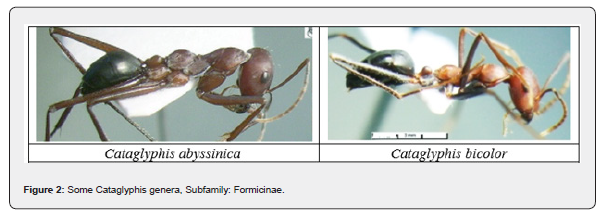
Cataglyphis abyssinica Forel, 1904; workers from DNP by Eisawi et al. [15], from Elgafel, Elbasheery, Jebel El Dayer by Ibrahim et al. [16] and from Al Khandag, Dordape, Tandalti Nyala by AK Omer and ZN Mahmoud and Plate 2.
Cataglyphis albicans (as lividus) Viehmeyer, 1923; locations: Bara, El Obeid; collectors: H Werner and R Ebner; material: ?. Workers from Alrahad and from DNP by Eisawi et al. [15].
Cataglyphis albicans auratus Karavaiev,1911; locations: Khartoum, Omdurman, Port Sudan; collector: V Karavaiev; material: workers.
Cataglyphis bicolor Viehmeyer, 1923; location: many places; collector: H Werner and R Ebner; material: workers. Also workers from DNP by Eisawi et al. [15], Eltaweel, Elbasheery. Abugaida by Ibrahim et al. [16] 2023, El Ga’ab Depression by ZN Mahmoud and YF Tahir, 2025 and from AllAKareem, Abo Gabra, Al Deain, Al Fashir, Alkamlin, Alsabloga, Dilling, Gilass, Hadida, Heglig, Kareema, Mango, Rigl AL Fola, Um al Hassan. by AK Omer and ZN Mahmoud, Plate 2.
Cataglyphis bicolor sudanica Karavaiev, 1912; location: Khartoum, Port Sudan; collector:?; material: workers and males. Workers from Kodraco by HH King and DNP by Eisawi et al. [15]; workers from Khashm El Girba, Khor Altimit, Wadi Halfa by AK Omer and ZN Mahmoud.
Cataglyphis bicolor viaticus Magretti, 1884; locations: Kassala, Sebderat; collector: P Magretti; material: workers.
Cataglyphis bombycinus Viehmeyer, 1923; location: Wadi Halfa; collector: H Werner and R Ebner; material: workers. Also workers from Selima Oasis by AK Omer and ZN Mahmoud.
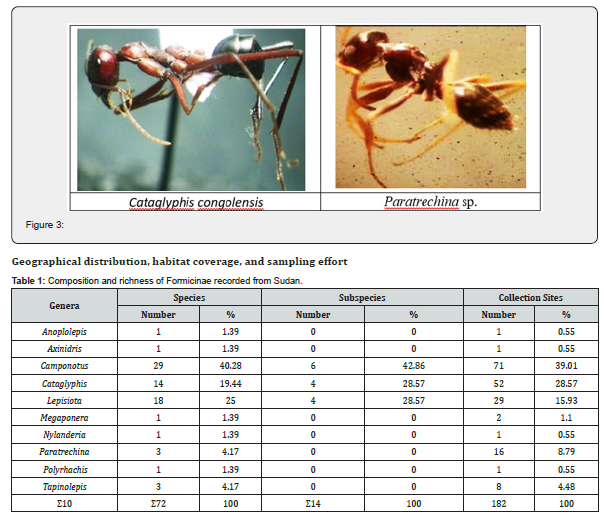
Cataglyphis congolensis Stitz, 1916; locations: Elrahad, Jebel El Dayer; collector: Ibrahim et al. [16]; material: workers. FR Sudan. Plate 3.
Cataglyphis desertorum Wheeler, 1906; locations: a nest in Gablain by Jaegerskiold, workers from Kordofan Desert by F Werner, workers and male from Port Sudan by V Karavaiev; workers from Sunnt forest, by Magboul et al. [12] and from Donglaby AK Omer and ZN Mahmoud.
Cataglyphis niger Taylor, 2005; location: Salom; collector: ?; material: workers also from Workers from Dordape, Haya, Musmarby AK Omer and ZN Mahmoud.
Cataglyphis oasium Menozzi, 1932; workers from El Ga’ab Depression by ZN Mahmoud and YF Tahir, 2025, as FR Sudan; and from Abudelaig, Musmar, Singa, Sulbby AK Omer and ZN Mahmoud.
Cataglyphis savignyi Forel, 1894; workers from DNP by Eisawi et al. [15] as FR Sudan.
Cataglyphis viatica Fabricius, 1787; workers from DNP by Eisawi et al. [15] as FR Sudan (Figure 2).
Lepisiota sp. Santschi, 1926; workers from El Obeid North Kordofan, by Ibrahim et al. [16].
Lepisiota affinis Santschi, 1937, originally described as Acantholepis affinis from Kenya; locations: DNP, Medani; collectors: AK Omer and ZN Mahmoud; material: workers.
Lepisiota canescens Emery, 1897; locations: Abo Karshawla, Al Hafair, El Obeid, Khartoum, Sinnar, Roseris, collectors: AK Omer and ZN Mahmoud, F Werner, H Werner and R Ebner, V Karavaiev; material: workers. Also, workers from DNP by Eisawi et al. [15].
Lepisiota capensis Mayr, 1862; location: S/E B; collector: P Magretti; material: workers. Also workers from DNP by Eisawi et al., 2022 [15] and from Alain by Ibrahim et al. [16].
Lepisiota capensis acholli Weber, 1943; workers from DNP by Eisawi et al. [15]. FR Sudan.
Lepisiota capensis issore Weber, 1943; workers from DNP by Eisawi et al. [15]. FR Sudan.
Lepisiota capensis minuta Forel, 1916; workers from DNP by Eisawi et al. [15]. FR Sudan.
Lepisiota capensis thoth Weber, 1943; workers from DNP by Eisawi et al. [15]. FR Sudan.
Lepisiota carbonaria Karavaiev, 1911; workers were collected from Port Sudan by V Karavaiev; DNP by Eisawi et al. [15]. Also, from Abbasiya, Al Hafair AK Omer and ZN Mahmoud,
Lepisiota curta Emery, 1897; locations: Abbasiya, Alkhiary, Alshwak, DNP, Gedarif, Sinnar; collector: AK Omer and ZN Mahmoud; material: workers.
Lepisiota frauenfeldi Mayr, 1855; location: S/E B; collector: P Magretti; material: workers. Also workers from Rashad by Eisawi et al. [14], and from DNP by Eisawi et al. [15].
Lepisiota gracilicornis Forel, 1892; workers from Port Sudan, Gulfan, Khartoum, Shendi by H Werner and R Ebner, V Karavaiev; queen from Port Sudan by H Werner and R Ebner. Also workers from Sunnt forest, by Magboul et al. [12]; DNP by Eisawi et al. [15], from Elain by Ibrahim et al. [16] and from Ad Damar Afad, DNP, Red Sea Resort, Shendi, Tandalti; collectors: AK Omer and ZN Mahmoud.
Lepisiota megacephala Weber, 1943; workers from Rashad as FR Sudan by Eisawi et al. [14].
Lepisiota obtusa Finzi, 1939; location: Port Sudan; collector: G Muller; material: ?.
Lepisiota omeri sp. nov., Taylor, Omer, Mahmoud, 2013; location of holotype HagAbdalla, paratype from Damazeen; collectors: AK Omer and ZN Mahmoud; material: workers.
Lepisiota palpalis Santschi, 1935; locations: Ar Rugayba, Kosti; collector: AK Omer and ZN Mahmoud; material: workers.
Lepisiota simplex Weber, 1942; location: banks of the Nile; collector: N A Weber; material: workers. Also, workers from DNP by Eisawi et al. [15].
Lepisiota validiuscula Emery, 1897; workers from Rashad by Eisawi et al. [14], as F R Sudan and from DNP by Eisawi et al. [15].
Megaponera analis Latreille, 1802; workers from El Obeid by Ibrahim et al. [16], FR Sudan. and from Abbasiya by AK Omer and ZN Mahmoud
Nylanderia jaegerskioeldi Mayr,1904; workers from Rashad by Eisawi et al. [14], FR Sudan.
Paratrechina sp. Motschoulsky, 1863; workers from Elain, Elgafeel, El Obeid, by Ibrahim et al. [15] and from El Ga’ab Depression by ZN Mahmoud and YF Tahir, 2025. Plate 3.
Paratrechina bourbonica Forel, 1886; this pantropical tramp species was once limited to Kenya; locations from Sudan are Singa Suki, Wad Alabass, Wad Alaziz; collectors: AK Omer and ZN Mahmoud; material: workers. FR Sudan
Paratrechina hagemanni new status ?; location: Wad el Hadad; collectors AK Omer and ZN Mahmoud; material: worker.
Paratrechina longicornis Latreille, 1802; location: Khartoum, Port Sudan; collectors: H Werner and R Ebner V Karavaiev; material: worker. Also, workers from Sunnt forest, by Magboul et al. [12], and from Abba Island, Al Maseid, Al Moltaga, Khartoum Shendi, Wad el Hadad by AK Omer and ZN Mahmoud.
Polyrhachis viscosa Smith, 1858; location: Darfur; collector: R C H Sweeney; material: workers.
Tapinolepis mediterranea Mayr, 1866; location: Elain; collector: Ibrahim et al. [16]; material: workers. FR Sudan.
Tapinolepis pernix sp. nov., Viehmeyer 1923; (described originally as Plagiolepis (Anoplolepis) pernix); locations: from Gobish; collector: F Werner. Material: workers and by J. Mathews from Kordofan and from Haj Abdalla by AK Omer and ZN Mahmoud.
Tapinolepis simulans Santschi, 1908; location: Al Rawakeeb; collectors: AK Omer and ZN Mahmoud: material: workers. FR Sudan (Figure 3).
Taxonomic composition and genera-level diversity
Table 1, indicates that:
1) The Formicinae fauna of Sudan comprises 72 species distributed across 10 genera, with 14 recognized subspecies. The distribution of species among genera is highly uneven. Camponotus is the most species-rich genus, accounting for 29 species (40.2%)and 6 subspecies, followed by Lepisiota with 18 species (25.0%) and Cataglyphis with 143 species (19.4%) and 4 subspecies. Together, these three genera contribute 60 species, ≈86% of the total recorded species, indicating that Sudanese Formicinae diversity is strongly concentrated in a small number of genera.
2) Camponotus is the most widely distributed genus, accounting for 71 sites (39%)subspecies, followed by Cataglyphis with 52 sites (29%) and Lepisiota with 29 sites (25.0%). Together, these three genera contribute 152 sites, ≈83% of the total recorded sites.
3) The relatively high representation of these genera may reflect their ecological adaptability and broad distribution across the heterogeneous habitats of Sudan, although differences in taxonomic attention and sampling intensity may also contribute to the observed pattern.
4) Anoplolepis, Axinidris, Megaponera, Nylanderia, and Polyrhachis are each represented by one species, while Tapinolepis and Paratrechina are represented by two and three species, respectively.
5) Subspecies are similarly concentrated: Camponotus, Cataglyphis, and Lepisiota together account for 14 subspecies (100%) recorded in the Table 1.
Geographical distribution, habitat coverage, and sampling effort
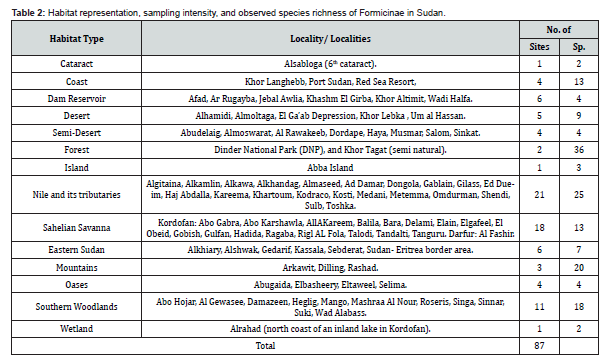
The dataset (Table 2) indicates a broad ecological and geographical coverage of sampling sites across Sudan, with substantial variation in both sampling intensity and the number of species recorded. The followings can be highlighted.
1) The collection covered a broad spectrum of Sudanese habitats and geographic regions, from the Red Sea coast and arid deserts to the Nile system, savannas, woodlands, mountains, and wetlands.
2) The species richness varied markedly among habitats, being highest in the Nile system, mountains, and southern woodlands, but these differences may reflect unequal sampling effort among localities.
3) The presence of newly sampled localities further expands the geographical coverage and potentially improves knowledge of species distributions in Sudan.
4) The new collection sites expand Sudan’s known sampling range and may provide evidence of previously undocumented species occurrences, strengthening the geographical basis of the study.
5) Species richness was not proportional to sampling-site number, with mountains supporting 20 species across three sites versus 13 species across 18 Sahelian savanna sites, suggesting influences of habitat characteristics, geographical heterogeneity, historical sampling, and methodological differences.
6) Camponotus maculatus is widely distributed across the habitat being collected from 37 out of 87 ≈ (43 %) of the sampled sites.
Discussion
The subfamily Formicinae was represented by 10 genera, with considerable variation in species richness. Camponotus was the most species-rich genus, comprising 29 species, followed by Lepisiota (18 species) and Cataglyphis (14 species). Anoplolepis pernix, described as sp. nov., from Sudan, was not recorded during the present survey. In contrast, C. cognatocompressus sp. nov., C. aurata sp. nov., and Tapinolepis pernix sp. nov. were re-collected from several localities. The survey also added Lepisiota omeri sp. nov., thereby increasing the known diversity of Formicinae in Sudan.
The distributional data further demonstrate the widespread occurrence of several Formicinae species. Camponotus maculatus was recorded from 37 localities, exceeding the 29 localities from which Brachyponera sennaarensis was reported by Omer [13], and suggesting that C. maculatus has a particularly broad distribution in Sudan. This pattern is consistent with the broad geographic success of Camponotus, whose species are widely distributed across sub-Saharan Africa, savanna ecosystems, and human-modified environments [9]. Historical records also provide evidence of wide geographic ranges. Tapinolepis pernix, originally described from Gobish, was subsequently recorded from several sites in Kordofan by Mathews, [11]. Similarly, L. omeri was later recorded from Damazeen. These indicate distribution extending beyond its type locality.
Patterns of habitat occupancy revealed substantial ecological flexibility within several genera. Species of Camponotus, Cataglyphis, Lepisiota, and Paratrechina occurred across desert, semi-desert, riverine, and mountainous environments, suggesting a high degree of ecological tolerance. Nevertheless, habitat specialization was evident in several taxa. For example, C. bombycinus was restricted to Selima Oasis, indicating a strong association with desert habitats, whereas T. simulans was recorded only from Al Rawakeeb and T. abyssinica exclusively from Jebel El Dayer. Similar patterns have been documented elsewhere in Africa, where some ant species show strong associations with particular environmental conditions. For example, several Proceratium species in Cameroon have been recorded from specific coastal, montane, and sandy forest habitats [19], whereas Cataglyphis fortis in Tunisia is closely associated with extremely arid salt-pan environments [20]. These suggest that localized distributions may reflect specific habitat or microclimatic requirements.
An additional ecological association was observed between Formicinae ants and the canopy of Senegalia senegal, particularly in canopy-fogging samples [11]. Frequently collected species included C. sericeus, L. acholli, and T. pernix, highlighting the importance of arboreal sampling for detecting vegetation-associated ants that may be underrepresented by conventional ground-based methods.
Species richness varied markedly among habitat types (Table 1), supporting the positive relationship between habitat complexity and ant diversity proposed by Andersen [21]. Riverine and cultivated habitats supported the richest assemblages, likely because of greater structural complexity, increased microhabitat availability, and more diverse and persistent food resources. This interpretation is consistent with evidence that habitat and patch heterogeneity strongly influence ant assemblage diversity and composition [22,23]. Elevated richness in cultivated habitats may reflect their disturbed, resource-rich conditions, which can also promote the establishment and spread of ant species.
The Formicinae fauna further reflects Sudan’s biogeographical position at the intersection of major African regions [24]. Saharo-Sahelian elements included C. aurata and C. bombycinus, whereas Afrotropical savanna elements were represented by Camponotus, Polyrhachis, Lepisiota, Anoplolepis, Nylanderia, and Paratrechina. These genera encompass diverse ecological strategies, ranging from arboreal and ground-dwelling [7]. Polyrhachis to the predominantly epigaeic and rapidly foraging Lepisiota and Anoplolepis. Nylanderia and Paratrechina generally occupy leaf litter, disturbed soils, and human-modified habitats, whereas Cataglyphis is strongly associated with arid and desert environments, particularly in transitional dry zones.
The fauna also contained pantropical and broadly synanthropic taxa. Paratrechina longicornis is widely distributed in tropical and subtropical regions and is strongly associated with disturbed and urban habitats. Similarly, A. pernix, N. jaegerskioeldi, and P. bourbonica have broad distributions across tropical environments. New country records, including Myrmecia analis and P. bourbonica, extend the known ranges of several Afrotropical and pantropical taxa [19]. These range extensions may indicate recent expansion facilitated by agriculture, habitat modification, and trade.
These findings highlight the value of diverse biodiversity sampling methods, though survey coverage in Sudan remained uneven, focusing mainly on central, eastern, and Nuba Mountains. Future research should focus on: (1) molecular phylogenetic studies to resolve species complexes, (2) long-term monitoring of ant communities in protected areas, and (3) assessment of the ecological impacts of invasive species if any.
Conclusion
By integrating historical records with newly generated field data, this study establishes an important baseline for ant biodiversity research in Sudan. Sampling covered the major geographical regions of Sudan, including the Nile Valley, eastern and western Sudan, although sampling intensity varied among regions and habitats. The description of L. omeri sp. nov. and new country records, including Cataglyphis albicans, C. a. franchettii, C. oasium, and P. bourbonica, highlights the value of sustained fieldwork and taxonomic collaboration. Further standardized sampling should prioritize poorly represented habitats, while GIS-based analyses should support distribution mapping and conservation planning, particularly in areas threatened by land-use intensification.
Acknowledgement
Thank are due to Oxford University Museum of Natural History for curating the specimens, and to J. H. Mathews for sharing information.
Dedication
To the memory of Dr. Brian Taylor, who verified the identification of the collected specimens, reviewed earlier drafts and approved the inclusion of his name as a co-author. He passed out before this manuscript was finalized.
Ethics
a) The authors declare no conflict of interest financial or otherwise.
b) Ethical issues pertaining to approval and consent to participate, human and animal rights, consent for publication, availability of data and materials are not applicable.
c) The Sudan Institute of Natural Sciences partially supported the study.
References
- Bolton B (2003) Synopsis and classification of Formicidae. Memoirs of the American Entomological Institute 71: 1-370.
- Ward PS, Blaimer BB, Fisher BI (2016) A revised phylogenetic classification of the ant subfamily Formicinae (Hymenoptera: Formicidae), with resurrection of the genera Colobopsis and Dinomyrmex. Zootaxa 4072(3): 343-357.
- Hölldobler B, Wilson EO (1990) The Ants. Cambridge, MA: Harvard University Press.
- Lach L, Parr C, Abbott K (Eds.), (2010) Ant Ecology. Oxford: Oxford University Press.
- Wagner D (1997) The influence of ant nests on Acacia seed production, herbivory and soil nutrients. Journal of Ecology 85(1): 83-93.
- Trager JC (1984) A revision of the genus Paratrechina (Hymenoptera: Formicidae) of the continental United States. Sociobiology 949-162.
- Davidson DW (1997) The role of resource imbalances in the evolutionary ecology of tropical arboreal ants. Biological Journal of the Linnean Society 61(2): 153-181.
- Wetterer JK (2008) Worldwide spread of the longhorn crazy ant, Paratrechina longicornis (Hymenoptera: Formicidae). Myrmecological News 11: 137-149.
- AntWiki (2026).
- Modiba RV, Pirk CW, Yusuf AA (2024) Temporal dynamics of scout release-behavior of termitophagous ponerine ant, Megaponera analis. Journal of Insect Behavior 37: 233-242.
- Mathews HJ (2006) Assemblages of plants and arthropods associated with Acacia senegal inside and outside plantations. Ph. D. Thesis, University of Oxford, UK.
- Magboul R, Khider A, Idris E, Alam TH (2013) Ant diversity at Sunut forest, Khartoum, Sudan. Egypt Acad J Biolog Sci 6(1): 43-46.
- Omer AK (2017) Ant Fauna of Sudan: diversity and bionomics. Ph. D., Thesis, Department of Zoology, Faculty of Science, University of Khartoum, Sudan.
- Eisawi KE, Subedi IP, Abdalla OM, He H (2021) Ant diversity and abundance in pasture system and two agricultural land uses in the Rashad district, Southern Sudan.
- Eisawi KE, Subedi IP, Yasin EE, Yode CD, et al. (2022). Variation in the rates of biomass removal by soil macro-fauna in different land uses at Rashad, South Kordofan, Sudan. Travaux du Muséum National d’Histoire Naturelle ‘Grigore Antipa’ 65(2): 173-197.
- Ibrahim MAM, Ahmed BMA, Mohamed NA, Omer AK (2023) Diversity of Ants in North Kordofan, Sudan. Journal of Entomology and Zoology Studies 11(5): 94-100.
- Mahmoud ZN, Tahir YF (2025) Ants of the Sudan: Formicidae of El Ga'ab Depression. Journal of the Faculty of Science and Technology 10: 137-145.
- Diamé L, Guénard B, Blanchard B, Dejean A, et al. (2017) Taxonomic revision of the ant genus Cataglyphis Förster, 1850 in West Africa (Hymenoptera: Formicidae). Zootaxa 4320(1): 1-89.
- Hita GF, Hawkes PG, Alpert GD (2014) Taxonomy of the ant genus Proceratium Roger (Hymenoptera, Formicidae) in the Afrotropical region with a revision of the Parnoldi clade and description of four new species. Zookeys 16(447): 47-86.
- Boulay R, Aron S, Cerdá X, Doums C, Graham P, et al. (2017) Social Life in Arid Environments: The Case Study of Cataglyphis Annual Review of Entomology 62: 305-321.
- Andersen AN (1995) A classification of Australian ant communities, based on functional groups which parallel plant life-forms in relation to stress and disturbance. Journal of Biogeography 22(1): 15-29.
- Ossola A, Nash MA, Christie FJ, Hahs AK, et al. (2015) Urban habitat complexity affects species richness but not environmental filtering of morphologically-diverse ants. Peer J 3: e1356.
- Tagwireyi P, Sullivan SMP (2016) Riverine Landscape Patch Heterogeneity Drives Riparian Ant Assemblages in the Scioto River Basin, USA. PLOS ONE 10(4): e0124807.
- Omer AK, Mahmoud ZN (2012) New records of ants from Sudan. In: B Taylor (Ed.), The ants of Africa.

























