




 IJESNR Home



Abstract
Rural communitieslivingin the vicinity of protected areas in Serengeti ecosystem rear helmeted guineafowl (Numida meleagris). Farming practices in each household plays a vital role in providing sources of protein and financial support. Many of these birds are from the wild guineafowl captured and eggs collected in villages near protected areas. Very little attention has been paid to assess communities engaged with guineafowl husbandry in both villages of agropastoral and pastoral. This research work bridges the gap by providing information on the flock size, wild guineafowl captured, techniques used, economic benefits and means of generating income in households. The study surveyed six villages using questionnaires to purposely collect primary data to a headman in each household involved with backyard rearing of guineafowl. Statistical analysis used Descriptive and Chi-square test (χ2), in SPSS version 16.0. Flock structure of farmed guineafowl were significantly different (p< 0.002). The percentage in flock proportion of class were adult males 19%, females 30%, sub-adults 10%, juvenile 15%, young 26%. Farmers used frequently noose tied on sticks 36.4% as preferred capture technique. The live captured individuals and eggs collected from nests have influenced the informal market performance and commonly sold in villages (bird) priced at 22,000 Tshs, and an (egg) cost 500 Tshs. Guineafowl farming practices and overall illegal capture have affected conservation of the species. The findings emphasize particularly on the conservation education and restricts captures of live birds, and eggs collection from wild guineafowl in protected areas and surrounding ecosystem.
Keywords: Guineafowl farming; Community benefits; Conservation; Ecosystems; Wild population
Background Information
The helmeted guineafowl (Numida meleagris) is widely distributed and adapted well in variety of habitats in sub-Saharan Africa [1]. The species was classified in theOrder Galliformes, family Phasianidae, Subfamily Numidae, and follows under genera Numida [2]. The study on molecular evidence of interbreeding Walker et al. [3] describes the intraspecific hybridisation between individuals, and indicated captive birds appeared morphologically intermediate between wild species and domesticated population.
The communities living in the vicinity of protected ecosystem practice subsistence agriculture, livestock keeping and poultry production include domestic chicken and guineafowl [4]. Most common management system for rearing guineafowl have been reported by farmers in various locations in Africa include semi-intensive, intensive systems, and also extensive system [5-7]. This farming practices plays a significant role in the economic advantages to farmers such as employment opportunities and source of household protein supply for a long period of time [8-13]. Other studies Nasir and Oluwaseun [14] indicate that guineafowl farming practices has been confirmed to contribute the efforts in poverty reduction and community achievement to address the Sustainable Development Goals 1 and 2. In addition, Rahman et al. [15] highlighted that guineafowl is valued for ecological importance as they contribute to improve soil fertility and maintaining the cycling of nutrients through deposition of manure in the ecosystems. For example, Ratcliffe & Crowe [16] noted that the species is considered as valuable but still under pressure due to growth in the human population and extensively habitat fragmentation. One important cause of landcover change in unprotected ecosystems has been agriculture that is probably linked to biodiversity loss, including precipitous declines in bird population [17,18]. With scant information available on the types of farming system and its effects, this study intended to develop urgent conservation measures for supporting sustainable management of the wild guineafowl.
According to Boldescu [19] community capture different animal taxa without proper authorization, that also affect conservation of fauna biodiversity in natural environment. Similarly, the results of Ratcliffe & Crowe [20] indicate that seasonal hunting conducted in the Midlands of Kwazulu-Natal South Africa also affected the wild guineafowl population. While, the main findings of the study by Crowe [21] agricultural expansion contribute declines of home range size, interconnected habitats and distribution of breeding birds in edges of protected areas boundary.
But most striking differences in the landscape of Serengeti are various anthropogenic effects on habitat and connectivity for wildlife movement and other biodiversity [22]. This emphasizes fundamental reason of assessing species decline, conservation of biodiversity and habitats as well as maintaining the ecosystems’ function [23,24].
The need to investigate on environmental consequences, ecological requirements and long-term survival of guineafowl within protected and unprotected ecosystems is still very crucial [16,25].
The results of Abdul-Rahman et al. [13] indicate that values of guineafowl and its products in rural areas have raised the rate of purchase and frequent of use by communities. However, these benefits might have encouraged the illegal capture of wild guineafowl by communities living close in the western and eastern boundaries of the Serengeti ecosystem.
Helmeted guineafowl serve as basis for household values, therefore are raised in backyard systems under smallholder farmers. Owing to rapidly growing in poultry production, we tested the hypothesis that farming practices might have led to impact wild guineafowl population distribution and eggs on their nests adjacent Serengeti ecosystem. Questionnaire’s survey was purposely conducted to obtain information from respondents with respect to benefits, levels of income generated, birds captured, flock characteristics and farmed population in households.
This provides an overview to support for any scientific based intervention for sustainable management strategies of the species in the region, include proposed study on reviewing the conservation legislation for the order of Galliformes population. Our study contributes to answer main question; Is farming practices in households in the rural areas of Serengeti driven by captures of wild guineafowl and eggs collection on nests? This paper help to reveal the scale of the problems and practical ways of ensuring sustainability of the species. Also, extensive research is needed for further analysis of guineafowl ecological significance in the buffers and open areas. These areas are potentially viable landscape for the >sustainable conservation of Serengeti ecosystem.
Material and Methods
Study area
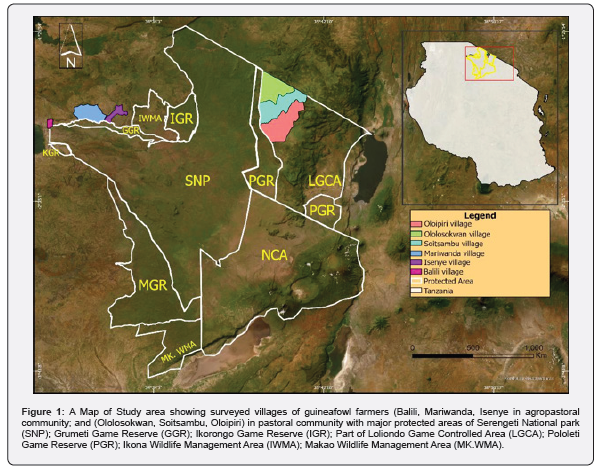
Geographically, Serengeti ecosystems lies between longitudes 1˚30'S - 3˚20'S and latitudes 34˚00'E - 5˚15'E [26]. The research was carried out in the northwest and east of the region where guineafowl farming occurs. The study areas include the selected parts of Serengeti National Park (SNP), Ikorongo - Grumeti Game Reserves (IGGR), Ikona Wildlife Management Area (IWMA), part of Loliondo Game Controlled Area (Loliondo GCA). and in villages found in the vicinity of these protected areas (Figure 1). Areas surrounding the ecosystem have common characteristics and are experiencing a high population growth who rely on agriculture and keeping of domestic animals as their important economic activity for the households [27,28]. Vegetation in the region Herlocker [29] is Savanna woodland, mainly covers a thorn woody plant community of Vachellia and Commiphora species. Grassland is largely dominate the vegetation in northern section with broad-leaved trees such as Combretum molle and Terminalia woodland. The climate is characterized by two rainfall pattern distribution across the study area, which starts mid-November until late May. Rainfall is approximately between 600-1,200 millimeters per year, while the mean monthly temperatures range from 270C and 190C respectively [30].
Study design and sampling procedures
A formal survey was conducted to investigate guineafowl farming practices in a sample of six villages selected including three agropastoral villages and three pastoral community bordering the protected areas. This was approved by village leaders who introduced the aims of the project to inhabitants of surveyed villages. Village registers provided by village leaders contained information on households that farmed guineafowl. A survey research design used purposive sampling include the collection of primary data required directly from households in each village [31-33]. A targeted study population is made up of agropastoral and pastoral communities with experience in rearing guineafowl. The semi-structured questionnaire was administered in surveyed villages, in each household and interviewed all keepers (31) selected. The status of farmed guineafowl population was assessed in three villages each from agropastoral and pastoral communities. Total number of survey households owned guineafowl (n = 27) were sampled in each village of Balili (n = 6), Mariwanda (n = 8), and Isenye (n = 13) for respondents to provide reliable answers based on their knowledge of farming practices. The villages (n = 3) of pastoral (Maasai) community, and total number of households (n = 4) were sampled at Soitsambu (n = 3), Oloipiri (n = 1) and Ololosokwan (n = 0) (Figure 1).
Information collected included the flock sizes, structure, sampled villages, guineafowl management practices, number of guineafowls reared, and marketing of guineafowls [7]. Hence, it became necessary during survey to collect detailed information on farming practices to verify if this human activity attracts further egg collection and live birds capture. Moreover, collection of eggs could be among of the key factor might influenced negatively reproduction success in the wild guineafowl population in areas of partial or no protection. Our analysis considered an approximation of the whole population on the performance of guineafowl farming includes the total number of 31 respondents to questionnaires interviewed in 6 villages.
Data analysis
The primary data was entered into Microsoft excel spreadsheet, values allocated to the appropriate codes and imported for analysis using statistical programme SPSS (version 16.0) Krstev [34]. Descriptive statistics was generated for describing the following: total farmed guineafowl population owned by interviewed farmers in the agropastoral and pastoral communities near protected areas boundary, flock sizes, structures, economic benefits to farmers such as income generated from selling of birds and eggs, birds captured and techniques employed, as well as potential market areas. Data were presented in frequency tables and percentages for simple comparisons of responses of individual households. Results were evaluated using Chi-square test (χ2), to establish statistical significance set at p ≤ 0.05. Number of farmers in village was computed to obtain results comparable between communities engaged in farming guineafowl. The total population of guineafowl in our study area estimated by summing the number of individuals in all villages studied.
Results
Total farmed helmeted guineafowl
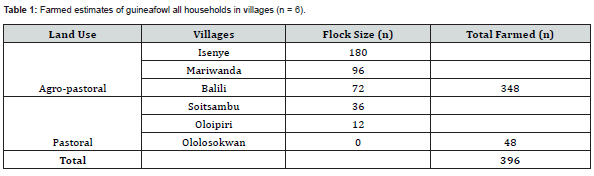
The study revealed that the population of guineafowl farmed in the study area was 396, of which 243 individuals were counted in agropastoral villages and remained 48 (birds) recorded in pastoral villages (Table 1).
Flock sizes and structure of farmed guineafowl.
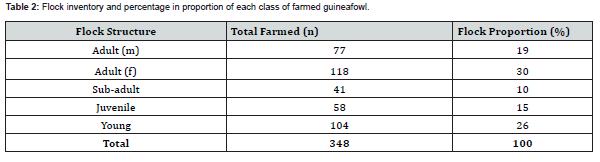
The flock sizes and structure were computed for total number of farmed guineafowl and composition of different age, sex categories and expressed as percentage in flock proportion (%) of class of farmed birds presented in (Table 2). Flocks varied with the highest proportion mainly composed of adult females 30 % (n = 118) while the proportion of Juvenile and sub-adult constituted only 15% (n = 58) and 10% (n = 41) respectively. Analysis of Chi-square test (ꭓ² = 37, df = 16, p< 0.002) found that the flock proportion of class of guineafowl being farmed in households significantly differed among communities in the study areas.
Economic benefits to farmers
During the course of the study, main reason given for the perceived economic benefits to farmers include: they kept as a source of food, household income, and for ornamental and sacrifice. Selling of farmed guineafowl and eggs was an important source for the household income. The largest proportion of the community in villages of agropastoral to the west of the Serengeti National Park (SNP) engaged more in selling the farmed guineafowl than pastoral to the east of the Serengeti National Park (SNP) (Table 3).
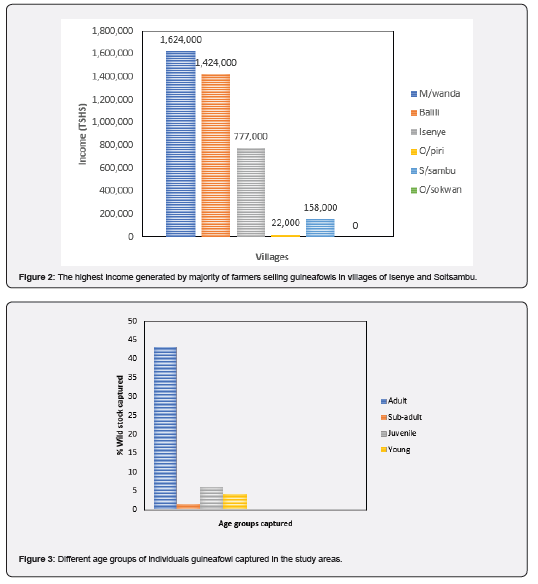
The total income generated by the sale of guineafowl was the highest in Isenye approximately (Tsh. 1,624,000.00) in the agropastoral area, and highest in Soitsambu (Tsh.158,000.00) in pastoral areas (Figure 2).
Illegal guineafowl capture and eggs collection
Illegal capture of wild guineafowl to provide food and income in the villages of agropastoral and pastoral was conducted mostly in Game reserve, buffer areas and grazing areas. The collection of eggs from wild guineafowl nests was reported to be higher in buffer areas, than in Game reserves and substantially lower elsewhere (Table 4). The farmers collected eggs from nest in the wild and reported to increase flock sizes in households through natural incubation methods and rearing of keets [6].
The age groups of wild stock guineafowls captured
Wild guineafowl due to its behavior or range were randomly captured on diverse habitat using various techniques in the study areas. Substantially more adult birds (43.1%) were captured than other age categories (Figure 3).
Wild guineafowl capture techniques
The results for wild guineafowl capture techniques (Table 5) in various location in the study area have revealed that series of noose tied on sticks (36.4%), and bamboo basket tied on sticks (21.2%) were the common frequently used by majority of respondents as non-invasive and efficient bird capture techniques. The least reported capture technique was hooked maize grain (3.0%).

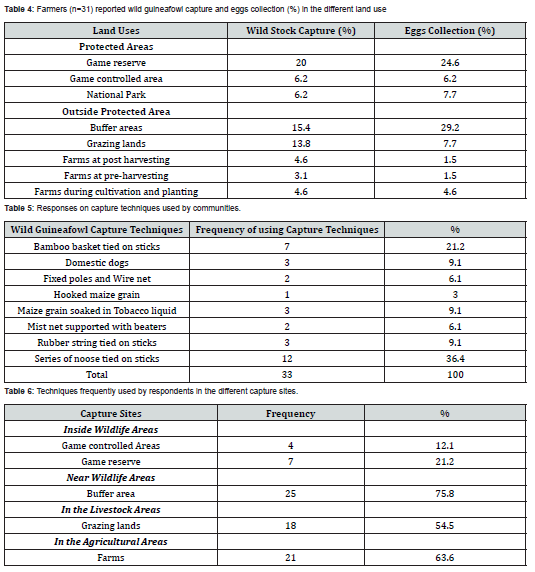
These techniques in capture sites were frequently used by respondents near wildlife areas (buffer area) 25%, in the agricultural (farms) 21%, and livestock areas (grazing lands) 18%). The least reported techniques were also used inside wildlife areas (Game controlled area 4%), and (Game reserve 7%) (Table 6).
Discussion
The main discussion of this paper is focused on farmed guineafowl, economic benefits and wild population illegal offtake in the vicinity of protected areas in Serengeti ecosystem. The studied guineafowl population in all surveyed villages to the west of the Serengeti National Park (SNP) is reared under smallholder, more extensive and provide more income than these practices provide to farmers in areas to the east of the Serengeti National Park (SNP). This observation confirmed that the dominance of agropastoral in the farming practices has more profitability of guineafowl production. This is not much different from findings by Baruwa & Sofoluwe [35] who reported that guineafowl production on relatively small scale is a profitable business and play a significant role in the social and cultural lives of farmers in Osun State, Nigeria. Our present study is supporting the evidence from tested hypothesis that the flock proportion of class of guineafowl being farmed in households differed and found higher in agropastoral communities. This variation may be attributed to factors of pastoral community (Maasai) not interested in farming practices as for them it could be primarily a secondary activity across villages in the eastern Serengeti.
These farming practices which utilize wild guineafowl revealed that communities acquired foundation stock mainly from captured individuals in the study areas and kept in the rural households. Furthermore, the results showed that eggs were collected from population in farms, grazing lands in the vicinity of wild conservation areas in the Serengeti region. This conforms to Gono [6] who observed that farmers collected eggs from the wild and hatch them using natural incubation methods to increase flock sizes. This study also revealed that the flock inventory of farmed guineafowl contained more adult female and young guineafowl than sub-adult and juvenile individuals. Hence the size and age structure of these farmed birds in agropastoral and pastoral farms differed (Table 2). The statistical significance of flock sizes of farmed guineafowl was probably due to higher proportion of adult females and young among households in all villages. Small flock size need not indicate that wild birds are infrequently caught, small flock size can also indicate high mortality in captive flock as reported in a recent study by Ebegbulem [36].
The information gathered by our study revealed that farmers mostly captured wild guineafowl to provide a source of food (both meat and eggs) and to generate income through the sale of birds, and that this practice provided economic benefits to farmers in the surveyed villages (Figure 2). Overall, these findings from our study are similar to those previously reported for farmers in Nasarawa State, Nigeria [37]. Pastoral community in the villages of Soitsambu and Oloipiri to the east of the Serengeti National Park (SNP) generates a small income from farmed guineafowl. According to the report of Nyariki et al. [38], traditionally the Maasai are pastoralists and they generate the majority of their household income from livestock. This study confirmed that income generated from sales of guineafowl was higher in the villages of Isenye, Balili and Mariwanda to the west of the Serengeti National Park (SNP) than in pastoral community in the surveyed villages of Soitsambu, Oloipiri and Ololosokwan to the east of the Serengeti National Park (SNP) where, lower number of birds sold was dominated by poor market.
From our results, agropastoral are key players in the value chain and the existing market performance of guineafowl in villages of western Serengeti ecosystem due to breeding stock and eggs sold to other farmers. This observation is in line with the report of Sinclair et al. [17] and Knight et al. [39] there is growing evidence that anthropogenic activities are linked to more effects on biodiversity within ecosystem. The findings of the study support the hypothesis that farming practices in agropastoral and pastoral communities is frequently operated at small scale, and farmers use opportunity to capture and collect eggs of wild guineafowl population near cultivated areas. This study also has shown that variety of techniques have been used by farmers for guineafowl captures in the area.
Our results suggest that wild guineafowl captured regularly in Game reserves adjacent to the Serengeti National Park (SNP) (Table 4). In the similar observation by Saina [5] large percent of breeding stock lay eggs in less disturbed habitats dominated by dense bush vegetation cover to avoid disturbances from predation. In addition, our results indicate that series of nooses and bamboo baskets tied on sticks were used to capture birds (Table 5). It has been observed the techniques used for capture wild guineafowl by farmers were reported higher near wildlife areas (buffer areas), agricultural (farms), and livestock areas (grazing lands) (Table 6). This plays an important role in the guineafowl’s farming strategy as reported in previous study by previous Njiforti [40] who revealed that nest loss was attributed to egg collection possibly by human.
By contrast, wild guineafowl eggs were more often collected in buffer areas than grazing lands and protected areas. The implication of this is that illegal off-take (i.e., collection of eggs and capture of bird) might have caused a population decline which is in line with findings reported by Ratcliffe & Crowe [20] and Jenkins et al. [41]. On the basis of these findings our study provides some insights that combined effects of human activities remain as critical threat to guineafowl populations adjacent protected areas of the Serengeti ecosystem. Other studies conducted elsewhere have provided understandings that illegal off-take rate has resulted to more ecological consequences and pressure on the population in wild environments [42].
Conclusion
This study highlights the guineafowl farming practices, and its interaction on wild population in agricultural and grazing landscape. Therefore, it is a concern that long-term anthropogenic pressures driven by human influences have negatively impacted the biodiversity in the agroecosystem. The communities observed that farming practices is profitable business and can significantly offer economic benefits for the households. Findings indicated farmed population of guineafowl differed between sites. There is considerable off-take of both eggs and birds from wild guineafowl in agropastoral and pastoral areas, and limited research on its effects remain underexplored. Furthermore, effective measures are needed to limit these effects both in the protected areas and areas surrounding the Serengeti ecosystem.
It was noted that buying and selling guineafowls and eggs collected from the wild were mainly sold at local markets and generated good profits. Whereas the captured wild stock in villages had similar importance on the integration of guineafowl farming practices into socio-economic livelihoods. However, this could have had a substantial effect on several nesting individuals, and expose them to higher risk of predation. In conclusion, growth of guineafowl production industry around Serengeti region revealed more potential for the community livelihood and its contribution to social values. Overall, respondents indicated that birds were mainly captured for economic benefits and social values. Consistent with the results of present study, these research gaps on illegal off-take, review of regulations and licenses of farming, and formal market structures for bird products are potential policy interventions that should rather be addressed. These contributes a starting point for further investigation in reducing impact on wild population and demonstrate considerably biodiversity conservation effort to increase the survival of eggs and nestlings in the areas adjacent Serengeti ecosystem.
Acknowledgement
I wish to thank Prof. Eivin Roskaft for facilitating availability of research from Norwegian University of Science and Technology (NTNU). I also thank Director General TAWIRI for granting research permission, field equipment and vehicle. Tanzania National Parks (TANAPA) and Tanzania Wildlife Authority (TAWA) are thanked for permission to conduct research in the Serengeti National Park, and Ikorongo - Grumeti Game Reserves. I also thank the District Executive Directors (Bunda, Serengeti, and Ngorongoro) for permission to work in the Game Controlled Area, Buffer areas and villages in western and eastern Serengeti. I thank Prof. Shombe N. Hassan, Dr. Robert Byamungu from Sokoine University of Agriculture, Department of Wildlife Management for their comments, inputs and important discussions. Rahabu E. Makongoro and Damian Nguma TAWIRI staff for supporting GIS shape files, Ardgard E. Mwamgeni (UDSM) for preparation of GIS map of the study area.
References
- Urban EK, Fry CH, Keith S (1986) The Birds of Africa, Game Birds to Pigeons (Birds of Africa) II: 8-11. Princeton University Press ISBN 10: 0121373029/ISBN 13: 9780121373023.
- Crowe TM (1978) The evolution of guinea-fowl (Galliformes, Phasianidae, Numidinae) taxonomy, phylogeny, speciation and biogeography.
- Walker AL, Ratcliffe CS, Bowie RCK, Crowe TM (2000) Fowl Play: Molecular evidence of interbreeding between wild and feral domestic Helmeted Guineafowl (Numida meleagris). MSc Thesis, Percy Fitz Patrick Institute, University of Cape Town, Rondebosch, South Africa.
- Gandiwa E (2011) Preliminary assessment of illegal hunting by communities adjacent to the northern Gonarezhou National Park, Zimbabwe. Tropical Conservation Science4(4): 445-467.
- Saina H (2005) Guinea fowl (Numidia meleagris) production under smallholder farmer management in Guruve District, Zimbabwe. Master of Philosophy Thesis.
- Gono RK, Svinurai W, Muzvondiwa JV (2013) Constraints and Opportunities to Guinea Fowl Production in Zimbabwe: A Case Study of the Midlands Province, Zimbabwe. International Journal of Science and Research (IJSR) 2(3): 236-239.
- Abdul-Rahman II, Adu YE (2017) The role of the rural farmer in guinea fowl (Numida Meleagris) value chain, a case study of the Tolon district. Livestock Research for Rural Development 29(4): 1-13.
- Jacop J, Pecastore T (2011) Keeping Guinea Fowl. Agricultural and Natural Resources-Family and Consumer Sciences-4 Youth Development-Community and Economic Development.
- Ngongolo K, Mtoka S (2013) Biodiversity conservation in inhabited area; what can helmeted guinea fowl (Numida meleagris: Numididae) domestication offer in socio-economic development and wildlife conservation. African Journal of Poultry Farming2(5)
- Zimi A (2013) Assessment of the Potential of Agricultural Extension Delivery on Guinea Fowl (Numidea meleagris) Production by Small Scale Farmers in the Upper East Region of Ghana, Doctoral dissertation, University of Ghana.
- FAO (2014) Poultry Sector Ghana. FAO Animal Production and Health Livestock Country Reviews No. 6. FAO, Rome.
- Issaka BY, Yeboah RN (2016) Socio-economic attributes of guinea fowl production in two districts in Northern Ghana. African Journal of Agricultural Research11(14): 1209-1217.
- Abdul-Rahman II, Angsongna CB, Baba H (2019) Guinea fowl (Numida meliagris) value chain: preferences and constraints of consumers. African Journal of Food, Agriculture, Nutrition and Development19(2): 14393-14414
- Nasir A, Oluwaseun, AO (2026) Guineafowl Production in Africa: Economic Importance and Constraints. Egyptian Journal of Veterinary Sciences 57(2): 244-258.
- Rahman SF, Baccouri W, Wanjala G (2025) A systematic review of guinea fowl diversity and its economic, socio-cultural and ecological significance in Africa. Tropical Animal Health and Production57(463).
- Ratcliffe CS, Crowe TM (2001) The effects of agriculture and the availability of edge habitat on populations of Helmeted Guineafowl (Numida meleagris) and on the diversity and composition of associated bird assemblages in KwaZulu-Natal province, South Africa. Biodiversity and Conservation10(12): 2109-2127.
- Sinclair ARE, Mduma SA, Arcese P (2002) Protected areas as biodiversity benchmarks for human impact: agriculture and the Serengeti avifauna. Proceedings of the Royal Society of London. Series B: Biological Sciences269(1508): 2401-2405.
- Hendershot JN, Smith JR, Anderson CB, Letten AD, Frishkoff LO, Zook JR, Daily GC et al. (2020) Intensive farming drives long-term shifts in avian community composition. Nature579(7799): 393-396.
- Boldescu A (2024) Urmările prejudiciabile în cazul infracțiunii de vânat ilegal. In Traditie şi inovare în cercetarea ştiinţifică, pp. 59-63.
- Ratcliffe CS, Crowe TM (2001) Declining populations of Helmeted Guineafowl in the midlands of KwaZulu-Natal, South Africa: A review of causes and remedies. South African Journal of Wildlife Research 31(3 & 4): 161-171.
- Ratcliffe CS, Crowe TM (2001) Habitat utilisation and home range size of Helmeted Guineafowl (Numida meleagris) in the midlands of KwaZulu-Natal province, South Africa. Biological Conservation98(3): 333-345.
- Veldhuis MP, Ritchie ME, Ogutu JO, Morrison TA, Beale CM, et al. (2019) Cross-boundary human impacts compromise the Serengeti-Mara ecosystem. Science363(6434): 1424-1428.
- Brawn JD, Robinson SK, Thompson FR (2001) The role of disturbance in the ecology and conservation of birds.Annual review of Ecology and Systematics 32(1): 251-276.
- Scharlemann JP, Green RE, Balmford A (2004) Land‐use trends in endemic bird areas: Global expansion of agriculture in areas of high conservation value. Global Change Biology10(12): 2046-2051.
- Oni FL, Oyeleye DO, Farinloye KF. Ojediran TK (2025) Population Status and Conservation Challenges of Wild Guinea Fowl in Nigeria: A Review. Biological and Environmental Sciences Journal for the Tropics 22 (1): 134-142.
- Mligo C (2015) Plant species composition and distribution in relation to land use patterns in serengeti ecosystem Tanzania. Open Journal of Forestry 5: 607-620.
- Estes AB, Kuemmerle T, Kushnir H, Radeloff VC, Shugart HH, et al. (2012) Land-cover change and human population trends in the greater Serengeti ecosystem from 1984–2003. Biological Conservation147(1): 255-263.
- Fyumagwa R, Gereta E, Hassan S, Kideghesho JR, Kohi EM, et al. (2013) Roads as a threat to the Serengeti ecosystem. Conservation Biology27(5): 1122-1125.
- Herlocker DJ (1974) Woody vegetation of the Serengeti National Park. Caesar Kleberg Research Program in Wildlife Ecology and Department of Range Science (Vol. 1Texas A & M University System).
- Sinclair ARE, Norton-Griffiths M (Eds.) (1979) Serengeti: dynamics of an ecosystem. University of Chicago Press.
- Yin RK (2003) Case study research: Design and methods(Vol. 5).
- Glasgow PA (2005) Fundamentals of survey research.
- Kwesi V, Ogada S, Kuria S, Oyier P, Malaki P, et al. (2022) Factors affecting production and market performance of Guinea fowls and Quails in Kenya. Journal of Agriculture, Science and Technology21(1): 37-42.
- Krstev D (2019) Using SPSS for Research and Data Analysis. Knowledge International Journal
- Baruwa OI, Sofoluwe NA (2016) Profitability and resource use efficiency of guinea fowl (Numida meleagris) production under tropical conditions. Journal of Livestock Science 7: 97-106.
- Ebegbulem VN (2018) Prospects and challenges to guinea fowl (Numida meleagris) production in Nigeria. International Journal of Avian and Wildlife Biology3(3): 182-184.
- Yakubu A, Musa-Azara IS, Haruna HS (2014) Village guinea fowl (Numidia meleagris) production systems in Nasarawa State, north central Nigeria: flock characteristics, husbandry and productivity. Livestock Research for Rural Development26(3): 26041.
- Nyariki DM, Mwang'ombe AW, Thompson DM (2009) Land-use change and livestock production challenges in an integrated system: the Masai-Mara ecosystem, Kenya. Journal of Human Ecology 26(3): 163-173.
- Knight EC, Mahony NA, Green DJ (2016) Effects of agricultural fragmentation on the bird community in sagebrush shrubsteppe. Agriculture, Ecosystems and Environment223: 278-288.
- Njiforti HL (1997) The breeding performance of wild helmeted guineafowl (Numida meleagris galeata Pallas) in the Waza National Park, North Cameroon. Revue d'écologie52(2): 173-186.
- Jenkins HM, Mammides C, Keane A (2017) Exploring differences in stakeholders’ perceptions of illegal bird trapping in Cyprus. Journal of ethnobiology and ethnomedicine13(1): 67.
- Katzner TE, Carlisle JD, Poessel SA, Thomason EC, Pauli BP, et al. (2020) Illegal killing of nongame wildlife and recreational shooting in conservation areas. Conservation Science and Practice2(11): e279.

























