




 IJESNR Home



Abstract
Keywords:Atmosphere; Mountain ranges; Biogeography; Coastal forests; Biodiversity; Tourism, Ecosystems
Opinion
The study of sacred sites and cultural-natural heritage is characteristic of many countries, reflecting certain common trends occurring in the modern world. For Kazakhstan, this issue is determined by real processes that have characterized the spiritual culture in recent years.
The territory of Kazakhstan is rich in natural, historical, and cultural objects that belong to the category of sacred or holy sites.
The Latin-Russian dictionary defines a range of meanings for this word (sacri): dedicated, intended, sacred, holy, inspiring respect, great, magical, mysterious, cursed, etc. [1]. The status of sacredness applies to mountains and rivers, the ruins of ancient structures, and monuments of cultural, historical, and natural heritage. Sacred sites are especially revered objects of natural and cultural heritage that hold significance in the memory of the people.
Each era leaves its mark, which is reflected in cultural and natural layers and presents interest for tourism and specially protected areas. World-renowned sacred sites include Stonehenge, the Nazca Desert, and Mount Fuji. The Five Great Mountains or Wuyue are located according to the five cardinal directions in Chinese geomancy, which includes the center as a direction. Altai and Katon-Karagai are areas of study.
The sparsely populated Altai mountains possess an atmosphere of permanence and inaccessibility, which conceals the ecological fragility inherent to all high mountain ranges in the world.
The Altai mountains cover an area of 600,000 square kilometers across Russia, Mongolia, Kazakhstan, and China (see Figure 1), reaching heights of 4,500 meters above sea level and including numerous peaks over 4,000 meters. They are home to more than 75 species of mammals and 2,000 species of wild plants, inhabiting a wide range of habitat types, from the alpine zone through scattered high-altitude forests and mountain steppes to lowland deserts and rare coastal forests in the valleys. The wild and domesticated species of the Altai Mountains, along with the various ecosystems in which they reside, contribute to the region’s biodiversity—a unique combination of natural values that is an indispensable product of natural selection, biogeography, and local history, as well as utilitarian values for sustaining human life today and in the future [2].
Boundary Description: The Katon-Karagay State National Natural Park is located in the upper reaches of the Bukhtarma, Belaya, and Chernaya Berel rivers, including the southern slopes of the Listvyaga and Katun ranges (with the eastern peak of Mount Elbrus), as well as the left-bank ridges of the Bukhtarma River: Sarymsakty, Tarbagatai (Southern Altai), and Southern Altai. The northern part includes a portion of the Katun Range.
On the north and east, it borders Russia (Altai Republic); on the southeast, it borders the People’s Republic of China; the western border runs along the Farpusnaya (Shurshutsa) River, adjacent to the Bolshenarymsky Forestry; the southern border runs along the Temir-Kaba River, along the border of the Muz-Bel Forestry of the Shingystai Forestry and along the administrative border of the Katon-Karagay and Kurchum districts, going southeast to the border with China.
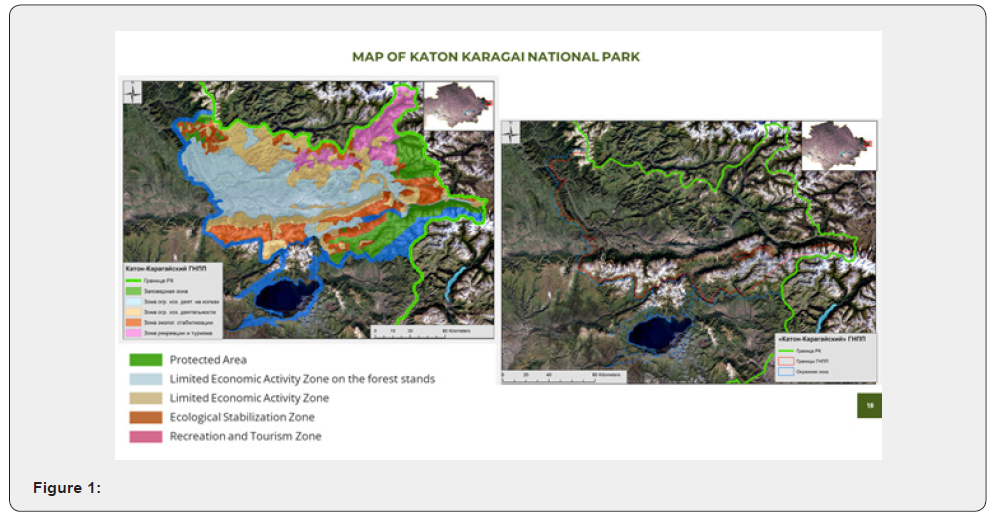
The park is located in the ecoregions of the Altai alpine meadows and tundra and the Altai steppe and semi-desert. These ecoregions represent all zones of high-altitude vegetation from steppes to alpine tundra. The ecoregions are characterized by very high diversity, as they are located on the biogeographical border between Siberia to the north and the cold deserts of Central Asia to the south. The vegetation is distributed into four altitudinal zones.
In the nival zone, at altitudes of 2800 meters and above, small communities of lichens and alpine vegetation grow in crevices and on rocky edges of snowfields and glaciers, including snow primrose and Altai buttercup.
The mountain tundra belt extends from 2100 to 2800 meters. Here, mosses and lichens can be found on the rocks, as well as shrubs and herbaceous tundras, including Altai fescue and honeysuckle.
The zone of subalpine forests and mountain meadows extends from 1200 to 2300 meters. The most common trees are Siberian cedar, larch, and birch. Grasses, sedges, and blueberries grow in the meadows.
Below 1200 meters is the mountain forest and meadowsteppe zone. At this level, birch and larch-aspen forests are located, as well as widespread grasses and shrubs.
Scientists have recorded 300 bird species, 69 mammal species, 6 reptile species, 3 amphibian species, and 17 fish species in the park (2022). [Katon-Karagay National Park Katon-Karagay National Park - Wikipedia] [Proceedings of the Katon-Karagay State National Natural Park. Publishing house “Media-Alliance.” Ust-Kamenogorsk, 2022. - 498 p.].
Today, the Katon-Karagay State National Natural Park holds two international statuses: UNESCO Biosphere Reserve “Katon- Karagay” and the transboundary biosphere reserve “Great Altai,” created on the basis of the BR “Katon-Karagay” (Kazakhstan) and the Katun Biosphere Reserve (Russia). Since 2019, it has been included in the International League of Protected Article 4 “The Statutory Framework of the World Network of Biosphere Reserves” UNESCO, defines the general criteria for designating an area as a biosphere reserve as follows:
1. It should encompass a mosaic of ecological systems
representative of major biogeographic regions, including a
gradation of human interventions.
2. It should be of significance for biological diversity
conservation.
3. It should provide an opportunity to explore and
demonstrate approaches to sustainable development on a
regional scale.
4. It should be of an appropriate size to serve the three
functions of biosphere reserves – conservation, development, and
logistic support.
5. It should include these functions through appropriate
zoning, recognizing core, buffer and outer transition areas.
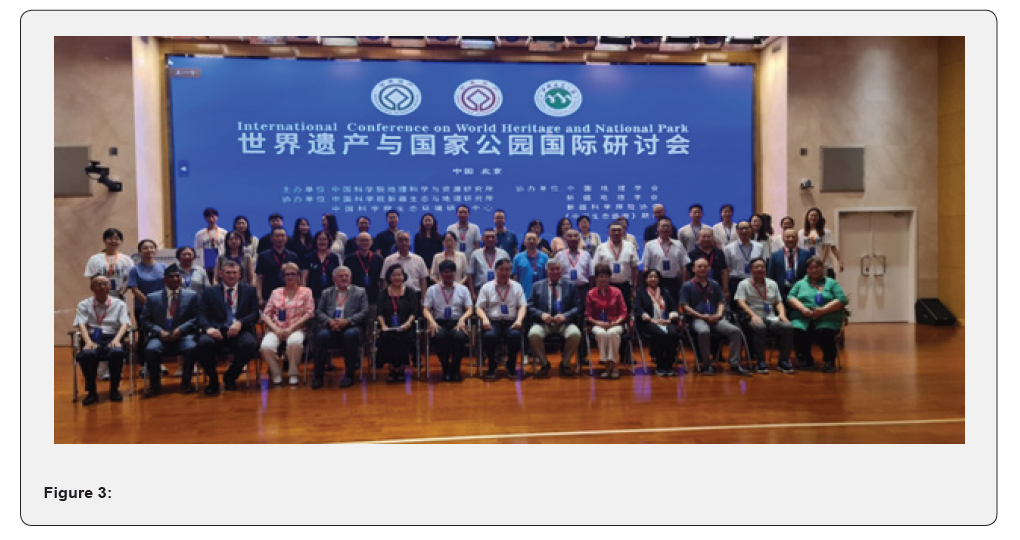
From July 30th to August 9th, 2024, the Xinjiang Institute of Ecology and Geography of the Chinese Academy of Sciences and the Institute of Geographic Sciences and Natural Resources Research of the Chinese Academy of Sciences held the “International Symposium on World Heritage and Natural Parks” (ISWHNP) in Beijing. Professor O.B. Mazbayev’s presentation was titled “The Ecological, Cultural, and Landscape Value of the Katon-Karagay National Park in Kazakhstan.”
The study of sacred places, cultural and natural heritage is typical for many countries, which indicates a certain commonality of trends occurring in the modern world. For Kazakhstan, this issue is caused by real processes that are characteristic of the spiritual culture of recent years associated with the ecological and cultural landscape. The territory of Kazakhstan is rich in natural, natural and cultural objects that are related to the category of sacred or holy places. Each era leaves its mark, which is found in the cultural and natural layers and is of interest to tourism and specially protected areas. The sparsely populated area of the Altai Mountains has an atmosphere of constancy and inaccessibility that masks the ecological fragility inherent in all high mountain ranges of the world.
Katon-Karagay National Park is located on the territory of Eastern Kazakhstan. This is one of the most picturesque and ecologically significant natural protected areas in the Altai Mountains region. “Katon-Karagay National Park was created by the Decree of the Government of the Republic of Kazakhstan No. 970 dated July 17, 2001 “On the establishment of the Katon- Karagay State National Natural Park”.
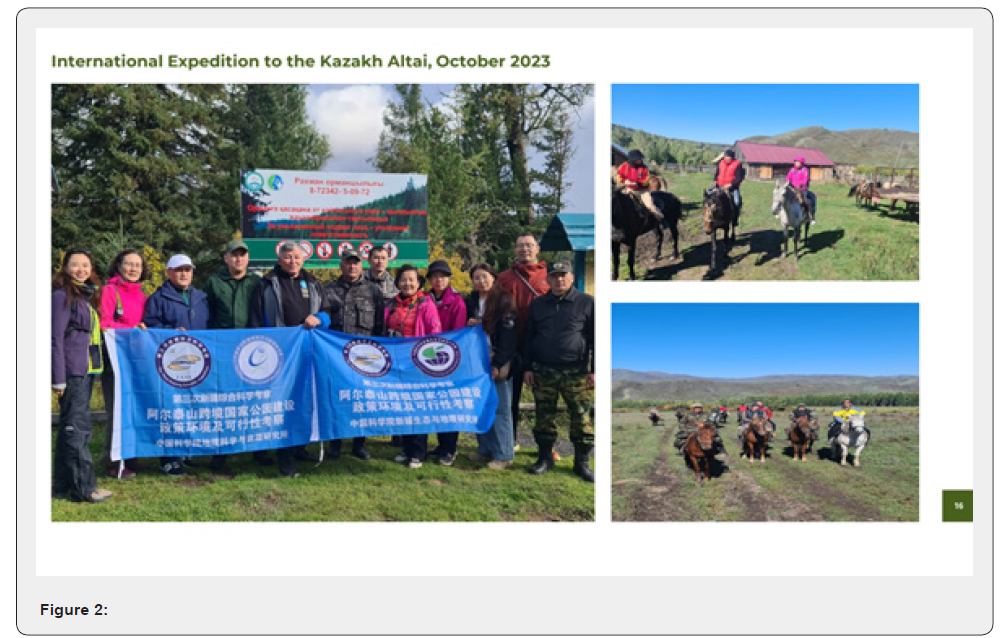
In 2014, the park was included in the UNESCO List of Specially Protected Heritage (Figure 2).
International scientific expedition Kazakhstan –China. Altai 2024 August
The purpose of my speech at this forum is to open a Large Altai bioreserve in Altai with the participation of four countries (Figure 3).
References
- (1976) Latin-Russian Dictionary. Moscow, 891.
- The Altai Mountains Biodiversity Conservation Strategy.

























