




 IJESNR Home



Abstract
The olive tree, a species of Mediterranean flora, has been an object of study for scientists since ancient times. The introduction of olives, as a species resistant to both drought and salinity, has become widespread in Azerbaijan, especially on the Absheron Peninsula. Olive groves have been established on hectares of land, and suburban areas have been greened. At the Dendrology Institute of the Ministry of Science and Education of Azerbaijan, the growth and development of 7-10-year-old seedlings of the European olive (Olea europaea L.) were studied under the influence of environmental factors. The species studied are recommended for use in landscape architecture, as well as for valuable products in the food and pharmaceutical industries.
Keywords:Environmental factors; Olea Europae L.; Growth and development
Introduction
The genus Olea L. of the Oleaceae Lindl. family includes 32 species. These are evergreen small trees or shrubs. Its natural habitat is Asia, Mediterranean countries, India, Australia, Africa, New Zealand, and other countries where it forms natural vegetation. Two of these species are cultivated in botanical gardens in Crimea, the Caucasus, and Central Asia.
The European olive (Olea europaea L.) is a tree-like plant with a height of 4–6, or sometimes 10–12 meters, and various umbrella-like forms. It is most commonly found in tropical and subtropical regions such as Australia, Mediterranean countries, and the tropical parts of the Asian continent. Its canopy diameter can reach 2 meters [1,2]. The leaves are entire, 3-8cm long and 1-5cm wide (4, pp. 127-128). The upper part of the leaves is a matte green, while the bottom is a shiny silver, and the edges are curled. In winter, starch accumulates in the leaf epidermis. Olea europaea L. leaves remain on the tree for 2–3 years before falling.
Results and Discussion
One of the most widely used and industrially significant tree species for landscaping all areas of the Absheron Peninsula belongs to the Oleaceae Hoffmgg et. Link family. The olive can be considered a classic or universal species, as it’s resistant to the dry subtropical climate of these areas, as well as to salinity, high temperatures, drought, and wind. This evergreen species, which adapts quickly to critical environmental conditions, is one of the ancient plants introduced to Absheron. Olive species, which are valuable industrial plants, are also at the forefront due to their nutritional significance.
Two main types of olives—European (Olea europaea L.) and African or wild olive (Olea verrucosa L.)—have been widely introduced and distributed in many countries around the world, and they have been widely used on the Absheron Peninsula for many years for both industrial and landscaping purposes. The oil obtained from its fruits and the preserved products made for food purposes are widely used.
The species of the Oleaceae Hoffmgg et. Link family require careful study from a biological perspective. During the research, seeds obtained from mature specimens of these species had a high germination rate, and vegetative propagation from young cuttings was also possible. It is more effective to create most of the seedlings used in landscaping from vegetative organs. In this case, 5–7-year-old seedlings begin to bear fruit, making them very suitable for planting olive groves. The fruiting period for seedlings grown from seeds -The main goal of our research was to study the resistance of olive varieties to changing environmental factors under Absheron conditions. The germination of mature European olive (Olea europaea L.) seeds is 80–92%, and its rapid growth makes it suitable for widespread use in landscaping work with 3–5-year-old seedlings. Since this species takes 8–10 years to reach the reproductive stage, it is very convenient for large-scale use in horticulture.
Although the germination of African olive (Olea verrucosa L.) seeds is 70-75%, the decorative value of the species with its dark green and evergreen leaves further enhances its appearance. The fact that this species reaches the productive stage at the age of 10–12, combined with its high yield, is notable. It is also important that these varieties, in addition to being resistant to the arid conditions, saline soils, and high temperatures of the Absheron Peninsula, also show high resistance to technogenically polluted soils and weather conditions. The xeromorphic structure of the plant’s leaves, the thick waxy coating on the leaves, and the dense and sparse hairs make it resistant to prolonged stress from all environmental factors [4,5].
The rapid adaptation of olive trees to the conditions of Absheron is explained by their proximity to the climate of their homeland, the Mediterranean countries. This idea is also confirmed by soil and air temperature indicators. At a soil temperature of 20.5-20.8°C and an air temperature of 23.7-23.0°C, the height of young shoots is 32.0-30.3sm and 30.1-30.3sm, respectively. The number of leaves on these shoots ranges from 34 to 38, and the leaf length is from 2.8 to 3.1sm (Table 1)
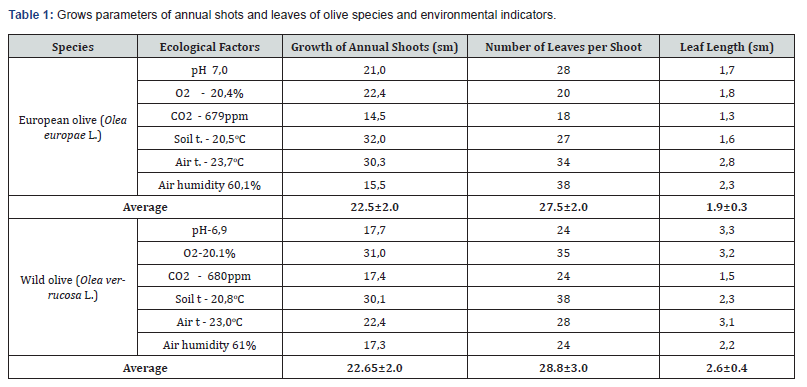
Thanks to all the above characteristics, olive varieties easily adapt to the ecological conditions of the Absheron Peninsula. This is why in the dry subtropical climate of Absheron, it is advisable to propagate and grow evergreen olives in accordance with green architecture [6]. On the other hand, the fact that the leaf organ is equipped with a hard epidermis and a thin hairy covering makes it one of the main plants selected for landscaping industrial enterprises. The olive tree is highly selective with respect to toxic pollutants present in the air and soil and is considered a highly resistant plant because it incorporates toxic substances into its metabolic process.
During the research, it was found that while pine species were selected based on the principle of facultative resistance to drought, salt tolerance, etc., olive, plane tree, and immortelle species are resistant by nature. It should probably be noted that the planting principle for landscaping the Absheron Peninsula needs some adjustment, as olive and pine varieties were planted alternately in rows. However, since pine species develop vertically due to light, olive species are constantly shaded and deprived of the opportunity to branch out, so the tree’s crown becomes compressed and lags in development (in areas such as Mardakan, Shuvelan, etc.).
However, pine species should be planted in rows at a distance of 3–4 meters, cypress species in groups, olive species in mass plantings, and evergreen and deciduous shrubs should be planted in dense rows along borders to form a green strip. The species used in landscaping the Absheron Peninsula differ from each other, showing different degrees of resistance to environmental factors (5, p. 210; 6, p. 132). Over the past 10 years, the number of exotic plant species imported from foreign countries for landscaping Baku and the Absheron Peninsula has increased significantly. Now, in most green areas of our cities, tropical and subtropical plant species have become significantly more complex in terms of numbers and species composition. Such green areas, which are economically costly, are not durable. Since the dry and hot summer days of Absheron become critical conditions for them, most species cannot withstand such stress and die.
Extensive Research and Analytical Studies have Led to the Following Conclusions
a) Olive varieties are resistant to soil and air drought,
which are environmental factors.
b) Olive plants develop quickly when the soil pH is
neutral.
c) When the levels of oxygen and carbon dioxide in the
air are close to normal, the process of photosynthesis in the leaves
is at its maximum level.
d) Since olives adapt quickly to the dry subtropical
climate of the Absheron Peninsula and are resistant to external
environmental factors, they are recommended for use in landscape
and park architecture..
References
- AM Askerov (2006) Higher plants of Azerbaijan. I, II "Nauka" 2004.
- F Guliev Oliva (2007) Olive tree (Olea europae) МВМ Baku, 2007. С.70.
- NI Aliyev (1998) Medicinal plants and phytotherapy in Azerbaijan. Baku, Science 346: 4.
- TS Mammadov (2010) Trees and bushes of Absheron. Nauka and education, С.468.
- TS Mammadov (2016) Dendroflora of Azerbaijan - Baku: Science, T. III. 2016, С. 400.
- Yu S Zhigorevich Oliva (1990) Baku. "Azerneshr", С. 235.

























