




 IJESNR Home



Abstract
An overview of the development directions of Seebeck and Nernst thermoelectric converters was conducted. An analysis of the physical mechanisms of the Seebeck and Nernst effects in various materials was carried out, and the efficiency of thermoelectric converters based on them was considered. It is shown that nanocomposite nanodisperse structures and nanoscale powders and multilayer nanofilms are currently the most promising material for the development of thermoelectric sources of electrical energy based on them.
Keywords:Seebeck and Nerst effects; Thermoelectric converters; Nanocomposite materials
Opinion
The problem of increasing the efficiency of existing energy sources, the search and development of new methods for energy production is one of the most actual tasks in the energy industry. Now, the most widely used is electrical energy. On an industrial level, electrical energy is obtained by nuclear, thermal, wind and hydroelectric power stations. The production of electricity by solar modules, which are considered the most ecologically clean sources of energy, is developing at a rapid pace. However, solar energy has drawbacks, the reason for which is the rather large area of solar power plants and the rather strong dependence of their efficiency on illumination and the geographical latitude and climate of their location. One of the promising methods for obtaining of ecologically clean electrical energy is generation using the Seebeck and Nerst thermoelectric effects. These effects describe the appearance of an electric field in materials when a temperature gradient occurs in them. Thermoelectric converters of this type can use natural heat sources or waste heat from industrial production. The advantage of energy sources that would be built on these principles is that Seebeck and Nerst thermoelectric converters do not contain moving details, these converters are reliable, fast-acting, silent, thermal stable and have very large lifetime values.
Current thermoelectric power systems designed for applications on different scales mostly use Seebeck effect. Their power output ranges from microwatts to several kilowatts in commercial applications. The most efficient materials for thermoelectric generation are semiconductors with large Seebeck coefficient, and low thermal conductivity. The highest values of Seebeck coefficients (S) are registered in semiconductor single crystals (Pb03Ge37Se69 - S=1570μV/K ). In metals, the concentration of conduction electrons depends very small on temperature, and the values of the Seebeck coefficients are not much smaller (Ni - S=-15μV/K, Bi – S=-72μV/K). Good results in the production of thermoelectric energy sources have been obtained using rare earth metals, but they are also expensive [1].
The efficiency of electric field generation in the material due to the Seebeck effect is characterized by the value of the thermoelectric factor ZТ [2].

Here σ and χ are the specific electrical conductivity and specific thermal conductivity, S are the values of the Seebeck coefficient, kB is the Boltzmann constant, h is the Planck constant, e and m*are the charge and effective mass of the electron, and T is the temperature. The possibility of practical use of the Seebeck effect strongly depends on the material. High values of ZТ ∼ 1 are obtained in materials such as alkali metal oxides, barium-cobalt oxide. The most promising material from the point of view of practical using in thermoelectric converters today are nanostructured materials and multilayer nanocomposite films in which they are obtained [3] high values of ZТ and high values of the Seebeck coefficient S ≈200 μV/K. Higher values of the Seebeck coefficient are obtained in nanocomposite heterogeneous films and nanopowder materials. Thus, in multilayer PbTe/PbSe (10/10nm) films, the absolute value of the Seebeck coefficient increases significantly when additional inhomogeneities are introduced into the film structure and reaches values of |S|=600μV/K. And in MnO2 nanopowders, record high values of the Seebeck coefficient were obtained, where this coefficient reaches the value of S≈20 000μV/K [4]. In the magnetic metal/nonmagnetic nanofilm composite structures, in which there is a strong spin-orbit interaction, in contrast to the classical longitudinal Seebeck effect, the transverse spin Seebeck effect can be observed. In such structures, by changing the direction of the magnetic moment of the magnetic metal, the magnitude and sign of the Seebeck electric field can be changed [5].
Summarizing the review, it can be said that the Seebeck effect was mainly studied in single-crystalline materials. It was poorly studied in nanostructured and non-composite materials and practically not studied in amorphous materials, although these materials have a lower thermal conductivity compared to crystalline materials, and there are promising to create thermoelectric Seebeck converters. Therefore, the transition to composite nanostructured and amorphous materials will allow the development of effective thermoelectric converters based on the Seebeck effect, which can be used in ecologically clean energy generation.
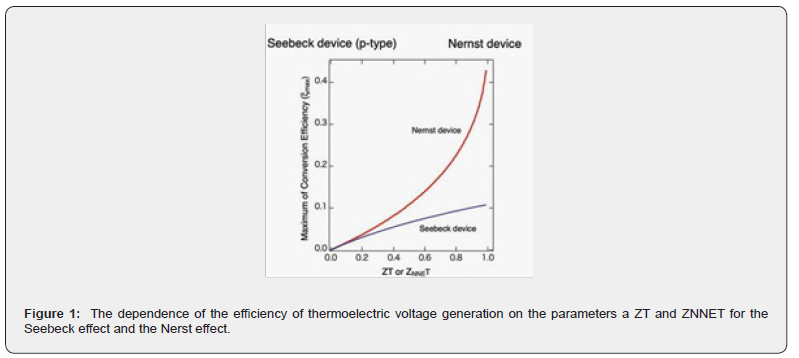
Although the Nernst effect (ANE), unlike the Seebeck thermoelectric effect, is realized in a magnetic field, it is nevertheless more promising for practical use. Firstly, the Nernst effect makes it possible to create energy converters from a heat source of various shapes. Secondly, the heat reservoir in the Nernst effect device can be installed separately from the electrical unit. Thirdly, unlike devices based on the Seebeck effect, it uses only one and not two different p -materials and n -materials. The crucial difference between these effects is that the Nernst effect is a transverse effect, while the Seebeck effect is longitudinal. This difference does not affect the design features of thermoconverters based on them, but gives advantages to Nerst thermoconverters. The temperature difference in both devices creates an electromotive force and an electric current Jc. In Seebeck thermoconverters, the thermal current caused by such a useful current Jc flows in the same direction as the temperature gradient from the hot to the cold side. Therefore, this thermal current transfers heat, and thus reduces the efficiency of the heat exchanger. In Nernst thermoconverters, Jc causes a thermal current from the cold side to the hot side, which increases the efficiency of their operation. The calculated value of the maximum efficiency ξmax [6] for both devices as a function of the Q is shown in Figure 1, where the Q for the Nernst effect is defined as:
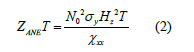
Here N0 is the Nerst coefficient σ and χ - specific electrical conductivity and specific thermal conductivity, Т - temperature.
If the material of the conductor has spontaneous magnetization, then in addition to the normal Nernst effect, an anomalous Nernst effect may occur in it, which is due to the action of the internal magnetic field. The magnitude of the total electric field E , which arises in a nonuniformly heated magnetic conductor under the action of the magnetic field H, is described as

Here ENE, EANE, N0, Ns, μ0 and Ms refer to the normal Nernst electric field vector, the anomalous Nernst electric field vector, the Nernst coefficient, the anomalous Nernst coefficient, the vacuum permeability, and the magnetization vector, respectively. The anomalous Nernst effect (ANE), one of the thermoelectric effects in a magnetic metarials, has recently attracted increasing interest due to its potential to generate electrical energy. The normal Nernst effect is proportional to H, and a sufficient magnetic field is required for thermoelectric conversion. Among the materials, a significant Nernst effect was observed in multilayer structures of Pt/Fe, Au/Fe, and Cu/Fe, in the magnetic semiconductor Ga1- xMnxAs ANE is spontaneous at zero field and, in principle, is proportional to the saturation magnetization. Therefore, when using magnetic materials with large values of the vector of anomalous Nernst coefficient Qs and the vector of magnetization Ms, it is possible to obtain the electric field vector E of Nernst without an external magnetic field. However, in most of the registered efficiencies of thermoelectric conversion with ANE are small, which complicates its practical application. Therefore, the search for new materials with high values of anomalous Nernst coefficient is one of the most important, and most recent scientific works are devoted to this.
Latter experimental and theoretical studies have shown that the ANE originates from a fictitious field (Berry curvature) in the momentum space in magnets and can be particularly enhanced when the Weyl points are tuned to be close to the Fermi energy [7,8]. The gigantic magnitudes of this effect in Heisler alloys can be easily predicted by calculating the electronic structure based on the presence of Weyl points, which serve as a kind of Berry curvature concentrators. This topological feature is responsible for the gigantic magnitudes of Nernst and Hall effects in Heisler alloys [9]. Due to the features of the electronic structure, in particular, the significant value of Berry curvature, giant values of Nernst effects can be observed in antiferromagnets [10]. Results of stude show that the concentration of the Berry phase in an antiferromagnet can significantly increase the ANE. However, ANE in antiferromagnets is still largely unstudied, partly because ANE was thought not to exist. Although a joint research team from the Max Planck Institute for Chemical Physics of Solids in Dresden discovered a large anomalous Nernst effect. They obtained an ANE in YbMnBi2 of 6mV/K [11], a record value for antiferromagnets, close to the ANE value in the best ferromagnets. The high value of ANE is explained by the influence of crystal topology, high spin-orbit coupling and complex and uncompensated magnetic structure of YbMnBi2. The skewed spin structure in YbMnBi2 breaks the time-reversal symmetry and provides a non-zero Berry curvature. At the same time, the large spin-orbit coupling of the heavy element bismuth contributes to the creation of a large external contribution. It shows a way to obtain high ANE values in some antiferromagnets with non-collinear spin structure and large spin-orbit coupling. An interesting method for obtaining of high ANE values was shown experimentally in the Co2MnGa alloy. A large anomalous Nernst coefficient is achieved for a polycrystalline Co2MnGa/AlN multilayer film deposited on an amorphous substrate, which is higher than 3.8μV/. The enhancement of ANE is explained by the effect of interfacial strain on the Seebeck coefficient, which is almost negligible. This opens avenues for search and provides the prospect of obtaining a significant increase in ANE [12]. In La0.5Sr0.5CoO3, the Nerst thermomagnetic transformation coefficient at a temperature below the Curie temperature reaches values of 0.21μV/K at 180 K for H=50 kOe. In Co2MnGa nanopowders, even higher values of the thermomagnetic Nerst transformation coefficient of ~6.0μV/K were obtained. In amorphous magnetic materials, the anomalous Nerst effect has practically not been studied. It shows that the study of the Nerst effect in polycrystalline nanodisperse and amorphous magnetic materials has not only a scientific novelty, but also a good prospect of practical using in the construction of efficient and thermoelectric electric field sources [13].
In practice, the Hall effect is used mainly for the creating of various magnetic field sensors and non-contact control elements. The widespread use of magnetic field sensors is caused, first of all, by the fact that a low-frequency magnetic field is very weakly absorbed by non-magnetic materials. Hall sensors, which are the most common magnetic field sensors, measure the change in material conductivity, as in magnetoresistive sensors, or measure the Hall voltage Vh that occurs in a current-carrying conductor under the action of a magnetic field. This field is directed perpendicular to the direction of the current and the value of the measured Hall voltage Vh is proportional to the current density j and the intensity of the acting magnetic field H

Rh =1/ne is the Hall coefficient, n and e are the density and charge of current carriers, A is the proportionality coefficient. In non-magnetic conductors, the Hall effect occurs under the action of the Lorentz force on the current carrier, and the effectiveness of this effect in the material is described by the coefficient of the normal Hall effect Rh. An anomalous Hall effect occurs in magnetic materials, which is related to the magnetization of the sample [14]. The normal Hall effect occurs under the action of the Lorentz force and its magnitude is proportional to the strength of the applied magnetic field. The anomalous Hall effect occurs when an electric current passes through magnetic materials, and the reason for its appearance is the spin-orbit interaction and electron scattering processes due to the inhomogeneity of the magnetic field in the material. The mechanism of the anomalous Hall effect is associated with the effect on the direction of electron movement of the conductivity of the magnetization of the material, the effects of spin-orbital interaction and scattering on the topological features of the material structureMost of the mechanisms of the anomalous Hall effect are caused by spin-orbital interaction, or scattering of the electron on the vortex states of magnetization as a result of the exchange interaction of the electron with the magnetic moments of the ions that form the magnetization field in the material. Anomalous Hall effect was observed in transition metals and their oxides, in magnetic semiconductors and topological insulators [15]. Recently, a special mechanism of the anomalous Hall effect, which may arise due to the antiparallelism of the magnetic moments separated by nonmagnetic atoms, has been predicted [16]. The magnitude of the Hall potential for a magnetic material can be written as

Here Rh and RS are coefficients of normal and abnormal Hall effects; d – sample thickness; B – magnetic field induction; M – magnetization of the sample material; W is an insignificant additional potential that can arise at the contacts, or under the influence of Nernst-Ettingshausen effects.
Today, the main material used in Hall effect magnetic field sensors are semiconductors, in which the values of the Hall coefficients are an order of magnitude higher than the reference values of the coefficients in non-magnetic metals [17]. In ferromagnetic metals, the values of RS coefficients, as a rule, exceed the values of Rh coefficients by an order of magnitude. An even greater difference between RS and Rh is observed for rare earth metals. The research of nanostructured and nanocomposite materials made it possible to obtain large values of RS coefficients in them, the values of which significantly exceed the values of RS coefficients in homogeneous samples [18,19]. This made it possible to propose new schemes for constructing magnetic field sensors based on the anomalous Hall effect in ferromagnets [20,21], however, to date, developments of this type have not gone beyond laboratory research. It is also important to note that studies of the anomalous Hall effect in amorphous ferromagnets have practically not been carried out, although it is known that amorphous magnetic materials have record high values of magnetic susceptibility.
References
9. AS Melo, AB Oliveira, C Chesman, et al. (2019) Scientific Reports 9: 15338.
- Yu Pan, C Le, Bin He, Watzman SJ, Yao M, et al. (2021) Giant anomalous Nernst signal in the antiferromagnet YbMnBi2. Nature Materials 21(2): 203-209.
- J Wang, Y Lau, W Zhou, T Seki, Y Sakuraba, et al. (2022) Strain Induced Large Anomalous Nernst Effect in Polycrystalline Co2MnGa/AlN ultilayers. Advanced Electronic Materials 8(9): 2101380.
- M Manikandan, Ar Ghosh, R Mahendiran. (2022) Nernst Effect and Giant Magnetostriction in Microwave-Synthesized La5Sr0.5CoO3. J Phys Chem C 126(2): 1152.
- Henry W Ott (1988) Noise Reduction Techniques in Electronic Systems. New York, p. 426.
- Nagaosa N, Sinova J, Onoda S, MacDonald AH, Ong NP (2010) Anomalous Hall effect. Rev Mod Phys 82: 1539-1592.
- Hao Q, Chen WZ, Wang ST, Xiao G (2017) Anomalous Hall effect and magnetic properties of FexPt1-x alloys with strong spin- orbit interaction. J Appl Phys 122(3): 033901.
- L Šmejkal, AH MacDonald, J Sinova, S Nakatsuji, T Jungwirth(2022) Anomalous Hall antiferromagnets. Nature Reviews Materials Vol. 1.
- T Zhou, R Qiao, T Xu, Q Cao, W Lü, et al. (2022) Anomalous Hall effect and ordinary Hall effect in variable range hopping regime of inhomogeneous ferromagnetic semiconductor. JMMM 562: 169728.
- Mikhailovsky Yu O, Mettus DE, Kazakov AP, Prudnikov VN, Kalinin Yu E, et al. (2015) Anomalous Hall effect in (Co41Fe39B20)x(AlO)1-x Solid State Phenomena 97: 473-477.
- Yang SY, Wang YJ, Ortiz BR, Liu D, Gayles J, et al. (2020) Giant, unconventional anomalous Hall effect in the metallic frustrated magnet candidate, KV3Sb5. Science Advances 6(31).
- D He, Y Cui, F Ming, W Wu (2023) Advancements in Passive Wireless Sensors, Materials, Devices and Sensors 23(19): 8200.
- A García-Gómez, JM Blanco, P Corte-León, M Ipatov, A González, et al. (2023) Anomalous Magnetic Anisotropy Behaviour in Co-Rich and Fe-Rich Glass-Coated Microwires under Applied Stress. Sensors 23(19):

























