




 IJESNR Home



Abstract
A survey of freshwater prawns in Cross River National Park (CRNP), Oban Division, revealed the occurrence and distribution of two species: Atya gabonensis (Family: Atyidae) and Palaemon paucidens (Family: Palaemonidae). Sampling was conducted across three major rivers Great Kwa, Ibe, and Eku from August to October, corresponding with the peak breeding season of freshwater prawns. The Great Kwa River exhibited the highest abundance of prawns with 385 individuals, (47.83%), followed by River Ibe with 230, (28.57%) while Eku River had the lowest abundance at 190, (23.60%). Statistical analysis using ANOVA indicated no significant relationship between prawns abundance collected across sites in different months in the park (p < 0.05). The study underscores the ecological and economic importance of these species while highlighting conservation needs to mitigate threats from habitat degradation and overharvesting.
Keywords:Biodiversity; Prawns; Conservation; Taxonomy; Farmers; Freshwater
Opinion
Prawns are very important organisms in the flow of energy especially in aquatic food chain, they are important food sources for human and larger animals from fish to whales. They exhibit high resistance to toxins in polluted areas and even contribute to high toxins level in their predators [1].
Prawns are extremely good sources of protein, low in fat and calories, making them a very healthy choice of food. Although, prawns have a high cholesterol content, they are low in saturated fat which is the fat that raises the cholesterol level in the body. About 115g portion of prawns contains almost half of the recommended daily protein needed by the body, but only contains 112 calories and less than 1g of fat. It contains a lot of omega-3 fatty acids, these acids are good and help prevent heart disease, circulatory disease and many other types of illnesses. Prawns also contain a high level of vitamin B12, Zinc, Iodine, phosphorus, potassium, selenium and iron, and have small quantity of calcium, magnesium and sodium. Most prawns live in tropical freshwater environment, influence by brackish water area but their gravid female migrates to estuaries to breed [2].
Freshwater prawns are integral to aquatic food webs, serving as both prey for larger fauna and consumers of detritus and plankton [1]. In Nigeria, prawns contribute approximately 12,000 metric tons (MT) annually to fisheries, with most exports destined for developed nations [3]. Despite their nutritional value of being rich in protein, omega-3 fatty acids, and micronutrients [4] research on freshwater prawns in CRNP remains sparse [5,6]. However, the vast diversity of prawns of the Cross River National Park, Oban Division is poorly known, the freshwater prawns is a major food source and protein source to the local settlers of the Cross River National Park. Therefore, this study will address critical gaps by conducting a comprehensive ecological assessment of freshwater prawn resources within the Oban Division of Cross River National Park (CRNP). As one of the most significant rainforest enclaves in West Africa, the park requires documented baseline data to manage its aquatic biodiversity effectively. Specifically, the study was designed to achieve the following aim: The study sought to identify the specific taxonomic varieties of freshwater prawns inhabiting the park’s river systems. Focusing on species identification and composition, and the specific diversity of the decapod community and verify if any endangered or endemic species are present in the protected area. To quantify the “catch per unit effort” across different river systems—the Great Kwa, Ibe, and Eku. By comparing numerical abundance, and pinpoint which river systems serve as the most productive habitats and understand how these populations are spatially distributed throughout the Oban Division. Freshwater prawns are highly sensitive to environmental changes. Therefore, the survey will check the presence and density of these prawns as bio-indicators of water quality. High abundance, will serve as a metric for the “pristineness” of the aquatic environment and its ability to support higher trophic levels, including fish and predatory birds. Finally, the research will provide empirical data to the National Park Service. This data is essential for developing sustainable management strategies, mitigating the impact of local artisanal fishing, and ensuring the long-term protection of the park’s fragile inland water ecosystems.
The findings are intended to bolster both local livelihoods and biodiversity conservation efforts within one of Nigeria’s remaining tropical rainforest strongholds. This area, recognized for its rich ecological value, is supported by the collaborative efforts of the CRNP-NCF-WCS Partnership (1994). By integrating sustainable practices, the research aims to promote the well-being of local communities while safeguarding the unique flora and fauna that define this critical ecosystem.
Global and regional perspectives
Prawn fisheries in West Africa are dominated by Macrobrachium spp., with M. vollenhovenii and M. macrobrachion constituting 60-83% of catches in mangrove creeks [7]. In contrast, CRNP’s freshwater systems host distinct species like Atya gabonensis, prized for its flavor but understudied [8]. Globally, habitat loss and pollution threaten prawn populations, with species like Palaemon paucidens exhibiting niche specificity [9].
Taxonomic and ecological gaps
Prior studies in Nigeria focused on brackish-water prawns [10], leaving freshwater systems like CRNP’s Great Kwa River poorly documented. This study builds on Powell’s [11] taxonomic framework to address these gaps.
Materials and Methods
Study area
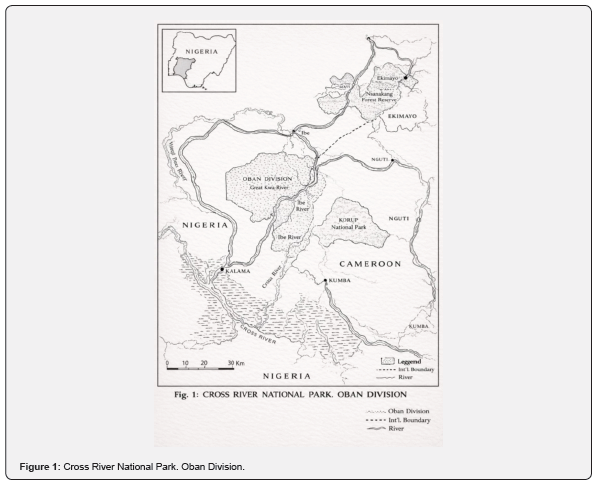
CRNP’s Oban Division, located between latitudes 5°50’– 6°29’N and longitudes 8°15’–9°30’E, encompasses dense tropical rainforests featuring three key rivers—Great Kwa, Ibe, and Eku— that were sampled in this study. The region experiences a bimodal rainfall pattern from May to November, which plays a crucial role in shaping the breeding cycles of local prawn populations. This climatic rhythm influences the availability of aquatic habitats and breeding conditions, as noted by the CRNP-NCF-WCS Partnership [12].
Field sampling
a) Sampling Design: Monthly collections (August–October)
involved the use of touch light, buckets, hand nets and local
fishermen as an assistant.
b) Preservation: Specimens were fixed in 10% formalin for
laboratory analysis, using the method of [13] (Figure 1).
Laboratory analysis
a) Taxonomy: Identified using Powell [11] & Enin et al. [10].
b) Statistical Tools: ANOVA tested abundance variations
across sites/months [14].
Results
Total species composition in all surveyed rivers on each sampling occasion
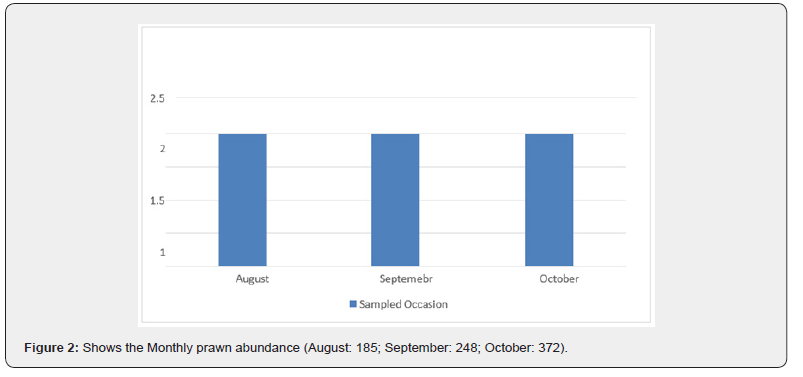
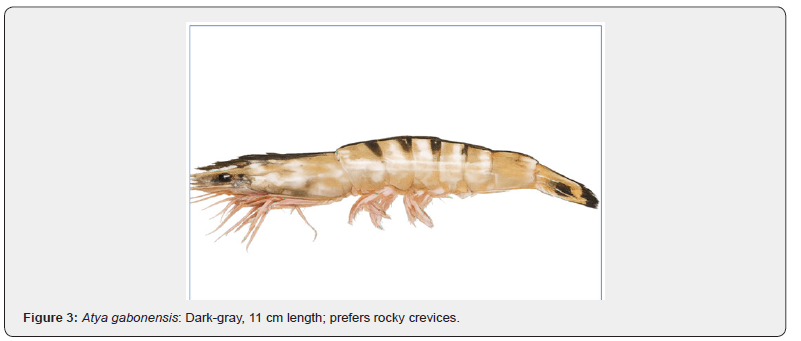
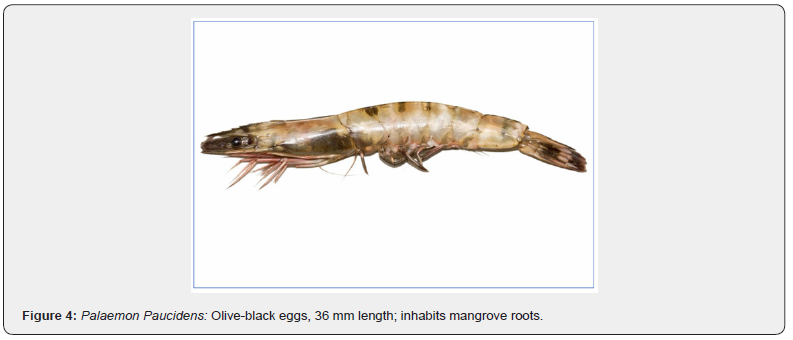
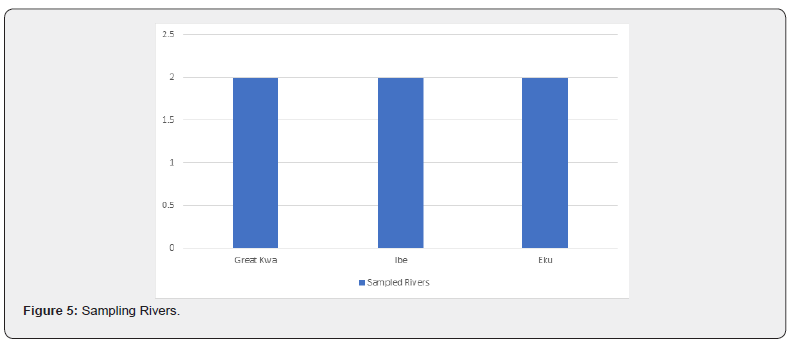
The species composition in the various locations of Cross River National Park, Oban Division was carried out on monthly basis, the first survey was in August of which two species were identified, the second survey sampling took place on September and two species were also identified, and the last survey sampling technique was October and two species were identified. All surveys were carried out at the three rivers in the park and Palaemon Paucideas had the highest number of species occurrence and abundance. The two species identified were Atya Gabonensis and Palaemon Paucideas as shown on Table 1 and Figure 2-5.
Spatial and Temporal Trends.
a) Monthly Catch: Peaked in October (372 prawns), aligning
with rainy-season breeding (Figure 2).
During the survey period as shown in Table 2, a total of (460) prawns were catch for Palaemon Paucidens, while the total catch for Atya Gabonensis was (345) respectively.



Total species composition in each sampled surveyed period
Table 3 shows the total number of freshwater prawns catch on each sampling regime. The Great Kwa River had the highest species abundance of 385 (47.83%) recorded for Palaemon Paucidens and Atya Gabonensis, this may be due to the connectivity with Cameroon’s Korup National Park or higher nutrient availability and a more diverse range of micro-habitats. Ibe River had 230 (28.57%) recorded for Palaemon Paucidens and Atya Gabonensis and it shows moderate abundance, this site serves as a vital corridor for species dispersal within the park. Eku River had the lowest catch of 190 (23.60%) species recorded for Palaemon Paucidens and Atya Gabonensis respectively. The presence of both species indicates that the river remains ecologically viable, though it may face different environmental pressures or have lower primary productivity than the Great Kwa, the data reveals a clear hierarchy in productivity and species richness among the sampled locations (Figure 6).
Statistical outcomes
The result revealed no significant spatial or temporal differences in the population data (p < 0.05), indicating that the populations remained relatively stable over both space and time. This stability suggests limited dispersal among the populations, meaning individuals are likely staying within localized areas rather than moving widely. These findings align with Hart’s [15] observations on population dynamics, emphasizing localized persistence rather than extensive migration.
Discussion
From the result, the study explores the distribution and abundance of freshwater prawns species within the Oban Division of Cross River National Park (CRNP), Nigeria. The Oban Division of Cross River National Park is a biodiversity hotspot. The rivers sampled were Great Kwa, Ibe, and Eku which serve as critical habitats for macro-invertebrates. Freshwater prawns are essential “indicator species”; their presence and abundance often reflect the water quality and the overall integrity of the aquatic food web. Two prawn species were commonly distributed and identified and include, Atya Gabonensis (the African Giant Fan Prawn) and Palaemon Paucidens. The survey reveals a significant presence of freshwater decapods across the three sampled river systems: Great Kwa River, Ibe River, and Eku River, and we gain insights into the biodiversity and health of one of Africa’s most significant rainforest ecosystems. A total of 805 individuals were collected, with Palaemon paucidens (510 individuals) being notably more abundant than Atya gabonensis (295 individuals) across all sites. The Great Kwa River emerged as the most productive site, accounting for 47.83% of the total catch. Its high numerical abundance (385 individuals) suggests a habitat rich in nutrients and optimal water quality parameters, such as dissolved oxygen and flow rate, which support crustacean life. In contrast, the Eku River showed the lowest abundance (23.60%), which may be attributed to localized environmental factors, varying flow velocities, or differences in substrate composition. In every location, Palaemon paucidens consistently outnumbered Atya gabonensis. This trend is likely due to the ecological strategies of the two species. Atya gabonensis is a specialized filter-feeder that requires specific rocky substrates and high-velocity currents to feed effectively using its fan-like chelae. Palaemon paucidens, being more of a generalist scavenger/predator, can thrive in a wider range of micro-habitats, explaining its higher numerical dominance (63.3% of the total population). The dominance of P. Paucidens reflects its adaptability to CRNP’s dynamic habitats [16], while A. gabonensis’s lower abundance may stem from specialized habitat needs [17].
It was observed by Powell [11], that little is known about fresh and brackish water prawns species in Nigeria. According to Petit [16], the species disappearance or appearance may be attributed to human influence and predation due to the harsh environment and or ecological conditions. Although, prawns can migrate to regions like national park for breeding purposes but their distribution has been suggested to implicate many factors such as pesticides in the environment, climate change which causes changes in their breeding cycles and rapid spread of pathogens (Alan 1992) [16].
Duellman & Trueb [17], reported that species such as Macrobrachium, Pllimanus and Anomura spp have been common in occurrence and distribution in Ethiopia freshwater bodies while the freshwater in Northeast Hawaii support the distribution and occurrence of Macrobrachiumohione, Austropotamobius Pallipes. It can be concluded that, some prawn species can be seen or observed in a particular habitat and can do well in another area, hence they usually observed difference species inhabiting certain or chosen ecological niche [13,17,20-38].
Threats and Conservation
a) Human Activities like illegal logging and fishing threaten
prawn habitats [39].
b) Climate change Altered rainfall patterns and may disrupt
breeding cycles [40].
Conclusion
This study provides CRNP’s first prawn species checklist, laying groundwork for future ecological and conservation research.
The survey confirms that the Oban Division of Cross River National Park supports a healthy population of freshwater prawns, specifically Palaemon paucidens and Atya gabonensis. The Great Kwa River stands out as the most significant habitat for these species, accounting for nearly half of the total population sampled.
The successful documentation of 805 individuals indicates that the aquatic ecosystem within the park remains relatively pristine. However, the lower numbers in the Eku River suggest that even within a protected area, localized environmental factors can significantly influence species density.
Recommendations
To ensure the long-term conservation of these crustacean
populations, the following actions are recommended:
a) Continuous Bio-monitoring system should be
established for seasonal monitoring program to track how prawn
populations fluctuate between the wet and dry seasons.
b) The government of the cross river national park (CRNP)
should ban and enforce strict laws on habitat protection and
destructive fishing practices (such as the use of chemicals or finemesh
nets) in the Great Kwa and Eku rivers, as these prawns are
highly sensitive to toxins.
c) Government should engage the local communities
surrounding the Oban Division on the importance of prawns in
the food chain, highlighting that healthy prawn populations lead
to healthier fish stocks.
d) Future surveys should include water quality and the
measurement of heavy metals and nutrient load to correlate
species abundance with specific chemical markers.
e) The future surveys should also expand and identify
smaller or more cryptic taxonomic species of the Desmocaris
genus which may have been overlooked in this primary catch.
References
- Epperly S, Avens L, Garrison L, Henwood T, Hoggard W, et al. (2002) Analysis of sea turtle bycatch in the commercial shrimp fisheries of Southeast US waters and the Gulf of Mexico. NOAA Technical Memorandum NMFS-SEFSC-490.
- FAO (2000) Aquaculture production statistics 1989-1998. (FAO Fisheries Circular No. 815).
- CEHRD (2007) Small scale shrimp fisheries in Nigeria. Centre for Environment, Human Rights and Development.
- FAO (2000) Fishery statistics: Aquaculture production (Vol. 86/2). FAO Fisheries Series No. 56/FAO Statistics Series No. 154.
- Marioghae IE (1982) Notes on the biology and distribution of Macrobrachium vollenhoveniiin the Lagos Lagoon (Crustacea, Decapoda, Palaemonidae). Revue de Zoologie Africaine 96(3): 493-508.
- Enin UI (1995) First estimates of growth, mortality and recruitment parameters of Macrobrachium macrobrachion(Herklots, 1851) in Cross River Estuary, Nigeria. Dana 11(1): 29-38.
- Marioghae IE (1987) An appraisal of the cultivability of Nigerian palaemonid prawns. *ARAC/87/WP/4*. UNDP/FAO/NIOMR.
- Powell CB (1983) Fresh and brackish water shrimps of economic importance in Niger Delta. Proceedings of 2nd Annual Conference of Fisheries Society of Nigeria, Calabar, January 25-27, 1982, pp. 254-255.
- Knowlton N, et al. (2004) Systematics of Palaemon Journal of Crustacean Biology 24(3): 491-499.
- Enin UI, Holzlohner S, Ama-Abasi D (2000) Catch structure of the multi-species gill net fishing in the Cross River, Nigeria. Proceedings of the Annual Conference of Nigeria Society for Biological Conservation, Owerri, September 25-29.
- Powell CB (1979) Three African shrimps of a new genus from West Africa fresh and brackish waters: Taxonomy and ecological zonation. Revue de Zoologie Africaine 93(1): 116-150.
- CRNP-NCF-WCS Partnership (1994) The biodiversity research programme Southeastern Nigeria. A collaboration between the Wildlife Conservation Society and the Nigeria Conservation Foundation.
- Odum EP (1971) Fundamentals of ecology (3rd edn). W.B. Saunders.
- Idaka I, Clemency OA (2005) Introductory biometrics: Statistical reasoning for environmental protection, management and education. Galax-Star Printers and Publishers.
- Hart AI (1999) Temporal distribution of macrobenthic fauna in mangrove forests of the Bonny Estuary, Nigeria. Journal of Applied Science and Environmental Management 3: 64-80.
- Petit C (1992). Disappearance of toads, frogs has some scientists worried. San Francisco Chronicle.
- Duellman WE, Trueb L (1994) Biology of amphibians. The John Hopkins University Press.
- Arrigoon JCV (1998) Tilapia. In: R Coste, AJ Smith (Eds.), The tropical aquaculturalist. ICTA, Macmillan, p. 78.
- Cooper JC, Scholz AT, Horrall RM, Hasler AD, Madison DM (1976) Experimental confirmation of the olfactory hypothesis with homing, artificially imprinted Coho Salmon (Oncorhynchus kisutch). Journal of Fish Research Board of Canada 33(4): 703-710.
- Enin UI, Holzlohner S, Nwosu FM (1997) Survey of fishing villages of the inner Cross River Estuary, Nigeria. Paper presented at the seminar on "Cross River Basin - Nature and Culture", Calabar, May 19-20.
- FAO (1969) Fisheries survey in the Western Regions, Nigeria. Final Report (FAO-UNDP/SF 74/NIR/6).
- FAO (1990) Field guide to the commercial marine resources of the Gulf of Guinea. FAO identification sheets for fishing purposes. FAO Regional Office for Africa.
- FAO (1995) Fisheries statistics of Nigeria (3rd edn). Federal Department of Fisheries.
- Fischer W (Ed.) (1918) FAO species identification sheets for fishing purpose: Western Central Atlantic (Fishing Area 31, Vols. 1-7). FAO.
- Fontan M, Anibarro B, Postigo I, J Martínez (2005) Allergy to freshwater shrimp. Journal of Investigational Allergology and Clinical Immunology 15(2): 150-152.
- Graening GO, Holsinger JR (2006) Annotated checklist of the amphipod crustaceans of Oklahoma, with emphasis on groundwater habitats. Proceedings of the Oklahoma Academy of Science 86: 65-74.
- Jones S (1969) The prawn fishing resources of India. In: MN Mistakidis (Ed.), Proceedings of the world scientific conference on the biology and culture of shrimps and prawns. FAO Fisheries Report 57(3): 735-747.
- Lee DA, Chan RY, Yu PY, Liao IC (1999) A revised checklist of the Penaeoidea (Crustacea: Decapoda) from the waters around Taiwan. The Raffles Bulletin of Zoology 47(2): 441-447.
- Marioghae IE (1981) The commercial fishery of Nematopalaemon hastatusin Nigeria. Paper presented at the National Conference on Agriculture, Cross River State University of Science and Technology, Port Harcourt.
- Micheal EH, Harvey AW (1998) Checklist of anomuran crabs from the Western tropical Pacific. Belgian Journal of Zoology 129: 363-389.
- Nwadiaro CS (1989) Preliminary observation on the nature, taxonomic composition, distribution and nutrient requirement of the usual algal jellies of Oguta Lake in South Eastern Nigeria. Internationale Revue der Gesamten Hydrobiologie 74: 633-642.
- Nwosu FM, Holzlohner S, Akpan ER (2002) Mangrove mapping in the Cross River Estuary, Nigeria. African Journal of Environmental Pollution and Health 1(2): 76-87.
- Patil SG, Talmale SS (2005) A checklist of freshwater ostracods (Ostracoda: Crustacea) of Maharashtra, India. Zoos' Print Journal 20(2): 1872-1873.
- Powell CB (1982) Fresh and brackish water prawns of economic importance in Niger-Delta. In Proceedings of the 2nd Conference of the Fisheries Society of Nigeria, Calabar, Nigeria.
- Sandifer PA, Smith TIJ (1985) Freshwater prawns. In: JV Huner, EE Brown (Eds.), Crustacean and mollusk aquaculture in the United States. AVI Publishing, pp. 63-125.
- Sharma A, Subba BR (2004) A new report of prawn Macrobrachium altifrons(Henderson) from Singhiya River, Biratnagar, Nepal. Our Nature 2(2): 33-34.
- Shrestha E, Tamrakar AS, Eeles D (2001) Shrimps of Kuligandaki and Narayani rivers. Bulletin of Biodiversity 1(2).
- Straughan D (1972) Influence of seasonal rainfall and water temperature on the population of Mercierella enigmaticain the Cross River Estuary. North Queensland Naturalist 9: 165-172.
- NCF-WCS Biodiversity Research Programme (2001) 109A Marian Road, Calabar - Nigeria.
- Alan C (2007) The atlas and red data book of the frogs of South Africa, Lesotho and Swaziland. Published by Africa's first on-line science magazine.

























