




 IJESNR Home



Abstract
The Bangladesh textile industry faces several serious problems at its current locations that are undermining competitiveness and growth. High energy costs and frequent gas shortages have increased production costs by around Tk 49/kg of yarn and reduced mill operations to roughly 40-50% capacity, forcing some mills to idle machines or incur generator costs Domestic mills increasingly struggle to compete with cheaper imported yarn, which can cost about $2.60/kg versus $3/kg domestically, due to Indian subsidies and informal imports flooding the market. Rising raw material costs, stagnant technology investment, and outdated machinery reduce productivity, while weak backward linkages mean heavy reliance on imported inputs. Political and economic instability has also depressed demand and complicated logistics and finance. A new location strategy—such as developing specialized textile hubs outside congested urban centers or near ports and energy corridors—could address these issues by improving infrastructure (better, stable energy supply and logistics), reducing transport and utility costs, and attracting new investment in modern technology. Dedicated industrial zones could also include training centers to build skilled workforces and link raw material suppliers more closely with manufacturers, strengthening backward linkages and supply chain resilience.
Keywords:Textile industry; Bangladesh textiles; Relocation; Sustainability; Special industrial zone
Graphical Abstract
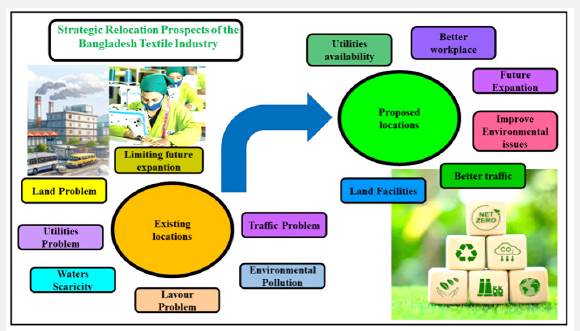
Introduction
The textile and ready-made garments (RMG) industry in Bangladesh has come forward as the backbone of the country’s economy over the last three decades. The industry contributes about 11-12% to the GDP and also generates about 84% of the country’s total export earnings, making Bangladesh the largest apparel exporter in the world [1,2]. The textile industry employs about 4.2 million people, of whom about 90% are women in the RMG sector, thereby making a significant contribution to poverty alleviation and socio-economic empowerment [3]. The major industrial areas have developed around Dhaka, Gazipur, Narayanganj, and Chattogram, forming a compact production zone that integrates spinning, weaving, dyeing, finishing, and garmenting [4].
However, despite its remarkable success, the industry is currently facing mounting pressure due to rising energy costs, infrastructure constraints, global competition, and environmental regulations. These pressures are mainly because the industries are concentrated in a compact urban area that lacks the capacity for expansion and modernization [5,6].
The idea of relocating textile industries to planned industrial zones or special economic zones (SEZs) is being increasingly recognized as a strategic move to overcome structural inefficiencies [7]. The existing textile industry clusters are plagued by gas supply bottlenecks, power instability, traffic congestion, high land costs, and pollution. The relocation of industries to specifically planned industrial parks close to ports, highways, and power corridors could ensure a stable supply of utilities, better logistics, advanced waste treatment facilities, and lower costs of operation [8,9]. Decentralized development would also ease urbanization while allowing for technological advancements and sustainable manufacturing processes in line with international norms [10].
This review critically analyzes the prevailing structural inefficiencies in the Bangladesh textile industry in its present locations and ascertains the feasibility and strategic significance of relocating industries. This review synthesizes secondary data from official documents, international trade data, industry journals, and recent academic literature. By incorporating economic, infrastructural, environmental, and policy considerations, this review seeks to present a comprehensive framework for understanding the strategic significance of relocation approaches to improve the competitiveness, sustainability, and resilience of industries.
Industrial Evolution and Economic Significance
Historical growth trajectory
The textile and ready-made garments (RMG) sector in Bangladesh started its formalization in the late 1970s and early 1980s after policy changes that favored export-oriented manufacturing [11]. The initial growth was fueled by the setting up of spinning and weaving mills, which formed the basis for the subsequent growth of the RMG sector [12]. The removal of trade restrictions under the Multi-Fibre Arrangement (MFA) in the 1980s and favorable market access to large markets like the European Union and the United States fueled growth [13]. Between 1990 and 2020, there was a huge growth in textile and garment exports, and Bangladesh shifted from being a minor exporter to the second-largest apparel exporter in the world, after China, although it was a marginal exporter in the 1990s [14].
Contribution to GDP and exports
During the fiscal year 2024-25, the country’s ready-made garment (RMG) exports were around USD 39.35 billion, registering a growth of around 8.8% on a year-on-year basis, contributing close to 81% of the country’s total merchandise export earnings, thus reiterating the sector’s preeminent role in the country’s economy. Of this total, the European Union (EU) continued to be the major market, absorbing close to 50% of the RMG exports, followed by the United States with around 19-20%, while other countries such as the United Kingdom and Canada accounted for relatively smaller shares [15]. (Figure 1) shows the recent trends and market distribution of Bangladesh’s RMG Exports (FY 2024–25 to FY 2025–26).
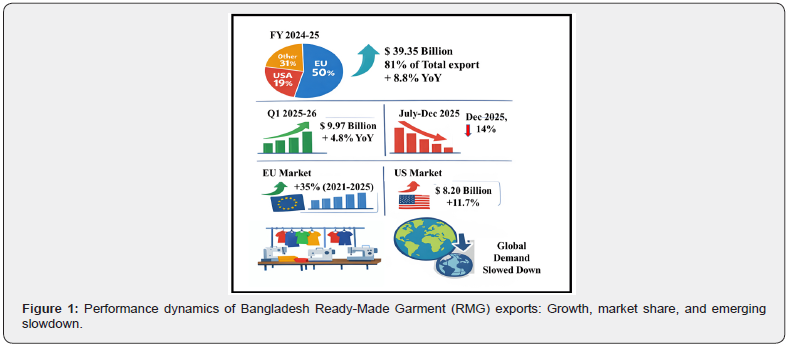
In the current fiscal year 2025-26, the export performance has registered mixed results, with RMG exports in July-September 2025 (Q1) amounting to around USD 9.97 billion, registering a 4.8% growth over the same period of the previous year, with modest growth in both knitwear and woven categories, despite a slight drop in September [16,17]. However, the total export during July-December 2025 was around USD 19.37 billion, registering a slight downturn of 2.6% over the same period of the previous year, with both categories registering downturns, and a drop of around 14% in December 2025 exports compared to December 2024 [18]. Recent data also reveals that the total export, including RMG, registered consecutive declines in the latter part of 2025 and early 2026, largely due to the slump in global demand, especially in the EU market [19].
Market-specific analysis shows that the country has retained its position as one of the prominent clothing exporting nations to the EU, with an estimated growth rate of 35% in exports from 2021 to 2025, surpassing its major rivals like China and India [20]. However, statistics from Eurostat indicate that there was a sharp decline in RMG exports to the EU in December 2025 [21]. Exports to the U.S. market recorded a growth rate of 11.7% in the calendar year 2025, reaching an export value of USD 8.20 billion despite the challenges posed by tariffs. The recent export scenario indicates that the sector is growing in terms of its overall position but is vulnerable to the changing demand situation in the global market [19,22,23].
Employment generation
The sector is also a large source of employment, directly employing an estimated 4 million people, of whom a large percentage are women. The indirect employment, through backward linkages such as logistics, packaging, and suppliers, is estimated to employ an additional 2-3 million people [24]. The labor-intensive nature of textile and garment manufacturing has made the sector a critical source in the alleviation of poverty and socioeconomic change, especially in rural and peri-urban areas where factory employment has become available to a large workforce [25,26].
Economic and Competitive Challenges
Rising utility and raw material costs
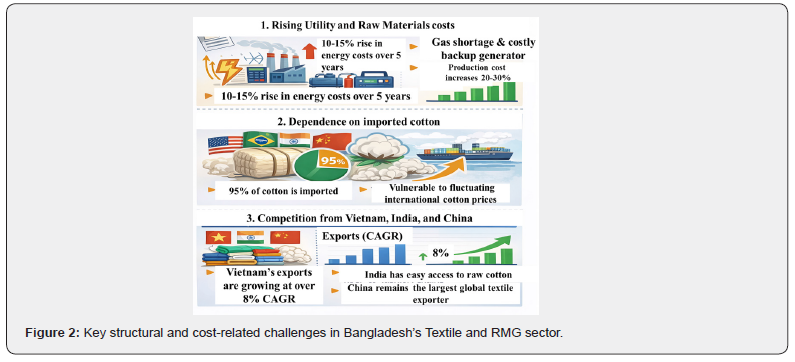
The Bangladesh textile and RMG sector has been facing challenges in terms of rising production costs, mainly because of the increasing cost of utilities. The industrial electricity tariffs have been increasing steadily, and the cost of energy has gone up by as much as 10-15% in the last five years, while gas shortages have been forcing the factories to run at lower capacities or use costly backup generators [27,28]. This has resulted in an increase in production costs by as much as 20-30% in some spinning and dyeing units. Moreover, foreign buyers have also been demanding that the sector meet energy efficiency norms, which requires additional investment in technology upgrades, further increasing costs [29].
Dependence on imported cotton
One of the major structural vulnerabilities in the textile value chain in Bangladesh is the dependence on imported raw materials, especially cotton. The local cotton industry is almost non-existent, as it satisfies only less than 5% of the total demand, and the remaining 95% of the raw cotton and yarn requirements are met through imports from countries such as the United States of America, Brazil, and India [30,31]. This dependence on the international market for cotton makes the industry vulnerable to changes in international cotton prices, which fluctuated considerably during the period 2021-2023, with an average price increase from around $0.80 per pound to over $1.10 per pound [32]. (Figure 2) indicates production cost pressures, cotton import dependence, and external competition; challenges for Bangladesh’s RMG industry.
Competition from Vietnam, India, and China
Bangladesh is increasingly challenged by the rising competitiveness of regional textile manufacturers with improved backward linkages and technology integration. The export of textiles from Vietnam has been increasing at a CAGR of over 8%, due to its growing integration into regional trade agreements and its focus on more diversified textile products [33,34]. The textile and apparel exports from India, estimated at over $17 billion in recent years, are less dependent on imports due to their easy access to raw cotton and fiber-to-fashion value chains [35]. However, China continues to be the largest global exporter of textiles (approximating 30% of the global market share), with highly automated manufacturing processes and economies of scale that enable it to maintain competitive pricing [36].
Environmental and Sustainability Pressures
Effluent treatment and water pollution
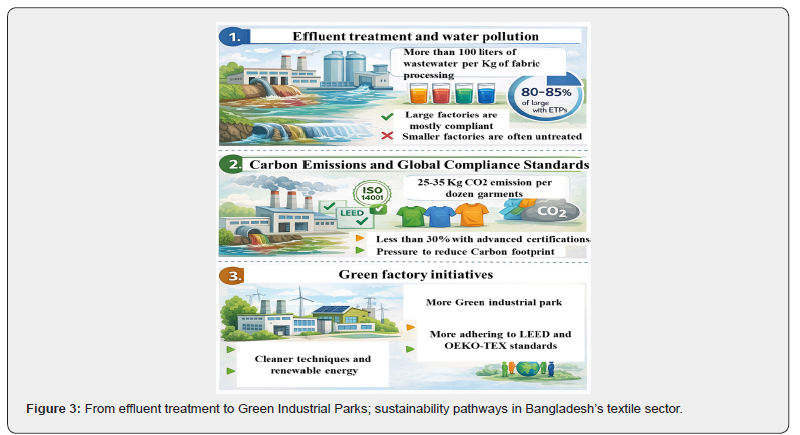
Environmental sustainability has emerged as a major concern for the Bangladesh textile industry, as the industry produces a substantial amount of wastewater during dyeing, printing, and finishing operations [37]. Textile factories can release as much as 150- 200 liters of wastewater per kilogram of fabric produced, which has high levels of dyes, chemicals, and biological oxygen demand (BOD) [38]. In this regard, the Bangladesh Garments Manufacturers and Exporters Association (BGMEA) stated that as of 2024, about 80-85% of the bigger factories in the proposed industrial zones have installed Effluent Treatment Plants (ETPs) or are connected to centralized effluent treatment plants [39,40]. However, the smaller factories, particularly in the older clusters, are still not properly treated and hence are environmentally non-compliant.
Carbon emissions and global compliance standards
Environmental sustainability is being increasingly emphasized by global fashion buyers, with carbon footprint disclosure becoming a norm in procurement agreements. The textile and apparel sector is a source of carbon emissions through energy consumption, transportation, and chemical processing [41]. It is estimated that the carbon intensity of the sector in Bangladesh is in the range of 25-35kg CO₂ per dozen pieces of apparel, which is higher than in some other competing countries because of the use of outdated machinery and fossil fuel-based energy [42]. Adherence to global standards such as ISO 14001 and the sustainability requirements of buyers has encouraged companies to adopt energy-efficient technologies and renewable energy. However, less than 30% of the total factories have achieved advanced sustainability certifications, which is a significant area for improvement [43,44]. (Figure 3) indicates Environmental Sustainability Challenges and Green Transition in Bangladesh’s textile and RMG sector.
Green factory initiatives
In recent years, public and private sector actors have encouraged “green factory” initiatives to minimize environmental effects and improve competitiveness. The Government of Bangladesh and global development partners have supported green industrial parks that include wastewater treatment, solid waste management, and renewable energy solutions [45,46]. By 2025, more than 10 textile parks are expected to be in operation with integrated environmental infrastructure, aimed at minimizing water use by 20-30% and total emissions by 15- 25% relative to traditional plants. In addition, adherence to norms such as LEED and OEKO-TEX has increased, with more factories adopting cleaner dyes, chemical recycling processes, and energy-saving equipment [47,48]. Such efforts not only make environmental improvements but also meet the demands and requirements of major export destinations like the EU and the US.
Strategic Relocation and Special Economic Zones (SEZs)
Development of planned textile parks
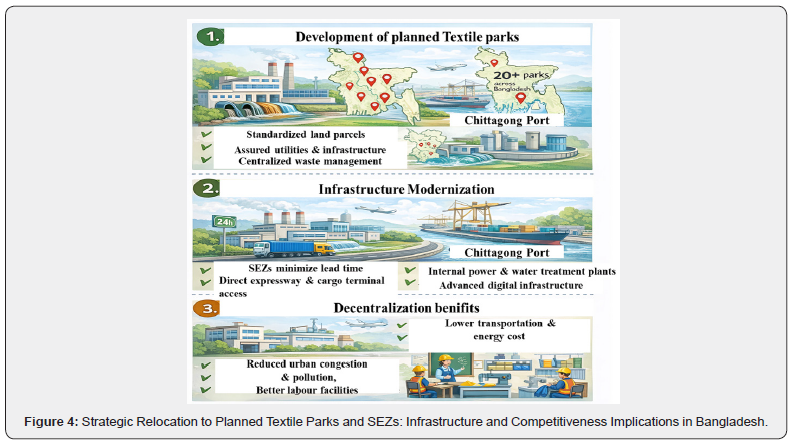
Strategic relocation to planned textile parks and special economic zones (SEZs) is now being identified as a feasible approach to improve competitiveness and sustainability. As of 2025, the Government of Bangladesh and the private sector have proposed the establishment of more than 20 textile-based industrial parks, including 10 large export processing zones located near strategic logistic hubs [49]. These industrial parks are intended to offer standardized land parcels, assured utility supply, and shared infrastructure [50]. The economies of scale approach also enable more efficient processing of central effluent treatment, hazardous waste management, and customs operations.
Infrastructure modernization
The modernization of infrastructure is one of the key focus areas of the strategic relocation plan. The SEZs are designed to have their own power plants, assured gas supplies, efficient water treatment plants, and sophisticated waste management systems [51]. The average textile SEZ project is designed to provide availability of power and uninterrupted gas supply, which is much higher than the level of reliability that is normally reported in the existing urban agglomerations [52]. The logistics infrastructure in these SEZs focuses on minimizing lead times, such as having internal connectivity to expressways and cargo terminals close to large ports like Chattogram, to reduce export transit times by 20- 30%, from the average door-to-port times of 48-72 hours to 24-36 hours [53-55]. Digital infrastructure, such as industrial IoT and automation, is also a key area.
Decentralization benefits
Decentralization by relocation provides a number of economic and social advantages. By relocating industries away from the congested urban agglomerations, such as Dhaka and Gazipur, relocation of industries will help to reduce congestion in urban areas and minimize environmental impact [56]. Decentralized parks in the vicinity of feeder road infrastructure can potentially reduce transportation costs of raw materials and finished products by 10-15%, and reduce supply chain cycles that are presently extended due to traffic congestion [57]. Positioning in the vicinity of energy infrastructure also improves the reliability factor and makes the industry less dependent on costly backup power supplies, which could potentially reduce energy costs by 5-12% [50,58]. Additionally, SEZs are often integrated with vocational training institutes specific to textile technology, which could potentially upgrade the skill levels of the workforce [59]. This integration helps to achieve 10-20% gains in labor productivity, as per industrial case studies, and helps to achieve competitiveness in the higher-value textile manufacturing segments [60]. (Figure 4) Indicates integrated infrastructure, logistics efficiency, and skill development through Textile SEZs in Bangladesh.
Policy, Investment, and Technological Upgradation
Government incentives
The government’s policy is an important factor in helping the textile and RMG industry achieve competitiveness and modernization. The Government of Bangladesh has adopted various fiscal and non-fiscal incentives, such as tax holidays of up to 10 years for new export-oriented textile projects in special economic zones (SEZs), duty-free importation of capital machinery, and accelerated depreciation allowances of 30-40% for technological improvements [61,62]. Export development funds and bonded warehouses enable manufacturers to defer or reduce the costs of imported raw materials and spare parts, which helps in improving liquidity. Moreover, public funding through institutions like the has provided credit lines for digitalization in the textile industry in subsidized loans with interest subsidies of 2-3% below market rates [63].
Industry 4.0 and Smart Manufacturing Potential
Technological upgradation towards Industry 4.0 is a crucial area for productivity enhancement and improved global competitiveness. Less than 25% of the textile mills in Bangladesh are using modern automation technology like PLCs, RFID tracking systems, or automated fabric inspection systems [64,65]. However, use of such smart manufacturing tools has been found to improve productivity efficiency by 15-30% and defect rates by 10-20% in comparative case studies. Machine monitoring using industrial IoT (Internet of Things) can enhance availability by 20-25% through predictive maintenance [66,67]. Cloud-based data analytics platforms also enable real-time quality monitoring, energy management, and resource allocation, which have been found to provide energy savings of 10-15% per unit of production in pilot projects [68].
Policy support is slowly encouraging the adoption of digital transformation through support for technology parks, public-private research collaborations, and skill development programs that align higher education with smart manufacturing skills [69,70]. The purpose of these efforts is to develop a talent pool that is ready for automation and data-driven manufacturing, thereby filling the gap between conventional manufacturing and modern textile manufacturing.
Future Outlook and Strategic Recommendations
The fate of the textile and RMG industry in Bangladesh will largely depend on how successfully it overcomes the structural constraints mentioned in the previous sections, such as infrastructure bottlenecks, increasing production costs, environmental pressures, and global competitiveness. The industry is currently indispensable to the economy, as exports have been over $42 billion per year and account for about 84% of total merchandise exports; however, to grow beyond the current performance level, a transformation strategy is needed rather than an evolutionary approach.
There should be a fast-tracked shift to the proposed Special Economic Zones (SEZs). By focusing new investments in industrial parks that are fully serviced with ≥99% reliability of utilities, shared effluent treatment plants, and logistics facilities, it is possible to cut operational costs by 10-20% while improving adherence to global sustainability norms. Decentralization will also help alleviate congestion in the larger agglomerations, such as Dhaka and Gazipur, to boost productivity and environmental sustainability.
Industry 4.0 technology upgrades should become mainstream rather than niche. A possible increase in productivity of 15-30% and a decrease in energy intensity of 10-15% could be achieved if the use of automation and industrial IoT in the current <25% of factories increase to at least 50% in the next decade. Also, by diversifying into man-made fibers, recycling technologies, and regional sourcing agreements, which can reduce the dependence on imported cotton (>95% currently), the resilience of supply chains can be improved. Lastly, to ensure long-term competitiveness and sustainability, policy continuity in terms of tax incentives, green financing, and human resource development will play a crucial role.
Data Availability Statement
All data used in this review are obtained from previously published studies, which are cited within the article. No new data were generated for this work.
References
- I. X. Global (2026) Sector Brief | Bangladesh’s RMG Sector: A Catalyst for Inclusive Growth and Economic Resilience,” IIX - Impact Investment Exchange.
- T Islam, Md A Halim (2022) Impact of ready-made garments (RMG) industries and sustainability: Perspective of the pandemic period in developing country. Cleaner Engineering and Technology 11: 100567.
- MAA Mamun, MM Hoque (2022) The impact of paid employment on women’s empowerment: A case study of female garment workers in Bangladesh. World Development Sustainability 1: 100026.
- S Sayam, Das N, Akter S, Saha J, Sarkar A, et al. (2025) Water and electricity consumption patterns with effluent quality in the textile processing industry of Bangladesh. RSC Advances 15(54): 46627-46648.
- P Chowdhury, T Islam, IJ Tasmia, NUR Chowdhury (2025) Power sector transformation in Bangladesh: Paving the pathways towards sustainable development. Energy Strategy Reviews 61: 101829.
- Saheb Ali Mondal, Mohammad Main Uddin, Nazma Akter (2026) The Textile Industry in Bangladesh: Growth Trends, Challenges, and Future Prospects.
- II Danja, X Wang (2024) Matching comparative advantages to special economic zones for sustainable industrialization,” Heliyon 10(14): e34411.
- How Dialogue is Shifting Bangladesh’s Textile Industry from Pollution Problem to Pollution Solution (2026) World Bank.
- Textile industry struggles as energy shortages stall production and investment (2026) Textile News, Apparel News, RMG News, Fashion Trends.
- SB Saif, AM Islam (2025) Growth, Development and Selected Social Sustainability Challenges Facing the Bangladesh Export Garment Industry. Businesses 5(1): 15.
- FICCI (2026) FICCI | The Garments and Textile Sector: A Change Maker for Bangladesh’s Economy.
- Kabeer N, Mahmud S (2025) Rags, Riches and Women Workers: Export-oriented Garment Manufacturing in Bangladesh.
- J Peltzman (1984) The Multifiber Arrangement and Its Effect on the Profit Performance of the U.S. Textile Industry. In the Structure and Evolution of Recent US Trade Policy, University of Chicago Press, pp. 111-150.
- Md Akram Hossain, Kawsar Uddin Mahmud (2025) Bangladesh’s Ready-made Garment Industry in the Era of Sustainable Development: A Triple Bottom Line Appraisal.
- The Daily Observer (2026) Bangladesh’s RMG exports notches 8.84% growth in FY25. The Daily Observer.
- T Focus (2026) Bangladesh’s RMG Export Reaches $9.97 Billion in July–September FY2025–26. Textile Focus.
- Dhaka Stream (2026) RMG exports attain 4.79% growth in July-September of FY26 | Dhaka Stream.
- T Focus (2026) RMG exports stood at $3.23bn, reflecting an -14.23% in December. Textile Focus.
- Hossain R (2026) US-EU Trade War: Risk for Bangladesh RMG Exports | The Business Standard.
- AA Rubel (2026) RMG exports to EU grew by 35.81% in 5yrs despite slowdown. Daily Times of Bangladesh.
- Bangladesh’s RMG exports to EU suffer setback. Dhaka Tribune. Accessed.
- T T TODAY (2026) India Bans RMG Imports from Bangladesh via Land Ports. Technical textiles today.
- Munni M (2026) 2025 RMG exports to US increase 11.75pc. The Financial Express.
- Gender equality in the Bangladesh RMG industry (2026) International Labour Organization.
- MM Hoque (2024) A Critical Review of Bangladesh’s Child Labor Regulations and Policies. World Development Sustainability 5: 100177.
- Mallik SK, Ramjan Ali, Nahiduzzaman DM, Shoumik SC, Islam T, et al. (2025) Sustainable textile industry: Balancing growth and environmental concerns in Bangladesh. Int J Sci Res Arch 14(1): 664-678.
- Elma SN (2026) Energy shortages threaten Bangladesh’s textile competitiveness, demanding a new energy policy framework. Textile News, Apparel News, RMG News, Fashion Trends.
- Md Atik Hasan (2025) Navigating Risks in Bangladesh’s Garment Industry: Analyzing the Effects of Rising Costs of Labor on Firm Profitability. Journal of Risk Analysis and Crisis Response 15(3).
- LA Wing (2026) Energy Efficiency in the RMG Sector: Sustainable Solutions. LightCastle Partners.
- Bangladesh 2026: Balancing Global Textile Dominance with Social Challenges | Modaes Global.
- Md Asaduzzaman (2022) Cotton Industry of Bangladesh an Overview of Supply & Deman.
- Hernandez V (2026) Do Cotton-Market Dynamics Suggest Higher Prices Are Around the Corner? International Banker.
- Stark KF, Bamber P, Couto V (2020) Analysis of the Textile and Clothing Industry Global Value Chains - Summary.
- NT Linh (2025) Export Performance of Vietnam’s Garment Manufacturing Enterprises: A Critical Analysis. ISAR Journal of Economics and Business Management 3(3): 7-13.
- S Gautam, M Lal (2020) Analysing competitiveness and trade performance: evidence from Indian textile industry and its select competitors. Transnational Corporations Review 12(4): 406-424.
- Riaño P (2026) Shift in Global Fashion Manufacturing: China’s Market Dominance Diminishes - Modaes Global. MODAES.
- M Shamsuzzaman, M Islam (2025) Environmental sustainability practices in effluent management of fashion manufacturing in developing country: Insights from Bangladesh. Cleaner Water 3: 100085.
- A Azanaw, B Birlie, B Teshome, M Jemberie (2022) Textile effluent treatment methods and eco-friendly resolution of textile wastewater. Case Studies in Chemical and Environmental Engineering 6: 100230.
- Tapamoy Chakraborty (2026) ETP (Effluent Treatment Plant) is a process design for treating the industrial wastewater for its reuse or safe disposal to the environment.
- Salma U (2026) Impact of water crisis and proposed water tax. Textile News, Apparel News, RMG News, Fashion Trends.
- Md Tareque Rahaman, Md Shakib Hossain Khan (2025) Green merchandising of textiles and apparel in a circular economy: Recent trends, framework, challenges and future prospects towards sustainability. Journal of Open Innovation: Technology, Market, and Complexity 11(1): 100457.
- Md Masum, Ullah MS (2026) Sustainable Clothing Production in Bangladesh: The Case of Energy Intensity and CO2
- Patil S, Kharde MR, Somatkar A, Dhede VM (2025) Impact Of ISO 14001 Adoption And Renewable Energy Integration On CO₂ Emission Reduction In The SAARC Region.
- I O Oyelakin, SK Johl (2022) Does ISO 14001 and Green Servitization Provide a Push Factor for Sustainable Performance? A Study of Manufacturing Firms. Sustainability 14(15): 9784.
- Mostakim K, Md Arman Arefin, Islam MT, Shifullah KM, Md Amirul Islam, (2021) Harnessing energy from the waste produced in Bangladesh: evaluating potential technologies. Heliyon, 7(10): e08221.
- Shams Al Majeed (2018) Promoting Green Industrial Park in Bangladesh.
- A. Rahman (2025) How Eco-Industrial Parks Can Be Delivered in Bangladesh: Public-Private Partnerships and Project Management Perspectives. Dec. 18, 2025, Social Science Research Network, Rochester, NY: 5942897.
- Why Textiles Still Rule the World: Global Industry Outlook 2025. Alchemie Technology.
- (2025) Leveraging Eco-Industrial Parks for a Sustainable Transition of Industries.
- Khan MR (2021) Sustainable Manufacturing and Environmental Pollution: A Case Study of Textile and Apparel Sector in Bangladesh.
- Pigliucci M, Dwivedi S, Chakraborty T, Scaini M (2026) Special Economic Zones: Challenges and Opportunities for Territorial Development.
- Mahmood S, Misra P, Sun H, Luqman A (2026) Sustainable infrastructure, energy projects, and economic growth: mediating role of sustainable supply chain management.
- Saha RC, Sabur HMA, Md Ruhul Saif T (2026) Maritime Technology and Research.
- (2026) An integrated intermodal freight transportation system to avoid container supply chain disruptions in Chattogram Port of Bangladesh Article information Abstract.
- Muntasir T, Abdullahi M (2026) Port Modernisation and National Consensus: Charting a Sustainable Path for Bangladesh.
- D J Edelman (2025) Managing the Urban Environment in Dhaka, Bangladesh. Current Urban Studies 13(2): 110-148.
- Satpathy PR, Ramachandaramurthy VK, Krishnan TRR, Padmanaban S (2025) Technological innovations and sustainable strategies for advancing electric vehicle performance and market integration. Energy Strategy Reviews 60: 101790.
- Zhang S, Xu C, Jiang J, Guo J (2024) Reliability and economic evaluation of energy storage as backup and load regulation power supply in data centers.
- Aggarwal A (2026) Special Economic Zones in South Asia: Structural Change, Competitiveness and Growth.
- Aggarwal A (2026) Impact of Special Economic Zones on Employment, Poverty and Human Development – ICRIER.
- Export Policy 2024-2027 Ministry of Commerce.
- Production Transformation Policy Review of Bangladesh. OCED, 2023.
- Razzaque MA, Rabi RI, Uzzaman H, Dey BK (2025) Supporting Bangladesh’s Exports After Least Developed Country Graduation. Adb South Asia Working Paper Series.
- IZ Mim, Md GS Rayhan, Md Syduzzaman (2024) Prospects and current scenario of industry 4.0 in Bangladeshi textile and apparel industry. Heliyon 10(11): e32044.
- Dutt P (2026) Industry 4.0 in Bangladesh’s Garment Sector: Opportunities, Challenges, and Transformative Implications.
- Chandrashekharaiah SB (2025) IoT-Enabled Manufacturing: Enhancing Supply Chain Visibility and Production Efficiency. World Journal of Advanced Research and Reviews 20(1): 1423-1435.
- Soori M, Arezoo B, Dastres R (2023) Internet of things for smart factories in industry 4.0, a review. Internet of Things and Cyber-Physical Systems 3: 192-204.
- Rao CK, Sahoo SK, Yanine FF (2024) IoT enabled Intelligent Energy Management System employing advanced forecasting algorithms and load optimization strategies to enhance renewable energy generation. Unconventional Resources 4: 100101.
- Ferlito C, Kabir M (2026) An Innovation Policy Agenda for Bangladesh.
- Akash MH, Aziz RA, Karmaker CL, Mainul Bari ABM, Kabir KMA, Islam ART (2025) Investigating the attributes for implementing circular economy in the textile manufacturing supply chain: Implications for the triple bottom line of sustainability. Sustainable Horizons 14: 100129.

























