




 IJESNR Home



Abstract
The gross chemical composition from four populations of Clarias gariepinus, obtained from different geographical sites in the Sudan was determined. The proximate analysis of the specimens of the four populations showed significant differences (p<0.05) in protein, moisture and ash contents but not in fat contents (p>0.05). Khor Abu Gassaba and Tordat Al Rahd populations had the highest calorific contents (185.81 and 178.64kcal/100g) respectively. Analysis of variance of the chemical composition from the four sites revealed highly significant difference (p<0.01) in protein, moisture and fat, and insignificant difference (p>0.05) in ash. The calculated caloric values were high in all populations, but the fat: protein ratio was low which is indicative of high digestibility. The correlation coefficient between body weight and chemical composition percentage of C. gariepinus, from the four locations ranged from weak to high, and from positive to negative correlations. It is concluded that C. gariepinus contain adequate quantity of animal protein, fat and ash that would support and promote human health.
Keywords:Clarias gariepinus; Chemical composition; Sudan
Introduction
Clarias gariepinus (Actinopterygii) belongs to a diverse group of ray finned fish found in most of the African countries [1,2]. In the Sudan, it is the second commercial fish after the Nile Tilapia (Oreochromis niloticus) in commercial importance. It is consumed as fresh or a processed dry fish product [3,4].
Fish is a highly nutritious source of animal food made up of 70-84% water, 15-24% protein, 0.1-22% fat, and 1-2% minerals, depending on the species, seasonality and habitat. The protein of fish is of particularly high nutritive value, rich in all essential amino acids in balanced proportions and exhibits high digestibility compared to many terrestrial animal proteins [5,6]. Fish is a rich source of several essential vitamins (A, B-complex, D, E and K) and minerals (Calcium, Phosphorus, Iron, Zinc, Iodine, Selenium, Magnesium and Potassium) important for human health [4,5].
The chemical composition of fish varies considerably among species and among the individual fishes of the same species depending on factors such as age, sex, abiotic and biotic features of its environment as well as seasonal changes [3,7]. Clarias gariepinus are considered as highly nutritious and an excellent source of high-quality protein, and other dietary essentials [7,8]. Clarias gariepinus has drawn the consideration of fish culture practitioners because of its tolerability to harsh environmental conditions, high growth rate, and diseases resistance [9]. Therefore, it has been widely introduced globally for aquaculture since the 1970s/80s [10,11].
The objective of this study is to determine and compare the gross chemical composition (protein, moisture, fat, ash, and calorific value) of four geographically distinct populations of Clarias gariepinus in Sudan, and to evaluate the variation in nutritional quality among these populations that can be used in the planning and development of aquaculture fish industry in the country.
Material and Methods
Material
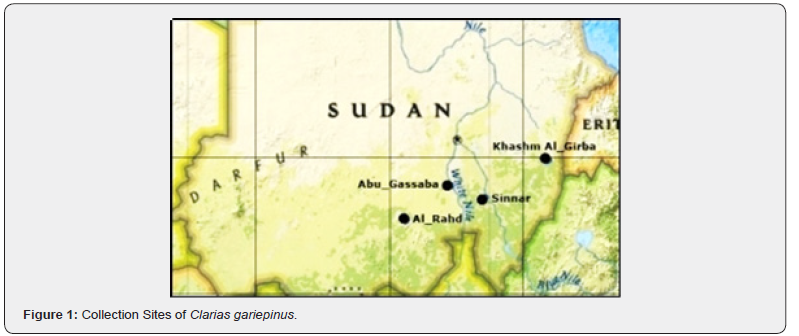
Out of 123 specimens of C. gariepinus, 21 specimens were selected randomly from four sites (Figure 1). The sites were: Site 1 (Sinnar Dam area, the Blue Nile), Site 2 (Khor Abu Gassaba, a seasonal stream fed from the Western Bank of the White Nile), Site 3 (Tordat Al Rahd an ephemeral water body in Northern Kordofan) and Site 4 (Khashm Al Girba, Atbara River). All specimens were purchased from fishers at the site, chilled and immediately transported to the laboratory.
Methods
Fish were identified following [1,12]. The body weight of each specimen was recorded in gm using a Docebel Braun balance.
The proximate chemical analysis followed the Association of official analytical chemists [13]. Each analysis was made in triplicates, and an average was calculated and recorded.
The calorific values were calculated using [5] equation as
follows:
Calorific value (Kcal/100g) = 4.1× Pr otein + 9.3× Fats
Fat to protein ratio was computed according to the equation
used by [5] as follows:
Fat: Protein = Fat%÷Protein%.
Statistical analysis
The data was subjected to Excell Programme Version 2016. The means of chemical composition were compared using Least Significant Difference (LSD) to test any significant differences (p<0.05) between the 4 fish population; as well as estimating the correlation coefficient (r) between the different traits.
Results
The chemical composition of C. gariepinus meat (Table 1) showed insignificant difference (p ≥0.05) between fat in the 4 sites. Site 1 was significantly different (p<0.05) from the other sites in moisture and ash. The highest mean % of moisture (80.038) was from site 4 and the lowest (69.85) was from the samples of site 3. The highest value, for ash, was 1.66 in site 3, and the lowest value was 1.02, in site 4. Sites 2 and 3 were significantly different (p<0.05) from the other sites in protein content, calorific value and fat to protein ratio. The highest mean protein value 43.05 was recorded in site 3 and the lowest 25.23 was from site 1. Sites 2 and 3 were significantly different from sites 1 and 4 (p < 0.05). The calorific value was highest in Tordat Al Rahd samples and the lowest fat to protein ratio was obtained from the same site.
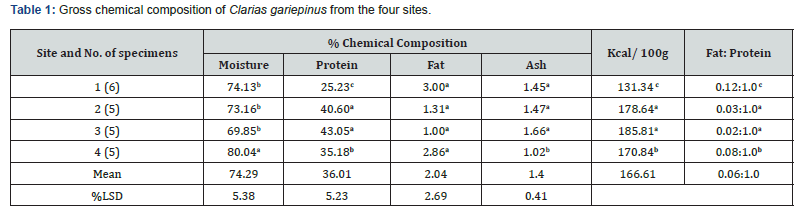
Superscripts with different letter in a column indicate significant differences.
Analysis of variance (Table 2) of the chemical composition from the four sites revealed highly significant difference (p<0.01) in protein, moisture and fat. The calculated F exceeded the tabulated F3,17 at p=0.01 which was 5.185. Insignificant difference (p>0.05) was found in ash, as the tabulate F3,17 at p=0.05 was 3.197. which is higher than the calculate F value.

**= highly significant (p<0.01), NS =not significant.
The correlation between body weight and chemical composition of the fish samples from the four locations is given in (Table 3). High negative correlation coefficient was in ash content from Sinnar and Khor Abu Gassaba. Moderate +ve correlation was recorded for fat from Sinnar and moderate -ve correlation in moisture form Tordat Al Rahd samples. The rest of the correlates are weak.
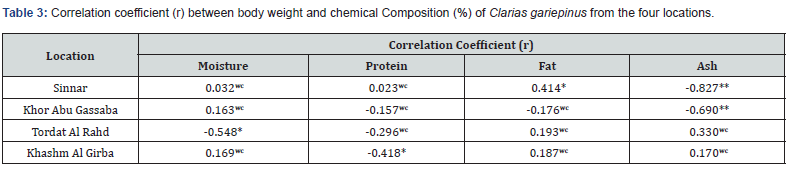
**high correlation r>0.65, *moderate correlation r≥0.649 to p<0.401, weak correlation r<0.40.
Discussion
Clarias gariepinus is an economically important widely distributed fish species in the Sudan [4]. The proximate analysis of fish refers to the quantitative determination of moisture, crude protein, crude fat and ash [14]. The chemical composition of fish varies within and between species depending on its age, sex, environment and season [3]. In this study, the ranges of moisture (69.85% to 80.04%); protein (25.23% to 43.05%); fats (1.0% to 3%); and ash (1.02% to 1.66%) are well within the ranges given by [5,14,15]. The Kcal/100g exceeded 150/Kcal/100g in all studied sites except Sinnar. This valued indicated that C. gariepinus is of a high nutritional value. This in agreement with the findings of [15] in the same species from Egypt. The chemical composition of fish flesh is a reliable predictor of its quality and nutritive value [16] and an important attribute in fisheries industry [17].
The four populations showed significant differences (p<0.05) in protein, moisture and ash contents but not in fat contents (p>0.05). Khor Abu Gassaba and Tordat Al Rahd populations, with the highest protein contents, suggests that the slow current in both sites is among the environmental factors affecting the chemical composition of the fish. Fish samples from the fastflowing Khashm Al Girba and Sinnar have the lowest protein contents. Hagar [4] studied C. gariepinus and claimed that in fast flowing water bodies, the fish use the protein to supplement the needed energy.
According to [18] fish with lower moisture content has a higher lipid and protein content, as well as a higher calorie density. The insignificant differences in moisture and ash contents explains the high protein contents in the four populations. The low fat to protein ratio indicates the flesh of these four populations has a high degree of digestibility. Similar findings were obtained by [4,19]. Also, the four populations have high quantities of protein of edible mater [5,20,21]. The correlation coefficient between body weight and chemical composition percentage of C. gariepinus, from the four locations ranged from weak to high, and from positive to negative correlations.
Claris gariepinus fish are good source of protein, with low fat and a delicious commodity [22,23]. According to [24] carbohydrates and are present in a small percentage of wet mass that is typically assumed to be negligible (p<0.5%).
In conclusion, C. gariepinus could be the fish of choice to start proper fish product industry in Sudan because of its adaptability to the different habitat conditions, its high nutritional value and acceptability as food by the population, but this needs in-depth investigations.
Ethics
Ethics approval and consent to participate, human and animal rights, consent for publication, availability of data and materials are not applicable.
Funding
This study was funded by the Ministry of higher Education and Scientific Research.
References
- Abu Gideiri YB (1984) Fishes of the Sudan. (1st edn), Khartoum University Press, p. 166.
- Van Steenberge MW, Vanhove MP, Chocha M, Larmuseau MH, Swart BL, et al. (2020) Unravelling the evolution of Africa’s drainage basins through a widespread freshwater fish, the African sharptooth catfish Clarias gariepinus. Journal of Biogeography 47(8): 1739-1754.
- Mahmoud HHY (2018) On the Quality of Clarias gariepinus from Tordat El Rahad, North Kordofan. M. Sc. Thesis. Department of Zoology, Faculty of Science, University of Khartoum.
- Hagar EA (2017) Growth and quality of the catfish Clarias gariepinus Cultured in Backyard. Ph. D. Thesis, Department of Zoology, Faculty of Science, University of Khartoum, Sudan.
- Babiker MM (1981) Dietary Nile fishes: A reclassification according to nutritional merit. Sudan Notes and Records 62: 161-170.
- Abolude DS, Abdullahi SA (2005) Proximate and mineral contents in component parts of Clarias gariepinus and Synodontis schall from Zaria, Nigeria. Nigerian Food Journal 23(1): 1-7.
- Ahmed I, Jan K, Fatma S, Dawood MA (2022) Muscle proximate composition of various food fish species and their nutritional significance: A review. Journal of Animal Physiology and Animal Nutrition 106(3): 690-719.
- Keremah R, Amakiri G (2013) Proximate composition of nutrients in fresh adult catfishes: Chrysichthys nigrodigitatus, Heterobranchus bidorsalis and Clarias gariepinus in Yenagoa, Journal of Agricultural Sciences 3(4): 291-294.
- Lal KK, Singh RK, Mohindra V, Singh B, Ponniah AG (2003) Genetic makeup of exotic catfish, Clarias gariepinus in India. Asian Fish Sci 16: 229-234.
10. Vitule JRS, Umbria SC, Aranha JMR (2006) Introduction of the African catfish Clarias gariepinus (Burchell, 1822) into Southern Brazil. Biological Invasions 8(4): 677-681.
- Rocha G (2008) The introduction of the African catfish Clarias gariepinus (Burchell, 1822) into Brazilian inland waters: a growing threat. Neotropical Ichthyology 6(4): 693-696.
- Bailey RG (1994) Guide to the fishes of River Nile in the Republic of the Sudan. J Natural History 28(4): 937-970.
- AOAC (2016) Official methods of analysis. Association of Official Analytical Chemists. Washington D.C., USA.
- Love RM (1970) The Chemical Biology of Fishes. Academic Press, London, U.K, p. 547.
- Nassar AG, Souzan SL, Abdel Aal HA, Abdel-Mobdy HE (2021) Nutritional value of African catfish (Clarias gariepinus) meat. Asian Journal of Applied Chemistry Research 8(2): 31-39.
- Sobczak M, Panicz R, Sadowski J, Polgesek M, Kujawska JZ (2022) Does Production of Clarias gariepinus × Heterobranchus longifilis Hybrids Influence Quality Attributes of Fillets? Food 11(14): 2074.
- Hantoush A, Al‐Hamadany QH, Al‐Hassoon, AS, Al‐Ibadi HJ (2015) Nutritional value of important commercial fish from Iraqi waters. International Journal of Marine Science 5: 1-5.
- Barua PP, Pervez MA, Sarkar D, Sarker S (2012) Proximate biochemical composition of some commercial marine fishes from Bay of Bengal, Bangladesh. Mesopotamian Journal of Marine Sciences, 27(1): 59-66.
- Hagar EA, Mahmoud ZN, Elhag AI (2021) Comparison of nutrients and fatty acid of wild and hatchery fingerlings of Clarias gariepinus fed five formulated feeds and cultured in recirculating aquaculture system. International Journal of Fisheries and Aquatic Studies 9(2): 14-18.
- Thammapat P, Raviyan P, Siriamornpun S (2010) Proximate and fatty acids composition of the muscles and viscera of Asian catfish Pangasius bocourti. Food Chemistry 122(1): 223-227.
- Chaijan M, Jongjareonrak A, Phatcharat S, Benjakul A, Rawdkuen S (2010) Chemical compositions and characteristics of farm raised giant catfish (Pangasianodon gigas) LWT - Food Science and Technology 43(3): 452-457.
- Anarado CJO, Ekolie E, Iziga CG, Anarado C, Eboatu AN (2023) A Comparative Study of the Nutritional Composition, Fatty Acid Profiles and Organoleptic Evaluation of Clarias gariepinus (African Catfish) and Oreochromis niloticus (Nile Tilapia) Raised under Wild and Pond-Cultured Systems. European Journal of Nutrition & Food Safety 15(9): 118-126.
- Askale G, András S, Zsuzsanna JS, Zoltán N, Ali O, et al. (2023) Chemical and Physical Properties of African Catfish (Clarias gariepinus) Fillet Following Prolonged Feeding with Insect Meal-Based Diets. Aquaculture Nutrition 2023(6080387): 9.
- Petricorena ZC (2015) Chemical composition of fish and fishery products. Handbook of Food Chemistry 1(28): 403-435.

























