




 IJESNR Home



Abstract
The global imperative to decarbonise has catalysed an unprecedented demand for “critical minerals,” positioning the energy transition as a cornerstone of modern industrial policy. However, this transition is currently unfolding within a binary governance framework that privileges large-scale, corporate-led mining while systemically marginalising artisanal and small-scale mining (ASM). Despite employing over 40 million people and underpinning local economies in the Global South, ASM is frequently pathologised as a high-risk sector, leading to exclusionary ESG strategies and “de-risking” reflexes that drive miners further into informality.
This article interrogates the “Decarbonisation Paradox”: the reality that securing “clean” minerals for the Global North often inadvertently “outsources” environmental degradation and social inequity to the Global South. By synthesising current research on livelihood displacement, “Development Minerals,” and the gendered inequities of resource governance, I argue that the current trajectory of the Green Transition risks reinforcing a two-tiered global economy.
Drawing on evidence from unstable political settlements and the failed “rituals of inclusion” in mineral policy, this research contends that formalisation is not merely a development objective but a strategic necessity for global supply chain integrity. True sustainability requires moving beyond punitive “crackdowns” toward state-led, inclusive formalisation that provides technical assistance for mercury-free processing and legal security for miners. This study concludes that the global energy transition will remain structurally and ethically flawed until ASM is integrated as a formal, legitimate frontline of the green economy.
Keywords: Artisanal and Small-scale Mining (ASM); Green transition; Formalisation; Critical minerals; ESG; Just transition
Introduction
The Global North’s commitment to a low-carbon future is predicated on a massive, unprecedented scaling of mineral extraction. While the transition away from fossil fuels is nonnegotiable for climate stability, the “Green Transition” is currently unfolding within a binary framework that privileges large-scale, corporate-led mining (LSM) while pathologising artisanal and small-scale mining (ASM). Despite employing an estimated 40-45 million people globally [1], ASM is frequently treated as a “risk” to be mitigated or an obstacle to be cleared, rather than a vital component of global resource governance.
This article argues that the current focus on “critical minerals “has inadvertently deepened the marginalisation of the ASM sector. The study contends that the exclusion of artisanal miners from formal green energy supply chains does not eliminate environmental or social impacts; instead, it “outsources” these liabilities to the informal shadow economy. Without a radical shift toward state-led formalisation, the global energy transition will remain structurally flawed, failing the very Sustainable Development Goals (SDGs) it purports to uphold.
Expanding the Rhetoric: The Myth of “Clean” Supply Chains
Current international governance, exemplified by the OECD Due Diligence Guidance [2], seeks to sanitize mineral origins through rigorous auditing. However, this creates an “Exclusionary ESG” environment. When global markets demand “conflict-free” or “mercury-free” minerals without providing the infrastructure for formalisation, they trigger a “de-risking” reflex among investors. This reflex incentivises the avoidance of ASM-heavy regions, effectively cutting off millions from legal markets [3,4].
The rhetoric of “clean” energy is further complicated by the “pendulum movement” of unstable political settlements [5]. In regions like Peru and Ghana, miners oscillate between brief periods of state tolerance and aggressive “crackdowns” that favour large concessions [4,5]. This instability prevents long-term environmental stewardship. For instance, while the Minamata Convention [6] mandates the reduction of mercury, informal miners cannot invest in retort technologies or mercury-free processing without the legal security of a mining licence. Consequently, the world’s demand for “clean” lithium or cobalt often displaces local labour into unregulated, mercury-intensive gold mining as a desperate survival strategy [7]. This sort of neglect has also been identified in the areas of development minerals.
The Development Mineral Gap and Livelihood Displacement
A critical oversight in the “critical minerals” discourse is the neglect of “Development Minerals”—materials like sand, clay, and gravel used for local domestic growth. As Kamlongera [8] demonstrates in Malawi, these resources are essential for local resilience but are ignored by global policymakers focused on export-oriented commodities.
Furthermore, the expansion of LSM for the low-carbon transition often leads to “mineral exhaustion” and the displacement of local communities [7]. In such contexts, the “ritual of inclusion” [9]—whereby women are nominally invited to governance meetings—fails to address deep-seated inequities. Research in Thailand and Ghana confirms that despite the rhetoric of SDG 5 (Gender Equality), women in ASM remain relegated to the most precarious roles with the least legal protection [10,11]. In order to significantly contribute to addressing this issue, it is imperative to note that strategic formalization can play a huge role [4].
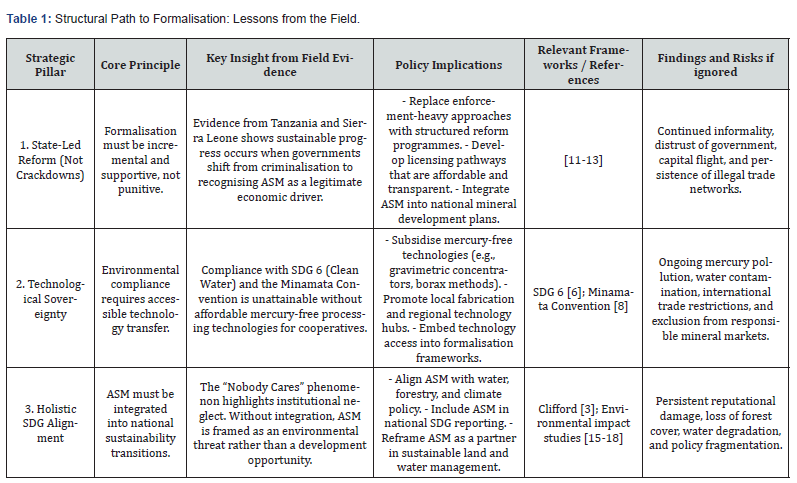
Structural Path to Formalisation: Lessons from the Field
Formalisation must move beyond a “one-size-fits-all” legal
stamp and be built “block by block” [4]. A credible 2026 global
strategy (see table 1) requires:
a) State-Led Reform over Crackdowns: As seen in Tanzania
and Sierra Leone, sustainable progress occurs when the state
moves from punitive “informality” to supportive policy reforms
that treat ASM as a legitimate economic driver [12-14].
b) Technological Sovereignty: Compliance with SDG 6
(Clean Water) [8] and the Minamata Convention [6] is only possible
if formalisation includes the transfer of mercury-free processing
technology at costs accessible to small-scale cooperatives.
c) Holistic SDG Alignment: We must move past the
“Nobody Cares” phenomenon described by Clifford [3]. If ASM is
not integrated into the transition, the sector will continue to be a
perceived threat to water supply and forest cover [15-18].
Conclusion: Beyond the Green Wash
The “Green Transition” currently stands at a moral and strategic crossroads. The pursuit of a low-carbon grid cannot be considered “sustainable” if it relies on a two-tiered global economy: a regulated, high-tech Global North and an informal, mercury-soaked Global South. As research into COVID-19’s impact on mining communities highlighted, the informal sector is exceptionally resilient but dangerously vulnerable to global shocks [18,19].
To move forward, the international community must reject the “de-risking” model that excludes artisanal miners in favour of an “engagement” model that formalises them. This is not merely an act of charity; it is a geopolitical necessity. If 45 million miners remain outside the formal economy, the global mineral supply chain will remain susceptible to shadow markets, human rights abuses, and environmental degradation that no “green” certification can truly erase. The transition must be “Just,” or it will not be truly “Green” [20-23].
References
- World Bank (2020) State of the Artisanal and Small-Scale Mining Sector 2020. International Bank for Reconstruction and Development/The World Bank & Pact.
- OECD (2016) OECD Due Diligence Guidance for Responsible Supply Chains of Minerals from Conflict-Affected and High-Risk Areas (3rd edn). OECD Publishing, Paris.
- Clifford MJ (2022) Artisanal and Small‐Scale Mining and the Sustainable Development Goals: Why Nobody Cares. Environmental Science & Policy 137: 164-173.
- Hilson G, Bartels E, Hu Y (2022) Brick by brick, block by block: Building a sustainable formalization strategy for small-scale gold mining in Ghana. Environmental Science & Policy 135: 207-225.
- Vila Benites G, Villanueva Ubillús A (2022) The pendulum movement: Unstable political settlements for artisanal and small-scale mining in Peru. Environmental Science & Policy 136: 78-90.
- UNEP (2013) Minamata Convention on Mercury: Text and Annexes. United Nations Environment Programme. [Adopted 2013; Entered into force 2017].
- Pedersen AF, Nielsen JØ, Friis C, Jønsson JB (2021) Mineral exhaustion and its livelihood implications for artisanal and small-scale miners. Environmental Science & Policy 119: 34-43.
- Kamlongera PJ (2024) Harvesting “development minerals” for local needs in sub-Saharan Africa: The case of Malawi. Environmental Science & Policy 160: 103851.
- Buss D, Rutherford B, Kumah C, Spear M (2021) Beyond the rituals of inclusion: The environment for women and resource governance in Africa’s artisanal and small-scale mining sector. Environmental Science & Policy 116: 30-37.
- Lawson L, Chowdhury AR (2022) Women in Thailand’s gem and jewellery industry and the Sustainable Development Goals (SDGs): Empowerment or continued inequity? Environmental Science & Policy 136: 675-684.
- Yakovleva N, Vazquez-Brust DA, Arthur-Holmes F, Busia KA (2022) Gender equality in artisanal and small-scale mining in Ghana: Assessing progress towards SDG 5 using salience and institutional analysis and design. Environmental Science & Policy 136: 92-102.
- Kinyondo A, Huggins C (2021) State-led efforts to reduce environmental impacts of artisanal and small-scale mining in Tanzania: Implications for fulfilment of the sustainable development goals. Environmental Science & Policy 120: 157-164.
- Maconachie R, Conteh F (2021) Artisanal mining policy reforms, informality and challenges to the Sustainable Development Goals in Sierra Leone. Environmental Science & Policy 116: 38-46.
- Ogan DD, Ndekugri IE, Oduoza CF, Khatib JM (2016) Principles for developing an effective framework to control minerals and rocks extraction impacts, mitigate waste and optimise sustainable quarries management. Resources Policy 47: 164-170.
- Niesenbaum RA (2020) Artisanal Gold mining in Las juntas de Abangares, Costa Rica: Approaches and barriers to achieving sustainability objectives. Resources Policy 114: 470-477.
- Hirons M (2020) How the Sustainable Development Goals risk undermining efforts to address environmental and social issues in the small-scale mining sector. Environmental Science & Policy 114: 321-328.
- Perks R, Schneck N (2021) COVID-19 in artisanal and small-scale mining communities: Preliminary results from a global rapid data collection exercise. Environmental Science & Policy 121: 37-41.
- Ogan DD, Moses T, Yenneti K, Hampton P (2025) Sustainable mining principles: optimizing its application to enhance small-scale gold mining in developing countries. Affiliation, Faculty of Science and Engineering, University of Wolverhampton, Issue Date; 2025-02-28.
- Ogan, D.D., Moses, T. and Yenneti, K., (2024). Formalization: optimizing its principles for improving small-scale gold-mining. Affiliation, Faculty of Science and Engineering, University of Wolverhampton, Issue Date; 2024-07-13.
- Oakley P (2022) Searching for pure gold: The impact of ethical gold sourcing certification programmes in the UK and Switzerland. Environmental Science & Policy 132: 101-108.
- Sadan M, Dan SL (2021) The role of artisanal mining in the sustainable development of Myanmar’s jadeite industry. Environmental Science & Policy 126: 189-196.
- Laing T, Moonsammy S (2021) Evaluating the impact of small-scale mining on the achievement of the sustainable development goals in Guyana. Resources Policy 116: 147-159.
- Hilson AE (2025) Women in development minerals: Artisanal and small-scale mining, governance, and the SDGs. Environmental Science & Policy 164: 103980.

























