




 IJESNR Home



Abstract
Using geo-chemical indices, this study evaluates the ecological risk of liquid waste on surface water in the Escravos estuary in Warri South-West LGA, Nigeria. The result revealed that pH ranged from 5.90 to 6.80, temperatures were steady between 27.0 and 27.5°C, and the turbidity was high, over the standard limits, owing to pollution from anthropogenic activities. Threatening health, the levels of heavy metals Cd (0.062-0.211mg/L), Hg (0.027-0.081mg/L), Cr (0.011-0.410mg/L), and Pb (0.017-0.040mg/L) were all above the standards set by the WHO. The geo-chemical indices (CF, MPI, PLI, HEI, mCd, PIS, and WQI) showed moderate to severe pollution; the most polluted areas were ES01/02 (WQI: 42,206) and ES02/01 (HEI: 44.88), both of which were caused by industrial effluents. With WQI of 15,272, ES03/01 (x) was the cleanest sample, though other samples had high concentrations of Cd and Pb. Among the public health and ecological concerns raised by the results are the potential for bioaccumulation in aquatic organisms and the long-term impacts of exposure, such as neurotoxicity and kidney impairment. This finding suggests that to protect water resources and reduce pollution in the Niger Delta area, immediate remediation and stronger regulatory interventions are needed.
Keywords:Ecological risk assessment; Liquid waste; Surface water; Warri south-west LGA; Delta state
Introduction
All forms of life depend on water, which also plays a crucial role in maintaining ecosystems and propelling economic and social progress [1]. Severe water contamination, especially in estuarine habitats, has resulted from growing industrialization, urbanization, and inadequate waste management procedures [2]. A growing number of studies have shown that water contamination is a serious problem on a worldwide scale [3-5]. The extraction of surface or underground water sources for domestic, commercial, and agricultural purposes is a direct result of this problem. Water quality has decreased and contamination has happened as a result of the global spread of industry. Many factors affect the physical and chemical properties of surface and groundwater, both naturally (rock-water leaching interaction and seawater intrusion) and artificially (mine, industrial contamination, overuse of pesticides and fertilizers, and domestic sewage) [6-9]. Contamination of surface water sources has negative effects on resource availability and appropriateness and is detrimental to human health. Due to the hidden danger of water contamination and the complicated networks of surface or ground waters, treating polluted water is also time-consuming and costly [10]. In order to determine the potential for pollution and the consequences on human consumption, it is crucial to evaluate and monitor water quality.
[11,12] both agree that surface or ground water modeling is one of the many beneficial approaches for understanding these systems and detecting current water concerns. Building such models, however, calls for specialized equipment because of the hydrological system’s complex and varied characteristics. Accurate and precise monitoring of surface water resource information, proper wastewater treatment facilities to remove waste from water, and a better understanding of hydrological processes and behavior are the most important elements in effectively managing and enhancing water quality [13].
In the Warri South-West Local Government Area (LGA) of Delta State, Nigeria, there are a number of estuaries that are home to an important aquatic ecosystem that facilitates oil exploration, transportation, and fishing. The estuaies are economically and ecologically important, but they are also severely polluted due to petroleum, industrial effluents, and home sewage [14]. These estuaries are located in the Niger Delta region, which has been severely damaged by decades of oil exploration and lax regulatory enforcement, according to [15]. Water quality has declined, biodiversity has declined, and local populations are at risk of health problems due to liquid waste pollution in the estuaries. Estuaries are home to dangerous concentrations of organic pollutants, hydrocarbons, and heavy metals, according to research [16]. Regardless of these worries, there is still a lack of thorough studies that should be doing an evaluation of the pollution levels and their effects on the Escravos Estuary in the long run. This research aims to address these critical knowledge gaps by; (i) determine the presence of heavy metals (Cd, Hg, Cr and Pb) and physiochemical parameters (Temperature, pH, Turbidity, C.O.D, D.O, and TDS) on water resource through comparison with [17] standard in the study area; (ii) evaluate the potential ecological risk through the application of models, such as; the Contamination Factor (CF), Metal Pollution Indexes (MPI), Pollutant Load Index (PLI), Heavy Metal Evaluation Index (HEI), Modified Degree of Contamination (mCd), Pollution Index of Surface water (PIS), and Water Quality Index (WQI): (iii) assess the potential dangers that these parameters give to human health; and (iv) implement measures to lessen the impact of heavy metal content on the research area’s surface water quality. This research will help strengthen the enforcement of effluent discharge limits update on Niger Delta water quality standards, and reduce human exposure and health risks. It will also provide important information for stakeholders and legislators to implement effective interventions.
The primary objectives of this study are to: Compile and synthesize existing paleontological data on fossilized amphibians, reptiles, and bird focusing on significant paleontological contributions, such as the first records and newly described species. It also aimed to provide a consolidated reference for future research on the vertebrate paleofauna of Sudan.
Materials and Methods
Research areas
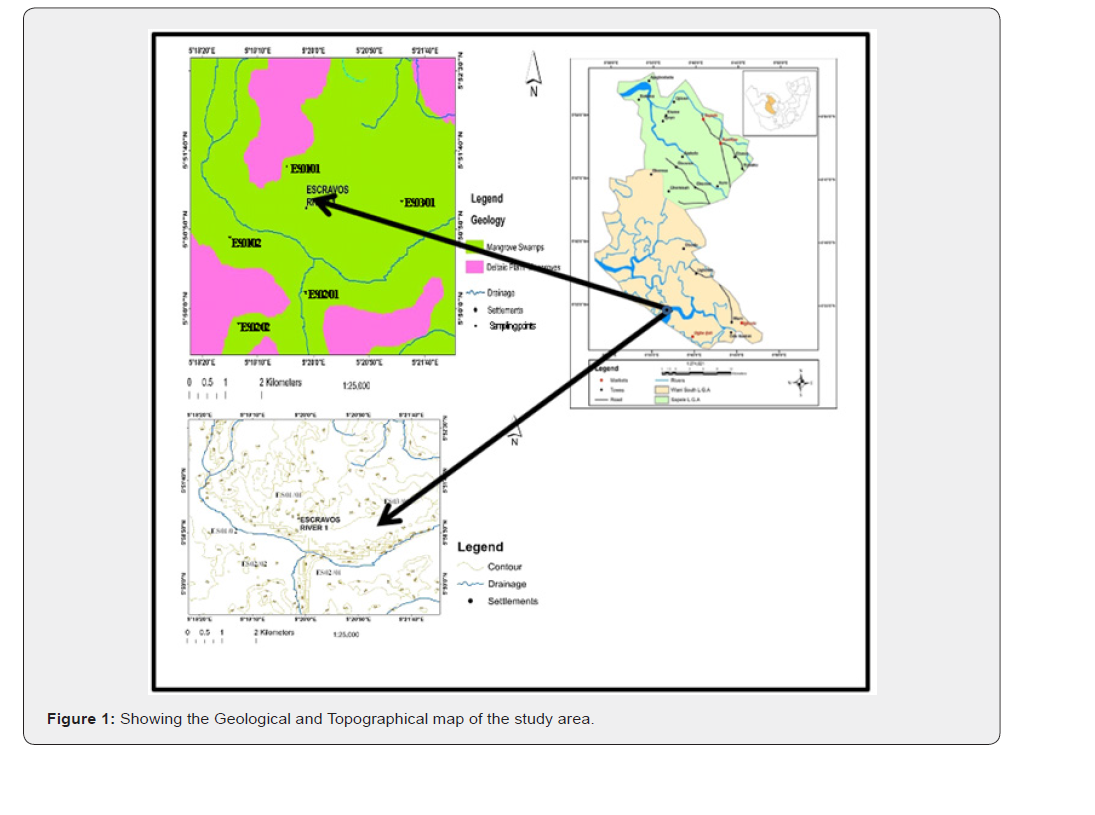
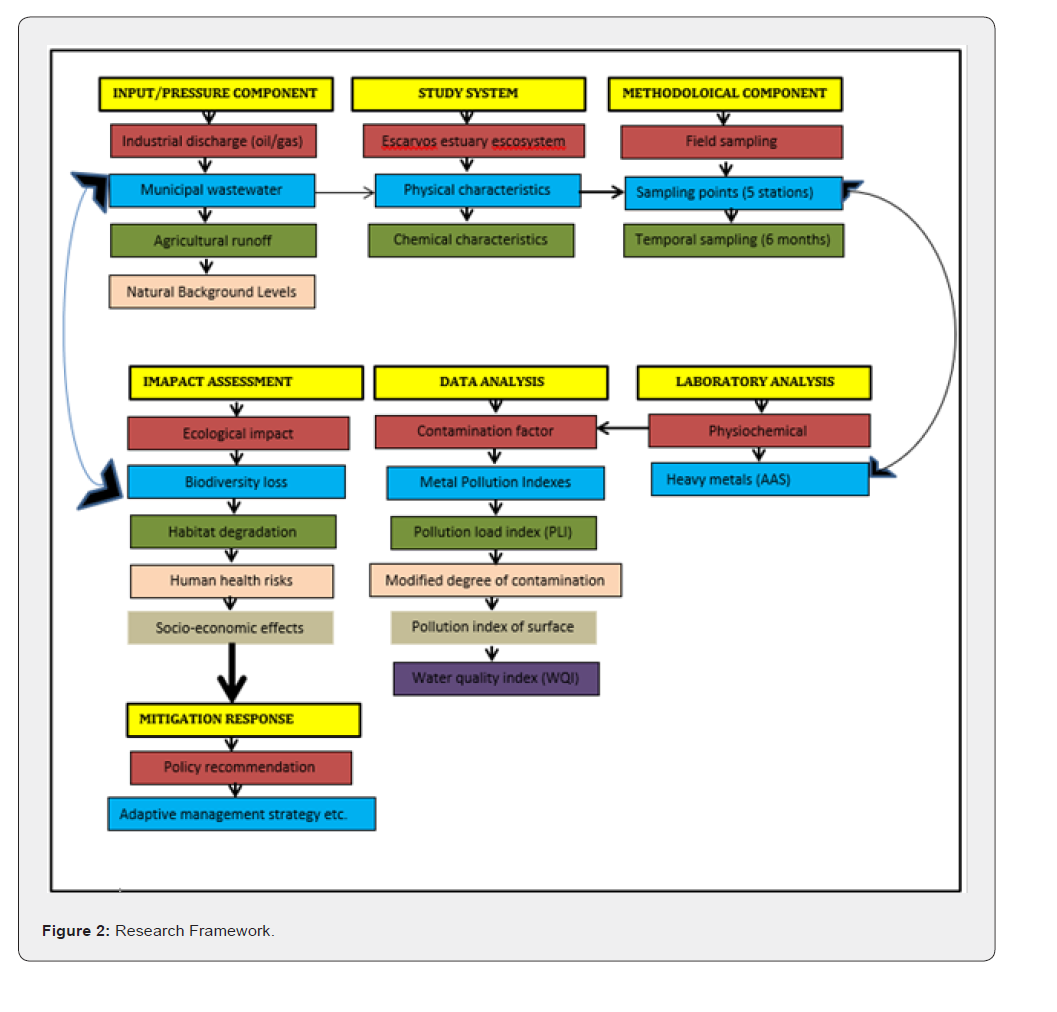
A crucial waterway in Nigeria, the Escravos Estuary is situated in the Warri South-West Local Government Area (LGA) of Delta State. Geographically, the region is bounded by the Equator at latitudes 5°50′0′′N and 5°51′40′N and by longitudes 5°18′20′′E and 5°21′40′E. Additionally, it is a dynamic brackish water environment that forms at the confluence of the Escravos River and the Atlantic Ocean [18]. Figure 1 include a topographical and geological map of the regions that were examined. According to [19] the study location has been the scene of multiple oil spills, each of which has had a catastrophic effect on the inhabitants’ access to clean water, farmland, ecosystems, and overall living conditions. The estuary is home to migrating birds, fish, and mangrove forests. It is also a key passageway for oil exports (Chevron’s Escravos Terminal) and fishing. That is affected by the dispersion of pollutants due to the diurnal tides. [20] stated that hydrocarbons, heavy metals (Pb and Cd), and drilling fluids are discharged by the Escravos Terminal and adjacent flow stations. Seasonal changes, like the dusty harmattan (November–March) and the turbulent season (April–October), have a major influence on the areas. Each typically receives 3000 mm of precipitation. Humans have had a profound impact on the mangrove ecological swamp forest that Escravos exists in, turning a large portion of it into grassland [21]. Escravos, on the other hand, are defined by their shallow beaches, which are essentially a product of the geological architecture of the recent Niger Delta. From 26 to 28 degrees Celsius is the usual range for the hot weather. Based on research conducted by [22] the coastal portions of the Niger Delta typically see a wind speed sequence of 0 to 3m/s once a month. The late afternoon and overnight hours can witness cycles of higher or lesser fluctuation.
A stratified random sampling approach was adopted to ensure representative coverage of: Industrial zones (near Chevron terminal), residential discharge points, agricultural runoff areas and control sites (upstream less-polluted areas). A preliminary site inspection was done prior to sample collection to guarantee the use of effective sampling methodologies. In all, five (5) surface water samples were taken at monthly collections over 6 months (covering wet and dry seasons) with pre-acid washed plastic sample vials or containers to eliminate potential contamination from the test and control sites between 8 and 10 am, at a depth of 0-30cm depth during high tides. Two drops of nitric acid were added to stabilize the samples’ contents and prevent metals from clinging to the container’s surface. The samples were preserved with HNO₃ (for metals) stored at 4°C during transport to laboratory.
Sample preparation and digestion
Each water sample, measuring 50cm³, were digested in a steam bath with a mixture of concentrated acids (HNO3, HCl, and H2SO4 in a ratio of 5:3:2). Clarity or lack of color in the solution indicated that digestion was complete. Filtration was performed on the samples after digestion to ensure they were compatible with 50cm³ of deionized water. Using an atomic absorption spectrophotometer, the HM concentration in the final filtrate was evaluated. Subsequent to each five sample analyses, the equipment underwent a blank test to ensure consistently accurate results. Every sample was run through three separate assays for every metal, and the findings were presented as means and standard deviations [23]. Both the data collection and the analysis followed the established protocols [24]. For this study, the researchers used a Perkin Elmer PINNACLE 900T atomic absorption spectrophotometer that had previously been calibrated using known standard quantities of the heavy metals involved. Adopting these approaches ensures accurate measurement of even trace amounts of pollutants, which is vital for a thorough evaluation of ecological risks.
Contamination factor (CF)
The index CF, which is divided into four grades; low degree (CF < 1), moderate degree (1 ≤ CF < 3), significant degree (3 ≤ CF < 6), and extremely high degree (CF ≤ 6), was suggested by [25] as a means to track the pollution of a certain metal over time. As a function of both the observed concentration and the metal’s natural abundance, the index CF is defined. As a result, the CF value has historically served as a means of monitoring the concentration of a certain metal in water.
The CF was calculated using the formula proposed by [26].

With; the metal concentration denoted as Cn and the background/target value denoted as Bn [27].
Metal pollution indexes
Using the methodology described by [28], the MPI was evaluated. A comprehensive assessment of the impact of heavy metals on water quality was conducted by the PI [29]. Equation 1:

In this case, the metal concentration is shown by Mn.
Pollution load index (PLI)
PLI is the contamination factor (CF) of the target heavy metals raised to the power of the nth root. A number of authors have made use of PLI to grade the water quality. We measured the PLI of the combined approaches of the four heavy metals according to [8,25]. The site and estuary are becoming less and less clean with time, as demonstrated by PLI values > 1, where PLI = 1 indicates the presence of only a baseline amount of pollutants and PLI = 0 indicates perfection. By calculating the sample’s relative toxicity to each of the four metals, the PLI determined the sample’s total toxicity level. To find PLI, [26] formula was used.
The result of the integral of;

Where:
“n” is the number of elements and “CF” denotes the
contamination factor.
Heavy metal evaluation index (HEI)
The HEI has been a true tool for improving the understanding of contaminated sites. Several mean qualities were employed to distinguish between the different levels of contamination, and HEI model values were generated for each instance according to their distinct mean qualities. Accordingly, the recommended HEI metrics for the given examples are as follows: low (HEI < 10), medium (HEI = 10-20), and high (> 20). An overall evaluation of the water’s heavy metal quality is provided by the HEI, which is computed in the following way.

Where;
For each ith parameter, Hc is the monitored value and Hmac is
the maximum permissible concentration (MAC).
Modified degree of contamination (mCd)
A number of researchers have utilized [26] modified degree of contamination (mCd) to quantify the amount of heavy metal pollution in surface and groundwater [21]. According to [29], the levels of mCd were classified as follows: extremely mCd < 1.5 is an exceptionally low level of pollution, 1.5 ≤ mCd < 2 is a low level of pollution, 2 ≤ mCd < 4 is arranged as a moderate level of pollution, 4 ≤ mCd < 8 is high level of pollution, 8 ≤ mCd < 16 is said to have an extremely high level of pollution, 16 ≤ mCd < 32 is said to have a very extremely high level of pollution, mCd > 32 is said to have Ultra-serious level of pollution.

Where:
n is the count of elements that were examined, and Cf^i is the
level of contamination. With this vague and generic formula to
determine the mCd, the study is able to include any number of
metals without restriction.
Pollution index of surface water (PIS)
A device that determines the suitability of surface water for human consumption is the PIS. According to [30] using the PIS involved five considerations. First, on a scale from 1 to 5, determine each figure’s relative weight (Rw) that represents the evaluation of water quality in relation to human health. Step two involves establishing the weight boundary (Wp) for each groundwater quality variable in order to widely ascertain each variable’s overall commitment to the groundwater quality status (Eq. 5). It is in Step III that the focus status (Sc) is determined. The water variable substance (C) in each example was divided by the matching quality standard breaking point (Ds) provided by Eq. 6 to achieve this.
Measurements used to survey the PIS in this study were those developed by [17]. Step IV calculates the overall nature of the surface water (Ow) by multiplying the weight boundary (Wp) by the fixation status (Sc) (19). Every single Ow value from each and every test (Eq. 7) needs to be part of Step V. The PIS technique has been utilized by numerous analysts due to its high utility in identifying surface and groundwater water properties [30,31]. All of the PISs for the examples was determined. A value of Ow above 0.1, as demonstrated by [30] denotes the instance accounts for 10% of the PIS is 1.0.

One study found that there are five levels of contamination in drinking water, as reported by [25] and another by [31]. Hence, contamination levels are indicated by the following: 1(<1) for minimal, 1-1.5 for low, 1.5-2.0 for moderate, 2.0-2.5 for high, and > 2.5 for extremely high.
Water quality index (WQI)
By combining various parameters, the overall quality of groundwater can be determined using a WQI. There has been an evaluation of the research region’s surface and groundwater quality for human consumption using the WQI. With a score below 50, the water is considered to be of excellent quality and suitable for both drinking and irrigation. A score between 50 and 100 is considered good, and the water can be used for both purposes. A score between 100 and 200 is considered poor, but it can still be used for industrial and irrigation. Finally, a score between 200 and 300 is considered to be extremely poor, and the water can only be used for irrigation. The water must be treated if its WQI score is greater than 300, as stated in studies by [21,27,32]. In the study, we used a weighted math list condition to find the palatable score scale (qi) for each boundary in the WQI. This was done by dividing the sample concentration (Ci) in each groundwater design by its WHO standard (Si). The product’s final value is then multiplied by 100.
By comparing the value to the WHO (Si), we were able to determine its relative weight (Wi):

qi is the quality parameter for the ith parameter, and wi is the weight parameter for the ith unit.
Results
Physiochemical and heavy metal attributes of surface water
The following table presents significant physicochemical and heavy metal parameters derived from surface water samples collected in the Escravos estuary in Warri South-West LGA. Data were compared using [17] criteria to assess pollution levels and potential health risks. Table 1 shows the temperature values (oC) ranging from 27.0 to 27.5°C, with an average of 27.25 and an SD of 23.46, as determined by the physicochemical properties of the surface water in the study area. The findings show no change, suggesting that the environmental conditions at each site of sampling are stable. All of them are up to standard with what the [17] considers to be acceptable for both controlled and uncontrolled sample scenarios. Due to its nature as a measurement of the water sample, thermal state is an important factor in chemical and biological processes [33]. With a range of 5.90 to 6.80 and an SD of 12.31, the pH value is, on average, at 6.35. Although these results are within the range of values provided by the WHO they do indicate environments that are slightly acidic to slightly alkaline, with ES03/01 having the most acidic conditions (pH 5.9). This acidic condition could be a sign of natural organic deterioration or industrial discharge, like petrochemical pollution; because low pH can harm pipes and makes heavy metals more soluble [34]. With a standard deviation of 1.78 and a range of 60.4 to 127 values, the turbidity value (NTU) is computed with an average of 93.70. The findings showed that the maximum levels in every one of the examined areas were greater than the 0–5 threshold that the WHO had established as its standard limit. With 127 NTU, ES01/01 was the most turbid site, indicating that oil and gas operations, untreated sewage, and industrial effluents are to blame for the water quality problems. With 60.4 NTU, ES03/01 was the least damaged area.
With an SD of 1.68 and a range of 0.72-1.10mg/L, the level of COD values average out at 0.91mg/L. Low COD levels (≤1.10mg/l), indicating organic contamination, but no WHO criterion. Additionally, a slightly greater COD was noted in ES01/02 and ES02/02 (1.10mg/l), which could be due to the organic waste input. For example, petroleum hydrocarbons are not biodegradable and can constitute such organic waste. The DO value is an average of 7.1mg/L, with a range of 5.8-8.4mg/L. Furthermore, in the study it was observed that all sites met or surpassed WHO criteria, according to the results, with the highest DO found in ES02/01 (8.4mg/l). While this indicates that overall levels are sufficient for aquatic life, it does imply that pollution hotspots may cause localized depletion. In accordance with [17] 500mg/l standard, the TDS value range is 27.6-111.75mg/L. All sampled areas were found to have low salinity, with an average TDS value of 99.61mg/l, significantly also below the WHO standard. Although ES01/02 has the greatest TDS at 111.75mg/l, the purest solution in terms of dissolved solids is ES03/01 (x) which is the controlled site with 27.6mg/l. Even if there are not any serious salinity problems, there may be effluent discharge from nearby industries (ES01/02) because of the greater TDS. With an SD of 0.307, the average Cd value (mg/L) is 0.112. From 0.062 to 0.211, we get the lowest and highest numbers, respectively.
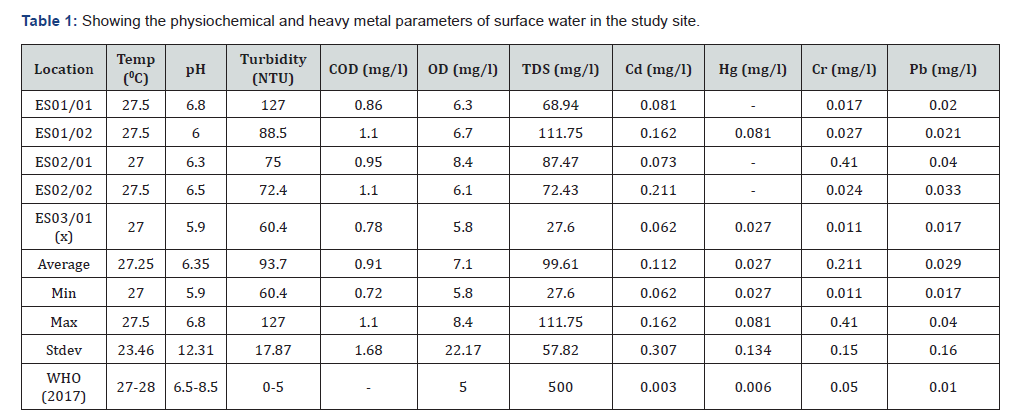
Therefore, with the exception of the most polluted site, ES02/02, the level of Cd in all of the samples was higher than the WHO limit of 0.211mg/l. As a result, kidney and liver failure, pulmonary edema, testicular damage, osteomalacia, adrenal gland and hemotopoietic system injury, and other symptoms might be observed in humans after an acute exposure to Cd [35,36]. Various values for Hg (mg/L) were recorded, ranging from 0.027 to 0.081, with 0.027 being the average and 0.134 being the SD. Only in ES01/02 (0.081mg/l) and ES03/01 (0.027mg/l) was Hg discovered in the study region. According to the Hg levels, every single one of the places that were sampled was over the recommended threshold of 0.006 set by [17]. This point to an increase in Hg levels at the controlled site(x). The earth’s crust also contains mercury, another ubiquitous element. This substance occurs naturally in brackish water at concentrations below 0.5mg/L. The oxidized form of mercury is particularly important for human nutrition [34]. A person’s bioavailability, age, gender, and physiological condition are some of the factors that determine the minimal daily requirement of mercury, which is predicted to be 10-50mg [31]. From 0.011 to 0.410mg/L, the average concentration of Cr is 0.211 (mg/L). All of the studied areas in ES02/01 had Cr levels over the permitted WHO limit of 0.410mg/l, which is primarily due to industrial pollution. All sites have Pb concentrations higher than 0.017-0.040mg/l. This is four times the maximum with ES02/01. The presence of Pb in surface water samples is likely due to pollution from human activities.
Evaluation of the potential health risk through the application of various geo-chemical models Contamination factor (CF)
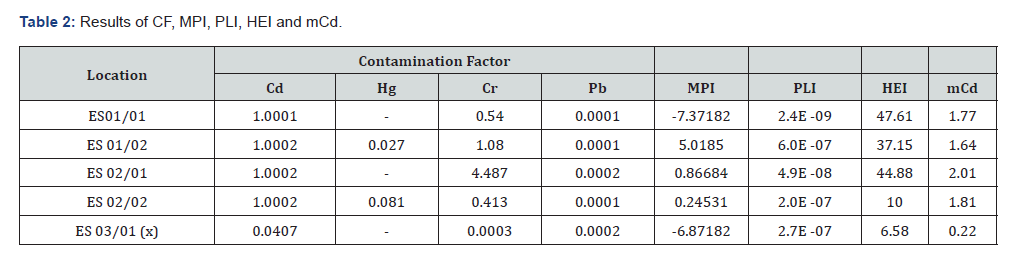
The CF analysis results for the research area are shown in Table 2. A CF value below 1 was observed in all samples except Fe, suggesting a minimal level of contamination. The remaining 26.2% of samples, which are indicative of a moderate level of contamination, fell between 1 and 3.
Table 2 shows that Cd concentrations varied from 0.0407 to 1.0002 throughout the research region. So, with the exception of site ES03/01 which displays a considerably lower value of 0.407, the majority of the sampling sites displayed extremely high Cd levels. Because of its toxicity, elevated Cd levels in the studied areas are typically indicative of industrial discharges, especially waste from oil refineries. Damage to the kidneys and bioaccumulation in aquatic creatures are two major health concerns that might result from this kind of pollution [37]. The concentrations of Hg ranged from 0.027 to 0.081. In addition, the study found that minimal Hg contamination was seen across all sampling locations, with the exception of two sites (ES01/02 and ES03/01 (x)), which had low Hg values of approximately 0.08. The amounts of Cr varied between 0.0003 and 4.4870. Sites like ES02/01, which had a Cr level of 4.4870, was probably attributed to petroleum processing. A high level of Cr poses a threat to aquatic ecosystems and human health in the study area. Hexavalent chromium Cr (VI), for instance, is known to be carcinogenic in human [38]. The CF values ranged from 0.0001 to 0.0002, indicating extremely low Pb contents suggesting that it may have been caused by small amounts of runoff from industrial effluents. The presence of low Pb content in the study is in line with N [39] study carried out on surface water in industrial region in Gazipur, Bangladesh that revealed low level of Pb contamination at all test sites.
Heavy metal pollution indexes (MPI)
Notably, ES01/01 (-7.37182) and ES03/01 (x) (-6.87182) showed negative values inside the range according to the MPI analysis results indicated in Table 2. Though, the Niger Delta streams may be experiencing dilution effects or tidal flushing processes, which could explain these negative results, which most likely reflect pollution levels below the baseline. On the other hand, pollution is indicated by positive MPI values at ES01/02 (5.01850) and ES02/02 (0.24531), where greater values indicate more significant contamination. Because these locations are so close to industrial discharge points, the quantities of pollutants such heavy metals and hydrocarbons are likely to be higher, contributing to the water pollution. This seems to be similar with [40] study that found that surface water in the Arieș River Basin Mining Area, Romania, is highly polluted. Their study used the MPI to determine that the middle section of the Arieș River basin, close to and downstream from the gold mine impoundment, is particularly polluted. The MPI value of (0.866846) at ES02/01 also indicates a moderate to low amount of pollution, which may be caused by human activities. This also agrees with the findings of [41], who found that groundwater MPI levels in Iraq were significantly lower than the critical index value of 100 but contradict that of [42] carried out in Illorin, North-central Nigeria which revealed a high MPI in surface water.
Pollution load index (PLI)
The presence of harmful contaminants, such as heavy metals, from industrial discharges, poor sewage disposal, or oil-related contamination, was indicated by the highest PLI value of 6.0 × 10⁻⁷ in sample ES 01/02 in the study as shown in Table 2. Because of their ability to enter water supplies through drinking water, these pollutants represent serious threats to aquatic ecosystems and human health. In contrast to ES 02/01 value of 4.9 × 10⁻⁸, Sample ES 02/02 displayed a moderate PLI of 2.0 × 10⁻⁷. Possibly caused by intermittent pollution sources, these moderate levels indicate detectable but not severe contamination. However, they do provide a possible risk of waterborne diseases including cholera and typhoid, as well as low-level deposition of heavy metals in aquatic food chains. On the other hand, sample ES 01/01 showed modest leakage risk with a PLI of 2.4 × 10⁻⁹. There was very little contamination at Site ES 03/01, as indicated by the even lower PLI of 2.7 × 10⁻⁹. Based on the result obtained from the study it is suggested that quick investigation actions should be taken for this site due to the significantly high PLI and the health hazards it poses. The PLI values of samples ES 01/01 and ES 03/01 are rather low. This result of this PLI validates the result of the CF in this present study. This result is consistent with the findings of [21] and [27]. Because the studies are conducted within the same geologic formation, it implies that factors that impact one place also have an impact on other areas.
Heavy metal evaluation index (HEI)
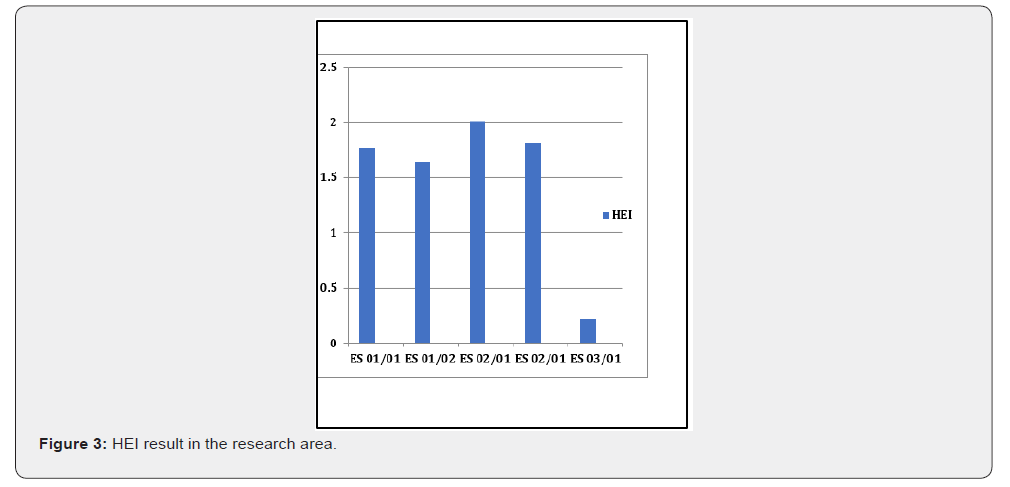
A number of sample sites showed extremely high levels of contamination according to figure 1. The HEI values for ES01/01 and ES02/01 from the result obtained were 47.61 and 44.88, respectively, which is rather high. These numbers indicate that heavy metal pollution is significant, which is most likely due to effluents from refineries and petrochemical plants. Toxic heavy metals, such as, Pb and Cd may have contributed and caused extensive damage to the environment; hence, such increased HEI readings indicate their presence. Because of this pollution, toxic metals can also bio accumulate in fish, which puts people at risk when they eat them. Also, chronic illnesses, such as renal damage, malignancies, and neurological diseases, can emerge from prolonged exposure to polluted water source [43].
Furthermore, with a HEI of 37.15, ES01/02 showed a significant amount of pollution, likely from comparable industrial sources, but to a lesser extent. At ES02/02, on the other hand, the pollution level was moderate, with a HEI score of 10.00, indicating that the industrial impact was not as severe. In contrast, ES03/01 had a reasonably clean HEI of 6.58, indicating a low pollution level. This finding lends credence to the idea that the other locations are actually significantly polluted.
Modified degree of contamination (mCd)
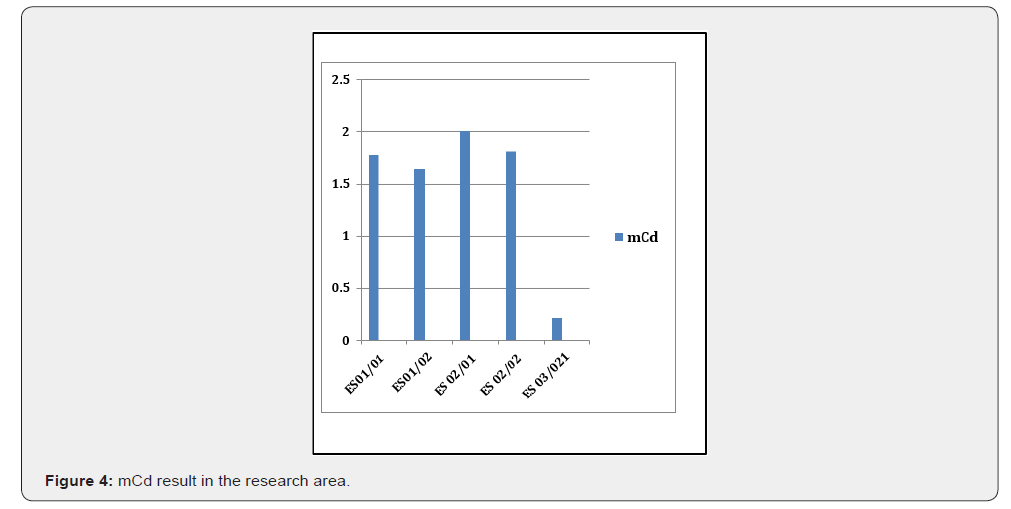
Table 2 and figure 2 shows that at two particular sampling points, ES01/01 and ES02/01, mCd concentrations were found to be increased, with values ranging from 1.64 to 2.01. At ES02/02 and ES01/01, similarly, there were high amounts, measuring 1.81 and 1.77, respectively. Surface water contamination is likely due to liquid waste discharge from nearby industries, oil spills, or inappropriate disposal procedures, as these increased results suggest. Anthropogenic (caused by humans) pollution sources are indicated by the presence of such contamination. The ES03/01 (x) on the other hand, had a low mCd level of 0.22, which confirms that the other sites’ increased levels are pollution-related and indicates that there is negligible baseline contamination. These results are in agreement with those of research in central Peru [44] and India [45] that found low mCd levels of 1.06 at sites labeled as low to very low contamination, respectively, suggesting generally low contamination levels in those areas.
Pollution index of surface water (PIS)
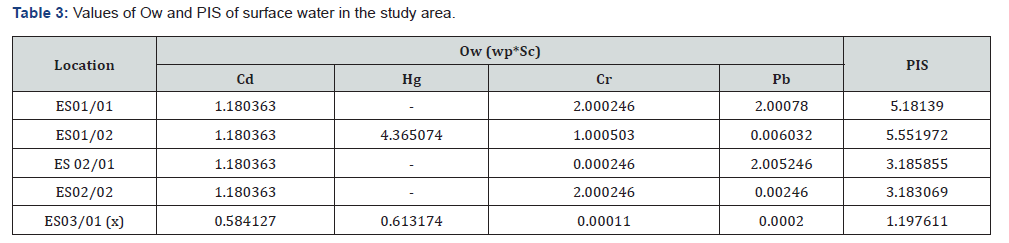
Based on the amounts of Cd, Hg, Cr, and Pb as well as a composite parameter (Ow), Table 3 below presents the PIS water, a quantitative measure for evaluating the effect of liquid waste on surface water quality. Findings showed that ES01/01, ES02/01, ES02/02, and ES02/01 had very high PIS values. Industrial or anthropogenic sources are likely attributed for the pollution in these places, as the PIS values are greater than 1. However, ES01/02 (PIS = 5.55) and ES01/01 (PIS = 5.18) are the most contaminated, mostly because of the amount of Pb that they contain. Though at low quantities, Hg is said to be extremely harmful, however it was noticed that ES02/01 demonstrates substantial Hg contamination (PIS = 4.36). ES02/02 and ES02/01 reveal moderate contamination levels, primarily from Pb and Cr, suggesting an uneven distribution of contamination, potentially caused by pollution at specific locations. Hence, all heavy metal indices are close to background levels (values close to zero), making ES03/01 the least polluted (PIS = 1.20). A control or less affected site may be indicated by the “(x)” symbol. Pollution or another composite parameter is represented by Ow (wp*Sc). With the exception of ES03/01, all of the sites exhibit a constant baseline pollution load, as indicated by their identical Ow values (1.18). The study’s findings show that Pb is the most prevalent pollutant in the majority of samples (PIS contributions > 3). The presence of Hg in ES01/02 (PIS = 4.36), which suggests a localized contamination source that could be due to industrial discharges or improper waste disposal, necessitates immediate intervention in the form of remediation measures and wastewater treatment from the source control. Though, Cr and Cd indicate intermittent contributions but are not important drivers of pollution in this dataset. However, even at low levels, they can be hazardous to aquatic life and human health, thereby posing risks such as neurotoxicity and kidney damage [46,47].
Water quality index (WQI)
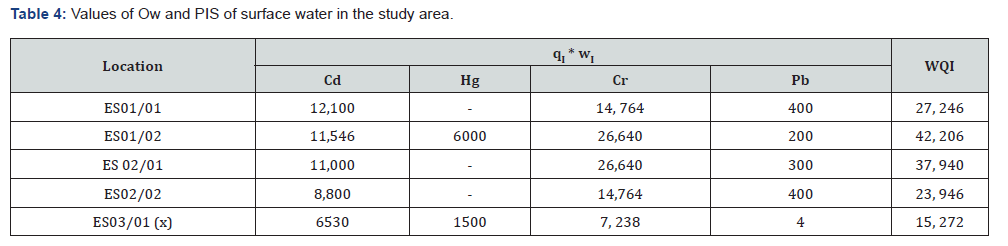
Water Quality Index (WQI) data from several sample sites is presented in Table 4. Result from the study revealed that the most polluted site was found to be ES01/02, with a high WQI of 42,206, mostly as a result of the exceptionally high Cr and considerable Hg contributions. The high levels of Cr and Pb in ES01/01 and ES02/01, respectively, cause them to have high WQIs of 27,246 and 37,940. Although it was observed that Hg was detected only in ES01/02 and ES03/01, which suggested low pollution, on the other hand, Cr seems to be the most significant pollutant, strongly contributing to the WQI in all locations except ES03/01. The WQI for Lower ES02/02 is mild at 23,946, but the levels of Cr (14,764) and Pb are still cause for worry. In contrast, ES03/01 (x) has an excellent water quality index (15,272), as a low concentration of Cr (7,238), and negligible Pb (4), suggesting better water quality. However, it was further observed that Pb is consistently present but varies widely from 4 to 400 with the highest impact in ES01/01 & ES02/02. While Cd levels are high across all sites but do not fluctuate as drastically as other HMs.
The WQI for Lower ES02/02 is mild at 23,946, but the levels of Cr (14,764) and Pb are still cause for worry. In contrast, ES03/01 (x) has an excellent water quality index (15,272), as a low concentration of Cr (7,238), and negligible Pb (4), suggesting better water quality. However, it was further observed that Pb is consistently present but varies widely from 4 to 400 with the highest impact in ES01/01 & ES02/02. While Cd levels are high across all sites but do not fluctuate as drastically as other HMs. This could be related to anthropogenic activities that endanger surface water resources [21,25,27,32].
Conclusion
Liquid waste poses a threat to surface water in the Escravos estuary in Warri South-West LGA, Nigeria. According to the study, HMs (Cd, Hg, Cr, Pb) poses a particular threat, as shown by the water quality evaluation, which shows contamination levels surpassing WHO standard in several sampled site. While Pb and Cd are the most persistent health hazards, Cr at ES02/01 reveals extremely high levels of pollution (CF = 4.487), most likely due to industrial contamination. On every sampled site, the turbidity levels were high, suggesting organic or sediment contamination.
While the levels of DO and TDS are within permissible ranges, while the slightly acidic pH could potentially worsen metal toxicity. Additional pollution indices for MPI suggest that ES01/02 is the most polluted with a value of 5.0185, whereas ES03/01 (x) appears to have very little contamination. The HEI shows that in ES01/01 (47.61) and ES02/01 (44.88), the environmental risk is substantial, mostly because of Cr and Hg. But PLI indicates that there is very little cumulative contamination, which means that the pollution is concentrated rather than affecting the sampled site. Based on this quick remediation is required. Waste products from industrial and artisanal refining should be prioritized for cleanup, with ES02/01 (high Cr) and ES01/02 (high MPI) being high on the list. There should be constant watch and public health effort, increase testing for Pb and Hg contamination, which can originate from runoff or illicit dumping, tighten rules for wastewater discharge, especially in areas with a high risk of contamination; and in addition, public health strategies by educating the locals on the dangers of HMs and make available alternate water sources. Finally, the results require immediate action to reduce ecological and health risks caused by metal contamination and turbidity, even though some locations (ES03/01 (x)) are less affected.
References
- Mishra BK, Kumar P, Saraswat C, Chakraborty S, Gautam A (2021) Water security in a changing environment: concept, challenges and solutions. Water 13(4): 490.
- Freeman L, Corbett D, Fitzgerald A, Lemley D, Quigg A, et al. (2019) Impacts of urbanization and development on estuarine ecosystems and water quality. Estuaries Coasts 42: 1821-1838.
- Ubaka EG, Ekwonu AM, Ogah JO, Eyisi CE (2019) Effect of pollution on the physicochemical characteristics of Otammiri River, Imo State. Am Acad Scholarly Res J 11(4):1-16.
- Ewuzie U, Aku NO, Nwankpa SU (2021) An appraisal of data collection, analysis, and reporting adopted for water quality assessment: a case of Nigeria water quality research. Heliyon 7(9): e07950.
- Ulakpa ROE, Eyankware MO (2021) Contamination assessment of water resource around waste dumpsites in Abakaliki Nigeria: a mini review. J Clean WAS 5(1): 17-20.
- Eyankware MO, Akakuru OC, Ulakpa ROE, Eyankware EO (2022) Hydrogeochemical approach in the assessment of coastal aquifer for domestic, industrial, and agricultural utilities in Port Harcourt urban, Southern Nigeria. Int J Energy Water Resource 7: 401-419.
- Eyankware MO, Ulakpa ROE, Ike J (2021) Re-evaluating coastal aquifer using graphical and geo-chemical approach: a case study of Niger Delta region, Nigeria. World Sci J 154: 133-151.
- Usman AO, Iheme KO, Chinwuko AI, Azuoko G, Akakuru OC (2022) Hydrogeophysical investigation of groundwater resources within Abakaliki, Lower Benue Trough Nigeria. COOU J Phys Sci 5(1): 473-491.
- Eyankware MO, Ulakpa ROE, Ogwah C (2020) The Study of Sea Water Intrusion in Coastal Aquifer of Niger Delta Region, Nigeria. Middle-East Journal of Scientific Research 28(4): 369-379.
- Islam MA, Al-mamun A, Hossain F, Quraishi SB, Naher K, et al. (2017) Contamination and ecological risk assessment of trace elements in sediments of the rivers of Sundarban mangrove forest, Bangladesh. Mar Pollut Bull 124(1): 356-366.
- Urom O, Opara AI, Usen OS, Akiang, F, Israel, H et al., et al. (2021) Electro-geohydraulic estimation of shallow aquifers of Owerri and environs, Southeastern Nigeria using multiple empirical resistivity equations. Int J Energy Water Resource 6: 15-36.
- Obasi PN, Akakuru OC, Nweke OM, Okolo CM (2022) Groundwater assessment and contaminant migration in fractured shale aquifers of Abakaliki mining areas, Southeast Nigeria. J Min Geology 58(1): 211-227.
- Mutegoa E (2024) Efficient techniques and practices for wastewater treatment: an update. Discov Water 4(69).
- Samuel A, Eyinla B (2009) Oil exploitation and marine pollution: evidence from the Niger Delta, Nigeria. J Hum Ecology 8: 177-182.
- Oviasuyi PO, Uwadiae J (2009) The dilemma of Niger-Delta region as oil producing states of Nigeria. J Peace Conflict Dev 16: 110.
- Osuji LC, Onojake CM (2006) Field reconnaissance and estimation of petroleum hydrocarbon and heavy metal contents of soils affected by the Ebocha-8 oil spillage in Niger Delta, Nigeria. J Environ Manage 79(2): 133-139.
- World Health Organization (2017) Progress on household drinking water, sanitation and hygiene 2000-2017: special focus on inequalities. World Health Organization.
- Zabbey N, Giadom FD, Babatunde BB (2019) Nigerian coastal environments. In: Finkl CW, Makowski C (Eds.), Encyclopedia of Coastal Science. Springer.
- Egbe RE, Thompson D (2010) Environmental challenges of oil spillage for families in oil producing communities of the Niger Delta region. J Hum Ecology 13:24-34.
- Odisu T, Okieimen CO, Ogbeide SE (2015) Post oil spill petroleum hydrocarbon components transport and evaluation in parts of the Niger Delta mangrove swamp of Nigeria: a case of hydrocarbon component transport through non-turbulent water. Eur J Sustain Dev Resource 5(1): 0152.
- Eyankware MO, Akakuru OC, Ulakpa ROE, Eyankware EO (2021) Sustainable management and characterization of groundwater resource in coastal aquifer of Niger delta basin Nigeria. Sustain Water Resour Management 7(58).
- Dada O, Qiao L, Ding D, Ma Y, Wang L (2015) Evolutionary trends of the Niger Delta shoreline during the last 100 years: responses to rainfall and river discharge. Mar Geology 367: 202-211.
- Sehgal M, Garg A, Suresh R, Dagar P (2012) Heavy metal contamination in the Delhi segment of Yamuna basin. Environ Monit Assessment 184(2): 1181-1196.
- American Public Health Association (2012) Standard Methods for the Examination of Water and Wastewater. (22nd edn), APHA.
- Agidi BM, Akakuru OC, Aigbadon GO, Schoeneich K, Isreal H, et al. (2022) Water quality index, hydrogeochemical facies and pollution index of groundwater around Middle Benue Trough, Nigeria. Int J Energy Water Resource 8: 1-20.
- Hakanson L (1980) An ecological risk index for aquatic pollution control: a sedimentological approach. Water Resource 14(8): 975-1001.
- Akakuru O, Akudinobi B, Nwankwoala H, Akakuru O, Onyekuru S (2021) Compendious evaluation of groundwater in parts of Asaba, Nigeria for agricultural sustainability. Geosciences Journal 25: 915-927.
- Caeiro S, Costa MH, Ramos TB, Fernandes F, Silveira N, et al. (2005) Assessing heavy metal contamination in Sado estuary sediment: an index analysis approach. Ecol Indic 5(2): 151-169.
- Eyankware MO, Akakuru OC (2022) Appraisal of groundwater to risk contamination near an abandoned limestone quarry pit in Nkalagu, Nigeria, using enrichment factor and statistical approaches. Int J Energy Water Resour 7: 603-621.
- Rao NS, Dinakar A, Sravanthi M, Kumari B (2021) Geochemical characteristics and quality of groundwater evaluation for drinking, irrigation, and industrial purposes from a part of hard rock aquifer of South India. Environ Sci Pollut Resource 28(24): 31941-31961.
- Akakuru OC, Casmir CZA, Aigbadon GO, Eyankware MO, Opar AI, et al. (2022) Integrating machine learning and multi-linear regression modeling approaches in groundwater quality assessment around Obosi, SE Nigeria. Environ Dev Sustain 25: 14567-14606.
- Akakuru OC, Akudinobi B, Opara AI, Onyekuru SO, Akakuru OU (2021) Hydrogeochemical facies and pollution status of groundwater resources of Owerri and environs Southeastern Nigeria. Environ Monit Assessment 193(10): 623.
- Abu Shmeis RM (2018) Water chemistry and microbiology. Compr Anal Chem 81: 1-56.
- Jessica B, Emmanuel S, Renald B (2020) Heavy metal pollution in the environment and their toxicological effects on humans. Heliyon 6(9): e04691.
- Tinkov AA, Filippini T, Ajsuvakova OP, Skalnaya MG, Aasethf J, et al. (2018) Cadmium and atherosclerosis: a review of toxicological mechanisms and a meta-analysis of epidemiologic studies. Environ Resource 162: 240-260.
- Genchi G, Sinicropi MS, Lauria G, Carocci A, Catalano A (2020) The effects of cadmium toxicity. Int J Environ Res Public Health 17(11): 3782.
- Lee JW, Jo AH, Kang YJ, Lee D, Choi CY, et al. (2024) Review of cadmium bioaccumulation in fish exposed to cadmium. Toxics 13(1): 7.
- Sharma P, Singh SP, Parakh SK, Tong YW (2022) Health hazards of hexavalent chromium (Cr (VI)) and its microbial reduction. Bioengineered 13(3): 4923-4938.
- Preonty NE, Hassan MN, Reza AHS, Md Ishtiak AH, Md Mahibi AM, et al. (2025) Pollution and health risk assessment of heavy metals in surface water of the industrial region in Gazipur, Bangladesh. Environ Chem Ecotoxicology 7: 527-538.
- Moldovan A, Török AI, Kovacs E, , Cadar O, Mirea IC, et al., (2022) Metal contents and pollution indices assessment of surface water, soil, and sediment from the Arieș River Basin Mining Area, Romania. Sustainability 14(13): 8024.
- Hamahsaeed MA (2024) Using heavy metals pollution index (HPI) and metal index (MI) for assessing quality of drinking water in Bardarash-Akre basin in Duhok governorate northern Iraq. Tikrit J Pure Science 29(2): 30-44.
- Clement OO, Kamaldeen M, Stephen O, Paul OF (2016) Assessment of metallic pollution status of surface water and aquatic macrophytes of earthen dams in Ilorin, north-central of Nigeria as indicators of environmental health. J King Saud Univ Science 28(4): 324-331.
- Subrina S, Md Azharul IP, Md Sagir A, Shamshad BQ, Mohammad AB, et al. (2025) Public health risk assessment and possible contamination with heavy metals in Saint Martin's Island, Bay of Bengal. J Hazard Mater Advance 17: 100568.
- Custodio M, Fow A, Chanamé F, Orellana-Mendoza E, Peñaloza R, et al. (2021) Ecological risk due to heavy metal contamination in sediment and water of natural wetlands with tourist influence in the central region of Peru. Water 13(16): 2256.
- Mandal S, Bhattacharya S, Paul S (2022) Assessing the level of contamination of metals in surface soils at thermal power area: evidence from developing country (India). Environ Chem Ecotoxicology 4: 37-49.
- Haghighizadeh A, Rajabi O, Nezarat A, Zahra H, Mina H, et al. (2024) Comprehensive analysis of heavy metal soil contamination in mining environments: impacts, monitoring techniques, and remediation strategies. Arab J Chem 17(6): 105777.
- Yang Y, Hassan MF, Ali W, Zou H, Liu Z, et al. (2025) Effects of cadmium pollution on human health: a narrative review. Atmosphere 16(2): 225.

























