




 GJTLH Home



Abstract
The rapid expansion of influencer marketing on Instagram has blurred the lines between authentic personal posts and sponsored content. Grounded in the Persuasion Knowledge Model (PKM) and Signaling Theory, this study examines how Advertising Literacy (AL), Legal Awareness (LA), and Disclosure Clarity (DC) drive Purchase Decision Influence (PDI) through the dual-mediating roles of Perceived Credibility & Authenticity (PCA) and Boundary Clarity & Perceived Deception (BCD). Using a quantitative cross-sectional design, data were gathered from 674 university students in Portugal. Hypotheses were evaluated via Partial Least Squares Structural Equation Modeling (PLS-SEM), followed by PLS Multi-Group Analysis (PLS-MGA) and the Welch-Satterthwaite test to test structural invariance across four follower-density categories (1–40, 41–80, 81–120, and >120 influencers).Structural results reveal that Disclosure Clarity (DC) is the strongest driver of both credibility and boundary identification (β = 0.391 and β = 0.380, p < 0.001). Mediation analysis confirms that PCA and BCD partially mediate all direct paths toward purchase decisions (p < 0.001). The MGA demonstrates high structural invariance across most paths, proving the model's generalizability, though significant variances (p < 0.05) emerged in paths linking Legal Awareness (LA) to boundary clarity and credibility among highly exposed followers. These findings show that transparent commercial disclosures do not hinder persuasion; rather, they foster long-term trust, strengthen credibility, and protect consumer autonomy in digital environments.
Keywords: Instagram; Digital influencers; Advertising literacy; Legal awareness; Disclosure clarity; PLS-SEM; Purchase decision
Abbreviations: PKM: Persuasion Knowledge Model; AL: Advertising Literacy; La: Legal Awareness; Dc: Disclosure Clarity; PDI: Purchase Decision Influence; PCA: Perceived Credibility & Authenticity; BCD: Boundary Clarity & Perceived Deception
Introduction
The digital transformation has profoundly reshaped contemporary communication models, making online interaction a structural component of modern society. The migration from traditional mass communication to interactive digital environments has altered the relationship between organizations and consumers, enabling the emergence of more personalized, participatory, and relationship-oriented marketing strategies [1]. Within this context, influencer marketing has become one of the fastest-growing communication tools, allowing brands to establish authentic and emotionally engaging relationships with consumers through content creators who are perceived as credible, relatable, and [2,3].
Unlike conventional advertising, influencer-generated content is frequently integrated into everyday narratives, personal experiences, and lifestyle recommendations [4]. This communication strategy enhances perceived authenticity and reduces consumers' resistance to persuasive messages [4]. Consequently, influencers have evolved into powerful opinion leaders capable of shaping attitudes, strengthening brand credibility, and influencing purchasing decisions, particularly among younger audiences who spend a substantial amount of time on social media platforms such as Instagram [2,5].
However, the growing integration of commercial messages into apparently spontaneous content raises important ethical, legal, and managerial challenges. One of the most debated issues concerns consumers' ability to distinguish between genuine personal recommendations and paid commercial communications. Although both Portuguese and European legislation establish that advertising must be clearly identifiable regardless of the communication medium, the boundaries between organic and sponsored content have become increasingly blurred within social media ecosystems [6]. This ambiguity may compromise advertising transparency, consumer autonomy, and informed decision-making while simultaneously undermining trust in influencer marketing [7].
The importance of this issue has increased considerably in recent years due to the rapid expansion of the influencer economy. Companies allocate substantial portions of their communication budgets to influencer campaigns because these are often perceived as more authentic and persuasive than traditional advertising. Nevertheless, evidence suggests that compliance with disclosure requirements remains limited. A recent Portuguese monitoring study reported that only 9% of commercial Instagram posts published by leading influencers were correctly identified as advertising, revealing a substantial discrepancy between current professional practices and existing legal obligations. This scenario raises fundamental questions regarding consumers' advertising literacy and their capacity to critically evaluate commercial content embedded within digital environments [8].
Despite the growing body of literature on influencer marketing, previous studies have predominantly focused on purchase intention, source credibility, trust, engagement, and parasocial relationships. Comparatively less attention has been devoted to consumers' recognition of the commercial nature of influencer-generated content and, more specifically, to the relationship between advertising literacy, legal awareness, perceived transparency, and purchasing behavior. This gap is particularly relevant among Generation Z, whose extensive exposure to digital platforms makes them one of the most strategically important market segments for brands.
Against this background, the present study investigates how young consumers perceive sponsored content published by digital influencers on Instagram. Specifically, it examines their ability to recognize commercial communication, their knowledge of the legal framework governing advertising disclosures, and the perceived influence of influencer marketing on consumer decision-making. To address these objectives, a quantitative study was conducted using a structured questionnaire administered to university students in Portugal.
The study contributes to the existing literature in three ways. First, it integrates advertising literacy, legal awareness, transparency, and consumer behavior within a single analytical framework. Second, it provides empirical evidence from the Portuguese context, where research on the legal recognition of influencer advertising remains limited. Finally, the findings offer practical implications for marketers, influencers, regulatory authorities, and policymakers by highlighting the importance of transparent disclosure practices to strengthen consumer trust, improve ethical communication, and enhance the effectiveness of influencer marketing strategies. The remainder of this article is organized as follows. The next section reviews the literature on digital communication, influencer marketing, advertising transparency, and the legal principles governing commercial identification on social media. The methodology is then presented, followed by the empirical findings, discussion, and conclusions.
Despite the extensive literature on influencer marketing, most research has focused on established variables such as purchase intention, source attractiveness, and digital engagement, with limited attention to an integrated structural framework to explain how consumers' prior knowledge interacts with regulatory transparency signals. Specifically, there is a clear lack of understanding of the dual mediating roles of Perceived Credibility and Authenticity (PCA) and Boundary Clarity and Perceived Deception (BCD) in mediating the relationships of Advertising Literacy (AL), legal awareness (LA), and Disclosure Clarity and Compliance (DC) on the Purchase Decision Influence (PDI). Furthermore, previous studies have neglected to examine whether these structural relationships are stable across or vary according to number of influencers followed by consumers.
To address this research gap, this study aims to present a comprehensive structural model based on the integration of the Persuasion Knowledge Model (PKM) and Signaling Theory. Specifically, the study seeks to achieve the following objectives:
i. Examine the direct and indirect effects of Advertising Literacy (AL), Legal Awareness (LA), and Disclosure Clarity and Compliance (DC) on Purchase Decision Influence (PDI) among young Instagram users.
ii. Examine the mediating roles of Perceived Credibility and Authenticity (PCA) and Boundary Clarity and Perceived Deception (BCD) in the relationships between the independent variables and Purchase Decision Influence (PDI).
iii. Assess the equivalence of the structural model across different influencer-following categories (1–40, 41–80, 81–120, and >120 influencers) using Partial Least Squares Multigroup Analysis (PLS-MGA) and the Welch–Satterthwaite test.
Digital Communication
Digital transformation has fundamentally reshaped the communication landscape, redefining how organizations, brands, and consumers interact. This transformation has been driven by rapid technological innovation, the widespread adoption of artificial intelligence and big data analytics, increasing market competition, and the migration of commercial activities to digital environments. Consequently, consumers have assumed a more active role throughout the value creation process by participating in product development, service customization, content generation, and the dissemination of consumption experiences [9].
The evolution from analogue to digital communication has transformed the traditional one-way transmission model into a multidirectional and interactive communication system. Whereas conventional media operated through centralized structures in which professional gatekeepers selected, organized and distributed information, digital platforms enable decentralized communication characterized by participation, dialogue and collaboration [10].
This paradigm shift has also redefined the relationship between firms and consumers. Organizations increasingly adopt relational approaches grounded in collaboration, transparency, and value co-creation. Social media platforms have evolved from simple communication channels into interactive ecosystems where brands engage in continuous conversations with consumers, encouraging participation, feedback, and long-term relationship building [11-13].
Consumers have consequently become active contributors to the communication process by creating, sharing, and disseminating digital content on an unprecedented scale. User-generated content—including reviews, recommendations, testimonials, and personal experiences has become a central element of digital communication ecosystems. Compared with traditional advertising, this type of content is generally perceived as more authentic, credible, and trustworthy because it originates from consumers rather than organizations, thereby exerting a significant influence on attitudes, engagement, and purchasing decisions [14,15].
Overall, the transition from one-way communication to interactive dialogue represents more than a technological evolution; it reflects a profound transformation in marketing philosophy. Contemporary digital communication is increasingly characterized by participation, transparency, collaboration, and co-creation, creating the conditions that enabled influencer marketing to emerge as one of the most influential communication strategies in the digital economy [16-18].
Influencer Marketing: A Contemporary Strategic Communication Paradigm
The emergence of social media platforms has transformed digital influencers into central actors within contemporary marketing ecosystems. The digital communication has become increasingly interactive, brands have progressively shifted from traditional advertising towards influencer-based strategies capable of fostering authentic relationships with consumers [19,20]. Consequently, influencers have evolved beyond content creators to become strategic intermediaries who shape consumer attitudes, stimulate engagement, and influence purchasing behavior.
Although no universally accepted definition of a digital influencer exists [21], the literature generally describes influencers as individuals who create and disseminate persuasive content to substantial online communities while maintaining a high degree of perceived authenticity and credibility. Their communication is typically embedded within personal narratives, everyday experiences, and lifestyle content, allowing promotional messages to appear natural rather than overtly commercial. This storytelling approach strengthens emotional connections with followers and enhances message engagement, trust, and perceived relevance [19,20,22-24].
Influencers simultaneously perform multiple roles within digital markets, functioning as opinion leaders, brand ambassadors, content creators, and relationship mediators between organizations and consumers. Their effectiveness derives largely from their perceived expertise, authenticity, and ability to establish meaningful social interactions with online communities. Consequently, influencer marketing has evolved from a complementary promotional technique into a strategic communication approach capable of generating awareness, engagement, trust, and purchase intentions across diverse consumer segments [25,26].
Current research identifies two principal approaches to influencer marketing campaigns. In brand-controlled collaborations, organizations retain greater control over message design and dissemination, whereas creator-led collaborations provide influencers with greater creative autonomy, enabling promotional messages to integrate more naturally into their personal communication [27]. Regardless of the strategic approach adopted, authenticity remains one of the strongest determinants of campaign effectiveness. Consumers respond more positively to communications that preserve the influencer's personal voice and are perceived as sincere, transparent, and consistent with their established online identity [19,22].
Another critical determinant of influencer effectiveness is perceived homophily, defined as the degree of similarity that followers perceive between themselves and the influencer. Shared values, lifestyles, interests, and experiences foster psychological closeness, increase trust, and strengthen emotional attachment, thereby enhancing consumers' receptiveness to commercial messages [21,28]. Rather than being viewed as traditional celebrities, influencers are often perceived as relatable peers, making their recommendations appear more credible and persuasive than conventional advertising.
The rapid expansion of influencer marketing has accelerated since the COVID-19 pandemic, when digital platforms became primary spaces for information, entertainment, and social interaction. As a result, brands substantially increased investment in influencer partnerships, recognizing social media as an effective environment for reaching highly connected audiences, particularly Generation Z [20,25,26,29]. Among social networking platforms, Instagram has consolidated its position as one of the leading ecosystems for influencer marketing due to its visual orientation, high engagement rates, and capacity to integrate commercial communication seamlessly into users' daily digital experiences [11-13].
Overall, influencer marketing represents a fundamental evolution in contemporary marketing communication. Its effectiveness is not determined solely by audience size but by the combination of authenticity, transparency, credibility, relational proximity, and meaningful engagement. These characteristics explain why influencer-generated content has become one of the most powerful mechanisms for shaping consumer perceptions, strengthening brand relationships, and influencing purchasing decisions within digital environments.
Introduction
7. Instagram Advertising: The Central Role of Digital Influencers
Within the contemporary social media landscape, platforms belonging to the Meta ecosystem, particularly Instagram, have become central spaces for communication, consumer engagement, and brand interaction [12]. The continuous expansion of digital communities has accelerated the adoption of influencer marketing, transforming social media into strategic environments where commercial communication is increasingly integrated into users' daily online experiences [25,26,29].
Among the various social networking platforms, Instagram has consolidated its position as one of the most influential ecosystems for influencer marketing. Its highly visual architecture, interactive functionalities, and algorithm-driven content distribution facilitate strong consumer engagement while enabling brands to communicate through authentic and immersive storytelling. These characteristics contribute to higher levels of interaction, value co-creation, and relationship building between brands and consumers, making Instagram particularly effective for business-to-consumer (B2C) communication [22,30].
Research suggests that Instagram users increasingly expect exposure to branded content while using the platform, largely because influencer endorsements have become an integral component of the user experience [30]. Rather than disrupting users' activities, commercial messages are frequently embedded within influencers' everyday content, reducing perceived intrusiveness and increasing advertising acceptance. Consequently, influencer-generated content is often perceived as more authentic, credible, and engaging than conventional advertising formats, strengthening consumers' trust and positively influencing brand attitudes and purchase intentions [22,25].
The strategic importance of Instagram is reflected in the sustained growth of investment in influencer marketing. Organizations increasingly allocate communication budgets to influencer partnerships because they offer greater opportunities for audience segmentation, engagement, and measurable marketing performance. In Portugal, for example, investment in the Instagram influencer market reached approximately €63 million in 2025, illustrating the growing economic relevance of this communication channel.
As influencer marketing has become increasingly commercialized, transparency has emerged as a critical ethical and regulatory requirement. Instagram has introduced standardized disclosure mechanisms, such as the "Paid Partnership" label, to improve the visibility of sponsored collaborations and facilitate consumers' recognition of commercial communications. Previous research indicates that clear advertising disclosures increase advertising recognition and contribute to greater transparency, thereby reinforcing consumer trust while supporting compliance with legal and ethical standards [30]).
Overall, Instagram has evolved beyond a social networking platform to become a sophisticated digital marketing ecosystem where commercial communication, consumer interaction, and content creation converge. Its ability to combine authenticity, engagement, and persuasive communication explains why it remains one of the most effective channels for influencer marketing and a particularly relevant context for investigating consumers' recognition of sponsored content.
Advertising Disclosure and the Principle of Identifiability in Influencer Marketing
One of the fundamental principles governing advertising regulation is that commercial communications must be clearly identifiable as such, regardless of the communication channel through which they are disseminated. This principle aims to safeguard consumer autonomy by ensuring that individuals can distinguish editorial or personal content from paid commercial messages. Within the context of influencer marketing, however, this distinction has become increasingly difficult because promotional content is frequently embedded within authentic personal narratives and everyday social interactions [31].
Although both Portuguese and European regulatory frameworks establish that advertising should be clearly recognizable, existing legislation was largely developed before the emergence of social media ecosystems and therefore provides only limited guidance regarding influencer-generated content. Consequently, substantial legal uncertainty remains concerning the practical implementation of disclosure requirements across digital platforms, particularly when commercial relationships are communicated through apparently spontaneous recommendations or lifestyle content [31].
This regulatory ambiguity has significant implications for consumer protection. The persuasive effectiveness of influencer marketing derives precisely from the integration of commercial messages into content perceived as authentic and non-commercial. When sponsorship disclosures are absent, ambiguous, or insufficiently visible, consumers may fail to recognize the persuasive intent of the communication, potentially affecting the transparency of decision-making processes and undermining informed consumer choice.
Empirical evidence suggests that compliance with disclosure requirements remains limited. A Portuguese monitoring study analyzing 5,294 Instagram posts published by leading influencers found that, among posts classified as commercial communications, only 9% were correctly identified as advertising. Conversely, the majority of sponsored publications were either incorrectly disclosed or lacked sufficiently clear commercial identification, revealing a substantial discrepancy between current industry practices and existing legal requirements [31].
These findings are consistent with broader European evidence. According to the European Commission, almost all influencers included in a recent monitoring exercise published commercial content, yet only a minority systematically disclosed the advertising nature of their collaborations. Such findings indicate that inadequate disclosure practices remain widespread across digital platforms, reinforcing concerns regarding consumer transparency, advertising literacy, and regulatory compliance.
From a marketing perspective, this situation reveals a structural paradox. Influencer marketing derives much of its persuasive power from authenticity, proximity, and trust, whereas advertising regulation requires explicit commercial disclosure to protect consumers. While transparent disclosures may reduce the implicit nature of persuasive communication, they simultaneously strengthen ethical standards, regulatory compliance, and long-term consumer trust. Achieving an appropriate balance between commercial effectiveness and transparency therefore represents one of the principal challenges facing influencer marketing in contemporary digital environments.
Against this background, understanding whether consumers are capable of recognizing sponsored content, and whether they possess sufficient knowledge of disclosure practices, constitutes an important research priority. Examining consumers' perceptions of advertising identifiability may contribute not only to the influencer marketing literature but also to the development of more effective regulatory frameworks and ethical communication practices.
Conceptual Framework
To explain the psychological and cognitive mechanisms underlying consumers’ responses to influencer marketing recommendations on Instagram, this research integrates the Persuasion Knowledge Model (PKM) [32] and Signaling Theory [33]. According to the Persuasion Knowledge Model (PKM), consumers develop knowledge about persuasion tactics that enables them to recognize, analyze, and respond to commercial messages. In this study, Advertising Literacy (AL) and Legal Awareness (LA) represent internal cognitive resources that shape consumers’ coping responses when evaluating influencer content [5]. Signaling Theory, on the other hand, posits that in information-asymmetric environments, explicit marketing signals reduce uncertainty; Disclosure Clarity and Compliance (DC) serve as an explicit market signal that clarifies the commercial intent of sponsored posts [32,34]. Taken together, these theoretical perspectives suggest that internal knowledge and external cues may influence behavioral responses both directly and through intermediate evaluative states, but rather operate through intermediate evaluative states. Accordingly, Perceived Credibility and Authenticity (PCA) and Boundary Clarity and Perceived Deception (BCD) act as two complementary mediating mechanisms through which consumers process commercial transparency before translating their evaluations into a Purchase Decision Influence (PDI).
Hypotheses Development
The Direct role of knowledge and disclosure signals (H1–H8)
When influencers provide clear commercial disclosure (DC), they provide an explicit market signal regarding the commercial nature of the content, thereby reducing ambiguity surrounding the persuasive intent of sponsored posts and potentially enhancing consumers’ perceptions of boundary clarity and credibility [4,33,34]. Similarly, consumers with higher Advertising Literacy (AL) and Legal Awareness (LA) may possess greater knowledge-based resources for distinguishing personal content from paid advertising and for evaluating the extent to which influencer practices conform to relevant ethical and legal standards [5,32,35]. Therefore, we hypothesize the following Figure 1:
H1: Advertising Literacy (AL) positively affects Boundary Clarity and Perceived Deception (BCD).
H2: Advertising Literacy (AL) positively affects Perceived Credibility and Authenticity (PCA).
H3: Legal Awareness (LA) positively affects Boundary Clarity and Perceived Deception (BCD).
H4: Legal Awareness (LA) positively affects Perceived Credibility and Authenticity (PCA).
H5: Disclosure Clarity and Compliance (DC) positively affect Boundary Clarity and Perceived Deception (BCD).
H6: Disclosure Clarity and Compliance (DC) positively affect Perceived Credibility and Authenticity (PCA).
H7: Perceived Credibility and Authenticity (PCA) positively affect Purchase Decision Influence (PDI).
H8: Boundary Clarity and Perceived Deception (BCD) positively affect Purchase Decision Influence (PDI).
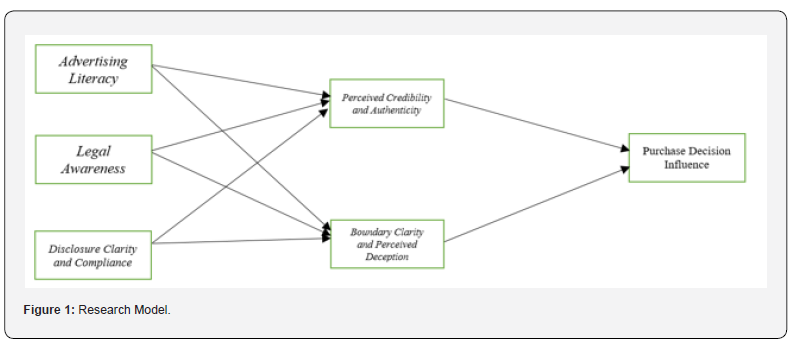
Mechanisms of mediation towards purchasing decisions (H7-H8 and indirect effects)
When consumers perceive greater clarity in distinguishing commercial from personal content and experience less perceived deception (BCD), their resistance to persuasive appeals may be reduced, which may, in turn, influence Purchase Decision Influence (PDI) [4,32]. Similarly, when influencer content is perceived as credible and authentic (PCA), consumers may be more receptive to the associated commercial message and more likely to respond favorably to the promoted product or brand [2,36]. Thus, PCA and BCD may serve as complementary evaluative mechanisms linking disclosure- and knowledge-related cues to consumers’ purchase-related responses. Therefore, we hypothesize the following:
H1a–H6a: Perceived Credibility and Authenticity (PCA) and Boundary Clarity and Perceived Deception (BCD) mediate the relationships between the independent variables (AL, LA, and DC) and Purchase Decision Influence (PDI).
Methodology
Study design
This study employed a quantitative, cross-sectional, and explanatory research design to investigate the structural relationships among advertising awareness, commercial disclosure, and consumers’ purchasing decisions in the context of Instagram influencer marketing. Partial least squares structural equation modeling (PLS-SEM) was employed to test the hypotheses and assess the mediating roles of Boundary Clarity and Perceived Deception (BCPD), as well as Perceived Credibility and Authenticity (PCA). The study population consisted of undergraduate students enrolled in marketing and management programs at higher education institutions in Portugal. A non-probability convenience sampling approach was adopted, given that this group is predominantly composed of Generation Z consumers, exhibits high levels of daily social media engagement, and is frequently exposed to influencer-generated and commercially sponsored content, making this group particularly relevant for examining digital consumer behavior. [37-42].
Participants and data collection
A combination of non-probability convenience sampling and snowball sampling was employed. The target population comprised university students from various regions of Portugal, including the North, Central, Greater Lisbon, Alentejo, Algarve, Madeira, and the Azores. Data were collected between January 2025 and January 2026 using a self-administered online questionnaire distributed through social media platforms and academic networks resulting in 674 valid questionnaires (N = 674) suitable for statistical analysis. The snowball approach encouraged participants to voluntarily share the questionnaire among their peers, thereby extending the geographical reach of the sample and increasing coverage across different regions and institutions. Participation was entirely voluntary and anonymous. Participants were provided with information outlining the objectives of the study and stating that their responses would remain confidential and be used solely for academic research purposes. Completion and submission of the questionnaire constituted informed consent, in accordance with established ethical research principles.
Instrument
The questionnaire was developed following an extensive review of the contemporary literature on influencer marketing, advertising disclosure, digital communication, and consumer behavior. It consisted of closed-ended questions organized into thematic sections covering: (i) participants' demographic characteristics; (ii) social media and Instagram usage patterns; (iii) perceptions of influencer marketing; (iv) recognition of sponsored content; (v) awareness of advertising disclosure requirements; and (vi) the perceived influence of digital influencers on purchasing decisions. All items were assessed using a seven-point Likert scale, where 7 indicated “strongly agree” and 1 indicated “strongly disagree.”
Data Analysis
The collected data were analyzed using a two-stage quantitative methodology, employing IBM SPSS Statistics (v. 28) and SmartPLS 4 software:
i. Descriptive Statistics (SPSS): Frequencies, percentages, means, and standard deviations were calculated to determine the demographic characteristics of the sample, in addition to describing patterns and behaviors of Instagram platform use.
ii. Structural Equation Modeling (SmartPLS 4): Partial Least Squares (PLS-SEM) was applied to test the research theoretical model. Based on the adopted two-stage methodology:
a. Outer model evaluation: The reliability and validity of the underlying variables were examined by measuring index loads, internal consistency (Cronbach's Alpha and Composite Reliability), convergent validity (AVE), and discriminant validity using the HTML5 criterion. Evaluation of the Inner Model: The hypotheses and direct relationships were tested by estimating the path coefficients beta and determining their statistical significance using non-parametric bootstrapping with 5,000 subsamples at a significance level of p < 0.05.
b. The multicollinearity problem was also examined using the variance inflation factor (VIF), and the effect size (f2) and the predictive power of the model out of sample were assessed using the algorithm (PLSpredict) and the dependence on the index (Q2).
Results
The sample size satisfied the minimum sample size requirements for structural equation modeling (SEM) according to [43]. More than 1,000 questionnaires were distributed, of which 674 valid questionnaires were collected for statistical analysis, providing a robust dataset for the study Table 1.
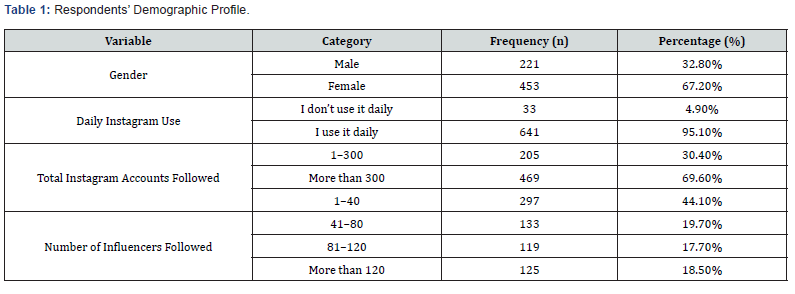
The descriptive results indicated that females constituted the majority of the sample at 67.2% (n = 453) while males accounted for 32.8% (n = 221). Instagram usage was also highly frequent, with 95.1% of participants using Instagram daily and 69.6% following more than 300 accounts, also, it can be clear that 55.9% of participants reported following more than 40 influencers (more than 40 influencers) Table 2.
Measurement Model Assessment
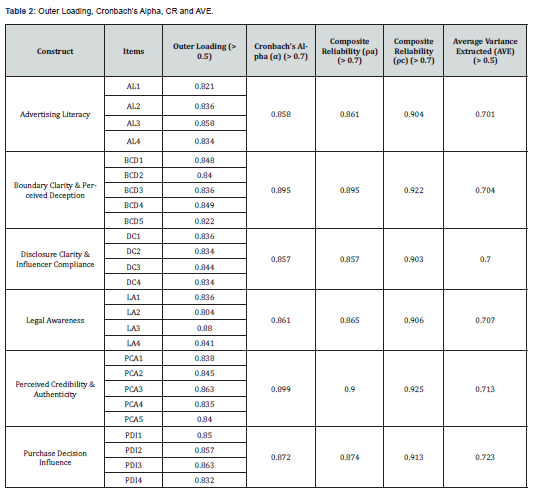
The measurement model was assessed in terms of construct reliability and validity. Indicator reliability was considered satisfactory when standardized factor loadings exceeded 0.70. Convergent validity was assessed using the Average Variance Extracted (AVE), with values of 0.50 or higher indicating that a construct explains at least half of the variance in its indicators [43,44]. Internal consistency reliability was evaluated using Cronbach’s alpha and composite reliability, with values above 0.70 generally considered satisfactory (Sarstedt et al., 2022). Overall, the results indicated satisfactory reliability and convergent validity across all constructs. The results of the measurement model assessment are presented in Table 2.
Discriminant Validity
The Fornell–Larcker criterion and the heterotrait–monotrait (HTMT) ratio were employed to assess discriminant validity. As shown in Table 4, the square root of the AVE for each construct, reported on the diagonal, exceeded its correlations with the other constructs, providing evidence of satisfactory discriminant validity according to the Fornell–Larcker criterion. In addition, all HTMT values were below the conservative threshold of 0.90, further supporting satisfactory discriminant validity [45] Table 3.
Assessment of Structural Model
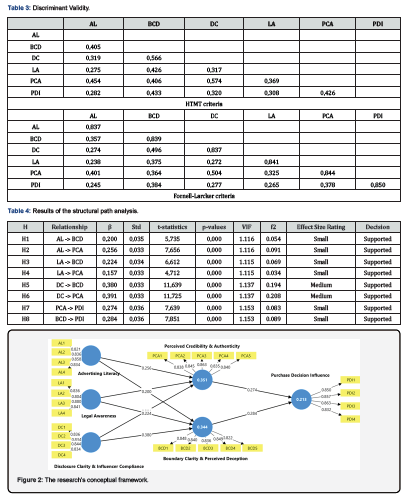
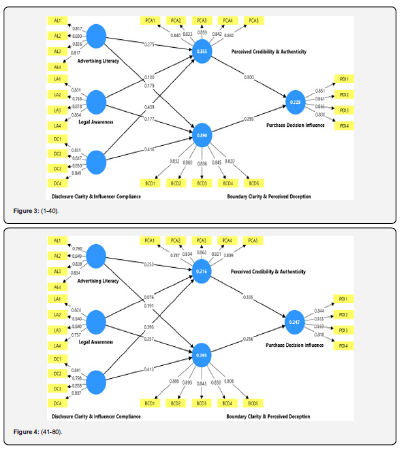
The structural model was assessed using a bootstrapping procedure based on 5,000 resamples to evaluate the statistical significance and precision of the estimated relationships. The analysis examined the standardized path coefficients (β), t-values, and p-values. The coefficient of determination (R²) was used to assess the proportion of variance explained in the endogenous constructs, while effect sizes (f²) were examined to determine the substantive contribution of each exogenous construct to the explained variance. Predictive relevance (Q²) was also assessed to evaluate the model’s out-of-sample predictive relevance. These procedures are consistent with established guidelines for PLS-SEM [43]. The results of the structural model are presented in Figure 2 & 3 and Table 4.
Direct Hypothesis Testing (Direct Effects)
The results of the direct path analysis (Table 4) indicate that all eight hypothesized direct relationships (H1–H8) were supported at a significance level of p < 0.001. The Disclosure Clarity & Compliance variable exhibited the strongest direct effects in the model, on Perceived Credibility and Authenticity (PCA) (β = 0.391, t = 11.725) and on and on Boundary Clarity and Perceived Deception (BCD) with a path coefficient of (β = 0.380, t = 11.639). Both BCD and PCA had similar positive direct effect s, with path coefficients of (β = 0.284, t = 7.851) and (β = 0.274, t = 7.639), respectively. The Inner VIF values indicate that there was no indication of problematic multicollinearity between independent and mediating variables; the values ranged between 1.115 and 1.153 well below the recommended threshold of 3.0 (VIF < 3.0). According to (Cohen, 1988) criteria for classifying effect size, a medium effect sizes were observed for the two paths DC → PCA (f2 = 0.208) and DC → BCD (f2 = 0.194), while the remaining direct paths recorded small effect sizes, with f2 values ranging from 0.034 to 0.091.
Predictive Power Assessment
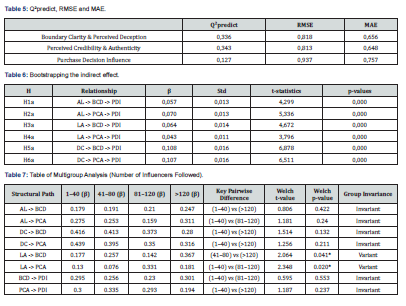
Table 5 All Q² values exceeded the conventional threshold of zero (Q² > 0) for all dependent and mediating variables. The model demonstrated predictive relevance for the mediating constructs, with Q² values of 0.336 and 0.343 and lower predictive relevance for the final dependent variable (Q2 = 0.127). Furthermore, the RMSE and MAE values indicate acceptable levels of prediction error for the level of prediction error at the latent variable level, supporting the model’s predictive performance Table 6. The bootstrapping results indicate statistically significant indirect effects for all six hypothesized mediation paths (H1a–H6a) at a significance level of p < 0.001. The t-values for all indirect effects exceeded the critical value of 1.96, ranging from 3.796 to 6.878, indicating statistically significant indirect effects through BCD and PCA between the independent variables and Purchase Decision Influence (PDI). Furthermore, Disclosure Clarity exerted its strongest indirect effect on Purchase Decision Influence (PDI) through the two mediating pathways with nearly identical indirect effect sizes: through BCD (β = 0.108, t = 6.878), and the second through PCA (β = 0.107, t = 6.511). Advertising Literacy (AL) also demonstrated to indirect effects on PDI via Perceived Credibility and Authenticity (PCA) (β = 0.070, t = 5.336) which was slightly stronger than its indirect effect through BCD (β = 0.057, t = 4.299). Similarly, Legal Awareness also showed significant indirect effects through both BCD (β = 0.064, t = 4.672) and PCA (β = 0.043, t = 3.796). Since all direct effects between the independent and target variables were statistically significant in the previous path analysis, in addition to the significance of all indirect effects the significance of these indirect effects supports partial mediation for both mediating variables (BCD and PCA).
Multigroup Analysis
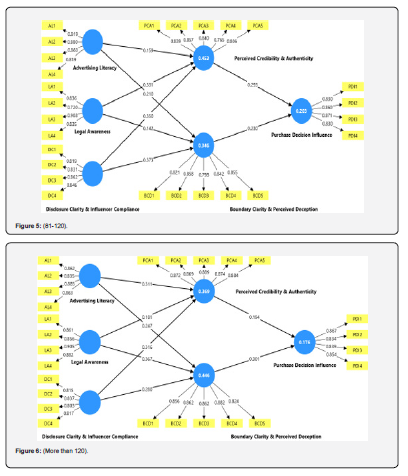
The results of the Multigroup Analysis (MGA), based on the Welch–Satterthwaite test, indicate that most structural paths did not differ significantly across the four influencer-following categories. Statistically significant differences were observed in only two paths involving Legal Awareness (LA). Six of the eight structural paths showed no statistically significant differences across groups, with p-values greater than 0.05. In particular, the positive direct effect of Disclosure Clarity and Compliance (DC) on both Boundary Clarity and Perceived Deception (BCD) and Perceived Credibility and Authenticity (PCA) remained significant across the four categories, with path coefficients ranging from β = 0.280 to β = 0.439. Pairwise comparisons between the lowest influencer-following category (1–40) and the highest category (>120) did not reveal statistically significant differences (p = 0.132 and p = 0.211, respectively). Similarly, the effect of Advertising Literacy (AL) on BCD and PCA did not differ significantly across the four groups (p = 0.422 and p = 0.240, respectively). The positive direct effects of BCD and PCA on Purchase Decision Influence (PDI) were also consistent across groups, with no statistically significant differences observed (p = 0.553 and p = 0.237, respectively). In contrast, statistically significant group differences (p < 0.05) were identified in the direct paths involving Legal Awareness (LA). Specifically, the comparison between the 41–80 and >120 influencer-following groups revealed a significant difference, with a stronger effect in the >120 group (β = 0.367) than in the 41–80 group (β = 0.257; t = 2.064, p = 0.041). A significant difference was also observed between the 1–40 and 81–120 groups, with the latter showing a stronger path coefficient (β = 0.331) than the former (β = 0.130; t = 2.348, p = 0.020) Table 7 and Figures (2-5).
Discussion
The results shows that Disclosure Clarity and Compliance (DC) exerted the strongest direct effects on Perceived Credibility and Authenticity (PCA) (β = 0.391, t = 11.725) and Boundary Clarity and Perceived Deception (BCD) (β = 0.380, t = 11.639). This finding is consistent with Signaling Theory, where the use of explicit disclosure tags (such as #ad or #sponsored) serves as a market signal أو serves as a signal to followers, reducing information asymmetry between the influencer and the follower, thereby reducing the potential for deceptive interpretation. The findings further revealed significant positive effects of Advertising Literacy (AL) on BCD (β = 0.200) and PCA (β = 0.256), consistent with the Persuasion Knowledge Model (PKM). This suggests that users with greater awareness of advertising and persuasive tactics may be better equipped to critically evaluate influencer content and distinguish commercial persuasion from organic communication. Similarly, Legal Awareness (LA) demonstrated significant positive effects on BCD (β = 0.224) and PCA (β = 0.157). This finding suggests that greater knowledge of the laws and regulations governing digital advertising may enable consumers to better assess the legitimacy of promotional content and evaluate influencer practices within broader ethical and legal frameworks. [4,33,34].
The mediation results indicate that both Perceived Credibility and Authenticity (PCA) and Boundary Clarity and Perceived Deception (BCD) function as partial mediators between the independent variables and Purchase Decision Influence (PDI). The indirect effect of Disclosure Clarity through PCA on PDI (β = 0.107, t = 6.511) explains that transparency in disclosure does not appear to influence PDI solely through a direct pathway, but rather may first reduce uncertainty and strengthen perceptions of credibility and authenticity that which may, in turn, enhance consumers’ purchase-related responses. The indirect effect through BCD (β = 0.108, t = 6.878) may be explained by the consumer's ability to distinguish more clearly between an influencer's spontaneous, personal content and paid content, which may enhance perceptions of control and transparency, potentially reducing resistance to persuasive appeals and strengthening purchase-related responses [2,32] Figure 6.
Pairwise comparisons using the Welch–Satterthwaite test revealed no statistically significant differences in most structural paths influencer-following categories (1–40, 41–80, 81–120, and over 120 influencers). This consistency suggests that the processes underlying transparency and credibility evaluations may be relatively consistent in the audience, across different levels of influencer-following behavior. The legal awareness pathway toward boundary clarity (LA to BCD) showed a statistically significant difference between the (41–80) and (>120) categories, with a stronger effect in the >120 group (β = 0.367 vs. β = 0.257, p = 0.041). This can be explained by the fact that higher levels of influencer following may expose users to a content environment saturated with implicit marketing, making participants in the >120 category potentially more attentive to regulatory and legal considerations when distinguishing entertainment-oriented content from commercial content. While the (LA → PCA) relationship showed a significant difference between the low (1–40) and mid-to-high (81–120) groups, favoring the latter (β = 0.331 vs. β = 0.130, p = 0.020), this suggests that as the number of influencers followed increases, awareness of legal controls may become more relevant for consumers in filtering information and evaluating an influencer's ethics when forming judgments of influencer credibility [46,47].
Theoretical Contributions
This study extends the digital marketing literature by integrating legal awareness (LA) and Advertising Literacy (AL) within an integrated framework to explain how consumers evaluate commercially sponsored content on social media platforms. The study also provides empirical evidence that the effects of disclosure clarity and Advertising Literacy on PDI operate partly through, but rather mediated by two mediating mechanisms: Perceived Credibility and Authenticity (PCA) and Boundary Clarity and Perceived Deception (BCD). The findings further enrich the literature on consumer behavior suggesting that the impact of disclosure clarity is remain relatively consistent across different influencer-following categories, while the impact of legal awareness varies among higher influencer-following groups.
Practical & Managerial Implications
The findings highlight the importance of clear and consistently enforced disclosure requirements that require influencers to use unambiguous disclosure mechanisms. The findings indicate that Disclosure Clarity and Compliance emerged as the strongest predictor, suggesting an important role in reducing ambiguity and improving consumers’ understanding of marketing intentions. From a brand management perspective, the findings suggest that marketing managers should prioritize influencers who adhere to standards of transparency and ethical disclosure. The findings do not suggest that clear sponsorship disclosure necessarily undermines consumer responses; rather, consumers may place greater trust in influencers who clearly distinguish between their personal opinions and paid advertising. Furthermore, the study challenges the assumption that commercial disclosure necessarily reduces audience engagement. The results show that clear disclosure may strengthen credibility and reduce uncertainty, which may contribute to more informed purchase-related responses.
Limitations
This study provides an integrated perspective on how consumers respond to commercial disclosure in influencer marketing, Nevertheless, several limitations should be acknowledged that which also provide directions for future research. The study focused on the relationships among Advertising Literacy (AL), legal awareness (LA), and disclosure clarity (DC) with PCA and BCD as mediating mechanisms (perceived credibility (PCA) and boundary clarity (BCD)) on Purchase Decision Influence (PDI). The model did not incorporate other behavioral or cognitive variables such as perceived influencer attractiveness, influencer-product fit, or concerns about digital privacy. Furthermore, the study sample focused on young consumers, specifically university students on Instagram. Although this group is highly active on Instagram and frequently exposed to influencer content, its demographic and behavioral characteristics may differ from older age groups or users with varying educational levels, thus limiting the generalizability of the findings to the broader consumer population. Future research could address these limitations, future research recommends testing the model through experimental designs that measure behavioral responses to controlled or real-world advertising exposure, in addition to expanding the sample to include broader demographic categories and diverse digital platforms such as TikTok, while examining additional moderators such as product type (luxury products versus basic products) or disclosure format (explicit versus implicit).
References
- Joshi Y, Lim WM, Jagani K, Kumar S (2025) Social media influencer marketing: Foundations, trends, and ways forward. Electronic Commerce Research 25(2): 1199‑
- Lou C, Yuan S (2019) Influencer Marketing: How Message Value and Credibility Affect Consumer Trust of Branded Content on Social Media. Journal of Interactive Advertising 19(1): 58‑
- Pushparaj P, Kushwaha BP (2024) Social Media Influencer Marketing: A Systematic Literature Review Using TCM and ADO Framework. International Journal of Consumer Studies 48(6): e13098.
- Evans NJ, Phua J, Lim J, Jun H (2017) Disclosing Instagram Influencer Advertising: The Effects of Disclosure Language on Advertising Recognition, Attitudes, and Behavioral Intent. Journal of Interactive Advertising 17(2): 138‑
- Lou C, Ma W, Feng Y (2021) A Sponsorship Disclosure is Not Enough? How Advertising Literacy Intervention Affects Consumer Reactions to Sponsored Influencer Posts. Journal of Promotion Management 27(2): 278‑
- European Commission (2025) Influencer Legal Hub.
- Directive 2005/29/EC (2005) Directive 2005/29/Ec of the European Parliament and of the Council.
- Portuguese monitoring evidence (2024) Advertising Self-Regulation launches guide on influencer marketing.
- Verhoef PC, Broekhuizen T, Bart Y, Bhattacharya A, Dong Q, et al. (2021) Digital transformation: A multidisciplinary reflection and research agenda. Journal of Business Research 122: 889‑
- Cardoso G (2023) Communication of communication: People are the message. Social Worlds.
- Santos C (2021) Presumption, o propulsor de uma nova era communicational (Dykinson). In: Pastor JMV (Ed.), Platforms, media consumption and new digital realities: Towards an integrative perspective, pp. 1019-1042.
- Santos C (2023) The 21 Characteristics of Advertising Communication in the XXI Century: The Supremacy of Virtuality and Visuality. Vista (12): e023013.
- Santos C (2024) The Contemporary "Matrix of the Three E's": Emancipation, Empowerment and Consumer Engagement. In Ferreira I, Advertising in the Age of Hyperstimulation, pp. 17-31.
- Hochstein RE, Harmeling CM, Perko T (2025) Toward a theory of consumer digital trust: Meta-analytic evidence of its role in the effectiveness of user-generated content. Journal of the Academy of Marketing Science 53(4): 1034‑
- Ukpabi DC, Karjaluoto, H (2018) What drives travelers’ adoption of user-generated content? A literature review. Tourism Management Perspectives 28: 251‑
- Thurau TH, Malthouse EC, Friege C, Gensler S, Lobschat L, et al. (2010) The Impact of New Media on Customer Relationships. Journal of Service Research 13(3): 311‑
- Mangold WG, Faulds DJ (2009) Social media: The new hybrid element of the promotion mix. Business Horizons 52(4): 357‑
- Vrontis D, Makrides A, Christofi M, Thrassou A (2021) Social media influencer marketing: A systematic review, integrative framework and future research agenda. International Journal of Consumer Studies 45(4): 617‑644.
- Alsaadi H, Wali A, Fakieh B (2024) A dataset analysis of digital marketings influence on purchase intentions of millennials and generation Z in Saudi Arabia. Data in Brief 57: 111045.
- Cong LW, Li S (2024) Influencer marketing and product competition. Journal of Economic Theory 220: 105867.
- Bu Y, Parkinson J, Thaichon P (2022) Influencer marketing: Homophily, customer value co-creation behavior and purchase intention. Journal of Retailing and Consumer Services 66: 102904.
- Bertaglia T, Goanta C, Spanakis G, Iamnitchi A (2025) Influencer self-disclosure practices on Instagram: A multi-country longitudinal study. Online Social Networks and Media 45: 100298.
- Li W, Zhao F, Lee JM, Park J, Septianto F, et al. (2024) How micro- (vs. mega-) influencers generate word of mouth in the digital economy age: The moderating role of mindset. Journal of Business Research 171: 114387.
- Andreoli TP, Vieira BDA (2022) Digital Influencers and the Reaction of Consumers. Revista Gestão & Conexões 11(1): 39-60.
- Ge J (2024) Influencers Marketing and its Impacts on Sustainable Fashion Consumption Among Generation Z. Journal of Soft Computing and Decision Analytics 2(1): 118‑
- Liu X, Zheng X (2024) The persuasive power of social media influencers in brand credibility and purchase intention. Humanities and Social Sciences Communications 11(1): 15.
- Vanninen H, Mero J, Kantamaa E (2023) Social Media Influencers as Mediators of Commercial Messages. Journal of Internet Commerce 22(sup1): S4‑
- Harrigan P, Daly TM, Coussement K, Lee JA, Soutar GN, et al. (2021) Identifying influencers on social media. International Journal of Information Management 56: 102246.
- Kim DY, Kim HY (2021) Trust me, trust me not: A nuanced view of influencer marketing on social media. Journal of Business Research 134: 223‑
- Herrando C, Hoyos MJMD (2022) Influencer endorsement posts and their effects on advertising attitudes and purchase intentions. International Journal of Consumer Studies 46(6): 2288‑
- Vargas L, Santos C (2025) Influencers’ Commercial Communication on Instagram: A study to monitor advertising identifiability. Vargas, Lurdes, Série II.
- Friestad M, Wright P (1994) The Persuasion Knowledge Model: How People Cope with Persuasion Attempts. Journal of Consumer Research 21(1): 1‑
- Spence M (1973) Job Market Signaling. The Quarterly Journal of Economics 87(3): 355.
- Connelly BL, Certo ST, Ireland RD, Reutzel CR (2011) Signaling Theory: A Review and Assessment. Journal of Management 37(1): 39‑
- Wojdynski BW, Evans NJ (2016) Going Native: Effects of Disclosure Position and Language on the Recognition and Evaluation of Online Native Advertising. Journal of Advertising 45(2): 157‑
- Sokolova K, Kefi H (2020) Instagram and YouTube bloggers promote it, why should I buy? How credibility and parasocial interaction influence purchase intentions. Journal of Retailing and Consumer Services 53: 101742.
- Bulante RJA, Catalan JM, Miranda NGL, Torres DT, Sabaulan JS (2025) The Consumer Behavior of Generation Z: An Impact in Modern Marketing Innovations. International Journal of Research and Innovation in Social Science, IX(XIV): 950‑
- Calvo ME, Dominguez AJP, Palmero FM (2025) Generation Z, Circular Fashion, and Sustainable Marketing. International Journal of Digital Marketing, Management, and Innovation 1(1): 1‑
- Ilmalhaq A, Pradana M, Rubiyanti N (2024) Indonesian local second-hand clothing: Mindful consumption with stimulus-organism-response (SOR) model. Discover Sustainability 5(1): 251.
- Kaur K (2025) The Impact of Influencer Marketing on the Consumer Behavior of Generation Z And Millennials. Agora International Journal of Economical Sciences 19(2): 181‑
- Singh P (2024) What Drives or Decelerates Generation Z? An Empirical Study Navigating Consumer Buying Intentions in Online Shopping. Sage Open 14(3): 21582440241263173.
- Venes A, Duarte A (2025) Gen Z’s Code: Cracking the Authenticity Formula in Influencer-Driven Social Media Advertising. In Rahman H (É), Digital Citizenship and Building a Responsible Online Presence IGI Global, p. 16.
- Hair JF, Hult GTM, Ringle CM, Sarstedt M, Danks NP, et al. (2021) Partial Least Squares Structural Equation Modeling (PLS-SEM) Using R: A Workbook. Springer International Publishing.
- Fornell C, Larcker DF (1981) Evaluating structural equation models with unobservable variables and measurement error. Journal of Marketing Research, pp. 39-50.
- Henseler J, Ringle CM, Sarstedt M (2015) A new criterion for assessing discriminant validity in variance-based structural equation modeling. Journal of the Academy of Marketing Science 43(1): 115‑
- Cohen J (1988) Set Correlation and Contingency Tables. Applied Psychological Measurement 12(4): 425‑
- Sarstedt M, Hair JF, Pick M, Liengaard BD, Radomir L, et al. (2022) Progress in partial least squares structural equation modeling use in marketing research in the last decade. Psychology & Marketing 39(5): 1035‑

























