




 GJTLH Home



Abstract
This article examines tourism competitiveness across a sample of 22 local destinations belonging to the Chilean Association of Tourist Municipalities (AMTC). The study applies an adapted version of the European Commission’s QUALITEST framework, complemented by selected dimensions associated with Smart Tourism Destinations. A quantitative, descriptive and comparative design was employed to assess two central dimensions: Destination Quality (DQ) and Product Quality (PQ). Data were collected from key local tourism informants through a structured questionnaire using a nine-point Likert scale and subsequently analyzed using arithmetic means and a four-quadrant competitive positioning matrix. The findings indicate that most destinations display relatively strong competitive performance; however, the disaggregated results reveal important structural gaps in digitalization, technological capabilities, accessibility, quality certification and the management of informal tourism services. The study demonstrates the usefulness of QUALITEST as a practical framework for differentiating competitive profiles among local destinations and argues that destination competitiveness should be understood not merely as a function of resource endowment, but as the outcome of governance capacity, coordinated management and product development. The findings also highlight the value of associative approaches to tourism governance for reducing territorial disparities and strengthening collective competitiveness in Chile.
Keywords: Tourism competitiveness; Qualitest model; Destination quality; Product quality; Chile
Abbreviations: QPCI: Quality Perception Condition Indicators; QMI: Quality Management Indicators; QMI: Quality Management Indicators; QPI: Quality Performance Indicators; DQ: Destination Quality; PQ: Product Quality
Introduction
Tourism has progressively consolidated its position as a strategic socio-economic activity in Chile. In order to support sustainable development and enhance the attractiveness of national and international markets, regional destinations have increasingly recognized the need to strengthen their competitive advantages by capitalizing on territorial assets and improving the quality of tourism services. However, a central challenge lies in developing competitive strategies within an associative framework while avoiding destructive forms of competition among destinations.
In this context, competitiveness cannot be understood in isolation. It involves, first, the quality of the integrated management of the destination and, secondly, the capacity of the tourism product to satisfy visitors throughout the value chain. The European Commission developed the quietest framework as a tool for monitoring and evaluating quality performance in tourist destinations and services through a multidimensional system of indicators [1].
The main purpose of this study is to identify, measure and compare similarities, differences and patterns of tourism competitiveness across a group of Chilean destinations, coded from D1 to D22. Its contribution lies in providing quantitative evidence that may support local public policy and collective strategic decision-making among associated destinations.
A local tourist destination may be understood as a physical and interactive space defined by geographical and administrative boundaries, in which visitors stay for at least one night and consume an integrated set of resources, attractions, facilities and services World Tourism Organization, 2002 [2]. Local destinations incorporate essential components such as transport, accommodation, food services, entertainment and natural or cultural attractions [3,4]. Coordination among territorial units responsible for environmental management, productive development, culture and regulation is likewise fundamental to sustaining local tourism governance [5].
Tourism competitiveness involves designing and implementing strategic plans that optimize the use of resources, improve market adaptability and generate above-average performance without imposing disproportionate social or environmental costs Bordas, 1993 [6,7]. Two broad approaches may be distinguished:
i. Individual competitiveness: the capacity of a specific firm or destination to provide more satisfactory experiences than its direct competitors [8].
ii. Associative or cooperative competitiveness: a strategy based on alliances among complementary destinations in order to expand market reach, develop regional packages and generate economies of scale [9,10].
The [1] proposed quaintest as a methodological framework for addressing competitiveness from a quality perspective. The framework is designed to measure, monitor and evaluate the quality performance of tourist destinations and services through multiple variables and indicators. In this study, the framework was adapted to the objectives and characteristics of the research. The adapted framework incorporates 16 quality themes and three broad types of indicators: Quality Perception Condition Indicators (QPCI), which capture subjective perceptions of quality conditions; Quality Management Indicators (QMI), which assess operational management practices; and Quality Performance Indicators (QPI), which provide quantitative evidence of performance. To enrich the analysis, selected dimensions associated with Smart Tourism Destinations were incorporated, including governance, technology, innovation, accessibility and sustainability [11,12].
Materials and Methods
Tourism competitiveness was operationalized through two central latent variables—Destination Quality (DQ) and Product Quality (PQ)—which were broken down into analytical areas and specific indicators adapted from quaintest Table 1.
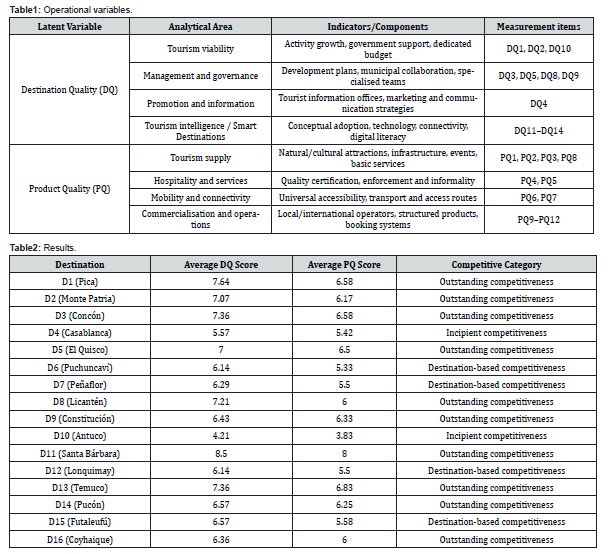
A quantitative, descriptive and comparative research design was employed [13,14]. The study used a non-probability judgement sample consisting of key informants responsible for local tourism management in destinations associated with the AMTC. From a target population of 29 member destinations, complete responses were obtained from 22 destinations. The participating destinations were anonymized and coded from D1 to D22 in order to preserve confidentiality and priorities systemic territorial analysis.
The questionnaire used a nine-point Likert scale, where 1 represented an incipient or very low level of performance and 9 represented outstanding performance. Data collection was carried out in two consecutive stages between January and February 2023: the instrument was first distributed digitally and was subsequently applied through standardized telephone interviews [15].
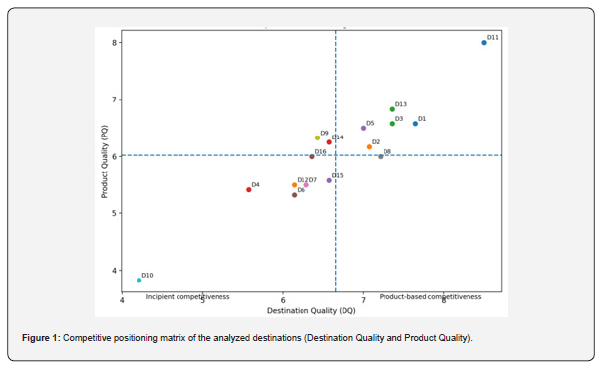
The analysis included: (1) the calculation of arithmetic means for the 14DQ items and 12PQ items for each destination; (2) the calculation of overall sample means; and (3) the construction of a four-quadrant competitive positioning matrix combining DQ and PQ scores to classify destinations as outstanding, incipient, destination-based or product-based competitive profiles.
Results
The participating destinations represented different geographical areas of Chile, including northern, central and southern territories. The profiles of local tourism managers also varied in terms of professional training and experience. A substantial proportion had relatively short periods of service in their current positions, highlighting the potential effects of staff turnover on the continuity of local tourism management. Administrative arrangements likewise differed, ranging from tourism offices and specialized units to departments and directorates.
The competitive positioning analysis shows that a substantial share of the destinations for which individual scores are reported were located in the outstanding competitiveness quadrant, exceeding the relevant reference thresholds in both dimensions. Nevertheless, several destinations displayed profiles more strongly based on destination management than on product development, while Casablanca and Antuco were positioned within the incipient competitiveness quadrant. The results therefore reveal that favorable overall positioning may coexist with important weaknesses specific dimension.
Figure 1. Competitive positioning matrix of the analyzed destinations (Destination Quality and Product Quality).
Destination Quality. Tourism viability showed generally positive perceptions of sustained activity growth and budget allocation, although digital connectivity remained a critical weakness. In tourism management, the existence of development plans, community collaboration and technical teams was positively assessed, but important shortcomings were identified in digital literacy programmed for local businesses. Promotion and information benefited from the presence of Tourist Information Offices and a growing awareness of Smart Tourism Destination concepts; however, practical implementation of information and communication technologies remained limited. Environmental management received comparatively favorable assessments, particularly in relation to waste, water and air management.
Product Quality. Tourism supply benefited from the abundance of natural and cultural attractions and the availability of basic supporting services. The principal weaknesses concerned the updating of activity programmed and limited commercialization through international operators. Hospitality and service quality constituted one of the most critical areas, reflecting low levels of quality certification and limited control of informal supply. Mobility and connectivity showed intermediate performance, while accommodation and related services displayed significant limitations in universal accessibility and the availability of centralized digital booking systems.
Discussion
The findings support the usefulness of quietest for differentiating levels and profiles of competitiveness among regional destinations in Chile. Consistent with the perspectives of [7,16], competitiveness does not depend solely on the availability of natural or cultural resources, but also on the capacity for coordinated management and systemic integration.
Although many destinations achieved favorable overall positions, the disaggregated analysis reveals substantial internal variation. Destinations with apparently consolidated competitive profiles may nevertheless display weaknesses in product quality, particularly in digital transformation, technological capabilities among tourism businesses, quality certification and accessibility [17-20].
The observed variation may also be associated with the high turnover of technical personnel responsible for local tourism units and with gaps in specialized expertise. This reinforces the need for continuous institutional processes and more stable professional capabilities. Associative structures such as the AMTC may provide an opportunity to address common operational gaps through shared programs for digital literacy, joint promotion, quality management and the monitoring of informal tourism services [21,22].
The main limitations research: (i) Sampling: the study was limited to destinations associated with the AMTC and therefore does not represent all tourist destinations in Chile. (ii)Subjectivity of data: measurements were based primarily on perceived self-assessments by local technical managers and may therefore contain social desirability or administrative optimism biases. (iii)Equal weighting of variables: the model assigned equivalent weight to all analytical areas and did not estimate the potentially different effects of variables such as accessibility or digitalization on visitor experience.
Conclusion
The general hypothesis of the research is partially supported. While the results reveal a clear tendency towards favorable competitive positioning, belonging to a high-competitiveness category does not guarantee homogeneous performance across all dimensions of destination and product quality.
The findings suggest that local tourism competitiveness in Chile is strongly dependent on the quality of destination management, which may operate as a structural condition for the development and improvement of tourism products. Priority areas for strengthening associative competitiveness include:
i. Implementing digital literacy and technology adoption programs for local tourism SMEs.
ii. Promoting wider adoption of quality certification and universal accessibility standards in accommodation and tourism services.
iii. Reducing turnover among local technical teams in order to provide continuity for Local Tourism Development Plans (Pladetur).
Overall, the study demonstrates that the assessment of competitiveness should move beyond aggregate scores. A combined analysis of destination quality and product quality provides a more nuanced understanding of territorial strengths and weaknesses and may support the design of collaborative policies aimed at strengthening the competitiveness of networks of destinations.
References
- European Commission, Directorate-General for Enterprise and Industry (2005) A manual for evaluating the quality performance of tourist destinations and services. Publications Office of the European Union.
- Timón DA (2004) The Concept of Tourist Destination: A Geographical-Territorial Approach. Tourism Studies (160): 45-68.
- Moreno M, Coromoto M (2010) Tourism and Tourism Product: Evolution, Concepts, Components, and Classification. Overview 14(2): 145-158.
- Sernatur (2016) Elements for the management of tourist destinations. National Tourism Service of Chile.
- Sernatur (2021) Report on local management and municipal tourism governance in Chile. National Tourism Service of Chile.
- Dwyer L, Kim C (2003) Destination competitiveness: Development of a model with application to Australia and Korea. International Journal of Hospitality Management 22(4): 369-414.
- Crouch GI, Ritchie JB (2000) The competitive destination: A sustainable tourism perspective. Tourism Management 17: 272.
- Vengesayi S (2003) A conceptual model of tourism destination competitiveness and attractiveness. ANZMAC 2003 Conference Proceedings.
- Fyall A, Garrod B, Wang Y (2012) Destination collaboration: A critical review of theoretical approaches to a multi-dimensional phenomenon. Journal of Destination Marketing & Management 1(1-2): 10-26.
- Ritchie JB, Crouch GI (2013) The competitive destination: A sustainable tourism perspective. CABI Publishing.
- Segittur (2015) Smart tourist destinations: Operational manual for the configuration of smart tourist destinations. Secretary of State for Tourism of Spain.
- Ávila ALD, Muñoz A, Sánchez S (2015) White Paper on Smart Tourist Destinations. Segittur.
- Sampieri RH, Collado CF, Lucio PB (2014) Research Methodology (6th edn). McGraw-Hill.
- Cauas D (2015) Definition of variables, approach and type of research. Electronic Library of the National University of Colombia.
- Díaz L, Ortiz R (2005) The structured interview focused on social research. Journal of Methodology in Social Sciences 12(2): 10-25.
- Dwyer L (2022) Destination competitiveness and resident well-being. Tourism Management Perspectives 43: 100996.
- Baños PJ, Jiménez FK (2012) The Competitiveness of Tourism Destinations: An Analysis from the Perspective of Quality. Studies and Perspectives in Tourism 21(4): 810-828.
- Gándara JM (2004) The quality and competitiveness of tourist destinations. Vision and Action 6(3): 70-81.
- Gambarota DM, Lorda MA (2017) Tourism as a local development strategy. Venezuelan Geographic Journal 58(2): 346-359.
- Henche BG (2005) Differential characteristics of the rural tourism product. Tourism Notebooks (15): 115-134.
- Linares HL, Garrido GM (2014) From sustainable tourism development to local development: Its complex behavior. PASOS Journal of Tourism and Cultural Heritage 12(2): 455-466.
- Sangpikul A (2017) The influences of destination quality on tourist satisfaction and loyalty. International Journal of Culture, Tourism and Hospitality Research 11(3): 420-435.

























