




 GJTLH Home



Abstract
Employee well-being is an important element of sustainable Human Resource Management because it supports the functioning of employees and
the long-term effectiveness of organizations. The gastronomy sector in Poland is characterized by demanding working conditions, which may
reduce well-being across psychological, physical, and social dimensions. The aim of this study was to assess these dimensions among employees
in this sector and to examine whether tools developed in psychological and medical sciences can be used to measure well-being for Human
Resource Management.
A quantitative survey was conducted among employees in the gastronomy sector in Poland using established instruments for assessing
psychological, physical, and social well-being. The analysis focused on the internal structure of well-being and the characteristics of the research
sample.
The results showed that the three dimensions differed in their levels and variability. The findings suggest that emotional strain, physical
demands, and workplace relationships shape well-being in this sector. The study indicates that these tools can support sustainable Human
Resource Management.
Keywords:Sustainable human resource management; Employee well-being; Gastronomy sector, Hospitality industry; Working conditions; Psychological well-being; Physical well-being; Social well-being; Labour practices in Poland; Workforce sustainability
Abbreviations: HRM: Human Resource Management; SWEMWBS: Short Warwick Edinburgh Mental Wellbeing Scale; SF36v2: Short Form Health Survey (Version 2); CAWI: Computer Assisted Web Interviewing; ILO: International Labour Organization
Introduction
In the academic literature, the concept of well-being is defined in various ways. In its literal sense, it denotes a state of comfort, health, happiness, and satisfaction [1]. The term well-being appeared in the definition of health formulated by the World Health Organization (WHO) in 1946. According to this definition, health “is a state of complete physical, mental, and social wellbeing and not merely the absence of disease or infirmity” [2].
In the academic literature, the concept of well-being is defined in various ways. In its literal sense, it denotes a state of comfort, health, happiness, and satisfaction [1]. The term well-being appeared in the definition of health formulated by the World Health Organization (WHO) in 1946. According to this definition, health “is a state of complete physical, mental, and social wellbeing and not merely the absence of disease or infirmity” [2].
According to the International Labour Organization (ILO), well-being at work relates to all aspects of working life, from the quality and safety of the physical work environment to how workers feel about their work, their work environment, the work climate, and work organization. The aim of workplace well-being initiatives is to provide occupational health and safety measures that ensure workers are safe, healthy, satisfied, and engaged at work [5]. Well-being is therefore a complex term that connects knowledge from different scientific fields and various dimensions of human functioning.
The Polish legal system imposes many obligations on employers, and these obligations are closely linked with the definitions of well-being presented earlier. The employer must protect the health and life of employees by ensuring safe and hygienic working conditions and by using scientific and technical achievements [6]. In the context of the WHO definition of health adopted by Poland in 1948, the employer must protect psychological well-being, physical well-being, and social wellbeing. This means acting in ways that do not harm employees in these areas.
Using the dynamic definition of well-being, the employer must set challenges for employees that match their physical, psychological, and social resources. Labour law follows this idea and obliges employers to modify the type or conditions of work or gives employees special rights when their health (occupational disease [7], pregnancy [8], etc.) or social situation changes (raising a child [9], caring for an ill family member [10], etc.). This allows them to meet work challenges with changed resources. Labour law also protects employees from practices that harm psychological well-being (mobbing [11], discrimination [12], etc.). The basic principles of labor law stress the need to respect the dignity and personal rights of employees and to meet their living, cultural, and social needs [13].
The Polish legal system enforces actions that support employee well-being, but employers often seem unaware of this fact. These actions generate extra costs [14], which often leads to resistance from employers who do not understand that HRM assumes that employees are the key resource of an organization. Changing this perspective requires adopting certain philosophical assumptions. Human resource management is a business philosophy on how to lead people to use their capabilities in the most effective way and, as a result, gain competitive advantage and maintain a strong position in the market. This requires investment not only in technology but also in people [15].
Materials and Methods
The following hypotheses were formulated:
i. H1. The level of well-being among employees in the
gastronomy sector is lower than mean level in Poland.
ii. H2. Tools previously used in psychological and medical
research can be used in HRM.
The study was designed with research tools used so far in the
social sciences (including psychology) and medical sciences. The
following tools were used:
i. The Polish version of the Short Warwick–Edinburgh
Mental Wellbeing Scale (SWEMWBS),
ii. The Polish version of the SF-36v2 questionnaire for
assessing quality of life,
iii. The author’s translation of the social trust question.
Using the SWEMWBS questionnaire for research purposes
required a non-commercial license issued by the University of
Warwick.
The study was designed to address the research hypotheses and questions. For this reason, selected subscales from the SF-36v2 questionnaire were used to allow inference and comparability of results with norms. The following subscales were used: role limitations emotional problems, general health, role limitations – physical problems, social functioning [16].
To verify the research hypotheses and answer the research questions, a survey study was carried out using an online questionnaire. The study was directed at employees in the gastronomy sector in Poland, who represented the target population. It was conducted from 4 April to 4 May 2025 on a sample of 144 respondents using the Computer Assisted Web Interviewing (CAWI) method, with Google Forms as the tool. Because of the characteristics of the target population, the sample was selected purposively. The questionnaire was shared in social media groups focused on employees and enthusiasts of the gastronomy sector, on groups for students (because many employees in this sector are students), and on groups for job seekers (because of the high turnover in this sector).
The questionnaire measured psychological, social, and physical well-being. Psychological well-being was assessed with SWEMWBS and the role limitations – emotional problems subscale. Social well-being was measured with the social trust question and the social functioning subscale. Physical well-being was measured with the general health and the role limitations – physical problems subscales.
Results and Discussion
Two-thirds of the respondents were members of Generation Z, more than one-quarter belonged to Generation Y, and the remaining participants represented Generation X and one person from the Baby Boomers generation. This structure reflects the prevalence of younger workers in the gastronomy sector. Almost one-quarter of the sample were men and three-quarters were women, which corresponds to the gender distribution typical for this sector in Poland. Almost half of the respondents worked in customer service positions, and more than one-quarter worked in kitchen roles. Employees in managerial positions accounted for 25.7% of the sample, divided almost equally between managers (including supervisors) and head chefs.
The distribution of metric results for psychological wellbeing measured with SWEMWBS is shown in Figure 1, and the comparison between statistical parameters and Polish norms appears in Table 1. The mean score in the sample was lower than the mean for the Polish population. The distribution was left-skewed (skewness −0.69), which means that more scores were below the mean. The distribution was leptokurtic (kurtosis 2.03), which means that answers clustered more tightly around the mean (lower standard deviation than in the population) and included more outliers than a normal distribution.

Source: Based on own research and Niesiobędzka M, Konaszewski K, Bednarz SBS, Surzykiewicz J (2024) Measuring mental well-being: validation of the Polish version of the Short Warwick Edinburgh Mental Wellbeing Scale (SWEMWBS). Studies in Theory of Education 2(47).

None of the respondents achieved scores within the top 15% of results for this questionnaire (28 points or higher). The mean score of the sample indicated a level associated with probable clinical depression (18 points or less). Only 20.8% of respondents achieved a level of psychological well-being that did not indicate depression, and the same percentage showed a level that suggested mild depression (>18–20 points). A total of 58.3% achieved scores indicating probable clinical depression.
The low mean level of psychological well-being did not translate into a greater limitation in functioning at work or in daily tasks caused by emotional problems. Respondents achieved a higher mean score on this subscale compared with the Polish population (Table 2). Respondents reported fewer problems on average, although the difference was not large (8.6% above the norm). The standard deviation was much higher, at 242.4% of the norm, which shows that the sample was more heterogeneous than the Polish population. The Pearson correlation coefficient for this subscale and the SWEMWBS results was 0.1824, which shows that there was no linear relationship. Emotional problems affected work and daily functioning differently for each person, and this was not linked to their level of psychological well-being.
The mean physical well-being measured with the general health and the role limitations – physical problems subscales was close to the results for the Polish population (Table 3). For general health, the mean was 0.14% lower than the national average, and for role limitations due to physical problems it was 3.12% higher. As with the emotional problems subscale, the standard deviation was much higher: 226.12% of the norm for general health and 259.82% for role limitations due to physical problems. Physical well-being was therefore more varied than in the Polish population. The Pearson correlation coefficient between these subscales was 0.5097, which indicates a moderate linear relationship between general health and the extent to which physical problems limited work or daily activities.

Source: Based on own research and Zreda DZ, Wrześniewski K, Bugajska J, Góral AJ (2009) Polish version of the SF36v2 questionnaire..., op. cit. op. cit., p. 89.

Source: Based on own research and Żołnierczyk Zreda et al. (2009).
Social trust in the research sample was on average 7.3% lower than in the Polish population (Table 4). Trust in coworkers was lower than general trust (12.3% lower than the national average), and trust in supervisors was almost one point lower than the national average. The difference between general trust and trust in coworkers was relatively small (5.4% lower), but trust in supervisors was almost one quarter lower. This shows that employees felt relatively safe with their coworkers but trusted their supervisors much less. Figure 2 shows this trend, with the distribution shifted to the left.

Source:Based on own research and the European Social Survey (2023-2024).
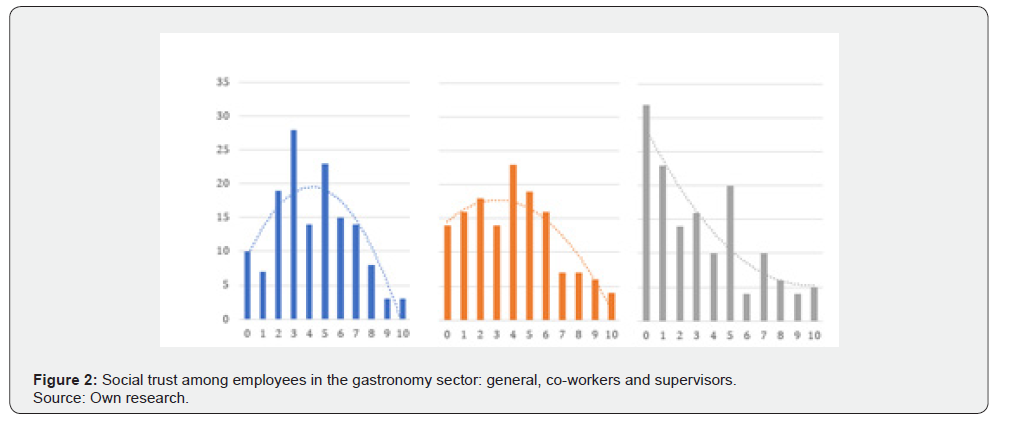
Compared with the distribution for the Polish population (Figure 3), clear differences appeared between the sample and the national results. In Poland, the most common answer was 5 on the scale, while among respondents from the gastronomy sector the most frequent value was 3 for general trust, 4 for coworkers, and 0 for supervisors. The distribution for trust in supervisors shifted strongly to the left, which shows low trust towards supervisors in this sector relative to the general population.

The social functioning subscale showed a level almost one quarter lower in the sample compared with the Polish population (Table 3). This indicates that physical and psychological wellbeing limited social functioning more in the sample than in the population. The standard deviation was also much higher: 229.65% of the population value. Respondents therefore showed a lower and more varied level of social functioning. There was no linear relationship between social functioning and general social trust. The relationship with trust in coworkers was weak, and the relationship with trust in supervisors was moderate (Pearson’s correlation coefficients: 0.1346; 0.2166; 0.3940). Social functioning depended most strongly on trust in supervisors.
Conclusion
The mean level of physical well-being in the sample of gastronomy employees was comparable to the Polish population. Psychological well-being was 29.8% below the norm, which may indicate clinical depression. Social well-being was also below the norm, particularly in the area of social trust in supervisors, which was 28.9% lower.
The tools used in the study, previously applied in psychological
and medical research –
i. The Polish version of the Short Warwick–Edinburgh
Mental Wellbeing Scale (SWEMWBS)
ii. Selected subscales of the Polish version of the SF36v2
quality of life questionnaire
iii. The social trust question - made it possible to reliably
assess the well-being of the employee sample for HRM purposes.
Their relatively short form and ease of administration and
analysis show that they have strong potential for implementation
in HRM. They could be used both as a tool for periodic group-level
assessment of employee well-being and for individual assessment,
applied with employee consent, for example during coaching or
mentoring. The hypothesis H2 was therefore fully confirmed.
References
- Łabędź A (2023) Management of employee well-being in the organization. In: Lisiński M, Dzieńdziora J (Eds.), Paradigms of contemporary management from the perspective of young scientists, WSB Academy, Dąbrowa Górnicza, p. 156.
- World Health Organization (WHO) (1946) Constitution of the World Health Organization. Basic Documents, Geneva: World Health Organization.
- Dodge R, Daly AP, Huyton J, Sanders LD (2012) The challenge of defining wellbeing. International Journal of Wellbeing 2(3): 222-235.
- Kloep M, Hendry L, Saunders D (2009) A new perspective on human development. Conference of the International Journal of Arts and Sciences 1(6): 337.
- International Labour Organization (2009) Workplace Well-Being.
- Pracy K (1974) Act of 26 June 1974 - Labour Code. Journal of Laws of 1974 (No. 24 item 141) as amended, Art. 207 2.
- Pracy K (1974) Act of 26 June 1974 - Labour Code. Journal of Laws of 1974 No. 24 item 141 as amended, Art. 230.
- Pracy K (1974) Act of 26 June 1974 - Labour Code. Journal of Laws of 1974 No. 24 item 141 as amended, Art. 178 et seq.
- Pracy K (1974) Act of 26 June 1974 - Labour Code. Journal of Laws of 1974 No. 24 item 141 as amended, Art. 187 et seq.
- Pracy K (1974) Act of 26 June 1974 - Labour Code. Journal of Laws of 1974 No. 24 item 141 as amended, Art. 173(1) et seq.
- Pracy K (1974) Act of 26 June 1974 – Labour Code. Journal of Laws of 1974 (No. 24, item 141) as amended, Art. 94(3).
- Pracy K (1974) Act of 26 June 1974 – Labour Code. Journal of Laws of 1974 (No. 24 item 141) as amended, Art. 18(3a) et seq.
- K Pracy K (1974) Act of 26 June 1974 – Labour Code. Journal of Laws of 1974 No. 24 item 141 as amended, Article 207 2(1).
- Mulicka I (2015) A human in the process of working in a modern organization. Part I. Opole University of Technology, Opole (Poland), p. 36.
- Armstrong M (1998) Human resource management. Strategy and action. Publishing House of the Professional School of Business, Cracow (Poland), p. 25.
- Franke E (2022) The Catering Industry and the Implementation of the Fair Working Conditions Assumptions of the European Pillar of Social Rights. Review of Applied Sciences 34(1): 76-81.

























