




 GJTLH Home



Abstract
The hospitality industry is highly competitive and service quality play a vital role in influencing customer satisfaction and long-term loyalty. This study examines the impact of service quality on customer satisfaction in hotels; with special reference to lemon tree hotel Dehradun. The study is based on the Servqual model, which includes five dimensions of service quality: tangibility, reliability, assurance responsiveness and empathy. Primary data were collected from 120 hotel guest through well-structured questionnaire using a five-point Likert scale purposive convenience sampling technique was used for data collection. The collected data were analyzed by using reliability analysis, correlation and multiple regressions. The findings indicate that all five dimensions of service quality have a significant and positive impact on customer satisfaction, with reliability and responsiveness emerging as most influential factors. The study emphasizes, the importance of delivering consistent and highquality services to enhance customer satisfaction, encourages repeat visits and generate positive word of mouth. The findings offer practical insights for hotel management to improve service performance and contribute to the existing literature on service quality and customer satisfaction in the hospitality industry.
Keywords:Service quality; Servqual model; Customer satisfaction; Positive word of mouth
Introduction
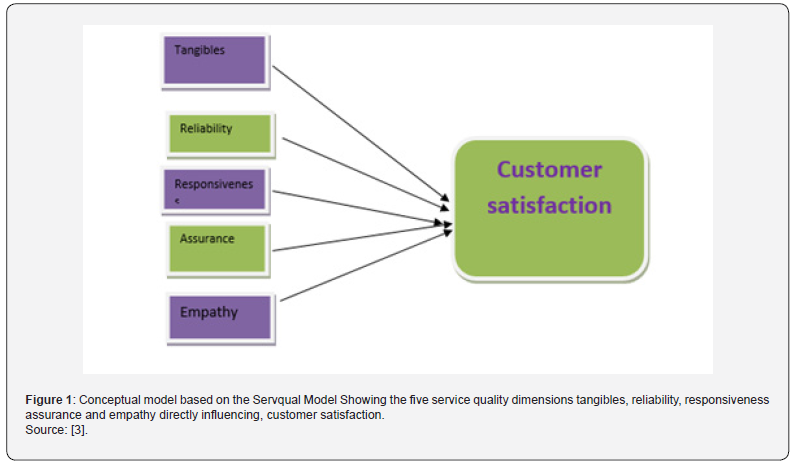
The hospitality industry is highly competitive, and service quality has emerged as a key differentiator in driving customer satisfaction and loyalty [1]. customer satisfaction reflects. The degree to which customer expectation are met or exceeded [2]. hotels that consistently deliver superior service qualities are more likely to build strong customer relationship, positive word of Mouth and higher market share. In recent years, the Indian hotel industry has witnessed rapid expansion due to rising disposable incomes Growth in domestic and international tourism, and increased business level, in such a competitive environment, hotels are no longer competing only on price or location; instead service quality has emerged As a critical determinants of customer satisfaction and long term success .service quality in hotels is inherently intangible, heterogeneous, and inseparable from service delivery, making it challenging to measure and manage effectively. Customers from perception of service quality based on multiple interactions with hotel staff, physical facilities, ambience, and service processes. These perceptions directly influence customer satisfaction, which reflects the extent to which guests feel their expectations have been met or exceeded during their stay in the contemporary hospitality landscape, customer expectations have become increasingly sophisticated due to exposure to global service standards and digital platform such as online booking portals and review website guest now evaluate hotel service quality through multiple dimensions such as tangibility (physical facilities and appearance ), reliability (ability to perform promised service accurately ), responsiveness (promptness and & willingness to help ), assurance (knowledge and courtesy of staff), and empathy (individual attention [3]. These dimensions collectively shape’s guest experience and significantly affect their satisfaction level. In the era of digital platforms and online reviews even minor service failures can quickly affect a hotel’s reputation and market position.
Customer satisfaction is widely recognized as a key outcome of service quality and a vital indicator of organizational performance in the hospitality sector .it represent the overall evaluation of their experience based on the comparison between expectations and actual service received [2] satisfied customers are more likely to visit hotel again and exhibit brand loyalty, while dissatisfied customers may switch to customers and spread negative word of mouth.
Lemon tree Hotel, Dehradun, posited in the emerging market of Uttarakhand, India, is a known for its mid to upper range services and contemporary hospitality offerings. This research aims to explore how service Quality influences customer satisfaction among guest at lemon tree Hotel. By identifying the most influential service quality factors, the study contributes to both academic literature and practical decision-making in hospitality management.
Literature Review
Concept of service quality in the hotel industry
Service quality is a critical concept in service-oriented industries, particularly hospitality, where customer experience largely depends on intangible service encounters [3] defined service quality as the gap between customer expectations and perceptions of service quality, in the hotel industry, service quality encompasses both tangible such as physical facilities and room amenities as well as intangible aspects such as employee’s behavior, responsiveness and reliability. Due to this inseparable nature of service production and consumption, maintaining consistent service quality remains a challenge for hotel. Servqual model developed by [3] is one of the most widely used frameworks to measure service quality .it identifies five key dimensions: tangible, reliability, responsiveness, assurance and empathy numerous hospitality studies have applied this model to assess service quality.
Customer satisfaction in hospitality industry
Customer satisfaction refers to a customer overall satisfaction of a product or services based on their consumption experience [2]. In hotels, customer satisfaction is shaped by multiple service encounters, including reservation process housekeeping services, food and beverage quality and staff interactions. Satisfied customers are more likely to revisit the hotel recommend it to others and contribute it to positive word of mouth. According to [4], customer satisfaction plays a pivotal role in building long term relationship between hotels and their guest.
Relationship between service quality and customer satisfaction
A substantial body of literature confirms a positive and significant relationship between service quality and customer satisfaction in the hotel industries [5], argued that perceived service quality is a direct antecedent of customer satisfaction. Similarly, [6], emphasized that customers form satisfaction judgment based on their perceptions of service performance across multiple dimensions. In hospitality specific research, Chen & Chen (2010) found that higher perceived service quality leads to greater customer satisfaction and favorable behavior intentions among hotel guests.
Role of Servqual dimensions in hotel customer satisfaction
Each Servqual dimension contributes differently to customer
satisfaction in hotels
i. Tangibles: include hotel infrastructure, room
cleanliness, décor, and staff appearance. Research indicates that
clean and well-maintained facilities significantly enhance first
impression and perceived value (Ryu & Han,2010).
ii. Reliability: Refers to hotel’s ability to deliver promised
service accurately and consistently. Studies show that error
in reservation, billing, or service delivery negatively impact
satisfaction (Gronroos,2007).
iii. Responsiveness: it involves prompt service and
willingness to help guests. Several studies show responsiveness
is most influential dimension affecting customer satisfaction in
hotels [7].
iv. Assurance: reflects employee’s knowledge courtesy
and ability to trust. This dimension is especially important for
business travelers and international guests [8].
v. Empathy: Includes personalized attention and
understanding customer needs. Research suggests that
empathetic service created emotional connections leading to
higher satisfaction and loyalty [1].
Service quality and customer satisfaction
In the Indian hospitality context, service quality plays an even more crucial role due to increasing completion and growing customer expectations, Gupta & Nepal (2019). noted that Indian hotel guests are highly sensitive to staff behavior, service responsiveness and value for money Figure 1. Studies conducted in Indian urban hotels reveal that while customer often appreciate physical facilities, dissatisfaction frequently arises from service delays and lack of personalized attention [9].
Moreover, the rise of online travel platform such as booking. com make my trip has increased transparency, making service quality failures more visible to potential customers as a result, hotels in India must consistently monitor and improve service quality to maintain positive online Figure 1 reputations and customer satisfaction [10].
Research Methodology
Research design
The present study adopts a descriptive and analytical research design to examine the impact of service quality on customer satisfaction in the hotel industry, with special reference to Lemon tree Hotel Dehradun [11-13]. The descriptive design helps in understanding customer’s perception of service quality dimension while the analytical design helps in examining the relationship between service quality and customer satisfaction. A quantitative approach was primarily used, supported by qualitative insights to strengthen interpretation of findings [14-17].
Research objectives
i. To examine the level of service quality perceived by
customers at lemon hotel Dehradun
ii. To analyze customer satisfaction levels with respect to
hotel service.
iii. To analyze the impact of service quality dimensions on
customer satisfaction at lemon
iv. Tree hotel Dehradun.
v. To identify the most influential service quality factor
affecting customer satisfaction in lemon tree Hotel Dehradun.
Research hypotheses
Based on the review of literature, the following hypotheses
were formulated.
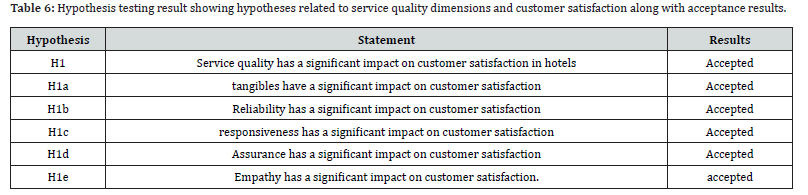
i. H1: Service quality has a significant impact on customer
satisfaction in hotels.
ii. H1a: tangibles have a significant impact on customer
satisfaction.
iii. H1b: Reliability has a significant impact on customer
satisfaction.
iv. H1c: responsiveness has a significant impact on
customer satisfaction.
v. H1d: Assurance has a significant impact on customer
satisfaction.
vi. H1e: Empathy has a significant impact on customer
satisfaction.
Population and sample size
The population of the study consists of all guests who stayed at Lemon tree hotels, Dehradun during the study period. A sample size of 120 respondents was selected for primary data collection.
Sampling techniques
A non-probability purposive sampling was adopted for this study.
Sources of data
The study is based on primary and secondary data. Primary data is collected through a well-structured questionnaire whereas secondary data were collected from books, research journals, published articles etc.
Research instrument
A structured questionnaire was designed based on Servqual
model. It consists of three sections
i. section A consists of demographic profile of consumers
ii. section B consists of service quality dimensions
iii. Section C consists of customer satisfaction measures
All items were measured using a five-point likert scale ranging from 1=strongly disagree to 5=strongly agree.
Data analysis techniques
The data collected and analyzed using SPSS software. Mean, stand deviation correlation and multiple regressions were used.
Data Analysis and Interpretation
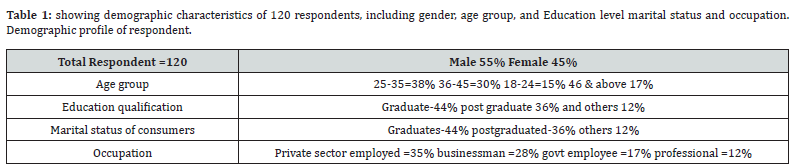
Demographic profile of respondent
Table 1
Reliability analysis
To assess the internal consistency of the measurement Cronbach’s alpha was calculated for all construct. The reliability values for each service quality dimension and customer satisfaction exceeded the acceptable threshold of 0.70 indicating good reliability of the instrument.
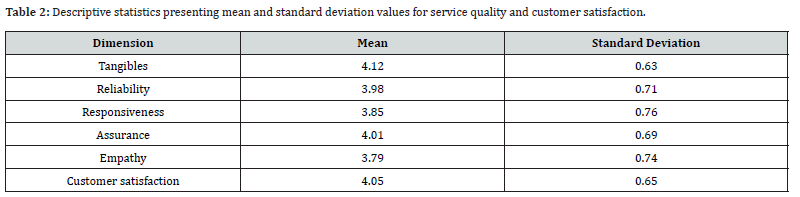
Descriptive statistics
Table 2
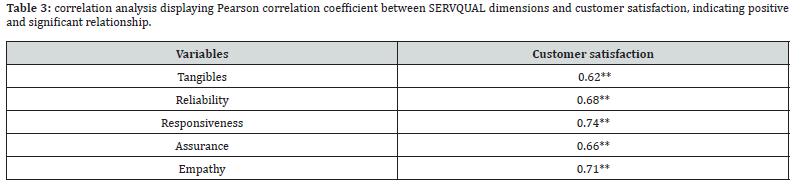
Correlation analysis
Table 3 Note ρ<0.1
Interpretation: all service quality dimensions show a positive and significant relationship between customer satisfaction, responsiveness and empathy exhibit the strongest correlations, highlighting their importance in shaping guest satisfaction.
Regression analysis
Table 4
Interpretation
The model explains 66% of the variance in customer satisfaction, indicating a strong explanatory power.
Regression coefficients
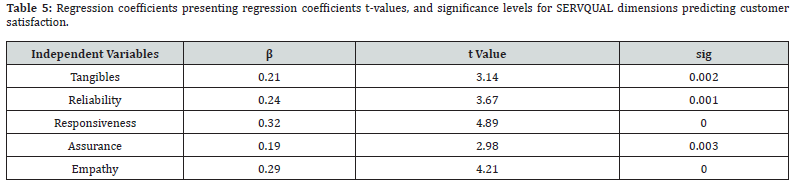
Table 5
Interpretation
All service quality dimensions have a significant positive impact on customer satisfaction. Responsiveness emerged as the most influential predictor, followed by empathy and reliability.
Hypotheses testing
Table 6
Discussion of Findings
The findings indicate that service quality significantly influences customer satisfaction at lemon tree hotel Dehradun. While tangible factors such as infrastructure and cleanliness create a positive impression, service responsiveness and empathetic staff behavior play a decisive role in determining overall satisfaction. These findings are consistent with prior studies [1,7]. Which emphasize the importance of human interaction in hospitality services?
Conclusion
The study concludes that improving service quality is essential for enhancing customer satisfaction in hotels. All five Servqual dimensions significantly impact satisfaction, with responsiveness and empathy playing a dominant role. Hotel management should prioritize service training and customer centric practices to sustain competitiveness.
Managerial Implications
The study indicates that service quality significantly influences customer satisfaction at Lemon tree hotel Dehradun. Hotel management should focus on improving reliability and responsiveness by ensuring timely, accurate and prompt service delivery, regular staff training program should be conducted to improve employee’s communication skill, service etiquette, and problem-solving abilities, ensuring consistent and high-quality service delivery. Management should design services based on customer expectations and feedback. Improving service quality helps managers enhance customer satisfaction, retain guests, improve band image, and achieve long term profitability.
Limitations and Future Research
Despite its contributions, the present study has certain limitations that should be acknowledged first the study is limited to lemon tree hotel Dehradun, which restrict the generalizability of the findings to other hotels, regions. Second the study used a sample size of 120 respondents, which although adequate for basic statistical analysis, may not fully represent the diverse customer base of hotel. Finally, the study focuses on service quality dimensions of SERVQUAL and does not consider other factors such as price perception, brand image; customer expectations etc. Future research can be conducted by including multiple hotels across different regions to improve the generalizability of findings. Studies may use a larger sample size and probability sampling techniques for more accurate results.
Conflict of Interest Statement
The author(s) declare that there is no conflict of interest associated with this research. The study was conducted independently, and no personal, professional, financial or institutional relationships influenced the research design, data collection, analysis, interpretation, or reporting of the findings.

Funding Statement
This research did not receive any specific grant from funding agencies in the public, commercial, or not for profit sectors.
References
- Kandampully J, Suhartanto D (2000) Customer loyalty in the hotel industry: the role of customer satisfaction and image. International Journal of Contemporary Hospitality Management 12(6): 346-351.
- Oliver RL (1997) Satisfaction: A behavioral perspective on the consumer. McGraw-Hill.
- Parasuran A, Zeithml VA, Berry LL (1988) Servqual: A multiple-item scale for measuring consumer perceptions of service quality. Journal of Retailing 64(1): 12-40.
- Kotler P, Bowen JT, Makens JC (2017) Marketing for Hospitality and Tourism (7th edn). Pearson Education.
- Cronin JJ, Taylor SA (1992) Measuring service quality: A re-examination and extension. Journal of Marketing 56(3): 55-68.
- Brandy MK, Cronin JJ (2001) some new thoughts on conceptualizing perceived service quality: A hierarchical approach Journal of Marketing 65(3): 34-39.
- Ladhari RL (2009) Service quality, emotional satisfaction, and behavioral intentions: A study in the hotel industry. Managing Service Quality 19(3): 308-331.
- Zeithml VA, Bitner MJ, Gremler DD (2018) Services Marketing: integrating customer focus across the film (7th edn). Mc Graw- Hill Education.
- Akaba A (2006) Measuring service quality in the hotel industry: A study in a business hotel in Turkey. International Journal of Hospitality Management 25(2): 170-192.
- Anderson EW, Sullivan MW (1993) The antecedents and consequences of customer satisfaction of firms. Marketing of Science 12(2): 125-143.
- Ekinci Y, Riley M (2001) Validating quality dimension. Annals of Tourism Research 28(1): 202-223.
- Gronroos C (1984) A service quality model and its marketing implications. European Journal of Marketing 18(4): 36-44.
- Han H, Back KJ, Barrett B (2009) Influencing factors on restaurant customer’s revisit intention: The role of emotions and switching barriers. International Journal of Hospitality Management 28(4): 563-572.
- Lee S, Jeong M (2012) Effects of experiential quality on perceived value, satisfaction and loyalty in the hospitality industry. International Journal of Hospitality Management 31(2): 498-506.
- Markovic S, Raspor S (2010) Measuring perceived service quality using Servqual: A Case Study of the Croatian Hotel industry. Management 5(3):195-209.
- Min H, Chung K (2002) Dynamic benchmarking of hotel service quality. Journal of Service Marketing 16(4):302-321.
- Namkung Y, Jang S (2007) Does food quality really matter in restaurants? Its impact on customer satisfaction and behavioural intentions. Journal of Hospitality and Tourism Research 31(3): 387-410.

























