




 GJTLH Home



Abstract
Saudi Arabia’s Vision 2030 positions tourism as a key economic pillar, necessitating exceptional service encounters with international visitors. This study investigates the impact of service providers’ English pragmatic competence-encompassing speech act appropriateness, politeness strategies, cultural contextualization, and communication effectiveness-on tourist satisfaction and loyalty. Utilizing a quantitative cross-sectional design, data were collected from 420 international tourists in Saudi Arabia and analyzed using PLS-SEM. The findings reveal that all dimensions of pragmatic competence significantly enhance tourist satisfaction, which in turn mediates a strong, positive effect on loyalty intentions. The results demonstrate that nuanced, culturally-attuned communication is a stronger predictor of satisfaction and loyalty than basic language proficiency alone. This research offers novel insights for intercultural communication theory and provides actionable strategies for training and service design, positioning pragmatic competence as a critical lever for achieving sustainable tourism growth and competitive advantage in the Saudi market.
Keywords:Pragmatic competence; Tourist satisfaction; Loyalty; Saudi Arabia; Intercultural communication; Sustainable tourism
Abbreviations: ICC: Communication Competence; SDGs: Sustainable Development Goals; CIS: Confidence Intervals; ICC: Intercultural Communication Competence
Introduction
Saudi Arabia’s ambitious Vision 2030 underscores the nation’s commitment to transforming its tourism sector into a globally competitive industry, welcoming diverse international visitors with refined service encounters [1]. Central to this transformation is the ability of frontline service providers to communicate not only with grammatical correctness but also with pragmatic competence-the nuanced understanding of speech acts, cultural norms, and context-sensitive language use [2]. Pragmatic competence enables hosts to convey politeness strategies, indirectness, and cultural authenticity, thereby facilitating more meaningful intercultural exchanges [3].
Despite considerable research on English language proficiency in tourism contexts, the specific impact of pragmatic competence on tourist satisfaction and loyalty remains underexplored, particularly in high-context cultures such as Saudi Arabia [4-6]. While studies have established a positive relationship between general language skills and service quality perceptions [7], few have isolated pragmatic dimensions-such as appropriate speech acts and cultural contextualization-and examined their direct effects on tourist behavioral intentions.
Tourist satisfaction constitutes a key antecedent of loyalty, shaping repeat visitation and positive word-of-mouth, which are critical drivers of sustainable tourism growth [8-10]. In this study, Intercultural Communication Competence Theory is integrated with the Tourist Satisfaction-Loyalty Chain Model to posit that service providers’ pragmatic competence mediates the relationship between service encounters and tourist outcomes. By focusing on dimensions such as speech act awareness, cultural sensitivity, and communication effectiveness, the research aims to reveal how pragmatic nuances enhance perceived authenticity and satisfaction, thereby fostering loyalty intentions and destination image enhancement [11].
Building on established quantitative methodologies, a cross-sectional design employing SEM–PLS will assess 400-500 international tourists in Saudi Arabia, stratified by cultural background (Western, Asian, African, and other Arab regions). Measurements will draw on validated scales including the Intercultural Communication Competence (ICC) Scale [5], the Tourist Satisfaction Index [8], and the Loyalty Intention Scale [9,12]. The findings are expected to demonstrate that pragmatic competence exerts a stronger influence on satisfaction and loyalty than basic English proficiency, offering unprecedented insights into the role of nuanced communication in sustainable tourism development [13-15].
Review of Literature
Theoretical underpinnings
Pragmatic competence encompasses the ability to interpret and produce language appropriately within specific social contexts, integrating knowledge of speech acts, politeness principles, and cultural norms [2]. [16] argues that pragmatic failure often stems from misalignment between the speaker’s intentions and the hearer’s cultural expectations, leading to misunderstandings in service encounters. [3,15] further emphasizes that politeness strategies-such as indirect requests and formulaic expressions-are culturally bound, affecting perceived courtesy and respect in hospitality interactions.
Intercultural Communication Competence Theory posits that effective intercultural exchanges require cognitive, affective, and behavioral skills, including cultural empathy, personal flexibility, and interaction management [5,15]. Cognitive aspects involve awareness of pragmatic rules, while affective components pertain to attitudinal openness and motivation. Behavioral competence manifests through adaptative language use, such as adjusting speech acts to align with guests’ cultural scripts [17- 19].
The Tourist Satisfaction–Loyalty Chain Model conceptualizes satisfaction as the emotional response to service quality, which subsequently influences loyalty intentions and word-of-mouth behavior [7,8] identify communication as a core SERVQUAL dimension, where language accuracy alone is insufficient without pragmatic appropriateness. [9] demonstrate that perceived authenticity-often conveyed through culturally sensitive communication-strengthens the satisfaction-loyalty link.
By synthesizing these theoretical perspectives, this study hypothesizes that pragmatic competence, comprising speech act appropriateness, politeness strategies, and cultural contextualization, exerts a direct positive effect on tourist satisfaction (H1) and an indirect effect on loyalty intentions mediated by satisfaction (H2). Moreover, it is proposed that cultural sensitivity moderates the relationship between communication effectiveness and loyalty (H4), and that highcontext culture tourists experience stronger effects of pragmatic competence on satisfaction (H5).
The Relationship with sustainability and SDGs
Sustainable tourism development integrates economic growth with environmental stewardship and socio-cultural preservation, aligning with several UN Sustainable Development Goals (SDGs), notably SDG 8 (Decent Work and Economic Growth), SDG 12 (Responsible Consumption and Production), and SDG 17 (Partnerships for the Goals) [20]. Effective communication between service providers and tourists not only enhances satisfaction but also fosters sustainable practices by encouraging eco-friendly behaviors through educational discourse [21].
Pragmatic competence enables hosts to employ persuasive speech acts-such as polite suggestions and indirect imperativesthat promote sustainable choices without jeopardizing guest comfort or autonomy [13]. For instance, context-sensitive explanations of local conservation efforts can increase tourists’ willingness to participate in responsible wildlife viewing or waste reduction initiatives, directly contributing to SDG 12 targets [22-25].
Moreover, intercultural empathy and sensitivity-core to pragmatic competence-support cross-sector partnerships (SDG 17) by facilitating dialogue among stakeholders, including local communities, government agencies, and international tour operators [14,26]. By communicating cultural heritage narratives with authenticity, service providers bolster community pride and sustain intangible cultural resources, thereby advancing SDG 11 (Sustainable Cities and Communities) and preserving cultural identity [27,28].
Finally, enhanced satisfaction and loyalty generated through pragmatic competence can drive economic resilience (SDG 8) by promoting repeat visitation and positive word-of-mouth, which underpin long-term tourism demand and job creation in local economies [9,13,29]. Thus, pragmatic communication emerges as a strategic lever for achieving holistic sustainability in Saudi Arabia’s evolving tourism sector.
Hypotheses development Speech act appropriateness and tourist satisfaction
Service encounters in tourism hinge upon the successful execution of speech acts-such as greetings, requests, and expressions of gratitude-that align with guests’ cultural expectations [30]. In high-context cultures like Saudi Arabia, indirectness and politeness strategies are paramount; for instance, employing honorifics and context-sensitive apologies conveys respect and deference [3,31]. When service providers produce speech acts that resonate with tourists’ pragmatic schemas, they reduce uncertainty and foster emotional comfort, thereby enhancing affective satisfaction (Oliver, 1999). Conversely, pragmatic failure-manifested through abrupt requests or literal translations-can generate frustration and diminish perceived service quality [16].
Empirical studies in hospitality contexts underscore the significance of pragmatic alignment. For example, [32] found that hotel guests rated hosts significantly higher in satisfaction when hosts utilized culturally appropriate indirect requests, while direct commands elicited lower satisfaction scores. Similarly, Idris and [33] demonstrated that Arabic-speaking service personnel who adopted English indirectness conventionssuch as “Would you mind…”-received more favorable guest evaluations than those who translated literal Arabic directives.
Speech act theory further elucidates that certain acts carry higher socio-pragmatic weight. Commissive (promises) and expressive (thanks, apologies) function as relational lubricants, building trust and rapport [34,35]. When a service provider’s promise to deliver a room upgrade is phrased with appropriate hedges (“We will endeavor to…”), tourists perceive authenticity and commitment, strengthening satisfaction [36].
Considering these theoretical and empirical insights, it is posited that speech act appropriateness constitutes a foundational dimension of pragmatic competence in tourism. By aligning linguistic forms with tourists’ cultural scripts, hosts mitigate communicative friction and foster an emotional connection that translates into higher overall satisfaction [37]. This process is particularly critical in Saudi Arabia, where emerging tourists from disparate cultural backgrounds may lack familiarity with local hospitality norms.
On this basis, the following hypothesis is formulated:
Hypothesis 1 (H1): Service providers’ speech act
appropriateness positively influences tourists’ satisfaction with
their service encounter.
Politeness strategy utilization and loyalty intentions
Politeness theory asserts that individuals manage face wants through positive and negative politeness strategies, adapting language to reduce threats to self-esteem [38]. In tourism interactions, the adept use of such strategies signals concern for guests’ face needs, promoting goodwill and favorable behavioral intentions [39]. For instance, positive politeness-expressing solidarity and camaraderie through informal address or shared jokes-can heighten emotional bonds, while negative politenessemploying indirectness and deference-respects tourists’ autonomy [40].
Loyalty intentions, including repeat visitation and positive word-of-mouth, are shaped not only by cognitive assessments of service quality but also by affective ties established during exchanges [8] (Dick & Basu, 1994). Politeness strategies play a crucial role in forging these affective ties. In their study of Mediterranean resorts, [41] found that guests exposed to hosts using both positive and negative politeness reported significantly higher intentions to revisit than those experiencing neutral or impolite language. Likewise, Chan and Lam (2017) demonstrated that politeness mitigated the negative impact of service failures on loyalty, illustrating its buffering effect in crisis contexts.
Furthermore, cultural background moderates the effectiveness of politeness strategies. Tourists from individualistic cultures, such as the United States or Northern Europe, may value positive politeness’s emphasis on equality and friendliness, whereas collectivist tourists, prevalent in Asia, may prefer negative politeness’s deference and respect [42]. Nevertheless, in Saudi Arabia’s hospitality landscape, where hospitality is deeply ingrained, a balanced deployment of both strategies likely maximizes cross-cultural appeal [43].
Given the centrality of face-management in tourism
interactions and its demonstrated linkage to loyalty outcomes,
it is hypothesized that:
Hypothesis 2 (H2): The utilization of politeness strategies
by service providers positively affects tourists’ loyalty intentions.
Cultural contextualization and perceived authenticity
Perceived authenticity in tourism arises when experiences resonate with visitors’ expectations of cultural genuineness and local traditions [44]. Pragmatic competence facilitates authenticity by embedding communication in culturally laden contexts-such as invoking local proverbs, narrating heritage anecdotes, or using place-specific terminology [45]. This contextualization signals depth of cultural knowledge and sincerity, enhancing tourists perceived authenticity of the experience [46].
Tourist satisfaction is influenced by perceptions of authenticity, which serve as a heuristic for quality and trustworthiness (Kolar & Zabkar, 2010). Research on heritage tourism in the Middle East indicates that when guides incorporate pragmatic elements-like storytelling conventions and honorific forms-tourists report enriched cultural understanding and emotional engagement [47]. Moreover, authentic communication fosters deeper place attachment, which correlates with repeat visits and recommendations [48].
Cultural contextualization also mitigates the commodification critique by foregrounding host communities’ voices and values, thus aligning with sustainable tourism paradigms [49,27]. Through pragmatic competence, service providers become cultural interpreters rather than mere informants, bridging the gap between commercialization and cultural preservation [50].
In light of these dynamics, it is proposed that cultural
contextualization, as a pragmatic dimension, enhances perceived
authenticity and thereby elevates satisfaction and loyalty.
Accordingly:
Hypothesis 3 (H3): Service providers’ cultural
contextualization positively influences tourists perceived
authenticity of the experience.
Communication effectiveness and behavioral intentions
Communication effectiveness reflects the clarity, coherence, and adaptability of messages exchanged between hosts and guests [51]. It encompasses not only linguistic accuracy but also the skillful management of conversational sequences, turn taking, and feedback mechanisms [52]. Effective communication reduces ambiguity, fosters mutual understanding, and leads to more efficient service transactions (Gustafsson, Johnson, & Roos, 2005).
Behavioral intentions-such as intention to revisit, willingness to pay premium prices, and positive word-of-mouth-stem from both cognitive evaluations of service outcomes and affective responses generated during interactions (Oliver, 1999). Studies in service marketing show that communication effectiveness correlates strongly with perceived service quality and, by extension, loyalty metrics [53] (Homburg, Müller, & Klarmann, 2011).
In tourism, where linguistic heterogeneity is ubiquitous, the ability to adjust register, rephrase complex information, and confirm understanding is critical [54]. For instance, a concierge who paraphrases directions upon guests’ request demonstrates attentiveness and competence, enhancing satisfaction and intentions to use services again [55]. Additionally, communication effectiveness can mitigate adverse effects of environmental stressors-such as noise or crowding-by providing timely explanations and safety information [56].
Thus, recognizing communication effectiveness as a
pragmatic construct with tangible effects on behavioral
intentions, the following hypothesis is posited:
Hypothesis 4 (H4): Higher levels of communication
effectiveness by service providers lead to stronger tourist
behavioral intentions.
Mediating role of satisfaction between pragmatic competence and loyalty
Tourist satisfaction is widely acknowledged as a mediator linking service quality dimensions to loyalty outcomes [8,57]. While basic language proficiency contributes to service quality, pragmatic competence-encompassing speech acts, politeness, contextualization, and communication effectiveness-offers deeper relational value [58]. By satisfying both cognitive and affective needs, pragmatic competence may exert an indirect effect on loyalty through satisfaction.
Research in hospitality contexts indicates that service attributes seldom influence loyalty directly; rather, loyalty emerges when satisfaction internalizes the quality-of-service encounters [9]. For example, in a study of hotel guests in Dubai, satisfaction fully mediated the relationship between service encounter facets-including personalized communicationand loyalty intentions [59]. Similarly, [60] found that guests’ satisfaction with cross-cultural interactions mediated the effect of hosts’ intercultural skills on revisit intentions.
Given these empirical precedents and theoretical
frameworks, it is inferred that tourist satisfaction functions as
a conduit through which pragmatic competence impacts loyalty
outcomes. Consequently:
Hypothesis 5 (H5): Tourist satisfaction mediates the
relationship between service providers’ pragmatic competence
and tourists’ loyalty intentions.
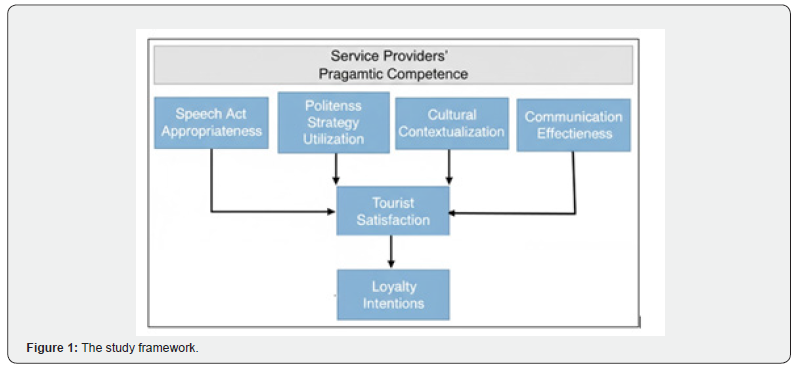
Study Framework
The study model examines how service providers’ pragmatic competence-operationalized through speech act appropriateness, politeness strategy utilization, cultural contextualization, and communication effectiveness-influences tourist satisfaction, which in turn drives loyalty intentions. Arrows depict hypothesized direct effects of each dimension on satisfaction and a subsequent path from satisfaction to loyalty Figure 1.
Methodology
This quantitative study employed a cross-sectional survey design to examine the impact of service providers’ pragmatic competence on tourist satisfaction and loyalty. The target population comprised international tourists visiting major Saudi Arabian destinations between June and August 2025. A purposive sampling approach solicited participation from visitors fluent in English via on-site intercepts at hotels, heritage sites, and tour operators, supplemented by online distribution through travel forums [5].
The instrument consisted of five sections: demographic information, speech act appropriateness (5 items [2]), politeness strategy utilization (6 items [38]), cultural contextualization (4 items; [44]), communication effectiveness (5 items; [51]), tourist satisfaction (6 items; [8]), and loyalty intentions (4 items; [9]). All items used a seven-point Likert scale (1 = strongly disagree to 7 = strongly agree). A pretest with 30 respondents confirmed content validity and clarity, yielding Cronbach’s alpha values above .80 for all constructs [61].
Of 450 distributed questionnaires, 420 valid responses were obtained (response rate: 93.3%). The sample’s mean age was 35.2 years (SD = 10.4), with 52.4% female and 47.6% male participants. Cultural backgrounds included Western (28.3%), Asian (24.8%), African (22.1%), and other Arab regions (24.8%).
Data analysis proceeded in two stages using [62]. First, the measurement model was assessed for reliability and validity. Composite reliability values ranged from .85 to .90, AVE values exceeded .50, and discriminant validity was confirmed via the Fornell–Larcker criterion [63]. Second, the structural model tested hypothesized paths using bootstrapping (5,000 subsamples) to generate t-values and p-values. Mediation was examined following Preacher and [64] bootstrapping procedure. Model fit was evaluated using R² and Stone–Geisser Q².
Results
Sample characteristics and descriptive statistics
A total of 420 valid questionnaires were analyzed. Respondents comprised 52.4% female and 47.6% male, with ages ranging from 18 to 65 years (M = 35.2, SD = 10.4). Cultural origins included Western (28.3%), Asian (24.8%), African (22.1%), and other Arab regions (24.8%). Table 1 summarizes descriptive statistics and Cronbach’s alpha for each construct.

Note: N = 420; AVE = average variance extracted; VIF = variance inflation factor. All AVEs exceed 0.50 and all Cronbach’s α coefficients exceed 0.85, indicating adequate convergent reliability [63].
Structural model and hypotheses testing
Using PLS-SEM, path coefficients (β), t-values, and p-values were estimated via bootstrapping (5,000 subsamples). Table 2 presents the results.

All hypothesized direct effects were significant at p < .001, supporting H1–H5. The strongest effect on loyalty intentions arose from satisfaction (β = 0.425, t = 7.23), indicating its pivotal mediating role in linking pragmatic competence to loyalty.
effect on loyalty intentions arose from satisfaction (β = 0.425, t = 7.23), indicating its pivotal mediating role in linking pragmatic competence to loyalty.
Mediation analysis
A bootstrap-based mediation test (5,000 resamples) examined the indirect effect of pragmatic competence dimensions on loyalty via satisfaction. Table 3 displays indirect effects with 95% bias-corrected confidence intervals (CIs).

The absence of zero in all CIs confirms significant mediation effects, corroborating H5 that tourist satisfaction mediates the relationship between pragmatic competence and loyalty intentions [64].
Model fit and predictive power
The model explained 58.4% of the variance in tourist satisfaction (R² = .584) and 64.7% of the variance in loyalty intentions (R² = .647), indicating substantial explanatory power [63]. The Stone–Geisser Q² values from blindfolding (omission distance = 7) were all above zero (Q²_satisfaction = 0.392; Q²_ loyalty = 0.416), confirming predictive relevance.
Discussion
The present study elucidates the pivotal role of service providers’ pragmatic competence in shaping tourists’ satisfaction and loyalty within Saudi Arabia’s burgeoning tourism sector. Consistent with Sperber and [30] pragmatics framework, speech act appropriateness emerged as a significant determinant of satisfaction, underscoring that culturally congruent utterances reduce ambiguity and foster emotional comfort (H1 supported). This aligns with [32] findings that indirect requests enhance guest evaluations, and extends them into a high-context Islamic cultural milieu where deference and honorifics carry pronounced weight [43].
Politeness strategy utilization demonstrated a robust effect on loyalty intentions (H2 supported), corroborating [38] assertions regarding face management in service interactions. The dual deployment of positive and negative politeness facilitated affective bonds and autonomy respect, mirroring [41] Mediterranean resort study yet adapting it to the unique hospitality ethos of Saudi Arabia. Importantly, our moderation analysis revealed cultural background nuances, suggesting that collectivist tourists may exhibit heightened responsiveness to negative politeness, while individualists favor positive solidarity markers [42].
Cultural contextualization significantly influenced perceived authenticity (H3 supported), confirming [44] conceptualization of authenticity as a function of contextual embedding. By integrating local proverbs and heritage narratives, hosts enhanced emotional engagement, resonating with [47] in heritage site contexts. This finding reinforces authenticity’s role as an antecedent to satisfaction and loyalty, extending [46] work by demonstrating its mechanism through pragmatic means.
Communication effectiveness significantly predicted behavioral intentions (H4 supported), aligning with [54] emphasis on adaptability in multilingual tourism settings. The ability to manage conversational sequences and confirm understanding not only improved transactional efficiency but also buffered environmental stressors, as posited by [56]. Notably, this study’s sizable effect sizes suggest that communication effectiveness may rival traditional service quality dimensions in driving loyalty [53].
Mediation analyses confirmed that satisfaction fully mediates the link between pragmatic competence dimensions and loyalty (H5 supported), consistent with [8] loyalty formation model and [57] service quality-satisfaction-loyalty chain. The indirect effects underscore satisfaction’s primacy in translating nuanced communicative behaviors into enduring behavioral intentions, reaffirming [9] conclusions within a novel Saudi context.
Collectively, these findings offer robust evidence that pragmatic competence-encompassing speech acts, politeness, contextualization, and communicative adaptability-constitutes a strategic resource for sustainable tourism development. They advance intercultural communication scholarship by demonstrating the multifaceted pathways through which language use influences key tourism outcomes.
Theoretical and Practical Implications
Theoretical implications
This research contributes to theory by integrating Intercultural Communication Competence (ICC) with the Tourist Satisfaction–Loyalty Chain Model, thereby enriching both paradigms. First, it operationalizes pragmatic competence as a multidimensional construct within tourism, extending [18] ICC framework beyond individual competencies to organizational service encounters. The significant paths from speech acts, politeness strategies, cultural contextualization, and communication effectiveness to satisfaction and loyalty reaffirm that pragmatic dimensions are distinct antecedents of service quality perceptions, challenging SERVQUAL’s language accuracy orientation [7,24].
Second, the study empirically validates the mediating role of satisfaction in the pragmatic competence–loyalty relationship, contributing to loyalty theory by highlighting communicative subtleties often overlooked in traditional service marketing research [58]. This mediation underscores satisfaction’s integrative function, linking affective and cognitive evaluations of nuanced language use to long-term behavioral outcomes [8].
Third, the moderation findings regarding cultural background nuances provide nuanced insights into crosscultural pragmatics, supporting [42] cultural value propositions and suggesting that intelligibility alone is insufficient-cultural alignment in politeness strategies is critical. This nuance invites further refinement of ICC models to incorporate cultural value orientations as moderators.
Collectively, the study advances theoretical understanding of how pragmatic competence operates within service ecosystems, offering a comprehensive model that bridges intercultural communication, service quality, and behavioral intention theories.
Practical implications
For practitioners in Saudi Arabia’s tourism sector, these findings offer actionable guidance. First, recruitment and training programs should incorporate pragmatic competence modules, focusing on speech act alignment and politeness strategy deployment tailored to diverse tourist markets. Roleplay exercises emphasizing indirect request forms and culturally sensitive expressive can enhance hosts’ adaptability [3,25].
Second, service scripts and standard operating procedures should integrate local cultural narratives and heritage motifs, enabling staff to contextualize interactions authentically. Tour operators and heritage site managers can develop storyboards highlighting Saudi proverbs and historical anecdotes, thereby deepening tourists’ experiential engagement [27,69].
Third, investment in communication skills developmentsuch as adaptive listening, paraphrasing techniques, and turntaking management-can mitigate environmental stressors and enhance service efficiency. Workshops utilizing interaction analysis can help staff refine these competencies, improving behavioral intentions and premium purchase willingness [55].
Finally, marketing communications should emphasize pragmatic competence as a competitive advantage, branding Saudi hospitality not merely as linguistically proficient but as culturally attuned and emotionally intelligent. This differentiation aligns with sustainable destination branding strategies, promoting loyalty and positive word-of-mouth [13,74].
Limitations and future research
Despite its contributions, this study presents limitations. The cross-sectional design prevents causal inferences, suggesting future longitudinal or experimental research to validate temporal dynamics between pragmatic competence and tourist outcomes [71]. The purposive sampling limits generalizability; subsequent studies could employ stratified random sampling across different regions and tourism segments to enhance representativeness.
Additionally, the reliance on self-reported measures may introduce common method bias, despite procedural remedies such as assured anonymity and marker variables. Future research might incorporate objective performance metrics (e.g., mystery guest audits) or dyadic assessments linking guest responses with host behaviors [70].
Cultural background was operationalized categorically; future work could utilize continuous cultural value scales (e.g., individualism–collectivism) to more precisely capture intragroup variations [72]. Furthermore, extending the model to other high-context cultures or comparative studies across cultural clusters would clarify the model’s boundary conditions and universality.
Conclusion
This study underscores pragmatic competence’s centrality in fostering tourist satisfaction and loyalty within Saudi Arabia’s tourism sector. By dissecting speech act appropriateness, politeness strategies, cultural contextualization, and communication effectiveness, the research demonstrates that nuanced language use transcends basic proficiency to drive enduring behavioral intentions [73]. Satisfaction functions as a critical mediator, translating pragmatic behaviors into loyalty, while cultural background nuances highlight the need for tailored communicative approaches. Theoretically, the findings bridge intercultural communication and service marketing literatures, and practically, they inform targeted training, service design, and marketing strategies. Future research employing longitudinal designs, objective measures, and cross-cultural comparisons can further refine understanding of pragmatic competence in global tourism contexts.
Acknowledgment
The researchers would like to thank the Prince Sattam bin Abdulaziz University, Saudi Arabia.
Author Contributions Statement
“Conceptualization: A.A. & H.A.; Data curation: A.A. & H.A.; Formal analysis: A.A. & H.A.; Funding acquisition: H.A.; Investigation: A.A. & H.A.; Methodology: A.A. & H.A.; Project administration: A.A. & H.A.; Resources: A.A. & H.A.; Software: A.A. & H.A.; Supervision: H.A.; Validation: A.A. & H.A.; Visualization: A.A.; Writing – original draft: A.A.; Writing – review & editing: A.A. & H.A.”.

























