




 GJO Home




Abstract
Perception is essential for humans to adequately function in the physical world. It is the ability to detect data of different types in this world. One example is light, which is both radiant energies traveling from a lamp or from the sun, and yet has mass [photons], thus requiring the most sophisticated types of sensors. Hearing, on the other hand, is more primitive because of the nature of sound , and its evolutionary saga, etc. The aim of this short paper is to outline these concepts, considering them from four vantage points. It is my hope this will at first spark interest in others. Thus, leading to a better understanding of our world, the human condition, not only for our patients, but for ourselves.
Keywords: Temporal bone in ENT; Sight; Sound
Introduction
I previously discussed the concept of bidirectional analysis in multiple senses [1]. I then analyze the importance of the temporal bone in ENT and in better understanding the human condition [2]. This paper continues this analysis. Dr. L. Mealey recently discusses states senses mostly ‘perceive and interpret’ through five processes - sight , sound, taste, smell, and body senses [3]. She explains how the mechanisms involved are important, not only to animals, but other fields such as biomedical engineering. She also summarizes how this area has developed. Being a psychologist, she contrasts the early work of William Wundt, concerned with mental responses to external stimuli, with contemporary philosopher William James concerned with, not what the system is but how it functions. I, having primarily a medical/surgical
foundation, wish to advance the conversation from a unique perspective.
Anatomical Issues in Perception
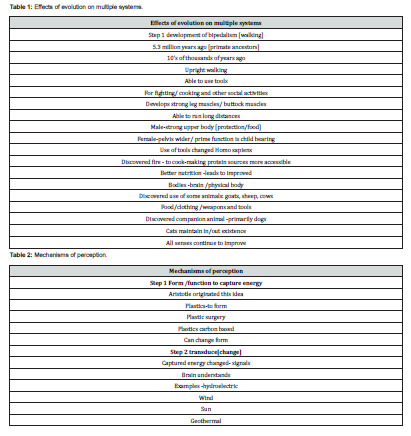
A discussion of any anatomical feature requires anthropological data ,which has increased quantitatively for many reasons, and qualitatively because of new probes Because of the genetic revolution from mapping the genome, Tuttle is a current assessment of evolution effects on multiple systems [4] [Table 1]. Table one summarizes current thoughts gleaned from archaeology, anthropology - greatly added by bio-probes developed by the relatively recent biological / neuroscience advances. We better understand things by analogies. I think of humans [obviously, I have been influenced by others, but am currently unaware] are like a worm e.g., our head has several orifices : head -2 eyes, 2 ears, one nose but functionally 2, and a mouth / bone of different types- vertebral bodies [allowing passage of nerves], protection [sternum , ribs] , pelvis [sex determined ],long/short bones in the extremities. Distally are also orifices [anus , vagina [in women] and urethra]. I using my MD skills, these structures need measures to maintain form and function; however, very few of us do ! This is why there is a wide variance in those 40 and up in age in their overall health and appearance. Chronic back pain is common, and is a significant cause of morbidly [5]. This article ,focuses on economic factors : number of people, cost of evaluation/ treatment etc., There are multiple other issues i.e., effects on physical, social and psychological issues, but this is not the thrust of this paper.
Exposition of Perceptive Organs
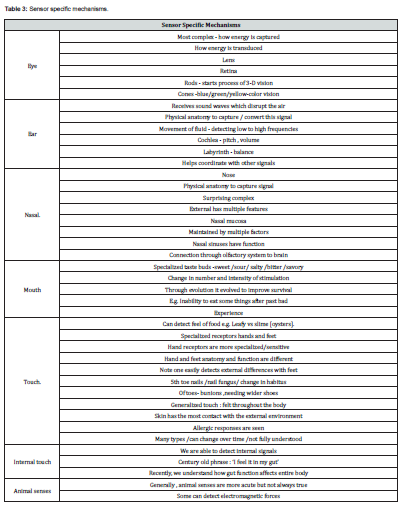
I now add data onto the schema which Mealy posits. Table 2 shows the idea of form and function. This is first proposed by Aristotle, a son of a physician. Thus, unlike contemporary, Plato, who thought of things such as a horse as approaching an ideal form, Aristotle considered the horse at hand. Thus, he generated the idea of form is created to pursue a certain function ; Mealy updates this schema. She then states perception by the senses, allows our brain to reconstruct the world. Table 3 shows how the 5 senses obtain and process data. This has ENT ramifications. One : the shape of the external ear [pinna] Two: external/internal ear canals are only internal cavities with skin canals need wax to prevent drying [which can lead to infection/itch tympanic membrane is skin -when there is negative pressure in middle ear cavity - retraction pocket e.g. cholesteatoma Three : better understand why allergy is important in ENT. This also shows why, chief complaints are indicative of not only the physical finding i.e., ear canal occluded by cerumen; swollen tonsils; nasal drainage etc. but other pathology. Further analysis of Linda Mealey’s work.
She notes William Wundt [6] was the founder of scientific psychology, concerned with the fundamental structures of the mind i.e. concerned with mental responses to external stimuli. William James [7] ,on the other hand was concerned with how this functioned i.e. functionalists of today. There work is still be done in these areas, even today. Dr Mealey’s work is truly impressive, and it conceptualized issues, with the data she had on hand. I already mentioned several updates. A major conceptual advance a further defining perception. My work and others suggest, through evolution there are multiple systems operative, to a varying degree. Perception is a two-way process, where data is influenced both from the inside and out. Perception can also be altered / perceived differently, depending upon what lens we metaphorically place over our eyes. This is nicely illustrated by the book “The Great Gatsby” by F Scott Fitzgerald [8]. I often experience this, especially listening to music. Sometimes the songs are based on atheist themes, yet I hear the theist message. It is now apparent in philosophy of the mind, a very difficult problem is we perceive the world in the first person , while others see us, in the third person. This means we each view the world seeing it through our subjective impressions, created in a multiplicity of ways. This is a highly complex ,debated area. Thus, I conclude this discussion.
Conclusions
Dr Mealey’s work is foundational. I urge those interested in these issues, study this work. I think it is essential for ENT and plastic surgeons to know this work , to improve their patient interactions and surgical results.
References
- Michael FA (2026) Bidirectionalism : An Ancient Tool to Navigate the World from Antiquity to Modernity. Glob J Otolaryngol 29(1): 556251.
- Michael FA (2026) Temporal Bone and Surrounding Structures: It’s Development, Anatomy, and significance, a mini-review. Glob J Otolaryngol 29(2): 55256.
- Mealey L (2026) Senses. EBSCO.
- Tuttle RH (2026) Human Evolution. Encyclopedia Britannica.
- Chang D, Lui A, Ame C (2024) Comparative Review of the Socioeconomic Burden of Lower Back Pain in the United States and Globally. Neurospine 21(2): 487-501.
- Britannica Editors (2026) William Wundt. Encyclopedia Britannica.
- Kallen Horace M (2026) William James. Encyclopedia Britannica.
- Martinez Julia (2026) The Great Gatsby. Encyclopedia Britannica.