




 GJO Home



Abstract
I present in this mini-review multiple aspects of the temporal bone. It is one of the most important bones in the human skeleton : systematically inspecting from multiple directions is my charge, both physically and intellectually. Physical, physiological, and some pathological conditions are presented. The discussion then expands to disciplines, distinct from medicine i.e. archeology, anthropology, psychology and philosophy, revealing a two-way communication present. It is my aim to allow at least a slightly better understanding of this subject. It is my hope, that it will stimulate others to study these issues in greater depth for the benefit of all.
Keywords: Temporal bone; Embryology; Classification sites; Anatomy; Functions; Importance in allied fields; Archeology; Anthropology; Psychology; Philosophy
Introduction
Dissection of a cadaveric temporal bone is an important rite of passage to all those starting a residency in otolaryngology, since its inception. I now realize these decades later, that it is important to teach not only anatomical features [1], and allied basic science concepts in physiology, pathology, embryology etc. [2-5], but also in allied fields i.e. radiology, neurology, immunology, infectious disease etc. [6]. It is apparent, there are allied fields i.e. audiology, physical therapy etc. are essential in this process [7]. I slowly discovered over decades, that there are lessons taught, which only later are at least as important professionally, but are essential for living a happy and productive life i.e. patience, attention to detail, humility, and joy. Life is a journey stated for millennia, from Odysseus to Joseph Campbell, let’s begin.
Temporal Bone Anatomy: Beginning of the Journey
We arrive soon after graduation from medical school. It already been rigorous. First, going to a rigorous university has even gotten more difficult, than I experienced. Assuming a perfect GPA and SAT/ACT scores, the latest odds i.e. ‘safety’ Penn State, The Ohio State etc. 70% ‘reach’ UT Austin, UNC, Ga Tech etc. 20 % unlikely 7% UCLA, Georgetown, MIT, The Johns Hopkins University, Yale etc. [8]. The major reason for this, in my opinion is the application process is now digital, thus allowing students to apply to more schools, than in my day. Also, there are criteria the schools use, [always debated and litigated], which weights the applicants. Only a minority [in number] of students graduate, and the procedure is repeated more vigorously, for spots in medical school and residency [9, 10]. We finally reach our ‘goal’, residency, but with time we all realize this is a journey that never ends ,throughout our lives; life is a series of journeys, we are always on a heroic quest, as envisioned by Joseph Campbell [11], and others i.e. Homer, Jesus etc. That said, it is easy to see what we learn in residency are not only important for a successful career, but a satisfying personal life. Life is imperfect, not fair, but it is what it is. Our culture supports teaching our children, to make a difference in the world, but this is statistically impossible in this highly complex, and competitive world to do so. The best we can do, is do our job to best of our ability, manifesting joy and other virtues as noted since antiquity- Aristotle, Jesus, Kalvin [please, don’t become too proud] etc. [12-14]. The number of others is exhaustive - representing ideas from the world in all times and places. So stated, let us review components of education, which are needed throughout life, although, modified by the life stage of the participant.
Components of Education
Recently, I was honored by being a participant on the education committee of the National Association of Scholars, which was tasked to develop an educational program from pre-K through college, for all students to learn all the skills needed to master basic mathematics, for this century Archimedes standards [15]. This curriculum develops thinking skills, fosters personality development essential needed in this century i.e. patience, humility, attention to detail etc., inspires improving difficult manual skills i.e. Chinese / Japanese script, pottery etc. and instills a lifelong habit of learning [we are all the ‘ karate kid’] [16 -18]. These skills are all essential to practicing the medical/surgical specialty of ENT. Back to the Temporal Bone Lab The temporal bone is a unique and important bone for several reasons. First, it is a compound bone i.e. part of the skull and part of the skull base [19]. It is present in all mammals. It has interfaces and is adjacent to all vital structures of the head and neck and of the brain. The distances are small in these interactions, thus a precise knowledge of anatomy , and excellent surgical techniques and dexterity is mandatory. Obviously, all these factors are not only recognized, early on in training, they are metaphorically like an onion, that reveals increasing complexity the more is known. The brain shows remarkable growth in the first several years of life, proceeding into the twenties [20]. Ossification sites allow for this growth. The skull and temporal bone have [5 + 11], compared to other bones i.e. mandible 2, sternum 6, humerus 8, pelvis 3, femur 5 etc. [21]. This represents ,the amount of growth required over time for maturation .
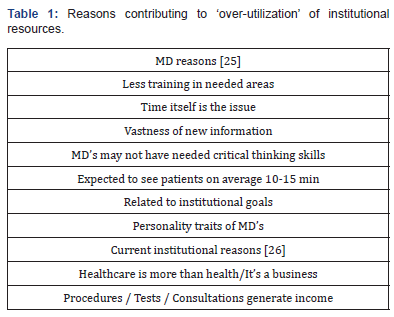
Embryology is essential for understanding the temporal bone, but also other common conditions of the head and neck i.e. branchial cleft cysts, dermoid cysts, hamartomas etc. presenting to a typical ENT practice [22-26]. This knowledge allows the MD to manage these problems , humanely and efficiently. Only needed, consultations both MD, and allied disciplines sought be sought for dx/tx purposes. It has been my experience that this suggestion, is being followed less for a multiplicity of reasons (Table 1). This is obviously a very complex subject, offered to transmit information and stimulate discussion. Thus stated, how does the temporal bone have importance in other arenas? Archeology and Anthropology Excavations of ancient sites from Egypt, the New world and the Eastern nations have a rich history [27]. We have learned much from these efforts. Forensic anthropologists use these bones, for several reasons [28]. Temporal bones [29, 30] and teeth [31] are pertinent to this discussion. Multiple areas have developed, notably ,the extraction of genetic material , to better understand both maternal [mitochondrial] and paternal [Y chromosomal] DNA to better understand our development of hundreds of thousands of years [32, 33].
Psychology and the Neurosciences
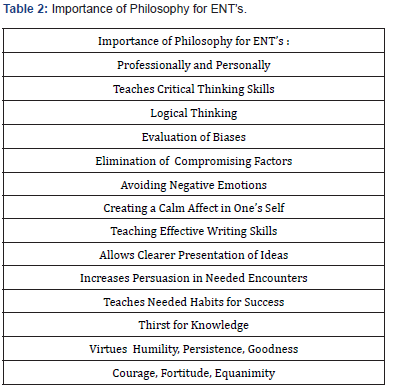
The ancients had ideas about how we think, feel and perceive ourselves and our surroundings [34]. Empiricism i.e. the use of the scientific method with instruments has progressed from the time of Galileo to the present [35]. Philosophical empiricism is also important [36]. Psychology has developed many schools from the analytic methods of Freud [37]/Jung [38], different physical model [behaviorism] [39], developing the neurosciences [imaging, functional testing, etc. [40] and person centered methods [41]]. These are all fields that the modern ENT must have at least an elementary understanding. Personality theory [42] is important in managing patients and better understanding one’s self. Philosophy - it’s importance everywhere in life I have documented, thus far, the immensity and complexity of information that the modern ENT surgeon is confronted with throughout a lifetime. Nonetheless, I argue that philosophical instruction is invaluable in [43]. I show this in Table 2. All these items are important in our lives. However, no one is perfect, and we must face this in ourselves. Egoism [a healthy self-regard] is essential, while egotism [narcissism] is pathological. Unfortunately, many today suffer ‘imposter’ syndrome [44]. We all make mistake and must accept this, in ourselves and in others [45].
Conclusion
This is an address, I would give to graduates of whatever area of expertise. Yes, we are all different individually and professionally, but we are all human and have similar desires, share similar experiences throughout our life cycles, and want to do our jobs to the best of our abilities, and that is his how we make a difference in our local environments.
References
- (2026) Dictionary.
- Zalta EN, Nodelman U (2026) Stanford Encyclopedia of Philosophy.
- Michael FA, Evangelos S, Angelo S (2025) Potential Advantages and Risks of Artificial Intelligence in Medical/Surgical Education: Can the Genie be Controlled ? Glob J Otolaryngol 28(2): 556233.
- Michael FA (2026) The Importance of Doubt in Administrating Large Organizations Including Medicine and Ways to Deal with it for the Benefit of All. Glob J Otolaryngol 28(3): 556238.
- Michael FA, Angelo S (2026) Southern Medical Association : A Unique Organization : Needed Now As Ever Before. Glob J Otolaryngol 28(5): 556248.
- Michael FA (2026) An Impression from Accessing a Major ENT Journal. Glob J Otolaryngol 28(5): 556250.
- Michael FA (2026) Cameras and Bagels : Metaphors as Tools to Better Understand and Navigate Society and Medicine in these Rapidly Changing Times. GJO J Otolaryngol 29(1): 556251.
- Blythe WR (2026) What’s an ENT. AAOHNS Foundation.
- Cohen J, Clark SB (2010) John Romano and George Engel : their lives and work. University of Rochester Press, Rochester, New York.
- Salvatore M, Sullivan PD, Wagner MS (2026) Physical Diagnosis Secrets, [Third Edition], Elsevier, Philadelphia.
- Powell JA, Daryell M, Gray JAM (2023) The Doctor, the Patient and the World-Wide Web: How the Internet is Changing Healthcare. J World Society of Medicine 96(2).
- Remes O (2016) Opinion: Why are we becoming so narcissistic? Here’s the science. University of Cambridge.
- Rhodewalt F (2026) Narcissism. Encyclopedia Britannica.
- Gimenez AR, Rohrich R, Rohrich RJ (2025) Safety and Complications in Lower Eyelid Blepharoplasty: A Systematic Review. PRS Global Open 13(9): e7102.
- Stein MJ, Aston SJ (2023) Ancillary Procedures to Facelift Surgery: What has Changed?. Aesthetic Surgery Journal.
- Rashid Y, Estela FAB (2025) Advances in Anti-aging Procedures : A Comprehensive Review of Surgical and Non-surgical Rejuvenation Techniques. Cureus 7(9): e92666.
- Ahmed IA, Mikail MA (2024) Diet and skin health: The good and bad.
- Linus Pauling Institute (2026) Nutrients in Skin Health. Oregon state university.
- Hopkins medicine (2026) Revolution in American Medicine.
- Historica Medica (2026) The Flexner Report and Modern Medicine Education.
- Fair JD (2025) Physical Culture. Encyclopedia Britannica.
- (2026) Academy of Functional Medicine.
- (2026) American Academy of Anti-Aging Medicine - A4M.
- Nandy B (2024) Key Trends Reshaping The Future Of U.S. Healthcare.

























