




 GJO Home



Abstract
Background: Muscle Tension Dysphonia (MTD) is a common hyper functional voice disorder characterized by excessive laryngeal muscle
activity, resulting in inefficient phonation and altered acoustic parameters. Laryngeal Manual Therapy (LMT) has been proposed as an effective
intervention to reduce laryngeal musculoskeletal tension and improve voice quality; however, objective acoustic evidence remains limited.
Aim: The present study aimed to evaluate the effectiveness of Laryngeal Manual Therapy on acoustic voice parameters - fundamental frequency,
jitter, and shimmer - in individuals with Muscle Tension Dysphonia.
Method: Ten participants aged 15–50 years, clinically diagnosed with MTD, were enrolled in a pre–post experimental study design. Sustained
vowel productions (/a/, /i/, /u/) were recorded in a sound-treated environment before and after five sessions of Laryngeal Manual Therapy.
Acoustic analysis was conducted using PRAAT software to obtain measures of fundamental frequency (Fo), jitter, and shimmer. Statistical
analysis was performed using paired t-tests to determine the significance of pre- and post-therapy changes.
Results: Statistically significant reductions (p < 0.05) were observed across all acoustic parameters following LMT. Mean fundamental
frequency decreased for all vowels, indicating normalization of elevated Fo associated with hyper functional phonation. Significant reductions
in jitter and shimmer were also noted, reflecting improved stability of vocal fold vibration and enhanced phonatory efficiency.
Conclusion: The findings demonstrate that Laryngeal Manual Therapy is effective in improving acoustic measures of voice function in
individuals with Muscle Tension Dysphonia. By reducing excessive laryngeal tension and promoting more efficient vocal fold vibration, LMT
serves as a valuable adjunctive approach in the clinical management of hyper functional voice disorders.
Keywords:Muscle Tension Dysphonia; Laryngeal Manual Therapy; Fundamental Frequency; Jitter; Shimmer
Abbreviations: MTD: Muscle Tension Dysphonia; LMT: Laryngeal Manual Therapy
Introduction
Voice refers to the aspect of speech production driven by the respiratory cycle and generated through the vibration of the vocal folds, forming an integral component of speech and a uniquely human attribute essential for effective verbal communication. The term voice is derived from the Latin word vox, symbolizing the expression of one’s inner self. Beyond its linguistic function in speech, voice serves a wide range of non-linguistic purposes, including singing, laughing, crying, and dramatic expression. In addition to conveying linguistic content, voice plays a predominant role in expressing emotions, personality traits, social identity, and individuality. It also serves as an indicator of physical health, emotional well-being, and aesthetic orientation, thereby enabling interpersonal connections that often transcend the literal meaning of spoken words. Physiologically, voice is defined as the laryngeal modulation of the pulmonary airstream, which is further shaped by the configuration of the vocal tract Brackett [1]. In this process, the lungs provide the aerodynamic power source, the vocal folds function as the vibratory mechanism, and the supraglottal vocal tract-including the pharynx, oral cavity, and nasal cavity-acts as a resonator that shapes sound into intelligible speech and song. During expiration, relaxation of the diaphragm and elastic recoil of the chest wall force air through the nearly closed vocal folds.
The interaction between aerodynamic forces and the Myo elastic properties of the vocal folds results in their rapid and periodic opening and closing, producing phonation. Thus, the larynx serves as the primary generator of voice and plays a crucial role in communication, social interaction, personality expression, and artistic performance. Voice quality reflects an individual’s habitual neuromuscular adjustments across the entire vocal apparatus, including the lungs, larynx, pharynx, tongue, jaw, and lips. These habitual “voice settings” develop over time and are shaped by social, cultural, and environmental influences. The resulting vocal pattern contributes to speaker identity and recognizability Mathieson [2]. Non-linguistic vocal cues convey information related to sex, age, emotional state, socioeconomic status, and certain physical characteristics. Markel & colleagues [3,4] demonstrated that vocal parameters such as pitch, loudness, and tempo show strong correlations with personality traits as measured by standardized psychological assessments. In recent decades, there has been a growing inclination toward professions that require extensive verbal interaction and sustained voice use, such as teaching, call-center work, broadcasting, and mass communication. Consequently, the demands placed on the human voice have increased, highlighting the need for an effective, wellmodulated, and pleasant vocal quality.
Evidence from occupational voice research further supports this concern, as altered voice quality has been documented in professionals exposed to prolonged loud voice use and adverse environmental conditions, such as rafting instructors, underscoring the vulnerability of occupational voice users to voice disorders Yadav et al. [5]. As vocal demands rise, maintaining optimal vocal health becomes essential to ensure communicative efficiency and professional performance. A normal voice is characterized by the absence of structural pathology, unusual vocal characteristics, or maladaptive vocal behaviors. Deviations in acoustic, aerodynamic, or perceptual parameters may result in voice disorders. Voice disorders may arise from vocal misuse or abuse, psychogenic factors, structural abnormalities, medical conditions, or neurological impairments. Psychogenic contributors include excessive musculoskeletal tension, stress, alcohol and caffeine consumption, smoking, medication use, and gastroesophageal reflux. Vocal misuse encompasses behaviors such as excessive loud talking, hard glottal attack, speaking in noisy environments, frequent coughing or throat clearing, and prolonged voice use.
Titze [6] described voice disorders as the response of a biomechanical oscillator to adverse environmental, systemic, or traumatic conditions, while Verdolini & Ramig [7] defined voice disorders as a combination of self-reported symptoms and clinically observed signs that are sufficiently disruptive to functional communication and require clinical intervention. Colton & Casper [8] identified eight primary symptoms associated with voice disorders, including hoarseness, vocal fatigue, reduced phonational range, breathiness, aphonia, pitch breaks, strain or struggle voice, and tremor, all of which reflect abnormalities in vocal fold vibration and phonatory effort. These symptoms commonly manifest as irregular control of pitch and loudness, inefficient glottal closure, and increased muscular tension during voice production. Factors influencing voice have been classified by Boon [9] into environmental and physical categories. Environmental factors such as poor air quality, low humidity, excessive noise, and increased speaker–listener distance can increase vocal effort and predispose individuals to vocal strain. Physical factors, including aging, fatigue, allergies, infections, hormonal changes, and hydration status, affect vocal fold structure and function. Additionally, the use of certain medications and recreational drugs may negatively impact vocal performance by altering mucosal lubrication, neuromuscular control, or respiratory efficiency.
Aim
To evaluate the effectiveness and efficiency of Laryngeal
Manual Therapy in patients with Muscle Tension Dysphonia.
Objectives
a) To obtain fundamental frequency values before and
after Laryngeal Manual Therapy sessions
b) To obtain jitter values before and after Laryngeal Manual
Therapy sessions
c) To obtain shimmer values before and after Laryngeal
Manual Therapy sessions
Review of Literature
Voice production is a complex neuromuscular process requiring the coordinated interaction of the respiratory, phonatory, resonatory, articulatory, and central regulatory systems. The larynx serves as the primary sound generator, with vocal folds vibrating under subglottic air pressure, and the resulting acoustic signal is shaped by the supraglottic vocal tract to produce intelligible speech. Optimal voice production relies on balanced muscular activity and efficient coordination across these subsystems, whereas disruption of this balance can result in functional or organic voice disorders Aronson [10]; Stemple [11]. Muscle Tension Dysphonia (MTD) is a common functional voice disorder characterized by excessive activation of intrinsic and extrinsic laryngeal muscles, either in the absence of structural pathology (primary MTD) or as a compensatory response to organic lesions (secondary MTD). Etiological factors include vocal misuse or abuse, prolonged vocal load, psychological stress, maladaptive postural and breathing patterns, and personalityrelated factors. Sustained hyperfunction of the laryngeal musculature is often associated with elevated laryngeal position, restricted vocal fold vibration, vocal fatigue, pain, and perceptual abnormalities in voice quality Lieberman [12]; Roy & Bless [13].
Laryngeal Manual Therapy (LMT) has emerged as an effective intervention to reduce excessive laryngeal musculoskeletal tension in MTD. Originally described by Aronson [14], LMT involves manual manipulation of the laryngeal and peri laryngeal structures to alleviate vocal hyperfunction. Clinical studies report that LMT produces immediate and sustained improvements in perceptual and acoustic voice measures, including reductions in jitter, shimmer, hoarseness, and vocal strain Roy et al. [15]; Roy & Leeper [16]. LMT also facilitates relaxation of extrinsic laryngeal muscles, repositions the hyolaryngeal complex to a more caudal position, and expands the oropharyngolaryngeal space, enhancing phonatory efficiency Morrison & Rammage [17]; Rubin et al. [18]. Improvements in articulatory precision and vocal tract flexibility have been documented, with significant gains in formant transitions, vowel space area, and vowel articulatory index Roy et al. [19]. Patient-reported outcomes additionally demonstrate reduced musculoskeletal discomfort and improved laryngeal comfort following LMT Rennan et al. [20]. Overall, the evidence supports LMT as an effective adjunct in MTD management, though further randomized controlled trials with standardized outcome measures are needed to establish uniform clinical protocols.
Methodology
Study Design and Participants
This study included ten participants diagnosed with hyper functional voice disorder, specifically Muscle Tension Dysphonia (MTD). Participants were aged between 15 and 60 years. A detailed case history was obtained for each individual, including demographic data (age and sex), duration of symptoms, prior history of dysphonia, presence of psychological stress or conflict, laryngeal pain or elevation, habitual voice use, allergies, and history of upper respiratory tract infections.
Selection Criteria
Participants were selected based on specific inclusion and exclusion criteria. Inclusion criteria comprised individuals diagnosed with Muscle Tension Dysphonia, with no history of prior medical interventions or voice therapy, and within the age range of 15 to 50 years. Participants with structural or anatomical abnormalities of the vocal folds were excluded from the study. Exclusion criteria included vocal paralysis, vocal nodules, vocal polyps, vocal cysts, or any other anatomical irregularities that could interfere with normal voice production or affect the outcomes of the study.
Tools and Instrumentation
The study utilized several tools and instruments to collect and analyze participant data. A case history form was employed to gather demographic and clinical information, including age, sex, duration of symptoms, prior history of dysphonia, psychological stress, laryngeal pain, voice use, allergies, and history of upper respiratory infections. Acoustic analysis was conducted using a laptop (HP Pavilion G4) equipped with PRRAT software to measure fundamental frequency, jitter, and shimmer. A digital voice recorder was used to capture sustained vowel sounds (/a/, /i/, /u/) from each participant before and after the Laryngeal Manual Therapy sessions, allowing for both pre- and postintervention evaluation of vocal parameters.
Voice Recording Procedure
Participants were evaluated in a sound-treated room. Sustained vowels /a/, /i/, and /u/ were recorded using a digital microphone positioned 15 cm from the participant’s mouth. Baseline voice samples were obtained prior to Laryngeal Manual Therapy (LMT), and post-intervention samples were recorded immediately after completion of therapy sessions.
Laryngeal Manual Therapy Procedure
LMT was administered over five therapy sessions, conducted
once or twice weekly. The therapy protocol included:
a. Correction of general posture and head position (≈5
minutes).
b. Practice of abdominal breathing at rest, standing, and
walking (≈5 minutes).
c. Integration of abdominal breathing with phonation (≈5
minutes).
d. Participant positioned in relaxed supine posture (≈2
minutes).
e. Manual manipulation of specific laryngeal and peri
laryngeal muscles based on individual complaints and therapeutic
goals (≈20 minutes).
f. Chant-talk approach (Boone & McFarlane, 2004)
combined with open-mouth technique to reduce vocal effort and
strain (≈10 minutes).
g. Repetition of open-mouth technique at habitual pitch
(≈5 minutes).
h. Steps 1–7 were repeated in all five therapy sessions.
i. Home exercises: Participants were instructed to
perform thyrohyoid muscle stretches, chant-talk, and open-mouth
exercises for 5 minutes twice daily.
This standardized protocol aimed to reduce excessive laryngeal tension, improve vocal fold coordination, and enhance phonatory efficiency in individuals with Muscle Tension Dysphonia.
Results and Discussion
The present study aimed to evaluate the effects of Laryngeal Manual Therapy (LMT) on individuals with Muscle Tension Dysphonia (hyper functional voice disorder). Ten participants aged 15–50 years were recruited. Voice samples were collected before and after five sessions of LMT. Sustained vowels (/a/, /i/, /u/) were recorded in a sound-treated room and analyzed using PRRAT software. Acoustic parameters assessed included fundamental frequency (Fo), jitter, and shimmer. Statistical analysis was performed using SPSS software to determine the significance of pre- and post-intervention changes.
Fundamental Frequency
Table 1 & Figure 1 present the mean fundamental frequency values for vowels /a/, /i/, and /u/ before and after LMT. Pretherapy mean Fo values were 120.70 Hz (/a/), 122.60 Hz (/i/), and 124.90 Hz (/u/), while post-therapy values decreased to 112.50 Hz (/a/), 114.60 Hz (/i/), and 116.30 Hz (/u/). Paired t-test analysis revealed statistically significant differences for all vowels (p < 0.05). The highest Fo values were observed for /u/ in both pre- and post-therapy recordings. These findings indicate that LMT effectively normalized the elevated fundamental frequency commonly observed in hyper functional voice disorders, consistent with previous reports by Roy et al. [15] and Kristiane M. Van Lierde & De Ley (2004).
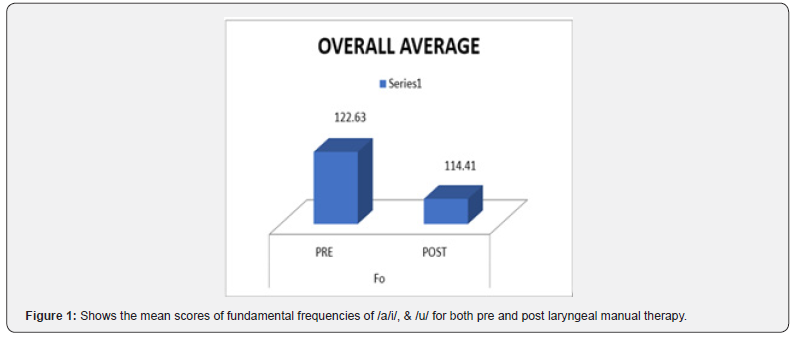

Comparison of mean scores of fundamental frequencies in both pre laryngeal therapy and post laryngeal therapy for /a/ , /i/, /u/.
Jitter
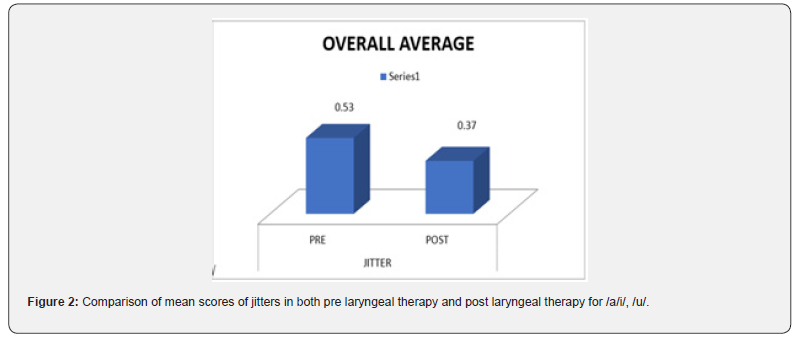
Table 2 & Figure 2 illustrate the mean jitter values for /a/, /i/, and /u/. Pre-therapy jitter values were 0.60 (/a/), 0.10 (/i/), and 0.30 (/u/), which decreased post-therapy to 0.40 (/a/) and 0.00 for both /i/ and /u/. Paired t-tests confirmed significant reductions in jitter across all vowels (p < 0.05), demonstrating improved stability of vocal fold vibration after LMT. These results corroborate earlier studies highlighting the efficacy of LMT in reducing perturbation measures and improving vocal quality Roy et al. [15]; Kristiane M. Van Lierde & De Ley, 2004).

Mean jitter (%) for vowels /a/ , /i/ and /u/ pre and post -LMT. Jitter decreased significantly for all vowels, indicating improved vocal fold stability.
Shimmer
Mean shimmer values are presented in Table 3 & Figure 3 Pretherapy shimmer was 3.90 (/a/), 2.70 (/i/), and 2.80 (/u/), which decreased to 2.80 (/a/), 1.82 (/i/), and 1.60 (/u/) post-therapy. Statistical analysis using paired t-tests indicated significant reductions (p < 0.05) in shimmer for all vowels. These findings reflect improved amplitude stability and phonatory efficiency following LMT, consistent with previous reports by Roy et al. [20] and Van Lierde et al. [21], supporting the therapeutic role of manual circumlaryngeal techniques in hyper functional voice disorders.
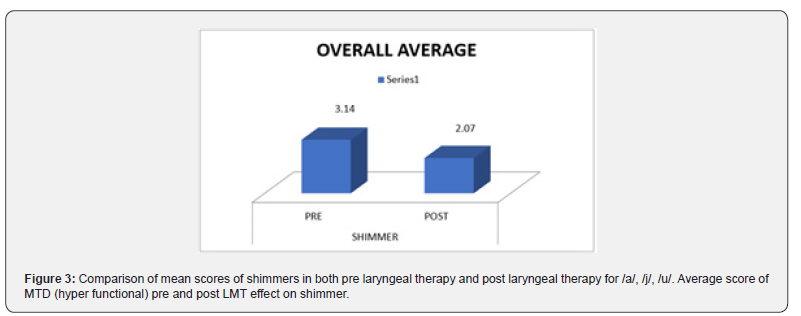

Mean shimmer (%) for vowels /a/ , /i/ and /u/ pre and post -LMT. Significant reductions indicate improved amplitude stability of vocal fold vibration.
Discussion
The findings of the present study demonstrate that Laryngeal Manual Therapy (LMT) is associated with significant improvements in acoustic measures of voice function in individuals with Muscle Tension Dysphonia (MTD). Specifically, reductions in fundamental frequency (Fo), jitter, and shimmer were observed after a course of five LMT sessions, indicating enhanced phonatory efficiency and reduced laryngeal hyperfunction. Elevated pre therapy Fo, jitter, and shimmer are characteristic of hyper functional voice disorders and are thought to reflect excessive laryngeal muscle tension and atypical vocal fold vibration patterns Lopes [22]. The significant post therapy decreases in these parameters suggest that LMT effectively modulates muscular tension within the phonatory subsystem, thereby promoting more stable and regular vocal fold vibration and improved voice quality. These results align with broader clinical evidence supporting manual interventions for hyper functional voice disorders.
Barsties, et al. [23] reported in a systematic review and meta-analysis that manual circumlaryngeal therapy produced large effect sizes for improvements in acoustic measures such as jitter and shimmer among individuals with MTD, reinforcing the present findings of reduced perturbation after manual therapy Barsties, et al. [23]. Although the meta-analysis did not find consistent evidence for changes in fundamental frequency across studies, the overall improvement in acoustic stability underlines the value of manual techniques in voice rehabilitation Barsties, et al. [23]. Earlier clinical investigations also demonstrated immediate reductions in jitter and shimmer following manual circumlaryngeal therapy in patients with functional dysphonia, further substantiating the role of manual approaches in altering vocal fold vibratory characteristics Mathieson, et al. [2]; Manual circumlaryngeal therapy outcomes, 2018). Notably, manual tension reduction techniques have been shown to produce sustained improvements in voice quality over time. A clinical trial involving functional dysphonia patients found that significant acoustic and perceptual gains were maintained in follow up assessments after manual therapy, with many subjects reporting consistent voice improvements (Manual circumlaryngeal therapy, 1998).
In addition, combined intervention approaches, such as manual therapy coupled with breathing exercises, demonstrated greater enhancement in laryngeal function and voice handicap outcomes than either intervention alone, suggesting potential synergistic effects Van Houtte [21]. These complementary findings emphasize the broader therapeutic context in which manual laryngeal techniques are implemented in clinical practice. The mechanisms underlying the observed improvements likely involve the reduction of excessive muscular tension in both intrinsic and extrinsic laryngeal muscles, normalization of hyolaryngeal positioning, and enhancement of respiratory– phonatory coordination, which collectively contribute to more efficient and less strained phonation. This mechanistic perspective is supported by narrative reviews that describe how manual techniques target specific anatomical structures and tension patterns, facilitating improvements in vocal tract dynamics and muscle balance (Narrative review of LMT methods, 2024). Specifically, manual release of peri laryngeal tension can enable improved glottal closure, increased harmonics to noise ratios, and more regular vibratory patterns, all of which are reflected in reduced acoustic perturbation measures.
Despite consistent evidence supporting acoustic improvements after manual therapy, research to date has limitations that warrant consideration. Many studies, including the current investigation, utilize small sample sizes and pre post designs without control groups, which limit generalizability. Additionally, variations in therapy protocols and measurement methods pose challenges for direct comparison across studies. The systematic review by Barsties [23] highlights the need for rigorous randomized controlled trials with standardized outcome measures to substantiate and refine evidence based protocols for laryngeal manual interventions.
Clinical Implications
The significant improvements in fundamental frequency, jitter, and shimmer post-LMT highlight its clinical relevance for individuals with hyper functional voice disorders Boone [25]. By targeting musculoskeletal tension and optimizing laryngeal positioning, LMT can complement traditional voice therapy approaches, such as vocal hygiene education and direct voice exercises, to achieve comprehensive rehabilitation. The immediate and measurable acoustic benefits observed in this study emphasize the utility of LMT as both an assessment and therapeutic tool for clinicians managing MTD.
Limitations and Future Directions
Despite the positive outcomes, this study was limited by a small sample size (n = 10) and the absence of a control group, which restricts the generalizability of the findings. Future studies should incorporate larger randomized controlled trials, standardized LMT protocols, long-term follow-up, and combined perceptual, acoustic, and aerodynamic measures to establish robust evidence for LMT efficacy. Additionally, investigation into the synergistic effects of LMT combined with behavioral voice therapy may provide insight into optimal intervention strategies for MTD.
Conclusion
The present study demonstrates that Laryngeal Manual Therapy significantly improves fundamental frequency, jitter, and shimmer in individuals with Muscle Tension Dysphonia. These findings indicate that LMT effectively reduces laryngeal hyperfunction, enhances vocal fold stability, and promotes more efficient phonation. LMT therefore represents a valuable adjunctive approach for the management of hyper functional voice disorders, offering measurable acoustic and functional improvements in voice quality.
References
- Brackett D (1971) Vocal behavior: Its importance and control. Little, Brown & Company.
- Mathieson L, Hirani SP, Epstein R, Baken RJ, Wood G, Rubin JS (2009) Laryngeal manual therapy: A preliminary study to examine its treatment effects in the management of muscle tension dysphonia. Journal of Voice 23(3): 353-366.
- Markel NN, Meisels M, Houck JE (1964) Personality correlates of voice quality. Journal of Speech and Hearing Research 7: 173-181.
- Markel NN, Meisels M, Houck JE (1973) Vocal indicators of personality. Journal of Speech and Hearing Research 16: 649-655.
- Yadav MC, Parmar A, Venkatachalam B, Bar M (2024) The voice quality of rafting instructors. International Journal of Scientific Research 13(06).
- Titze IR (1994) Principles of voice production. Prentice Hall.
- Verdolini K, Ramig LO (2001) Review: Occupational risks for voice problems. Logopedics Phoniatrics Vocology 26(1): 37-46.
- Colton RH, Casper JK (1990) Understanding voice problems: A physiological perspective for diagnosis and treatment. Williams & Wilkins.
- Boon DR (1991) Voice disorders. Allyn & Bacon.
- Aronson AE (1980) Clinical voice disorders: An interdisciplinary approach. Thieme-Stratton.
- Stemple JC (1994) Voice therapy: Clinical case studies. Mosby.
- Lieberman P (1998) Speech physiology, speech perception, and acoustic phonetics. Cambridge University Press.
- Roy N, Bless DM (1998) Muscle tension dysphonia. Current Opinion in Otolaryngology & Head and Neck Surgery 6(3): 159-164.
- Aronson AE (1990) Clinical voice disorders (3rd). Thieme Medical Publishers.
- Roy N, Bless DM, Heisey D, Ford CN (1997) Manual circumlaryngeal therapy for functional dysphonia: An evaluation of short- and long-term treatment outcomes. Journal of Voice 11(3): 321-331.
- Roy N, Leeper HA (1993) Effects of manual laryngeal musculoskeletal tension reduction techniques on voice quality. Journal of Voice 7(2): 157-165.
- Morrison MD, Rammage LA (1994) Muscle misuse voice disorders: Description and classification. Singular Publishing Group.
- Rubin JS, Lieberman J, Harris TM (2000) Diagnosis and treatment of voice disorders (2nd). Singular Publishing Group.
- Roy N, Ford CN, Bless DM (2009) Muscle tension dysphonia and manual therapy outcomes. Journal of Voice 23(3): 353-366.
- Rennan JA, Roy N, Leeper HA (2011) Patient-reported outcomes following laryngeal manual therapy. Journal of Voice 25(5): 593-599.
- Van Houtte E, Van Lierde K, Claeys S (2011) The efficacy of manual therapy in muscle tension dysphonia: A randomized controlled trial. Journal of Voice 25(2): 202-207.
- Lopes LW (2012) Acoustic characteristics of hyper functional voice disorders. Journal of Voice 26(6): 818.
- Barsties V, Latoszek B, Watts CR, Hetjens S (2024) Effects of manual circumlaryngeal therapy on muscle tension dysphonia: A systematic review and meta-analysis. Journal of Voice 38(1): 45-58.
- Mathieson L (2001) Greene and Mathieson’s the voice and its disorders (6th). Whurr Publishers.
- Boone DR, McFarlane SC (2004) The voice and voice therapy (7th). Pearson Education.

























