




 GJO Home



Abstract
Tinnitus is a complex perceptual phenomenon that can significantly affect daily functioning and emotional well-being. Although traditionally viewed as an otological condition, contemporary research emphasizes the involvement of cognitive, emotional, and attentional processes in tinnitus-related distress. This narrative review examined behavioral and audiological approaches to tinnitus management, with a particular focus on Cognitive Behavioral Therapy (CBT) and Tinnitus Retraining Therapy (TRT). Findings indicated that CBT has the strongest evidence base, consistently demonstrating reductions in tinnitus distress and improvements in quality of life across both in-person and digital delivery formats. Evidence for TRT was more variable, with limited and heterogeneous findings, although sound therapy and hearing aids remain clinically valuable for patients, especially those with comorbid hearing loss. Guideline literature consistently endorsed CBT as a first- line intervention for bothersome tinnitus, while emerging digital and audiology-delivered models expanded access to care. Pediatric tinnitus was identified as an under-researched area, highlighting a clear gap in lifespan-oriented management. Taken together, the literature supports a patient-centered and psychologically informed approach to tinnitus care in which audiology plays a central role. Interventions that promote adaptation, coping, and understanding may be as meaningful to patients as those that target the percept itself.
Keywords:Tinnitus; CBT; TRT; Sound Therapy; Audiology; Digital Health; Counseling
Abbreviations:CBT: Cognitive Behavioral Therapy; TRT: Tinnitus Retraining Therapy; AAO-HNS: American Academy of Otolaryngology–Head and Neck Surgery
Introduction
Tinnitus is a common and often distressing auditory perception characterized by the sensation of sound in the absence of an external stimulus. Its prevalence increases with age, but it can affect individuals across the lifespan, including children and adolescents. While tinnitus is not typically a life-threatening condition, it can significantly interfere with daily functioning, contributing to difficulties with concentration, sleep, emotional regulation, and overall quality of life. For some individuals, tinnitus is a minor and occasional annoyance, whereas for others it becomes a persistent and intrusive experience that requires clinical attention. The complexity of tinnitus lies not only in the sound itself but in how the brain interprets and responds to it. Research suggests that tinnitus distress is closely related to neural and emotional mechanisms involving the auditory system, limbic structures, and attention networks. This overlap between auditory and psychological processes has shaped modern approaches to tinnitus management, shifting the focus from attempting to eliminate the phantom sound to helping individuals reduce its impact, gain control, and improve daily functioning. However, the past decades, several therapeutic approaches have emerged to support tinnitus patients. Among these, Cognitive Behavioral Therapy (CBT) and Tinnitus Retraining Therapy (TRT) have been two of the most widely discussed behavioral and audiological interventions. CBT focuses on the cognitive and emotional reactions associated with tinnitus, helping patients modify distressing thoughts and behaviors, while TRT is based on the neurophysiological model and emphasizes habituation through sound therapy and directive counseling.
Both approaches offer non-pharmacological strategies that align with current tinnitus guidelines and the growing preference for patient-centered care. Despite the growing interest in behavioral and audiological interventions, the field remains heterogeneous and characterized by variations in methodology, treatment protocols, and population groups. Pediatric tinnitus, for example, is still under- recognized and under-researched, even though children can experience functional and emotional consequences similar to adults. Furthermore, digital and remote delivery models, such as internet-based CBT, have added a new dimension to tinnitus care, offering scalable and accessible options for individuals who lack local tinnitus services. Given this context, there is a need to examine the current evidence on CBT and TRT, compare their clinical effectiveness, and explore how these approaches can be implemented in real-world audiology practice. This narrative review aims to synthesize the existing literature, highlight strengths and limitations of both interventions, consider the needs of different age groups, and discuss emerging clinical models that support long-term tinnitus management.
Need of the study
Despite the considerable prevalence of tinnitus and its impact on daily functioning, the current evidence base remains heterogeneous and characterized by gaps across both clinical and research domains. CBT and TRT have emerged as two key non- pharmacological interventions, yet they originate from different theoretical frameworks and have been evaluated with varying degrees of methodological rigor. CBT has accumulated stronger empirical support, particularly in reducing tinnitusrelated distress, while the evidence for TRT remains more limited and heterogeneous. Guidelines across different countries now consistently recommend CBT as a first-line intervention, but practice patterns often diverge, and TRT continues to be widely used in audiology settings. Several additional gaps highlight the relevance of the present work. Pediatric and adolescent tinnitus remains substantially under-researched, despite evidence that younger individuals may experience functional difficulties similar to adults. Furthermore, access to specialized tinnitus care varies significantly across regions, and many patients do not receive structured counseling or behavioral support.
The emergence of digital and remote delivery models offers promising solutions, yet these innovations are still in development and have not been fully integrated into standard audiology practice. From a clinical perspective, tinnitus represents a compelling area of study due to its complex interaction between auditory, psychological, and emotional factors. As tinnitus patients often present first to audiology services, understanding both audiological and behavioral approaches becomes essential. From an academic standpoint, comparing CBT and TRT within the broader context of guidelines, evidence gaps, and emerging clinical models contributes to a more comprehensive and contemporary understanding of tinnitus management. Finally, the presence of tinnitus patients in routine audiology practice reinforces the practical importance of identifying interventions that are both evidence-based and feasible to implement across diverse care settings.
Review of Literature
Definition & Mechanisms
Tinnitus is commonly defined as the perception of sound in the absence of an external auditory source. Patients often describe it as ringing, buzzing, hissing, or clicking, with variations in loudness, pitch, and laterality. Although tinnitus is strongly associated with sensorineural hearing loss and aging, it may arise at any stage of life and affect individuals across the lifespan. For some, tinnitus is a benign experience that is easily ignored, while for others it becomes intrusive, persistent, and emotionally distressing. Early views of tinnitus considered it primarily as an otological phenomenon originating in the inner ear. Over time, however, research has shown that tinnitus is not solely an “ear problem,” but rather a complex perceptual experience involving multiple neural systems. Two influential models have contributed to this shift in understanding. The first is the neurophysiological model proposed by Jastreboff & Hazell [1], which describes tinnitus distress as the result of interactions between the auditory system, the limbic system, and the autonomic nervous system. According to this model, the presence of tinnitus does not automatically lead to suffering. Instead, distress occurs when the tinnitus signal acquires negative emotional significance. If the sound is interpreted as threatening, bothersome, or uncontrollable, attention becomes focused on it and habituation becomes difficult. Conversely, if tinnitus is perceived as neutral or unimportant, the brain is more likely to ignore or filter out the signal over time.
More recent neuroimaging and neuroscientific research has expanded on this concept. Rauschecker [2] proposed that tinnitus distress involves a failure of neural “gating” mechanisms that regulate the flow of sensory information between auditory and limbic structures. In this framework, tinnitus becomes salient when the brain fails to suppress the signal, allowing it to reach conscious awareness where emotional and attentional processes can amplify it. This model helps explain why tinnitus distress can fluctuate with stress, anxiety, attention, and sleep, and why individuals with similar tinnitus loudness may report very different levels of suffering. Taken together, these models support the idea that what troubles tinnitus patients is not only the sound itself, but also the emotional and cognitive response to that sound. This perspective provides a theoretical foundation for behavioral and audiological interventions such as Cognitive Behavioral Therapy (CBT) and Tinnitus Retraining Therapy (TRT), both of which aim to reduce tinnitus- related distress by altering the meaning of the sound, promoting habituation, and improving coping strategies.
Tinnitus Retraining Therapy (TRT)
Tinnitus Retraining Therapy (TRT) is a behavioral and audiological intervention developed from the neurophysiological model proposed by Jastreboff & Hazell [1]. The main goal of TRT is to facilitate habituation to tinnitus by reducing the emotional relevance and perceptual salience of the sound. In contrast to approaches that attempt to eliminate tinnitus or suppress its loudness, TRT focuses on altering the individual’s reaction to the tinnitus signal so that it becomes neutral, less intrusive, and gradually less noticeable in daily life. TRT typically consists of two core components. The first is directive counseling, which provides patients with information about tinnitus mechanisms, reassurance about the benign nature of the condition, and strategies for reducing fear or negative associations. The second component involves sound therapy, often delivered through lowlevel broadband noise or sound enrichment devices intended to decrease auditory contrast and support habituation. When combined, these elements aim to modify neural connections between the auditory and limbic systems, allowing the brain to filter out tinnitus in a more automatic and effortless manner.
Although TRT has been widely used in clinical practice for several decades, research findings remain mixed. In a large randomized clinical trial, Scherer et al. [3] compared TRT with standard of care and found no significant advantage for TRT in improving tinnitus-related quality of life. Similar conclusions were drawn by Phillips & McFerran [4] in a Cochrane review, which noted that the available evidence supporting TRT is limited and of low certainty due to methodological inconsistencies, small sample sizes, and a lack of standardized treatment protocols. These findings suggest that while some individuals may benefit from TRT, especially those who respond well to structured counseling, the overall effectiveness of TRT remains uncertain within the broader tinnitus population. Despite these limitations, TRT continues to play a role in tinnitus management, particularly within audiology settings where clinicians are accustomed to integrating counseling and sound enrichment strategies. Its focus on habituation complements the emerging understanding that tinnitus-related distress is influenced not only by the auditory signal itself, but also by emotional and attentional processes. In this sense, TRT provides an important point of comparison for Cognitive Behavioral Therapy (CBT), which targets similar mechanisms through different therapeutic pathways.
Cognitive Behavioral Therapy (CBT) for Tinnitus
Cognitive Behavioral Therapy (CBT) is one of the most widely studied psychological interventions for tinnitus, and its primary focus is the reduction of tinnitus-related distress rather than the elimination of the tinnitus sound itself. CBT is grounded in the understanding that emotional and cognitive reactions to tinnitusincluding worry, fear, catastrophic interpretations, and selective attention-play a central role in how intrusive and debilitating the condition becomes. By addressing these reactions, CBT aims to promote adaptation, improve coping strategies, and support the individual’s ability to engage in daily activities despite the ongoing tinnitus perception. Meta-analytic research provides strong support for the effectiveness of CBT in tinnitus management. Hesser et al. [5] conducted a systematic review and meta- analysis demonstrating that CBT significantly reduces tinnitus-related distress when compared with control conditions. More recent evidence from a network meta- analysis by Landry et al. [6] suggests that guided CBT may be particularly effective, and that internet-based CBT also yields meaningful improvements. These findings are consistent with updates from Zhong et al. [7] and Xian et al. [8], which highlight the growing role of digital CBT platforms and mobile delivery systems in expanding access to tinnitus care.
The benefits of CBT have also been observed in clinical practice. In a randomized clinical trial, Cima et al. [9,10] reported superior outcomes for patients receiving a CBT-based multidisciplinary treatment program compared with those receiving standard care. Similar trends have been found in studies investigating remote or digitally delivered CBT. Beukes et al. [11] demonstrated that online CBT can achieve significant reductions in tinnitus distress, while Henry et al. [12] provided evidence that CBT-informed counseling can be feasibly integrated into audiology settings. Together, these studies suggest that CBT is not only effective, but also adaptable across different healthcare environments and modes of delivery. A core strength of CBT is that it addresses the discrepancy often observed between tinnitus loudness and tinnitus suffering. Patients may report similar levels of loudness, yet widely different levels of distress. CBT targets the psychological, attentional, and behavioral mechanisms responsible for this difference, enabling patients to interpret tinnitus in a less threatening way and to reduce avoidance behaviors that reinforce distress. In this sense, CBT offers a complementary perspective to audiologybased habituation approaches, emphasizing that tinnitus- related disability is influenced as much by emotional and cognitive factors as by auditory perception.
Pediatric and Adolescent Tinnitus
Pediatric tinnitus remains underrepresented in the literature due to a combination of methodological and developmental challenges. Children may have difficulty articulating tinnitus percepts, severity, and associated distress, which can result in underreporting or misinterpretation of symptoms. Most standardized tinnitus assessment tools have been developed and validated for adult populations and may not be developmentally appropriate for use in children. In addition, tinnitus-related distress in younger individuals may present indirectly through behavioral changes, sleep disturbances, or attentional difficulties rather than explicit symptom complaints. Ethical considerations, parental mediation of symptom reporting, and variability in cognitive and emotional development further complicate both research design and clinical intervention in pediatric populations.
Beyond these measurement limitations, existing tinnitus management models were primarily developed for adults and may not fully account for developmental factors relevant to children. While the neurophysiological mechanisms underlying tinnitus perception are likely similar across the lifespan, the Jastreboff model may require adaptation for pediatric cases. A developmentally informed framework would place greater emphasis on parental counseling, reassurance, and normalization of the tinnitus percept, alongside age- appropriate sound enrichment strategies aimed at reducing auditory contrast. Cognitive-behavioral principles may be applied indirectly, focusing on emotional regulation, sleep routines, and attentional redirection rather than formal cognitive restructuring. Such an approach acknowledges developmental differences while preserving the core habituation principles of tinnitus management.
Sound Therapy and Audiological Management
Sound therapy represents an important component of tinnitus management and is commonly used in audiology practice. Its primary aim is to reduce the contrast between tinnitus and the surrounding auditory environment, thereby facilitating habituation and reducing the perceptual dominance of the tinnitus signal. Various forms of sound therapy can be employed, including environmental sounds, sound generators, hearing aids, or combination devices that integrate amplification with broadband noise. For individuals with coexisting tinnitus and hearing loss, hearing aids may offer a dual benefit. Amplification increases the availability of external auditory input, which can partially mask the tinnitus signal while improving speech understanding and reducing listening effort. In many cases, these effects may contribute to a reduction in tinnitus-related discomfort by supporting more natural auditory processing and decreasing the salience of the tinnitus percept.
Evidence for sound-based interventions has been synthesized in several reviews. Sereda et al. [13] reported that both hearing aids and sound enrichment strategies can lead to improvements in tinnitus annoyance and overall patient comfort, although the degree of benefit varies across studies. The authors also noted that counseling is frequently integrated into sound-based treatment protocols, which complicates attempts to isolate the contribution of sound alone. This is consistent with broader trends in tinnitus care, in which behavioral and audiological elements are often combined to address both perceptual and emotional aspects of the condition. While sound therapy does not aim to eliminate tinnitus, it aligns with the modern understanding that tinnitus management involves promoting adaptation rather than attempting to suppress the sound. Its integration into audiology settings makes it a practical and widely accessible strategy, and it complements other interventions such as Tinnitus Retraining Therapy (TRT), which incorporates sound as a core component to support habituation.
Clinical Guidelines for Tinnitus Management
Clinical practice guidelines play an important role in translating research evidence into recommendations that support consistent and effective care. The American Academy of Otolaryngology–Head and Neck Surgery (AAO-HNS) published comprehensive tinnitus guidelines in 2014, emphasizing patient education, audiological evaluation, and non-pharmacological interventions for individuals with bothersome tinnitus. Notably, the guideline strongly recommends Cognitive Behavioral Therapy (CBT) as an effective treatment for reducing tinnitus-related distress and improving quality of life. In contrast, routine use of pharmacological agents, dietary supplements, and complementary remedies is discouraged due to insufficient evidence. Imaging studies are not recommended unless the tinnitus is unilateral, pulsatile, or accompanied by neurologic signs or other concerning features Tunkel et al. [14].
More recent international reviews have reinforced these positions. Langguth et al. [15] reported that despite variability across countries and healthcare systems, CBT consistently emerges as the intervention with the most robust evidence base, while sound therapy is considered supportive but not universally endorsed as a stand-alone treatment. The authors also noted that evidence for Tinnitus Retraining Therapy (TRT) remains limited, and that its inclusion within guidelines varies depending on regional practices and clinician preference. Importantly, emerging trends highlight the growth of digital and remote delivery models, which may improve access to tinnitus care in settings where specialized services are limited. Taken together, existing guidelines support a patient-centered approach that prioritizes education, counseling, and behavioral interventions, with audiology playing a central role in evaluation and ongoing management. These recommendations align closely with the shift toward interdisciplinary and psychologically informed tinnitus care, and they provide an important framework for understanding how CBT and TRT fit into modern clinical practice.
Emerging Models of Tinnitus Management
Recent years have seen notable changes in how tinnitus care is organized and delivered. One of the most significant developments has been the rise of digital and remotely delivered interventions, particularly online Cognitive Behavioral Therapy (CBT). These programs provide structured educational content, coping strategies, and cognitive exercises through internet platforms, and they offer a practical solution for individuals who cannot easily access specialty tinnitus services. In a randomized clinical trial, Beukes et al. [11] demonstrated that online CBT can produce meaningful reductions in tinnitus distress, similar in magnitude to in- person interventions. Meta-analytic findings from Xian et al. [8] and Zhong et al. [7] further support the effectiveness of digital CBT and highlight its potential to enhance accessibility, reduce costs, and overcome geographical limitations. Parallel to the growth of digital interventions, tinnitus care is increasingly incorporating multidisciplinary and psychologically informed models. Cima et al. [9,10] reported improved outcomes for patients receiving a CBT-based multidisciplinary treatment program compared with usual care, illustrating the value of integrating audiology, psychology, and medical perspectives.
While such models are effective, their scalability may be limited in regions with fewer specialized services or where mental health integration into audiology is still developing. Audiology-led approaches have also gained attention. Henry et al. [12] found that counseling-based interventions informed by CBT principles can be feasibly delivered by audiologists, suggesting a potential avenue for expanding tinnitus services without overstepping interdisciplinary boundaries. This approach aligns with the broader trend toward patient-centered and psychologically informed audiology, in which education, reassurance, and coping strategies are central components of care. Together, these emerging models reflect an evolution in tinnitus management from a focus on diagnosis and symptom reduction toward a more holistic emphasis on adaptation, functioning, and selfmanagement. They also point to future directions that may involve hybrid delivery formats combining digital tools, audiological support, and psychological techniques to improve access and optimize outcomes for a diverse and geographically distributed patient population.
Method
Aim of the Study
The aim of this narrative review is to examine and compare behavioral and audiological approaches to tinnitus management, with a particular focus on Cognitive Behavioral Therapy (CBT) and Tinnitus Retraining Therapy (TRT). The study synthesizes current evidence regarding efficacy, applicability, and clinical integration, and considers emerging models of care, pediatric considerations, and recent guideline recommendations. The overarching goal is to provide a contemporary and clinically relevant overview of tinnitus interventions that bridges academic research and audiology practice [16].
Design
This study was designed as a narrative literature review. Narrative reviews are appropriate for synthesizing findings from diverse study designs and theoretical perspectives, especially when the evidence base is heterogeneous and cannot be easily aggregated using systematic or quantitative methods. This approach allows for the integration of research from psychology, audiology, neuroscience, and clinical guideline literature.
Inclusion Criteria
Articles were selected based on the following criteria:
a) Publications addressing tinnitus treatment,
management, mechanisms, or clinical guidelines.
b) Studies examining CBT, TRT, sound therapy, digital
interventions, or multidisciplinary care models.
c) Reviews, systematic reviews, meta- analyses,
randomized controlled trials, or consensus statements.
d) Peer-reviewed publications.
e) Articles published in English.
f) Publications ranging approximately from 2015 to 2025,
with the exception of seminal theoretical works (e.g., Jastreboff
model) that provide essential conceptual foundations.
Exclusion Criteria
Publications were excluded based on the following criteria:
a. Articles not directly addressing tinnitus mechanisms or
management.
b. Non-peer-reviewed publications, editorials,
commentaries, and conference abstracts.
c. Case reports and anecdotal descriptions without
empirical or theoretical contributions.
d. Studies focused primarily on invasive or pharmacological
interventions not relevant to behavioral or audiological
approaches.
e. Publications outside the time period specified, unless
foundational [17].
Procedure
Articles were identified through academic search engines and reference lists, using terms related to tinnitus, CBT, TRT, behavioral interventions, audiology, sound therapy, digital health, and clinical guidelines. Seminal theoretical works were included to contextualize modern interventions, while more recent publications were prioritized to reflect contemporary practice and research. After initial screening for relevance, the final article selection emphasized methodological rigor, clinical applicability, and representation across behavioral, audiological, and lifespan perspectives.
Results
Synthesis of the reviewed literature revealed consistent patterns in tinnitus mechanisms and management outcomes across audiology, psychology, neuroscience, and clinical guideline domains. Across studies, outcome measures consistently demonstrated stronger associations between tinnitus-related distress and emotional, cognitive, and attentional variables than with tinnitus loudness measures alone. Neurophysiological and behavioral models emphasized interactions between auditory pathways and non-auditory systems, particularly limbic and attentional networks, supporting the relevance of habituation- and cognition-based therapeutic approaches. Comparative analysis of therapeutic interventions indicated that Cognitive Behavioral Therapy (CBT) showed the most consistent evidence for reducing tinnitus- related distress. Meta-analyses and randomized controlled trials reported improvements across multiple outcome domains, including tinnitus annoyance, catastrophic thinking, functional impairment, and quality of life. These effects were observed across both face-to-face and digitally delivered CBT formats. In contrast, evidence supporting Tinnitus Retraining Therapy (TRT) was less consistent. Although TRT remains widely implemented in audiology practice, reported outcomes varied substantially across studies. Methodological heterogeneity, nonstandardized treatment protocols, and the frequent combination of counseling and sound therapy limited conclusions regarding its comparative effectiveness relative to standard care.
Sound-based audiological interventions were frequently reported as supportive management strategies, particularly among individuals with coexisting hearing loss. Improvements in tinnitus annoyance and listening comfort were described; however, the independent contribution of sound therapy was difficult to isolate due to its routine integration with counseling components. Pediatric and adolescent tinnitus was markedly underrepresented in the reviewed literature. Available studies primarily reported prevalence data and relied on extrapolation from adult tinnitus models. The absence of structured pediatric intervention trials highlighted a significant evidence gap, likely influenced by developmental, methodological, and ethical challenges. Synthesis of clinical guideline literature demonstrated broad consensus regarding the recommendation of CBT as a first-line intervention for bothersome tinnitus. In contrast, TRT and sound therapy were variably endorsed across guidelines. Emerging digital and audiology-led models were identified as potential approaches for improving accessibility to tinnitus care, although long-term comparative outcome data remain limited.
Discussion
The findings of this review highlight important distinctions between behavioral and audiological approaches to tinnitus management, particularly when comparing CBT and TRT. While both interventions aim to reduce tinnitus-related distress, they differ in their theoretical foundations, treatment components, and availability across healthcare settings. CBT targets the cognitive and emotional mechanisms that contribute to tinnitus suffering, whereas TRT emphasizes habituation through directive counseling and sound enrichment. In practice, these distinctions influence both clinical outcomes and the feasibility of implementation.
The evidence base supporting CBT is consistently stronger than that supporting TRT. Meta-analytic studies report significant reductions in tinnitus-related distress following CBT, and multiple randomized trials have confirmed its effectiveness. In contrast, evidence for TRT remains mixed and limited by methodological variability, small sample sizes, and inconsistent protocols. These differences have been reflected in clinical guidelines, which uniformly recommend CBT as a first-line intervention for bothersome tinnitus. However, TRT continues to be widely used in audiology settings, likely due to its historical integration into clinical practice and the relative accessibility of sound-based interventions. From a clinical and practical standpoint, the scalability of CBT has increased with the development of digital and remote delivery formats. These models address longstanding barriers to access, including geographical limitations and shortages of specialized psychological services. Digital CBT also aligns with broader trends in audiology toward patient-centered counseling and self- management support. Audiologists are frequently the first point of contact for tinnitus patients, and recent studies have shown that counseling approaches informed by CBT principles can be feasibly delivered within audiology practice. This suggests that audiology may play an increasingly important role in bridging behavioral and audiological care.
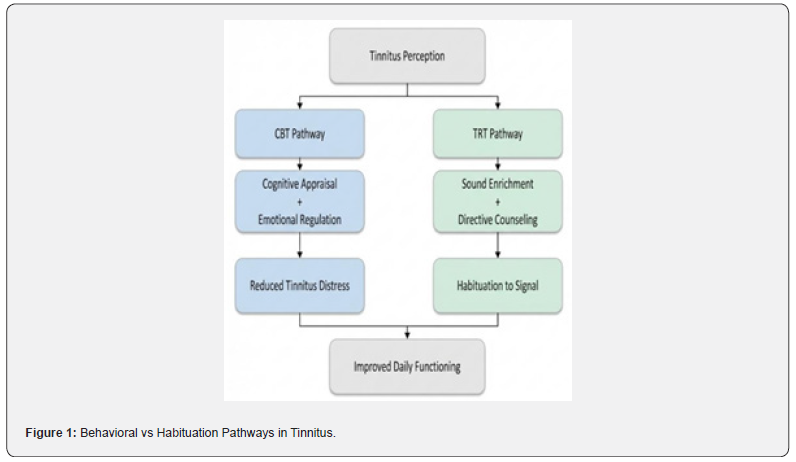
TRT retains clinical relevance, particularly for patients who benefit from structured counseling and sound therapy. Hearing aids and sound enrichment strategies can support habituation and reduce the perceptual dominance of tinnitus, especially in individuals with coexisting hearing loss. However, TRT may be less adaptable to modern service delivery models, and its evidence base remains insufficient to justify strong guideline recommendations. As shown in Figure 1, CBT and TRT operate through distinct but complementary mechanisms, ultimately supporting tinnitus adaptation through different pathways The integration of behavioral and audiological perspectives appears to offer the most promising framework for future tinnitus care. Multidisciplinary models such as those reported by Cima et al. demonstrate the effectiveness of combining psychological and audiological expertise, although these approaches may be challenging to scale in routine clinical settings. Hybrid models that incorporate digital CBT, audiology-delivered counseling, and sound therapy may offer a practical compromise that aligns with both patient needs and healthcare resource realities.
The limited research addressing pediatric tinnitus further underscores the need for flexible and developmentally appropriate approaches. Given the lack of dedicated interventions for younger populations, adapting adult models may offer a provisional solution, though empirical validation remains necessary. Overall, the literature indicates that tinnitus distress arises from an interaction of perceptual, emotional, and cognitive factors. Interventions that address these dimensions comprehensively are more likely to support long-term adaptation. Audiology is well- positioned to contribute to this paradigm, particularly as the discipline embraces psychologically informed practice and integrates new digital tools for counseling and self-management. This conceptual model illustrates how Cognitive Behavioral Therapy (CBT) primarily targets cognitive and emotional responses to tinnitus, leading to reduced distress, whereas Tinnitus Retraining Therapy (TRT) emphasizes sound enrichment and directive counseling to promote habituation. Both pathways ultimately aim to improve daily functioning.
Conclusion
The purpose of this review was to examine behavioral and audiological approaches to tinnitus management, with particular attention to CBT and TRT, as well as emerging trends in digital care, guideline recommendations, and lifespan considerations. The literature suggests that tinnitus is best understood as a multidimensional condition involving auditory, emotional, and cognitive components. This perspective supports the use of interventions that promote adaptation rather than attempting to eliminate the tinnitus percept itself. Across the studies reviewed, CBT demonstrated the most consistent evidence in reducing tinnitus-related distress and improving quality of life. Its focus on modifying thoughts, emotional responses, and attentional patterns appears to align well with the mechanisms underlying tinnitus suffering. Digital and remote CBT formats also show promise for addressing accessibility barriers, particularly in regions where specialized services are limited. TRT, while conceptually grounded in the neurophysiological model and widely used in audiology settings, showed more variable evidence, and guideline recommendations for its use remain mixed. Nevertheless, sound therapy and hearing aids continue to represent important tools for patients, especially when hearing loss is present.
Audiology plays an essential role in tinnitus care as the first point of contact for many patients. The integration of counseling, education, and sound-based strategies reflects the increasingly interdisciplinary nature of tinnitus management. Growing interest in psychologically informed audiology highlights an important evolution in the field and suggests that collaborative models combining behavioral and auditory approaches may offer the most comprehensive support for patients. Despite advancements in the field, several gaps remain. Pediatric tinnitus is underrecognized and under-researched, and many clinical models are designed primarily for adults. Access to psychological services varies widely, and not all patients are offered evidencebased interventions. Future work should explore how digital tools, audiology- delivered counseling, and integrated care pathways can expand access and improve outcomes for diverse patient populations. Ultimately, tinnitus management benefits from approaches that acknowledge both the auditory origin of the percept and the emotional experience that determines its impact. Helping patients understand their tinnitus, reduce fear and uncertainty, and engage in effective coping strategies may be just as meaningful as any attempt to alter the sound itself.
References
- Jastreboff PJ, Hazell JWP (2004) Tinnitus retraining therapy: Implementing the neurophysiological model. Cambridge University Press. (Original work published 1993).
- Rauschecker JP, Leaver AM, Mühlau M (2015) Tuning out the noise: Limbic-auditory interactions in tinnitus. Neuron 84(4): 767-779.
- Scherer RW, Holleman R, Boucher A (2019) Tinnitus Retraining Therapy versus standard of care: A randomized controlled trial. Ear and Hearing 40(5): 1045-1055.
- Phillips J, McFerran D (2022) Tinnitus Retraining Therapy for tinnitus: Cochrane systematic review. Cochrane Database of Systematic Reviews 3: CD005006.
- Hesser H, Weise C, Westin VZ, Andersson G (2011) A systematic review and meta-analysis of cognitive-behavioral therapy for tinnitus distress. Clinical Psychology Review 31(4): 545-553.
- Landry EC, Sandoval XC, Simeone C, Tidler S, Lea J (2020) Systematic review and network meta-analysis of cognitive and behavioral therapies for tinnitus. Otolaryngology-Head and Neck Surgery 162(1): 28-40.
- Zhong L, Meng Q, Jin Y (2025) Cognitive-behavioral approaches for tinnitus: Updated systematic review and meta-analysis. International Journal of Audiology 64(1): 44-58.
- Xian H, Zhou Q, Li Y (2025) Efficacy of digital and mobile-based CBT interventions for tinnitus: Meta- analysis. Journal of Telemedicine and e-Health 31(2): 214-227.
- Cima RFF, Van Breukelen GJP, Vlaeyen JWS, Anteunis LJC (2012) Tinnitus rehabilitation: A randomized controlled trial. The Lancet 379(9830): 1951-1959.
- Cima RFF, Botha L, Vlaeyen JWS (2018) Tinnitus treatment: Clinical trials and mechanisms. Hearing Research 361: 88-97.
- Beukes E, Andersson G, Fagelson M, Manchaiah V, Baguley D (2021) Internet‐based cognitive behavioral therapy for tinnitus: A randomized controlled trial. American Journal of Audiology 30(1): 52-63.
- Henry JA, Thielman EJ, Zaugg TL, Peltier E (2023) Audiologist- delivered tinnitus counseling informed by CBT: Feasibility and outcomes. American Journal of Audiology 32(1): 77-89.
- Sereda M, Hall DA, Hoare DJ (2017) Sound therapy for tinnitus management: Hearing aids and combined devices. Journal of the American Academy of Audiology 28(6): 548-559.
- Tunkel DE, Bauer CA, Sun GH (2014) Clinical practice guideline: Tinnitus. Otolaryngology-Head and Neck Surgery 151(2S): S1-S40.
- Langguth B, Kreuzer PM, Kleinjung T, De Ridder D (2023) Tinnitus: Global clinical practice guidelines and consensus statements. HNO 71(3): 172-183.
- Dullaart MJ, Melchers B, Govaerts PJ, Van de Heyning P (2021) Pediatric tinnitus: Systematic review of treatment and management strategies. International Journal of Pediatric Otorhinolaryngology 144: 110692.
- Rosing SN, Schmidt JH, Baguley DM (2016) Prevalence and characteristics of tinnitus and hyperacusis in children: A systematic review. Journal of the American Academy of Audiology 27(2): 156-161.

























