




 GJO Home



Abstract
Introduction: Chronic rhinosinusitis (CRS) and asthma share clinical and inflammatory features and are increasingly viewed as manifestations of a unified airway disease. The six-minute walk test (6MWT) is widely used to assess cardiopulmonary function in asthma patients, but its use in individuals with CRS has not yet been explored. This study aims to evaluate whether patients with CRS exhibit impaired cardiopulmonary function as measured by the 6MWT.
Methods: A cross-sectional study was conducted among adult patients diagnosed with CRS with nasal polyps, according to EPOS criteria, who were followed at a tertiary university hospital’s otolaryngology outpatient clinic. Participants underwent the 6-minute walk test (6MWT), spirometry, and completed the SNOT-22 questionnaire, rating nasal obstruction using a Visual Analog Scale (VAS). Lund-Kennedy and Lund-Mackay scores were obtained, and patients were classified according to type 2 inflammation.
Results: A total of 52 patients were evaluated (mean age: 54.7 years; 55.8% male), of whom 46.2% had asthma. The mean distance walked in the 6MWT was 524.1 meters (96.3% of predicted). No significant correlations were found between walking distance and SNOT-22, Lund-Kennedy, Lund-Mackay scores, VAS for nasal obstruction, type 2 inflammatory status, or Spirometric obstruction.
Conclusion: CRS, with or without asthma, was not associated with reduced functional capacity as measured by the 6MWT. Therefore, CRS does not appear to be a confounding factor when using the 6MWT to assess treatment response in asthma patients.
Keywords:Rhinosinusitis; Respiratory function tests; Walk test; Nasal polyps; Diagnostic techniques; Respiratory system
Abbreviations:CRS: Chronic Rhinosinusitis; VAS: Visual Analog Scale; 6MWT: Six-Minute Walk Test
Introduction
There is a significant overlap between symptoms, inflammatory response, and treatment of patients with chronic rhinosinusitis (CRS) and asthma [1,2], increasing the specialist’s focus on the airway as a whole [2–4]. The 6-minute walking test (6MWT) assesses cardiorespiratory function and is used in cases of moderate and severe asthma. It measures the maximum distance a patient can walk in 6 minutes [5]. It is a valuable tool for assessing the limitations of daily activities, and it has recently been used for evaluating asthma treatment with immunobiologist [3]. Patients with type 2 inflammatory endotype of CRS have a high prevalence of asthma, and possibly a higher inflammatory response associated with nasal obstruction [6]. For instance, previous studies demonstrated an improvement in pulmonary function and asthma exacerbation after endoscopic sinus surgery [4,7]. However, despite the high prevalence of CRS in patients with asthma, there are no studies evaluating the 6MWT specifically in patients with CRS, and whether this nasosinusal condition is associated with worse cardiopulmonary function [1]. This study aims to evaluate if patients with CRS have impaired cardiopulmonary function measured by the 6MWT.
Method
A cross-sectional study involving adult individuals diagnosed with primary CRS with nasal polyps, as classified by the EPOS [1], who were followed in the otorhinolaryngology outpatient clinic of a tertiary university hospital, was performed. Patients who could not perform 6MWT due to orthopedic or cardiac risks were excluded. The University Ethical Committee (CAAE: 90802318.3.0000.5404) approved this study and all participants signed a written informed consent. All individuals completed a clinical questionnaire, the Sino-Nasal Outcome Test 22 (SNOT-22) and were asked to rate nasal obstruction using a Visual Analog Scale (VAS). Patients performed the 6MWT and spirometry following ATS guidelines [5,8]. The predicted 6MWT distance was calculated using a validated equation [9]. All patients underwent nasal endoscopy and CT scans to determine the Lund-Kennedy and Lund-Mackay scores. Additionally, patients were classified as Type 2 endotype according to the EPOS criteria [1]. The primary outcome will be the six-minute walking distance (6MWD). Based on previous studies, we assumed a standard deviation of 50 m and a minimal clinically important difference (MCID) of 50 m between groups. Using a two-sided two-sample t-test with a significance level of 0.05 and 90% power, the required sample size was calculated as 21 participants per group (42 in total). To account for an estimated 10% attrition rate, we plan to recruit 24 participants per group (48 in total). Data were analyzed with SPSS 16.0 software. The Shapiro-Wilk test was used to evaluate normal distribution. For variables with normal distribution, Student’s t-test was used to compare two independent groups; otherwise, the Mann-Whitney test was used. The Spearman Correlation Coefficient was used to assess the correlation. The significance level was set at 5%.
Results
A total of 52 patients were evaluated with a mean age of 54.7 years. Twenty-nine participants were male (55.8%). Twentyfour individuals (46.2%) had asthma, and 3 (5.8%) were active smokers. Nonsteroidal anti-inflammatory drug intolerance was observed in 8 patients (15.4%). Type 2 inflammation was identified in 42 participants (80.8%). The mean score on the SNOT-22, Lund-Kennedy and Lund-Mackay scores were 48.35, 7.4, and 14.9, respectively. The VAS for nasal obstruction had a mean value of 57.4. Table 1 summarizes the mean characteristics of these patients divided into the asthma and non-asthma groups.
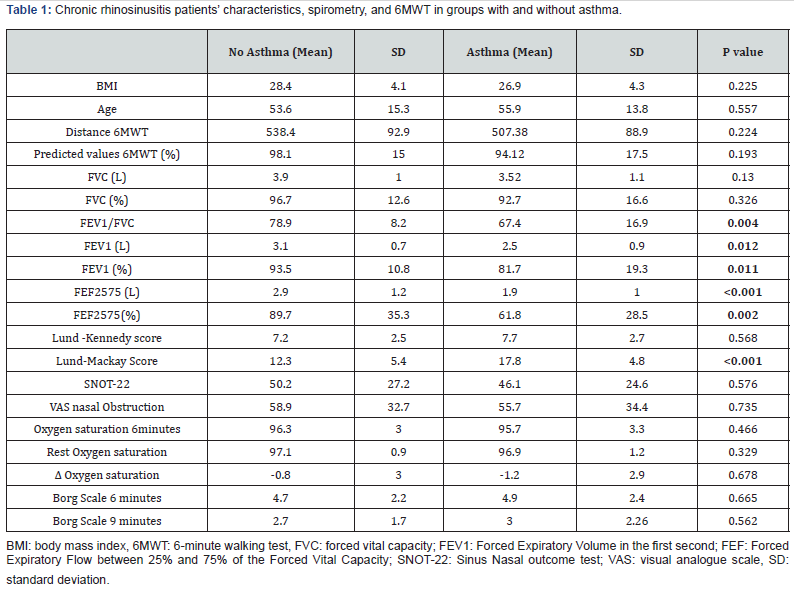
BMI: body mass index, 6MWT: 6-minute walking test, FVC: forced vital capacity; FEV1: Forced Expiratory Volume in the first second; FEF: Forced Expiratory Flow between 25% and 75% of the Forced Vital Capacity; SNOT-22: Sinus Nasal outcome test; VAS: visual analogue scale, SD: standard deviation.
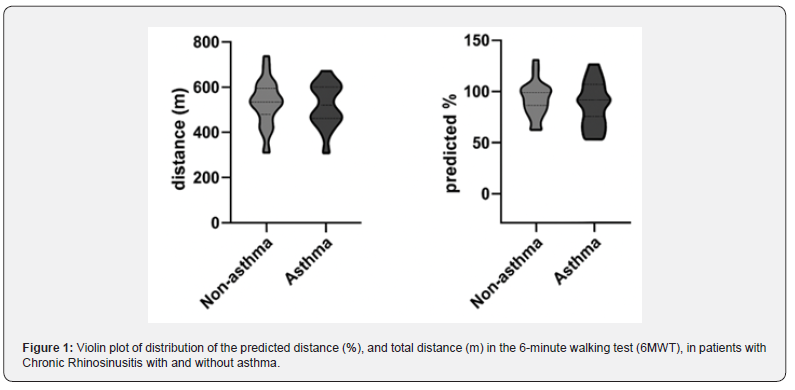
The mean distance covered in the six-minute walk test was 524.1 meters, corresponding to 96.3% of the predicted value. Resting oxygen saturation was 97% (SD: 1.1), decreasing to 96% after the test (SD: 3.13). Figure 1 shows the distribution of the 6MWT both in individuals with and without asthma. Spearman correlation analysis between the distance walked in the 6MWTand the scores of the SNOT-22, Lund-Kennedy (LK), and Lund-Mackay (LM) did not reveal significant associations (r = -0.157 for SNOT- 22; r = 0.105 for total LK; r = 0.102 for total LM). Also, VAS and the distance walked in the 6MWT showed no significant association (p = 0.991). Likewise, the presence of a Type 2 inflammatory pattern (p = 0.816) or obstruction in the spirometry (p=0,4) was also not related to the distance walked in the test.
Discussion
The 6MWT is a standardized, submaximal exercise test used to assess functional capacity and aerobic endurance in individuals with various cardiopulmonary or systemic conditions [3,5,8]. It is widely used due to its simplicity and reproducibility, and it reflects the patient’s ability to perform daily physical activities. It’s a complementary tool in the assessment of patients with asthma, particularly in moderate to severe cases [3,5,9]. Previous studies investigated the relation between exercise and nasal obstruction, especially using nasal clips or vasoconstrictors, and found few alterations in performance in these individuals tested [10]. In this study, VAS for nasal obstruction did not correlate with the distance or predicted distance in the 6MWT. The additional inflammatory charge provided by chronic sinusitis [2,6] was not investigated on evaluation of exercise performance or cardiorespiratory function in previous reports [9,10]. Our study could not correlate the severity of the rhinosinusitis with worse performance in the 6MWT, which can be explained by the capacity of mouth breathing during exercise, and a minor role of nasal inflammation compared to pulmonary inflammation, just as in cases of mild asthma, the walking test tends to be normal [2,3,6,10]. The individuals evaluated in this study had a mean predicted distance of 96.1% indicating that neither asthma nor rhinosinusitis affected the cardiopulmonary performance. To our knowledge, this study is the first to evaluate the 6MWT in a population with CRS. Despite its small sample size, it showed that the CRS did not contribute as a confounder in the 6MWT. Larger studies that divide patients by asthma severity and assess performance before and after nasal treatment may be useful in the future. In the era of immunobiologics, instruments that measure response to therapy are becoming increasingly useful, and studying potential confounders is imperative.
Conclusion
Cardiopulmonary function, as measured by the 6-minute walk test, was not impaired in patients with chronic rhinosinusitis, regardless of asthma status. Therefore, CRS does not appear to be a confounding factor when using the 6MWT to evaluate systemic asthma treatment. Larger studies assessing the entire airway axis and incorporating pre- and post-treatment evaluations may confirm and expand upon these findings.
References
- Fokkens WJ, Lund VJ, Hopkins C, Hellings PW, Kern R, et al. (2020) European Position Paper on Rhinosinusitis and Nasal Polyps 58(Suppl S29): 1-464.
- Bachert C, Luong AU, Gevaert P, Mullol J, Smith SG (2023) The Unified Airway Hypothesis: Evidence From Specific Intervention With Anti-IL-5 Biologic Therapy. Journal of Allergy and Clinical Immunology: In Practice 11(9): 2630-2641.
- Lombardi C, Berti A, Cottini M, Roca E, Ventura L (2023) Using the 6-min walk test to assess the clinical response to mepolizumab and conventional therapy in severe eosinophilic asthma. ERJ Open Res 9(5).
- Cao Y, Hong H, Sun Y, Lai Y, Xu R (2019) The effects of endoscopic sinus surgery on pulmonary function in chronic rhinosinusitis patients with asthma: a systematic review and meta-analysis. European Archives of Oto-Rhino-Laryngology. Springer Verlag 276: 1405-1411.
- ATS Committee on Proficiency Standards for Clinical Pulmonary Function Laboratories (2002) American Thoracic Society ATS Statement: Guidelines for the Six-Minute Walk Test. Am J Respir Crit Care Med 166(1): 111-117.
- Tomassen P, Vandeplas G, Van Zele T, Cardell LO, Arebro J (2016) Inflammatory endotypes of chronic rhinosinusitis based on cluster analysis of biomarkers. Journal of Allergy and Clinical Immunology 137(5): 1449-1456.
- Mullol J, Maldonado M, Castillo JA, Miguel-Blanco C, Dávila I, et al. (2022) Management of United Airway Disease Focused on Patients With Asthma and Chronic Rhinosinusitis With Nasal Polyps: A Systematic Review. Journal of Allergy and Clinical Immunology: In Practice 10(9): 2438-2447.
- Enright PL, Sherrill DL (1998) Reference Equations for the Six-Minute Walk in Healthy Adults. Am J Respir Crit Care Med 158.
- Pitzner-Fabricius A, Clark VL, Backer V, Gibson PG, McDonald VM (2022) Factors associated with 6-min walk distance in severe asthma: A cross-sectional study. Respirology 27(12): 1025-1033.
- Walker A, Surda P, Rossiter M, Little S (2016) Nasal function and dysfunction in exercise. Journal of Laryngology and Otology. Cambridge University Press 130: 431-434.

























