




 GJO Home



Abstract
The revolving-door (RD) flap, first described by Masson in 1972, represents a refined and reliable approach for the reconstruction of anterior auricular defects. Despite its long-standing success, the RD flap has been gradually underutilized in modern otologic practice, often replaced by full-thickness skin grafts. This opinion highlights the importance of reintroducing the RD flap as a primary choice in auricular reconstruction, emphasizing its superior aesthetic outcomes, robust vascularity, and structural stability. Based on extensive clinical experience, the RD flap offers an ideal blend of surgical efficiency, cosmetic excellence, and patient satisfaction. It deserves renewed attention and broader adoption in the era of minimally invasive and patient-centered reconstructive surgery.
Keywords:Revolving-door flap; Auricular reconstruction; Conchal defect; Surgical innovation; Aesthetic outcome
Abbreviations:RD: Revolving-Door; FTSG: Full-Thickness Skin Graft
Introduction
In auricular reconstructive surgery, achieving both functional restoration and aesthetic harmony remains a demanding challenge. Among the numerous techniques developed for anterior conchal defects, the revolving-door (RD) flap-first described by Masson in 1972-stands out for its refined design and elegant execution [1]. Despite its long history and well-documented reliability, this technique has gradually fallen out of mainstream surgical practice, replaced by simpler yet less ideal options such as full-thickness skin grafts (FTSG) [2]. This decline reflects a broader trend in modern reconstructive surgery: a preference for convenience over craftsmanship. However, as our clinical expectations evolve-emphasizing precision, minimal scarring, and patient satisfaction-it may be time to revisit the RD flap and recognize its relevance in today’s surgical landscape.
The Case for Reconsidering the RD Flap
The RD flap offers a unique combination of mechanical stability, aesthetic integration, and minimal donor-site morbidity. Unlike skin grafts, which rely solely on the recipient bed for revascularization, the RD flap maintains a robust axial blood supply through the post-auricular and mastoid perforators of the posterior auricular artery. This dual-sided perfusion minimizes the risk of necrosis and provides immediate tissue viability. From an aesthetic perspective, the post-auricular skin perfectly matches the anterior conchal surface in color, thickness, and texture. Recent systematic analyses have reinforced this view, demonstrating that among various reconstructive approaches, the revolving-door flap consistently achieves the lowest complication rates and highest patient-reported aesthetic satisfaction [3].
Surgical Practicality and Learning Curve
A frequent misconception surrounding the RD flap is that it is technically demanding. In fact, once the surgeon understands the concept of the skin-cartilage tunnel and the rotational axis, the procedure can be performed efficiently under local or general anesthesia. The dependable collateral vascular network of the posterior auricular and superficial temporal arteries, as emphasized in other auricular flap designs such as the V–Y advancement flap, further explains the high survival rate of the revolving-door flap [4]. The learning curve is short, typically requiring only a few supervised cases for mastery.
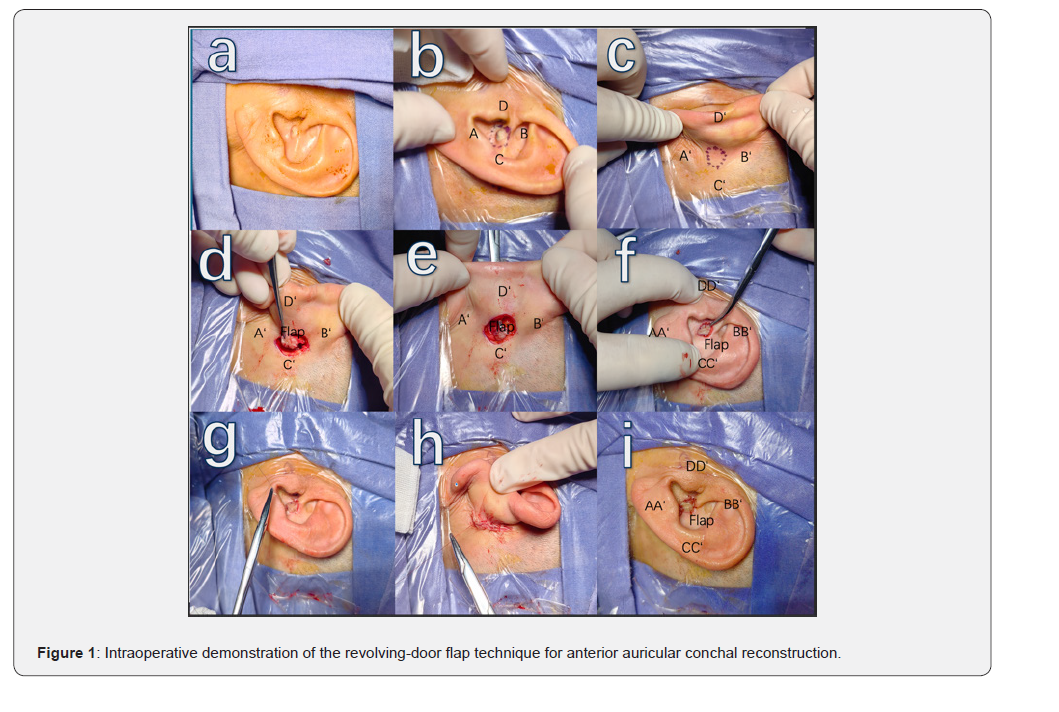
a) Preoperative view of the conchal defect following tumor
excision.
b) The anterior defect margins (A–D) are identified.
c) Corresponding points (A′–D′) are marked on the
postauricular surface for flap design.
d) The postauricular flap is elevated in a subcutaneous
plane, maintaining the central cartilage pedicle and robust
vascular supply.
e) The flap is rotated anteriorly through the cartilage
tunnel in a “revolving-door” motion to reach the conchal defect.
f) The flap edges are precisely aligned and sutured with
minimal tension.
g) Immediate postoperative view showing excellent color
match, contour restoration, and minimal donor-site morbidity.
This stepwise technique provides stable coverage, preserves
ear contour, and can be performed efficiently under local
anesthesia.
Aesthetic and Functional Superiority Over Skin Grafting
While full-thickness skin grafts remain a staple in reconstructive practice, they inherently lack the structural and physiological advantages of a vascularized flap. The centripetal contraction of grafted tissue often leads to contour depression, distortion of the auricular bowl, and even narrowing of the external auditory canal. By contrast, the RD flap maintains the three-dimensional architecture of the auricle, ensuring both functional sound reflection and cosmetic balance [2].
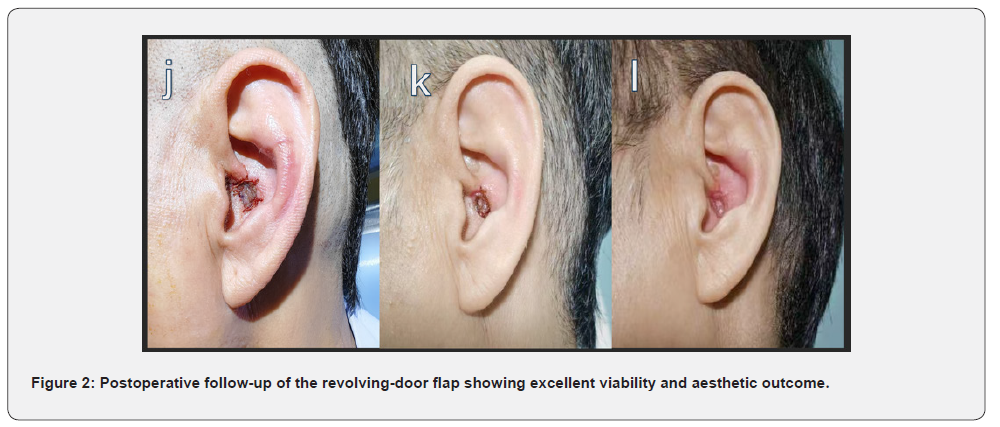
a) Postoperative day 1: The flap appears well-perfused
with mild congestion at the margins.
b) Postoperative week 1: Progressive epithelialization and
reduction in edema with stable contour.
c) Postoperative week 3: Complete wound healing with
excellent color match, contour restoration, and inconspicuous
scarring. These sequential images demonstrate the robust
vascularity, rapid healing, and long-term cosmetic superiority
of the revolving-door flap compared with traditional grafting
methods.
Future Perspectives: Rediscovering Classic Techniques in a Modern Era
In an age dominated by digital design, tissue engineering, and robotic assistance, traditional reconstructive principles may seem antiquated. Yet, the RD flap exemplifies the timeless value of anatomical precision and surgical artistry. As highlighted by Jovic et al. [5], auricular reconstruction has evolved from ancient craftsmanship to a convergence with digital and biotechnological innovation-where concepts such as bio printed cartilage scaffolds and composite tissue allotransplantation may redefine the future of external ear reconstruction. Its simplicity allows seamless integration with modern adjuncts such as intraoperative imaging, adhesive biomaterials, and AI-assisted 3D modeling for flap planning.
Conclusion
The revolving-door flap represents more than a surgical technique-it embodies the balance between anatomical respect, aesthetic intuition, and functional restoration. As reconstructive surgeons seek refined, minimally invasive, and patientcentered approaches, it is time to reintroduce this elegant yet underappreciated method into regular practice. The “forgotten elegance” of the RD flap deserves not only remembrance but revitalization, bridging the heritage of surgical craftsmanship with the innovation of modern otologic reconstruction.
Acknowledgement
The authors sincerely thank the Department of Otorhinolaryngology, Eye & ENT Hospital of Fudan University, for its continuous support, academic guidance, and collaboration throughout this work. We are also deeply grateful to our patients for their trust and cooperation, which made this clinical experience and study possible.
References
- Masson C, Gabouriaut D, Friggi A (1972) Ultrastructure of a New Olfactory Receptor of Insect, Found on Antennae of Ant Camponotus-Vagus Scop (Hymenoptera, Formicinae). Z Morphol Tiere 72(4): 349.
- Dessy LA, Figus A, Fioramonti P, Mazzocchi M, Scuderi N (2010) Reconstruction of anterior auricular conchal defect after malignancy excision: Revolving-door flap versus full-thickness skin graft. J Plast Reconstr Aes 63(5): 746-752.
- Moreno-Vazquez S, Antoñanzas J, Oteiza-Rius I, Redondo P, Salido-Vallejo R (2023) Reconstructive Procedures of the Auricular Concha after Cutaneous Oncologic Surgery: A Systematic Review. J Clin Med 12(20): 6521.
- Allen L, Munroe K, Taylor SM (2021) A novel approach to earlobe reconstruction using the V to Y advancement flap. J Otolaryngol-Head N 50(1): 32.
- Jovic TH, Stewart K, Kon M, Whitaker IS (2020) Auricular reconstruction: A sociocultural, surgical and scientific perspective. J Plast Reconstr Aes 73(8): 1424-1433.

























