




 GJO Home



Abstract
Keywords:Cell carcinoma; Radial forearm; Spreading tumor; Sclerodermiform; Superficial; Systemic chemotherapy; Carcinoma syndrome
Abbreviations:EAC: External Auditory Canal; NBCCS: Nevoid Basal Cell Carcinoma Syndrome; BCC: Basal Cell Carcinoma; WHO: World Health Organisation
Introduction
The most common neoplasm in humans is skin cancer, and among skin cancer most common type is Basal cell carcinoma constitutes approximately 75% of all cancer [1,2]. WHO describes it as “a locally invasive, slowly spreading tumor that arises in the epidermis and in which the peripheral cells typically mimic the basal cells of the epidermis” [3]. Disease mostly involves the elderly age group, and incidence is slightly higher in males than in females [4]. The most common risk factor for BCC is exposure to ultraviolet radiation of 290to 320nm wavelength [5]. Other risk factor includes male sex, skin type (Fitzpatrick I and II), advanced age (> 60 years), long-term immunosuppression, a positive family history, nevoid basal cell carcinoma syndrome (NBCCS), or xeroderma pigmentosum [1]. It can also develop from chronic scar, Marjolin’s ulcer, and sinuses [6]. Clinically, it can be of ulcero-nodular, superficial, sclerodermiform, and pigmented subtypes. The nodular subtype is the most common [1]. The disease is locally aggressive, but the rate of metastasis is very low, 0.0028 to 0.1% of patients [7]. Treatment options for BCC include surgery, radiation, cryotherapy, curettage, and electrodesiccation. Systemic chemotherapy, laser treatment, and topical use of 5-fluorouracil (5 FU) ointment are the less common therapeutic strategies available [8]. Surgery is the mainstay of treatment, with an adequate margin during resection, and careful planning is needed for the reconstruction of the defect to attain the best aesthetic and functional outcome.
Case Report
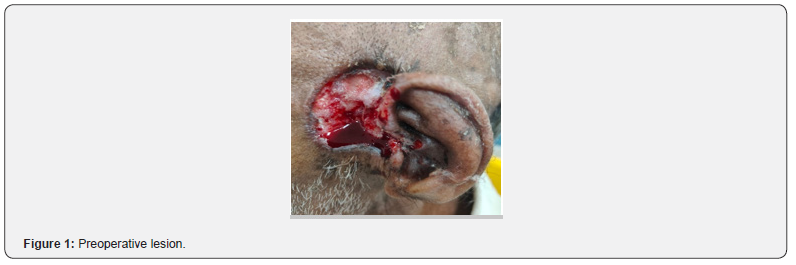
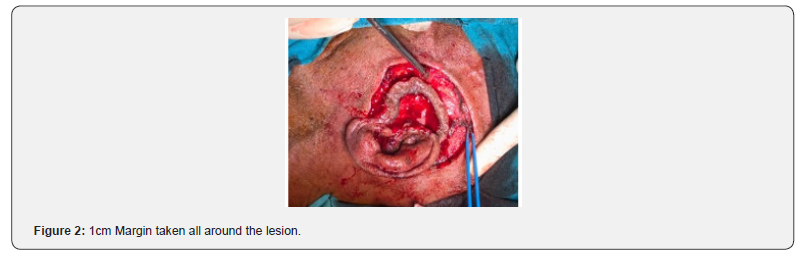
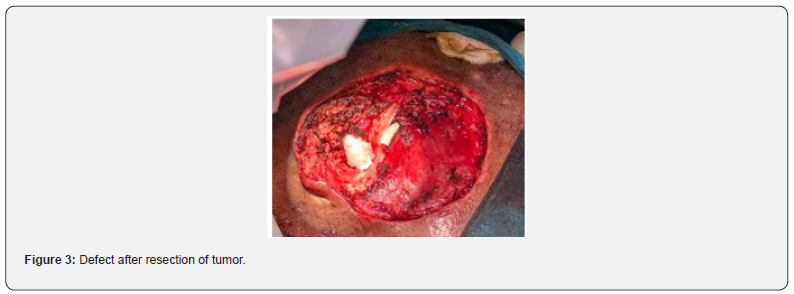
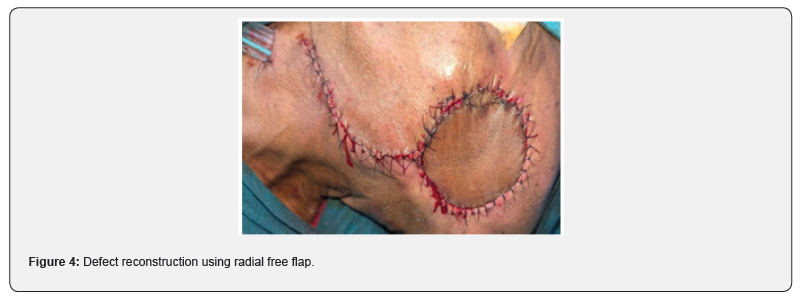
A 76-year-old male patient presented with a non-healing ulcer on the left side of his face involving the pinna for the last 2 years. It is gradually progressing in size, and it occasionally bleeds on touch. This is associated with discharge from the left ear. Biopsy from the ulcer reported as basal cell carcinoma. After taking consent, the patient was planned for surgery. Patient was intubated intraorally and taking 1cm margin all around the tumour, the tumour was resected in toto along with limited lateral temporal bone resection to get a clear bony External auditory canal (EAC) margin. The defect was closed using a radial forearm free flap. The postoperative period was uneventful. Figure 1 shows the preoperative lesion. Figure 2 shows the 1 cm intraoperative margin taken all around the tumour. Figure 3 shows the complete excision of the tumour. Figure 4 shows the reconstruction of the defect using a radial forearm free graft.
Discussion
Surgical treatment for Basal cell carcinoma includes excision along with reconstruction of the defect. Since most of the BCC involves the face, maximal care and planning is needed for the reconstruction of the defect to get the best aesthetic and functional outcome. There are different options available for the defect reconstruction, which include local flaps like advancement flap, rotation flap, or transposition flap, with good cosmetic results as it matches the colour of the surrounding tissue. However, a free flap reconstruction can give superior aesthetic results with improved form and function [5]. Complete tumour excision with adequate surgical margin is an important treatment principle. For tumours of less than 2 cm in size, a 4mm margin is sufficient; for tumors of a size of 2cm or greater 6mm margin is required [9]. After surgery recurrence rate of BCC is 5to 14%. Inadequate margin in 26-67% of cases is a common risk factor for recurrence [10]. Other risk factors for recurrence are location and size of tumour [ H zone with size >6mm, M zone with size >10mm, and L zone with size > 20 mm] are considered to have a high recurrence rate. H zone includes the center of the face (periorbital, eyelids, eyebrows, nose, angle of the jaw, temples, ears, pre- and postauricular), the genital region, hands, and feet. M zone: Cheeks, forehead, chin, lower lip, capillitium, neck, pretibial region, and L zone includes torso, limbs. Histological subtype, prior radiotherapy, and perineural growth are also risk factors for recurrence [1]. Among the free flap reconstruction for the defect options are the radial free forearm flap and the anterolateral thigh flap. Due to technically more difficult in harvesting the ALT flap, and its bulky appearance, the radial free forearm flap is the best in terms of cosmesis and functionality [11].
References
- Seidl Philipp M, Frischhut N, Höllweger N, Schmuth M, Nguyen VA, et al. (2021) Known and new facts on basal cell carcinoma. J Dtsch Dermatol Ges 19(7): 1021-1041.
- Fijałkowska M, Koziej M, Antoszewski B (2021) Detailed head localization and incidence of skin cancers. Sci Rep 11(1): 12391.
- Dhondge R, Hussain M, Nagarkar R (2024) Reconstructive Options for Basal Cell Carcinoma Defects in the Head and Neck Region: An Institutional Experience. Indian J Otolaryngol Head Neck Surg 76(1): 329-335.
- Christenson LJ, Borrowman TA, Vachon CM, Tollefson MM, Otley CC, et al. (2005) Incidence of basal cell and squamous cell carcinomas in a population younger than 40 years. JAMA 294(6): 681-690.
- BuzzellRA (1993) Effects of solar radiation on the skin. Otolaryngol Clin North Am 26(1): 1-11.
- Johanson TM, Rowe DE, Nelson BR (1992) Squamous cell carcinoma of the skin. J Am Acad Dermatol 26(3pt2): 467-484.
- Piva de Freitas, Paola, Senna, César Galusni, Tabai, et al. (2017) Metastatic Basal Cell Carcinoma: A Rare Manifestation of a Common Disease. Case Reports in Medicine 2017: 8929745.
- Sharma A, Khanna R, Khanna P, Khanna R, Khanna S, et al. (2024) A case series analysis of basal cell carcinoma (BCC): Not the deadliest but certainly the most destructive form of skin cancer. Acta Med Int 11(3): 263-268.
- Janjua OS, Quereshi SM (2012) Basal cell carcinoma of the head and neck region: an analysis of 171 cases. Journal of Skin Cancer 2012: 943472.
- Sartore L, Lancerotto L, Salmaso M (2011) Facial basal cell carcinoma : analysis of recurrence and follow up strategies. Oncology Reports 26(6): 1423-1429.
- Shunyu NB, Sarma G, Akhtar H (2025) Reconstruction of advanced basal cell carcinoma of face: a case report. Journal of Analytical Oncology 14(1): 1-3.

























