




 ETOAJ Home



Statistical Analysis of the Relationship between Facial Anthropometry and N95 Respirator Fit Performance
CHAN Wing-yu1, NG Sau-yee1, NG Sun-pui1*, YICK Kit-lun2, LOH Anthony Wai-keung2
1 Division of Science, Engineering and Health Studies, School of Professional Education and Executive Development, The Hong Kong Polytechnic University, Hong Kong, China
2 School of Fashion & Textiles, The Hong Kong Polytechnic University, Hong Kong, China
Submission: May 18, 2025;Published:May 27, 2026
*Corresponding author:NG Sun-pui, Division of Science, Engineering and Health Studies, School of Professional Education and Executive Development, The Hong Kong Polytechnic University, Hong Kong, China
How to cite this article:CHAN Wing-y, NG Sau-y, NG Sun-p, YICK Kit-l, LOH Anthony Wai-k. Statistical Analysis of the Relationship between Facial Anthropometry and N95 Respirator Fit Performance. Eng Technol Open Acc 2026; 7(1): 555701.DOI: 10.19080/ETOAJ.2026.07.555701
Abstract
The importance of respirator fit can hardly be overestimated; however, the relationship between facial anthropometry and fit performance still lacks some understanding. Quantitative fit testing using the 3M 1870+ N95 respirator and PortaCount Pro+ 8038 was carried out in 144 subjects (PASS, all with a fit factor ≥100). Thirty-eight facial measurements were taken, and fit factors obtained in seven exercises were considered. Overall, the average fit factor was 177.0, with 43.8% of participants attaining the ceiling value. Among all facial measurements, bizygomatic breadth showed the highest correlation coefficient, the second and third being labiomental angle and sellion cross length. Dynamic exercises proved more strongly related to facial anthropometric measures than static exercises. Participants with high fit factors were associated with increased facial width, lower facial angles, and greater head circumference. In multiple linear regression (MLR), a low predictive value (R² = 0.342) was observed, whereas in LASSO regression analysis, four independent variables were identified, making a model with a smaller R² (R² = 0.158). It was found that facial width and lower facial angles were primary predictors of fit performance in respirators, with greater sensitivity of dynamics performance.
Keywords:N95 respirator; facial anthropometry; fit testing; bizygomatic breadth; labiomental angle
Introduction
Respiratory protective equipment, especially N95 filtering facepiece respirators (FFRs), forms an integral part of personal protection against pathogens, particulate matter, and occupational hazards encountered in various industries, healthcare and emergency response [1-3]. In turn, the efficiency of respiratory protective equipment directly depends on its ability to achieve a sufficient seal between the device itself and the face of the user; even slight deviations could significantly reduce the level of protection due to increased leakage of air inside [4-5]. Quantitative fit testing (QNFT) has proven to be a reliable technique of assessing the performance of respirator fit by providing objective measures of fit factor (FF) that describe the quotient between ambient and in-mask concentrations of aerosols [6-7]. Despite the extensive literature on fit testing procedures, many years of research and regulatory requirements concerning the implementation of fit testing procedures in workplace settings, the number of fit test failures is rather impressive, with fit failure rates reported to range between 10% and over 50%, depending on respirator type, studied populations and used protocols [8-10]. Notably, the pattern of fit failure is predictable and is influenced by the morphological features of users’ faces, suggesting that anthropometric mismatch between respirator and face serves as the main cause of poor fit results [11-13]. The determination of facial dimensions contributing most to this problem is critical for improving the design of respiratory protective equipment, fitting guidelines and fit test methods [14-16].
Anthropometry refers to the process of measuring facial dimensions in order to quantitatively evaluate the geometric properties of respirator-face interaction [17-18]. Several key facial dimensions have been identified previously, among which are face width (bizygomatic breadth), face length (menton–sellion length), jaw width (bigonial breadth), and angular facial parameters [19-21]. However, previous literature displays substantial heterogeneity as different dimensions tend to emerge as “critical” depending on particular respirator, population of interest and methods used [22-24]. This variation could reflect the diversity of fit problems associated with specific types of respirators or be due to the small sample sizes and presence of ceiling effects in fit test data [25-26]. Such knowledge gaps have been addressed in the current research by conducting a systematic investigation involving 144 participants that were quantitatively fitted with the 3M 1870+ N95 Filtering Facepiece Respirator (FFR), which is one of the most commonly used respirators in medical practice [27]. In total, 38 facial dimensions were measured according to standardized guidelines, while the exercise-specific fit factors for seven exercises that involved both static breathing and movement exercises were measured. The statistical analyses encompassed the application of correlation coefficients, multiple linear regression (MLR), LASSO regression, and group comparisons. The goals of the current study include the following points: (1) estimating the magnitude and direction of associations between each facial dimension and overall fit factor; (2) identifying the important facial dimensions for prediction using MLR; (3) comparing the anthropometric characteristics of high-fit subjects and low-fit individuals; and (4) examining the difference between static and dynamic exercises in terms of the analyzed parameters.
Materials and Methods
Study Design and Participants
A total of 144 participants of Chinese origin were recruited to take part in the research. All participants included in the study were adults aged 20-50 years old regardless of gender. Criteria for inclusion in the study were as follows: (1) Age between 20 and 50 years; (2) Chinese origin; (3) Lack of chronic respiratory diseases; (4) Lack of cardiovascular diseases; (5) Capability to carry out physical exercise involved in fit test. The following criteria served as the basis for exclusion from the study: (1) Facial deformities associated with surgical or traumatic procedures; (2) Presence of facial hair that could prevent the proper fitting of a respirator; (3) Respiratory infections at the time of testing; (4) Pregnancy; (5) Claustrophobia or fear of respirators. All participants signed an informed consent form before taking part in the experiment.
Respirator Specifications
The 3M 1870+ N95 Filtering Facepiece Respirator (3M Company, St. Paul, MN) is a cup-type, fluid-resistant respirator designed for healthcare workers. The features of this respirator include a three-paneled construction with a foam nose piece, an adjustable nose clip, and two headbands that attach to the crown of the head and the back of the neck. The 3M 1870+ respirator is a NIOSH-certified N95 respirator under 42 CFR Part 84. It means that this type of respirator filters at least 95% of particulates from the air [28]. It is commonly used by healthcare workers and has been studied during numerous fit-tests [29–30].
Quantitative Fit Testing Protocol
The quantitative fit test was carried out using the TSI PortaCount Pro+ Model 8038 Respirator Fit Tester. The PortaCount uses a condensation particle counter that measures ambient aerosol particles and calculates fit factors in real time during the exercises that were done in succession. Prior to the quantitative fit test, each participant was trained on the correct way of wearing the respirator, including facial positioning of the respirator, nose clip adjustment to get a proper seal, and strap positioning. The user seal check procedure had been performed by each participant before the quantitative test. The fit test consisted of the following seven exercises that were completed successively:
I. Exercise 1: Normal Breathing (static) – 60 seconds
normal breathing without any movement;
II. Exercise 2: Deep Breathing (static) – 60 seconds of deep
breathing without any movement;
s
III. Exercise 3: Head Side to Side (dynamic) – 60 seconds
slow movement of the head from one side to another;
IV. Exercise 4: Head Up and Down (dynamic) – 60 seconds
slow upward/downward head movements;
V. Exercise 5: Talking (dynamic) – 60 seconds reading the
pre-determined text aloud;
VI. Exercise 7: Bending Over (dynamic) – 60 seconds
bending over and touching the toes repeatedly;
VII. Exercise 8: Normal Breathing Repeat (static) – 60
seconds normal breathing without any movement.
It should be noted that static tasks refer to situations where the participant remains stationary and only breathes normally, while dynamic tasks involve external movements such as head turning, talking and bending over. The grimacing exercise (exercise 6) was skipped since it is not used in OSHA quantitative fit test. All of the above exercises were done approximately for 60 seconds each and exercise specific fit factors were recorded by the PortaCount. To obtain the overall fit factor, the average of all the individual fit factors were calculated using the formula for harmonic mean. The pass mark was 100 or more.
Facial Anthropometric Measurements
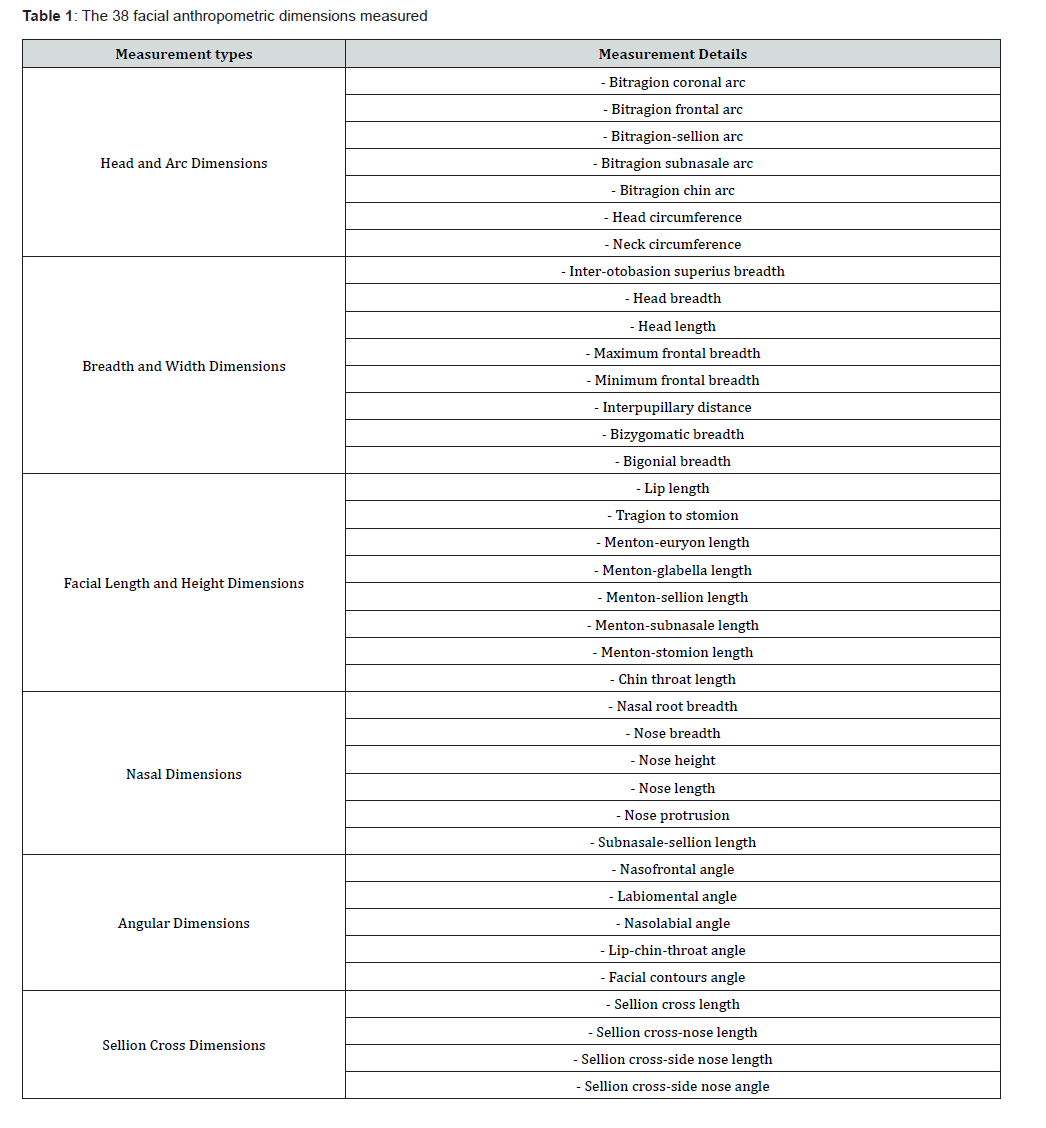
The 38 anthropometric measurements on the face for each individual were made according to standardized methods and equipment. These measurements were carried out by qualified individuals based on protocols developed based on anthropometric norms [31-33]. The linear measures were taken using spreading callipers, sliding callipers, and anthropometry tapes with an accuracy of 1 mm. Angular measures were measured with the help of digital protractors or were calculated using linear measurements along with anatomical points. The 38 measures, as described in (Table 1), are measured. Definition of all these measures, including the procedure of measurement, is in accordance with anthropometric standards [34-35].
Statistical Analysis
All statistical analyses were performed in Python 3.8 with the help of NumPy, SciPy, pandas, and scikit-learn libraries. Significance threshold was chosen to be α = 0.05 for all tests, except in case when marginal significance was indicated at α = 0.10. The following descriptive statistics were computed for the overall FF and exercise-specific FFs – mean, standard deviation (SD), median, minimum, maximum, coefficient of variation (CV%), and the proportion of subjects at the ceiling value (FF = 201). Correlation analysis was used for assessment of relationships between facial dimensions and fit factors. Linear relationships were assessed by means of Pearson correlation coefficient (r), while monotonic relationships were analyzed through Spearman rank correlation coefficient (rs). For statistical assessment of significance both types of correlation coefficients were subjected to two-tailed tests. In order to compare different exercise conditions, correlations were pooled into static exercises (Exercises 1, 2, and 8) and dynamic exercises (Exercises 3, 4, 5, and 7). Correlation coefficients within each category were averaged, and their difference was calculated (Δr).
For group comparison, subjects were divided into high FF group (FF ≥ 201, i.e., those achieving the maximum, n = 63) and low FF group (FF ≤ 155, i.e., those achieving the lowest FF, which constituted about the fourth quartile, n = 37). Comparison between groups was done by means of Mann–Whitney U test, and mean differences were computed as an estimate of effect size. Statistically significant levels were p < 0.001, p < 0.01, p < 0.05, p < 0.10 (marginal), and not significant. Multiple linear regression (MLR) analysis was employed in order to assess cumulative effect of 38 facial dimensions on overall FF. Dependent variable was transformed logarithmically for improvement of normality. Standardized β-coefficients, t, and p-values were calculated for each independent variable. Model’s performance was estimated via R² and adjusted R² values as well as F-statistic. In order to solve a problem of multicollinearity and decrease number of predictors, LASSO regression analysis was employed. Regularization parameter λ was estimated in course of 5-fold cross-validation to achieve minimal mean square error. Variables having non-zero β-coefficient were included, and then a new MLR model was built.
Results
Descriptive Statistics of Fit Factors
Descriptive statistics for the overall fit factor and fit factors specific to each type of exercise are presented in (Table 2) below. The mean overall fit factor was 177.0 (SD = 30.6, median = 195.5) with all participants satisfying the criterion of FF ≥ 100. Ceiling effect was evident with a significant 43.8% (n=63) of the participants scoring the maximum FF score of 201. Fit factors specific to each exercise were characterized by considerable heterogeneity. Static breathing exercises, which include Exercises 1, 2, and 8 had high average fit factor values with Exercise 2 (deep breathing) being associated with the highest mean (192.5, SD = 26.1) and coefficient of variation (13.6%). Regarding dynamic exercises, Exercise 5 (talking) was found to have the highest mean fit factor value (193.8, SD = 21.3, CV = 11.0%) and Exercise 7 (bending over) the lowest mean fit factor value (166.2, SD = 54.7, CV = 32.9%). Coefficient of variation varied significantly from 11.0% (talking) to 32.9% (bending over). Hence, inter-subject variability in fit factor for bending over exercises was highest compared to other dynamic exercises. Percentage at ceiling for individual exercises varied significantly from 63.2% (bending over) to 89.6% (normal breathing static), with higher ceiling percentages among static than dynamic exercises.
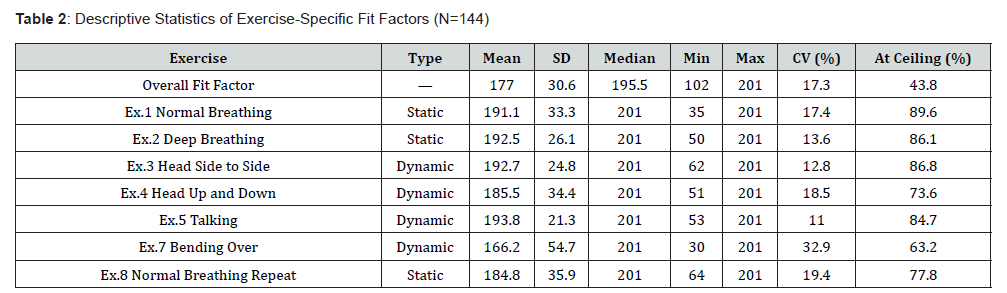
Note: CV = coefficient of variation; At Ceiling = percentage of subjects achieving maximum fit factor of 201.
Correlations Between Facial Dimensions and Fit Factors
The top 10 dimensions with the highest associations with the overall fit factor are summarized in (Table 3). Bizygomatic breadth (widest face width, cheeks), which is the distance between the zygomatic arches, was found to be the dimension most strongly correlated with the overall fit factor (r = 0.348, p < 0.001). Larger bizygomatic breadth corresponds to wider faces and was associated with higher fit factors. Secondly, labiomental angle had the second highest association with the overall fit factor (r = 0.304, p < 0.001; Spearman rho = 0.310, p < 0.001). Larger labiomental angles were correlated with better fit. Thirdly, sellion cross length (distance between sellion and midline of the nose) also had a relatively strong association (r = 0.286, p < 0.001).
Other dimensions with significantly positive associations with the fit factor were lip-chin-throat angle (r = 0.269, p < 0.01); head circumference (r = 0.261, p < 0.01); menton-sellion length (height of the face, r = 0.253, p < 0.01); and chin-throat length (r = 0.220, p < 0.05). However, nasal root breadth (r = -0.264, p < 0.01) and nose height (r = -0.230, p < 0.01) had negative associations with the overall fit factor. Thus, narrower nasal roots and shorter noses were associated with higher fit. Note that the magnitudes of correlations were generally small to moderate. The strongest correlation (bizygomatic breadth) accounted for only 12.1% of variance (r² = 0.121).
Static Versus Dynamic Exercise Comparison
The difference between correlation strengths of static and dynamic exercises is shown in (Table 4), for several facial dimensions selected from the analysis performed in the previous section. There were some dimensions which showed a considerably higher correlation with dynamic exercises than with static exercises.
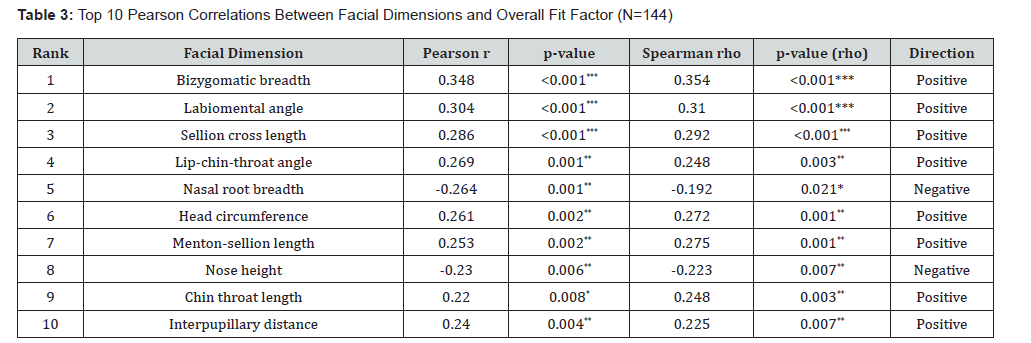
Note: **p<0.001, **p<0.01, *p<0.05. Positive direction indicates larger dimension associated with higher fit factor; negative direction indicates smaller dimension associated with higher fit factor.*
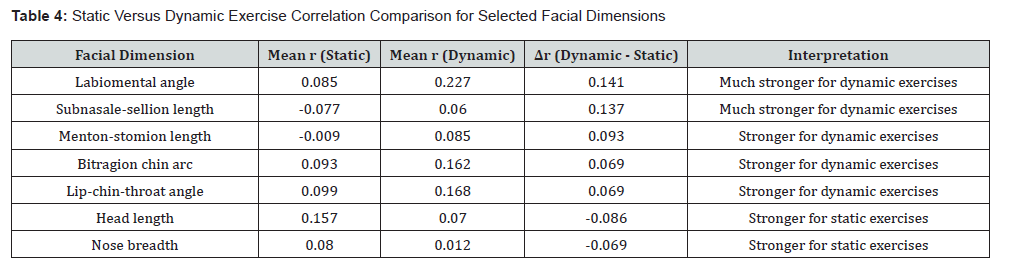
Note: Static exercises include Ex.1, Ex.2, Ex.8; Dynamic exercises include Ex.3, Ex.4, Ex.5, Ex.7. Positive Δr indicates dimension is more strongly correlated with fit during dynamic exercises; negative Δr indicates stronger correlation during static exercises
For example, the labiomental angle showed the highest difference, with the mean correlation being r = 0.085 with static exercises and r = 0.227 with dynamic exercises, resulting in a difference of Δr = +0.141. It means that the prominence of the chin and the lower face angle are the most important factors determining the fit during dynamic exercises rather than static exercises. Similar differences between correlation strengths were found for the subnasale-sellion length, with Δr = +0.137; the menton-stomion length, with Δr = +0.093; the bitragion chin arc, with Δr = +0.069; and the lip-chin-throat angle, with Δr = +0.069. In addition, there were also some dimensions showing higher correlation with static exercises than with dynamic exercises. For example, the head length showed a difference of Δr = −0.086 (more significant correlation with static exercises); and the nose breadth showed a difference of Δr = −0.069 (also more significant with static exercises).
High Versus Low Fit Factor Group Comparison
A comparative analysis of facial dimensions of subjects with high fit factor (FF ≥ 201; at ceiling; n = 62) and low fit factor (FF ≤ 155; bottom quartile; n = 37) is provided in (Table 5). Subjects with high fit factors showed significantly greater values of the majority of facial width and length parameters, as well as greater lower facial angles. The largest differences were seen in bizygomatic breadth (136.0 mm vs 123.7 mm; difference = 12.3 mm; p < 0.001), labiomental angle (133.2° vs 122.0°; difference = 11.3°; p < 0.001), head circumference (591.6 mm vs 562.6 mm; difference = 29.1 mm; p = 0.003), menton-sellion length (116.0 vs 110.9 mm; difference = 5.1 mm; p = 0.003), and lip-chin-throat angle (122.9° vs 113.6°; difference = 9.3°; p = 0.004). Subjects with high fit factors had significantly smaller nasal root breadth (26.2 vs 30.8 mm; p = 0.016) and nose height (16.6 vs 19.7 mm; p = 0.011). In other words, narrow and small-sized noses were associated with high fit factors, which probably reflected the need to create tight seals along the nose bridge line where any excessive nose dimension could create gaps.
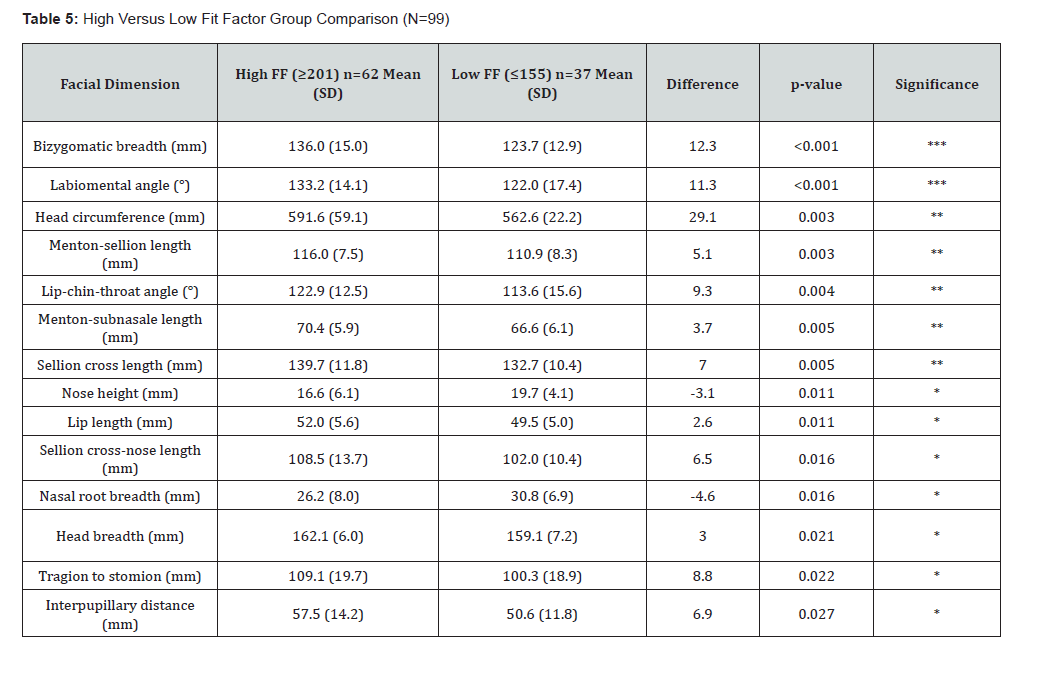
Note: **p<0.001, **p<0.01, *p<0.05. Only dimensions with p<0.05 are shown. Positive difference indicates high-fit group has larger dimension; negative difference indicates high-fit group has smaller dimension.*
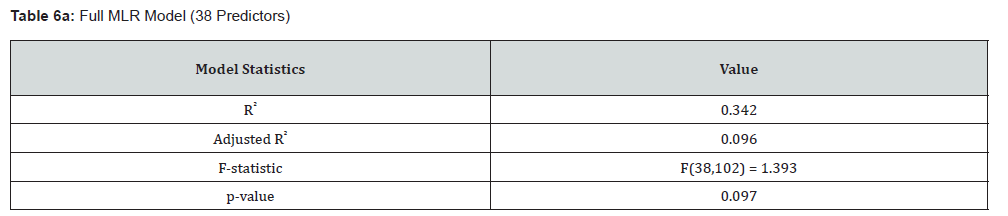

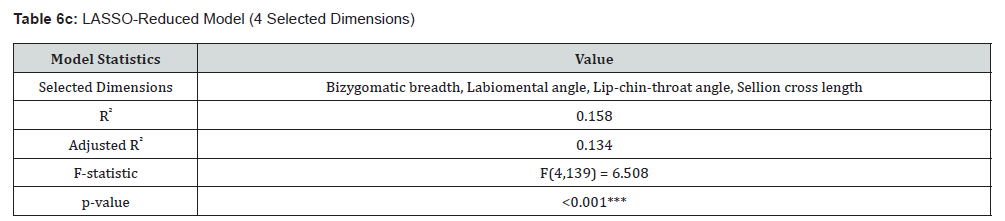
Note: **p<0.001, *p<0.05, †p<0.10 (marginal). Full model includes all 38 facial dimensions; only significant predictors shown. LASSO model selected through cross-validated regularization
Multiple Linear Regression (MLR) and LASSO Variable Selection
The results from the full MLR model and LASSO regression models with dimension selection are presented in Table 6a-c. The full MLR model with all 38 facial dimensions included resulted in the R-squared value of 0.342, which corresponds to explaining 34.2% of variance in the overall fit factor (R² = 0.342, Adjusted R² = 0.096, F(38, 102) = 1.393, p = 0.097). It approaches statistical significance; however, it does not reach it probably because of the high number of predictors relative to the sample size. Out of 38 predictors used, only three demonstrated significant association with the outcome variable. In particular, chin-throat length (β = 0.059, t = 2.289, p = 0.024) and labiomental angle (β = 0.050, t = 2.232, p = 0.028) were statistically significant predictors, while nose breadth was marginally significant (β = 0.047, t = 1.682, p = 0.096). Standardized beta values suggest that increasing one of these factors by 1SD leads to a rise of the outcome variable by approximately 0.05–0.06SD. LASSO regression was performed with the regularization parameter chosen through cross-validation procedure. According to LASSO regression, four variables were identified as predictors with non-zero coefficient values: bizygomatic breadth, labiomental angle, lip-chin-throat angle, and sellion cross length. The reduced linear regression model that included only four variables had the following coefficients: R² = 0.158, Adjusted R² = 0.134, F(4, 139) = 6.508, p < 0.001. That means these four variables include the majority of explanatory capacity. The main finding from the LASSO regression analysis can be formulated as follows. A rather limited number of facial dimensions – mostly those describing facial width (bizygomatic breadth) and angles in the lower part of the face (labiomental angle, lip-chin-throat angle) – can predict respirator fit reasonably well. These variables may be used for constructing a practical screening model for respirator fit.
Results
Principal Findings
In this study, 144 individuals were subjected to quantitative fit testing using the 3M 1870+ N95 respirator with the intention of examining the association between anthropometry and respirator fit. The following are some of the conclusions drawn from the findings. Firstly, facial width measures, particularly bizygomatic breadth, play an important role as predictors of fit factors since a wider face is associated with better fit performance. Secondly, lower facial angles such as labiomental and lip chin throat angles show significant relationships with fit since they reflect chin projection and lower facial form which affect sealing [36]. Thirdly, dynamic exercises show stronger correlations with facial measures than static breathing exercises, suggesting that anthropometric requirements differ across biomechanical demands [37, 38].
Facial Width Dimensions as Primary Predictors
Bizygomatic breadth, which can be described as the maximum facial width at the level of cheekbones, correlated most strongly with total fit factor (r = 0.348, p < 0.001) and remained a reliable predictor throughout different analyses. This finding aligns with previous literature, demonstrating the importance of facial width as a key determinant of respirator fit. Biomechanically, such relationship can be caused by several aspects: the increased facial width provides a larger sealing surface area, distributes straps tension more uniformly, and results in optimal pressure distribution along the respirator periphery [39, 40]. In the analysis of high and low fit-factor groups, individuals obtaining ceiling fit factors had significantly larger bizygomatic breadth values compared to low fit-factor subjects (136.0 vs 123.7 mm, p < 0.001). On average, the difference corresponded to approximately one standard deviation. Therefore, facial width can be regarded as a main determinant of respirator fit, where narrow-faced subjects are more prone to experiencing poor fit performance [41].
Additionally, significant correlations were detected between respirator fit and other width-based variables: head circumference (r = 0.261, p < 0.01), head breadth (r = 0.200, p = 0.016), and interpupillary distance (r = 0.240, p = 0.004). In accordance with literature, these findings suggest the significance of total head size (length and width combined) for fit performance [42-43].
Additionally, significant correlations were detected between respirator fit and other width-based variables: head circumference (r = 0.261, p < 0.01), head breadth (r = 0.200, p = 0.016), and interpupillary distance (r = 0.240, p = 0.004). In accordance with literature, these findings suggest the significance of total head size (length and width combined) for fit performance [42-43].
Lower Facial Angles and Chin Morphology
Labiomental angle (i.e., the angle between the lower lip, prominence of the chin, and throat) proved to be the second strongest predictor of fit factor (r = 0.304, p < 0.001) and one of two significant predictors in the full MLR (β = 0.050, p = 0.028). As noted above, this angular dimension describes the prominence of the chin and its projection in front of the face, a crucial factor required for obtaining a good seal in the lower area of the face where respirators are most susceptible to leakage [47]. The significance of this angular variable was even more pronounced during dynamic exercises (mean r = 0.227 for dynamic tasks versus r = 0.085 for static breathing; Δr = +0.141). In other words, the chin is especially crucial when performing activities that put mechanical stress on the lower face and create tension in the facial muscles that interfere with maintaining the seal [48–49]. People with more prominent chins (larger labiomental angles) tend to maintain the seal more effectively than people with less prominent chins during dynamic exercises.
Another similar angular dimension was observed, namely, the lip-chin-throat angle (r = 0.269, p < 0.01). Interestingly, the association was higher during dynamic tasks (Är = +0.069). Taken together, correlations, group comparisons (a labiomental angle difference between high-fitting and low-fitting subjects of 11.3°, p < 0.001), and LASSO results (the labiomental angle was identified as one of four key angles) point to the significance of lower facial angles for respirator fit. Curiously, chin-throat length (distance from the chin to the throat) had a positive coefficient (â = 0.059, p = 0.024) in the full MLR but a negative (and non-significant) correlation (r = .0.122, p = 0.146). It is possible that the former result is due to the phenomenon of suppressed variables in MLR. Specifically, the chin-throat length is a dimension correlated with the labiomental angle, and both variables account for independent aspects of fit quality [50]. As far as biomechanics of respirator fit are concerned, the relevance of the discussed dimensions follows from the necessity of fitting the three-dimensional geometry of the respirator-cup to the chin-jaw structure. The chin, lips, and throat form the surface where cup-shaped respirators like 3M 1870+ fit in (Figure 4). Therefore, people with prominent chins (as described by the labiomental angle and/or chin-throat length) have a more favorable geometry for making contact in this area.
Dynamic Versus Static Exercise Performance
However, in the analysis of the associations with anthropometrics, differences were found in relation to static and dynamic exercises. Dynamic exercises, including head movements side-to-side, up-and-down, talking, and bending over, are more strongly associated with several key anthropometric predictors: labiomental angle (Δr = +0.141), subnasale-sellion length (Δr = +0.137), and menton-stomion length (Δr = +0.093).
It appears that the influence of facial anthropometrics is greater for dynamic exercises, since it may affect the ability of achieving a sufficient seal through active movement. In other words, while in the case of static breathing, the seal of a respirator depends only on passive factors, in the case of active movement, additional stress is exerted upon the seal because of mechanical factors. This may expose some problems with fit performance based on the results [51-53]. In practice, the use of static and dynamic tests for fit-checking purposes is recommended. However, taking into account the obtained findings, one could assume that dynamic test results would be better at demonstrating anthropometric limitations [54]. Fit testing programs may therefore benefit from emphasizing these maneuvers, and respirator designs should consider performance under dynamic conditions in addition to static fit [55].
Implications for Respirator Design
The identification of four major factors – bizygomatic breadth, labiomental angle, lip-chin-throat angle, and sellion cross length through LASSO regression analysis offers important guidance for designing optimally fitting respirators. Bizygomatic breadth represents facial width whereas labiomental angle, lip-chinthroat angle, and sellion cross length relate to facial angles or length. Existing respiratory mask sizing systems usually provide two or three sizes of respirators based largely on face length and face width. The current results show that adding facial angle measurements to existing sizing systems can improve prediction capabilities, especially in dynamic conditions [56]. Measurement of facial angles is somewhat more complex in terms of equipment needed for measurement; it is either required special tools or derivation of angles from anatomic landmarks.
Three-dimensional facial scans may be helpful in providing a rapid method of acquiring detailed facial geometry information, including both linear measures and surface angles [57–58]. Recent research suggests that 3D facial scans can be used for predicting the best fit between masks and wearers as well as model matching. The four-factor LASSO analysis performed in this research can become the basis for efficient scanning-based screening processes based on the selected critical measures [59]. Another design recommendation is related to the inverse relationship between nose dimension and mask fit factor. Individuals having narrow nasal root breadth (r = −0.264, p < 0.01) and short nose height (r = −0.230, p < 0.01) showed better fit suggesting that nose bridge region may represent a critical sealing interface and excessive nose dimensions may lead to sealing problems. Thus, the adaptability and conformance of nose bridges in masks should be improved. It is important to notice that about 43.8% of participants reached maximum fit factors, implying the overall good fit quality for 3M 1870+ respirators.
Implications for Fit Testing Protocols
The fact that 43.8% of subjects reached the maximal achievable value of the fit factor proves that there was a significant portion of people who showed exceptional fit performance with respect to the 3M 1870+ respirator. The maximum measurable fit factor with the help of the instrument in question is about 200–201; it is quite enough for conducting assessment of pass/fail criterion (FF ≥ 100 in case of N95 respirators) though some limitation regarding the scope of visible fit factors among high-performers could occur [60–62].
Moreover, some investigations have considered modified methods for fitting that allow observing high fit factors like controlled negative pressure or other approaches. Nevertheless, when considering an occupational health setting, the fit factors exceeding 200 already do not provide any additional benefits because the assigned protection factor cannot be exceeded and the differences between these high values have limited clinical significance [63]. It is also important to note that fit factors show differences depending on the type of exercise performed; moreover, in terms of dynamics and statics, the first ones demonstrate more variations. It means that certain factors connected with movement and body posture may affect sealing efficiency [64].
Comparison with Existing Literature
Our results are supported by and build on existing evidence on anthropometric correlates of respirator fit. The identification of bizygomatic breadth as the most significant correlate (r = 0.348) corresponds to findings from several studies highlighting the importance of facial width. For example, Zhuang et al. (2005) demonstrated that bizygomatic breadth is one of the key predictors in N95 respirator fit in a variety of models, while Yu et al. (2024) showed similar results for a large Chinese sample. The importance of the labiomental angle and other facial angles below the lips is supported by earlier findings by Oestenstad et al. (1992) that the dimensions of the chin are important predictors of fit for half-mask respirators and Han et al. (2003) on the importance of angular facial measurements as predictors in Korean populations. In particular, the discovery that these dimensions show higher correlations during dynamic exercises provides deeper insights into the biomechanics of the process.
The inverse correlation between the measures of nose (nasal root breadth r = −0.264; nose height r = −0.230) is also consistent with previous findings by Zhang et al. (2020) who discovered that subjects with small noses had better fitting for Chinese people. The negative associations might be caused by the need to achieve a tight seal around the nose bridge, which requires the cup-shaped respirators to accommodate the nasal structure. A substantial fraction of subjects (43.8%) achieved maximal attainable fit factor, which is consistent with findings of optimal respirator models tested on favorable populations [65]. It is noteworthy that dynamic exercises produce greater anthropometric associations than static ones and expands the previous evidence by Roberge et al. (2014) and Jung et al. (2021) on the difference in fit factors among exercises and difficulty of dynamic ones [66-67]. The LASSO-based four-dimension model (bizygomatic breadth, labiomental angle, lip-chin-throat angle, sellion cross length) represents a compact predictor set that can find applications in practice. Despite previous findings on critical anthropometric dimensions, there are very few attempts to develop predictors based on variable selection approaches. Although the predictive power of the four-dimension model is rather modest (R² = 0.158, p < 0.001), it compares reasonably well to related literature.
Limitations
Several limitations should be considered when interpreting the present findings. First, the use of an all-pass sample, in which 100% of subjects achieved a fit factor (FF) ≥ 100, represents a selected population for whom the 3M 1870+ respirator provided adequate fit. This selection bias limits generalizability to populations with higher fit failure rates and may underestimate the strength and variability of anthropometric–fit relationships across the full spectrum of performance. Inclusion of subjects who fail fit testing would enable a more complete characterization of these relationships. Second, a substantial ceiling effect was observed, with 43.8% of subjects reaching the maximum measurable fit factor. This truncation of the upper distribution reduces variability and may attenuate observed correlations between facial dimensions and fit performance, potentially obscuring stronger underlying associations [68-69]. Future studies may benefit from incorporating respirator models with lower pass rates or alternative methodologies capable of capturing a broader range of fit outcomes [70]. Third, the study examined only a single respirator model (3M 1870+), which limits the applicability of findings to other N95 designs. Differences in facepiece geometry, seal configuration, and sizing systems across respirator models may lead to distinct interactions with facial anthropometry, and therefore the identified predictors may not generalize universally. Comparative investigations across multiple respirator designs would provide a more comprehensive understanding of modelspecific anthropometric requirements and improve the external validity of predictive frameworks.
Conclusions
To quantify whether facial anthropometry affects fit performance of N95 respirators, a statistical analysis was performed on 144 individuals who underwent quantitative fit testing using the 3M 1870+ N95 respirator. The findings confirm a correlation between specific anthropometrical measurements and respirator fit performance. For example, facial width and lower facial angles were identified as predictors of respirator fit performance. In particular, Bizygomatic breadth proved to be the strongest predictor with wider face correlating with increased fit factor values. Labiomental angle and lip-chin-throat angle are considered significant lower facial dimensions because of their relevance in dynamic exercises that include head movement and talking.
Identification of four variables that are included in the LASSO variable selection model, viz., bizygomatic breadth, labiomental angle, lip-chin-throat angle, and sellion cross length can be helpful in practical applications and contribute to the development of a concise prediction model. It is worth noting that in dynamic exercises, anthropometric parameters correlate with fit performance to a greater extent than static breathing exercises. Thus, fit testing protocols should focus on exercises that provide challenges to seal stability.
Almost half of the subjects obtained maximum measurable values of the fit factor, which demonstrates that the 3M 1870+ respirator exhibits high levels of fit performance regardless of facial morphology.
This paper highlights several directions for future research related to N95 respirator fitting. Comparative analysis involving different models of respirators is necessary to identify modelspecific requirements concerning the anthropometric properties of patients. Including individuals who fail respirator fit test will allow for a complete characterization of subjects regarding fit performance and, thus, create a more complete profile. Threedimensional facial scanning technique can potentially enhance the accuracy of measurements. Moreover, studies focused on longterm wearing of respirators can be useful in clarifying stability issues. Finally, it is important to include additional demographic characteristics like age and sex in further analysis.
These findings can be applied to the improvement of the current practices related to N95 respirator fitting. First, the importance of measuring facial width should be emphasized. Second, lower facial angles should be considered for the purpose of obtaining more precise predictions. Third, the LASSO model developed in this study allows creating a concise screening tool for occupational settings. In conclusion, facial anthropometry has some predictive power when assessing fit performance of N95 respirators. Specifically, facial width and lower facial angles turned out to be the most important parameters influencing respirator fit performance.
Acknowledgements
This research was funded by Research Grants Council (RGC) of the Hong Kong Special Administrative Region, China, grant number UGC/FDS24/E05/21. The APC was funded by College of Professional and Continuing Education, an affiliate of The Hong Kong Polytechnic University, grant number SEHS-2024-352(J).
References
- Lui AK, Lam SC, Li L, Keung KK, Lee JK, et al. (2011) N95 respirator fit testing procedure augmented with prediction based on facial anthropometry. Emergency Services and Health Informatics 2: 4-17.
- Winski T (2017) If the mask fits: an assessment of facial dimensions and mask effectiveness. Occupational and Environmental Medicine.
- Wang G, Luo C, Cui C, Wang S, Huang J (2025) Establishment of a fit prediction model of N95 respirator based on facial images. Environmental Health and Preventive Medicine 30: 101-101.
- Yu M, Griffin L (2026) Fit prediction for filtering facepiece respirator using 3D face shape. Applied Ergonomics 131: 104667.
- Vollmer W, Bergman MS, Boyles H, Meyers J, Payne NY (2025) Quantitative head form fit evaluation and predictive modeling to assist with selecting N95 filtering facepiece respirators to mitigate respiratory hazards. Journal of Occupational and Environmental Hygiene 22(12): 959-969.
- Khairul Hasni NA, Ismail R, Muhamad Robat R, Mohamad N, Suib FA (2023) The effect of N95 designs on respirator fit and its associations with gender and facial dimensions. PLoS one 18(11): e0288105.
- Wang G, Luo C, Cui C, Huang J (2024) Study on the relationship between the fitness of three types of N95 respirators and facial dimensions. Journal of Occupational and Environmental Hygiene 21(5): 319-325.
- Ng WC, Mbadjeu Hondjeu AR, Syrett A, Caragata R, Rozenberg D (2020) Subject validation of reusable N95 stop-gap filtering facepiece respirators in COVID-19 pandemic. PLoS One 15(11): e0242304.
- Zhuang Z, Coffey CC, Ann RB (2005) The effect of subject characteristics and respirator features on respirator fit. Journal of occupational and environmental hygiene 2(12): 641-649.
- Zhang X, Jia N, Wang Z (2020) The relationship between the filtering facepiece respirator fit and the facial anthropometric dimensions among Chinese people. Industrial health 58(4): 318-324.
- Manganyi J, Wilson KS, Rees D (2017) Quantitative respirator fit, face sizes, and determinants of fit in South African diagnostic laboratory respirator users. Annals of work exposures and health 61(9): 1154-1162.
- Kim H, Han DH, Roh YM, Kim K, Park YG (2003) Facial anthropometric dimensions of Koreans and their associations with fit of quarter-mask respirators. Industrial health 41(1): 8-18.
- Lin YC, Chen CP (2017) Characterization of small-to-medium head-and-face dimensions for developing respirator fit test panels and evaluating fit of filtering facepiece respirators with different face seal design. PloS one 12(11):e0188638.
- Yu M, Griffin L, Durfee WK, Arnold S (2024) Face anthropometry for filtering facepiece respirators: analysis of the association between facial dimensions and respirator fit. Annals of Work Exposures and Health 68(3): 312-324.
- Lee SA, Chen YL, Hwang DC, Wu CC, Chen JK (2017) Performance evaluation of full facepiece respirators with cartridges. Aerosol and Air Quality Research 17(5): 1316-1328.
- Han DH (2000) Fit factors for quarter masks and facial size categories. Annals of occupational hygiene 44(3): 227-234.
- Zhuang Z, Liu Y, Coffey CC, Miller C, Szalajda J (2015) Inward leakage variability between respirator fit test panels–Part I. Deterministic approach. Journal of occupational and environmental hygiene 12(11): 753-760.
- Zhuang Z, Bergman M, Brochu E, Palmiero A, Niezgoda G, et al. (2016) Temporal changes in filtering-facepiece respirator fit. Journal of occupational and environmental hygiene 13(4): 265-274.
- Yu Y, Jiang L, Zhuang Z, Liu Y, Wang X, et al. (2014) Fitting characteristics of N95 filtering-facepiece respirators used widely in China. PLoS One 9(1):
- Niezgoda G, Kim JH, Roberge RJ, Benson SM (2013) Flat fold and cup-shaped N95 filtering facepiece respirator face seal area and pressure determinations: a stereophotogrammetry study. Journal of occupational and environmental hygiene 10(8): 419-424.
- Groce DW (2007) An investigation of the relationship between respirator half-facepiece fit and facial anthropometry using three-dimensional laser scanning technology. West Virginia University.
- Yang M, Liu X, Wang Z, Sun X (2023) Facial anthropometric dimensions distribution and effects to fits of filtering facepiece respirators in Chinese people.
- Niu X, Koehler RH, Yermakov M, Grinshpun SA (2023) Assessing the fit of N95 filtering facepiece respirators fitted with an ear loop strap system: a pilot study. Annals of Work Exposures and Health 67(1): 50-58.
- Tahernejad A, Mostafavi R, Tahernejad S, Rostami M (2020) Predicting the Fit between the Respirator and Face based on facial anthropometric dimensions using neural-fuzzy method (used in crises). Journal of Health Sciences & Surveillance System 8(4): 168-172.
- Niezgoda G, Kim JH, Roberge RJ, Benson SM (2013) Flat fold and cup-shaped N95 filtering facepiece respirator face seal area and pressure determinations: a stereophotogrammetry study. Journal of occupational and environmental hygiene 10(8): 419-424.
- (2020) 3M™ Health Care Particulate Respirator and Surgical Mask 1870+, N95. Technical Data Bulletin. St. Paul, MN.
- Bergman MS, He X, Joseph ME, Zhuang Z, Heimbuch BK, et al. (2015) Correlation of respirator fit measured on human subjects and a static advanced head form. Journal of occupational and environmental hygiene 12(3): 163-171.
- Bergman MS, Zhuang Z, Hanson D, Heimbuch BK, McDonald MJ, et al. (2014) Development of an advanced respirator fit-test head form. Journal of Occupational and Environmental Hygiene 11(2): 117-125.
- International Organization for Standardization (ISO) (2017) ISO 7250-1:2017 Basic human body measurements for technological design - Part 1: Body measurement definitions and landmarks. Geneva, Switzerland.
- Gordon CC, Blackwell CL, Bradt miller B, Parham JL, Barrientos P, et al. (2014) 2012 anthropometric survey of us army personnel: Methods and summary statistics.
- Farkas LG (1994) Anthropometry of the Head and Face (2nd ed.). New York: Raven Press.
- Lohman TJ, Roache AF, Martorell R (1992) Anthropometric standardization reference manual. Medicine & Science in Sports & Exercise 24(8): 952.
- Mortimer D (1994) Practical laboratory andrology. Oxford University Press.
- Han DH, Choi KL (2003) Facial dimensions and predictors of fit for half-mask respirators in Koreans. Aiha Journal 64(6): 815-822.
- Liu Y, Zhuang Z, Coffey CC, Rengasamy S, Niezgoda G (2016) Inward leakage variability between respirator fit test panels–Part II. probabilistic approach. Journal of occupational and environmental hygiene 13(8): 604-611.
- Oestenstad RK, Perkins LL (1992) An assessment of critical anthropometric dimensions for predicting the fit of a half-mask respirator. American Industrial Hygiene Association Journal 53(10): 639-644.
- Zhuang Z, Slice D, Benson S, Landsittel D, Viscusi D (2009) Facial shape variation of US respirator users. In International Conference on Digital Human Modeling pp: 578-587.
- Aliya NH, Rahmawati NT, Hastuti J, Febriana SA (2023) The facial measurements in health workers at Dr. Sardjito General Hospital, Yogyakarta. J Med Sci 55(2): 142-150.
- Spies A, Wilson KS, Ferrie R (2011) Respirator fit of a medium mask on a group of South Africans: a cross-sectional study. Environmental Health 10(1): 17.
- Coffey CC, Lawrence RB, Campbell DL, Zhuang Z, Calvert CA, et al., (2004) Fitting characteristics of eighteen N95 filtering-facepiece respirators. Journal of occupational and environmental hygiene 1(4): 262-271.
- Zhuang Z, Landsittel D, Benson S, Roberge R, Shaffer R (2010) Facial anthropometric differences among gender, ethnicity, and age groups. Annals of occupational hygiene 54(4): 391-402.
- Yu M, Griffin LA (2024) Product Specific Anthropometry for Wearable Product Design: A Case Study of Respirator Specific Face Anthropometry Development and Testing. Available at SSRN 4837907.
- Bergman MS, Zhuang Z, Hanson D, Heimbuch BK, Mc Donald MJ, et al., (2014) Development of an advanced respirator fit-test head form. Journal of Occupational and Environmental Hygiene 11(2): 117-125.
- Griffin L, Yu M, Sokolowski S, Arnold S, Durfee WK (2023) Innovation in Respirator Design, Research, & Protection: A model of predictive fit for occupational safety and health. In Proceedings of the Human Factors and Ergonomics Society Annual Meeting Sage CA: Los Angeles, CA: SAGE Publications 67(1): 821.
- Liu BY, Lee JK, Mullins H, Danisch SG (1993) Respirator leak detection by ultrafine aerosols: a predictive model and experimental study. Aerosol science and technology 19(1): 15-26.
- Zhou H (2019) Study on Face Classification and Modeling Based on the Respirator-fit Problem for Chinese Adults. Computer Science and Information Technology.
- Biagiotti E, Korna M, Rice DO, Barker D (2019) Predicting respirator size and fit from 2D images. International Journal of Human Factors Modelling and Simulation 7(2): 137-151.
- MacKinnon DP, Krull JL, Lockwood CM (2000) Equivalence of the mediation, confounding and suppression effect. Prevention science 1(4): 173-181.
- Hoover MD, Lackey JR, Vargo GJ (2001) Independent evaluation of the lepestok filtering facepiece respirator (No. PNNL-13581). Pacific Northwest National Laboratory (PNNL), Richland, WA (US).
- Han DH, Choi KL (2003) Facial dimensions and predictors of fit for half-mask respirators in Koreans. Aiha Journal 64(6): 815-822.
- Janssen LL, Luinenburg MD, Mullins HE, Nelson TJ (2002) Comparison of three commercially available fit-test methods. AIHA Journal 63(6): 762-767.
- Kim H, Han DH, Roh YM, Kim K, Park YG (2003) Facial anthropometric dimensions of Koreans and their associations with fit of quarter-mask respirators. Industrial health 41(1): 8-18.
- Rengasamy A, Zhuang Z, BerryAnn R (2004) Respiratory protection against bioaerosols: literature review and research needs. American journal of infection control 32(6): 345-354.
- Or PL (2013) An alternate approach for fit test in identifying respiratory protection by N95 respirator.
- O’Kelly E, Arora A, Pirog S, Ward J, Clarkson PJ (2021) Comparing the fit of N95, KN95, surgical, and cloth face masks and assessing the accuracy of fit checking. PloS one 16(1): e0245688.
- Bergman MS, Zhuang Z, Hanson D, Heimbuch BK, McDonald MJ (2014) Development of an advanced respirator fit-test head form. Journal of Occupational and Environmental Hygiene 11(2): 117-125.
- Bergman M, Zhuang Z, Brochu E, Palmiero A (2015) Fit assessment of N95 filtering-facepiece respirators in the US Centers for Disease Control and Prevention Strategic National Stockpile. Journal of the International Society for Respiratory Protection 32(2): 50-64.
- Kamal M, Bhatti M, Stewart WC, Johns M, Collins D (2023) Safety goggles with elastic headband to improve N95 fit following failed quantitative fit test. Indian Journal of Critical Care Medicine: Peer-reviewed, Official Publication of Indian Society of Critical Care Medicine 27(6): 386-391.
- TSI Incorporated (2022) Porta Count Pro+ Model 8038 Respirator Fit Tester Operation and Service Manual. Shoreview MN.
- Okoth-Okelloh AM, Onyango R, Tonui WK, Okumu W, Ouma C (2015) Occupational Health and Safety Administration (OSHA) in the Morgues: Management and practice of the universal precautions in Morgues in Kenya. Biosafety 4(1): 121.
- Campbell DL, Coffey CC, Lenhart SW (2001) Respiratory protection as a function of respirator fitting characteristics and fit-test accuracy. AIHAJ-American Industrial Hygiene Association 62(1): 36-44.
- Zhuang Z, Bradtmiller B, Shaffer RE (2007) New respirator fit test panels representing the current US civilian work force. Journal of occupational and environmental hygiene 4(9): 647-659.
- Roberge RJ, Palmiero AJ, Liu Y, Kim JH, Zhuang Z (2014) Effect of upper strap downward displacement on n95 filtering facepiece respirator fit factors: a pilot study. Journal of occupational and environmental hygiene 11(5): 338-341.
- Jung J, Kim J, Yang H, Lim YJ, Kwak SH (2021) Fit-failure rate associated with simulated reuse and extended use of N95 respirators assessed by a quantitative fit test. Infection Control & Hospital Epidemiology 42(11): 1313-1317.
- Zhuang Z, Bradtmiller B, Shaffer RE (2007) New respirator fit test panels representing the current US civilian work force. Journal of occupational and environmental hygiene 4(9): 647-659.
- Oestenstad RK, Perkins LL (1992) An assessment of critical anthropometric dimensions for predicting the fit of a half-mask respirator. American Industrial Hygiene Association Journal 53(10): 639-644.
- Zhuang Z, Landsittel D, Benson S, Roberge R, Shaffer R (2010) Facial anthropometric differences among gender, ethnicity, and age groups. Annals of occupational hygiene 54(4): 391-402.

























