



 CTFTTE Home




Abstract
Nature-inspired design and artificial intelligence (AI) offer complementary approaches to developing smart textiles and intelligent clothing systems. Biological structures and behaviors provide models for improving textile functionality, including thermal regulation, moisture management, lightweight construction, surface coloration, sensing, and environmental responsiveness. Birds represent a particularly valuable source of inspiration because their feathers, plumage arrangements, body structures, and adaptive behaviors demonstrate diverse strategies for protection, communication, insulation, and movement. The hoopoe (Upupa epops), with its distinctive crest, patterned plumage, and specialized ecological behaviors, provides an illustrative model for investigating adaptive textile surfaces, hierarchical structural patterns, and bio-inspired visual design. Other birds, including owls, penguins, kingfishers, and flamingos, offer complementary models for acoustic management, thermal insulation, optical coloration, and structural organization. When combined with AI-based image analysis, generative design, predictive modeling, and sensor-data interpretation, these biological principles can support the development of responsive fabrics and intelligent garments. This article proposes a conceptual framework linking avian biological characteristics, transferable design principles, textile engineering, and AI-enabled optimization. It also identifies research challenges concerning functional validation, durability, manufacturability, sustainability, and data reliability. The framework provides a foundation for future experimental research into nature-inspired smart clothing.
Keywords: Biomimicry; Artificial intelligence; Smart textiles; Intelligent clothing; Avian structures; Hoopoe; Adaptive materials; Sustainable textile engineering
Abbreviations: AI: Artificial Intelligence
Introduction
>The development of smart textiles and intelligent clothing has expanded the role of textile materials beyond conventional protection and decoration toward sensing, monitoring, adaptation, and interaction with the surrounding environment. Advances in functional fibers, conductive yarns, flexible electronics, responsive polymers, and computational design have enabled garments to perform functions related to physiological monitoring, thermal comfort, movement analysis, and environmental sensing. Nevertheless, the integration of multiple functions into textile structures remains challenging because flexibility, comfort, durability, washability, and manufacturing feasibility must be maintained simultaneously. Nature-inspired design, commonly associated with biomimicry and bio-inspired engineering, offers an alternative approach to addressing these challenges. Living organisms have evolved structural and functional solutions to environmental demands, including heat exchange, water repellency, mechanical protection, optical communication, and energy-efficient movement.
Rather than reproducing biological forms solely for decorative purposes, bio-inspired textile engineering investigates the underlying principles responsible for their performance and translates these principles into manufacturable material structures. Birds are particularly relevant to this approach. Their feathers combine lightweight construction with insulation, surface protection, and specialized aerodynamic functions. Variations in feather geometry, barb and barbule organization, plumage distribution, and surface microstructure provide opportunities for developing textile architectures with tailored properties. For example, penguin plumage can inspire research into insulation and moisture management, while the optical structures of certain kingfisher feathers can inform the development of structural coloration without relying exclusively on conventional pigments. The hoopoe (Upupa epops) provides an additional and distinctive design model.
Its erectile crest, contrasting black-and-white wing and tail patterns, and warm-colored plumage offer opportunities for translating biological organization into responsive textile surfaces, patterned fabric construction, and visually distinctive fashion applications. Its biological characteristics should, however, be distinguished from engineered functions: the crest is primarily involved in communication and display, and any application to mechanically responsive textiles require independent design and experimental validation. Artificial intelligence can strengthen this translation process by identifying biological patterns in digital images, classifying morphological features, generating textile design alternatives, predicting material behavior, and optimizing combinations of fibers, yarns, weave structures, and responsive components. Integrating biological observation with AI-assisted engineering may therefore establish a systematic pathway from natural inspiration to experimentally validated intelligent clothing.
Research Problem
>Despite growing interest in biomimetic materials and AI-assisted textile development, a methodological gap remains between observing biological characteristics and translating them into textile structures with measurable functional performance. Natural forms may be reproduced visually without identifying the mechanisms responsible for their biological effectiveness. Similarly, AI-generated designs may appear innovative but lack sufficient experimental evidence regarding mechanical properties, comfort, durability, or practical manufacturability. The central research problem is therefore: How can avian biological structures and behaviors be systematically translated into AI-assisted textile designs that produce measurable improvements in the functional performance, adaptability, and sustainability of smart textiles and intelligent clothing systems? The problem encompasses four related questions:
i. Which structural and functional characteristics of selected birds can provide scientifically transferable principles for textile engineering?
ii. How can AI methods identify, represent, and optimize these biological principles within textile structures?
iii. Which material properties and performance indicators are required to validate the resulting smart textile and clothing prototypes?
iv. How can bio-inspired innovation be implemented without compromising wearer comfort, environmental responsibility, and industrial feasibility?
Research aim and objectives
Research aim: This study aims to establish a conceptual framework for integrating avian-inspired design principles with artificial intelligence to support the development of functional, adaptive, and sustainable smart textiles and intelligent clothing systems.
4.1.2. Specific objectives
i. Identify relevant morphological, structural, optical, and behavioral characteristics of selected bird species.
ii. Translate these characteristics into textile design principles and potential engineering applications.
iii. Examine how AI-based image processing, generative design, predictive modeling, and optimization can support bio-inspired textile development.
iv. Propose textile and clothing applications inspired by the hoopoe and other selected birds.
v. Define measurable performance indicators for evaluating thermal comfort, moisture transport, mechanical behavior, optical effects, sensing accuracy, and durability.
vi. Develop a research framework connecting biological observation, digital modeling, textile prototyping, experimental validation, and design optimization.
vii. Identify sustainability, safety, ethical, and manufacturing considerations relevant to commercial implementation.
Results and Discussion
>Theoretical framework
From Avian Biology to Intelligent Textiles: The proposed framework consists of five interconnected stages: In the first stage, biological characteristics are documented using scientific literature, photographs, microscopy, or three-dimensional imaging where appropriate. In the second, AI techniques extract measurable characteristics, such as geometric patterns, feature dimensions, color distributions, and structural relationships. The third stage translates these characteristics into yarn arrangements, woven or knitted architectures, surface treatments, flexible mechanisms, or integrated sensing systems. The fourth stage produces physical prototypes using suitable textile manufacturing processes. Finally, laboratory testing evaluates whether the intended function has been achieved. Experimental results can then be used to refine the design and, where sufficient data are available, train predictive models for subsequent optimization. A fundamental principle of this framework is that biological resemblance does not itself demonstrate functional equivalence. Each proposed application must be evaluated against defined engineering requirements and appropriate reference material.
Avian models and their potential textile applications
The hoopoe (Upupa epops): adaptive surface design and pattern engineering
The hoopoe is distinguished by its prominent erectile crest, elongated bill, and contrasting plumage patterns. Its wings and tail display conspicuous black-and-white markings, while the body exhibits warm reddish-brown coloration. These characteristics offer several avenues for bio-inspired textile research. First, the erectile crest provides a model for studying variable surface geometry. Its visible expansion and retraction can inspire pleated textile panels, foldable structures, and garments incorporating shape-changing elements. An engineered version might use shape-memory polymers, elastic yarns, pneumatic microstructures, or small flexible actuators. AI-based geometric optimization could investigate how panel dimensions, hinge spacing, material stiffness, and actuation conditions affect the resulting shape. Second, the hoopoe's contrasting plumage offers a model for computational pattern generation.
Image-processing algorithms can identify the distribution, orientation, and dimensions of black-and-white markings and convert them into woven patterns, knitted motifs, printed surfaces, or digitally generated fashion designs. The objective is not merely to copy the bird's appearance but to establish a reproducible relationship between biological pattern geometry and textile construction parameters. Third, the layered arrangement of feathers suggests a research direction for hierarchical surface design. Textile engineers could investigate whether appropriately arranged overlapping textile elements improve surface coverage, flexibility, or protection. These effects must be measured experimentally rather than assumed from visual similarity. The hoopoe therefore offers a particularly useful model for integrating aesthetic innovation with responsive geometry and computational textile pattern engineering. Its crest should be treated as a biological source of design inspiration, not as evidence that a proposed textile will automatically possess adaptive or protective capabilities.
The owl: acoustic management and surface architecture
Owl feathers possess specialized structures associated with quiet flight in several species. Their biological characteristics can inspire research into textile surfaces intended to modify airflow, reduce friction-related noise, or provide acoustic absorption. AI-assisted image analysis could characterize selected feather-edge geometries, while computational simulations could examine alternative textile surface arrangements. Potential applications include specialized protective garments, acoustic-control fabrics, and textile components used in environments where sound management is important. However, the acoustic performance of a textile cannot be inferred directly from an owl's flight behavior. Airborne sound absorption, sound transmission, and aerodynamic noise are different physical phenomena and must be tested separately.
The penguin
Thermal Insulation and Moisture Management: Penguin plumage and the underlying biological insulation system provide models for investigating thermal protection in cold environments. Textile research could explore multilayer constructions, controlled air spaces, and surface arrangements that balance insulation, flexibility, and moisture transport. AI-based thermal modeling could assist in selecting layer thicknesses, porosity, fiber combinations, and fabric density. Candidate garments could then be evaluated through thermal resistance, evaporative resistance, air permeability, and moisture-management tests. The design objective is not to reproduce penguin plumage literally but to investigate transferable principles of insulation and environmental protection within wearable materials.
The kingfisher: structural coloration and surface engineering
The brilliant coloration of many kingfishers is associated with optical interactions involving feather microstructure, although the specific mechanisms vary among species. Such biological systems provide inspiration for textile surfaces designed to produce color through light interaction rather than exclusively through chemical pigments. AI-assisted image analysis and optical simulation could help identify promising geometric arrangements for photonic textile coatings, fibers, or patterned surfaces. Applications may include color-changing fashion materials, decorative technical textiles, and research into reduced-pigment coloration. Potential benefits for sustainability would depend on the manufacturing process, material composition, durability, and end-of-life characteristics of the resulting product.
The flamingo: structural organization and color-responsive design
Flamingos provide a model for studying the relationship between biological coloration, surface appearance, and environmental or dietary influences. Their characteristic pink coloration is primarily associated with carotenoid pigments acquired through their diet, rather than being a direct example of structural coloration.
This distinction makes flamingos relevant to research on pigment-inspired textile coloration, color stability, and the relationship between material composition and visual appearance. AI-based color analysis could quantify hue, saturation, spatial distribution, and color change under controlled conditions, supporting the development of textile coloration systems with defined aesthetic and performance requirements.
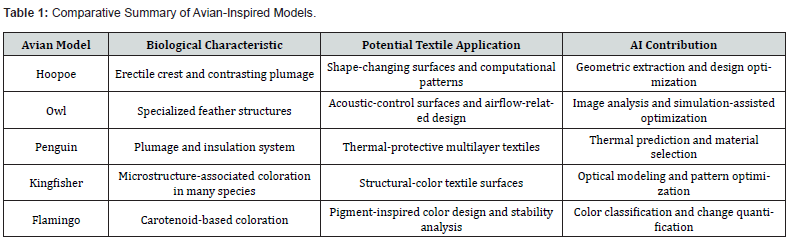
Comparative summary of avian-inspired models in Table 1
The table identifies research opportunities rather than established performance claims. The suitability of each model depends on species-specific biological evidence and experimental confirmation of the proposed textile function. Its role extends beyond visual pattern reproduction to the prediction, optimization, and control of textile performance. Recent reviews identify AI-assisted sensing, materials optimization, and adaptive functionality as important directions in smart textile development [1-3] (Table 1).
Computer vision and biological feature extraction
Computer vision can be used to analyze avian photographs and microscopic images, extracting geometric features such as feather orientation, pattern spacing, surface coverage, curvature, and color distribution. Convolutional neural networks and segmentation algorithms can classify these features, while image-processing techniques can convert them into digital textile patterns. For hoopoe-inspired designs, the extracted features may include crest geometry, stripe orientation, and the spatial distribution of contrasting plumage. The resulting digital representations can be translated into woven structures, knitted surfaces, printed patterns, or three-dimensional textile models. To ensure scientific reliability, image acquisition should use standardized conditions, and AI outputs should be checked against biological observations. Species identification, image quality, and the limited availability of microscopic data may influence model performance.
Generative design and structural optimization
Generative AI and computational optimization can produce alternative textile architectures from defined biological principles and engineering constraints. Relevant variables include yarn linear density, warp and weft density, weave structure, layer thickness, porosity, fiber composition, and surface geometry. For example, a hoopoe-inspired responsive panel could be modeled by varying fold geometry, elastic recovery, and actuator placement. A penguin-inspired multilayer fabric could be optimized for thermal resistance while limiting mass and thickness. Multi-objective optimization is particularly relevant because smart clothing must balance several competing requirements.
Predictive Modeling and Smart Garment Control
>Machine learning can identify relationships between textile construction, environmental conditions, sensor signals, and garment performance. Regression models may estimate thermal resistance or tensile behavior, while classification models may distinguish activity states or identify predefined environmental conditions. In intelligent clothing, textile-integrated sensors can collect information about temperature, humidity, deformation, pressure, or physiological signals. AI algorithms can interpret these measurements and support appropriate responses, such as adjusting ventilation, activating a flexible component, or providing a wearer alert. A hoopoe-inspired garment could incorporate an engineered foldable panel whose configuration changes in response to temperature or movement. The biological crest supplies geometric inspiration; the sensing, decision-making, and actuation functions are implemented through engineered materials and electronic control.
Digital twins and closed-loop design
A digital twin can represent the relationship between a textile's virtual structure, manufacturing parameters, and observed physical performance. By integrating simulation with experimental measurements, the model can be updated as additional data become available. For bio-inspired textiles, this approach may connect digital feather-inspired geometries with woven or knitted prototypes, mechanical tests, thermal measurements, and surface characterization. AI-assisted optimization can then recommend subsequent design modifications. The reliability of such systems depends on representative experimental data, validated physical models, and clear uncertainty estimates. A digital representation alone does not establish that a textile will perform as predicted under actual wearing conditions.
Proposed research methodology
This article establishes a conceptual framework. The following methodology is proposed for subsequent experimental implementation; it does not represent completed laboratory testing.
Research design
A design-based experimental approach is recommended, combining biological observation, computational modeling, textile prototyping, and quantitative performance evaluation. The study should initially focus on one primary biological model—the hoopoe—and use selected alternative bird-inspired designs as comparative models.
6.4. Experimental phases
Phase 1: Biological documentation. Collect scientifically reliable images and descriptions of the selected avian characteristics. Record relevant geometric, optical, or structural variables and distinguish directly observed features from interpretations.
Phase 2: Digital feature extraction. Apply image processing and, where appropriate, machine-learning methods to quantify selected biological features. Assess extraction accuracy against manually verified measurements.
Phase 3: Textile translation. Convert the selected characteristics into manufacturable textile specifications. For the hoopoe model, these may include patterned weave structures, pleated panels, or flexible surface elements. Establish control specimens that do not incorporate the proposed biomimetic feature.
Phase 4: Prototype manufacturing. Produce experimental samples using suitable weaving, knitting, coating, lamination, or flexible-actuation technologies. Maintain controlled manufacturing conditions and document deviations.
Phase 5: Laboratory evaluation. Test the specimens according to the intended function, using recognized standards where applicable. Repeat measurements under defined conditions and report uncertainty.
Phase 6: AI-assisted optimization. Train or calibrate predictive models using measured results. Separate training and test data appropriately, compare predictions against baseline methods, and use the validated model to propose improved designs.
Performance evaluation in Table 2
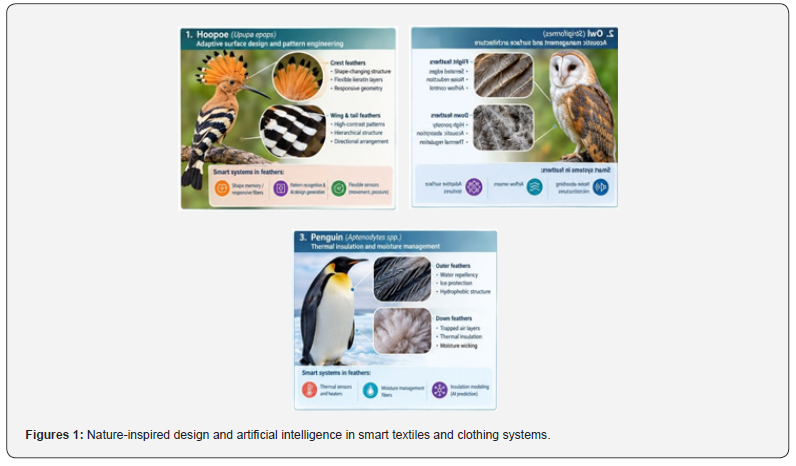
The selection of tests must correspond to the intended application. For instance, acoustic absorption testing is appropriate for acoustic-control textiles, whereas aerodynamic noise measurements are required to investigate noise generated by moving air. These properties should not be treated as interchangeable [Table 2] (Figure 1 & 2).
Proposed research hypotheses
The following hypotheses can be tested in a subsequent experimental study:
i. H1: AI-assisted extraction of biological features will improve the reproducibility of translating selected avian patterns into textile design specifications compared with an unstructured manual-design process.
ii. H2: Textile structures developed using defined avian-inspired geometric principles will demonstrate measurable differences in selected functional properties compared with appropriately matched control structures.
iii. H3: Predictive models incorporating textile construction parameters and experimental measurements will estimate selected performance outcomes more accurately than an appropriate baseline model.
iv. H4: Multi-objective AI optimization will identify textile designs that provide improved trade-offs among functional performance, comfort, durability, and material consumption.
These hypotheses require experimental testing. No statistical significance, percentage improvement, or predictive accuracy should be claimed before data are collected and analyzed.
Applications in intelligent clothing systems
The proposed framework supports several potential application areas.
Adaptive fashion and wearable design
Hoopoe-inspired crest geometry could inform garments with expandable collars, foldable decorative elements, or shape-changing panels. AI-assisted design could optimize the relationship between visual appearance, deformation, flexibility, and garment comfort. Such applications would require safe actuation mechanisms and sufficient resistance to repeated use.
Protective and outdoor clothing
Bird-inspired insulation and surface structures may guide the development of garments for cold environments, outdoor activities, and selected occupational applications. Their performance should be evaluated in terms of thermal protection, moisture transport, weight, durability, and wearer mobility.
Health monitoring and human-machine interaction
AI-enabled smart textiles can integrate sensors into garment structures to support movement analysis, physiological monitoring, and interactive feedback. Avian-inspired geometry may contribute to flexible sensor placement, protective surface design, or responsive garment architecture, although the sensing functions themselves depend on engineered components and validated algorithms.
Sustainable fashion and product development
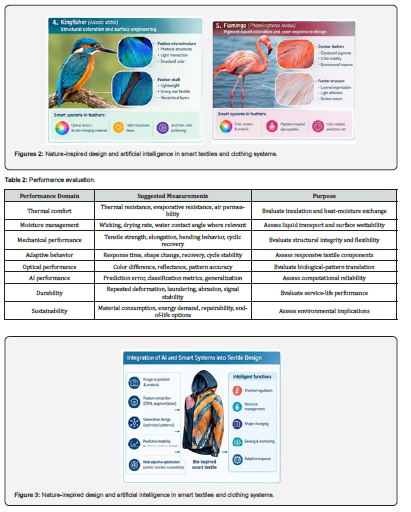
Biological design principles may encourage efficient material use, multifunctional structures, and longer-lasting products. Nevertheless, biomimicry does not automatically guarantee sustainability. Environmental performance must be assessed across material sourcing, manufacturing, use, maintenance, repair, and end-of-life management (Figure 3).
Discussion
>The proposed integration of avian-inspired design and artificial intelligence represents a transition from visual imitation toward engineering-based biomimicry. Textile approaches to nature-inspired textile design frequently emphasized the reproduction of surface appearances or isolated material characteristics. A more rigorous approach identifies the biological mechanism, translates it into a design variable, and tests the resulting textile against defined performance criteria. Within this framework, the hoopoe offers a distinctive combination of visual patterning and variable crest geometry. These characteristics can inform two complementary design pathways: computational reproduction of plumage patterns and engineered responsive surfaces inspired by crest movement. The first pathway is primarily concerned with pattern accuracy and textile aesthetics, whereas the second requires the integration of materials, mechanical design, and control systems. The comparison with owls, penguins, kingfishers, and flamingos demonstrates that different biological models should be selected according to the engineering problem. Thermal insulation, optical coloration, acoustic behavior, and pigment-based appearance involve different physical mechanisms. Their integration into a single research program is possible, but their performance criteria and experimental methods must remain distinct [4-10].
AI provides a means of coordinating these pathways by processing biological images, generating alternative designs, predicting material properties, and optimizing manufacturing parameters. However, the effectiveness of AI depends on data quality, model interpretability, independent validation, and the availability of sufficiently representative experimental samples. Small datasets and differences between simulated and manufactured structures may limit generalization. A further challenge is the integration of responsive components into garments without compromising comfort, flexibility, washability, safety, or repairability. Future research should therefore evaluate complete clothing systems rather than isolated material properties alone. Interdisciplinary collaboration among textile engineers, biologists, materials scientists, computer scientists, and fashion designers will be essential for translating the proposed framework into practical applications.
Research limitations and future directions
Several limitations should be acknowledged. First, the present article proposes a conceptual framework rather than reporting an experimental dataset. Its suggested applications and hypotheses require laboratory verification. Second, the biological characteristics of birds vary among species and environmental conditions, making species-specific documentation necessary. Third, computational predictions may not capture all interactions among yarn geometry, finishing treatments, deformation, humidity, and manufacturing variability. Future research should prioritize the development of validated image datasets, standardized procedures for biological feature extraction, and reproducible methods for translating biological geometries into textile structures. Experimental studies should compare bio-inspired samples with conventional controls and assess both initial performance and durability after repeated use. Further opportunities include low-energy AI processing, textile-integrated sensing, explainable predictive models, and closed-loop systems that connect digital design with automated manufacturing and laboratory testing. Environmental assessment should also examine whether proposed bio-inspired solutions reduce material consumption or improve service life relative to conventional alternatives.
Conclusion
>Nature-inspired design and artificial intelligence provide a promising framework for advancing smart textiles and intelligent clothing systems. Avian biological characteristics offer diverse sources of inspiration for responsive surfaces, thermal protection, optical design, and textile pattern engineering. In particular, the hoopoe's erectile crest and contrasting plumage provide complementary models for shape-changing textile components and computationally generated fabric patterns. AI can support this translation through computer vision, generative design, predictive modeling, and multi-objective optimization. Nevertheless, successful biomimetic innovation requires more than visual resemblance or computational novelty. It depends on identifying transferable biological principles, converting them into manufacturable structures, and validating their performance through controlled experiments. The proposed framework establishes a research pathway from avian observation to AI-assisted textile design, prototype development, and functional evaluation. Its principal contribution is to connect biological inspiration with measurable engineering requirements, thereby supporting the development of intelligent garments that combine functionality, adaptability, aesthetic value, and responsible material use.
References
- K Chatterjee, S Wei, T Ghosh (2022) Smart textiles through bio-inspired innovation. in Biomimicry for Materials, Design and Habitats: Innovations and Applications. Elsevier, pp: 291-335.
- Y Wan (2026) AI-driven wearable smart textiles: A review of research trends and frontiers. Fashion and Textiles 13: 19.
- Hu Z, Hong H, Lin T (2026) Review of progress of AI in biomimetics: From biological patterns to closed-loop discovery, Biomimetics 11(5): 320.
- Parker AR, Lawrence CR (2001) Water capture by a desert beetle. Nature 414(6859): 33-34.
- AR Parker (2000) 515 million years of structural color. Journal of Optics A: Pure and Applied Optics 2(6): R15-R28.
- Leslie Eadie, Tushar K, Ghosh (2011) Biomimicry in textiles: Past, present and potential. An overview,” Philosophical Transactions of the Royal Society A 8 (59): 761-775.
- Z Liang, Deng Y, Shi Z, Liao X, Zong H, et al. (2026) AI-driven design of powder-based nanomaterials for smart textiles: From data intelligence to system integration. Advanced Powder Materials 5(1): 100356.
- Nathan IDS, Manya PB, Medha CA, Meka LC, Vijeesh Vi, Sneha N (2026) Exploring hydrophobicity and biocompatibility in fabricating advanced biomimetic materials inspired by avian feathers: A review. Next Materials 12: 102327.
- Das S, Shanmugam N, Kumar A, Jose S (2017) Review: Potential of biomimicry in the field of textile technology. Bioinspired, Biomimetic and Nano Biomaterials 6(4): 224-235.
- Elnashar EA (2026) Design and Development of Smart Clothing Systems for Individuals with Special Needs: Technological Innovations and Applications in Developed Nations. Journal of Child Education and Culture.