



 CTFTTE Home



Abstract
Phase change materials (PCMs) are an important part of textile thermal management because they can absorb and release heat in a temperature-responsive manner, enabling adaptive temperature regulation in biomedical textiles, protective clothing, and personal comfort. Polyethene glycol (PEG) is a particularly appealing PCM candidate due to its tunable temperature transition behaviour, low toxicity, high biocompatibility, and favourable environmental profile. Low-molecular-weight PEGs, such as PEG 100, PEG 400, and PEG 1000, are particularly helpful because their melting and crystallisation properties can be tailored to certain comfort or physiological temperature ranges. Molecular weight, crystallinity, latent heat storage, and transition temperature are discussed in connection with the thermal behaviour of low-molecular-weight PEGs. With a focus on enhancing loading stability and longevity, coating, padding, encapsulating, electrospinning, and fibre-filling techniques are also investigated. Recent developments in form-stabilisation and composite design are emphasised, as PEG-based PCMs may exhibit minimal intrinsic thermal conductivity and leakage.
Keywords: Energy efficiency; Encapsulation technology; Functional Textiles; Grafting methods; Thermal conductivity
Abbreviations: PCMs: Phase Change Materials; PEG: Polyethene Glycol; CNTs: Carbon Nanotubes; LCAs: Life Cycle Assessments
Introduction
The development of functional textiles for flexible and energy-efficient heat management is on the rise. Because they absorb and release latent heat during phase transitions, phase change materials (PCMs) are particularly effective at buffering temperature fluctuations and enhancing wearer comfort in textile substrates. Salt hydrates and paraffins make up the majority of traditional textile PCMs. Paraffins are petroleum-derived, flammable, and prone to leaking despite having good latent heat and stability. Although salt hydrates have a high thermal storage density, phase separation, supercooling, and corrosivity prevent their use in wearables.
The development of functional textiles for flexible and energy-efficient heat management is on the rise. Because they absorb and release latent heat during phase transitions, phase change materials (PCMs) are particularly effective at buffering temperature fluctuations and enhancing wearer comfort in textile substrates. Salt hydrates and paraffins make up the majority of traditional textile PCMs. Paraffins are petroleum-derived, flammable, and prone to leaking despite having good latent heat and stability. Although salt hydrates have a high thermal storage density, phase separation, supercooling, and corrosivity prevent their use in wearables.
Polyethylene Glycol as a Phase Change Material
Molecular Weight and Thermal Properties
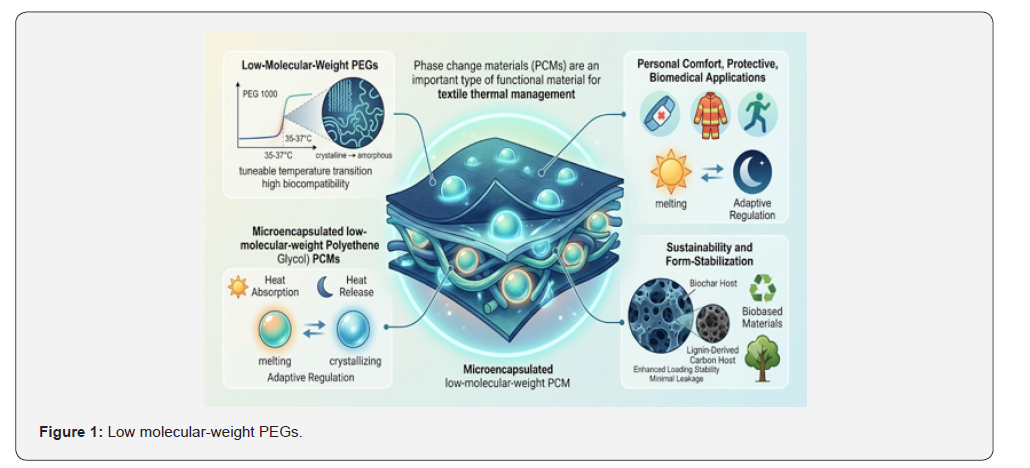
Polyethylene glycol (PEG) is a polyether whose thermal characteristics are significantly dependent on molecular weight. As the MW increases, PEG transitions from low-melting liquids to waxy solids with increasing melting temperatures and latent heat. PEG 100 is primarily used as a plasticiser or additive because its melting point is below 0°C, making it unsuitable as a standalone PCM. PEG 400 melts at 4-8°C and is useful for cold-storage applications, but it typically requires encapsulation or form stabilisation in textiles. PEG 1000 is one of the most studied textiles PCMs due to its melting range of 35-40°C, which is similar to skin temperature. Its latent heat ranges from 120 to 160 J/g, depending on purity and composite structure, making it appropriate for wearable thermal regulation. Higher-MW PEGs, such as PEG 2000, 4000, and 6000, have higher melting and latent heat, but they are more difficult to manufacture into textiles due to increased viscosity and decreased solubility [2].
Phase Change Behaviour and Energy Storage Capacity
PEG-based PCMs store and release thermal energy via their latent heats of fusion and crystallisation, and their storage capacity increases when form-stabilised in polymer matrices or porous hosts, frequently exceeding 60 J/g. Ultra-flexible PEG/ PVA membranes made by green electrospinning with melting and freezing latent heats of 60.1 J/g and 59.1 J/g at 55 % weight basis PEG, respectively, and a phase change range of 26.9-38.9°C, ideal for personal thermal control. Thermal conductivity can also be enhanced by adding fillers like carbon nanotubes (CNTs), expanded graphite, or boron nitride, while leakage during melting is controlled by encapsulation or form-stabilisation via capillary forces, hydrogen bonding, or cross-linking [3].
Eco-Friendly and Safety Advantages
PEG’s proven nontoxicity and biocompatibility distinguish it from many traditional PCMs, making it suitable for human-contact applications such as protective apparel, biomedical dressings, and personal thermal management textiles. Unlike petroleumderived paraffins, which may raise concerns about impurities or VOC emissions during thermal cycling, PEG is generally regarded as chemically inert and safer for skin contact; this safety profile is further supported by studies such as Kim et al., who highlighted PEG’s advantages in direct-contact applications. For wearable use, PEG’s safety is strengthened by form-stabilisation, encapsulation, and chemical grafting, which reduce the risk of liquid leakage onto the skin during phase change. From a sustainability perspective, PEG-based PCMs are also advancing through biobased synthesis routes, solvent-free and catalyst-free processing, green electrospinning with water-based scaffolds, and the use of bio-based or waste-derived hosts such as lignin-based carbon and carbonised cotton fabric waste, all of which improve performance while supporting greener manufacturing and circular material flows.
Applications for Textiles
a) Green Electrospinning - Electrospinning is a promising technique for creating PEG-based nanofibers with a large surface area, superior breathability, and efficient temperature regulation. PEG is typically coupled with a structural polymer to improve form stability, and water-based processing can mitigate environmental problems associated with solvent use [4].
b) Coating and Padding -Coating and padding are easy and scalable methods for applying PEG to materials. These technologies are simple to apply, but leakage control is critical; form stabilisation or cross-linking is often required to maintain performance.
c) Encapsulation - Encapsulation increases durability and helps to prevent leaks during phase change. PEG can be encased in polymer shells, biopolymer systems, or porous hosts to maintain thermal performance during repeated heating and cooling processes [5].
d) Chemical Grafts - Chemical grafting enables a more durable attachment of PEG to textile substrates, thereby improving wash resistance. It is less adaptable than physical approaches, yet it is effective when long-term stability is required [6].
Comparative Analysis: PEG vs. Conventional PCMs
PEG vs. Paraffin-Based PCMs
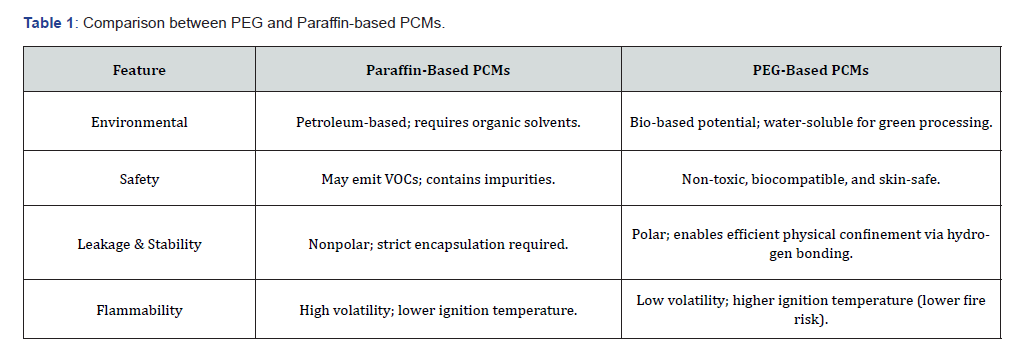
While paraffins are widely utilised for their high latent heat, Polyethene Glycol (PEG) offers a safer, more sustainable alternative, specifically optimised for textile applications (Table 1).
PEG vs. Inorganic Salt Hydrates
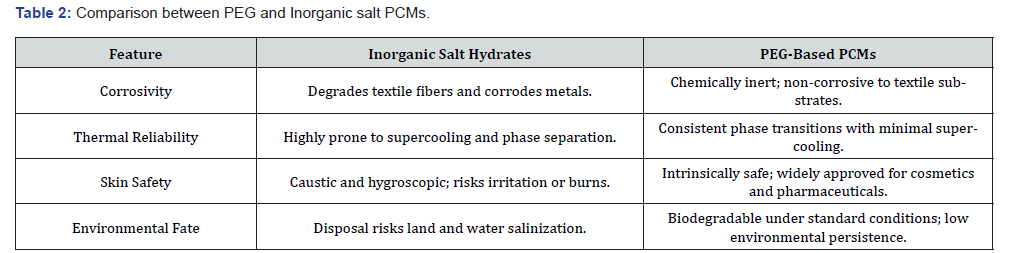
Inorganic salt hydrates offer cost-effectiveness and high latent heat, but their chemical reactivity severely limits their viability in wearable textiles (Table 2).
Form Stabilisation and Leakage Prevention
Preventing liquid-phase PCM migration is crucial for fabric breathability and comfort. Because PEG is polar, it has strong chemical interactions with cellulosic and protein-based fibres, providing enhanced leakage resistance through four basic mechanisms:
I. Microencapsulation is the process of encapsulating PEG
within protective micro- or nano-shells.
II. PEG is impregnated into highly porous materials, such as
expanded graphite and carbonised biomass. Capillary forces and
hydrogen bonding ensure high loading capacities (up to 70% by
weight).
III. Polymer Matrix Blending is the process of physically
restricting PEG within structural polymer networks (e.g., PVA,
polyurethane) by electrospinning or melt mixing, which is often
strengthened by crosslinking [7].
IV. Chemical grafting is the process of covalently attaching
PEG to the textile substrate. While this ensures permanent
prevention of leakage, the limited molecular mobility may result
in a minor loss of latent heat capacity [8].
Emerging Trends and Research Gaps
To achieve broad commercialisation, future research must
address three essential areas:
i. Technical Optimisation and Scaling: Focus on optimising
low-molecular-weight formulations (PEG 100 and 400) for cold
storage. Transition from lab-scale testing to continuous industrial
production with proven long-term wash durability.
ii. True sustainability entails developing a 100% biobased
PEG synthesis to eliminate reliance on petroleum. Conduct
comprehensive Life Cycle Assessments (LCAs) and prioritise
biodegradable encapsulation to integrate these textiles into a
circular economy.
iii. Multifunctionality: Combine thermal features with
secondary characteristics (e.g., antibacterial, UV protection,
conductivity) to produce high-value smart wearables and
biomedical textiles.
Summary
For textile thermoregulation, low-molecular-weight PEGs outperform volatile paraffins and corrosive salt hydrates in terms of environmental sustainability. Recent advances in green encapsulation and waste-derived host materials have effectively addressed prior leakage difficulties. To fully realise their commercial potential, the industry must now prioritise increasing bio-based production and ensuring long-term durability. Finally, PEG-based PCMs provide a compelling pathway to next-generation smart textiles that strike an ideal balance between thermal performance, human safety, and environmental responsibility.
References
- Jiajia W, Mingxu W, Li D, Chunhong Z, Jian S, et al. (2022) Ultraflexible, breathable, and form-stable phase change fibrous membranes by green electrospinning for personal thermal management. ACS Sustainable Chem Eng 10(24): 7873-7882.
- Hossein B, Maryam M, Jukka S, Julie BZ, Maryam RY (2023) Form-stable phase change electrospun nanofibers mat with thermal regulation and biomedical multifunctionalities. J Energy Storage 66: 107660.
- Tianyang L, Hong P, Lihui X, Kai N, Yong S, et al. (2022) Shape-stabilized phase change material with high phase change enthalpy made of PEG compounded with lignin-based carbon. Int J Biol Macromol 213: 134-144.
- Giang T, Le MT, Tran TN (2024) Using carbonized cotton fabric waste to prepare polyethylene glycol composite phase change materials with improved thermal conductivity and solar-to-thermal conversion. ACS Omega 9(2): 2559-2567.
- Bojana BP, Stipana S, Mateja K (2021) Microencapsulation for functional textile coatings with emphasis on biodegradability—A systematic review. Coatings 11(11): 1371.
- Andrew K, Nicole AW, E. Bhoje G, Rajkumar Pl (2023) Recent progress in PEG-based composite phase change materials. Polymer Reviews 63(4): 1078-1129.
- Zhigang L, Shang G, Xiaolong L, Xiuli C, Xinpeng H, et al. (2023) Facile, catalyst-free, and high enthalpy PEG-based phase change composite for use in photothermal conversion and waste heat recovery. J Energy Storage 74(Part B).
- M Zayed, E Abd El-Aziz, HA Othman, H Ghazal, Ahmed GH (2024) Development of bio-based phase change material composites for thermal regulation of cotton fabrics. Discov Chem 2(271).

























