



 CTFTTE Home



Abstract
The fashion industry faces increasing scrutiny due to its environmental footprint, characterized by overproduction, waste, and resource-intensive processes. Additive manufacturing (AM) offers a transformative pathway toward sustainability by enabling on-demand production, material efficiency, and design innovation. This mini-review examines the role of 3D printing in advancing sustainable fashion through four key lenses: the development of eco-friendly materials, the adaptation of AM processes, the implementation of circular design strategies, and a critical analysis of environmental considerations. The paper highlights recent advancements, presents comparative analyses, and discusses how digital fabrication can support a closed-loop fashion ecosystem. Challenges and future directions are outlined to guide researchers and industry stakeholders in harnessing AM for a more sustainable fashion future.
Keywords: Sustainable fashion; 3D printing; Circular economy; Biodegradable materials; Digital fabrication; Environmental impact
Abbreviations: AM: Additive Manufacturing; PLA: Polylactic Acid; FDM: Fused Deposition Modeling; SLS: Selective Laser Sintering; DIW: Direct Ink Writing; LCAs: Lifecycle Assessments
Introduction
The global fashion industry is a significant contributor to environmental degradation, accounting for substantial carbon emissions, water consumption, and textile waste [1]. Traditional subtractive and mass-production models are increasingly incompatible with sustainability goals. Additive manufacturing (AM), or 3D printing, has emerged as a disruptive technology with the potential to redefine fashion production through digital, layer-by-layer fabrication [2]. While early applications focused on prototyping and avant-garde aesthetics, recent research has shifted toward leveraging AM for ecological and economic sustainability. Innovations in biodegradable polymers, recycled feedstocks, and design-for-disassembly principles position 3D printing as a catalyst for circular fashion [3]. This review synthesizes current developments at the intersection of AM and sustainable fashion, with a focus on materials, processes, design frameworks, and environmental impact. The innovation of this work lies in its integrated analysis of how 3D printing not only reduces waste through precise manufacturing but also enables circularity through material recovery, modular design, and closed-loop systems—while critically assessing the full environmental lifecycle of printed fashion goods.
Sustainable Materials for 3D-Printed Fashion
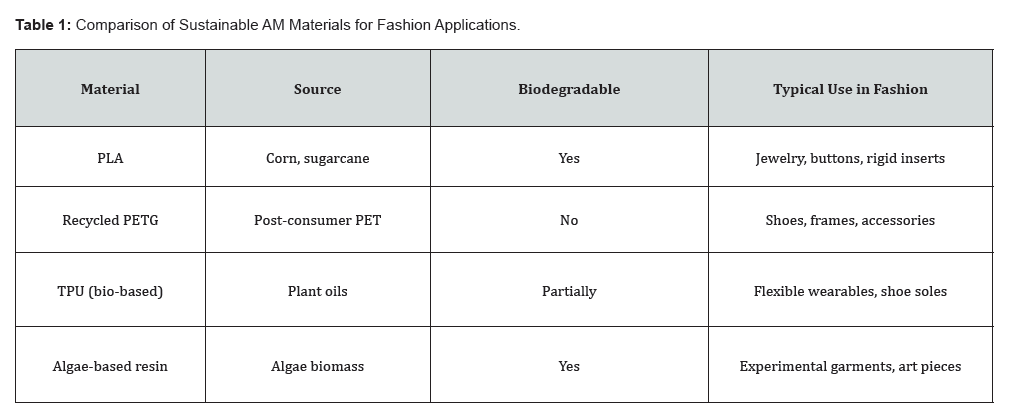
A critical enabler of sustainable 3D-printed fashion is the development and use of environmentally responsible materials. Traditional AM thermoplastics like ABS and PLA are derived from fossil fuels, but recent advances focus on bio-based, biodegradable, and recycled alternatives [4]. (Table 1) compares key sustainable AM materials. Bio-based polymers such as polylactic acid (PLA) dominate due to their renewable origins and compostability. Recycled filaments from post-consumer plastic waste reduce dependency on virgin resources [5]. Emerging biocomposites integrate natural fibers like hemp or wood, offering improved sustainability and unique aesthetics. Material selection directly influences the environmental footprint and end-of-life options for printed fashion items [2].
AM Processes Optimized for Sustainable Production
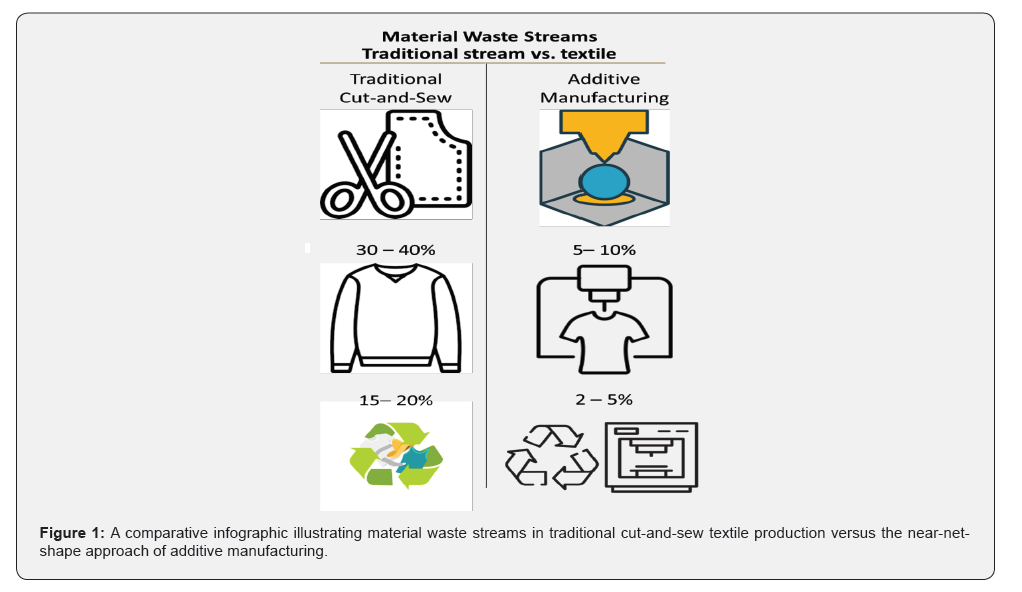
Different AM processes offer varying degrees of material efficiency, energy use, and design flexibility. Selecting the appropriate method is crucial for minimizing environmental impact. Fused Deposition Modeling (FDM) allows precise material deposition but can generate support waste. Powder-based methods like Selective Laser Sintering (SLS) enable high powder reuse rates, approaching zero-waste production [6]. Direct Ink Writing (DIW) and electrohydrodynamic processes facilitate textile-like, seamless fabrication, reducing assembly needs. (Figure 1) could illustrate the waste comparison between traditional cut-and-sew and various AM methods, highlighting the additive advantage [7].
Circular Design Strategies Enabled by 3D Printing
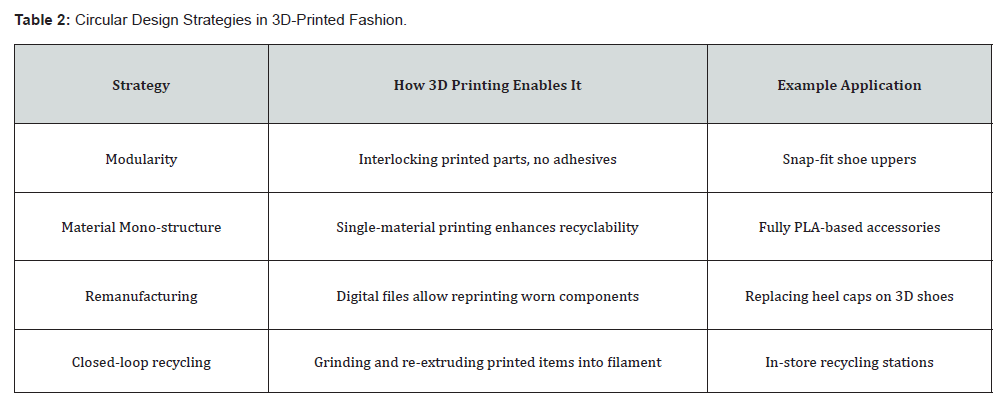
Circular design in fashion emphasizes longevity, reuse, and recyclability. 3D printing facilitates several key strategies, summarized in (Table 2) [3]. Design for disassembly allows easy repair and material recovery. On-demand digital production minimizes overstock and transportation. Customization through body scanning extends product lifespan via improved fit [7]. These strategies collectively support a shift from linear to circular fashion systems [3].
Environmental Considerations in 3D-Printed Fashion
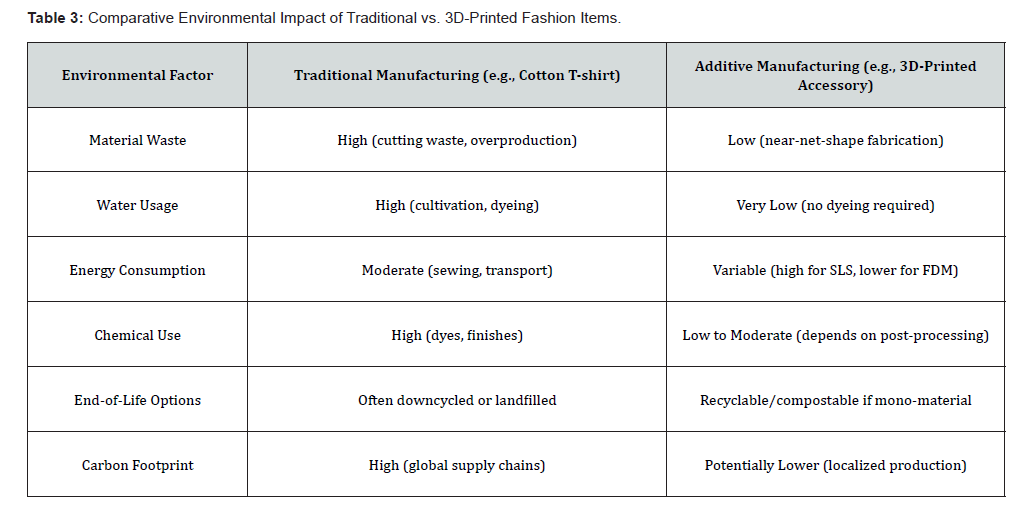
A holistic environmental assessment of 3D-printed fashion must consider the full lifecycle. Key considerations include energy use, waste generation, water and chemical footprints, and end-of-life management [8]. (Table 3) provides a comparative analysis with conventional manufacturing. While AM reduces material waste and can lower transportation emissions through localization, energy intensity in some processes (e.g., SLS) remains a concern [9]. The integration of renewable energy in print facilities is essential. Furthermore, end-of-life management requires design for mono-material use or established recycling streams to prevent downcycling [8]. Comprehensive Lifecycle Assessments (LCAs) are needed to quantify net benefits and guide sustainable implementation [9].
Case Studies and Industry Adoption
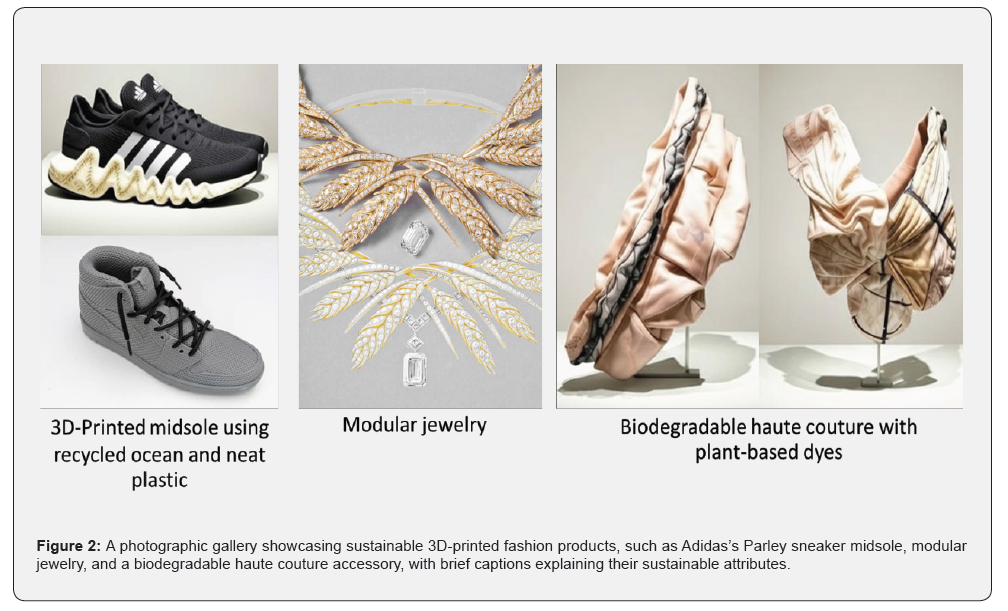
Forward-thinking brands demonstrate the viability of sustainable 3D-printed fashion. Iris van Herpen collaborates with material scientists on biodegradable haute couture [2]. Adidas, with Parley for the Oceans, creates 3D-printed sneaker midsoles from intercepted marine plastic [5]. Open-source initiatives like Project DANI develop modular jewelry from recycled plastics [3]. These cases, illustrated in (Figure 2) showing a gallery of sustainable 3D-printed fashion items, highlight a tangible shift toward commercial sustainable practices, though challenges in scalability and cost persist [7].
Conclusion and Future Framework
3D printing holds significant promise for advancing sustainability in the fashion industry by reducing waste, enabling circular design, and promoting eco-friendly materials. The integration of environmental considerations into the AM lifecycle is crucial for realizing its full potential. Future efforts should focus on:
a. Developing Multi-material Recycling Systems: To handle
complex printed textiles and composites.
b. Advancing Low-Energy AM Processes: And powering
them with renewable energy.
c. Establishing Standardized LCAs and Transparency Tools:
Such as digital product passports for printed garments.
d. Fostering Hybrid Manufacturing Ecosystems: That
combine AM’s precision with traditional textile craftsmanship for
optimal sustainability.
As technology and circular infrastructure mature, 3D printing is poised to become central to a regenerative fashion system— where digital design, localized production, and material recovery create a closed-loop model for the industry.
References
- Niinimäki K, Peters G, Dahlbo H, Perry P, Rissanen T, et al. (2020) The environmental price of fast fashion. Nature Reviews Earth & Environment 1(4): 189-200.
- Akhoundi B, Mashayekhi A (2023) A Mini-Review of Using Additive Manufacturing in the Fashion & Textile Industry? Trends in Textile Engineering & Fashion Technology 7(5).
- Glogar M, Petrak S, Mahnić Naglić M (2025) Digital Technologies in the Sustainable Design and Development of Textiles and Clothing—A Literature Review. Sustainability 17(4): 1371.
- Carias Duron LM, Granero Garcia J, Mandurai C, Hoyer J, Kukal J, et al. (2025) Kinetics and Mechanical Performance of Bio-Based Polyurethane Wood Composites for Sustainable 3D-Printed Construction Materials. Sustainability 17(23): 10461.
- Kyriakidis IF, Kladovasilakis N, Pechlivani EM, Tsongas K (2024) Mechanical Performance of Recycled 3D Printed Sustainable Polymer-Based Composites: A Literature Review. Journal of Composites Science 8(6): 215.
- Ford S, Despeisse M (2016) Additive manufacturing and sustainability: an exploratory study of the advantages and challenges. Journal of Cleaner Production 137: 1573-1587.
- Khajavi SH (2021) Additive Manufacturing in the Clothing Industry: Towards Sustainable New Business Models. Applied Sciences 11(19): 8994.
- Kokare S, Oliveira JP, Godina R (2023) Life cycle assessment of additive manufacturing processes: A review. Journal of Manufacturing Systems 68: 536-559.
- Dehghani M, Goyal P (2022) Design and Development of Textile Fabrics Using 3D Printing Technology. ECS Transactions 107(1): 19313.

























