CTFTTE Home



Abstract
Keywords: Adelaide ristori; Italian actress; Empress eugenie; Costume; Dressmaker
Short Communication
Adelaide Ristori (1822-1906), first Italian actress, understood with her artistic intuition the strategic importance of costumes, an essential element for actorly interpretation and for making the character. Ristori was the first Italian actress to systematically engage with overseas travels. To interpret Marie Antoinette (1867), who was dressed by a personal dressmaker, Rose Bertin, famous for her eccentric hairstyles, Ristori chose the tailor who first signed his creations and is now considered to be the first true stylist: Charles Frederick Worth (1825-1895). The English couturier conquered Paris by inventing ‘tailored’ dresses for aristocratic and upper-class women, made with fabrics chosen from the refined French textile sample. For Adelaide/Maria Antoinette, he recreated garments with a historical flavor, with attention to the needs of the stage. The play was written by Paolo Giacometti for her second tour in the United States. In New York the staging was grandiose, through different scenic settings in which 30 characters and 68 extras move; there was stage music composed for the occasion.
Worth, who boasted in his letterhead that he was the tailor of Empress Eugenie, exclusively dressed actresses and singers of the Parisian stage with inexhaustible fantasy, he signed costumes for court festivities and for the theatre, thus linking his name to the prima donnas who influenced both female tastes, and the virile imaginary of the Second Empire. Adelaide expressively wanted him for this show, which was meant to be international, and decided to part from the philological approach to costumes: a trend that subsequent divines – such as Sarah Bernhardt and Eleonora Duse – would then emulate. The exchange of letters between the actress and the playwright reveal the total trust that Ristori had in Worth’s work.
Worth’s conception got the better of the traditional costumes of the piece, coldly indebted to historical models, these being a necessary outfit to define, as the public expected, the drama of the heroine, from the splendor of Versailles to the bare guillotine. Ristori was the leading actress and stood out above all others: c’est la Reine. Her stage dresses are marked by a canon of elegance and enhancement of the body, elements that constitute Worth’s true signature and that will then become a constant in the history of the Maison, until its closure (1956). Adelaide would remain linked to the Worth label, wearing modern vertical silhouette dresses for her public image, and sporting garments tailored for her.
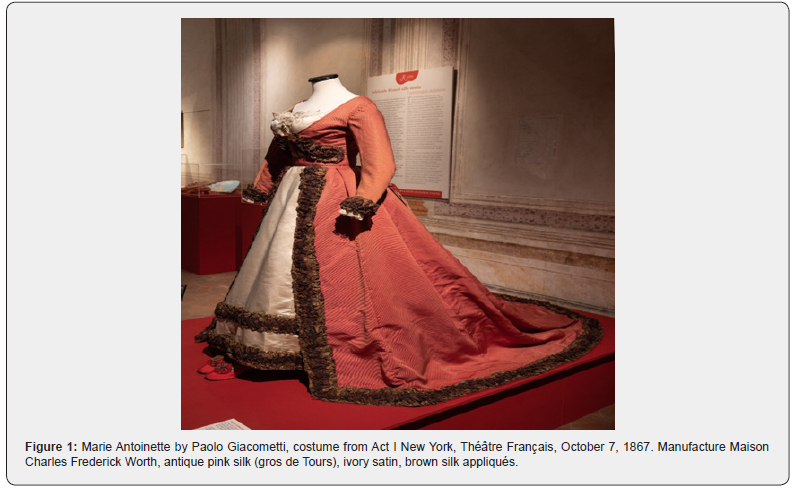
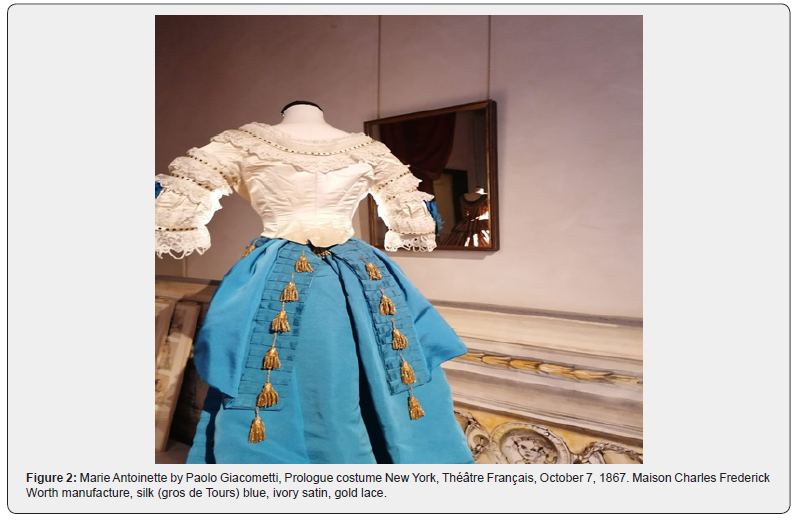
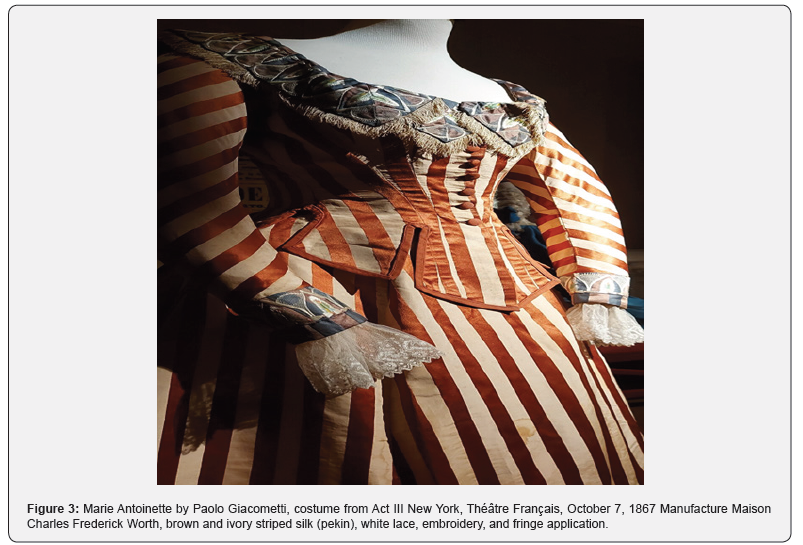
Adelaide wore seven sumptuous costumes, all designed by Worth and previewed by Empress Eugenie, the last French sovereign. Three of these costumes are now preserved at the Actor’s Museum in Genoa and were exhibited in 1922, the centenary of the actress’s birth. These three stage costumes are among the oldest preserved in Italy and testify to the great relationship between fashion and theatre.
(Figure 1) The essential line of the period is skillfully captured, and the ornamental excesses eliminated in favor of a chromatic duality, Worth’s typical formula. The outcome allows more expressive freedom to the actor’s body. (Figure 2) Worth chooses to play with colors: white is the color dear to the queen and bleu, with heraldic reference, represents France. (Figure 3) The dress is a perfect court lady’s outfit, created in Paris so to pay homage to the Louis XVI’s style, as expressively requested by the Empress Eugenie.