




 ARR Home




Abstract
Subsequent article adds to marketing theory by highlighting some influences that are often overlooked in analyses. Mainly from the area of distant marketing environments, with a focus on empirical dependencies. It also expands the conditions for using marketing analytical models. Likewise, it takes into account mathematical, economic, and social factors that are often neglected. The aim of the article is to provide a guide, in a general level about some aspects, on which influences should not be ignored in marketing analyses.
Keywords: Marketing management; Marketing theory; Analytical models; Marketing factors; Empirical factors; Mathematical laws; Statistical conditions; Economical rules; Social factors
Introduction
The following article examines selected aspects of marketing practice that typically have a significant impact on marketing analysis. The principles and procedures described below have been derived primarily from practical experience. Marketing textbooks generally overlook them or mention them only in passing. However, the text also draws on a number of well-known marketing rules and concepts. This article is not intended as an independent research study. Its aim is to supplement existing knowledge with insights into some lesser-known areas of marketing practice. It is therefore primarily educational in nature and is based on practical experience. It is thus a methodological text. The following list of empirical influences on marketing analyses is not exhaustive. Drawing on practical experience, the article is intended to supplement marketing theory with lesser-known and less frequently applied findings and principles. The selected influences fall primarily within the area of the Distant (Macro) Marketing Environment. They have been included mainly because they are very often overlooked by marketers, despite having a significant impact on the outcome. The article also extends the application of established rules and procedures. It also applies conventional mathematical or statistical methods to marketing.
Most people understand Marketing as a mean for promotion, marketing communications, direct selling, and other activities aimed at increasing sales [1]. This represents a deliberate blurring of the meaning of the discipline. The reason is that many countries have laws restricting the activities mentioned above, whereas no country restricts marketing itself.
So, what, then, is marketing as a discipline about? There are several official labels for marketing that help sell this products. For example: “Satisfying customer needs.” “Having the right product at the right time, in the right place.” [2] In reality, however, it is about improving market position, improving competitive position, increasing sales, increasing profit, changing market behavior, and gaining other advantages over competitors. It is therefore a management tool. Just as a spade is one of a gardener’s basic tools, marketing is one of the basic management tools. Armies have been using marketing for thousands of years. As early as the 6th century BC, Sun Tzu provided an excellent description of management and marketing tactics in his book The Art of War [3]. Because business is a war. This is why The Art of War is taught not only at West Point, but also in marketing programs at leading universities around the world. Because business success is based on knowledge and application of marketing.
At the same time, marketing is, by definition, not a separate scientific discipline. It is a method, an interdisciplinary discipline. Marketing combines a range of partial findings from several academic disciplines, while also incorporating rules and principles derived empirically from practical experience. This article focuses on the application and use of some important empirical marketing rules. One of the important principles of marketing is that everything used in marketing must be somehow converted into numerical values. If another form of expression is used, such as a verbal description, it is merely a subjective opinion. Moreover, it is not comparable, because each of us expresses ourselves through our own idiosyncrasies, our own understanding, and so on. Therefore, in order to compare any marketing results, it is necessary to compare numerical values obtained using the same method.
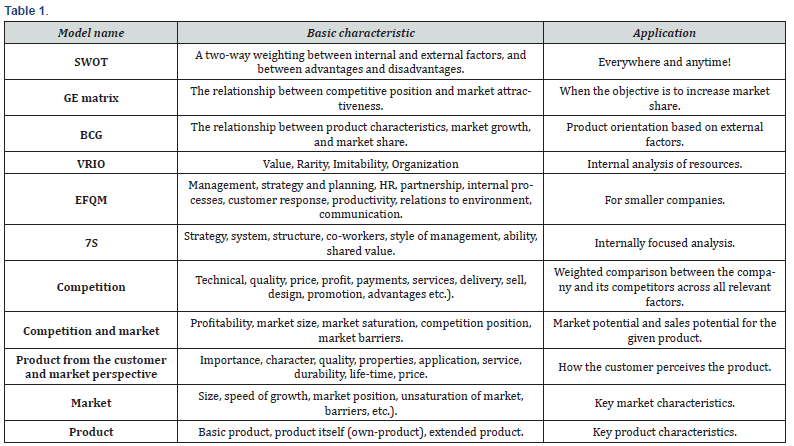
To provide a better understanding of the above, marketing analytical models will be used as an example. There are many such models. I will mention only the most basic ones (Table 1).
The following applies to the use of all marketing analytical models.
a) Each model, and each factor within it, must be converted into a numerical value. Several methods can be used to convert a factor into such an objective numerical value for marketing purposes. However, the most appropriate method is usually the “Weight/Size/Effect” calculation method ([4], Weighted Factor Model). Very often, a marketer leaves the factor being examined in the form of a textual description. This is a major mistake. Such a description cannot be used for analytical purposes!
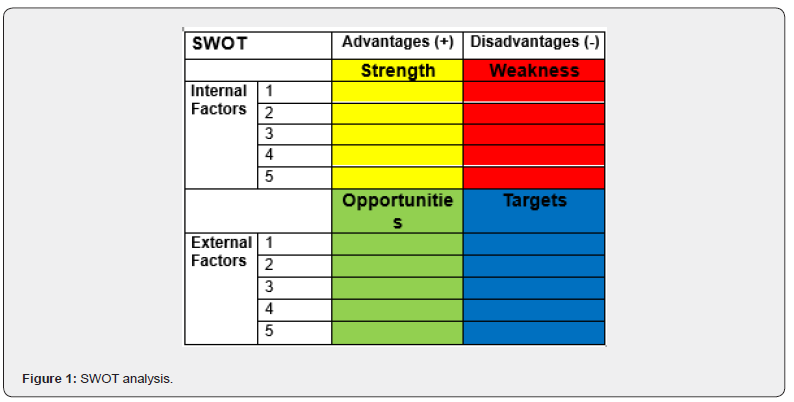
b) For each case being addressed, the appropriate analytical model must be used! At the same time, a SWOT analysis must always be performed! [5]. Thus, at least two models are used in any marketing analysis. The SWOT analysis checks whether any errors have occurred and broadens the picture by incorporating other relevant factors. A very common mistake in SWOT analysis is for the marketer to base the assessment on the literal meaning of the words Strengths, Weaknesses, Opportunities, and Threats. However, SWOT analysis is universal in that it provides a two-way weighting. On the one hand, it compares (weighs) internal and external factors. On the other hand, it compares positives/advantages with negatives/disadvantages. See the following Figure 1.
Mathematical influences
a) “Law of large numbers” [6]. Current internet tools make it possible, in some cases, to conduct marketing research literally on a global scale. However, if a marketer knows what they are doing, they know that in certain cases each factor being examined will have the same probability of occurrence. According to this mathematical law. This is because the research was not properly targeted, for example at a specific market, target group, etc. Artificial intelligence (AI) is often used for marketing research. It is suitable for some purposes, but not for others. In particular, because it does not use “Random sampling.” Consequently, the results obtained with its assistance are always biased. However, they may be biased in the desired direction. This must be kept in mind when working with it. From this reason there is necessary to know how any given AI works.
b) “Random sampling” [7]. It is mathematically defined as follows: “Random sampling means that, before the process begins, every element in the test has an equal probability of being selected. Random sampling is a procedure for selecting units in which inclusion is determined by chance rather than by discretionary selection.” This means that any marketing research must be conducted in such a way as to eliminate all subjective influences.
c) Statistical assumption [8]. Any group constituting the tested or examined “Random sample” must contain more than 50 people. Otherwise, the results obtained are not statistically significant and may be subject to substantial error. Only in exceptional defined cases the number should be smaller.
d) Verification of results. Even if a marketer obtains unbiased field data by any means and the data are recorded with complete reliability, their credibility must still be verified. This can be done using several methods. The appropriate test must always be selected according to the relationship being examined and the data obtained. The most common methods are: Standard deviation, Coefficient of variation, chi -square (χ²), Student’s criterion, Pearson distribution [9].
e) Coefficient of variation. This is used to test a single factor under examination for which more than 50 observations have been obtained. If our marketing research includes multiple factors, we use the Coefficient of variation to test each one of them. If the Coefficient of variation for a given factor and its corresponding series of values exceeds 10 %, this indicates a systemic or systematic error.
Economic influences
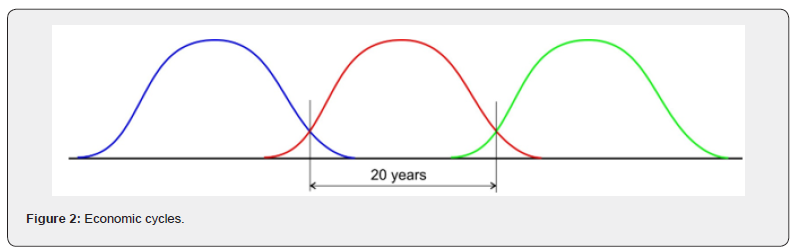
a) Economic cycles. Each 20-year period has four main global economic drivers. As shown in Figure 2. Once these economic drivers pass the midpoint of their cycle, they begin to weaken and new major global drivers start to emerge. Although they may still appear productive in nominal terms, if their contribution is less than 4%, this actually constitutes a decline.
b) The IMF rule. International Monetary Fund (hereinafter the IMF). Every country that takes out a loan from the IMF signs contractual terms and conditions nicknamed the “Golden Brick” [10]. These terms transfer control over the country’s national bank to the IMF and, at the same time, stipulate that every government is required to follow and implement IMF instructions. Consequently, key economic issues in the country are decided not by government authorities and local interest groups, but by the IMF.
c) The “Second-person rule”. If a marketer needs to obtain non-public economic information about local conditions in a target market, it is advisable to identify person No. 2. Person No. 1, for example the president, is merely a frontman. The real power and decision-making processes lie with person No. 2, who remains in the background. That person’s economic interests are crucial to developments in the country or in a particular area of activity.
d) “Parkinson's Law” [11]. According to these laws, any government organization with more than 100 employees generates so much administrative work that dealing with it keeps the organization itself occupied. The European Commission will be used as an example. There, employees in each office have approximately 30 minutes a day to devote to one specific case. They are also the only ones who actually do all the work. Heads of Representation receive their positions as a reward for services rendered. The day-to-day operation of the office is managed by the secretary. According to the Second-person rule. Anyone wishing to push through a regulation or measure at EU level is therefore forced to hire a lobbying firm that handles all the legwork, knows whom to approach in each office, and keeps pushing until the document is considered. This is an expensive undertaking. Consequently, all EU decisions and measures are tailored to someone wealthy. In the case of subsidies, 80 % of each program is intended for someone specific and 20 % for everyone else. According to the “Pareto principle”.
Social influences
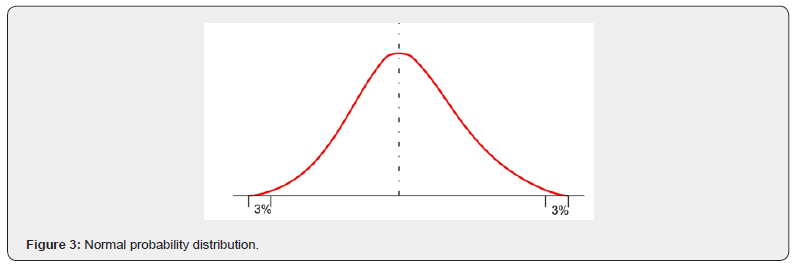
a) Virtually any human activity, interest, human characteristic, behavior, etc. can be modeled using the normal probability distribution. The so-called “Gaussian curve” [12]. Figure 3. In simplified terms, this curve tells us that in every society there are approximately 3 % of people who are deeply interested in something and approximately 3 % who are not interested in it at all. The rest of the population lies between these two extremes, with the highest concentration in the middle. If the marketing research results we have measured or identified for a population deviate from this curve, this means that either we have made an error or some strong external factor is affecting the parameter being examined and distorting the curve.
b) The “Pareto principle” [13] tells us that 80 % of sales are generated by 20 % of products, and vice versa. However, this principle also applies to decision-making processes, market composition, and other marketing parameters.
c) The “Succession rule” [14]. In generational, or so-called family businesses, the first generation builds the company and the second generation fails. According to the “Pareto principle”, this occurs in 80 % of cases. The reason is that the first generation has strong motivation and a clear objective. The second generation, however, is raised in conditions of prosperity with the sole objective of maintaining what already exists. However, the world is dynamic, and it is necessary to respond to changes and continue developing the company. If a generational family business survives the second generation, it is not until the third generation that its further development resumes.
d) The “Counter-rule”. If a marketer needs to quickly gain an understanding of a general issue, the following procedure applies. As a starting point, the marketer takes the exact opposite of what is presented by the public media and accepted by the majority of the population. The marketer then asks who benefits economically from the activity in question. This will usually produce an objective and truthful answer. Nevertheless, an answer obtained in this way must subsequently be verified and analyzed.
e) Trends. It is not only clothing and culture that are subject to trends. Industry and other human activities are as well. The environmentalism trend is on the decline, while a trend toward automated technologies appears to be emerging.
Conclusions
To accomplish the task at hand, a marketer needs to consider all factors that have an effect on the process concerned. Not only those described in marketing textbooks [15] and manuals. But also, as a rule, all those listed above, from both the theoretical and empirical categories. However, the above list of empirical influences is neither complete nor definitive. Common sense must always be applied, but marketing or mathematical methods must also be used to assess the significance of each category for the particular marketing case being addressed. If any of them is insignificant, it should be excluded. If another influence not listed here is significant, it should be added. At the same time, if an influence on the process being examined is significant, its so-called Critical factors must also be identified and defined. All marketing analyses must also take into account that any AI produces biased results.
References
- Theodore Levitt, Marketing Myopia, Harvard Business Review Press Books, Jun 16, 2008,2601-PDF-ENG,
- Philip Kotler, The Past, Present, and Future of Marketing, Journal of Marketing, American Marketing Association (AMA),3.12.2024,
- Sun Tzu (1963) The Art of War, (S. B. Griffith, Trans.), Oxford University Press.
- Charity Entrepreneurship (CE), Weighted Factor Model, Charity Entrepreneurship’s 2019/2020 research.
- Humphrey A (2025) SWOT Analysis for Management Consulting, SRI Alumni Newsletter.
- Richard Routledge, Britannica Editors, Law of Large Numbers, Sep. 12, 2026.
- Cochran WG (1977) Sampling Techniques, John Wiley & Sons., 3rd, New York.
- Roscoe JT (1975) Fundamental Research Statistics for the Behavioral Sciences, Holt, Rinehart and Winston, New York.
- DeGroot MH, Schervish MJ (2012) Probability and Statistics, Boston, Pearson.
- (2024) International Monetary Fund, Articles of Agreement of the International Monetary Fund, Washington, DC, International Monetary Fund.
- Northcote C, Parkinson (2024) Parkinson's Law, Blurb, Incorporated, ISBN1034965395, 9781034965398.
- Rice JS (2006) Mathematical Statistics and Data Analysis, 3rd , Belmont, CA, Thomson Brooks/Cole.
- Juran JM (1954) Universals in Management Planning and Controlling, Management Review 43(11): 748-761.
- Naděžda Petrů, Jan Kramoliš, Peter Stuchlík (2020) Marketing Tools in the Era of Digitalization and their Use in Practice by Family and Other Businesses, E+M Ekonomie a Management, XXIII, Technical University of Liberec.
- Kotler P, Keller KL, Chernev A (2024) Marketing Management, 17th, Harlow: Pearson.