




 ARR Home



Abstract
Background: A growing body of research indicates that older adults and individuals with motor losses require assistive devices to accelerate recovery and facilitate daily activities. However, there is a lack of research that offers technological solutions in addressing basic human needs of people with motor impediments, namely feeding, cleaning/waste removal, and voice communications, that may be necessary during rehabilitation.
Methods: A qualitative research approach, including critical analysis and reflective synthesis of the scientific literature on current
technological solutions for the treatment of waking disturbances, has been employed in this study.
Conclusions: The study provided an innovative assistance device with novel components for feeding, waste removal/cleaning, and voice
communication that aid the treatment process.
Novelty - The study produced a high-level design in the form of a prototype for comprehensive, holistic care of people with walking impairments, including fragile older persons. The automated system supports mobile rehabilitation and technological assistance for feeding, waste removal/cleaning, and voice communication.
Significance - The study promotes technology-integrated solutions in the form of a design prototype to provide comprehensive, holistic care for people with walking impairments, including fragile older persons, thereby enhancing their physical and psychological well-being and potentially improving healthcare in homes, rehabilitation centres, and care facilities for older people.
Keywords:Assistive devices; Health product design; ICT; Feeding assistance; Waste removal/cleaning system; Voice guidance
Introduction
Walking, feeding, and waste elimination are among the most severe difficulties associated with ageing and age-associated changes in musculoskeletal function that apply to people with neurological and muscle traumas, Alzheimer’s patients, people with brain strokes, traumatic damage to locomotor movements of the lower extremity, such as legs The World Health Organisation (WHO), [1]. There is a lack of research that examines technologies, e.g., assistive devices for feeding and elimination of waste as crucial body functions to minimise costs and may provide relief during walking rehabilitation in institutions for older adults and home environments. Researchers (e.g., Médéric, Pasqui, Plumet & Bidaud [2]; Sharkey & Sharkey [3] report an increase in the ageing population in EU countries, accompanied by a decrease in future resources for the care of older adults Eurostat [4]. Several studies have explored various technical solutions to improve walking and locomotor movements among older adults and people with walking disabilities, e.g., Buning, Angelo & Schmeler [5]; Lunenburger, Colombo, Riener, & Dietz [6]; Garzia-Vazquez, Rodrigues, Saldaña & Tentori [7]. However, there are no suitable technical health solutions that integrate ICT and AI to support feeding, waste elimination, and voice-guidance during walking and other rehabilitation activities for people with motor impairments, injuries, or advanced age.
It has been generally accepted that the recovery of individuals with malfunctioning muscular systems also depends on proper functioning and the ability to feed and eliminate waste during rehabilitation, which may accelerate recovery. To address these basic human needs, the emphasis should be on the use of ICT, AI, robotics, telemetry, and audio stimulation to encourage older adults and the person with walking impairments to participate in rehabilitation activities that may improve their emotional and psychological well-being, e.g., Intille [8]; Krebs & Hogan [9]. Rehabilitation centres and nursing homes aim to provide care at minimal cost, including transportation, during walking rehabilitation; however, older people often require transportation and additional human resources to meet individual needs for feeding and waste elimination. Thus, there is an urgent need to examine a variety of technological means for the elderly and people with locomotor dysfunction injuries, because the allocation of adequate human resources at home and in nurseries has been a burden in both developed and developing societies Yu, Spenko & Dubowsky [10]; Mocanu S, Mocanu I, Anton & Munteanu [11]; Vacher, Portet, Chahuara, Caramihai, Munteanu, Mocanu, I & Mocanu S [12]; Losco, Lupacchini, Bradini & Paciotti [13]. These research findings present a basis for this study that culminates in a design of an automatic healthcare system with four sub-systems, namely, walking, feeding, cleaning, and voice guidance, that received a patent in South Africa in 2018.
Based on the above discussions, this study was conducted
to explore current technological solutions to minimise the use
of human resources during walking rehabilitation. The primary
purpose of the study was to design an automated healthcare assistance
device to support the psychological well-being of individuals
with walking impairments and older adults, and to provide
technological solutions for feeding and waste elimination. This
has directed specific research objectives, namely: (1) to critically
analyse and reflectively synthesise current research on the design
of healthcare assistance devices for older adults and people with
walking disturbances; (2) to design an automatic health system
with components and functionalities to improve feeding and
waste elimination/cleaning using voice guidance during walking
rehabilitation. The emerging question set in this paper is:
RQ1: What are the components and functionalities of the automatic
healthcare assistance device?
The article has been structured as follows: The “Research methodology” section describes qualitative research design relevant to this study; The “Theoretical framework for a design of an automatic healthcare assistance device (AHAD)” presents current technological solutions for older adults and persons with walking disturbances and justifications for a holistic automatic healthcare system; The section four present a schematic representation of the AHAD system with components and description of its functionalities; The “Discussion” section outlines the discussion of the current literature in comparison with the proposed technological design and provides an answer to the research question. Section six describes conclusions, and section seven highlights “value added, limitations, and future research”. The paper finishes with “References”.
Research Methodology
Qualitative Study Approach
This qualitative research incorporates the critical analysis and reflective synthesis of scientific literature (e.g., Fook [14,15]; Koch & Harrington [16]; Morley [17] Bordens & Abbott [18]; Bowen [19]; Noble & Smith [20]; Tesch [21]) on current technological means to assist the elderly and people with walking impairments caused by underlying diseases or injuries. Critical reflection on current research findings regarding holistic solutions to the rehabilitation needs of persons with impaired walking abilities has been insufficiently reported. A critical reflection can designate paths for transformation that move beyond rigid thinking. Thus, the critical analysis and reflective synthesis of documentary resources (e.g., Hamideh & Ghaljaie, 2017; Snyder [22]; Ritchie, Lewis & Elam [23] informed the design of an innovative, holistic, automated healthcare assistance device (AHAD) to aid elderly persons, individuals with injuries, and individuals with walking impairments, and to improve their self-care. Furthermore, this qualitative research approach, integrated with the creative inspiration of the researcher, directed the research further after the proof of the concept was appreciated in a South African patent titled “An automatic healthcare assistance device” granted in 2018.
Sampling and search procedures
The researcher searched the websites of accredited journals and databases, as well as Google Scholar, PubMed, Scopus, and Academia.edu. Studies were included if they assessed different aspects of the technological means and design of assistive devices for walking impairments across various categories of affected people. A total of 25 papers were included in this study. The researcher used the “snowball” technique to search for published papers Naderifar [24]; Saumya, Rajneesh & Spriha [25]. Search terms/criteria focused on the core concept, the phenomena of the technological systems in assisting older adults and persons with walking disturbances, including feeding, cleaning and voice instructions. The following search terms and search strings were derived: walking rehabilitation; technology for feeding and waste removal; older adults and assistive technology; healthcare assistance product design; walk* AND assist* techno*.
Data analysis and assessment of trustworthiness
In this study, traditional literature reviews have been supplemented by critical reflection (Several major themes emerged regarding the use of assistive devices to address walking needs. Data analysis included coding and the identification of categories Alvesson & Skoldberg [26]; Noble & Smith [20]; Bowen [19]; Ritchie [23]; Kothari [27]. The selected written data sources were critically analysed and reflectively synthesised into four final themes: a lack of holistic healthcare assistance devices; technological solutions to support feeding and waste removal functionalities; a need for an assistance walking device with subsystems to cater for basic human needs; a lack of assistance devices that promote self-care, and privacy of people during rehabilitation. These themes were evaluated as the most relevant for explaining the phenomena of healthcare assistance design. The assessment of trustworthiness encompassed peer/colleague reviews, the declaration of the researcher’s biases, and a rich description of the phenomenon under study. Analytical pattern matching and inference strategies were tracked Tesch [21] to ensure internal validity.
The theoretical framework for the automatic healthcare assistance device
Current technological solutions in assisting older adults and people with special walking needs
To address walking disorders, it is necessary to examine current
applications of ICT tools and robotics in the design of assistive
devices that support walking rehabilitation. There are several
intelligent systems in the field of walking rehabilitation, including
comprehensive care for individuals in need.
Intelligent systems: Research advances are visible in
Ambient Assisted Living (AAL) Losco, Lupacchini, Bradini & Paciotti
[13] and smart homes Cavallo, Aquilano, Odetti, Arvati &
Carrozza [28]; Chan, Campo, Estève & Fourniols [29] that aim
to support older adults or people with disabilities in their daily
lives in their homes, instead of being moved to nursing homes. Researchers
Cavallo [28] developed a smart home for Alzheimer’s
disease-related assistance and an intelligent sensor system for rehabilitation
to aid older adults.
Smart home solutions and AAL support incapacitated people in daily life at home, facilitate early detection of distress situations, enable remote monitoring, and promote safety and well-being. Another smart home research project Garzia-Vázquez [7] comprises sensors, a voice recognition system, actuators, software, and devices designed to detect and respond to the needs of a person in need. Researchers Vacher, Portet, Chahuara, Caramihai, Munteanu, Mocanu I & Mocanu S [12] designed the indoor personal monitoring, supervision, and assistance SweetHome and AmiHomeCare systems. This sweet-home system is a home automation system designed for older adults to monitor a person’s status without compromising autonomy.
Another intelligent solution for older adults and people with disabilities is the system titled ‘An ambient assisted rehabilitating and living (AARL)’ that includes the patient, robots, sensor network, caregivers, and internal devices. The software, equipped with intelligent algorithms, enables communication among humans, robots, and environments Nguyen, Oh, & You [30]. The innovative sensor system for assistance and rehabilitation has been developed by researchers Cavallo [28], [31]. Researchers Mocanu S, Mocanu I, Anton & Munteanu [11] developed AmIHomCare, a complex ambient intelligent system for home medical assistance that enables older adults to live in their preferred environment. Vacher [12] highlight many research projects that tend to create healthy, innovative living environments for older adults, e.g., A Home of the Future Intille [8]; the CASAS, behaviour-based home and energy prediction system Chen & Cook [32]; Ageing in Place Rantz, Faan, Skubek, Subic, Miller, Galambos, Aleksander, Keller & Popescu [33]. The smart systems described above were developed and tested. They provided innovative solutions for comprehensive medical care for older adults, including the implementation of novel technologies for walking rehabilitation and activities of daily living.
The author Vacher [12] points out that the voice-based solution Woelfel & McDonough [34] is a better solution for an automated home system architecture than more intrusive solutions such as video cameras Vacher [12]. Thus, audio technology appears to have great potential for easy daily living for older adults and frail persons. Although new technologies have been developed to enhance mobility, clinicians must consider multiple factors when matching a person to an assistive device Verza, Carvalho, Battaglia, & Uccelli [35]. Use of an assistive device for mobility may be fulltime or part-time, depending on the level of disability and functional characteristics Verza [35]. Many studies can be found in the literature e.g., Cavallo [28]; Dubowsky, Genot Godding, Kozono, Skwersky, Yu, H & Yu, L [36]; Graf [37]; Khatib, Yokoi, Brock, Chang & Casal [38]; Krebs [9]; Lunenburger [6], Médéric [2]; Nguyen [30], Sharkey & Sharkey [3]; Yu H [10] addressing the application of robotic solutions namely, sensory systems, with programmability and elaboration of information for older adults and people with disabilities.
Despite the many contributions of the AmiHomeCare project, smart home and AAL solutions, and other robotics solutions, there remains no consensus on a comprehensive technical solution for feeding and waste elimination for older adults, people with disabilities, and injured individuals. Thus, intelligent technical solutions must accommodate basic human needs by designing a unit for walking rehabilitation, accompanied by self-feeding and elimination units, since these life functions require substantial human resources and cause individual suffering. Because current automated devices offer no innovative solutions for a system that will cater to the basic needs of the person described above, which may be due to a lack of a holistic approach to the person during rehabilitation, the goal of this study was to design a prototype assistance device. Thus, the above technological advancements were the basis for the development of an assistance device titled “An automatic healthcare assistance device (AHAD)” that aims to extend support for a needy person during walking rehabilitation. Furthermore, research findings e.g., Khatib [38]; Cavallo [28], [31]; Krebs [9]; Nagai, Nakanishi & Hanafusa [39]; Lunenburger [6] provided theoretical and conceptual background for the development of the AHAD device.
Results of the literature review
The automated devices that adequately aid basic human needs such as feeding and waste removal, are rare in current research, e.g., Cavallo [31]; Intille [8], and this prevents a deeper understanding of the walking rehabilitation process and undermines the needs of the individuals with mobility problems as well as it impedes caretakers from adequately utilizing resources for better healthcare. Healthcare education and training, as well as awareness of technologies that support waste removal, are urgently needed Graf [37]; Nagai [39]; Yu [10]. The literature indicates a pressing need for research and development of assistive devices in both developing and developed countries Graf [37]; Eurostat [4]; The World Health Organisation (WHO) [1]. Thus, adequate assistive products and awareness and training programs on technology- based walking rehabilitation for feeding and cleaning/waste removal are lacking in many societies. The aforementioned literature informed the design of the automatic healthcare assistance device. The following section describes the AHAD with major sub-systems, namely walking, feeding, waste removal/cleaning, and voice guidance, that may support a needy person.
AHAD: A holistic healthcare solution
The Automatic Healthcare Assistance Device (AHAD) Jakovljevic [40] is a multifunctional device that supports individuals with mobility impairments and uses robotics, telemetry, sensors, and voice-control features, including AI, to provide a range of functional support to the ageing population, people with walking impairments, and individuals with mild cognitive disabilities. The device, with its feeding, cleaning, voice-guidance, and walking functions, operates in concert to facilitate daily living for older adults and individuals with special walking needs and supports walking, feeding, and cleaning in homes, hospitals, nursing homes, clinics, and rehabilitation centres, thereby facilitating a faster rehabilitation process by providing voice-based therapeutic reassurance and minimise the necessity for transportation and allocation of human resources in institutions and home environments that influence the costs and prolong the time of recovery and could assist in detecting, preventing, and rectifying motor movement disabilities by providing efficient assistance using voice guidance. The AHAD also comprises a method for using the apparatus to facilitate walking, feeding, and cleaning needs of a patient, as well as voice-based therapeutic reassurance and walking simulation necessary for patients with mild Alzheimer’s disease. During the earliest stage of rehabilitation, the person faces mental challenges and fears with little confidence to sustain painful exercises. The device can be readily configured to meet the diverse needs of a patient with a walking disability. AHAD provides patient-control features and mechanisms that record the kinematic state of the knees, hips, and heels. The patient is free from belts during walking exercises. The balance support, multifunctional seat, and voice instructions within the AHAD encourage the patient to sustain a walking effort.
The AHAD architecture
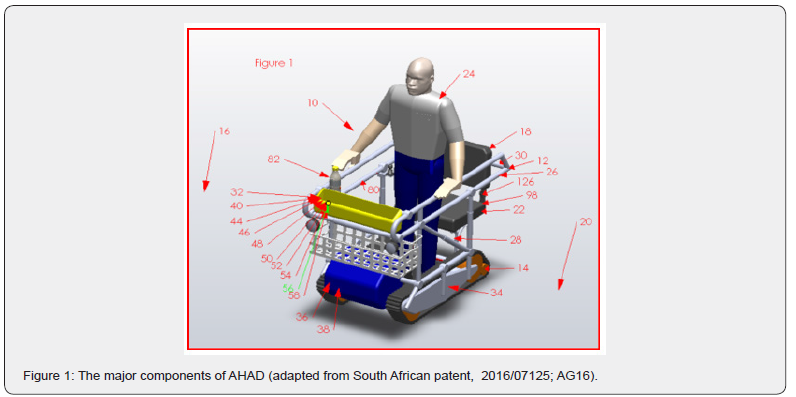
The major components of the AHAD, along with their descriptions, are presented schematically below.
Figure 1: The key symbols descriptions:
10 – AHAD; 12- frame; 14 – operating system; 16 – end region;
18- multifunctional seating arrangement; 22-seat; 24- patient;
26 – safety bars; 28- side bar; 30- cross bar; 32- screen; 34-
track frame; 36 – gear arrangements; 38- batteries; 40- control
board; 44- PLC processor; 46- eye tracer; 48 – voice recorder; 50
-microphone; 52-speaker; 54- video camera; 56-voice recognition
system; 58- radio frequency transmission system; 60- interface;
80- outer sensors; 82-inner sensors; 98- a lever; waste removal/
cleaning sensor; 126-drayer (see Figure 1).
The subsequent paragraphs present explanations of the AHAD
major components:
a) A frame and drive means
b) The operating system
c) Safety and support members
d) The multifunctional seating arrangement
e) The walking arrangement
f1
a) The frame and drive means
AHAD comprises a frame mounted on a drive means, an operating system, and a multifunctional seating arrangement located at the opposite end of the frame (see Figure 1). The frame may include safety bars that allow a patient standing within the frame to hold them for support during walking exercises. The drive may take the form of a continuous track that allows a patient to ascend steps one step at a time. The continuous track may be a caterpillar ™-type track configured to prevent the device from slipping downstairs. A motor and gear arrangement may be used to operate the drive means.
b) The operating system
The operating system may control the device’s overall operation, including direction, speed, and turning. The sensors detect the distance and position of the device from objects in the vicinity. The operating system may be controlled remotely by a caregiver, who can send commands via a wireless remote hand device. Data transmitted to the operating system may be sufficient for it to control the device’s speed and position. The operating system may include a messaging system that sends short voice commands to reinforce patient movements and encourage sustained walking. It is worth noting that the voice commands sent by the operating system may assist a patient with mild Alzheimer’s disease symptoms.
c) Safety and support mechanisms
The sensors may record instances in which the patient is unbalanced, with the patient protruding beyond the sides or in an unsafe position. The safety mechanism may include safety members placed on either side of the frame. The safety mechanism may include a safety fastening means that is activated upon activation of the safety members. The safety members, in turn, activate the fastening members to fasten the unbalanced patient to the seat. The support members may assist in balancing a patient using the device. The support members may be mounted on the frame bars, allowing them to slide along the frame.
d) The multifunctional seating arrangement
The multifunctional seating arrangement may include a patient seat. The multifunctional seating arrangement may be converted into a wheelchair. The multifunctional seating arrangement may include a removable toilet to accommodate the cleaning system. The multifunctional seating arrangement may include a detachable container located underneath the seat. Moveable plates on the seat may open, allowing waste to be released into a container or incinerated. The multifunctional seating arrangement may be configured into a bed for the patient to rest.
e) The walking arrangement
In addition to the above components, the walking structure contains the following mechanisms: multifunctional chair, manual drive, control, sensors, a, b, c, d, lights, basket, electric motor, automatic drive control, caterpillar system controlled by the motor, the main control board, an eye tracker, and a telemetry control system.
Components of the AHAD sub-systems
The succeeding paragraphs present mechanisms and descriptions of the AHAD sub-systems.
i. The cleaning subsystem /waste removal subsystem
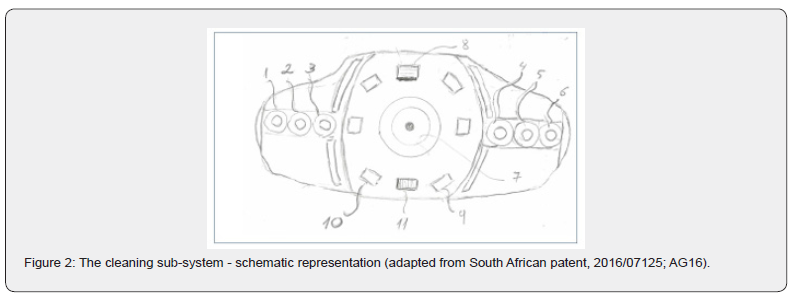
The cleaning/waste removal subsystem includes cleaning mechanisms, see Figure 2.
The following are components of the cleaning subsystem with descriptions: 1- Sprayer unit control; 2- Dryer unit control;3-Vacuum sacking unit control; 4-Vacuum sacking manual button; 5- Sprayer manual button; 6-Drier manual button; 7-Lights; 8-Well-being body monitoring unit;9-Sensor (Figure 2).
The cleaning/waste removal subsystem may include several cleaning components triggered by an activating member, such as a belt placed on the patient in a non-invasive manner. The belt may include buttons for activating a vacuum cleaner, a water sprayer, and a dryer. It should be noted that the cleaning subsystem may be connected to a special nappy if a patient is nappy-dependent. The cleaning sensors may transmit data to the operating system, which then activates an automatic cleaning subsystem to clean the patient.
ii. The feeding sub-system
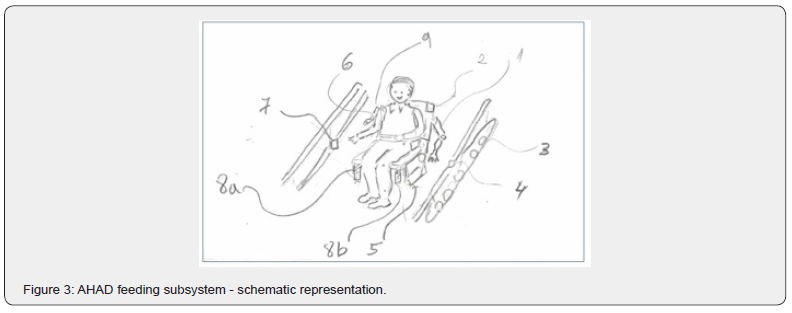
The feeding sub-system may include communication with support members and may be activated by voice commands and/ or eye movements. A food storage member may be located on one side of the multifunctional seating arrangement. The food storage member may be in the form of a portable chest refrigerator. The sensor may indicate a food shortage, and the eye tracker and voice input may be used. The feeding system may include a board mem ber that can be removed and placed in front of the patient in an open receiving position. See Figure 3.
The key elements of the feeding subsystem are as follows: 1-Robotic arm; 2- Signal unit a; 3- Sensor b; 4- Caterpillar; 5- Flexible board -feeding; 6- Robotic arm; 7-Balance system 8a and 8b;9-Signal unit b. The following sections describe additional AHAD functionalities and the dynamics among subsystems.
Additional AHAD functionalities
The AHAD records the patient’s movements and can also serve as a wheelchair, with a movable seat integrated into its structure. The caterpillar’s technology enables it to climb and descend steps while maintaining balance, thereby minimising the need for human support. The voice subsystem is activated in response to changes in subsystems that support walking, feeding, and waste removal. Furthermore, the AHAD environment provides cognitive stimulation through voice guidance and visual stimuli, motivates the person to engage in regular walking exercises, satisfies basic human needs without requiring unnecessary transportation, and minimises physical constraints Nagai [39]. Thus, the AHAD provides easy accessibility, autonomy, walking and psychological rehabilitation, simplicity of use, operational safety, and product feasibility for older adults and individuals with special walking needs.
Dynamics within the AHAD
The AHAD, a walking rehabilitation system with a remote voice communication module, comprises the signal acquisition and detection, signal discrimination and classification, and module activation. Furthermore, the AHAD comprises a regulator, connected to the operating system via software, that analyses and synchronises streams of data, including clearing, feeding, movement, and voice data. These streams are composed of data from various sensors, placed in the vicinity of the person or activated by voice, push buttons or three lights (green, red, and orange). The AHAD system processes real-time auditory data to manage the acquisition and processing of the patient’s input voice and motor movement data via an audio- and motor-movement analysis processor. The real- time framework was developed to manage the acquisition and processing of sensory data and sound-detection events. The AHAD operating system analyses audio signals containing predefined voice instructions and the person’s responses to activate corresponding actions, thereby feeding and cleaning subsystems. Several modules operate synchronously. For example, if the feeding subsystem is enabled in real time, other subsystems are locked. The AHAD speech detector is designed to accept only a limited set of predefined voice messages that direct the conversation toward therapeutic material relevant to the identified modules..
A Summary of the AHAD
The AHAD is an automatic, innovative rehabilitation ICT and AI device that supports software modules, automation, robotics, sensors, and a voice communication system. The design of the AHAD system follows the Human-centred design principles Losco, Lupacchini, Bradini, L Paciotti [13], following three-stage model: analysis of current rehabilitation needs of people with special walking requests; development of a paper prototype; and results, which highlight the best design solutions for testing the prototype. The AHAD is a product that emerged from Health Assistance Devices (HAD), a new paradigm in ICT and artificial Intelligence, to assist older adults and the general population. Based on ubiquitous computing, this technology enables the integration of computing into our living environment Weiser [41]; Dubowsky [36]; Mocanu [11]; Chan [29]; Losco, Lupacchini, Bradini & Paciotti [13]. There are architectural barriers in homes and institutions; a shortage of staff in nursing homes; physical obstacles that limit opportunities for walking rehabilitation; and a lack of automated infrastructure to support basic human needs, including feeding and waste removal/cleaning. The AHAD may help alleviate the constant need for transportation for cleaning or feeding, may have a positive psychological influence on patients and caregivers, and may reduce time and costs, thereby increasing energy for walking exercises.
Discussion
This paper describes the design of a robotic automatic health-assistance device for older adults and individuals with mobility impairments. Taking societal limitations into account, the components of the AHAD are designed to minimise transportation for feeding and cleaning during the recovery process and to enable convenient walking exercises; thus, it is a fully equipped unit that supports crucial basic life functions. The AHAD system assists with feeding, walking, cleaning, and voice communication and exhibits complex robotic functionalities, including a mechanical structure that provides means for self-care and minimises dependence on nursing engagements. The AHAD was designed to account for the constraints faced by older adults and persons with mobility impairments, given the limited resources available in many societies to support basic life functions during treatment. This paper argues about a lack of adequate resources and, consequently, a lack of appropriate care for older adults and people with motor impairments within the current healthcare institutions, and a lack of awareness and knowledge of how to incorporate technology to address all relevant needs and well-being of the patient during walking and other rehabilitation processes.
In this article, innovative technological solutions for older adults and people with motor disorders were discussed Gulick [42]; Finlayson [43]; Noseworthy, Lucchinetti, Rodriguez & Weinshenker [44] as a basis for the derivation of the AHAD, which may serve as a critical aid to caregivers and decision-makers in healthcare institutions. Thus, AHAD was derived through a combination of theoretical, practical, and reflective experiences to support the rehabilitation process and to recognise the impact of the multifaceted nature of older adults’ and persons with motor impairments, their physical and mental needs. The documentary analysis and reflective synthesis indicated a dynamic intersection of numerous factors related to walking, rehabilitation, the appreciation of basic human needs, and technological development in the field e.g., Dubowsky [36]; Lunenburger [6]; Chen [32]. Existing ignorance regarding the introduction of technology into intimate topics, such as waste removal, should be placed within the context of longterm research and healthcare goals.
Furthermore, the documentary analysis indicates the importance of designing comprehensive care for older adults, including robotics, sensors, full supervision, and auditory stimulation Vacher [12]. Research findings, e.g., Intille [8] and Gulick [41], highlight the multiplicity of innovative designs, but there is no consensus on which technological means can be used to provide comprehensive caregiver solutions. The research question seeks to determine the following: “What are the components and functionalities of the automatic healthcare assistance device? To answer the research question, the author developed the AHAD, which comprises feeding and waste-removal/cleaning subsystems. Although the subsystems are depicted as separate entities, they interact synergistically, in that each function may influence and guide the others. Consequently, components of the AHAD are interconnected, including automatic feedback control and monitoring. Healthcare institutions, with their resources and opportunities, play a vital role in the rehabilitation of older adults and people with mobility limitations, and may benefit from this technological innovation due to its novelty, provision of a detailed, logically connected structure, and its innovative components driven by AI models that are out of focus of this article.
Conclusion
The article explored theoretical and research perspectives on assistive devices, providing a range of technological solutions for older adults and people with walking impairments, culminating in the development of the Automatic Healthcare Assistance Device (AHAD) as a multifunctional healthcare device.
The article described several innovative technological solutions
for providing holistic care for older adults and people with
motor impairments, applicable in homes, nursing homes, and in
stitutions. In summary, an in-depth analysis of the literature, existing
practices at nursing homes, examinations of current technological
solutions, and the design of the AHAD prototype reveal the
following tentative conclusions:
i. This unique assistance device stimulates the process of
walking associated with older age or traumatic damage to locomotor
movements.
ii. AHAD provides automatic control features and self-control
of feeding and waste removal functionalities during walking
exercises that minimise the cost of transportation and human resources
Nagai [39].
iii. The AHAD provides additional features than current
technological solutions, se.g, self-sufficiency, no restrictions for
movements in space, voice stimulation with a minimal requirement
of human resources, e.g., Cavallo [28], [31]; Krebs [9]; Losco
[13].
In light of the discussion in this article, it can be concluded that older adults and people with mobility impairments require comprehensive care, as they are defenceless and vulnerable and unable to meet their basic human needs without advanced technologies.
Value added, limitations, and future research
Value added: The design of the AHAD makes use of robotics, telemetry, sensors, and voice-control features, which support people with walking impairments, and the aging population, and people with mild mental disabilities is based on the solid theoretical framework, with the purpose, to contribute to holistic care at homes and institutions and this may be regarded as the originality and the value of this study. Changing how we construct our decisions regarding holistic rehabilitation may provide an innovative foundation for novel ideas and remediation. The design presented in this paper may also encourage multidisciplinary research on technological approaches and on an inclusive rehabilitation framework for individuals with walking impairments and other co-occurring disabilities. This research output may serve as a point of departure for the healthcare of older adults and people with walking disturbances so that caregivers are better informed to develop altruistic and humanitarian values towards the older adults and are capacitated to question critical policies, government, and the media on automatization and technological solutions of basic human needs such as feeding and waste removal Jakovljevic [40]; Cavallo [28]; Dubowsky [36].
The AHAD, with its multifunctional structure, components,
and dynamics, provides a deeper insight into automated assistance
devices in healthcare. The design presented in this paper will
encourage multidisciplinary research on technological approaches
and an inclusive rehabilitation framework for individuals with
walking impairments and other accompanying disabilities. Thus,
the AHAD provides a foundation for further examination of advanced
technological features for older adults and individuals
with mobility needs. A limitation of this research is the lack of
testing of the prototype in different rehabilitation environments,
particularly the examination of voice communication and the
proper functioning of the feeding and waste-removal subsystems.
The outcome of this study aims to motivate researchers to conduct
further investigations into the phenomena of assistive devices and
their applications in comprehensive care for people with walking
impairments. Future research directions: Thus, the conclusions
of this study should be applied with caution in healthcare institutions,
particularly at home, given the need for further research
and testing in real-world settings. Therefore, the functionality of
the AHAD and its method of use require additional research and
analysis, including in-depth assessment and testing procedures, to
identify potential malfunctions in real-world environments.
Data availability statement: Data sharing does not apply to
this article as no new data were created or analysed in this study.
Declaration of Figure 1: Permission has been granted by the
University of South Africa’s Directorate of Innovation, Technology
Transfer, and Commercialisation as a copyright holder to reproduce
the figures.
Competing interests: No competing interests were disclosed.
References
- The World Health Organisation (WHO) (2011). World report on disability.
- Médéric P, Pasqui V, Plumet F, Bidaud P (2003) Design of an Active Walking Aid for Elderly People. Laboratoire de Robotique de Paris. Design of a walking-aid and sit-to-stand transfer-assisting device for older adults. ffhal-03135888f, 1–7. Int. Workshop on Service, Assistive, and Personal Robots. Madrid, Spain.
- Sharkey A, Sharkey N (2012) Grandmother and the robots: ethical issues in robot care for older adults. Ethics and Information Technology 14(1): 27-40.
- Eurostat (2010) https://ec.europa.eu/eurostat/documents/3888793/14842408/KS-01-21-385-EN-N.pdf/78e803f6-7e06-341c-c99f-67ac67cb8e28.
- Buning ME, Angelo JA, Schmeler MR (2001) Occupational performance and the transition to powered mobility: A pilot study. Am J Occup Ther 55(3): 339-344.
- Lunenburger L, Colombo G, Riener R, Dietz V (2005) Clinical Assessments Performed During Robotic Rehabilitation by the Gait Training Robot Lokomat. Proceedings of 9th IEEE International Conference on Rehabilitation Robotics (ICORR), Chicago pp. 345-348.
- Garzia-Vázquez JP, Rodrigues MD, Saldaña D, Tentori ME (2010) An agent-based architecture for developing activity-aware systems for assisting the elderly. Journal of Universal Computer Science 16(12): 1500-1520.
- Intille SS (2002) Designing a home of the future. IEEE Pervasive Computing 1(2): 76-82.
- Krebs HI, Hogan N (2006) Therapeutic robotics: a technology push. Proceedings of IEEE 94(9): 727-1738.
- Yu H, Spenko M, Dubowsky S (2003) An adaptive shared-control system for an intelligent mobility aid for older adults. Autonomous Robots 15: 53-66.
- Mocanu S, Mocanu I, Anton S, Munteanu C (2011) AmIHomCare: a complex ambient intelligent system for home medical assistance. Proceedings of 10th WSEAS International Conference on Applied Computer and Applied Computational Science (ACACOS '11), March 8-10, Venice. Monograph, ISBN: 978-960-474-281-3.
- Vacher M, Portet F, Chahuara P, Caramihai S, Munteanu C, et al. (2014) Indoor personal monitoring, supervising, and assistance in the Sweet-Home and AmiHomeCare case studies. CEAI 16(1): 50-61.
- Losco G, Lupacchini A, Bradini L, Paciotti D (2017) Design for the ambient assisted living. The Design Journal 20: S2090-S2108.
- Fook J (1996) The reflective researcher: social workers. theories of practice research. Sydney: Allen & Unwin.
- Fook J (2004) Critical reflection and transformative possibilities. Davies L, Leonard P, (Eds). In social work in corporate ero: practices of power and resistance. Aldershot, Ashgate p. 16-30.
- Koch T, Harrington A (1998) Reconceptualising rigour: the case for reflexivity. Journal of Advanced Nursing 28(4): 882-890.
- Morley C (2008) Chapter 14: Critical Reflection as a Research Methodology. In Knowing Differently: Arts-Based and Collaborative Research. ISBN: 97-8-I-60456-378-8 Editors: P. Liamputtong, J. Rumbold, Nova Science Publishers. Inc pp. 265-280.
- Bordens KS, Abbott BB (2011) Research design and methods: a process approach. New York: McGraw-Hill.
- Bowen GA (2009) Document analysis as a qualitative research method. Quot Res J 9(2): 27-40.
- Noble H, Smith J (2013) Qualitative data analysis: A practical example. Evid. Based Nurs 17(1): 2-3.
- Tesch R (1990) Qualitative research: Analysis types and software tools. New York, NY Falmer.
- Snyder H (2019) Literature review as a research methodology: An overview and guidelines. J Bus Res 104: 333-339.
- Ritchie J, Lewis J, Elam G (2003) Designing and selecting samples. Ritchie J, Lewis J, (Eds). In Qualitative research practice. A guide for social science students and researchers. Thousand Oaks, CA, Sage pp. 77-108.
- Naderifar M, Hamideh G, Ghaljaie F (2017) Snowball sampling: a purposeful method of sampling in qualitative research. Strides Dev Med Educ 14(3): e67670.
- Saumya V, Rajneesh KG, Spriha P (2017) Sampling typology and techniques. IJSRD - International Journal for Scientific Research & Development 5(09).
- Alvesson M, Sköldberg K (2000) Reflexive methodology—new vistas for qualitative research. London: Sage.
- Kothari CR (2004) Research methodology: Methods and techniques. New Delhi: New Age International Publishers.
- Cavallo F, Aquilano M, Odetti L, Arvati M, Carrozza MC (2009a) A first step toward a pervasive and smart ZigBee sensor system for assistance and rehabilitation. Proceedings of IEEE 11th International Conference on Rehabilitation Robotics, June 23-26, Kyoto International Conference Center, Japan pp. 631-637.
- Chan M, Campo E, Estève D, Fourniols JY (2009) Smart homes — current features and future perspectives. Maturitas 64(2): 90-97.
- Nguyen DT, Oh SR, You BJ (2005) A framework for internet-based interaction of humans, robots, and responsive environments using agent technology. In IEEE Transactions of Industrial Electronics 52(6).
- Cavallo F, Aquilano M, Odetti L, Arvati M, Carrozza MC (2009b) Toward a smart home solution for domiciliary assistance in Alzheimer’s disease”. Proceedings of the International Conference on Alzheimer's Disease (ICAD), Vienna, Austria. July 2009.
- Chen C, Cook DJ (2012) Behaviour-based home energy prediction. CASAS smart home environment. Proceedings of the Sixth International Conference on Intelligent Environments, 19-21 July, Kuala Lumpur, Malaysia p. 1-7.
- Rantz MJ, Fann RN, Skubek M, Subic M, Miller SJ, et al. (2013) Sensor technology to support ageing in place. JAMDA 14(6): 386-391.
- Woelfel M, McDonough J (2009) Distant Speech Recognition. New York: John Wiley and Sons pp. 573.
- Verza R, Carvalho ML, Battaglia MA, Uccelli MM (2006) An interdisciplinary approach to evaluating the need for assistive technology reduces equipment abandonment. Mult Scler 12(1): 88-93.
- Dubowsky S, Genot F, Godding S, Kozono H, Skwersky A, et al. (2000) PAMM – A robotic aid to the elderly: A helping hand for the elderly. Proceedings of IEEE Int. Conference on Robotics and Automation p. 1-7.
- Graf B (2001) Reactive navigation of an intelligent robot walking aid. IEEE Int. Workshop on Robot and Human Interaction. Proceedings of 10th IEEE International Workshop on Robot and Human Interactive Communication (Roman, 2001), Bordeaux, Paris, France pp. 353-358.
- Khatib O, Yokoi K, Brock O, Chang K, Casal A (1999) Robots in human environments: basic autonomous capabilities. International Journal of Robotics Research 18(7): 684-696.
- Nagai K, Nakanishi I, Hanafusa H (2003) The assistance of self-transfer of patients using a power-assisting device. Proceedings of IEEE Int. Conference on Robotics and Automation pp. 4008-4015.
- Jakovljevic M (2018) Automatic healthcare assistance device (AHAD) (South African Patent No. 2016/07125). South Africa Patent and Trademark Office.
- Weiser M (2009) The computer for the 21st Scientific American 265(3): 66-67.
- Gulick EE (2001) Emotional distress and activities of daily living functioning in persons with multiple sclerosis. Nurs Res 50(3): 147-54.
- Finlayson M (2004) Concerns about the future among older adults with multiple sclerosis. Am J Occup Ther 58 (1): 54-63.
- Noseworthy JH, Lucchinetti C, Rodriguez M, Weinshenker BG (2000) Multiple sclerosis. N Engl J Med 343(13): 938-952.

























