




 ARR Home



Abstract
Conventional development of Inland Valley Swamps (IVSs) for agriculture in tropical regions involves extensive canal construction, including a main drain and a peripheral irrigation canal. This design effectively controls water but often severs the critical hydrological and biogeochemical linkages between the swamp and its contiguous hillslopes. In resource-constrained environments, this complex infrastructure is costly to build and maintain, and it prevents the swamp from receiving nutrient-bound sediments and organic matter naturally eroded from the uplands. Thus, this study proposes and evaluates a redesigned IVS development model that maintains only the essential main drain canal while eliminating the peripheral canal. The objective is to leverage natural hillslope processes to enhance soil fertility and reduce external input dependency, thereby promoting a more sustainable and economically viable agro-ecosystem. Here, a comparative study was conducted between the conventional and the proposed design using a combination of geospatial modeling of sediment deposition and nutrient budget analysis. A case study from a representative IVS in Sierra Leone was used to parameterize the model, incorporating data on local soil, topography, rainfall, and land use. The model predicts that the elimination of peripheral canal allows for the unobstructed deposition of 5‒8 tons ha⁻¹ yr⁻¹ of hillslope sediments into the IVS. This sediment flux contributes significantly to the nutrient budget, supplying some 35 kg N ha⁻¹ yr⁻¹, 12 kg P ha⁻¹ yr⁻¹, and 20 kg K ha⁻¹ yr⁻¹. This reduces the required mineral fertilizer application by an 25‒40% to achieve target rice yields. Furthermore, the proposed design reduces initial earthworks and long-term maintenance costs by over 50% compared to the conventional system. The redesign of IVS development by omitting peripheral canal presents a pragmatic eco-hydrological strategy for sustainable intensification. It transforms IVS from a hydrologically isolated production unit into an integrated landscape element that benefits from natural nutrient subsidies. This approach is particularly suited to resource-constrained tropical environments, offering a pathway to improved productivity, enhanced resilience, and reduced economic burden for smallholder farmers.
Keywords:ACOG: American College of Obstetricians and Gynaecologists; hCG: Chorionic gonadotropin Inland Valley Swamp; Nutrient cycling; Low-input systems; Tropical Africa; Smallholder farmer
Abbreviations: IVSs: Inland Valley Swamps; CD: Conventional Design; PR: Proposed Redesign; DEM: Digital Elevation Model; RUSLE: Revised Universal Soil Loss Equation
Introduction
Inland Valley Swamps (IVSs) are seasonally waterlogged wetlands located in the upper reaches of river networks across tropical Africa and Asia. They represent a vast, underutilized resource for sustainable agricultural intensification, particularly for staple crop production like rice (Oryza spp.), due to their inherent soil moisture availability and generally higher native fertility compared to adjacent uplands [1,2].
Conventional development of IVSs for agriculture has historically followed an engineering-centric paradigm aimed at total water control [3]. This typically involves the construction of two primary hydraulic structures: 1) a main drain canal to remove excess water and prevent prolonged submergence, and 2) a peripheral irrigation/drainage canal that encircles the swamp, designed to intercept hillslope runoff and either divert it away or distribute it within the swamp [4]. While this design provides a high degree of hydrological management, it has significant drawbacks, especially in resource-constrained tropical environments.
First, the construction and maintenance of this dual-canal system are capital/labor-intensive, often exceeding the financial and technical capacities of local communities and governments [5]. Second, and more critically from an ecological perspective, the peripheral canal acts as a moat, effectively severing the lateral connectivity between the hillslopes (the contributing area) and the swamp floor (the depositional area) [6]. This disruption halts the natural geomorphological process where sediments, organic matter, and associated nutrients (N, P, K, micronutrients, etc.) are transported from the hillslopes and deposited in the swamp during runoff events [7]. By intercepting and diverting this resource-laden flow, the conventional design necessitates a higher reliance on external mineral fertilizers to maintain soil fertility — inputs that are often unaffordable or inaccessible to smallholder farmers [8]. We hypothesize that a strategic redesign of IVS development that maintains the crucial main drain for water table control but eliminates the peripheral canal to create a more resilient and productive agro-ecosystem. This design leverages natural landscape processes to provide a continuous, low-cost nutrient subsidy, thereby reducing external input dependency. This paper aims to conceptualize this paradigm shift, provides a theoretical and practical framework for its implementation, and quantitatively evaluates its potential benefits in terms of nutrient input and cost-effectiveness compared to the conventional model.
Materials and Methods
Study Area and System Concept
The proposed design was conceptualized and analyzed using a representative IVS located in the Sahn Massaquoi Village in Pujehun District, Sierra Leone (07° 20’ 27.2″ N, 011° 37’ 12.2″́ W; 11 m). The region experiences a tropical monsoon climate with an average annual rainfall of 2,500 mm. The IVS is flanked by gently sloping hills (5‒15% gradient) under a mosaic of secondary bush and smallholder upland farms. Soils on the hillslopes are highly weathered, acidic Ultisols, while the swamp bottom has hydromorphic properties. Two system designs were compared: 1) Conventional Design (CD), which features a main drain and a peripheral canal, and 2) Proposed Redesign (PR), which features only a main drain with the swamp floor open to the hillslopes.
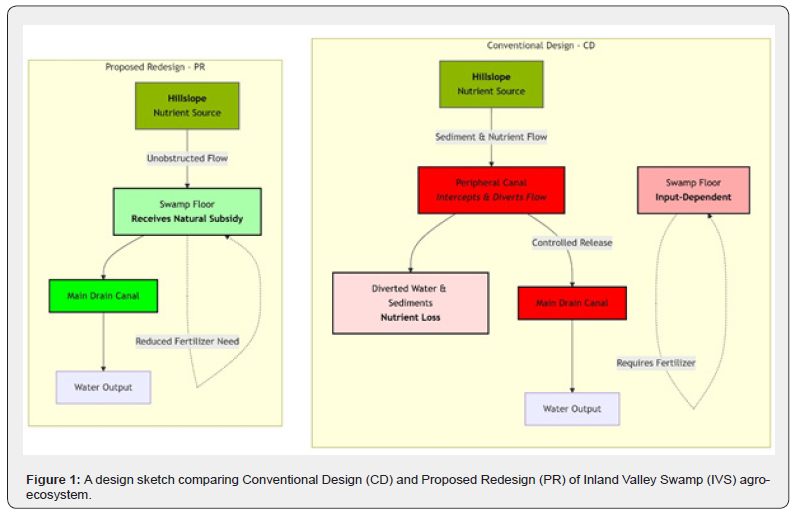
Figure 1 is a schematic comparison of the CD and PR development models of IVS. In the conventional Design (CD), the peripheral canal (red) acts as a moat, intercepting and diverting nutrient-bound sediments and organic matter from the contiguous hillslopes. This hydrologically isolates the swamp, making it dependent on external fertilizer inputs. The Proposed Redesign (PR) eliminates the peripheral canal and restores lateral connectivity. Sediment-laden nutrients from the hillslopes are deposited directly onto the swamp floor, providing a continuous ecological subsidy. The main drain (green) is retained for essential water table control, but the system functions as an integrated, more sustainable landscape unit. The main drain here can be used both for drainage and irrigation after minor adjustments. This can be done by installing breakers along the drain to raise the water level and opening the water in-take pass along the bonds to let water in and out of the plots.
Geospatial Sediment Deposition Modeling
A Digital Elevation Model (DEM) of the study area was used
to delineate the catchment and the IVS boundary. The Revised
Universal Soil Loss Equation (RUSLE) was used to estimate annual
soil loss from the contiguous hillslopes [9]:
A = R × K × L × S × C
where A is annual soil loss (t ha⁻¹ yr⁻¹), R is rainfall-runoff erosivity factor, K is soil erodibility factor, L and S are slope length and steepness factors, and C is cover-management factor.
The Sediment Delivery Ratio (SDR) to the swamp in the PR scenario was estimated based on catchment topography and connectivity [10]. In the CD scenario, the SDR was assumed to be near zero due to the interception by the peripheral canal.
Nutrient Budget Analysis
The nutrient contribution from the deposited sediments was calculated by multiplying the estimated sediment deposition rate by the average nutrient concentration (Total N, Available P, Exchangeable K) of the hillslope soils, determined from laboratory analysis of composite samples. A simple partial nutrient budget was constructed for a representative rice crop, comparing the nutrient supplied by hillslope sediments in the PR system with the fertilizer recommendations for the CD system.
Economic Assessment
A comparative cost analysis was done based on standard earthwork calculations. The volume of soil to be excavated for the main drain and the peripheral canal was estimated from the crosssectional dimensions and length. The cost saving from the PR design was calculated as the percent reduction in total earthwork volume.
Results
Hydrological and Sediment Connectivity
The RUSLE model estimated an average hillslope soil loss of 12 t ha⁻¹ yr⁻¹. With an estimated SDR of 0.5 for the PR design, the annual sediment deposition into the IVS was calculated to be 5‒8 t ha⁻¹ of swamp area. In the CD scenario, this sediment flux was effectively captured by the peripheral canal, leading to siltation of the canal itself and a net loss of this material from the agroecosystem.
Nutrient Input from Hillslope Sediments
The chemical analysis of hillslope soils revealed moderate nutrient concentrations. The annual nutrient contribution to the IVS under the PR design is summarized in Table 1.
This natural nutrient subsidy represents a significant portion of the typical fertilizer recommendation for swamp rice (e.g., 60‒80 kg N ha⁻¹, 20‒30 kg P₂O₅ ha⁻¹, 20‒30 kg K₂O ha⁻¹), potentially reducing the required mineral fertilizer application by 25‒40%.
Economic and Maintenance Implications
The elimination of the peripheral canal resulted in over 50% reduction in the total volume of earthworks required for IVS development. For the modeled 10-hectare swamp, this translated to a saving of 4,000 m³ of excavation. Furthermore, the PR design eliminates the recurring cost and labor associated with desilting and maintaining the peripheral canal, a major challenge in conventional systems.
Discussion
Reconnected Landscape for Sustainable Fertility
The results of the study demonstrate that the proposed redesign fundamentally shifts the IVS from an engineered inputdependent system to an integrated ecosystem-based one. By allowing natural deposition of hillslope sediments, the PR design reactivates a key ecological process suppressed by conventional engineering [6,7]. The annual nutrient inputs (Table 1) constitute a substantial “ecological subsidy,” enhancing the sustainability and resilience of the farming system. This is analogous to the principles of conservation agriculture, which seek to work with, rather than against, natural processes [11]. This approach is particularly advantageous in tropical environments where soils are often highly weathered and infertile. The deposited sediments not only provide nutrients but also contribute to improving the soil physical properties (texture and water-holding capacity) and can help in sequestering organic carbon [12].

Addressing Potential Challenges
A valid concern with the PR design is the potential for excessive sedimentation or the introduction of contaminants from the hillslopes. Management of the hillslopes is therefore critical. Promoting sustainable land use practices on the contiguous slopes (such as agroforestry, contour farming, and maintained vegetation cover) is essential to ensure that the sediment flow is beneficial and non-destructive [13]. This necessitates a holistic landscapescale management approach rather than a focus solely on the swamp bottom. Another consideration is water management, where the peripheral canal in the CD system provides a means for supplemental irrigation during dry spells. In the PR design, this function is lost. However, in many rain-fed IVS, the primary challenge is excess water, not deficit. The main drain remains critical for preventing waterlogging and can be adjusted to perform this second function too. In regions with pronounced dry seasons, the PR system can use this adjusted main drain for irrigation.
Implications for Policy and Practice
For governments and development agencies operating in resource-constrained settings, the PR design offers compelling cost-effective alternative. It drastically lowers the barrier to entry for IVS development, enabling the bringing of more land under productive use with limited funds. It also aligns with the principles of “Climate-Smart Agriculture” by enhancing natural resource use efficiency and building system resilience [14]. Extension services should be trained to communicate this new paradigm, emphasizing the co-management of the hillslopes and the swamp. Farmer-led implementation, where communities understand the direct link between hillslope conservation and swamp fertility, can foster a powerful incentive for sustainable landscape management.
Conclusion
The conventional design of IVS with its dual-canal system is a relic of a top-down, high-input agricultural paradigm that is often inappropriate for the ecological and socioeconomic realities of tropical Africa. By redesigning IVS development to maintain only a dual-function main drain that eliminates the peripheral canal is a pragmatic shift towards a more synergistic and sustainable model. This open-swamp design harnesses natural hillslope processes to provide a continuous low-cost nutrient subsidy that reduces dependency on expensive mineral fertilizers. It significantly lowers construction and maintenance costs, making swamp development more accessible to poor communities. The success of this approach hinges on integrated landscape management, where the health of the hillslopes is recognized as integral to the productivity of the swamp. Future research should focus on field-based validation through long-term trials, monitoring actual sediment and nutrient fluxes, crop yields, and soil health indicators under the proposed design compared to conventional systems.
References
- Windmeijer PN, Andriesse W (Eds.) (1993) Inland Valleys in West Africa: An Agro-ecological Characterization of Rice-Growing Environments. ILRI.
- Rodenburg J (2014) Sustainable rice production in African inland valleys: Seizing the potential. Agricultural Systems 123: 1-6.
- Oosterbaan RJ (1994) Agricultural Drainage Principles and Applications. ILRI Publication.
- Gbakima AA (1994) Inland valley swamp development in Sierra Leone. Singapore Journal of Tropical Geography 15(2): 162-175.
- Braimoh AK (2004) Modeling land-use change in the Volta Basin of Ghana. Ecology and Society 9(1).
- Verhoeven JT, Setter TL (2010) Agricultural use of wetlands: opportunities and limitations. Annals of Botany 105(1): 155-163.
- Woperëis MCS (2007) Farming the valley: a resource guide for lowland rice-based systems in West Africa. Africa Rice Center.
- Sanchez PA (2002) Soil fertility and hunger in Africa. Science 295(5562): 2019-2020.
- Renard KG (1997) Predicting soil erosion by water: a guide to conservation planning with the Revised Universal Soil Loss Equation (RUSLE). USDA Agriculture Handbook.
- Vigiak O (2012) A segmentation approach for mapping sediment delivery ratio at the regional scale. Journal of Soils and Sediments 12(1): 1-17.
- Hobbs PR (2008) The role of conservation agriculture in sustainable agriculture. Philosophical Transactions of the Royal Society B 363(1491): 543-555.
- Lal R (2003) Soil erosion and the global carbon budget. Environment International 29(4): 437-450.
- Mati BM (2007) Managing the impact of land use on the water resources of the Lake Victoria Basin. IAHS Publication.
- Lipper L (2014) Climate-smart agriculture for food security. Nature Climate Change 4(12): 1068-1072.

























