




 ARR Home



Abstract
Purpose: To find out if the role coffee plays in eyelid spasms is beneficial or deleterious.
Methods: This is a narrative review of articles on coffee and eyelid spasms. Original articles on eyelid spasm and coffee were searched on popular databases.
Results: Out of a total of over 1000 studies from the different databases searched, only six was found eligible for the study. One of the studies showed a beneficial effect, one showed a deleterious effect, two were inconclusive, one showed no effect and one with a deleterious effect with no direct link to coffee.
Conclusion: The role of coffee in eyelid spasms still remains inconclusive. While some studies point in the direction of a trigger and some a therapy, the heterogeneity of these studies as well as the balanced contradictory findings from this review, makes it difficulty to draw an overall conclusion on the exact role of coffee in diverse eyelid spasm. Although additional findings showing the association of eyelid spasms with some other lifestyle factors noted among regular coffee drinkers might suggest a tilt towards a trigger in the presence of certain parameters, a meta-analysis and randomized controlled clinical trials on the definitive role of coffee in eyelid spasms would be highly recommended.
Keywords:Coffee; Eyelid spasms; Trigger; Therapy; Review; Narrative
Introduction
Food has a great impact on the nervous system. Some of the effects could be beneficial while others could be deleterious. Eyelid spasms which include a range of involuntary movements in the eye due to abnormalities in nervous coordination, are quite common and range widely from subtle to grossly debilitating. While there are different causes of eyelid spasms, certain food and medications may have an impact on this condition. The most common psychoactive agent consumed globally is caffeine, with coffee, chocolate and tea being the most common natural sources. [1] It is quite important to note that while some patients give a history of intake of large amounts of coffee around periods of eye lid spasms, many literature reports a decline in the incidence of eyelid spasms with coffee intake. These eye lid spasms range from blepharospasms, to ocular myokymia, hemifacial spasms amongst others. While so many factors like lack of sleep, stress, dry eyes and too much caffeine has been linked with eyelid spasms, [2] coffee seems to be a particularly common trigger. Regarding the pharmacokinetics of caffeine which is a major active agent in coffee, its mechanism of action is by binding to adenosine receptors which are found in both the central and peripheral nervous system, as well as the blood vessels and heart. Caffeine antagonizes type 2A adenosine receptors earlier on in brain development. [1] While the cortical control of eyelid movement is not yet well elucidated, recent findings primary motor cortex (M1). Newer studies also show the role of the amydala, however the direct role of the cortical areas in the pathophysiology of eyelid movement is not yet known [3].
If coffee is taken at toxic doses, it could additionally cause alterations in cellular functions by releasing calcium from central stores at levels that might be lethal. [1] It is important to note the role of calcium in muscle contraction which is what occurs in eyelid twitches and the possible implication of this on the role caffeine might play in ocular spasms. However, the effect is dose related and therefore with conflicting evidences, there is need to find out the effect of coffee on the eyelid spasms and a possible dose response variability. Eyelid spasms are usually due to excessive muscular activities caused by nervous stimulation and involving the eyelid muscles. Coffee is a common beverage taking many times as part of breakfast mostly in developed countries but also increasing popular in developing nations as well. It has a stimulating effect on the nervous system, hence its use to awaken the senses early in the morning. It is also popular amongst students wherein the use may be inappropriate as it has additive properties. Despite the usefulness of this beverage, its long-term implication on the nervous system needs to be explored. One of these is its effect on the muscles of the eye including its effect with regards to blepharospasm, ocular myokymia amongst others. Eyelid myokymia, which is the most common of these spasms is said to be mostly benign with no association with any disease, although it may rarely precede the more serious facial myokymia which may be associated with brain stem tumors [4].
There have been numerous studies showing the beneficial effect of coffee in reducing eyelid spasms, while others point to an increase incidence of eyelid spasms with the use of coffee. According to the pathophysiology of caffeine, which is a nervous stimulant, it seems reasonable that this beverage should induce rather than relieve this condition. A wide range of studies showing its beneficial effect in these conditions warrants the need to review literature on the possible role of this beverage in people with these conditions. One of the most common type of eyelid spasm is eyelid myokymia, which is precipitated by large consumption of caffeine. It is a form of eyelid spasm that seems to be common amongst medical students and therefore sometimes called “medical students” disease. [5] Blepharospasm, which is a kind of dystonia [6] is a more severe form of eyelid twitch and usually lasts longer. While sometimes the cause might be found for instance with irritation of the cornea or conjunctiva, in many other instances the cause is not known.
Eyelid twitches which is a general term used to describe all eyelid muscle spasms including blepharospasms, ocular myokymia, amongst others, have been found to triggered by stress, caffeine, fatigue and alcohol intake in excess. [7] Asides ocular spasms, some of the other causes found to cause muscle spasms generally include anxiety and stress, physical activity, stimulants such as coffee and nutrient deficiencies [8]. This study aims to find out the effect of coffee on the eye lid spasms by giving a narrative review on articles related to coffee drinking and eyelid twitches. This is in a bid to better educate sufferers of eyelid spasms and those predisposed on the implications of coffee intake on their condition, as well as to ensure appropriate management of the eyelid spasm.
Beneficial Effects
The beneficial effect of coffee in eyelid spasms was noted according to some research, [9] which shows that coffee drinking is protective against eyelid blepharospasm, with the authors estimating that there is need to take one or two cups of coffee daily for the beneficial effect to be noticed. Furthermore, defazio et al. [10] in a case control study on 166 outpatients with blepharospasm to find out the effect of non-decaffeinated coffee and cigarette on the development of blepharospasm, found that 4% and 5% of the hospital and population control groups were past drinkers of coffee, while 22% and 17% of the hospital and a population control groups respectively were past smokers. A strong suggestion of coffee confering a protective effect on blepharospasm was strongly suggested, and a doubt about the association of smoking with blepharospasm was made. In another study, it was found that coffee drinkers are less likely to develop primary late onset blepharospasm. It was noted that this effect was proportional to the quantity of coffee consumed with one or two cups noted to play this protective role [8].
Deleterious Effect
On the other hand, particularly at high doses the deleterious effect of coffee in eyelid spasms was noted. It has been reported that although moderate coffee drinking is considered safe, excessive consumption is said to result in eyelid spasms [11]. Another study by Defazio et al. [12] in which first degree relatives of patients with primary blepharospasm were evaluated using a diagnostic procedure which had a 2-step validation. It was found that there was no significant difference between sporadic and familial cases regarding the amount of times coffee is taken and presence of eye diseases, or in the onset age, sex or there ability to spread. There was however a significant inverse association between ever drinking coffee and the case status. It was concluded from this large family based study that coffee drinking and eye diseases are risk factors for blepharospasm [12]. Also, it was noted that coffee which is a diet nervous system stimulant are big causes of eyelid twitching. This it does by increasing muscle activity [13].
Other Factors
Asides the possible role coffee and lifestyle may play on eyelid spasms such as ocular myokymia, it is important to find out the role other factors such as drugs and herbal medications might play, particularly if they are ingested concurrently with coffee. Khalkhali in a case report of a 47-year old woman who was started on topiramate for binge eating and thereafter developed a chronic lower lid twitching progressing to a same side upper lid and eyebrow twitching. This patient had no history of caffeine, alcohol use and does not smoke. The was no significant change with lifestyle modifications. The was however a resolution of the symptoms when topiramate was discontinued. It was concluded that despite eyelid myokymia being a benign condition, it might be very distressing if long standing. The neuroophthalmic side effect of topiramite should also be made aware to physicians [14]. Research at the moment is mixed with regards to the role coffee makes in eyelid spasms. This research intends to review and analyse the numerous research work conducted on these in other to better understand the role of coffee in lid spasms and offer appropriate recommendations.
Rationale for the Review
Eyelid spasms while many times might not be harmful, is usually grossly disturbing and of serious concern for the affected individual. It impacts on the individuals performance, quality of life and in some cases may signify more serious pathological condition. Many of these individuals present to the eye clinic with concerns about the abnormality. Coffee is a common beverage and may have addictive effect making it very crucial to know the role it plays with regards to ocular spasms particularly in predisposed individuals. It is important to know if coffee is a trigger for or worsens eyelid spasms or is of therapeutic benefit in these spasms, as different literatures give conflicting report on these. The lack of common agreement with regards to the role of coffee in eyelid spasm makes it imperative to undergo a review of literatures on this, in other to better advise the populace and manage patients with this condition. The public health implication of these is that if coffee actually induces these ocular spasm, then a whole number of individuals with ocular spasms may have new onset of ocular spasms or worsening of the spasms due to a knowledge gap. Z On the other hand, if it has therapeutic benefits and it is avoided in these group of individuals instead of being consumed, then a potential therapy for these spasms may be overlooked. Thus the rationale for these study.
Methods
Research Procedure
A narrative review of articles on the effect of coffee on eyelid spasms was conducted. Having formulated the research questions, the key concepts in the research question were identified and made into a concept table. Thereafter, search terms were developed using key words and free text terms. The fields to be searched were decided and a search field descriptor that searches the title, abstract and keywords were used. A comprehensive search was done using this search technique for relevant articles published on indexed journals and databases like PubMed, Google Scholar, Medline, Embase, CINAHL, Scopus, and Web of science. This was done using search words like ocular twitching and coffee, coffee and bleparospasm, coffee and ocular myokymia, eye movement and coffee, coffee and eyelid spasms, coffee amount and ocular twitching. The searches were collected qualitatively. A critique of the nature and quality of evidence available with regards to the research question was also done. The researcher conducted the screening of the literature and data extraction. The Newcastle-Ottawa Quality Scale and Agency for Healthcare Research and Quality scales was used to assess the quality of the selected studies.
A standard framework based on the research question type was created using the Population, Intervention, Comparison, Outcome and Time (PICOT) approach. To select the studies based on the objectives of the research, the quality assessment for each relevant study was first be done. This was done by looking at the content validity of the research, how credible, applicable and generalize- able the research is. The studies’ risk of bias, imprecision, publication biases, inconsistencies were also considered. After this was done, the studies found to be of sufficient quality were selected for the study. The aggregated data from interviews, observational studies and other qualitative studies were assessed. The outcomes obtained were noted based on the research objectives of the study. The results obtained were summarized as a narration. There was however significant heterogeneity and a meta analyses could not be done.
Ethics Approval
This review research did not need an ethical approval because only published research was utilized.
Research Protocol
After the relevant articles were selected based on the quality for the research and the eligibility criteria, the findings were noted based on the specific research objectives. The data obtained was thereafter summarized as a narration. A meta-analysis could not be done due to the heterogeneity of the findings.
Inclusion Criteria
All articles on coffee and eyelid spasms, coffee and blepharospasm, coffee and ocular myokymia, coffee amount and ocular twitching were searched on indexed journal after an assessment of the quality of the selected studies was done.
Exclusion Criteria
Articles not found in indexed journals, articles which were found not to have good quality based on the Newcastle-Ottawa Quality Scale and Agency for Healthcare Research and Quality scales, and articles whose nature was irrelevant to the research questions were excluded. Review articles were also excluded from the study.
Outcome Variables:
Number of studies showing beneficial effects of coffee on eyelid
spasms
Number of studies showing deleterious effect of coffee on eyelid
spasms
Amount of coffee showing what effect on eyelid spasms
Effect of other nutrition or lifestyle related events on eyelid
spasms.
Summary statistic for each selected study.
Statistical Techniques: This Was Done in two Stages
i. The summary for each of the selected studies was obtained
as a narration, based on the objectives of the study and the
outcomes of interest.
ii. An analysis of the narrations obtained was then made.
Data Extraction
The data about the effect of coffee on eyelid spasms were independently extracted by the author. The relevant characteristics of the study based on outcome measures including quantity of coffee, type of eyelid spasm, effect of coffee on lid spasms were obtained from the abstracts.
Data Analysis
A review of the titles and abstracts of articles based on the initial search was done. The articles selected were those published in English and reports on coffee and lid spasms, including clinical trials and observational studies were those considered. All the data was validated by the investigator and those with missing data were excluded from the study. Two review articles were excluded from the study. The data collected was summarized as a narration.
Quality Assessment
The quality of the research of assessed using Newcastle-Ottawa scale
Results
Search Strategy and Selection Criteria
This was done using through a search on PubMed, CINAHL, Web of Science, Scopus, Embase, Google scholar and Medline databases using different Medical Subject Headings (MeSH) keywords to allow desired studies to be evaluated. Time filters ere not applied on the search. The search key words were. The results were downloaded and reviewed manually.
Google scholar searched on blepharospasm and coffee yielded over 1000 search results, with 2 found eligible for selection
PubMed search yielded 7 searches with 4 of this eligible for selection
Embase yielded 197 for coffee and blepharospasm and 12 for coffee and ocular myokymia with 1 initially selected but later excluded from the study being a review article.
Scopus did not yield any relevant search
CINAHL, Medline and Web of Science did not yield any relevant search as well.
Search strategy a) Included
Records identified PubMed(n=7), Embase (n=12), CINAHL
(n=0), Scopus(n=0)
Google Scholar identified (n>1000), Web of Science (n=0)
Records screened (n>1000)
Reports eligible(n=6)
Studies included in review(n=6)
b) Excluded
Records not screened but removed e.g duplicates(n=2)
Records excluded(n=2)
Reports retrieved but excluded afterwards(n=2)
Overall, over 1000 articles were elicited by the primary search. A manual search was conducted. After removing the irrelevant articles and duplicates, the articles were thereafter screened for eligibility. In all 3 observational studies, one case report, one cross-sectional survey and one case control.
Outcomes
Out of the six studies with a total of number of 1,145 participants, only one showed a deleterious effect, one study showed a beneficial effect, two of the studies were inconclusive, one showed no effect and the other showed no direct link. The last study with no direct link, however showed a deleterious effect by an indirect association with coffee intake. The different types of eye lid spasms include eyelid myokymia, blepharospasm, hemifacial spasms were noted
Narrative Summary Statistics of Selected Studies
Beneficial
Defazio et al. [7] in a case control study on 166 outpatients with BSP, who were consecutively recruited in five Italian centers over a 12 month period in addition to 228 patients that are hospital control with primary hemifacial spasm and 187 population control subjects.
Results
A total of 33 cases and 34 control patients. Coffee status among the cases, k=0.89, p<0.0001, control patients k=0.87, p<0.0001, smoking status cases, k=0.90, p<0.0001, control, k=0.93, p<0.0001. Average number of cups/day (cases icc=0,89, P<0.0001, control patients, icc=0.85, p<0.0001) and packs per day (cases, ICC =0.95, P<0.0001), control patients, ICC=0.92, P<0.0001. A univariate logistic regression analysis revealed an inverse association between benign essential blepharospasm and ever drinking coffee and cigarette smoking, while a multivariate analysis made a confirmation of these inverse association with coffee but with no association with cigarette smoking.
Conclusion
Coffee drinking may be associate inversely with primary BSP development and there might be a dose related effect of coffee intake on the association between coffee and BSP. No other nutritional association with BSP was noted but with cigarette smoking, which was not statistically significant.
Inconclusive
Lee et al. [15] in an observational study to analyse the clinical features of benign essential blepharospasm in Korean patients. This was done by evaluating patients diagnosed with benign essential blepharospasm in Kim’s Eye Hospital from Nov 2014 to Dec 2016 using clinical examination and questionnaire.
Results
Showed the majority (83.2%) were not smokers, and those that drank less than one cup of coffee a day were 30.7%.
Conclusion
It was concluded that the coffee use was high but the percentage of patients that drank many cups of caffeinated beverages as low. However, because they did not compare coffee consumption to a control group, it would be difficult to determine if the results indicated that caffeine provides a protective effect regarding Benign Essential Blepharospasm.
Peckham et al. [16] in a study on 240 patients with benign essential blepharospasm to characterize patients with Benign Essential Blepharospasm were by family history, diagnoses and environmental risk factor using clinical examination and questionnaire.
Results
This showed benign essential blepharospsm was more common among females (2.8 to 1). Fifty percent had only benign essential blepharospsm, 31% had this with meige syndrome while 4% had it in addition to eyelid apraxia. The majority are non smokers, were not exposed to antipsychotic and anti emetic agents, had no history of trauma to the head and a normal birth history.
Conclusion
It was concluded that the study confirms previous reports of usual caffeine, age, sex, tobacco use and family history in patients with blepharospasm. Since the conclusions from previous studies on blepharospasm and coffee intake is varied, the study is grouped as inconclusive.
No Effect
Hadzic et al. [17] in a crossectional survey to determine the factors associated with eyelid myokymia and it’s prevalence amongst 100 students in a medical faculty, found that the fifth year students had more likelihood to develop eyelid myokymia than students in the third and forth year.
Results
Out of all the students, 77% noted that they drank coffee regularly and 16% were smokers. However, intake of coffee and smoking did not correlate statistically with eyelid myokymia (P=0.310 and P=0.568). Consumption of energy drinks seen in 39% of the students was a significant predictor for the development of eyelid myokymia (P=0.046). The intake of alcohol seen in 52% of the students did not correlate with the development of eyelid myokymia.
Conclusion
Eyelid myokymia is a common phenomenon among medical faculty students, with increased incidence before exams and during times of immense reading.
Deleterious
Defazio et al. [12] in a study on first degree relatives of 122 patients who had primary blepharospasm who had examination with a validated diagnostic procedure.
Results
showed no significant differences were noted sporadic and familial cases in terms of coffee drinking frequency and eye diseases. There was a significant inverse relationship between ever drinking coffee and case status (Adjusted OR 0.23; 95% CI 0.1-0.8; P=0.02).
Conclusion
It was concluded that from the large family based study, the new information is suggestive eye diseases and coffee are risk factors for the development of blepharospasm. Furthermore, the two exposures viz coffee and eye diseases had a similar confluence on both sporadic and familial blepharospasm, and both had a convergent expression phenotypically in both cases of blepharospasm.
Sun et al. [18] in a case report of a 59 year old man who had retinitis pigmentosa, and who received Argus II retinal prosthesis in the left eye, three years before presenting with left hemi facial contractions.
Results
Based on the report of the eyelid contraction corresponding to the location of the retinal prosthesis, it was hypothesized that there was wireless transmission of electric signals from the external coil to the coil implanted which might have induced spasm of the facial nerve and possibly playing a role in the onset of the hemifacial spasm. It is however important that inspite of this hypothesis, the social history of the patient revealed he drank more than 3 cups of coffee per day.
Conclusion/
It was concluded that to the knowledge of the authors, this represents the first reported case if hemifacial spasm in Argus II use.
Discussion
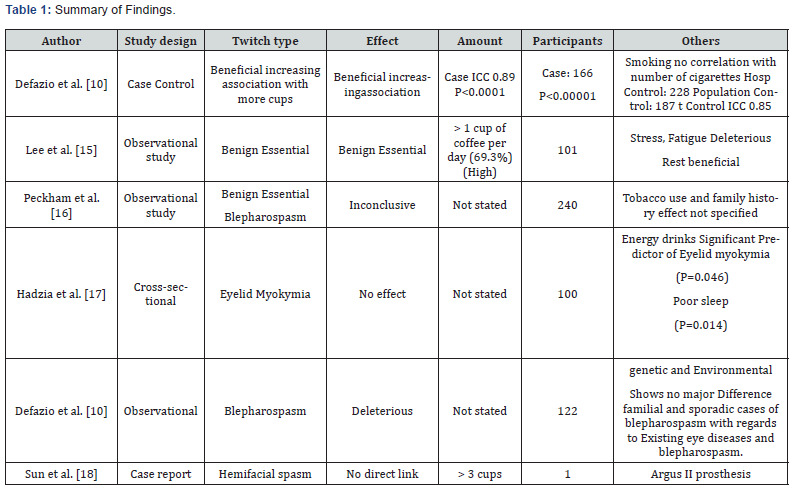
A total of six research works and 1,145 study participants were reviewed to find out if coffee has a therapeutic or deleterious effect on ocular spasms of diverse types in lieu of conflicting reports in literature. In all, majority of the cases of ocular spasm were blepharospasm 4(66.7%), while one was ocular myokymia and the other one hemifacial spasm. There were no clear conclusions in two of the reports, one stated a deleterious effect, one stated a beneficial effect, one stated no effect, the effect in two were not stated and one had no direct link with coffee intake but gave a social history of coffee consumption and in that the consequence was deleterious. Although it is not conclusive if the effect of coffee on eyelid spasms is a trigger or a therapy from these studies, the study showing no effect had an association of eyelid spasms with energy drinks noted among regular coffee drinkers. Additionally, in another study the association of coffee with argus II prosthesis was in an individual consuming more than 3 cups of coffee. This might indicate that the role of coffee in eyelid spasms may be modified in the presence of certain parameters.
Both a beneficial and a deleterious effect was noted in blepharospasm. For the beneficial case, increasing benefits were noted after intake of more than 3 cups while for the deleterious effect, the number of cups were not specified. In ocular myokymia, the only study analyzed revealed a deleterious effect, and in hemifacial spasm no direct link was identified in the study analyzed but an association with intake of more than three cups of coffee. The proposed direct cause in this case being argus II prosthesis and the effect was deleterious. With regards to the amount of coffee that produces what effect, in most of the studies this was not stated. In the one stated, the amount as greater than 1 cup in one and greater than 3 cups in the other. The report was inconclusive in the one with more than one cup and deleterious in the one with greater than three cups. In some other cases, although the amount was not stated, it was concluded that the effect of coffee was beneficial and the effect is more with increasing intake of coffee.
In assessing for other nutrition, drug or lifestyle related events having any role in ocular spasms in coffee consumers, a number of other factors were associated. A principal factor was tobacco consumption which was listed in two of the studies, although the effect was not directly linked to further analysis and no correlation with the number of cigarettes. Another factor was energy drink consumption which was found to trigger ocular myokymia in one of the studies. Others include existing eye disease, stress, fatigue and rest which has opposite effects with the former being deleterious and the later beneficial, and argus II retinal prosthesis. Another study however by Gunes, [19] which sought to find out other associations with eyelid twitching noted an association of eyelid twitching with digital screen time. However, no relationship was noted between eyelid twitching and blood electrolyte level, uncorrected refractive error and glaucoma, which were the other associations checked in their study.
Although some studies suggested a possible dual effect of coffee on eyelid spasms, none elucidated this effect well. The dose of coffee was also not stated in most of the studies to allow for this deduction.
In trying to find out if the effect of coffee varies depending on the type of eyelid spasms, three types of eyelid spasm as reviewed in this work. For blepharospasm, there was no clear cut overall effect of coffee in this condition. For the only case with ocular myokymia, although there was no statistically significant link with coffee intake in the study but rather with energy drinks, findings revealed that majority (77%) of the study participants were regular coffee drinkers. This might show an indirect link, perhaps aggravated by energy drink consumption. The findings from this study are however, in keeping with findings in recent research [20] suggesting that caffeine consumption and stress might be a trigger for episodes of dystonia. Regarding the third type of spasm, which is hemifacial spasm, there was no direct link with coffee given in the report but rather the link was proposed to be with the retinal prosthesis although a social history of consumption of more than three coffee cups as given in this very rare incidence. It is important to note that the beneficial effect of coffee in eyelid spasms was noted to be only among patients with blepharospasm kind of eyelid spasm and not in ocular myokymia or hemifacial spasm. This might suggest a variation in the role coffee plays in eyelid spasm depending on the type of eyelid spasm and not merely having a general effect in all eyelid spasms. This might mean that the difference in the pathophysiology of the different eyelid spasms might determine the kind of response elicited by coffee intake. Further large-scale studies would however be required to help understand the definite effect of coffee in the different eyelid spasms.
Conclusively, the mixed result from these reviewed studies indicates a possible need for a meta-analysis and a large-scale randomized control clinical trials in order to determine with certainty the role coffee plays in eyelid spasms. Although considering the fact that the study linking eyelid spasms with argus II prosthesis was in a patient who drank more than 3 cups of coffee a day, and the study showing a statistical correlation of eyelid spasms with energy drink was among regular coffee drinkers, it might suggest that the effect of coffee might have an interactive role with certain lifestyle parameters and might tilt towards a deleterious role in the presence of some parameters. Additionally, it remains to be proven if the beneficial effect of coffee on eyelid spasm is only in blepharospasm or if it extends to other eyelid spasms as well. A large scale randomized clinical control study on the role of coffee in the different types of eyelid spasm would play a very key role in ensuring the definitive role of coffee in eyelid spasms in general is known. It would also show whether coffee has a dual role in ocular spasms, different effects in diverse eyelid spasms, a dose related effect, an outcome depending on interaction with other lifestyle parameters and the possible mechanisms for these. This would allow for appropriate dietary counselling on coffee intake among individuals with eyelid spasm or in those predisposed to them.
Limitations
The overall result of the study was dependent on the quality of the selected studies. This limitation was however significantly reduced by careful selection of studies with sufficient quality using the Newcastle-Ottawa Quality Scale and Agency for Healthcare Research and Quality scales. Furthermore, the investigator also served as the validator for the selected studies. The risk of bias from this was however reduced by having a pre-defined protocol and using measures to reduce the risk of publication bias. Another limitation to this study was the limited number of case control studies on coffee and eyelid spasms and the divergence of the conclusions. Large, randomized case control studies might be necessary in this regard to allow the definite effect of coffee in lid spasms to be more objectively studied (Table 1).
References
- Jennifer L Temple, Christophe Brnard, Steven E Lipshultz, Jason D Czachor, Joslyn A Westphal, et al. (2017) The Safety of Ingested Caffeine: A Comprehensive Review. Front Psychiatry 8: 80.
- Blepharospasm. https://ww.nei.nih.gov>blepharospasm. Accessed 20/1/2024.
- Hallet Mark, Evinger Craig, Jankovic Joseph, Stacy Mark (2008) Update on Blepharospasm. Neurology 71(16): 1275-1282.
- Bryon L Lam, Lid Myokymia, Roy, Fraunfelders (2008) Current Ocular Therapy (Sixth Edition) Elsevier Inc. ISBN 978-1-4160-2447-7
- Abd Alkader Jafer, Bhupendra C Patel (2023) Eyelid Myokymia.
- Scorr M Laura, Cho J Hyun, Berkmen K Gamze, Mckay J Lucas, Klein Christine, et al. (2022) Clinical Features and Evolution of Blepharospasm: A Multicenter International Cohort and Systematic Literature Review. Dystonia 1: 10359.
- (2024) Medical Encyclopedia. Eyelid twitch.
- Suzzane Allen (2024) What You Need to Know About Muscle Twitching. Healthline.
- (2022) BMJ Specialty Journals. “Coffee Drinking Protects Against an Eyelid Spasm.” ScienceDaily. ScienceDaily.
- Defazio G, Martino D, Abbruzzese G, Girlanda P, Tinazzi M, Fabbrini G (2007) Influence of coffee drinking and cigarette smoking on the risk of primary late onset blepharospasm: evidence from a multicentre case control. J Neurol Neurosurg Psychiatry 78(8): 877-879.
- Pia Grant (2023) Caffeine & Eyelid Twitching.
- Hallet Mark, Evinger Crai, Defazio G, Abbruzzese G, Aniello MS, Bloise M, Crisci C, et al. (2011) Enviromental risk factors and clinical phenotype in familial and sporadic primary blepharospasm. Neurology 77(7): 631-637.
- Ha Noi (2008) Eyelid twitching: Why? https://www.vinmec.com. Accessed 23/7/2024 Bryon L, Lam MD. Lid Myokymia. Roy and Fraunfelders. Current Ocular Therapy (Sixth Edition). Elsevier Inc. ISBN 978-1-4160-2447-7
- Khalkhali Mohammadrasoul (2016) Topiramate-Induced Persistent Eyelid Myokymia.Case Rep Psychiatry 2016: 7901085.
- Lee Jeong Min, Baek Ji Sun, Choi Hye Sun, Kim Sung Joo, Jang Jae Woo, et al. (2018) Clinical Features of Benign Essential Blepharospasm in Korean Patients. Korean J Ophthalmol 32(5): 339-343.
- Peckham Elizabeth, Lopez Grisel, Shamim Ejaz, Richadson Sarah, Sanku Sharika, et al. (2011) Clinical Features of Patients with Blepharospasm: A Report of 240 Cases. Eur J Neurol 18(3): 382-386.21.
- Hadzic Sanela, Kukic Ismir and Zvornicanin Jasmin (2016) Prevalence of Eyelid Myokymia in Medical Students 14(6): 1-6.
- Sun Y Susan, Mammo A Danny, Kooze Kenani D, Montezuma Sandra (2020) J Vitreoretin Dis 4(4): 325-326.
- Gunes IB (2024) Association Between Eyelid Twitching and Digital Scree Time, Uncorrected Refractive Error, Intraocular Pressure, and Blood Electrolyte Imbalances. Cureus 16(9): e69259.
- Chavan Rohini, Kumbhar Anjali, Manocha, Rane Pritish (2024) Caffeine and Dystonia: A Stimulant and Nightmare for Some Individual. Pharmaceutical Research: Recent Advances and Trends 6: 26-33.

























