




 ARR Home



Abstract
This study was performed in 3 municipalities in the State of Chihuahua (Chihuahua, Juárez and Villa Ahumada), with the objective of determining the fluoride concentration in tap water. The fluoride concentration was analyzed following NMX-AA-077-SCFI-2001. The fluoride concentration in the tap water samples ranged between 0.87 and 5.08 mg/L, with levels exceeding the maximum permissible limit established by the NOM-127-SSA1-2021. The pH ranged from 7.48-8.20. To determine the health risk posed by consuming tap water with a high fluoride concentration, the Hazard Quotient (HQ) was determined. The HQ in the municipalities of Juarez and Villa Ahumada was 1.460 and 2.540, respectively, which represents a high risk to the health of the population. A statistical analysis indicated a positive linear correlation of r=0.91 between fluoride and pH, and a negative linear correlation of r=-0.93 between pH and precipitation. Furthermore, using ANOVA, it was determined that there were significant differences between the mean fluoride concentration obtained in the samples and the established permissible limit (WHO) for drinking water, which indicates it is essential to remove this analyte from the drinking water for human use and consumption.
Keywords:Fluoride; Tap water; pH; EC; HQ
Abbreviations:HQ: Hazard Quotient; CDI: Chronic Daily Intake; ANOVA: An Analysis of Variance
Introduction
Low concentrations of fluoride are beneficial for tooth health. However, in high concentrations it poses a public health risk, depending on the exact concentration and the duration of exposure Kimambo [1]. The contamination of drinking water with fluoride is a global health concern Kimambo [1], Gutiérrez et al. [2]. A high fluoride concentration in drinking water is attributed to the high concentration of this analyte in the soil of geogenic origin with rocks containing fluorite, biotite, and cryolite. Additionally, the chemical-environmental conditions are favorable for its dissolution, infiltration, and dilution in the groundwater Cervantes-Trejo [3], Chihuahua [4], Jagtap [5]. Furthermore, fluoride concentrations increase with an increase in the depth of the aquifer Ayoob [6]. In the state of Chihuahua, the piezometric surface of the aquifers varies in depth from 1 to 140 m, with the most common levels between 10 to 80 m. In the semiconfined aquifer of Sacramento-Chihuahua located in the municipality of Chihuahua, 124.8 Mm3 is extracted annually, whereas the recharge is 55 Mm3, indicating an overexploitation INEGI [7].
In humans, fluoride is absorbed through oral intake; approximately 75-90% is absorbed through the digestive tract, and 99% of the fluoride present in the body is retained in the bones Ayoob [6]. Fluoride is necessary for dental health (0.5-1.0 mg/L), however, excessive fluoride intake (>1.5 mg/L) for extended periods of time during tooth formation produces dental fluorosis, an endemic illness known since ancient times that mainly affects the teeth. Dental fluorosis is a chronic disease that produces mottled teeth, and, in severe cases, softening of the bones and neurological damage Chandrajith [8], Valenzuela [9]. Therefore, fluoride is classified as a highly toxic element. In agreement with the legal standards from the World Health Organization (WHO), the permissible limit for drinking water is 1.5 mg/L, based on a consumption of 2 L/day Kherapisheh [10]. Similarly, this is the maximum concentration established by the Mexican legislation NOM-127-SSA1-2021 SSA [11].
In Mexico, approximately 6% of the population is affected by the concentration of fluoride in groundwater. The Mexican states that exceed the permissible limit are Aguascalientes, Chihuahua, Durango, Guanajuato, Mexico State, Jalisco, San Luis Potosi, Sonora, and Zacatecas Valenzuela [9]; these states were identified with endemic fluorosis. The state of Chihuahua has a high community index of dental fluorosis of 0.63 Betancourt [12]. Due to its climatic conditions, the use of groundwater is crucial for human consumption and development, but extraction exceeds recharge for which most of the state’s aquifers are overexploited. Fluoride concentrations are particularly elevated in arid regions, where the hydraulic flow is lower and therefore the contact between groundwater and fluoride-rich rocks is increased Rodríguez- Lozano [13]. Furthermore, Sánchez [14] shows a correlation between igneous rocks with an acidic composition, and a high fluoride concentration in water. The present study covers an arid region where the highest fluoride concentrations in Mexico were reported Alarcón-Herrera et al. [15]. This study investigates fluoride concentration in drinking water, and a statistical correlation between fluoride and the physicochemical parameters pH and EC. The results are compared to other regions in the world with similar environmental conditions. Finally, the present study is important because it determines the Hazard Quotient (HQ) and its potential health risks.
Materials And Methods
Study Site
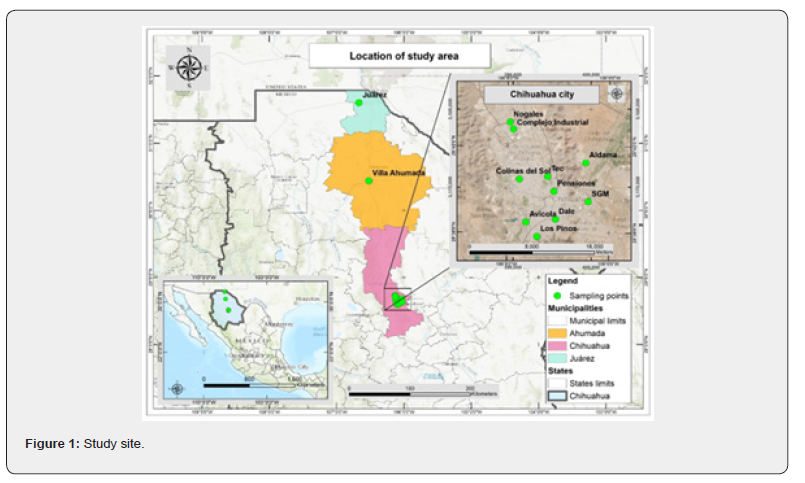
The study area is located in the center and north of the state of Chihuahua. This region is characterized by few water bodies and an extreme semi-arid climate. The primary source of water supply is groundwater. Tap water samples were collected at 11 locations in the municipality of Chihuahua (samples: Tec, Los Pinos, Nogales, Pensiones, Aldama, Colinas del Sol, Avícola, Complejo Industrial, Dale, SGM, and Tiradores) with the objective of obtaining a representative sample. These samples pertain to the Sacramento- Chihuahua aquifer. The tap water samples from the municipality of Villa Ahumada come from the Flores Magón-Villa Ahumada aquifer, and the water samples from the municipality of Juárez correspond to the Valle de Juárez aquifer (Figure 1). The tap water samples were collected following the procedures established by the NOM-014-SSA1-1993 [16]. Based on the latest population census and historical annual precipitation data, the population size of Chihuahua, Villa Ahumada, and Juarez is 937,674, 14,635 and 1,512,450 inhabitants, respectively CONAGUA [17], with a mean precipitation of 370, 208, and 223 mm, respectively CONAGUA [18].
Sample Collection and Treatment
Thirty threetap water samples were analyzed in August 2023; twenty seven samples from the municipality of Chihuahua, 3 from the municipality of Villa Ahumada, and 3 from the municipality of Juárez. Groundwater is the main water source for the communities in the study area. The samples were collected in new 500 mL polyethylene bottles and transported immediately to the laboratory for chemical analysis. The sample containers were washed at least 3 times with the sampled water before its collection. The bottles were stored at 4 °C prior to analysis. The fluoride content was analyzed following NMX-AA-077-SCFI-2001.
Methodology for the determination of Fluoride
The determination of fluoride was performed using the HACH brand UV-VIS DR/4000U spectrometer, previously calibrated, and the SPADNS technique.
Health risk assessment, Hazard Quotient (HQ)
In general, water consumption represents the main health
risk to the population associated with groundwater. Therefore,
fluoride exposure through the consumption of tap water was
evaluated based on Chronic Daily Intake (CDI) and the Hazard
Quotient (HQ). The CDI per kilogram of body weight per day (mg/
kg/day) was calculated based on the rate of water intake, exposure
frequency, exposure duration, body weight, and average time,
using the following equation proposed by USEPA Dehghania [19]
CDI = C*DI*F*ED / BW*AT
where C is the fluoride concentration in water (mg/L), DI is the daily water intake (L/d), F is the exposure frequency (d/y), ED is the duration of exposure (y), BW is the average body weight (kg), and AT is the average time (d). The average water consumption rate of adults was considered 2 L/d, and the average body weight 72 kg.
The Hazard Quotient (HQ) was calculated using the following
equation:
HQ = CDI/RfD
where RfD is the reference dosage of fluoride in mg/ kg/d. Taking into account oral fluoride intake and its noncarcinogenic nature based on the USEPA risk assessment method, a recommended RfD of 0.06 mg/kg/d was used in HQ calculations. Deleterious health impacts should be considered cautiously; an HQ greater than 1 (HQ > 1) suggests a high potential health risk of the contaminant, while an HQ less than 1 (HQ < 1) indicates a minimal risk. Higher HQ values indicate a greater level of risk, with the possibility of long-term health hazard impacts increasing Dehghania [19].
Results And Discussion
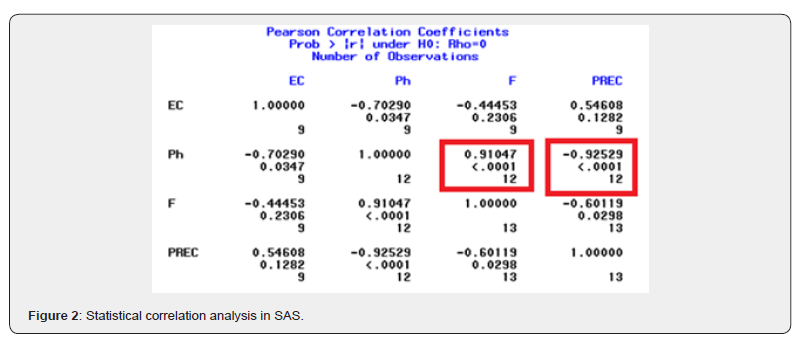
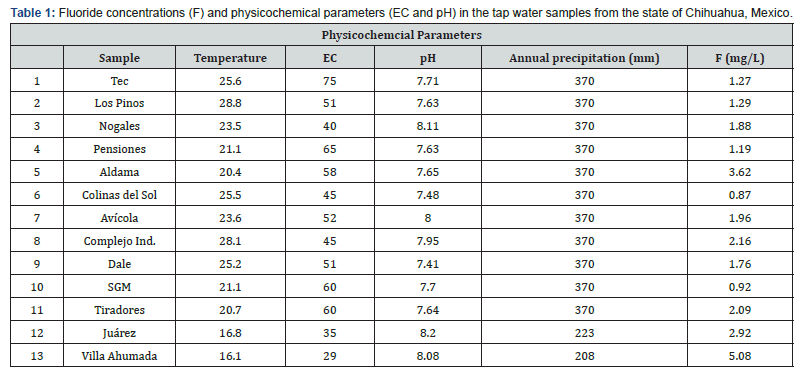
The results of fluoride concentrations, EC, and pH in the tap water samples can be observed in in Table 1. The fluoride concentration obtained in the tap water samples ranged from 0.87 to 5.08 mg/L, respectively. The fluoride concentration averaged 1.73 mg/L in the municipality of Chihuahua (samples 1 to 11), 2.92 mg/L in the municipality of Juárez, and 5.08 mg/L in the municipality of Villa Ahumada, which is up to 5 times above the permissible limit. Bone fluorosis occurs due to chronic intake of water with an average fluoride concentration greater than 4 mg/L. Dental mottling is common in the municipality of Villa Ahumada, and dental and bone fluorosis are irreversible Edmunds [20]. The variability in the fluoride concentrations in the study is attributed to chemical weathering Gutiérrez [21]. The pH values found were in a range of 7.48-8.2 which is related to the origin of the well that supplies drinking water to the state of Chihuahua. Alkaline pH values are attributed to low rainfall (Figure 2). The results of the statistical analysis in SAS are presented in Figure 2, in which it can be observed that there was a positive linear correlation between pH and fluoride of r = 0.91047 (p < 0.0001). For the correlation between annual precipitation and pH, a negative linear correlation of r = -0.92529 (p < 0.0001) was observed, which indicates that lower precipitation is associated with higher pH levels in the water, reflecting alkaline conditions at the study site.
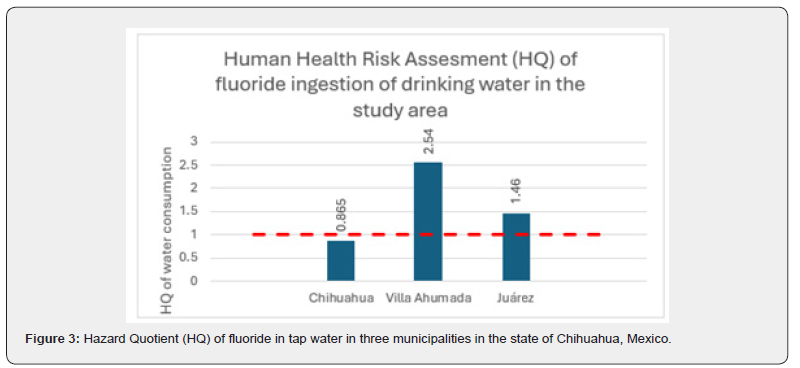
An Analysis of Variance (ANOVA) was performed to compare the mean fluoride concentrations with the maximum permissible limit from the WHO. The results indicate significant differences (P < 0.05); the levels found in the present study exceed the threshold of 1.5 mg/L established by international (WHO) and national (NOM- 127-SSA1-2021) legislation. The HQ was calculated (Table 2) to determine the health risk related to the intake of water containing fluoride, based on an average daily water intake of 2 L/d. Table 2 shows an HQ of 0.801 for the municipality of Chihuahua. However, for the municipalities of Juárez and Villa Ahumada, values of 1.460 and 2.540 were observed; these HQ values greater than 1 indicate a potential public health risk. This can also be observed in Figure 3, which shows the HQ results along with the safety threshold and the associated health risk from water intake, assuming a consumption of 2 L/d. Table 3 shows a comparison of the levels found in the present study with respect to levels reported in the literature. Table 3 shows the range of fluoride levels obtained in the present study (0.87–5.08 mg/L) in municipalities in the state of Chihuahua. However, it is important to note that the levels reported in the literature for Chihuahua correspond to other municipalities in the state, and, in some cases, to average values for the entire state. The present study reports levels from three municipalities in a precise and specific manner [22-26].


Conclusions
There is a strong positive linear correlation between fluoride concentrations and water pH (r = 0.91047), and a strong negative linear correlation between fluoride and precipitation (r = -0.92529); as water alkalinity increases, the fluoride concentration also increases, which is attributed to the low precipitation levels in the region. Furthermore, the presence of fluoride is attributed to chemical weathering of rocks in the groundwater and to the arid zone. High HQ values of 1.460 and 2.540 were found in Juárez and Villa Ahumada, respectively, which pose a health risk to the exposed population. The municipality of Villa Ahumada had the highest fluoride concentration in tap water, exceeding national and international standards, which represents a serious health problem for the population. It is recommended to implement a monitoring plan in the state of Chihuahua to identify wells with fluoride concentrations that exceed permissible limits and develop a treatment plan for the removal of fluoride from the drinking water in the studied areas.
References
- Kimambo V, Bhattacharya P, Mtalo F, Mtamba J (2019) Fluoride occurrence in groundwater systems at global scale and status of defluoridation-State of the art. Groundwater for Sustainable Development 9: 100223.
- Gutiérrez M, Espino-Valdés MS, Alarcón-Herrera MT, Pinales-Munguía A, Silva-Hidalgo H, et al. (2021) Arsénico y Flúor en agua subterranea de Chihuahua: origen, enriquecimiento y tratamientos posibles. Tecnociencia Chihuahua 15(2): 828.
- Cervantes-Trejo A, Pineda Álvarez C, Santellano-Estrada E, Cortes-Palacios L, Rentería-Villalobos M (2018) Distribution of Chemical Species in the Water-Soil-Plant (Carya illinoiensis) System near a MineralizationArea in Chihuahua, Mexico—Health Risk Implications. International Journal of Environmental Research and Public Health 15(7): 1393.
- Chihuahua G (2023) Agua de Calidad Fisicoquí Chihuahua: Comisión Estatal para la Protección contra Riesgos Sanitarios.
- Jagtap S, Yenkie M, Labhsetwar N, Rayalu S (2023) Fluoride in drinking water: An in-depth analysis of its prevalence, health effects, advances in detection and treatment. Materials Today: Proceedings.
- Ayoob S (2006) Fluoride in Drinking Water: A Review on the Status and Stress EffectsFluoride in Drinking Water: A Review on the Status and Stress Effects. Critical reviews in Environmental Science and Technology 36: 433-487.
- INEGI (2023) Hidrología Subterránea Chihuahua.
- Chandrajith R, Padmasiri JP, Dissanayake CB, Prematilaka K (2012) Spatial distribution of fluoride in groundwater of Sri Lanka. Sci. Total Environ (4): 303-309.
- Valenzuela L, Ramírez-Hernández J, Sol J, Reyes J (2011) Alternativas para la Eliminación Doméstica de Fluor en el Agua de Consumo Humano. SCIELO p. 23-32.
- Kheradpisheh Z, Mirzaei M, Hossein Mahvi A, Mokhtari M, Azizi R, et al. (2018) Impact of drinking water flouride on human throid Hormones: a case-control study. Sci Rep p. 1-7.
- SSA (2022) Norma Oficial Mexicana NOM-127-SSA1-2021, Agua para uso y consumo humano. Límites permisibles de la calidad del agua. Secretaría de Salud. Diario Oficial de la Federación, México, 2 de mayo.
- Betancourt-Lineares A, Irigoyen-Camacho ME, Mejía-González A, Zepeda-Zepeda M, Sánchez-Pérez L (2013) Prevalencia de fluorosis dental en localidades mexicanas ubicadas en 27 estados y el D.F. a seis años de la publicación de la Norma Oficial Mexicana para la fluoruración de la sal. Revista de Investigación Clínica (RIC) pp. 237-247.
- Rodríguez Lozando F (2022) Evolución espacial y temporal de la presencia de fluoruros en el acuifero meoqui-delicias, chihuahua. Chihuahua: Universidad Autónoma de Chihuahua.
- Sánchez Díaz L (2007) Origen, transporte, distribución y concentraciones de los fluoruros en el sistema Hidrogeológico Volcánico Atemajac-Toluquilla, Jalisco Mé Posgrado Ciencias de la Tierra, UNAM.
- Alarcón-Herrera MT, Martín Alarcón D, Gutierrez M, Reynoso-Cuevas L, Martín-Dominguez A, et al. (2020) Co-occurrence, possible origin, and health-risk assessment of arsenic and fluoride in drinking water sources in Mexico: Geographical data visualization. Science of the Total Environment 698: 134168.
- NOM-014-SSA1-1993 (1993) Norma oficial mexicana. Nom-014-ssa1-1993 "procedimientos sanitarios para el muestreo de agua para uso y consumo humano en sistemas de abastecimiento de agua publicos y privados".
- Conagua (2014) Programa de Medidas Preventivas y de Mitigación de la Sequí Chihuahua: CONAGUA.
- Conagua (2025) Normales Climatológicas por Estado. Gobierno de Mé
- Dehghania M, Zareic A, Yousefi M, Asghari F, Haghighat G (2019) Fluoride contamination in groundwater resources in the southern Iran and its related human health risks. Desalination and Water Treatment (153): 95-104.
- Edmunds M, Smedley P (2013) Fluoride in natural waters IN Essentials of Medical Geology, Imapacts of Natural Environment on Public Health. New York: In essentials of Medical Geology.
- Gutiérrez M, Alarcón-Herrera MT (2022) Fluoruro en aguas subterráneas de la región centro-norte de México y su posible origen. Revista internacional de contaminación ambiental 38: ISSN 0188-4999.
- Galicia-Chacón L, Molina N, Oropeza A, Gaona E, Juárez L (2011) Análisis de la concentración de fluoruro en agua potable de la delegación Tláhuac, Ciudad de Mé Revista internacional de contaminación ambiental 27: ISSN 0188-4999.
- Gutiérrez M, Reyes-Gómez V, Nuñez D, Alarcón-Herrera MT (2017) Monitorero hidrológico y de calidad de agua en tres acuíferos del centro del estado de Chihuahua en cuencua del rio Conchos: una mirada desde las ciencias ante el cambio climá Instituto Mexicano de Tecnología del Agua pp. 205-223.
- (2021). NORMA Oficial Mexicana NOM-127-SSA1-2021, Agua para uso y consumo humano. Límites permisibles de la calidad del agua. México: Diario Oficial de la Federación.
- Solanki Y, Agarwal M, Gupta AB, Shukla P (2022) Fluoride occurrences, health problems, detection, and remediation methods for drinking water: A comprehensive review. Sci. Total Environ pp. 807.
- Vázquez-Bojórquez C, López-Verdín S, Villanueva-Arriaga R, Castañeda-Castaneira E, Juárez-López MLA, et al. (2022) Fluoruros en agua de consumo al norte y occidente de Mé Revista Médica del Instituto Mexicano del Seguro Social 60(2): 179-187.

























