




 ARR Home



Summary
This article presents the results of the work on the graphic reconstruction of the appearance of a woman who lived in the territory of modern Azerbaijan approximately in the 14th-17th centuries. Not having the opportunity to conduct radiocarbon dating of the studied bone remains, as well as to carry out molecular genetic analyses, we relied only on the results of craniometric and cranioscopic studies. We only had the opportunity to apply the method developed in previous years by our scientists for diagnosing the anthropological type based on the skull, as well as the original method of craniological diagnostics of the chronological typicality of the skull; we conducted the corresponding studies. It was established that the anthropological type of the woman (whose skull was examined) corresponded to the Caspian anthropological variant of the southern European race, and the morphotype of her skull is most similar to the morphology of the craniological samples that were found in the territory of modern Azerbaijan and which chronologically belong to the late Middle Ages. Using this data and the results of work carried out in the «Other Worlds Studio» Laboratory of facial reconstruction, it was possible for the first time to recreate the appearance of a woman who lived in the late Middle Ages on the Absheron Peninsula in Azerbaijan.
Keywords:Facial reconstruction from the skull; Azerbaijan of the late Middle Ages; Craniometry; Diagnostics of chronological typicality of the skull; Discriminant functions
Introduction
With the advent of new computer technologies and software (including various new generation application software packages that are integrated under the general name of «Artificial Intelligence»), graphic visualization of people’s appearance based on skeletal bones discovered by archaeologists has reached a new technological level. Recent years have been very productive in this context and many interesting works have appeared on the relevant topic [1-3]. However, unfortunately, in this format, despite successful experience in some studies [4], this principle is rarely used in our country in archaeological and historical restoration studies. Taking into account these circumstances, the purpose of this work was to carry out a computer 3D reconstruction of the appearance of an unknown woman (living approximately in the 14th-7th centuries on the Absheron Peninsula) based on the skull. This work will undoubtedly expand ethnographic knowledge about Azerbaijan in the late Middle Ages, and the results of graphic visualization will enhance popular scientific interest in this topic.
Materials and Methods
The study involved a woman’s skull that was accidentally found in the second half of the last century on the Absheron Peninsula. Initially, the skull was submitted for forensic examination by law enforcement agencies. However, the investigation later concluded (including based on the results of the forensic examination) that the skull and some other bones of the skeleton found with it were buried no later than the 19th century and therefore are of no interest in a legal context. One of the authors of this article, back in the 1990s, while carrying out her dissertation research [5], performed craniometry and photography of this skull, as well as diagnostics of the sex, age and height of the individual whose bones were examined. The craniometry technique complied with the generally accepted standards recommended by R. Martin [6]. Craniometric features were examined using the craniometric form proposed by Sh.M. Musayev [7] and used in Azerbaijan in forensic medical examinations. Standard craniometric instruments were used (digital caliper (accuracy 0.01 mm), thickness compass (accuracy 0.5 mm), coordinate compass (accuracy 0.1 mm), goniometer and metal measuring tape). Most measurements (except local ones) were made from the skull mounted on a Mollison tripod in the Frankfurt horizontal plane. Forensic medical studies for the purpose of diagnosing group personality traits and its anthropological type were carried out according to the recommendations adopted in forensic practice [8]. Diagnosis of the chronological typicality of the skull was carried out using the original method developed by Professor Sh.M. Musayev [9]. Reconstruction of the face (features of appearance) of an unknown woman was implemented using 3D visualization methods developed on the basis of the method of M.M. Gerasimov [10].
Results
As noted, the skull of an unknown woman was examined (during a forensic examination) back in the 90s of the last century using forensic methods that are described in various scientific textbooks [7-9]. A wide range of applied methods based on craniometry, cranioscopy and osteometry, which are used by forensic scientists, allow for a fairly reliable diagnosis of group personality traits (gender, race, age, height, etc.). By the way, some of the diagnostic methods used in this case were developed taking into account the population and anthropological characteristics of modern inhabitants of the Caucasus [7,9]. This article presents only the results of using the relevant diagnostic methods. It was established that the bones examined belong to a middle-aged Caucasian woman (approximately 28-35 years old) with an approximate body length of 161-165 cm. The woman’s height was unexpectedly tall for the geography in which the skeleton was found, since the average height of Azerbaijani women did not exceed 160 cm even in the 20th century [5,11]. The weak gracefulness of the female skeleton as a whole was also noteworthy, which could have been the result of environmental factors and adaptation. Cranioscopic signs also indicated maturation and testified to the possible predominance of masculine features. The anthropological type was determined using the original method of Sh.M. Musayev [9], and it was established that the woman’s skull could be classified as belonging to the Caspian anthropological type (high frequency of gracile skeletal variants, medium or poorly developed hair, slightly above average height in representatives, dolicho-mesocephalic skull, medium width or narrow face, medium or slightly above average length, protruding nose, etc.). However, the results of the corresponding discriminant functions, with the help of which the diagnostics were carried out, were very close to the values of the group centroids (indicators that are terminal for the division of groups; in this case, the equations differentiated the Caspian anthropological type from the Pontic and Caucasian ones, which were positioned as a single array). Some of the angular and metric features also corresponded more to the values that are characteristic of the Caucasian anthropological type (possibly, in this case, there was crossbreeding, which thus affected the morphotype).
Thus, we could say that we were dealing with the skeletal remains of a woman of the Caucasian race, belonging to the Caspian anthropological type. This woman was clearly distinguished by her somewhat tall stature and mature constitution; at the time of her death, she was approximately 28-35 years old. She most likely did not suffer from any diseases associated with bone pathology or diseases that could indirectly affect her locomotor apparatus during her life. In her appearance, along with the characteristic features inherent in the Caspian anthropological type, there could also be features more consistent with the Caucasian anthropological type. Only the chronological period during which this woman lived remained unclear.
Forensic methods for determining the time that human remains have been in the ground based on preserved bones are aimed at differentiating the periods of time that bones have been in the ground in a range of, as a rule, up to 100 years [8,12]. The great antiquity of burial is extremely rarely of interest to law enforcement agencies and, accordingly, the methodological base in this format has been very poorly developed by forensic doctors. The wording about burial no later than the 19th century in the context of anthropological reconstruction, of course, did not suit us. However, it was not possible to find the necessary funding to conduct radiocarbon analysis and clarify the dating of skeletal remains. Nevertheless, we had an original method of craniological diagnostics of the chronological typicality of the skull, proposed by Professor Sh.M. Musayev [9]. This method was developed specifically for craniological studies of the inhabitants of the Caucasus and takes into account the characteristics of the inhabitants of the region. Although this method of predicting the chronological era of a skull (the approximate historical date of life of an individual whose skull became the object of a forensic examination) was originally intended for the tasks of forensic medicine, in practice it may prove no less effective in the work of specialists in historical anthropology.
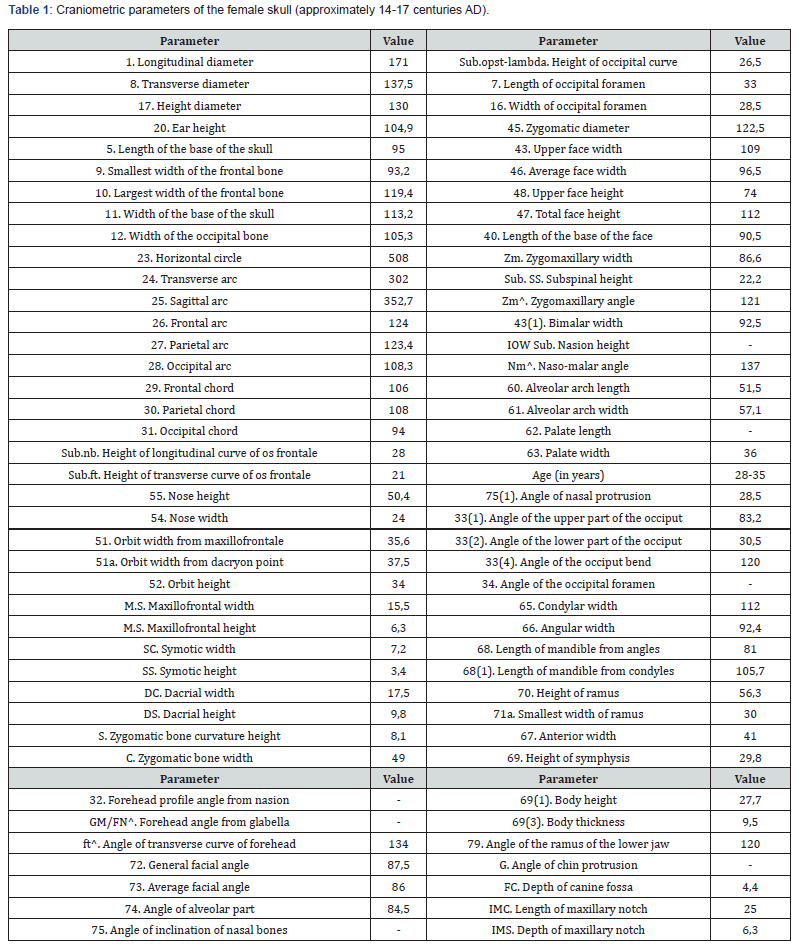
The method of Sh.M. Musayev is based on the results of the analysis of craniometric features of 335 female and male skulls that were discovered on the territory of modern Azerbaijan (in different regions and at different times). Back in the second half of the last century, these craniological objects were quite convincingly attributed by Azerbaijani archaeologists and anthropologists to the period of the 1st -20th centuries AD [13]. Without going into details of the mathematical component of this method, we will only note that it allows us to predict the chronological typicality of the skull using discriminant functions. A set of three discriminant functions allows us to produce a differential classification of four chronological groups: 1) skulls of the 1st -7th centuries; 2) skulls of the 8th-9th centuries; 3) skulls of the 14th -17th centuries; 4) skulls of the 20th century. To implement the appropriate diagnostics, craniometric data from the female skull, which became the object of our study, were necessary. We took all measurements that could be measured based on the preservation of craniometric landmarks. Table cells with a dash correspond to parameters that could not be measured due to various reasons (bone tissue defect, damage, etc.). The results of craniometry of the examined female skull are presented in Table 1.
Thus, having the results of craniometry, we have carried out diagnostics of diagnostics of chronological typicality of the studied skull. According to the results of discriminant functions, the skull belonged to a woman who lived on the territory of modern Azerbaijan approximately in the 14th -17th centuries AD. Since this stage of our research is of the greatest interest, we provide here the relevant information on the procedures performed. Below in Table 2 we provide a mathematical model for, designed to diagnose the chronological affiliation of the skull by craniometric features Table 2.

This mathematical model is based on discriminant functions, each of which determines the values in one of three mutually perpendicular axes: (x), (y) and (z). Thus, we have a conditional 3-dimensional plane, which is divided by these axes into 8 octants. In the course of developing the model, group centroids were determined for each cluster of skulls (grouped by chronology). For example, the values of group centroids for the chronological group of skulls of the 1st -7th centuries determine the coordinates of a certain point. The octant in which this point falls is thus characteristic of the cluster of craniological objects related to the chronological group of skulls of the 1st -7th centuries. It is easy to see that four octants are, as they were, free and do not participate in the determination. Of course, if the coordinate of the point (calculated using the proposed functions) falls into one of these octants, then the diagnostics will be considered unsuccessful and the conclusions on the chronological typicality of the skull will have to be abandoned.
In our opinion, the capabilities of this method will be most fully demonstrated by our own example with the study of the skull of an unknown woman. Using the results of our craniometry, we will calculate the results of the discriminant functions DF(x), DF(y) and DF(z). To do this, we will first multiply the value of the corresponding craniometric feature (or indicator) by its coefficient from Table 2 (the coefficients intended for the feature «gender» are multiplied either by «1» if the skull is male, and by «2» if the skull is female). Then we will sum the resulting numbers together and the constant value of each function from the table. For example, for the result of the DF(x) function, this will be the sum of the values obtained after multiplying in rows 2-13 of the second column of the table plus the number 4.78523 (the function constant). This result will be the coordinate of the desired point along the (x) axis. In our case, the number was 1.1997. The coordinates for the (y) and (z) axes were calculated in the same way. They turned out to be -1.1028 for the (y) axis and -1.1589 for the (z) axis. As we can see, the obtained values determine the studied skull in the lower right octant, which is located in front of the plane formed by the intersection of the (x) and (y) axes. (Visually, it is not so difficult to imagine if we assume that the classical two-dimensional plane of the X-axes (drawn from left to right) and Y-axes (drawn from bottom to top) is pierced from front to depth (that is, from the viewer into the distance in the forward direction) by the Z-axis; in this case, the values of the (z) axis before the intersection with the plane of the (x) and (y) axes have a negative sign, and after the intersection, they are positive). Thus, we have 4 octants located in front of the plane formed by the intersection of the (x) and (y) axes, and 4 octants located behind this plane. As we noted, the point we established fell into the lower right octant, which is located in front of the plane of the (x) and (y) axes. This octant is determined by the group centroids of the chronological group of the 14th -17th centuries as an area characteristic of the craniometric parameters of the skulls belonging to the specified period. Thus, the skull we are studying with a fairly high probability belongs to the period of the 14th -17th centuries. Of course, the results of the functions could point to another octant, corresponding to another chronological group, or even fall into an empty octant (as we said, in this case, one should refuse diagnostics using this method).
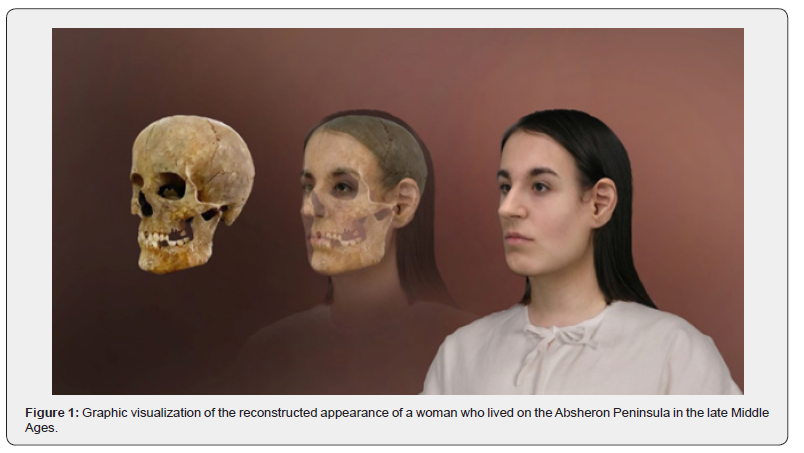
After we had obtained some information about the individual whose skeletal remains were examined using craniometry and cranioscopy, it was decided to reconstruct the appearance of this person. The results of all the above-described studies were as follows: the skeletal remains of a woman of the Caucasian race were discovered, living approximately in the 14th -17th centuries in the territory of modern Azerbaijan; the woman was approximately 28-35 years old at the time of her death and was somewhat tall for her time (161-165 cm) and had not suffered from any diseases in her life that could have affected her skeletal remains; cranioscopic signs indicated possible masculine features in appearance, and the skeleton was more consistent with a muscular type of constitution; the woman’s skull can most likely be attributed to the Caspian anthropological type, but manifestations of phenotype features characteristic of the Caucasian anthropological type are not excluded. All the above information, as well as digitalized photographs of the female skull, were submitted to the Laboratory of Human Appearance Reconstruction «Other Worlds Studio». The staff of this laboratory reconstructed the woman’s appearance based on the method of M.M. Gerasimov. The restoration of lifetime features of appearance was expressed in the creation of a graphic portrait in digital format. The supposed photo portrait was created in isometric projection according to the modernized method of M.M. Gerasimov by Professor Veselovskaya E.V. [14], using the Adobe Photoshop CC 2020 graphic editor. The photo reconstruction of the appearance of a woman from Azerbaijan from the late Middle Ages, implemented in this way, is shown in Figure 1.
Conclusions
In the course of the work, a graphic reconstruction of the external appearance of a woman from the medieval historical past of Azerbaijan was performed for the first time. The craniometric and cranioscopy data of this woman’s skull indicate that she belongs to the Caspian anthropological type of the South European race and also allow us to speak about the correspondence of the morphotype of this skull with the morphology of craniological samples from the late Middle Ages (which were discovered on the territory of modern Azerbaijan). The results of the work also clearly demonstrate the effectiveness and broad perspectives of the integrated activity of forensic medical experts and specialists in historical anthropology.
References
- Wilkinson C (2010) Facial reconstruction – anatomical art or artistic anatomy? Journal of Anatomy 216(2): 235-250.
- Zubova AV (2021) Cranial Traumas in a Sample from the Pucara de Tilcara Fortress (Jujuy Province, Argentina). Archaeology, ethnology and anthropology of Eurasia 49(3): 147-156.
- Shirobokov IG, Pankova SV (2022) Data of computer-assisted tomography in studies of the head of a male mummy from grave 4 at the cemetery of Oglakhty. Archaeological news 34: 275-293.
- Ibragimov A Sh, Evseev RV, Aliev AA (2003) Restoration of the external appearance of a man from the Shemakha burial ground of the early Middle Ages. Bulletin of Moscow University. Series XXIII (Anthropology). 1: 129-137.
- Ibragimov A Sh (2004) Study of the possibility of predicting the length of the human body by craniometric features and its forensic significance. PhD thesis, Azerbaijan Medical University, Baku p. 130.
- Martin R, Saller K (1956-1962) Lehrbuch der Anthropologie in systematischer Darstellung. Stuttgart: Gustav Fischer Verlag Bd. 2, s. 579-991.
- Musayev Sh M (1999) Forensic medical craniological identification of the inhabitants of the Caucasus. Baku, Elm p. 130.
- (2000) Forensic and medical identification (editor Tomilin V.V.). Moscow, Norma p. 466.
- Musayev ShM (1997) Possibilities of craniometric studies in forensic medical identification of the personality of residents of the Caucasus. Dissertation for the degree of Doctor of Medical Sciences, Moscow p. 337.
- Gerasimov MM (1949) Fundamentals of facial reconstruction from the skull. Moscow, Sovetskaya Nauka p. 188.
- Fattakhov FG (1996) Forensic medical determination of age in female and male individuals of Azerbaijani nationality aged 11-20 years. Baku p. 128.
- Rubezhansky AF (1978) Determining the age of burial of a corpse based on bone remains, Moscow, Meditsina p. 120.
- Kasimova RM (1960) Anthropological study of skulls from Mingechevir (in connection with the study of the ethnogenesis of the Azerbaijani people) Baku, Publishing House of the Academy of Sciences of the Azerbaijan SSR p. 135.
- Veselovskaya EV (2016) Anthropological reconstruction of human appearance. Development and application of new methodological approaches. Dissertation for the degree of Doctor of Historical Sciences, Moscow p. 194.

























