




 ARGH Home



Distribution of Colonic Polyp in Children and Endoscopic Management in a Private Hospital of Bangladesh
Akmat Ali1*, Maimuna Sayeed2 and Richmond Ronald Gomes3
1Department of Hepatology, Ad-din Women’s Medical College, Dhaka, Bangladesh
2Department of Pediatric Gastro enterology, Ad-din Women’s Medical College, Dhaka, Bangladesh
3Department of Medicine, Ad-din Women’s Medical College, Dhaka, Bangladesh
Submission:June 27, 2026;Published:July 24, 2026
*Corresponding author: Akmat Ali, Department of Hepatology, Ad-din Women’s Medical College, Dhaka, Bangladesh
How to cite this article: Akmat A, Maimuna S, Richmond Ronald G. Distribution of Colonic Polyp in Children and Endoscopic Management in a Private Hospital of Bangladesh. Adv Res Gastroentero Hepatol, 2026; 22(5): 556096.DOI: 10.19080/ARGH.2026.22.556096.
Abstract
Background: In Bangladesh Colonic polyp is one of the most common causes of rectal bleeding in pediatric age group. Juvenile polyps are the most common form of tumor of the colon in children, accounting for more than 90% of colonic polyps. The advent of endoscopic polypectomy through colonoscopy has significantly reduced the risk associated with surgical polyp removal. We assessed the safety and efficacy of colonoscopy polypectomy in children.
Methods: We retrospectively identified patients aged 18 years and below, who underwent colonoscopy for removal of polyp during January 2020 through November, 2024 at Crescent Gastro liver & General Hospital, Dhaka, Bangladesh. We reviewed medical records for demographics information, clinical and laboratory profile, colonoscopy findings, clinical outcome including complications and one month follow up data of each patient. Total intravenous anesthesia by propofol (TIVA), or pethidine and midazolam combination were used for anesthesia. Colonoscopy was done with Pentax EPK-P processor, Pentax EC-380 LKP Colonoscope, ERBE ICC200 diathermy and Captivator- medium (27mm) hexagonal or rounded stiff wire loop polypectomy snare from Boston Scientific were used.
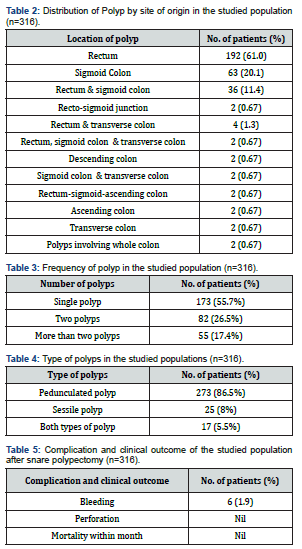
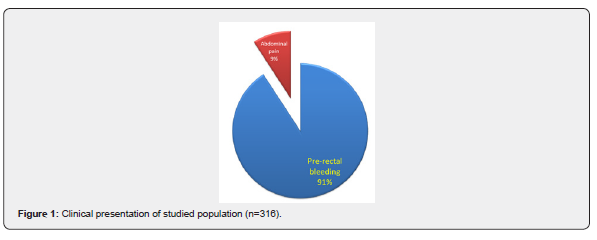
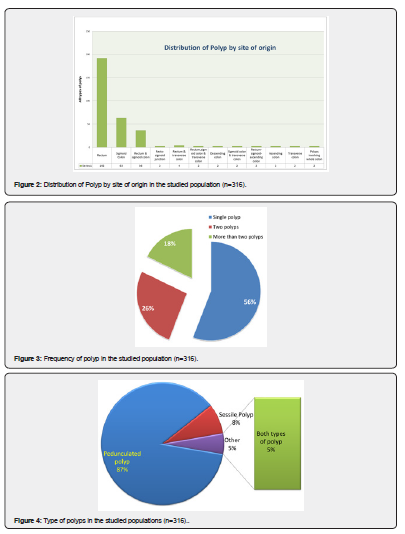
Results: We identified 316 patients who underwent colonoscopy polypectomy during our study period. Most patients (89%) came through outpatient department. The patients were between 2 and 18 years of age and more than half (205/316) were male. Over 91% (287/316) reported a history of per rectal bleeding and 9% (28/316) had abdominal pain. Of 316, 192 (61%) patients had polyp at rectum, 63 (20.1%) had at sigmoid Colon, 36 (11.4) had at rectum & sigmoid colon, 2 (0.67%) had at recto-sigmoid junction, 4 (1.3%) had at rectum & transverse colon, 2 (0.67%) had at rectum, sigmoid colon & transverse colon, 2 (0.67%) had at descending colon, 2 (0.67%) had at sigmoid colon & transverse colon, 2 (0.67%) had at rectum-sigmoid-ascending colon, 2 (0.67%) had at ascending colon, 2 (0.67%) had at transverse colon and polyps involving whole colon in 2 (0.67%) patients. We identified single polyp in 173 (55.7%) patients, two polyps in 82 (26.5%) patients and more than two polyps in 55 (17.4%) patients. Of all, 273 (86.5%) patients had pedunculated polyp, 25 (8%) had sessile polyp and 17 (5.5%) patients had both types of polyps. During colonoscopy, bleeding occurred in 6 (1.9%) patients and none had perforation. All of them were managed endoscopically. No other immediate complications were reported. There was no mortality within one month follow up.
Conclusion: Rectum is the most common site for colonic polyp. Colonoscopy snare polypectomy is a simple, effective, and safe procedure for the management of colorectal polyp in children.
Keywords: Colonic polyp; Paediatric colonoscopy; Endoscopic polypectomy
Introduction
Colonic polyps are the common cause of isolated lower gastrointestinal bleeding in children [1]. Juvenile colonic polyps are the most common colorectal polyps in children, account for 70–80% of the colorectal polyp in children and typically appearing as a solitary polyp [2, 3]. The advent of endoscopic polypectomy through colonoscopy has significantly reduced the risk associated with surgical polyp removal. There has been limited study on evaluation of the performance status of colonoscopy polypectomy in children with clinically suspected colorectal polyps and subsequent surveillance colonoscopy. Therefore, this study aimed to assess the safety and efficacy of colonoscopy polypectomy and to measure the clinical outcome of patient after colonoscopy polypectomy.
4. Materials and Methods
Three hundred sixteen children with colonic polyps were reviewed retrospectively in the department of Gastroenterology and hepatology at Crescent Gastro-liver and General Hospital, Green Road, Dhaka from January 2020 to November 2024. Written informed consent was obtained from the parents of individual participants prior the procedure after carefully explaining the procedure details and potential complications. Parents who did not consent to the procedure and/or had thrombocytopenia and coagulopathy were also excluded from the study. Cases 18 years and below who underwent colonoscopy for removal of polyp were included in this study. The juvenile colonic polyp was diagnosed by the presence of five or less hamartomatous polyps in the colon or rectum in the absence of family history. The medical records for demographics information, clinical and laboratory profile, colonoscopy findings, clinical outcome including complications and one month follow up data of each patient were reviewed. Total intravenous anesthesia by propofol (TIVA), or pethidine and midazolam combination were used for anesthesia. Colonoscopy was done with Pentax EPK-P processor, Pentax EC-380 LKP Colonoscope, ERBE ICC200 diathermy and Captivator- medium (27mm) hexagonal or rounded stiff wire loop polypectomy snare from Boston Scientific were used.
Results
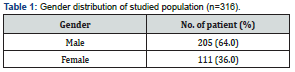
Among the 316 study patients, 205 patients, that is majority were male (64%), with a male-to-female ratio of 1.8:1 (Table1). They were presented at ages ranging from 2 to 18 years, with a mean age of 8 years. Two hundred eighty-one (89%) cases were coming through outpatient department. Over 91% (287/316) reported a history of per rectal bleeding and 9% (28/316) had abdominal pain (Figures 1-4) (Tables 2-5) (Images 1 & 2).
Discussion
Juvenile polyps are important cause of rectal bleeding and the most common gastrointestinal tract tumors in children [4]. The mean age of the patients at the time of diagnosis was 8 years , whereas similar study conducted in Bangladesh found mean age about 5 to 6 years [5-7]. A majority of the children were male (64%), A similar preponderance of male children was observed by Mahmud et al. [5], Poddar et al. [4] & Mandhan et al. [7]. In this study, majority patients had history of per rectal bleeding (91%), very few patients present with abdominal pain (9%). Mahmud et al. [5] also observed similar features of per rectal bleeding and abdominal pain. About half of the patients in this current study had single polyp (55.7%) and majority were located in the rectum (61%). On the other hand, Silbermintz et al 1, Mahmud et al5 found single polyp in 94.8% and 82.8% respectively. Poddar et al. [4], Lin et al. [8] found majority polyps of their studied population were found in rectosigmoid location.
Given the above finding, sometimes polyps can be found above the rectosigmoid area. Therefore, a total colonoscopy is suggested in all children with per rectal bleeding, which was also emphasized by Poddar et al. [4]. In this present study, majority (86.5%) of the patients had pedunculated polyps. Similar data were found in other studies by Das et al. [6] Mandhan et al. [7] and Rathi et al. [9]. Possible major complications of colonoscopy polypectomy include hemorrhage, and intestinal perforation, which may be seen with electrocautery. In this present study, no significant complications were seen immediately after the procedure, except for minor bleeding in only 6 (1.9%) cases, which were managed endoscopically. There were no cases of perforation, nor any long-term complications seen within the period of one month follow up. Mahmud et al. [5] observed nearly similar result. Therefore, We advocate colonoscopy polypectomy for the therapeutic management of colonic polyps in children since it is safe and effective.
Conclusion
Rectum is the most common site for colonic polyp. Per rectal bleeding in the most common clinical problem. Colonoscopic snare polypectomy is a simple, effective, and safe procedure for the management of colorectal polyp in children.
References
- Silbermintz A, Matar M, Assa A, Zevit N, Glassberg YM (2019) Endoscopic Findings in Children with Isolated Lower Gastrointestinal Bleeding. Clin Endosc 52(3): 258-261.
- Thakkar K, Fishman DS, Gilger MA (2012) Colorectal polyps in childhood. Curr Opin Pediatr 24(5): 632-637.
- Thakkar K, Alsarraj A, Fong E, Holub JL, Gilger MA (2012) Prevalence of colorectal polyps in pediatric colonoscopy. Dig Dis Sci 57(4): 1050-1055.
- Poddar U, Thapa BR, Vaiphei K, Singh K (1998) Colonic Polyps: Experience of 236 Indian Children. The American Journal of Gastroenterology 93(4): 619-622.
- Mahmud S, Parvez M, Baidya M, Tasneem F, Hasan AR (2024) Colonoscopic polypectomy of juvenile polyps in children: Experience from a tertiary centre of Bangladesh. Gastroenterology & Endoscopy 2(1): 1-6.
- Das SR, Karim ASMB, Rukon Uzzaman M, Mazumder MW, Alam R (2022) Juvenile Polyps in Bangladeshi Children and Their Association with Fecal Calprotectin as a Biomarker. Pediatr Gastroenterol Hepatol Nutr 25(1): 52-60.
- Mandhan P (2004) Juvenile colorectal polyps in children: experience in Pakistan. Pediatric Surgery International 20(5): 339-342.
- Lin CH, Wu RS, Lin WC, Wu SF, Chen AC (2009) Colonoscopic polypectomy of colorectal polyps in children under general anesthesia. Kaohsiung J Med Sci 25(2): 70-76.
- Rathi C, Ingle M, Pandav N, Pipaliya N, Choksi D (2015) Clinical, endoscopic, and pathologic characteristics of colorectal polyps in Indian children and adolescents. Indian Journal of Gastroenterology 34(6): 453-457.

























