




 ARGH Home



Mid-Term Outcome of Poem on Ineffective Esophageal Motility
Brittany Pass, David Okuampa, Omar Khan, Aditya Vyas, Michael Tran, Kelly Schulte and Qiang Cai*
Louisiana State University Health Sciences Center Shreveport School of Medicine, Shreveport, Louisiana, United States
Submission:May 07, 2026;Published:May 15, 2026
*Corresponding author:Qiang Cai, MD, Ph.D., Professor of Medicine, Division of Gastroenterology and Hepatology, Louisiana State University Health Science Center at Shreveport, Shreveport, Louisiana, USA
How to cite this article:Brittany Pass, David Okuampa, Omar Khan, Aditya Vyas, Michael Tran, et al. Mid-Term Outcome of Poem on Ineffective Esophageal Motility. Adv Res Gastroentero Hepatol, 2026; 22(3): 556090.DOI: 10.19080/ARGH.2026.22.556090.
Abstract
Background: Ineffective esophageal motility (IEM) is a condition of failed and disrupted peristalsis in the distal esophagus; using manometry, a
distal esophageal contraction amplitude of < 30 mmHg with ≥ 50% ineffective liquid swallows is diagnostic [1-3]. IEM has an estimated prevalence
of 20-30% [1]. Clinically, the most common symptoms are reflux, and dysphagia [1,2]. Management is focused on medical GERD treatment and
lifestyle modification due to limited pharmacological intervention for esophageal motility [4]. There is currently no established treatment for
dysphagia in IEM. However, per oral endoscopic myotomy (POEM) has emerged as a novel and effective treatment for dysphagia in achalasia,
diffuse esophageal spasm, and jackhammer esophagus [5-7]. Therefore, it is theorized that it may be a beneficial treatment for IEM-associated
dysphagia.
Case Description: We retrieved all patients with the diagnosis of IEM who underwent POEM in our endoscopic center. All had an extensive
work-up for their dysphagia before being referred to us. IEM was diagnosed by their HRM. All of them had dysphagia, gastroesophageal reflux
symptoms (GERD) and were taking proton pump inhibitors. All of them tried some other medications without significant effect on their dysphagia.
POEM was performed for all of them. Four patients, three male and one female, ages 65, 56, 57, and 58, were retrieved. POEM was successfully
performed on all patients. The average procedure time was 31 minutes. The follow up times after POEM were 13 months, 24 months, 26 months,
and 12 months, respectively. Dysphagia was resolved in all of them. The Echardt score for the first, third, and fourth patients decreased from 7
and 8 to less than 3. The first, second, and third patients gained 20 pounds, 3 pounds, and 10 pounds in their recent clinic follow ups. The second
patient’s dysphagia recurred after (how long time?) and his Echardt score has increased to 7 at their most recent follow-up. Their GERD is well
controlled, except for in the second patient who reported no change in his GERD
Conclusion: To our knowledge, this is the first report of the outcome of POEM on patients with IEM and dysphagia. For patients with IEM and
refractory dysphagia, POEM is effective all four cases, though more cases are needed to further confirm the conclusion./p>
Keywords:Esophageal Motility; POEM; Dysphagia
Abbreviations:IEM: Ineffective Esophageal Motility; POEM: Per Oral Endoscopic Myotomy
Introduction
Ineffective esophageal motility (IEM) is characterized as ineffective or failed peristalsis of the distal esophagus with frequent breaks during swallows that may result in poor esophageal emptying [2,8]. High resolution esophageal manometry (HRM) is the current gold standard for assessment and diagnosis of esophageal motility abnormalities; combining HRM with intraluminal impedance sensors aids diagnosis [1,9]. The diagnostic criteria for IEM is ≥ 50% ineffective liquid swallows and a distal esophageal contraction amplitude of < 30 mmHg [1,3]. IEM is thought to be caused by the failure of myenteric neurons to stimulate peristalsis in the distal esophagus due to inflammatory mediators shown to decrease acetylcholine release, such as interleukin-6 and platelet activating factor [2]. Overall, IEM continues to be under-diagnosed and under-treated [1]. Even so, it is the most common abnormality on esophageal manometry [1]. It has a 20-30% prevalence in the general population but is more common among patients with smooth muscle disorders, connective tissue disorders, gastroparesis, and diabetes with autonomic dysfunction [1,8]. Clinically, patients present with numerous intermittent symptoms, such as dysphagia, heartburn/ reflux, chest pain or fullness, and throat clearing [1,2]. IEM patients fall into one of two categories: a more severe form with dysphagia as the predominant symptom or a milder form with GERD as the predominant symptom [1,3]. There is limited knowledge about the natural history of IEM, however, in most instances, it does not progress over time or significantly impact quality of life [4,8].
Treatment of IEM is severely limited; there are few promotility medications available with varying efficacy, and numerous side effects [1,2,4,9]. Metoclopramide and Domperidone did not improve esophageal motility compared to placebo. 4 Erythromycin showed some improvement to esophageal motility, but it carries the risk of tachyphylaxis, cardiac dysrthymia, and possible incitation of antibiotic resistance [4]. Similarly, bethanechol allowed for complete bolus transit, and increased distal esophageal contraction and amplitude, however, many patients could not tolerate the side effects, such as drowsiness, nausea, and increased urinary frequency [4]. Beyond medical therapy, empiric esophageal dilation and lower esophageal sphincter botulinum toxin injections have been used with variable success [2,9]. Currently, symptom management, primarily focused on GERD, with diet and lifestyle modification, such as careful chewing, remain the focus of IEM treatment [4,9]. Recently, per oral endoscopic myotomy (POEM) has emerged as an effective treatment for dysphagia in achalasia, diffuse esophageal spasm, jackhammer esophagus, and non-malignant EGJ outlet obstruction [5-7]. POEM is a natural orifice transluminal endoscopic procedure that is performed by tunneling submucosally in the distal esophagus to the LES to complete a myotomy while preserving the outer longitudinal muscle bundles [7]. POEM is a safe procedure with a low incidence of serious adverse events that can typically be medically or endoscopically managed; the most common events are significant bleeding and mucosal perforation [6,7]. Here, we present 4 cases of IEM with dysphagia treated with POEM. We present this article in accordance with the CARE reporting checklist.
Case Description
Methods
Participants were recruited at our academic institution between April 2022 and June 2023. We are retrospectively studying their procedural outcomes over time. To our knowledge, this is the first study to monitor IEM patients who underwent POEM for dysphagia.
Ethical Approval
This study was approved by the Louisiana State University Health Shreveport Ethics Committee. Written consent was obtained from all participants.
Case Presentation
Case 1
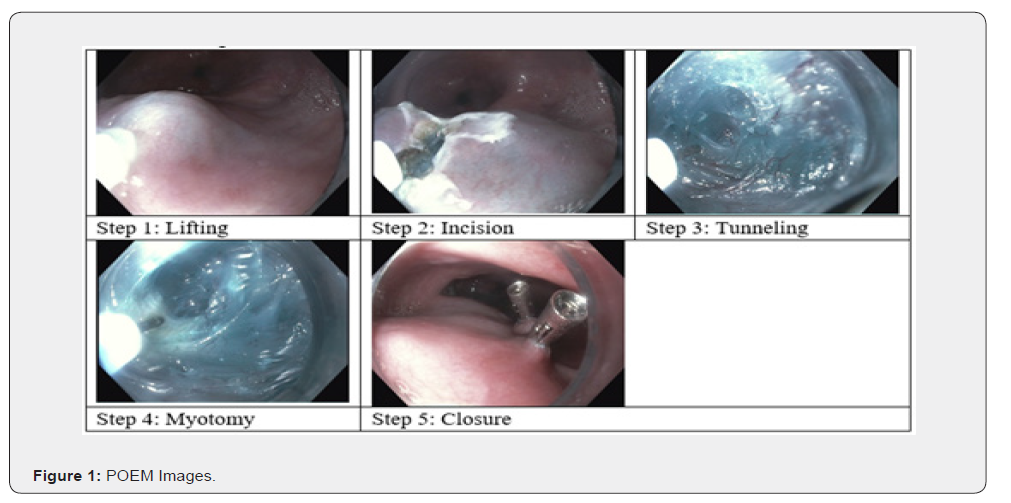
The first case was a 65-year-old male who presented with a one-year history of weight loss, regurgitation, and dysphagia. He was only able to consume liquids. His past medical history included refractory GERD and hernia repair. His initial Echardt score was a 7. Subsequent EGD showed food in the esophagus, and esophageal manometry showed ineffective esophagus. After discussion of the risks and benefits of the POEM procedure, the patient chose to undergo the procedure. A single myotomy from a posterior approach was performed (Figure 1). The procedure was uncomplicated and lasted 40 minutes. He was discharged on a proton pump inhibitor. At his two-month follow-up, he had gained 20 lbs and was feeling significantly better. At his 13 month follow-up, he continued to have symptom relief. His GERD is well controlled, and he can eat anything he likes. His Echardt score has dropped to 1.
Case 2
The second case was a 56-year-old male who presented with a fifteen-year history of dysphagia and chest pain. He was only able to consume liquids. His past medical history was significant for GERD, esophageal perforation, gastroparesis, two prior Nissen Fundoplication’s, an esophageal dilation, an esophageal stent, and a G-POEM procedure. A subsequent esophageal manometry showed ineffective esophagus. His initial Eckhardt score was an 8. After discussion of the risks and benefits of the POEM procedure, the patient chose to undergo the procedure. A single myotomy was performed. The procedure was uncomplicated and lasted 34 minutes. At his one-month follow-up, his dysphagia was much better and Echardt score went down to 2. He continued to have symptoms of early satiety, fullness, and nausea. Six months following his procedure, he gained 3lbs. At his 24 month followup, he feels that the effects of the procedure are “wearing off.” He is experiencing some dysphagia and must avoid eating meat. He reports daily heartburn but no weight loss. His Echardt score has risen to a 7. We are planning to schedule Redo POEM
Case 3
The third case was a 57-year-old female who presented with a multiple year history of dysphagia, heartburn, and regurgitation. Her medical history is significant for achalasia, GERD, thyroid disease, and a robotic Heller myotomy with fundoplication. A previous barium esophagram showed achalasia with abnormal peristalsis and tertiary peristalsis. A prior EGD showed proximal dilation of the distal esophagus, mild stricture lower, semi-solid food and liquid, and concern for abnormal motility in the distal esophagus. An esophageal manometry showed elevated LES pressures. Her initial Eckhardt score was a 5. She has a 30-year history of smoking 3-4 cigarettes daily with occasional alcohol use. Her family history is significant for a sister with muscular dystrophy. After discussion of the risks and benefits of the POEM procedure, the patient chose to undergo the procedure. A single myotomy from a posterior approach was performed. The procedure was uncomplicated and lasted 25 minutes. At her sixweek follow-up, she was feeling much better. Her dysphagia had resolved, and she gained 10lbs. At her 26-month follow-up, she continued to have symptom relief. She can eat whatever she likes. Her Echardt score was a 2.
Case 4
The fourth case was a 58-year-old male who presented with a 3-year history of dysphagia, nausea, vomiting, and GERD. His medical history included hiatal hernia repair and vasovagal syncope. An esophageal manometry showed ineffective esophageal motility. His initial Eckhardt score was a 6. After discussion of the risks and benefits of the POEM procedure, the patient chose to undergo the procedure. A single myotomy was performed. It was an uncomplicated procedure that lasted 26 minutes. He had significant improvement of his symptoms of GERD, nausea, and vomiting. He continued to have prandial abdominal pain that resolves about 10 minutes post-prandially. At his 12-month follow-up, he was doing well. His only symptom was occasional GERD often related to his diet. His Echardt score was a 1.
Discussion
Ineffective esophageal motility (IEM) is characterized as failed or discontinuous peristalsis in the distal esophagus [1]. It is theorized that the peristaltic disruption is due to a defect in triggering the lower esophageal muscles present with or without weak muscle contraction [1]. Patients present with a variety of symptoms, such as dysphagia, GERD, regurgitation, chest fullness, and pain [1]. The current treatment focuses on medical GERD management and lifestyle modifications [2,3]. POEM is a natural orifice transluminal endoscopic procedure that is performed by tunneling submucosally in the distal esophagus to the LES to complete a myotomy while preserving the outer longitudinal muscle bundles [7]. POEM patients are discharged on antibiotics with gram negative coverage and a high-dose PPI therapy [5]. Many studies have shown POEM to be effective in relieving dysphagia in patients with achalasia and spastic esophageal motility disorders [5,6]. It is a safe procedure with a low incidence of adverse events; most of which can be managed endoscopically or medically [6,7].
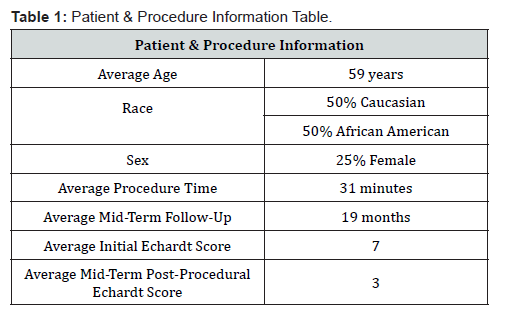
Four patients from our center with IEM-associated dysphagia underwent POEM. There was 100% technical success; the average procedure time was 31 minutes. One of the patients was female. The average age was 59 years. In the mid-term followup, averaging about 19 months after the procedure, all patients’ dysphagia were resolved initially and three of them (75%) had continued symptom relief. The average initial Echardt score was a 7. The average mid-term Echardt score was a 3, leading to an average 4 point reduction. In all four patients, POEM provided relief of their IEM-associated dysphagia for at least one year. The one patient experiencing dysphagia symptoms had a twoyear period post-procedure without symptoms. He also has many comorbidities that may be contributing to the recurrence of his symptoms, including gastroparesis, and prior esophageal perforation (Table 1).
Conclusion
In our experience, POEM has been successful in relieving symptoms of dysphagia in IEM patients with continued relief through mid-term follow-up for most. Some patients’ dysphagia may recur, just like patients with achalasia, a redo POEM may be needed. More cases are needed to confirm this conclusion, as well as, continued following of patients to determine the average length of relief from dysphagia in IEM treated with POEM.
References
- Abdel Jalil AA, Castell DO (2015) Ineffective Esophageal Motility (IEM): the Old-New Frontier in Esophagology. Curr Gastroenterol Rep 18(1): 1-7.
- Shetler KP, Bikhtii S, Triadafilopoulos G (2017) Ineffective esophageal motility: Clinical, manometric, and outcome characteristics in patients with and without abnormal esophageal acid exposure. Diseases of the Esophagus 30(6).
- Blonski W, Vela M, Safder A, Hila A, Castell DO (2008) Revised criterion for diagnosis of ineffective esophageal motility is associated with more frequent dysphagia and greater bolus transit abnormalities. American Journal of Gastroenterology 103(3): 699-704.
- Jandee S, Geeraerts A, Geysen H, Rommel N, Tack J (2021) Management of Ineffective Esophageal Hypomotility. Front Pharmacol 12: 638915.
- Liu-Burdowski J, Duarte-Chavez R, Kahaleh M (2022) Per-oral Endoscopic Myotomy. J Clin Gastroenterol 56(1): 16-22.
- Jawaid S, Draganov PV, Yang D (2020) Esophageal POEM: the new standard of care. Transl Gastroenterol Hepatol 5: 47-47.
- Ahmed Y, Othman MO (2019) Peroral endoscopic myotomy (POEM) for Achalasia. J Thorac Dis 11: S1618-S1628.
- Gyawali C, Sifrim D, Carlson D (2019) Ineffective esophageal motility: Concepts, future directions, and conclusions from the Stanford 2018 symposium. Neurogastroenterol Motil 31(9): e13584.
- Patel DA, Yadlapati R, Vaezi MF (2022) Esophageal Motility Disorders: Current Approach to Diagnostics and Therapeutics. Gastroenterology 162(6): 1617-1634.

























