




 ARGH Home



Antibiotics Prophylaxis in Gastric per Oral Endoscopic Pyloromyotomy: A Pilot Study
Omar Khan, Brittany Pass, Ross Dies, David Okuampa, Gabrielle Sanford, Michael Tran, Aditya Vyas, Kabir Husain, Michelle Neice and Qiang Cai*
Professor of Medicine Director, Division of Gastroenterology and Hepatology, Louisiana State University, USA
Submission:September 13, 2025;Published:September 25, 2025
*Corresponding author:Qiang Cai, Professor of Medicine Director, Division of Gastroenterology and Hepatology Louisiana State University, USA
How to cite this article:Omar Khan, Brittany Pass, Ross Dies, David Okuampa, Gabrielle Sanford et al. Antibiotics Prophylaxis in Gastric per Oral Endoscopic Pyloromyotomy: A Pilot Study. Adv Res Gastroentero Hepatol, 2025; 21(5): 556075.DOI: 10.19080/ARGH.2025.21.556075.
Abstract
Abstract: Background: Gastric per-oral endoscopic pyloromyotomy (G-POEM) is an endoscopic therapeutic modality for treatment of refractory gastroparesis. The standard perioperative G-POEM course was largely adopted from the initial esophageal per oral endoscopic myotomy (POEM) procedures done for achalasia and most often includes an intraoperative intravenous dose and a postoperative oral course of antibiotics to prevent potential infections. However, the necessity of antibiotic prophylaxis as part of a standard G-POEM protocol remains unknown. Our study aimed to see if patients undergoing G-POEM required any antibiotics at all.
Methods: Starting July 2023, patients without diabetes would receive no prophylactic antibiotics. Patients with diabetes, however, would still receive only one dose of antibiotics shortly before. Patients were assessed on post-procedure day 1 and post-procedure day 2, either by a bedside visit or a phone call if they were discharged from hospital. The patients were each reassessed 1-2 months after G-POEM by an in-person clinic visit or by phone.
Results: A total of 30 consecutive patients were enrolled in the study from July 2023 to March 2024. Only two patients were male. The average age was 54 years. Seven patients had diabetes. Of the 30 enrolled patients, only 1 required additional postoperative antibiotics for persistent abdominal pain during post-procedure follow up. Although this patient demonstrated no signs of infection such as fever or chills. All the other patients had no signs of infection or worsening gastroparesis. All thirty patients reported an improvement of their gastroparesis symptoms without any signs of infection; seventeen patients met the criteria for clinical success of G-POEM.
Conclusion: Given the rise of bacterial resistance to antibiotics and the patient-reported adverse effects or allergies to antibiotics, this study supports that providers can consider avoiding perioperative antibiotics and postoperative antibiotics for patients undergoing G-POEM. Patients with diabetes are often relatively immunocompromised and likely benefit from some antibiotics perioperatively, however, further studies with more patients are needed to standardize this.
Keywords:Antibiotics prophylaxis; Endoscopic pyloromyotomy; POEM; Antimicrobial; Gastrointestinal endoscopy
Abbreviations:G-POEM: Gastric Per-Oral Endoscopic Pyloromyotomy; POEM: Per Oral Endoscopic Myotomy; ASHP: American Society of Health-System pharmacists; IDSA: Infectious Diseases Society of America; SIS: Surgical Infection Society; SHEA: Society for Healthcare Epidemiology of America; SSI: Surgical Site Infection
Introduction
Antimicrobial or drug resistance is a significant public health threat. As a result of inappropriate prescribing of antimicrobial agents such as antibiotics, drug-resistant pathogens are more common. Antibiotics themselves can cause adverse effects, such as putting patients at risk for Clostridium Difficile infection [1]. This has increased mortality and healthcare costs [2]. There is now a greater emphasis on judicious prescription of antibiotics to prevent further development of drug resistance. Given the easy access of information and over-prescribing of antibiotics, patients are now more aware of adverse side effects from antibiotics they have taken, leading to more self-reported allergies. This is further complicated by inconsistencies between patient-reported allergies and documented allergies in the electronic medical records [3]. As a result, it has become more difficult to select the appropriate antibiotic when necessary. This applies to procedures that require perioperative antibiotics as part of protocol, such as gastric per-oral endoscopic pyloromyotomy (G-POEM) which is an emerging therapeutic endoscopic procedure for gastroparesis. The necessity of antibiotic prophylaxis as part of a standard G-POEM protocol remains in question and has never been rigorously examined before, as the protocol was based off the initial esophageal per oral endoscopic myotomy (POEM) procedures done for achalasia. Patients undergoing POEM usually receive intraoperative intravenous dose and a postoperative oral course of antibiotics to prevent potential infections. Examples of the common antibiotics given are piperacillin-tazobactam, levofloxacin, and ciprofloxacin. There was one study that showed no difference in outcomes between patients who received pre-operative antibiotics and patients who did not receive pre-operative antibiotics prior to undergoing the esophageal POEM procedure, but all these patients had received postoperative antibiotics [4].
There are guidelines from the American Society for Gastrointestinal Endoscopy that help determine the need of antibiotic prophylaxis in endoscopic procedures, but these do not include the relatively newer procedures such as POEM and G-POEM [5]. The 2013 guidelines from the American Society of Health-System Pharmacists (ASHP), the Infectious Diseases Society of America (IDSA), the Surgical Infection Society (SIS), and the Society for Healthcare Epidemiology of America (SHEA) recommended antibiotic prophylaxis in high-risk patients undergoing gastroduodenal surgical procedures to reduce the rate of surgical site infection (SSI), usually either with a 1stgeneration or a 2nd-generation cephalosporin. These risk factors included decreased gastric motility, increased gastric pH due to acid-suppression medications, obesity, and American Society of Anesthesiologists classification of at least 3 [6,7]. Prior studies have shown that the acidic nature of the stomach acts a natural deterrent to most bacterial infections introduced into the stomach [7]. Given that there is no surgical or skin incision in G-POEM, it is difficult to extrapolate the current guidelines for antibiotic prophylaxis to G-POEM. Our study aimed to see if patients undergoing G-POEM required any antibiotics at all, perioperative and/or postoperative.
Methods
Patient selection
Starting July 14th, 2023, we modified our G-POEM antibiotic prophylaxis protocol and all patients undergoing G-POEM were enrolled. Patients without diabetes would receive no prophylactic antibiotics. Patients with diabetes, however, would still receive only one dose of antibiotics shortly before or during the procedure. Patients were assessed on post-procedure day 1 and post-procedure day 2 either by bedside visit or phone call if they were discharged home. The patients were each reassessed at 1-2 months after G-POEM by in-person clinic visit or by phone call.
Gastric Per-oral endoscopic myotomy (G-POEM) procedure
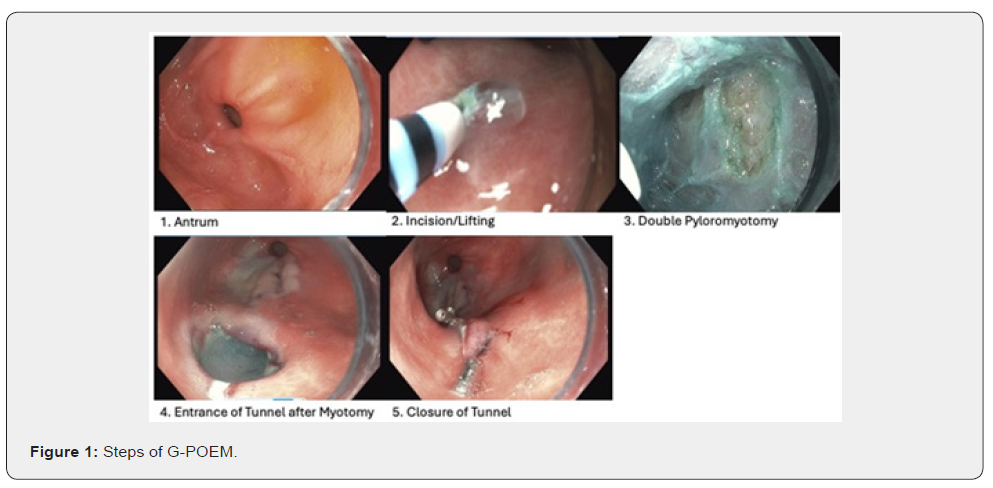
Written consent was obtained after all patients were provided with pertinent information and instructions about the procedure along with possible adverse outcomes. None of the patients were hospitalized prior to the procedure. All procedures were done under general anesthesia in supine position. Patient preparation and surgical technique were performed as previously described [8-10]. A senior clinical gastroenterology fellow was involved in all cases and performed the initial EGD for each procedure which were performed using a gastroscope (GIF-H190; Olympus, Tokyo, Japan) with a transparent distal cap attachment (MH-588;Olympus). A Hybrid knife I-type (ERBE, Germany) was used for POEM. CO2 was used for insufflation. The technique consisted of four basic steps: (I) mucosal incision after lifting with premixed methylene blue solution, (ii) submucosal tunneling, (iii) myotomy, and (iv) mucosal incision closure (Figure 1). The length of submucosal tunnel dissection and the myotomy of the muscle layer was approximately 5cm and 2cm respectively. individualized and tailored according to the feasibility and safety at the procedure. At the end of each procedure, an endoscopic inspection was performed. The mucosal incision was closed by using through the scope clips. The decision to admit the patient post-procedure was made in the endoscopic recovery area based on hemodynamic stability, clinical symptoms, procedure time, intra-procedural complications, as well as patient transport and social issues.
Data collection
After obtaining institutional review board approval, data was collected by retrospective chart review. It included relevant demographic information, clinical variables, and documentation of the follow-up or clinical status of the patient within 1-2 months after undergoing the procedure.
Data analysis
Descriptive statistics were used to give a general understanding of the data and the variable characteristics. The mean was calculated for continuous data, and percentages were calculated for categorical variables. This was done to summarize the data and provide an overview of the variables and their distributions. The Chi-squared test was used for testing the G-POEM outcomes between patients who received antibiotics and patients didn’t receive antibiotics.
Results
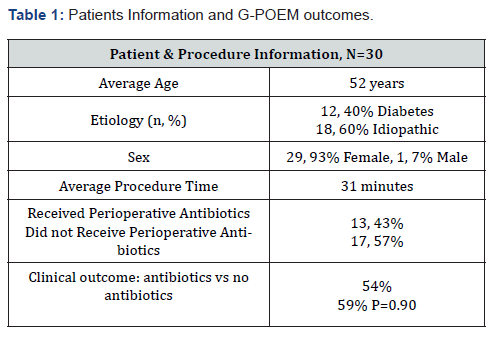
Thirty patients who underwent G-POEM were included in the study. One of these patients was included twice as she underwent a redo G-POEM during the study period. There was a total of three patients in this study who underwent a redo G-POEM, but the index G-POEM for the other two patients was done before the initiation of the study. The average age of patients was 52 years old. There were 28 females and 2 males (Table 1). Thirteen of the thirty patients received perioperative antibiotics, with one of these patients being a redo G-POEM. Twelve of these patients who received perioperative antibiotics had diabetes and one patient had sarcoidosis. The remaining eighteen patients were classified as idiopathic gastroparesis. Of the thirty patients total, only two patients required a course of postoperative antibiotics. For both patients, they had undergone the G-POEM procedures for the first time. One of the patients had a history of multiple abdominal surgeries while the other patient had a history of active Crohn’s disease that was in process of transitioning to another biologic therapy as her disease was not controlled her current therapy. Neither of these two patients had any objective signs of fever or infection. All thirty patients reported an improvement in their gastroparesis symptoms without any signs of infection; seventeen patients met the criteria for clinical success of G-POEM. The shortterm clinical outcomes G-POEM were similar between the patients who received one dose of antibiotics and patients who didn’t receive antibiotics (Table 1).
Discussion
Gastroparesis is objectively delayed emptying of the stomach in the absence of mechanical obstruction. Gastroparesis can be idiopathic, but it has also been associated with diabetes, medications, and post-surgical complications. The underlying pathophysiology of gastroparesis is not completely clear but is thought to be from impairment of the nerve coordination and motor systems of different regions of the stomach. G-POEM is an emerging endoscopic therapeutic modality for treatment of refractory gastroparesis.8 The standard perioperative G-POEM course was largely copied from the initial esophageal POEM procedures done for achalasia and most often includes antibiotic prophylaxis. However, the necessity of antibiotic prophylaxis as part of a standard G-POEM protocol remains in question, given that the acidic environment of the stomach is itself a natural deterrent to most bacterial infections. Given the rise of bacterial resistance to antibiotics due to overprescribing, observed medication interactions, and patient-reported adverse effects or allergies to antibiotics, reducing the need for perioperative and/or post-operative antibiotics in G-POEM procedures is essential. This study shows that patients who have no diabetes undergoing an initial G-POEM procedure may not require antibiotic prophylaxis.
In our study, all procedures we evaluated were done by a single expert endoscopist, thus eliminating inter-personnel variability depending on the level of expertise and technique. Moreover, all the myotomies were tailored with a standard protocol of a 5 cm tunnel dissection and a 2 to 3 cm double myotomy. No mortality and adverse events were reported in study. We acknowledge our study has limitations. One limitation is that some of these patients could not be evaluated directly in person on their follow-up given their distance from the hospital. As a result, antibiotics were sometimes prescribed based on clinical judgement after discussing with the patients about their symptoms over the phone. If they could be evaluated in person, it is possible that the two patients who were prescribed antibiotics may not have needed the post-operative course.
Another limitation of the study is the post-operative symptoms to be aware of to determine the need for post-operative antibiotics. Patients with gastroparesis may develop chronic abdominal pain or discomfort, which may complicate the course after undergoing G-POEM. Some of these gastroparesis patients have also undergone multiple procedures or surgeries prior to undergoing the G-POEM. Besides objective fever, there needs to be more studies to determine symptoms that would require a postoperative course of antibiotics. In this study, patients with diabetic gastroparesis still had one dose of antibiotics shortly before the procedure, it is unknown whether one dose of antibiotics prophylaxis is necessary or not, more studies are needed to identify the truth. In conclusion, this study supports the idea that providers can consider avoiding perioperative antibiotics and postoperative antibiotics for healthy patients undergoing an initial G-POEM. Patients with diabetes are often relatively immunocompromised and likely benefit from some antibiotics perioperatively. Going forward, larger multicenter prospective trials directly comparing outcomes in G-POEM patients with and without antibiotics are needed before widely incorporating altered antibiotics regimens for the G-POEM procedure. Further data is also needed on optimal timing of follow-up and symptoms to be aware of after undergoing a G-POEM to determine the need for post-operative antibiotics.
References
- CDC (2024) Antimicrobial Resistance Facts and Stats. Antimicrobial Resistance.
- World Health Organization (2023) Antimicrobial Resistance. World Health Organization.
- Kabakov A, Rhodes NJ, Wenzel R (2019) Discrepancies Between Patient Self-Reported and Electronic Health Record Documentation of Medication Allergies and Adverse Reactions in the Acute Care Setting: Room for Improvement. J Pharm Technol 35(4): 139-145.
- Zhai Yuqi, Langhe Ending, Li Haikai, Qin Zhihui, Shi Xiaolin, et al. (2013) Is Preoperative Antibiotics Necessary for Infection Prevention before Peroral Endoscopic Myotomy: 1939. American Journal of Gastroenterology 108: S587.
- Khashab MA, Chit Hadi KV, Acosta RD (2015) Antibiotic prophylaxis for GI endoscopy. Gastrointestinal Endoscopy 81(1): 81-89.
- Dale W Brazer, E Patchen Dellinger, Keith M Olsen, Trish M Perl, Paul G Auwaerter, et al. (2013) Clinical practice guidelines for antimicrobial prophylaxis in surgery. American Journal of Health-System Pharmacy 70(3): 195-283.
- Gorbach SL, Plaut AG, Nahas L, Weinstein L, Span Knebel G, et al. (1967) Studies of intestinal microflora. II. Microorganisms of the small intestine and their relations to oral and fecal flora. Gastroenterology 53(6): 856-867.
- Dacha S, Mekaroonkamol P, Li L, Shahnavaz N, Sakaria S, et al. (2017) Outcomes and quality-of-life assessment after gastric per-oral endoscopic pyloromyotomy (with video). Gastrointest Endosc 86(2): 282-289.
- Spandorfer R, Zhu Y, Abdelfatah MM, Mekaroonkamol P, Dacha S, et al. (2020) Proximal and Distal Gastric Retention Patterns in Gastroparesis and the Impact of Gastric Per-Oral Endoscopic Myotomy: A Retrospective Analysis Using Gastric Emptying Scintigraphy. J Null Med Technol 48(2): 158-162.
- Abdelfatah MM, Noll A, Kapil N, Shah R, Li L (2021) Long-term Outcome of Gastric Per-Oral Endoscopic Pyloromyotomy in Treatment of Gastroparesis. Clin Gastroenterol Hepatol 19(4): 816-824.

























