ARGH Home



A Case of completely Embedded Sunflower Seed Shell Palatal Tonsil Foreign Body
Deng Liang*
Department of Gastroenterology, Lun jiao Hospital, China
Submission:February 17, 2025;Published:February 28, 2025
*Corresponding author:Deng Liang, Department of Gastroenterology, Lun jiao Hospital, Shende District, FoShan City, 528308, China
How to cite this article:Deng L. A Case of completely Embedded Sunflower Seed Shell Palatal Tonsil Foreign Body. Adv Res Gastroentero Hepatol, 2025; 21(3): 556065.DOI: 10.19080/ARGH.2025.21.556065.
Abstract
A 38-year-old woman experienced throat pain and foreign body sensation after eating sunflower seeds on June 1, 2024. After twice of otolaryngology department examination, no foreign body was found, and the symptoms persisted. On the morning of June 3, under intravenous general anaesthesia, a gastroscopy examination was performed, and a yellow spot was found in the left palatal tonsil. It was suspected that the foreign body was completely embedded in the tonsil. The foreign body forceps extracted a 4mm long wooden fibrous foreign body, and the patient’s throat pain and foreign body sensation disappeared after the foreign body was removed.
Keywords:Tonsil; Foreign body; Electronic gastroscope; Pharyngalgia
Abbreviations:CT: Computerized Tomography
Introduction
Pharyngeal foreign bodies are quite common and are mainly handled by otolaryngology. In special cases where otolaryngology cannot detect foreign bodies, gastroenterologists may be able to help through electronic gastroscopy. Below is a report of a case of pharyngeal foreign body discovered through electronic gastroscopy
Case Report
A 38-year-old female patient experienced throat pain and foreign body sensation after eating sunflower seeds on June 1, 2024. She went to the otolaryngology department for treatment in the afternoon , but foreign body cannot be found during the laryngoscopy examination. The patient still felt throat pain and foreign body sensation. On the afternoon of June 2, she visited the otolaryngology department again, but no foreign body was found during the pharyngeal examination still. The otolaryngology department doctor considered pharyngitis, but pharyngalgia did not improve after medication treatment . On the morning of June 3, the patient felt that the throat pain worsened and requested a gastroscopy examination. Under intravenous general anaesthesia, a gastroscopy with a transparent cap was performed to carefully observe the oropharynx and laryngopharynx without any obvious foreign bodies. After removing the transparent cap, the lens was wiped, and no obvious foreign bodies were observed in the epiglottis and left and right pyriform fossa. After retracting the gastroscopy lens to the tongue roots, a yellow dot was seen on the surface of the left palatal tonsil. Whether the yellow dot was a foreign body? A yellow fibrous foreign body, about 4mm long, was seen after being clamped with foreign body forceps. Upon reexamination of the left palatal tonsil, the yellow dot disappeared, with no bleeding on the surface, and no pus flowing out (Figure 1, Figure 2). After removing the foreign body, the patient’s throat pain and sensation of the foreign body disappeared.
Discussion
Pharyngeal foreign body was one of the common emergencies in ear, nose, throat, head and neck surgery, which was easy to detect and remove. Large foreign bodies can cause damage to the pharynx. Improper handling can often delay the condition and lead to serious complications. According to the different locations of foreign body entrapment, pharyngeal foreign bodies can be divided into three types: 1. Nasopharyngeal foreign bodies are relatively rare and may have symptoms of nasal obstruction, often with a foul Odor if left for too long; 2. Foreign bodies in the oropharynx and throat often have foreign body sensation and stinging sensation, and the symptoms are obvious when swallowing, with the pain location fixed; 3. When a sharp foreign body punctures the mucosa, a small amount of bleeding can be seen. A larger foreign body can cause difficulty swallowing and breathing. The main causes are: 1 Eating carelessly, swallowing fish bones, flesh and bones, fruit pits, etc; 2. Children play and put small toys, coins, etc. into their mouths to swallow; 3. Swallowing during sleep, coma, or drunkenness (such as denture loss); 4. Attempting suicide and intentionally swallowing foreign bodies.
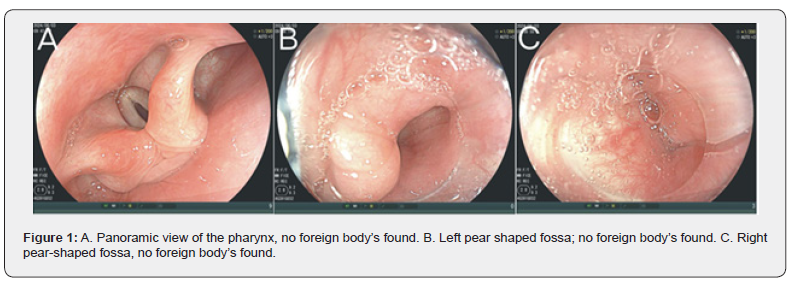
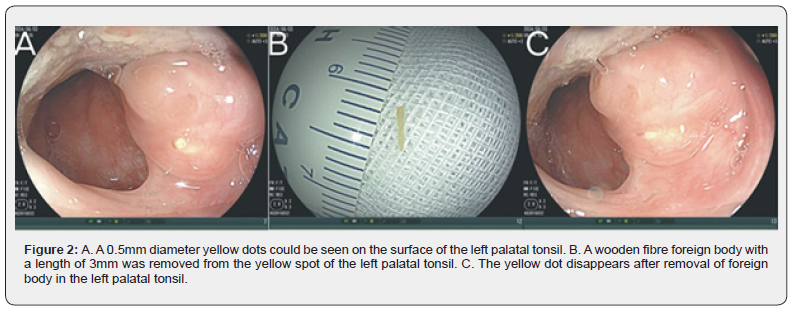
Most foreign bodies in the pharynx are located in the tonsils, tongue roots, epiglottic valleys, pyriform fossa, and other areas. They can be directly examined or detected through specialized instruments such as indirect laryngoscopy and fibre optic laryngoscopy. Metal or bone foreign bodies can appear as highdensity shadows in the pharynx through CT scans. The surface of the tonsils has tonsil dimples, which can easily cause foreign body entrapment. If the patient forcibly swallows, some foreign bodies can be completely embedded in the tonsils, making it impossible to see the residual end of the foreign body on the surface of the tonsils. Some of the pharyngeal foreign body sensation was caused by tonsil stones, and high-density shadows of the tonsils can be seen on pharyngeal CT in some patients with tonsil stones. There have been reports of feather shaped foreign bodies in the pharynx of infants aged 7 and 9 months [1]. Feather foreign bodies caused tonsils and pharyngeal abscesses, which were cured after surgery and antibiotic treatment.
The most likely cause of foreign bodies was feather shedding from down jackets or bedding, which was mistakenly swallowed by infants [2,3]. There have also been reports of sewing needles piercing the tonsils [4]. Pharyngeal foreign bodies can shift to the vocal cords, although rare, they are extremely dangerous and can easily cause airway spasms and laryngeal edema [5]. A study analysed 829 cases of foreign bodies in children’s ears, nose, and throat, and found that the nose (58.7%) and ears (20.2%) were the most common anatomical locations, followed by the mouth/ pharynx/tonsils (12.3%), exophages (6.2%), and tracheobronchial tree (2.4%). The most common foreign bodies in different parts were the nose beads (30.8%), ear beads (32.1%), fish bones in the mouth/pharynx/tonsils (56.8%), nuts and peanuts in the tracheobronchial tree (70%), and coin/disc batteries in the esophagus (80.7%) [6]. Sunflower seeds are the most common airway aspiration foreign body in children [7]. There have been reports that consuming a large amount of sunflower seed shells can cause rectal faecal impaction [8], but there were no relevant literature reports on the pharyngeal foreign body of sunflower seed shells.
The most unique aspect of this case was that the patient has a clear history of eating sunflower seed shells. During the eating process, there was pharyngeal pain, but after twice of otolaryngology and nasopharyngoscopy examinations, no foreign body was found. The patient still suffered from pharyngeal pain, discomfort, and foreign body sensation. We had to request a gastroscopy examination. Under good intravenous anaesthesia, with the assistance of a transparent cap to support the space, we could clearly observe the various corners of the pharynx through the gastroscopy. Even so, at the beginning, we did not find where the foreign body was. During the retraction process, we carefully observed that there was a yellow dot attached to the surface of the left palatal tonsil, and we were not sure whether it was tonsillitis or foreign body. Through the use of foreign body forceps that we found that it was a puncture fibre from sunflower seed shells. If the gastroscopy examination did not carefully observe the tonsils, or if the tonsils yellow dot were found to be untreated due to inflammation, the penetration of sunflower seed shells may lead to tonsil abscess.
The reflection this case brings us was that if the patient has a clear history of foreign body ingestion, as long as the patient experiences foreign body sensation and pain, even multiple nasopharyngeal or endoscopic examinations cannot fully indicate that the foreign body has disappeared and cannot considered the symptoms of foreign body sensation and pain are inflammatory reactions caused by foreign body piercing the mucosa. It was necessary to consider whether the foreign body may completely penetrate the mucosa, carefully observe every corner of the pharynx, and do not overlook suspicious manifestations. Try using foreign body forceps to clamp suspicious manifestations, which may reduce the chance of foreign body residue. Currently, an increasing number of early-stage pharyngeal cancers have been detected through electronic gastroscopy [9]. Compared with laryngoscopy, electronic gastroscopy has higher clarity and better manoeuvrability. After no foreign objects are found during laryngoscopy, electronic gastroscopy is also an option for examining the throat.
Acknowledgement
Thank you to the anaesthesiologist and digestive endoscopy nurse for their assistance during the operation of this case.
Conflict of Interest
I declare that there was no financial interest, or any conflict of interest exists or competitive financial interests or personal relationships that may affect the work reported in this article.
References
- Takahashi A, Sugawara C, Kudoh K (2018) Lingual tonsillolith: prevalence and imaging characteristics evaluated on 2244 pairs of panoramic radiographs and ct images. Dentomaxillofac Radiol 47(1): 20170521.
- Gabelica M, Tafra R, Martini MK, Kontic M, Markic J, et al. (2020) Feather foreign body caused peri parotid and peritonsillar abscess in a 9-month-old girl, Aurwas Nasus Larynx 48(5): 1023-1025.
- Wai Sum C, Mihaela N, Kwashan U (2018) Unusual 'feathery' cause of a parapharyngeal abscess in an infant, BMJ Case Rep 2018: bcr2017222813.
- Shitij A, Sharma JK, Pippal SK (2009) An unusual foreign body (sewing needle tip) in the tonsils. Braz J Otorhinolaryngol 75(6): 908.
- C I Nor H, Mwasron K, Mohamad I (2017) A rare case of a sharp foreign body on the vocal cord. Malays Fam Physician 12(2): 23-25.
- Ceyhun A (2020) Management of foreign bodies in the ear, nose and throat in children: a review of 829 cases from Northern Anatolia. Otolaryngol Pol 74(5): 1-5.
- Ali Bilal U, Yener A, Atilla E (2022) Foreign body aspirations in children and adults. Am J Surg 224(4): 1168-1173.
- Purcell L, Gremse DA (1995) Sunflower seed bezoar leading to faecal impaction. South Med J 88(1): 87-88.
- Ni XG, Zhang QQ, Zhu JQ (2018) Hypopharyngeal cancer associated with synchronous oesophageal cancer: risk factors and benefits of image-enhanced endoscopic screening. J Laryngol Otol 132(2):154-161.