




 ADOH Home



Abstract
Periodontal therapy has traditionally been considered the primary approach for controlling plaque-associated biofilm and anaerobic microorganisms. Successful treatment outcomes are reflected by a reduction in inflammation and improvement in clinical parameters such as probing pocket depth, clinical attachment level, and bleeding on probing. In addition, regenerative approaches involving bone grafts, guided tissue regeneration (GTR) membranes, growth factors, and advanced biomaterials play a significant role in enhancing periodontal healing and tissue reconstruction. Biologically driven periodontal therapy represents a contemporary approach focused on the preservation and regeneration of periodontal tissues through biologically guided principles. This approach integrates host modulation and regenerative strategies to restore the structural and functional integrity of the periodontium. Evidence-based periodontal therapy further supports the integration of scientific evidence with clinical practice to achieve predictable outcomes. Furthermore, minimally invasive techniques, including microsurgery and flapless procedures, have transformed periodontal practice by reducing postoperative discomfort, enhancing healing, and improving patient-centered outcomes. With appropriate case selection and precise regenerative planning, biologically driven therapy aims to preserve natural anatomy and ensure long-term functional stability. Additionally, digital technologies are increasingly contributing to improved diagnosis, prognosis, and treatment planning in modern periodontal care.
<Keywords:eriodontal regeneration; Scaffolds; Growth factors; Minimal invasive approach; Tissue engineering; Smart biomaterial
Abbreviations: GTR: Guided tissue regeneration; PDGF: Platelet-derived growth factor; MIST: Minimally Invasive Surgical Technique; OHRQoL: Oral health–related quality of life; AI: Artificial intelligence
Introduction
In the modern technological era, dentistry is shifting from conventional interventions toward personalized, biologically informed therapeutic strategies aimed at optimizing tissue engineering and patient outcomes. Periodontal therapy has evolved into a biologically driven approach focused on restoring the natural homeostasis of the periodontium. Regenerative clinical protocols include guided tissue regeneration (GTR), autogenous and allogeneic bone grafts, growth factors, and enamel matrix derivatives, all of which contribute to the regeneration of alveolar bone, cementum, and periodontal ligament. There is a mechanical barrier for GTR technique where epithelial cells and CT cells both are excluded and the space remains undisturbed to regrow the population cells of PDL and alveolar bone. GTR functions as a mechanical barrier that excludes epithelial and connective tissue cells, thereby allowing selective repopulation by periodontal ligament and bone-forming cells. Evidence from systematic reviews and meta-analyses demonstrates significant clinical improvement, particularly in large intrabony defects, [1] with comparable outcomes for both resorbable and non-resorbable membranes [2,3].
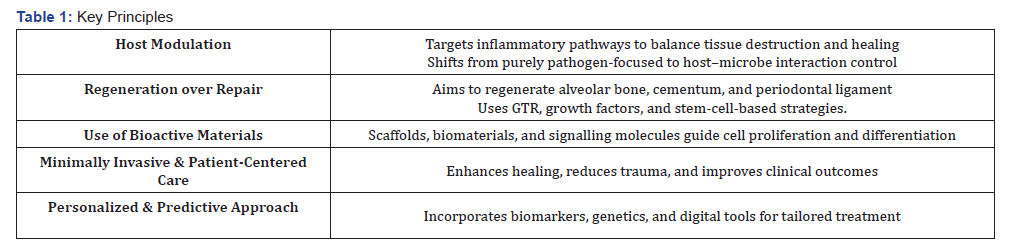
Enamel matrix derivatives, typically delivered using a propylene glycol alginate carrier, further enhance wound healing by promoting cellular proliferation, differentiation, and extracellular matrix formation [4]. Clinical and histological studies support the use of these biologically active materials—alone or in combination with growth factors such as platelet-derived growth factor (PDGF)—to achieve predictable periodontal regeneration. These materials show improved long-term outcomes, especially when used in intrabony defects. However, factors such as poor oral hygiene, smoking, diabetes mellitus, genetic predisposition, and stress may adversely affect treatment outcomes. Therefore, the selection of appropriate biomaterials depends on defect characteristics and the goal of maintaining periodontal attachment equilibrium. Biologically driven periodontal therapy refers to an approach that integrates host modulation, regenerative biology, and biomaterials to restore periodontal structure and function, moving beyond conventional mechanical plaque control. It is a modern, evidence-based approach that focuses on modulating biological processes of the host and regenerating periodontal tissues, rather than only eliminating bacterial plaque.
Methodology
Databases: PubMed, Scopus, Google Scholar
Keywords: “periodontal regeneration”, “biomaterials”, “host
modulation”
Inclusion: English articles, last 20 years
Type: Narrative review
Scaffolds in periodontal regeneration
Bioactive materials play a central role in advancing regenerative approaches for the repair of damaged tissues. These materials function as scaffolds that support cellular proliferation, angiogenesis, and extracellular matrix formation. Bioactive scaffolds include natural materials such as collagen, matrices, and hyaluronic acid, which possess the ability to guide tissue regeneration and repair. In addition, growth factors, cytokines, and adhesive peptides are often used in conjunction with natural polymers to enhance their biological activity. These components facilitate cellular signalling, promote tissue regeneration, and improve clinical outcomes. Similarly, synthetic materials such as hydrogels and nanoparticles can be engineered to deliver bioactive molecules in a controlled manner, thereby improving the tissue microenvironment and supporting regenerative processes [5]. Adhesive peptides and antimicrobial agents further enhance cell–scaffold interactions, which are essential for cellular activity and tissue formation. Biocompatibility remains a critical factor in the selection of both natural and synthetic scaffolds. Properties such as minimal cytotoxicity, low immunogenicity, and a negligible inflammatory response are essential for promoting tissue growth and reducing the risk of adverse reactions [5]. Overall, bioactive scaffolds have diverse biomedical applications, providing structural support and facilitating functional recovery through the incorporation of matrices and growth factors. Therefore, they form the fundamental basis of tissue engineering and play a crucial role in extracellular matrix development.
Minimal invasive periodontal therapy
The surgical aspect of dentistry has progressively evolved toward minimally invasive procedures that aim to reduce postoperative complications by preserving soft tissue architecture, promoting early wound healing, and minimizing morbidity. This approach has provided a new direction for both cosmetic and aesthetic periodontal surgeries. Minimally invasive techniques, such as microsurgery, the Minimally Invasive Surgical Technique (MIST), and flapless procedures, are performed with high precision to facilitate tissue regeneration while minimizing surgical trauma, improving healing outcomes, and enhancing patient comfort [6]. In aesthetic procedures where papilla preservation is critical, minimally invasive periodontal surgeries combined with bone grafting techniques have demonstrated favorable clinical outcomes. The adjunctive use of regenerative materials further enhances periodontal regeneration by promoting cellular differentiation and tissue healing.
The flapless technique represents an advanced minimally invasive approach that avoids elevation of the mucoperiosteal flap. This technique helps preserve blood supply and maintain soft tissue contours, thereby improving aesthetic outcomes. Both hard and soft tissues are preserved more effectively, aligning with the primary objective of minimally invasive therapy. Additionally, these techniques reduce the risk of complications and are increasingly accepted by patients. Flapless procedures can be applied in various clinical situations with greater precision and predictability.
Patient centred and Host Modulatory Approaches
The true endpoint of periodontal therapy is the improvement of oral health–related quality of life (OHRQoL), along with the integration of systemic health management. The primary goal is to achieve tangible, patient-centered benefits rather than solely focusing on surrogate clinical measures. These endpoints are clinically meaningful and include patient-reported outcomes such as tooth mobility, bleeding during brushing, tooth sensitivity, and food impaction. In clinical practice and trials, such outcomes are essential, as they reflect real improvements experienced by patients and enhance treatment acceptance. Adjunctive use of host modulation therapy helps reduce the cascade of tissue destruction and shifts the therapeutic paradigm toward more favorable clinical outcomes. Furthermore, behavioural modifications play a crucial role in biologically driven periodontal therapy. These include effective oral hygiene practices for biofilm control, smoking cessation programs, and lifestyle changes aimed at reducing systemic inflammation. Such interventions contribute to improvements in clinical parameters, including probing pocket depth and gingival health, by modifying the bacterial environment and host response [7,8].
Discussion
The present review highlights the paradigm shift from conventional mechanical periodontal therapy to a biologically driven approach that integrates regenerative principles, biomaterials, and patient-centered care. While traditional therapy primarily focuses on biofilm control, current strategies emphasize restoration of the periodontal apparatus through regeneration of alveolar bone, cementum, and periodontal ligament. This is supported by advances in guided tissue regeneration and biomaterial-based therapies, which have demonstrated predictable clinical outcomes, particularly in intrabony defects. The incorporation of bioactive scaffolds, growth factors, and stem cell–based approaches further enhances tissue regeneration by promoting cellular proliferation, differentiation, and extracellular matrix formation. However, variability in clinical outcomes persists due to patient-related factors such as oral hygiene, systemic health conditions, and genetic predisposition. Therefore, personalized treatment planning remains essential.
Minimally invasive surgical techniques and the use of advanced biomaterials have improved healing outcomes and patient acceptance, while reducing morbidity. In parallel, emerging technologies such as artificial intelligence and digital diagnostics are transforming periodontal care by enabling early disease detection, risk assessment, and precise treatment planning. Despite these advancements, challenges remain, including cost, technique sensitivity, and limited long-term evidence for some regenerative modalities. Future research should focus on optimizing biomaterial design, enhancing stem cell integration, and validating digital tools to achieve predictable and sustainable periodontal regeneration.
Future directions
1. Smart biomaterials and tissue engineering: Smart biomaterials have the potential to mimic tissue growth and promote vascularization, thereby facilitating nutrient transfer and supporting metabolic processes involved in host defense. These scaffolds are designed to function as an extracellular matrix and enable the controlled release of growth factors such as TGF-β, FGF, PDGF, BMPs, and IGF-I and II. Such growth factors can be incorporated through physical encapsulation or chemical immobilization using biomimetic interactions, allowing for sustained release while minimizing initial burst release [9]. Stem cell–based therapies further enhance tissue engineering by providing a reliable source of cells for the formation of new tissues, thereby improving regenerative potential. Recent advancements focus on hydrogel systems, microspheres, and three-dimensional bioprinting technologies, which enable precise delivery of bioactive molecules. These approaches also incorporate biologically active nanoparticles and gene-modified cells, offering promising strategies for multi-tissue regeneration [10].
2. Digital and AI guided periodontal therapy: Artificial intelligence (AI) technology, based on machine learning and deep neural networks, has the potential to standardize diagnostic processes while enhancing patient-centered care. Deep learning algorithms can accurately detect periodontal bone loss and identify early signs of periodontitis using digital imaging techniques. AI systems are also capable of evaluating regenerative procedures, such as the placement of bone grafts and collagen membranes in intrabony defects, by analyzing radiographic data. Furthermore, AI can quantitatively assess bone fill and monitor treatment outcomes with high precision. This capability makes it a valuable tool for identifying patients at increased risk of developing periodontitis in the future. AI-driven models have demonstrated strong potential in improving diagnostic accuracy and supporting clinical decision-making in periodontal care. Overall, AI technology is transforming dentistry by enhancing diagnostic, prognostic, and therapeutic approaches, thereby providing a new direction for modern periodontal practice.
3. Predictive and Personalized periodontal care: Chairside diagnostic kits serve as important clinical tools for detecting inflammatory, diagnostic, and prognostic biomarkers, enabling early diagnosis and effective management of periodontal disease. Diagnostic biomarkers help identify disease onset, activity, and progression, whereas prognostic biomarkers assist in predicting disease severity and future outcomes. Salivary chairside diagnostic kits, used at the point of care, offer a convenient and personalized approach for monitoring oral infections [11,12].
Genetic testing kits can identify specific interleukin gene polymorphisms, particularly IL-1A and IL-1B. Interleukin-1 is a pro-inflammatory cytokine involved in the pathogenesis of periodontitis. Individuals with certain genetic profiles may exhibit a faster rate of disease progression and increased severity. Additionally, epigenetic modifications—such as RNA interference, histone modification, and DNA methylation—can influence gene expression, with levels varying between healthy and diseased states. Advancements in digital technologies, including artificial intelligence, further enhance periodontal diagnosis and treatment planning. AI-based systems allow clinicians to analyse disease patterns, assess risk, and support decision-making for both nonsurgical and surgical interventions.
Conclusion
The future of periodontal care lies in translating biological insights into clinical practice, thereby ensuring therapies that are precise, predictive, and patient-centered. The integration of biologically driven principles into periodontal therapy is expected to enhance treatment outcomes, particularly when combined with regenerative materials. The development of smart biomaterials is increasingly focused on advanced scaffolds and stem cell–based approaches, enabling functional adaptability and maintaining physiological balance. In addition, the transition from natural to synthetic biomaterials, along with advancements in surface modification and their clinical applications, is reshaping the field of periodontal regeneration. Furthermore, the incorporation of digital technologies and three-dimensional (3D) printing in dentistry supports a more predictive and personalized approach to treatment planning, ultimately improving patient-centered outcome.
References
- Needleman IG, Worthington HV, Giedrys-Leeper E, Tucker RJ (2006) Guided tissue regeneration for periodontal infra-bony defects. Cochrane Database Syst Rev 19(2): CD001724.
- Rodriguez IA, GS S, Fetz AE (2018) Barrier membranes for dental applications: A review and sweet advancement in membrane developments. Mouth Teeth 2: 1-9.
- Hassan SU, Bilal B, Nazir MS (2021) Recent progress in materials development and biological properties of GTR membranes for periodontal regeneration. Chem Biol Drug Des 98(6): 1007-1024.
- Sculean A, Reich E, Chiantella GC, Brecx M (1999) Treatment of intrabony periodontal defects with an enamel matrix protein derivative (Emdogain): a report of 32 cases. Int J Periodontics Restorative Dent 19(2): 157-163.
- Sutanu Dutta, Sanchi Havanagi, Parichita Mishra, Divakar Sharma, Bhisham Narayan Singh (2025) From inert to intelligent: smart biomaterials reshaping the landscape of bioengineering, International Journal of Smart and Nano Materials 16(4): 845-877.
- Agraja Patil, Swapna Mahale, Chaitanya Joshi (2017) Minimally invasive techniques for periodontal therapy. International Journal of Oral Health Dentistry 3(1): 10-14.
- Shah EB, Modi BB, Shah MA, Dave DH (2017) Patient Centered Outcomes in Periodontal Treatment-An Evidenced Based Approach. J Clin Diagn Res 11(4): ZE05-ZE07.
- Lakshmi Kanth Kolaparthy BB (2018) Santosh Kumar. Patient Centered Outcome Assessment for Periodontal Therapy A Review. Int J Biol Med Res 9(3): 6448-6454.
- William V Giannobile, Scott J Hollister, Peter X Ma (2011) Future Prospects for Periodontal Bioengineering Using Growth Factors. Clin Adv Periodontics 1(2): 88-94.
- Xiuting Wang, Jinlong Chen, Weidong Tian (2021) Strategies of cell and cell-free therapies for periodontal regeneration: the state of the art. Stem Cell Research & Therapy 13(1): 536.
- Ghallab NA (2018) Diagnostic potential and future directions of biomarkers in gingival crevicular fluid and saliva of periodontal diseases: Review of the current evidence. Arch Oral Biol 87: 115–124.
- He W, You M, Wan W, Xu F, Li F, et al. (2018) Point-of-care periodontitis testing: biomarkers, current technologies, and perspectives. Trends Biotechnol 36(11): 1127-1144.

























