




 ADOH Home



From Operative Caries Treatment to Non-Operative Caries Treatment. A Danish Paradigm Shift
Kim Ekstrand*, Jette Christiansen and Christian Christiansen
Department of Odontology, Faculty of Health and Medical Sciences, University of Copenhagen, Denmark
Submission: September 05, 2024; Published: September 17, 2024
*Corresponding author: Kim Ekstrand, Department of Odontology, Faculty of Health and Medical Sciences, University of Copenhagen, Denmark
How to cite this article: Kim E, Jette C, Christian C. From Operative Caries Treatment to Non-Operative Caries Treatment. A Danish Paradigm Shift. Adv Dent & Oral Health. 2024; 17(4): 555971. DOI: 10.19080/ADOH.2024.17.555971
Keywords: Paradigm Shift; Kuhn’s paradigm shift theory; Cariology; Randomized, controlled clinical trial (RCCT); Prophylactic programs
Introduction
In this year 2024 it is 25 years ago that Professor Anders Thylstrup, Department of Cariology, Royal Dental College, Copenhagen University died too early. In remembering him and what he has done in Cariology, we will focus on him as the “Father” of a paradigm shift from operative caries treatment to non-operative caries treatment in Denmark in the sense of Kuhn’s paradigm shift theory [1].
The Formation of the Concept “Non-Operative Caries Treatment”
1981, Prof. A. Thylstrup visited Nexeo Municipal Dental Health Service for children and adolescents. Here he said “You drill too much and too early” [2].
In the years around 1986 the concept “non-operative caries treatment” were formed and explained in contrast to the traditional operative caries treatment strategy [3-11].
The Content of Non-Operative Caries Treatment
From 1981 Nexeo Municipal Dental Health Service had a close collaboration with prof. A. Thylstrup implementing the newest knowledge in cariology.
The collaboration in the1980’s included some of the Banding-studies [12]. The PhD student J. Carvalho made her thesis in Nexeo [13-15].
The PhD student I. Kuzmina learned in Nexeø the non-operative caries treatment concept and made her thesis in Moscow, Russia [16-18].
1987-2016 Nexeo collaborated in different innovations with KR Ekstrand, including: “Risk Assessment”, “Plaque-stagnation Areas”, “Papilla diagnostic”, “Study of Eruption” and implementing a non-operative caries treatment strategy in Greenland [19-24].
1987-1997 The Nexø dentists Jette Christiansen and Dorte Vinther together with Prof. A. Thylstrup and associate Prof. KR. Ekstrand gave courses and congress-presentations nationally and internationally about “non-operative caries treatment”.
1997-2018 Jette Christiansen and associate Prof. KR. Ekstrand, gave extensive courses and congress-presentations nationally and internationally highlighting “non-operative caries treatment” (NOCTP). 1988 Nexø made the first written manual “Nexø metoden” about non-operative caries treatment of erupting first permanent molars, based on the innovative knowledge of Prof. A. Thylstrup, associate Prof. KR Ekstrand, associate Prof. C. Bruun and PhD J. Carvalho.
1991 Nexeo extended the non-operative caries treatment strategy to all surfaces, and in a written form: “The Nexeo Method: A dental health care program based on individualized non-operative caries treatment of children and adolescents aged 0-18. The aim of the program is to maintain sound teeth using the fewest resources possible”.
1991-2011: 6 editions of “the Nexeo Method”, in Danish, English, German and Portuques on paper and website [25,26].
Paradigm Shift: From Operative Caries Treatment to Non-Operative Caries Treatment
More and more international scientists have looked at “non-operative caries treatment” as a new paradigm [27-33].
V. Baelum et al. [34,35]: “The best caries diagnostic method is the one that results in the best long-term dental health outcome for the tooth and the patient. It follows that the more relevant approach to caries diagnostic test evaluation uses the randomized, controlled clinical trial (RCCT) study design to determine whether a new caries diagnostic method results in better long-term health outcomes than the traditional method does. The use of the RCCT design allows evaluation of the professionally determined dental health outcome and may also include evaluation of patient preferences and cost aspects. However, no such RCCTs have yet been carried out, and we must therefore make do with a different approach.” Non-operative caries treatment as a principle is integrated in the Danish Municipal Dental Health Services for children and adolescents.
1998-2003 The dental faculty in Greifswald University Germany had: “Die Bornholmermetode” in their curriculum (a variation of “the Nexeø Method” and for several years the faculty sent groups of dental students to a 2 days course in Nexø).
2014- For 10 years a Dutch Association for Oral Health “Ivoren Kruis” in the Netherlands has educated the private clinic’s dental staff in non-operative caries treatment (a variation NOCTP of the Nexø Method after Vermaire JH) [36-38].
In New Zealand TDB ADVISORY Ltd (www.tbd.co.nz) supported of New Health NZ Inc. A cost benefit analysis of Nexeo method compared to the Child smile programme of Scotland [39].
It is reasonable to conclude that Prof. A. Thylstrup and his staff in collaboration with Nexø Municipal Dental Health Service have educated the Danish dental staff to move from unspecific prophylactic programs and traditional operative caries intervention to an individualized non-operative caries treatment strategy and this way have improved the dental health significantly - very few cavities, very few fillings, and nearly no extractions see Table 1 and [40].
In Nexeo/Denmark (Table 1):
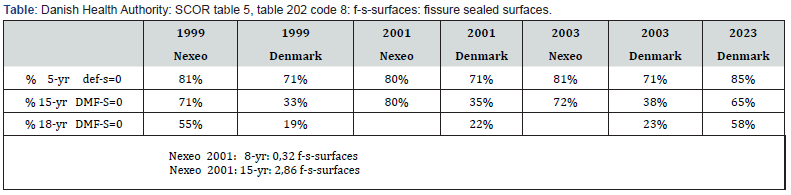
When the results of the “high level of dental health for children and adolecents in Nexø and Denmark” are put together with the references, the “world-wide courses and presentations at congresses” about the issues: “Caries Dentium and Non-operative caries treatment”, “the Dutch RCT of Vermaire JH”, “the Dutch economic evaluation”, “the NZ Cost-benefit analysis”, “Time for a paradigm shift of van Amerongen JP, van Palenstein WH and Helderman”, “Changing paradigms of Fejerskov O”, “New paradigm and caries treatment of Kidd E” “ The dental caries paradiams and nominalistic caries paradiam of Baelum” and “Paradigms and maintaining sound teeth of Paris S, Meyer-Lueckel H og Ekstrand KR”, it seems clear that the concept “non-operative caries treatment”, the content and practice, is now so well documented as a separate treatment in contrast to the over hundred years old “operative caries treatment” paradigm.
According to “Kuhns Paradigm Shift Theory” a paradigm shift has taken place from “operative caries treatment” to the new paradigm “non-operative caries treatment”. This new paradigm in cariology is first shown in Denmark with local and national results, and is now expanding worldwide! Jette Christiansen’s Key-note lecture April 2024 in Utrecht Nederlands [41], and after the lecture Jette Christiansen and Christian Christiansen were awarded the dr. Carl Witthaus Medal for their work on caries prevention. Unfortunable Prof. Anders Thylstrup died too early to see, that he and his staff with their research in caries on the surfaces of teeth, their proposal of non-operative caries treatment and active communication on this issue have made a paradigm shift. He is the real “Father” of the new Paradigm in cariology.
References
- Kuhn TS (1970) The structure of Scientific Revolutions, second edition 1962, 1970 by the University of Chicago, Chicago.
- Bille J, Thylstrup A (1982) Radiographic Diagnosis and Clinical Tissue Chances in Relation to Treatment of Approximal Caries Lesions. Depatment of Cariology, Royal Dental College, Copenhagen, Denmark Caries Res 16: 1-6.
- Consensusreport (1986) Prevention and Treatment of Dental Caries. Dan Med Bull 33: 199-202.
- Nyvad B, Fejerskov O (1986) Active root surface caries converted into inactive caries as a response to oral hygiene. Scand J Dent Res 94(3): 281-284.
- Thylstrup A, Leach SA, Qvist V (1988) Dentine and Dentine Reactions in the Oral Cavity: Thylstrup A, Qvist V, IRL Press, Oxford, Washington DC USA p. 3-16.
- Vigild M (1989) Dental caries and the need for treatment among institutionalized elderly. Community Dent Oral Epidemiol 17(2): 102-105.
- Carvalho JC, Ekstrand KR, Thylstrup A (1991) Results after 1 year of non-operative occlusal caries treatment of erupting permanent first molars. Community Dent Oral Epidemiol 19(1): 23-28.
- Carvalho JC, Thylstrup A., Ekstrand KR (1992) Results after 3 years of non-operative occlusal caries treatment of erupting permanent first molars. Community Dent Oral Epidemiol 20(4): 187-192.
- Fejerskov O (1994) Recent advancements in the treatment of root surface caries. Int Dent J 44(2): 139-144.
- Thylstrup A, Vinther D, Christiansen J (1997) Promoting chances in clinical practice. Treatment time and outcome studies in a Danish public child dental health clinic (Nexø). Community Dent Oral Epidemiol 25(1): 126-134.
- Fejerskov O (1997) Concepts of dental caries and their consequences for understanding the disease. Community Dent Oral Epidemiol 25(1): 5-12.
- Thylstrup A, Bruun C, Holmen L (1994) In vivo Caries Models-Mechanisms for Caries Initiation and Arrestment. Adv Dent Res 8(2): 144-157.
- Carvalho JC, Ekstrand KR, Thylstrup A (1989) Dental plaque and caries on occlusal surfaces of permanent first molars in relation to stage of eruption. J Dent Res 68(5): 773-779.
- Carvalho JC, Ekstrand KR, Thylstrup A (1991) Results after 1 year of non-operative occlusal caries treatment of erupting permanent first molars non-operative occlusal caries treatment. Community Dent Oral Epidemiol 19(1): 23-28.
- Carvalho JC, Thylstrup A, Ekstrand KR (1992) Results after 3 years of non-operative occlusal caries treatment of erupting permanent first molars. Community Dent Oral Epidemiol 20(4): 187-192.
- Kuzmina I, Kuzmina E, Ekstrand KR (1995) Dental caries among children from Solntsevsky--a district in Moscow, 1993. Community Dent and Oral Epidemiology 23(5): 266-270.
- Ekstrand KR, Kuzmina I, Kuzmina E, Christiansen MEC (2000) Two and a half-year outcome of caries-preventive programs offered to groups of children in Solntsevsky district of Moscow. Caries Res 34(1): 8-19.
- Kuzmina I, Ekstrand KR (2015) Outcomes 18 years after implementation of a non-operative caries preventive program-- the Nexö-method--on children in Moscow, Russia. Community Dent Oral Epidemiol 43(4): 308-316.
- Ekstrand KR, Christiansen J, Christiansen MEC (2003) Time and duration of eruption of first and second permanent molars: a longitudinal investigation. Community Dent Oral Epidemiol 31(5): 344-350.
- Ekstrand KR, Christiansen MEC (2005) Outcomes of a Non-Operative Caries Treatment Programme for Children and Adolescents. Caries Res 39: 455-467.
- Ekstrand KR, Christiansen MEC (2008) (Swedish Dental Journal) Tandläkartidningen 100(2): 50-58. (Finnish Dental Journal) Suomen Hammaslääkärilehti 4/2008 28-37. (Norwegian Dental Journal) Nor Tannlegeforen Tid (2008) 118: 92-99. The Nexø method seen from an oral health promotion perspective.
- Ekstrand KR, Christiansen J, Christiansen MEC (2008) Implementing a non-operative cariestreatment strategy in Greenland 2008-2016.
- Ekstrand KR, Qvist V (2015) The impact of a national strategy in Greenland after 4 years. Int J Paediatric Dent 25(4):255-66.
- Ekstrand KR, Abreu-Placeres N (2020) The impact of a national caries strategy in Greenland 10 years after implementation. A failure or a success?. Int J Circumpolar Health 79(1): 1804260.
- (2010) 2010 Portugal ”da Promocao Saúde Oral” César Mexia de Almeida e Jette Christiansen ”O Método de Nexo - um Programa de Saúde Dentária Baseado no Tratamento Individualizado e Nao- invasivo da Cárie em Criancas e Adolescentes dos 0 aos 18 Anos”.
- (2011) 2011 Quintessence Publishing: “Revolutions in Pediatric Dentistry” Ed. Splieth C. Chapter 3, p. 21-35. Christiansen J: “Non-operative caries treatment”.
- Fejerskov O (2004) Changing paradigms in concepts on dental caries: consequences for oral health care. Caries Res 38(3):182-91.
- Pitts NB (2004) Are We Ready to Move from Operative to Non-operative/Preventive Treatment of Dental Caries in Clinical Practice?. Caries Res 38(3): 294-304.
- Van Amerongen JP, Van Palenstein WH, Helderman (2010) Paradigm shift in dentistry for children: from restorative to preventive treatment of caries. Ned Tijdschr Tandheelkd 117(3): 139-141.
- Kidd E (2011) The implications of the new paradigm of dental caries. King’s College London UK, J Dent 39(Suppl 2): 53-58.
- Meyer-Lueckel H, Paris S, Ekstrand KR (2013) Caries Management – Science and Clinical Practice. Georg Thieme Verlag KG Germany 2013 (www.thieme.de).
- Kidd E, Fejerskov O (2013) Changing concepts in cariology: forty years on. Dental 40(4): 277-286.
- Santamaria RM, Innes N, Christiansen J, Splieth CH (2013) Paradigmenwechsel bei Karies an Milchzä Zusammenfassung der Hauptvorträge der Frühjahrstagung der DGKiZ.
- Baelum V, Heidmann J, Nyvad B (2006) Dental caries paradigms in diagnosis and diagnostic research. Eur j Oral Sci 114: 263-277.
- Fejerskov O, Nyvad B, Kidd E (2015) Dental caries: The Disease and its Clinical management, (3rd Edn). Oxford Wiley Blackwell 10: 183-4 Baelum V, Nyvad B, Gröndahl H.-G, Fejerskov O. The foundations of good diagnostic practice: Diagnostic test evaluation in the nominalistic caries paradigm.
- Vermaire JH (2018) Application of the Nexø method in a general dental practice in the Netherlands: 6-year results of a RCT. Int Dent Hyg 16(3): 419-425.
- Vermaire JH, van Loveren C, Brouwer WBF, Krol M (2014) Value for money: economic evaluation of two different caries prevention programme compared with standard care in a randomized controlled trial. Caries Res 48(3): 244-253.
- Verlinden DA, Schuller A, Vermaire, Reijneveld SA (2023) Long-term effects of a community-based oral health intervention for young children in the Netherlands: A 5-year follow-up. Community Dent Oral Epidemiol 52(4): 431-439.
- In New Zealand TDB ADVISORY Ltd (www.tbd.co.nz) supported of New Health NZ Inc has worked out a rapport, December 2016”. The Costs and Benefits of a National Tooth Brushing Education Programme for Children.
- Ekstrand KR, Christiansen J, Christiansen MEC, Bakhshandeh A (2024) The Caries Experience in Child and Youth Oral Health Care in Denmark from 1972-2022. A Narrative Interpretation of Success. J Dentistry Oral Disor 10(1): 1182.
- Ps Christiansen J (2024) Key-note lecture at 10 years celebration of NOCT-P in Utrecht, the Nederland’s.

























