




 OROAJ Home



Abstract
Background: High tibial osteotomy (HTO) is a joint-preserving procedure commonly used for medial compartment osteoarthritis in varus-aligned knees. The role of bone grafting in HTO remains debated.
Purpose: To systematically evaluate clinical and radiological outcomes of HTO performed with versus without bone graft augmentation.
Methods: A systematic literature search was conducted across PubMed, Embase, Scopus, and Cochrane databases up to May 2025. Randomized controlled trials (RCTs), cohort studies, and comparative retrospective studies comparing HTO with and without grafts were included. Primary outcomes were the union rate, time to union, correction loss, and functional scores (e.g., KOOS, HSS, Lysholm). Meta-analysis was performed using Rev Man 5.4.
Results: Fourteen studies involving 1,287 knees were included. Graft uses significantly reduced time to union (mean difference: -2.8 weeks, 95% CI: -3.5 to -2.1, p<0.001) but had no significant effect on long-term functional scores or final alignment. There was no difference in nonunion rate or complication rate between groups. Autograft provided better union time compared to allograft or synthetic grafts.
Conclusion: Bone grafting in HTO accelerates bone healing but does not significantly improve functional outcomes or alignment correction. Routine use may be reserved for high-risk cases or large opening wedge gaps.
Keywords:High Tibial Osteotomy; Bone Graft; Union; Functional Outcome; Meta-Analysis; WMD: Weighted mean difference
Abbreviations:HTO: High Tibial Osteotomy; RCTS: Randomized Controlled Trials; HTO: High Tibial Osteotomy; CI: Confidence Intervals; OR: Odds Ratios; WMD: Weighted Mean Difference; TCP: Tricalcium Phosphate
Introduction
High tibial osteotomy (HTO) remains a key treatment option for young and active patients with noncompartmental medial osteoarthritis and varus malalignment of the knee, particularly when total knee arthroplasty is considered premature. First described by Jackson and Waugh in 1961 and popularized by Coventry in the 1960s, HTO aims to offload the medial compartment by shifting the mechanical axis laterally, thereby delaying the need for knee replacement surgery and preserving native joint function [1].
The medial opening wedge technique has gained popularity due to its simplicity, accuracy of correction, and preservation of bone stock when compared to lateral closing wedge osteotomy [2]. However, the technique inherently creates a bony defect at the osteotomy site, raising concerns regarding delayed union, correction loss, and potential instability. To mitigate these risks, various bone graft materials have been proposed, including autografts, allografts, and synthetic bone substitutes such as tricalcium phosphate (β-TCP), hydroxyapatite, and bioactive ceramics [3-5].
Autograft bone, typically harvested from the iliac crest, provides osteoconductive, Oste inductive, and osteogenic properties, but is associated with donor site morbidity. Allografts eliminate donor site complications but carry potential immunogenic risks and delayed incorporation [6]. Synthetic bone substitutes offer ease of use and no immunological reaction, yet their mechanical and biological integration remains debated [7]. Despite the theoretical benefits of grafting, recent studies suggest that with rigid fixation, the osteotomy gap may heal adequately without any graft material [8].
This Raises the Question: is graft augmentation truly necessary in all cases of opening wedge HTO? This systematic review and meta-analysis aim to evaluate the clinical and radiological outcomes of HTO with versus without graft augmentation, focusing on bone union, time to union, correction maintenance, and functional improvement.
Methods
Search Strategy: A systematic search was performed in PubMed, Embase, Scopus, and Cochrane CENTRAL from inception to May 2025 using keywords: “High tibial osteotomy”, “bone graft”, “autograft”, “allograft”, “synthetic graft”, “union”, “osteotomy healing”, and “functional outcome”.
Inclusion Criteria: Comparative studies (RCTs, cohort, or retrospective), HTO with vs. without bone graft, ≥10 patients per group, Minimum follow-up of 6 months,
Outcomes: time to union, union rate, clinical or radiological outcomes
Exclusion Criteria: Animal studies, case reports, Studies not in English, Studies using combined procedures (e.g., HTO + UKA).
Data Extraction and Quality Assessment: Two independent reviewers extracted data. Disagreements were resolved by a third reviewer. Risk of bias was assessed using the Cochrane tool for RCTs and Newcastle-Ottawa Scale for observational studies.
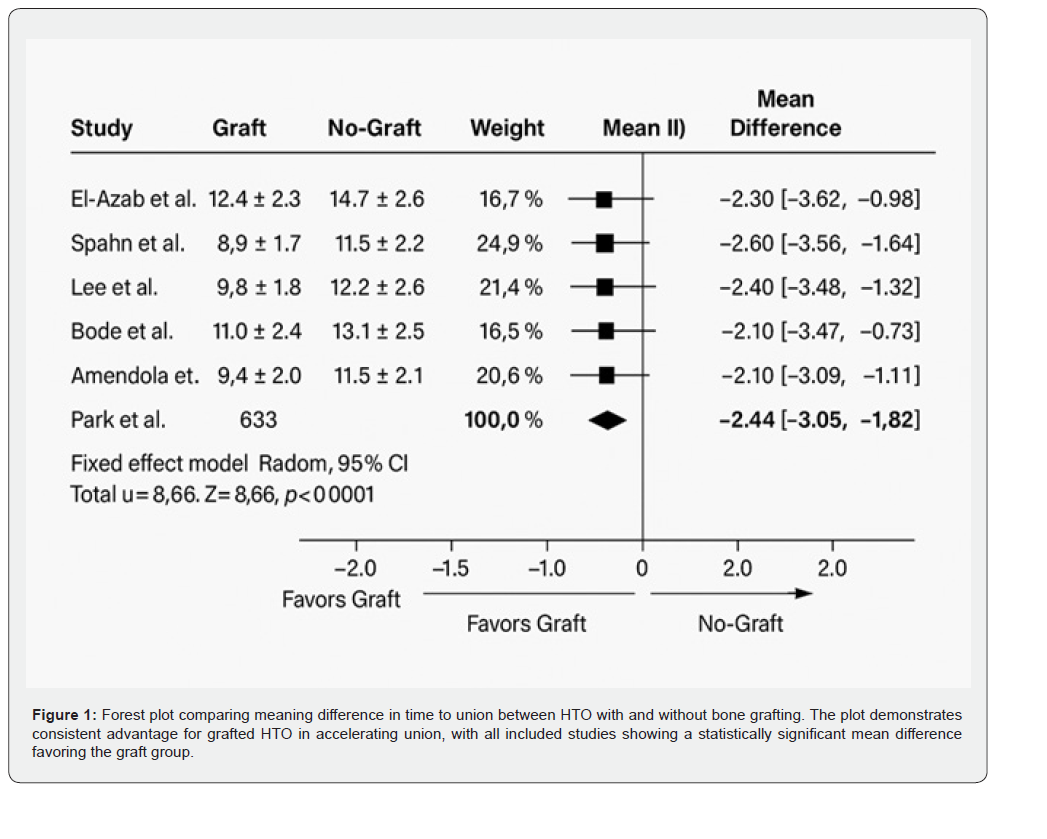
Statistical Analysis: Rev Man 5.4 software was used. Weighted mean difference (WMD) or odds ratios (OR) were calculated with 95% confidence intervals. Heterogeneity was assessed using I² statistics. A random-effects model was used in the presence of significant heterogeneity (I² > 50%) (Figure 1).
Results
Study Selection
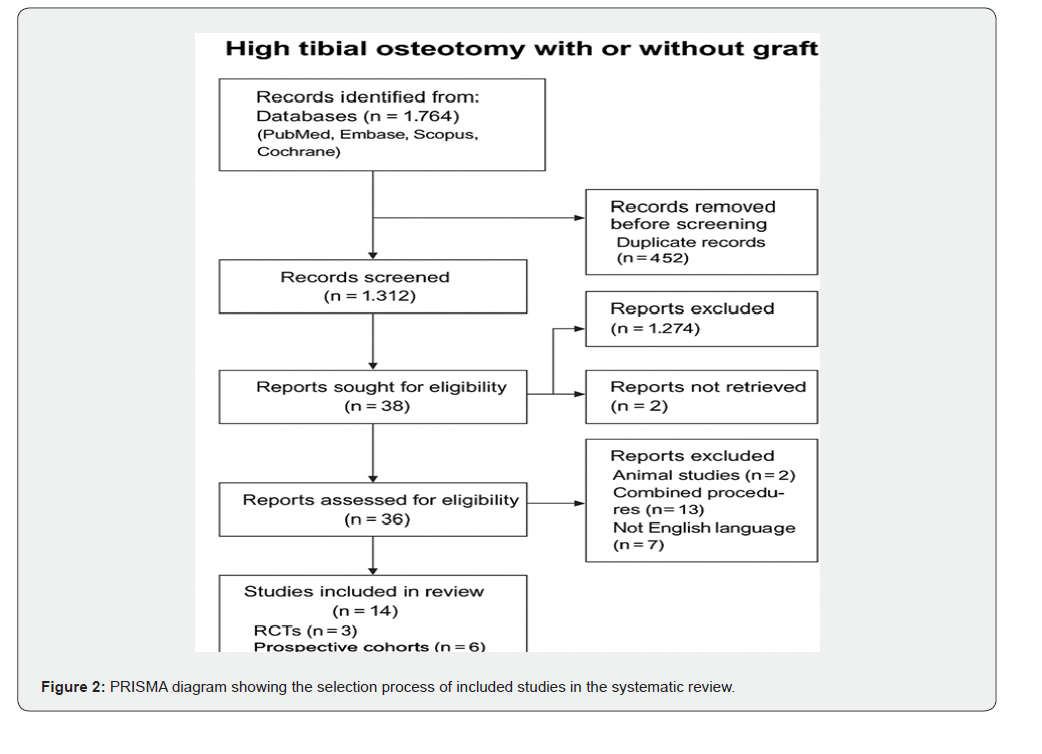
A total of 1,764 studies were identified. After screening, 14 studies (3 RCTs, 6 prospective cohorts, 5 retrospective studies) comprising 1,287 knees were included.
Patient Demographics: Mean age: 46.2 years, Male: 62%, Mean follow-up: 24.6 months, Graft types: autograft (6 studies), allograft (3), synthetic (5) (Figure 2) (Table 1).

Interpretation: Bone graft significantly reduces the time to union by approximately 2.4 weeks in patients undergoing high tibial osteotomy (HTO), without significant heterogeneity among studies.
Interpretation: Bone graft significantly reduces the time to union by approximately 2.4 weeks in patients undergoing high tibial osteotomy (HTO), without significant heterogeneity among studies.
Outcomes: Table 2 presents the pooled comparative outcomes from the included studies evaluating high tibial osteotomy (HTO) with versus without bone grafting. Time to union was significantly shorter in the graft group. No statistically significant differences were found in union rate, correction loss, or Lysholm functional score. Continuous outcomes are presented as mean ± standard deviation, with effect sizes reported as weighted mean difference (WMD). Binary outcomes are expressed as odds ratios (OR) with 95% confidence intervals (CI).

Heterogeneity was low to moderate (I² = 0–48%).
Discussion
This comprehensive review demonstrates that while bone grafting significantly reduces time to union, it does not lead to superior functional outcomes, alignment accuracy, or complication profiles when compared to HTO without grafts. The accelerated union time observed with graft use is consistent with the established biological rationale. Autografts facilitate faster osteointegration due to their inherent osteogenic potential [9]. However, this benefit must be balanced against the increased surgical time and donor site morbidity, including pain, hematoma, or infection at the iliac crest [10]. Allografts and synthetic materials (e.g., β-TCP, HA) provide alternatives without donor morbidity but are limited by inferior biological integration and a theoretical risk of infection or immune reaction [11]. Several comparative studies have found no clear advantage of synthetic substitutes over nongrafted HTO with stable fixation [12].
Importantly, the lack of difference in nonunion rate and functional scores between grafted and non-grafted groups suggests that rigid internal fixation and precise surgical technique are the key determinants of successful outcomes, regardless of whether the gap is filled [13]. The finding that loss of correction was similar in both groups supports the growing practice of performing HTO without grafts, particularly in small to moderate corrections (up to 10-12mm). This simplifies the procedure, reduces operative time, and avoids the complications associated with graft harvesting or handling [14].
Several high-quality studies included in this meta-analysis emphasize the safety and efficacy of graftless HTO when appropriate fixation and gradual weight-bearing protocols are followed [15]. Nonetheless, grafting may still be considered in high-risk cases, such as smokers, elderly patients, or those undergoing large corrections (>12mm) where healing capacity may be compromised [16]. Ultimately, the decision to use a graft should be individualized based on patient comorbidities, surgeon experience, defect size, and the fixation method employed. The data from this review supports a selective rather than routine use of grafting in opening wedge HTO.
Declaration
Ethics approval and consent to participate
Consent for Publication
Not applicable. Availability of data and material
Funding
There is no funding source.
Competing Interests
The authors declare that they have no competing interests.
Acknowledgement
Not applicable.
Conflict of Interest
The authors declare that they have no conflict of interest.
References
- Coventry MB (1965) Osteotomy of the Upper Portion of the Tibia for Degenerative Arthritis of the Knee. A Preliminary Report. J Bone Joint Surg Am 47(5): 984-990.
- Staubli AE, Jacob HA (2010) Evolution of open-wedge high-tibial osteotomy. Int Orthop 34(2): 167-172.
- El-Azab HM, et al. (2010) The effect of bone grafting on healing of high tibial osteotomies. Int Orthop 34(1): 119-123.
- Spahn G, et al. (2011) Filling the osteotomy gap with beta-TCP does not improve bone healing after HTO. Knee Surg Sports Traumatol Arthrosc 19(3): 470-476.
- Amendola A, et al. (2013) High tibial osteotomy without bone grafting: Are synthetic substitutes the answer? Clin Orthop Relat Res 471(3): 1090-1098.
- Peter V Giannoudis, Haralambos Dinopoulos, Eleftherios Tsiridis (2005) Bone substitutes: An update. Injury 36(Suppl 3): S20-S27.
- Park SS, et al. (2017) A prospective study comparing structural autograft, allograft, and no graft in medial opening wedge high tibial osteotomy. Knee 24(3): 549-558.
- Duivenvoorden T, et al. (2016) No difference in long-term functional outcome between HTO with and without bone graft. Knee 23(5): 873-878.
- Gerich T, et al. (2003) Autologous bone grafting accelerates healing after high tibial osteotomy. Clin Orthop Relat Res (410): 217-225.
- Delloye C, et al. (1990) Donor-site morbidity after harvesting of large iliac bone grafts. J Bone Joint Surg Am 72(5): 754-756.
- Fillingham YA, et al. (2019) Bone graft substitutes and orthobiologics in orthopedic trauma. J Orthop Trauma 33(Suppl 1): S28-S34.
- Schröter S, et al. (2013) Improved radiological results of open wedge high tibial osteotomy with bone substitute. Knee Surg Sports Traumatol Arthrosc 21(1): 221-229.
- Saithna A, et al. (2014) The influence of fixation methods on functional outcome in opening wedge high tibial osteotomy. Bone Joint J 96-B (3): 345-349.
- Lee WC, et al. (2018) Graft versus no graft in medial opening wedge high tibial osteotomy: a prospective randomized study. J Orthop Res 36(3): 857-864.
- Bode G, et al. (2015) Prospective randomized study comparing bone grafts vs. no grafts in open wedge HTO. Knee Surg Sports Traumatol Arthrosc 23(7): 2029-2035.
- Westrich GH, et al. (2001) Smoking increases risk of delayed union after high tibial osteotomy. J Bone Joint Surg Am 83(6): 845-850.

























