




 OROAJ Home



Can Acute Soft Tissue Injuries of the Knee in Adults be SAFELY Managed through a Virtual Fracture Clinic?
Andrew Lewis1*, Kristen Bucknall1, Andrew Davies2 and Anne-Marie Hutchison2
1Physiotherapy Department / Minor Injuries Unit, Swansea Bay University Health Board, Neath Port Talbot Hospital, Baglan Way, Port Talbot, SA12 7BX
2Department of Trauma and Orthopaedics, Swansea Bay University Health Board
Submission: December 08, 2023; Published: January 18, 2024
*Corresponding author: Andrew Lewis, Physiotherapy Department, Swansea Bay University Health Board, Neath Port Talbot Hospital, UK
How to cite this article: Andrew Lewis*, Kristen Bucknall, Andrew Davies and Anne-Marie Hutchison. Can Acute Soft Tissue Injuries of the Knee in Adults be SAFELY Managed through a Virtual Fracture Clinic?. Ortho & Rheum Open Access J. 2024; 22(5): 556097. DOI: 10.19080/OROAJ.2024.22.556097
Abstract
Can acute soft tissue injuries of the knee in adults be safely managed through a virtual fracture clinic? Andrew Lewis, Kristen Bucknall, Andrew Davies, Anne-Marie Hutchison Highlights X-rays of acute soft tissue injuries do not predict the requirement of urgent surgery.
Bucket handle meniscus tears had no consistent pattern of swelling on X-ray.
Of four lipohaemarthroses only one sustained a fracture.
Management in a virtual fracture clinic for acute knee injuries was inconsistent.
Background: The Coronavirus pandemic mandated an immediate and dramatic change in the delivery of acute trauma services to minimize face-to-face contact. In our hospital, patients presenting to the Emergency Department with a knee injury and no fracture seen on X rays were referred to a “Virtual Fracture Clinic” (VFC) where Xray’s and clinical notes were reviewed by the duty Trauma and Orthopaedic Consultant the following working day. We present the outcomes of 101 consecutive patients managed through this process and deemed to have a “Soft Tissue Knee Injury” with a minimum follow-up of six months.
Objective:
Do x-ray findings predict the severity of soft tissue injury / likelihood of surgery?
Is VFC management consistent for x-ray findings / likelihood of surgery?
Materials and Methods: All x-rays were reviewed by a sub-specialist knee surgeon blinded to notes or clinical outcomes. Electronic clinical records were reviewed to determine further clinical appointments, surgical treatment and pending interventions.
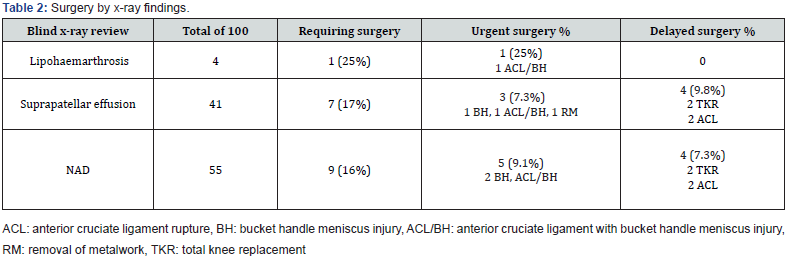
Results: Of 101 patients, the knee surgeon diagnosed 1 Fracture, 4 lipohaemarthroses, 41 significant effusions and 55 patients with normal x-rays. Correlation to urgent surgery was 100% for fracture (1/1), 25% for lipohaemarthrosis (1/4), 7.3% for significant effusion (3/41) and 9.1% for normal x-rays (5/55). A further 9.8% (4/41) of the “effusion” group and 7.3% (4/55) of the “normal” group were subsequently listed for non-urgent surgery. Overall, 17% (7/41) of “effusion” patients and 16% (9/55) of “normal” patients required surgery. Management plans from VFC varied within groups.
Conclusion: Acute “soft-tissue” injuries of the knee in adults cannot be reliably managed via VFC based on x-ray findings. A staged review by an appropriately trained health professional could reduce demand for acute knee surgical clinics and may enhance patient outcomes.
Keywords: Acute; Soft-tissue; Knee; X-ray; Virtual
Abbreviations: ED: Emergency Department, MIU: Minor Injury Units; VFC: Virtual Fracture Clinic; GP: General Practitioners; AD: Abnormality Detected
Can acute soft tissue injuries of the knee in adults be safely managed through a virtual fracture clinic?
Background
Acute knee injuries are a common presentation in Emergency Departments (ED) and Minor Injury Units (MIU) accounting for 6.6 million presentations in the USA over a 9-year period and 8% of all presentation in Sweden prior to the COVID-19 pandemic [1,2]. Data from a Virtual Fracture Clinic during COVID-19 in the United Kingdom showed 6% of all presentations were for knee injuries [3] with the 2% discrepancy possibly as a direct result of government restrictions on sport participation. In the authors’ local hospitals prior to COVID-19, patients sustaining acute injuries were seen by an Emergency Nurse Practitioner or emergency department doctor in an MIU/ED. All patients deemed in need of Orthopaedic management were referred to a next day fracture clinic for a face-to-face consultation with an Orthopaedic doctor. At this clinic the injury was reviewed objectively and radiologically before a management plan made on a case-bycase basis. During the COVID-19 pandemic, local Fracture Clinic services underwent a rapid revision with the introduction of a Virtual Fracture Clinic (VFC) [3]. This new way of working resulted in 67% of all patients being discharged without a face-toface appointment with written advice on how to self-manage their injuries. The remaining 33% were seen in a face-to-face fracture clinic for an objective assessment.
Soft tissue injuries of the knee have no radiological bone injury and the initial clinical assessment is typically incomplete due to patient pain and/or apprehension. “Soft tissue injury” was the largest single diagnostic group of knee injuries referred to the VFC accounting for 74% of all knee injuries [3]. The lack of detailed information available to review virtually with no evidence of bone injury on x-ray meant Orthopaedic doctors regularly brought patients back to a face-to-face fracture clinic for further assessment, potentially over-medicalising patients and negating the benefit of a VFC. An exception may be the presence of lipohaemarthrosis which is thought to be very specific for an intra-capsular fracture and therefore raises the suspicion of a serious occult injury [4]. Not all soft tissue injuries to the knee require surgery yet for some a successful outcome is linked to the speed of surgical correction [5,6]. Enhancing this decision-making process is therefore of great interest. It is currently unknown if managing such injuries on a “virtual first” basis is appropriate given the lack of radiological bone injury and limited objective assessment. Prior to a change in local pathways a review of adult patient outcomes for those referred to VFC from ED/MIU with an acute knee “soft tissue injury” was required.
Materials and Method
From April 2020 to November 2020 all consecutive patients aged 16 and over classified as an acute knee “soft tissue injury” (no obvious bone injury) were referred to VFC. Data was collected on patient demographics, delay in VFC review, management from VFC and any subsequent Orthopaedic clinic input. To ensure data capture of patients who were not improving post-injury or who had possibly been mismanaged through VFC, routes back into local health services were screened until 6 months post-VFC as agreed by author consensus. If a patient had ongoing pain following an injury reviewed in VFC they were able to contact fracture clinic directly, self-refer to Physiotherapy, re-present to ED/MIU or be referred to secondary care by their General Practitioners (GP). Electronic records for each patient were screened and if any represented after being discharged from VFC the relevant notes were accessed and data collected where relevant. When patients were presented with multiple injuries they were included in this study if x-rays were taken of the knee. An Orthopaedic Consultant with a special interest in knee injuries (AD) reviewed the X-rays taken in ED/MIU of all included patients, blinded to any notes. X-ray findings were recorded as fracture, lipohaemarthrosis, suprapatellar effusion or no abnormality detected (NAD). A narrative analysis of the data was performed.
Results
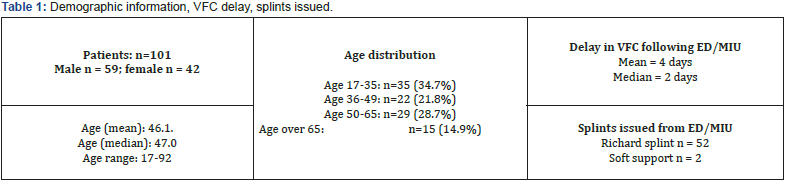
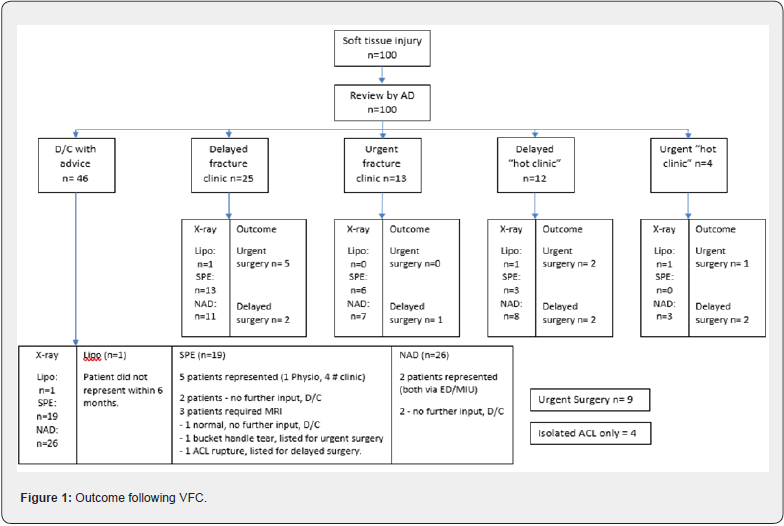
Between April 2020 and November 2020, 101 patients were referred to VFC for a “soft tissue injury” of the knee. Data is presented for demographics, VFC delay following attendance to ED/MIU, and splints issued by ED/MIU in table 1. Outcomes following specialist blind review of 101 X-rays included fracture n=1, lipohaemarthroses n=4, suprapatellar effusions n=41, NAD n=55. For subsequent analysis the fracture was excluded leaving 100 x-rays with no visible bone injury. Surgery was required for 17 of 100 patients with distribution by x-ray shown in table 2. If the structural damage required urgent surgery (delaying surgery would likely lead to sub-optimal outcomes) it was categorized as “urgent”, where urgent surgery was not required it was categorized as “delayed”. Four lipohaemarthroses were detected; one required urgent surgery for an acute ACL rupture with lateral meniscus root tear (25-year-old male), one was managed conservatively for a femoral condyle fracture subsequently detected on MRI (38-year-old male), one partial thickness ACL rupture detected following MRI with the patient failing to attend Orthopaedic follow-up (40-year-old male), one was discharged from VFC without face-to-face review and did not represent within 6 months (22-year-old male). 46 patients were discharged from VFC without face-to-face orthopaedic review. Seven of those re-attended with ongoing symptoms through self-referral to ED/ MIU (n=2), Physiotherapy (n=1) and fracture clinic (n=4). Five of the seven had a suprapatellar effusion on x-ray of which one self-referred to Physiotherapy with no further referral required, four re-attended fracture clinics where one required no further input and was discharged, the remaining three were referred for an MRI. Following MRI, one was discharged with a normal MRI, one sustained an ACL rupture and listed for delayed surgery, one sustained a bucket handle tear and was listed for urgent surgery. The remaining two patients that re-attended following discharge from VFC had NAD on x-ray, both attended via ED/MIU with neither requiring further input. Other pathologies within the 100 patients included one suspected infection/cellulitis and seven suspected quadriceps ruptures. Of these injuries none required surgery, all were reviewed face-to-face in fracture clinic following VFC, two suspected quadriceps ruptures had a suprapatellar effusion on x-ray and the remaining five had NAD on x-ray. Comparing management of patients from VFC showed no obvious coherent pattern. Possible outcomes from VFC included:
a) Direct discharge without face-to-face assessment
b) Delayed face-to-face review in generic fracture clinic.
c) Urgent face-to-face review in generic fracture clinic (less than one week)
d) Delayed face-to-face review in a specialist “hot knee clinic” staffed by an Orthopaedic knee specialist.
e) Urgent face-to-face review in “hot knee clinic” (less than one week).
All four lipohaemarthroses had a different outcome from VFC. Of 41 Suprapatellar effusions 19 were discharged, 13 were seen in a delayed generic fracture clinic, 6 in an urgent generic fracture clinic, three seen in a delayed hot clinic and none seen in an urgent hot clinic. Of 55 patients with NAD on x-ray 26 were discharged, 11 were seen in a delayed generic fracture clinic, 7 were seen in an urgent generic fracture clinic, 8 seen in a delayed hot clinic and 3 seen in an urgent hot clinic. Distribution of outcome from VFC by x-ray are presented in figure 1.
Discussion
This study is the first to review the outcomes of acute soft tissue knee injuries presenting to ED/MIU where a virtual Orthopaedic review was sought. The period of data capture was conducted during the Covid-19 pandemic in 2020 and may not be fully representative of normal injury rates as contact sport participation was reduced to slow the spread of Covid-19. A gender bias was noted with increased prevalence of soft tissue knee injuries in males (n=59 compared to females (n=42). The largest age group was 17-35 years old accounting for 34.7% of all presentations. Using very rapid x-ray assessment of acute knee injuries in ED/MIU without obvious fracture may be inappropriately reassuring. It is possible that those with NAD on x-ray may have developed a suprapatellar effusion with a greater delay following injury, similarly those with effusion may have displayed a lipohaemarthrosis if left supine for 10 minutes on a trolley for the cell separation to form [4]. There was no local guidance available to guide Emergency Nurse Practitioners or Emergency Department Doctors on which patients to x-ray in a rested supine position. Conversion to surgery could not accurately be predicted by x-ray findings alone questioning the appropriateness of a VFC approach for these injuries. X-ray findings of lipohaemarthrosis had 25% conversion to surgery, suprapatellar effusion and NAD had 17% and 16% conversion respectively. Conversion to urgent surgery for lipohaemarthrosis, suprapatellar effusion and NAD were 25%, 7.3% and 9.1% respectively suggesting triage to specialist orthopaedic clinic cannot be reliably based on x-ray. VFC was staffed by a range of sub-specialty Trauma and Orthopaedic Consultants, and it was noted anecdotally by the authors that a higher referral rate to specialist knee clinics was made by nonknee specialists from VFC. It is likely, though not investigated here, that this is similarly true for the other sub-specialties. The authors found that 4 of the 17 patients listed for surgery were for TKRs. It is likely that acute knee clinics were used inappropriately during the Covid-19 pandemic as a route to specialist knee consultants when elective surgical clinics were not available.
Due to the established held orthopaedic notion that lipohaemarthrosis is indicative of an occult intra-capsular fracture only one of the four lipohaemarthrosis in this sample had a proven fracture. It is important to note however that due to very low incidence of lipohaemarthrosis within the whole sample, there was insufficient power to form robust conclusion concerning the management of patients with this presentation. Until contradictory research is published the status quo should be maintained, however this is an area of future research interest. Based on the above difficulties in reviewing acute soft tissue knee injuries virtually, a benefit may exist for delayed face-to-face review and possible repeat x-ray or MRI by an Advanced Physiotherapy Practitioner or Emergency Nurse Consultant with direct access to Orthopaedic “hot knee clinic”. The benefit of such an approach for this patient group has previously been demonstrated enhancing patient outcomes and satisfaction [7-9].
Limitations
As all patients were reviewed electronically, it is unclear what the clinical outcome was of patients in this sample, especially those discharged from VFC (n=46). This group of patients included one lipohaemarthrosis, 19 suprapatellar effusions and 26 NAD. Seven of the 46 discharged from VFC represented and were reviewed face-to-face. To enhance conclusions, the remaining 39 patients could have been contacted directly to review outcomes.
Conclusion
Based on the above findings a Virtual Fracture Clinic is not an appropriate method for managing acute knee injuries where no bone injury is seen on x-ray. The authors propose such patients should undergo a delayed review with an appropriately trained clinician.
Funding source
This research did not receive any specific grant from funding agencies in the public, commercial, or not-for-profit sectors.
References
- Ferry T, Bergström U, Hedström EM, Lorentzon R, Zeisig E (2014) Epidemiology of acute knee injuries seen at the Emergency Department at Umeå University Hospital, Sweden, for 15 years. Knee Surg Sports Traumatol Arthrosc 22(5): 1149-1155.
- Gage BE, McIlvain NM, Collins CL, Fields SK, Dawn Comstock R (2012) Epidemiology of 6.6 million knee injuries presenting to United States emergency departments from 1999 through 2008. Acad Emerg Med 19(4): 378-385.
- Hutchison AM, Williams P, Bebbington A, Mullins M, Lewis A, et al. (2021) Efficacy of a Virtual Fracture Clinic Model Created During Covid-19 Pandemic. Arch Orthop 2(1): 1-11.
- Ferguson J, Knottenbelt JD (1994) Lipohaemarthrosis in knee trauma: an experience of 907 cases. Injury 25(5): 311-312.
- Krutsch W, Zellner J, Baumann F, Pfeifer C, Nerlich M, et al. (2017) Timing of anterior cruciate ligament reconstruction within the first year after trauma and its influence on treatment of cartilage and meniscus pathology. Knee Surg Sports Traumatol Arthrosc 25(2): 418-425.
- Sheth U, Sniderman J, Whelan DB (2019) Early surgery of multiligament knee injuries may yield better results than delayed surgery: a systematic review. J ISAKOS, 4(1): 26-32.
- Jibuike OO, Paul-Taylor G, Maulvi S, Richmond P, Fairclough J (2003) Management of soft tissue knee injuries in an accident and emergency department: the effect of the introduction of a physiotherapy practitioner. Emergency Medicine J 20(1): 37-39.
- Sheppard LA, Anaf S, Gordon J (2010) Patient satisfaction with physiotherapy in the emergency department. Int Emergency Nursing 18(4): 196-202.
- Farrell SF (2014) Can physiotherapists contribute to care in the emergency department? Australas Med J 7(7): 315-317.

























