




 OMCIJ Home




Abstract
Forests represent important reservoirs of biological and chemical diversity and have historically contributed numerous natural products to traditional medicine and modern drug discovery. The Himalayan region is particularly notable for its ecological heterogeneity and rich plant diversity, including numerous woody species that remain insufficiently characterized from a phytochemical and pharmacological perspective. These plants synthesize chemically diverse specialized metabolites, including phenolics, flavonoids, terpenoids, alkaloids, tannins and glycosides, several of which have demonstrated biological activities in experimental studies. Recent investigations of Himalayan and Himalayan-associated species, including Prunus cerasoides, Berberis aristata, and Hippophae rhamnoides, demonstrate the considerable chemical diversity present within woody plant resources. Nevertheless, the detection of phytochemicals or preliminary in-vitro activity should not be interpreted as evidence of clinical efficacy. Future research should integrate forestry, ethnobotany, phytochemistry, metabolomics, pharmacology and toxicology to identify reproducible and biologically validated natural-product leads. Equally important is the sustainable management of plant resources because increasing medicinal demand may place additional pressure on wild populations. This Opinion highlights the potential of underexplored Himalayan woody plants as a scientifically valuable interface between forest biodiversity, natural-product chemistry and sustainable bioresource utilization.
Keywords: Himalayan woody plants; Natural products; Phytochemicals; Medicinal plants; Phytochemistry; Biodiversity; Drug discovery; Sustainable utilization.
Introduction
Natural products have occupied a unique position in medicinal chemistry because of their structural diversity, biological complexity and ability to interact with multiple molecular targets. Despite the rapid development of synthetic chemistry and computational drug design, natural products continue to contribute important molecular scaffolds and lead structures for drug discovery [1,2]. Recent analyses further indicate that natural-product-derived compounds remain relevant throughout different stages of pharmaceutical development [2,3]. Forests are therefore more than sources of timber, fuelwood and ecosystem services. Their plant diversity constitutes a potentially valuable reservoir of specialized metabolites produced through millions of years of ecological adaptation. Phenolics, flavonoids, terpenoids, alkaloids, tannins and other secondary metabolites contribute to plant defence and ecological interactions while also attracting considerable interest in pharmaceutical and nutraceutical research.
The Himalayan region is particularly important because its pronounced gradients in altitude, climate, soil and habitat have generated substantial biological diversity. Numerous woody species occurring in Himalayan landscapes have also been associated with traditional medicinal practices. However, a considerable proportion of these species remains insufficiently characterized regarding chemical composition, pharmacological mechanisms, bioavailability and safety. This creates an important interdisciplinary opportunity linking forestry, natural-product chemistry and medicinal chemistry. Forestry provides information concerning species identity, ecology, distribution, regeneration and sustainable harvesting, whereas phytochemistry and medicinal chemistry provide tools for chemical characterization and evaluation of biological activity.
Himalayan Woody Plants as Sources of Bioactive Phytochemicals
Woody plants synthesize a broad spectrum of specialized metabolites. Their composition can vary according to species, genotype, plant part, developmental stage, season, geographical origin and environmental conditions. Consequently, a forest species should not be considered chemically uniform.
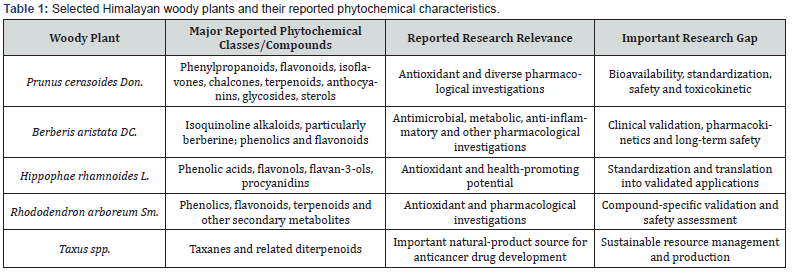
Recent research on Prunus cerasoides Don. commonly known as Indian Himalayan cherry or Padmaka, illustrates this chemical complexity. A recent comprehensive review documented more than 200 investigated phytomolecules and highlighted flavones, isoflavones, chalcones, terpenoids, glycosides and sterols, with phenylpropanoids, anthocyanins, carotenoids and terpenoids contributing substantially to its specialized metabolism [4]. Importantly, the authors also emphasized gaps concerning bioavailability, standardization, safety and toxicokinetics.
Similarly, Berberis aristata DC., an important Himalayan medicinal shrub, is particularly notable for isoquinoline alkaloids, especially berberine. A recent review summarized its phytochemistry, pharmacology, pharmacokinetics and safety and reported experimental evidence for several biological activities while emphasizing the need for additional clinical, pharmacokinetic and toxicological investigations [5]. Hippophae rhamnoides L. provides another useful example. A 2024 review reported phenolic acids, flavonols, flavan-3-ols and polymeric procyanidins in different plant parts and discussed antioxidant and other health-related activities associated with these compounds [3]. Interestingly, branches and leaves may contain substantial quantities of phenolic compounds, demonstrating that non-fruit plant material can also be chemically important Table 1.
From Forest Biodiversity to Natural-Product Discovery
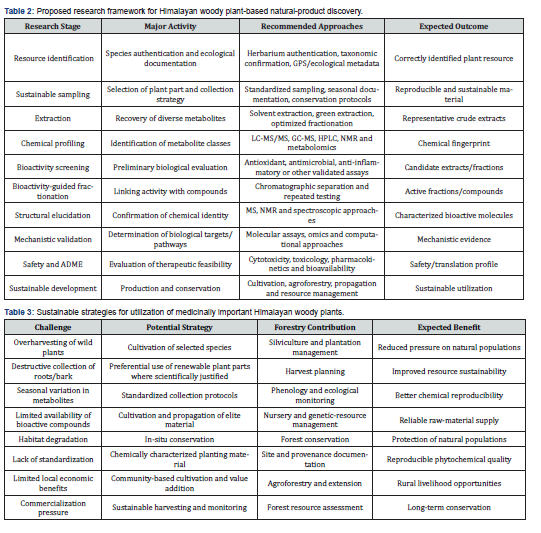
The identification of a potentially bioactive plant compound involves considerably more than conventional preliminary phytochemical screening. Modern natural-product discovery increasingly combines ethnobotanical information with advanced extraction, chromatographic separation, spectroscopic characterization, metabolomics, molecular biology and pharmacological evaluation [2]. Plant-derived natural products can possess highly complex chemical profiles, and the isolation of individual active constituents may be challenging because some compounds occur at low concentrations or interact synergistically with other constituents. Recent reviews therefore emphasize improved strategies for extraction, isolation, target identification and molecular optimization in natural-product drug discovery [2,6]. A scientifically robust research framework should therefore proceed from botanical authentication and ecological characterization toward chemical profiling, bioactivity-guided fractionation, compound identification and subsequent mechanistic and safety evaluation Table 2.
Why Phytochemical Presence Is Not Equivalent to Therapeutic Efficacy
A major challenge in medicinal-plant research is the tendency to equate the detection of a particular phytochemical class with medicinal effectiveness. Such an interpretation is scientifically inappropriate. For example, the identification of phenolics or flavonoids in a plant extract can indicate chemical richness, but it does not establish that the extract will produce a therapeutic effect in humans. Biological activity observed under conditions may not translate directly into in-vivo efficacy because of absorption, metabolism, distribution, target engagement and toxicity.
This distinction is particularly relevant for Himalayan woody plants. The recent review of Prunus cerasoides specifically identifies bioavailability, standardization, safety and toxicokinetic information as important barriers to validated therapeutic development [4]. Likewise, the recent Berberis aristata literature emphasizes that promising pharmacological findings should be accompanied by further clinical and toxicological studies before broader therapeutic conclusions are drawn [5]. Therefore, future research should move from “phytochemical screening” toward “compound-to-mechanism validation.”
Sustainable Utilization: Connecting Medicinal Chemistry with Forestry
Natural-product research cannot be separated from the conservation of its biological resources. Increased commercial interest in a medicinally valuable species can potentially increase harvesting pressure on wild populations. Sustainable natural-product discovery should therefore integrate chemical research with conservation biology and forest management. Plant-derived natural products offer opportunities for pharmaceutical development, but challenges associated with extraction, isolation, sustainable supply and low abundance of target compounds must be addressed [7]. For Himalayan woody plants, cultivation and agroforestry-based production may provide a practical pathway for reducing pressure on natural populations while generating additional livelihood opportunities Table 3.
Future Research Priorities
The future investigation of Himalayan woody plants should increasingly employ modern analytical and biological technologies. LC-MS/MS, high-resolution mass spectrometry, NMR spectroscopy and metabolomics can provide detailed chemical fingerprints, while molecular approaches can help connect candidate compounds with biological targets. Another important direction is the integration of ethnobotanical knowledge with modern natural-product research. Traditional knowledge can assist in prioritizing species and plant parts for investigation, but such information should serve as a starting point rather than proof of efficacy. Recent natural-product research has also emphasized the importance of improving the transition from natural molecules to drug-like candidates through structural optimization, target identification and assessment of absorption, distribution, metabolism, excretion and toxicity (ADMET) properties [6]. For Himalayan woody plants, an interdisciplinary model involving foresters + phytochemists + medicinal chemists + pharmacologists + molecular biologists + conservation scientists would therefore be particularly valuable.
Conclusion
Himalayan forests represent an important intersection of biological diversity, traditional knowledge and chemical diversity. Underexplored woody plants such as Prunus cerasoides, Berberis aristata anddemonstrate the diversity of phytochemical resources that can be investigated for natural-product discovery [3-5]. However, the scientific value of these resources should not be overstated. The presence of phytochemicals or preliminary biological activity does not establish therapeutic efficacy. Rigorous chemical characterization, mechanistic investigation, bioavailability assessment, toxicological evaluation and clinical validation remain essential. The concept of forests as “living pharmacies” should therefore be understood not as a claim that forests directly provide medicines, but as a perspective emphasizing that forest biodiversity represents a potentially valuable reservoir of natural chemical diversity. Integrating this resource with modern medicinal chemistry while maintaining sustainable forest management could open new avenues for natural-product discovery and simultaneously contribute to biodiversity conservation and rural development.
References
- Atanasov AG, Zotchev SB, Dirsch VM, Supuran CT (2021) Natural products in drug discovery: advances and opportunities. Nature Reviews Drug Discovery 20: 200-216.
- Wang Y, Wang F, Liu W, Geng Y, Shi Y, et al. (2024) New drug discovery and development from natural products: Advances and strategies. Pharmacology & Therapeutics 264: 108752.
- Singh B, Oberoi S, Kaur A (2024) Phenolic compounds in sea buckthorn (Hippophae rhamnoides L.) and their health-promoting activities: a review. International Journal of Food Science & Technology 59(9): 6642-6658.
- Jyotshna, Shanker K (2025) An insight review on phytochemistry, pharmacological evidences, and biosynthesis of key metabolites of Indian Himalayan cherry (Prunus cerasoides Don.) with emphasis on its safety and use in traditional phytomedicine. Chemistry & Biodiversit 22(3): e202401814.
- Marchelak A, Gieleta M, Krasocka W, Magiera A (2025) Berberis aristata DC. (Indian barberry): Current insight into botanical, phytochemical, and pharmacological aspects, pharmacokinetics, safety of use and modern therapeutic applications. Fitoterapia 183: 106539.
- Acharya A, Nagpure M, Roy N, Gupta V, Patranabis S, et al. (2024) How to nurture natural products to create new therapeutics: Strategic innovations and molecule-to-medicinal insights into therapeutic advancements. Drug Discovery Today 29(12).
- Ahmad M, Tahir M, Hong Z, Zia MA, Rafeeq H, et al. (2025) Plant and marine-derived natural products: sustainable pathways for future drug discovery and therapeutic development. Frontiers in Pharmacology 15: 1497668.

























