




 OMCIJ Home




Abstract
Kinetics of aqueous racemization of 5-phenylhydantoin (5-PH) has been experimentally well investigated. In phosphate buffers, the buffer-catalyzed racemization was shown to be due almost solely to the catalysis by the hydrogen phosphate ion (divalent phosphate, HPO42-). On the other hand, in a mixed solvent of deuterated phosphate buffer and deuterated dimethylsulfoxide (DMSO-d6), the deuteration rate constant was shown to be close to half of the racemization rate constant. This means that, at the molecular level, the hydrogen/deuterium (H/D) substitution occurs with inversion of configuration. In this present study, a novel phosphate-catalyzed racemization mechanism of 5-PH was revealed which can explain the above experimental findings by density functional theory (DFT) calculations. In this mechanism, the HPO42- ion abstracts the proton from the C5 position in the first step, producing an interanionic complex between an enolate intermediate and a dihydrogen phosphate ion (monovalent phosphate, H2PO4-) ion, while remaining bound to the enolate by interanionic hydrogen bonding, can “sneak around” to the back of the enolate plane with a very small energy barrier and donates the proton originally bound in the HPO42-ion to the C5 atom, resulting in the inversion of the C5 atom. When the H atom in HPO42- was replaced by a D atom, the calculated Gibbs energy of activation at 323.15 K (103.8 kJ mol−1) was in good agreement with the experimental Gibbs energy of activation for deuteration reported in the literature. This strongly suggests that the presently found novel racemization mechanism actually operates in phosphate buffer.
Keywords: 5-Phenylhydantoin; Racemization; Deuteration; Phosphate buffer; Buffer catalysis; Density functional theory; Hydrogen phosphate ion; Dihydrogen phosphate ion; Enolate ion; Interanionic hydrogen bond
Abbreviations: DFT: Density Functional Theory; 5-PH: 5-Phenylhydantoin; DMSO: Dimethylsulfoxide; TS: Transition State; C-PCM: Conductor-Like Polarizable Continuum Model; IRC: Intrinsic Reaction Coordinate; R: Reactant; RC: Reactant Complex; IC: Intermediate Complex; P: Product; PC: Product Complex; ZPE: Zero-Point Energy
Introduction
Derivatives of hydantoin (imidazolizine-2,4-dione) are important as drug and drug-like compounds [1,2]. Especially, 5-monosubstituted hydantoins, where the C5 carbon atom is asymmetric, are good models of chiral drugs, and their aqueous racemization reactions have been well investigated [3-15]. Moreover, they are important precursors of enzymatic asymmetric syntheses of optically active d- and l-α-amino acids which are of industrial importance [5,16-22]. In these syntheses, enzymatic and/or nonenzymatic (spontaneous) racemization reactions of the 5-monosubstituted hydantoins play an important role.
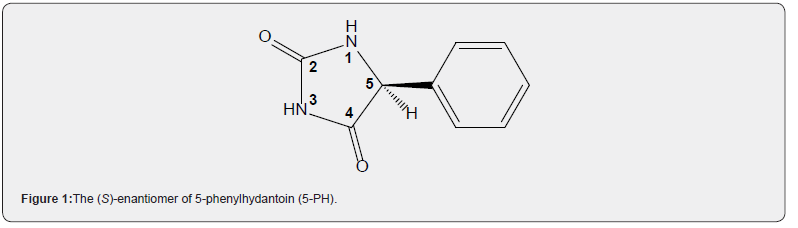
Kinetics of aqueous nonenzymatic racemization of 5-phenylhydantoin (5-PH) in particular has been well investigated experimentally [3,6] (Figure 1 shows the (S)-enantiomer of 5-PH). 5-PH is a metabolite of anticonvulsant ethotoin (3-ethyl-5-phenylhydantoin) [3]. Dudley and Bius [3] showed that racemization of 5-PH is catalyzed by several buffers. Particularly in phosphate buffers, they showed that the buffer-catalyzed racemization is due almost solely to the catalysis by the hydrogen phosphate ion (divalent phosphate, HPO42-) rather than by the dihydrogen phosphate ion (monovalent phosphate, H2PO4-). At the physiological pH of 7.4, the inorganic phosphate exists predominantly as HPO42- and H2PO4- ions in the ratio of about 4:1, since the pKa value of H2PO4- is 6.82 [23]. Therefore, the HPO42- ion is also expected to effectively catalyze the 5-PH racemization in vivo. The catalysis by the HPO42- ion is an example of general base catalysis. Dudley and Bius [3] proposed a mechanism in which an enol species appears as an intermediate although there is another possibility of an enolate ion intermediate.
Reist et al. [6] investigated 5-PH racemization from the (S)-enantiomer in the 1:1 (v/v) mixed solvent of phosphate buffer and dimethylsulfoxide (DMSO) and in its deuterated counterpart, i.e., the 1:1 (v/v) mixed solvent of deuterated phosphate buffer and deuterated DMSO (DMSO-d6). Since the activation energies of deuteration (H/D substitution) at the C5 atom and racemization were identical within experimental errors, they concluded that the two reactions share a common mechanism. Moreover, they found that, in the deuterated system, the pseudo-first-order rate constant for deuteration was approximately half of the pseudo-first-order rate constant of racemization. At 50 °C, the deuteration rate constant was 11.3 ± 1.9 h-1, while the racemization rate constant in the deuterated system was 21.1 ± 1.4 h-1. This means that, at the microscopic and molecular level, the deuteration occurs with inversion of configuration of the C5 atom. Therefore, intermediacy of a plane-symmetrical enolate or enol species was thought to be unlikely (unless the intermediate is unsymmetrically solvated), since the deuteration of the intermediate would occur equally from either side of the symmetry plane and thus the deuteration rate would be identical with the racemization rate. The Gibbs energy of activation for the deuteration (H/D substitution) of 5-PH was determined to be 94.6 ± 11.7 kJ mol-1 at 50 °C.
In general terms, asymmetric CH carbon atoms α to a carbonyl group (as the C5 atom of 5-monosubstituted hydantoins) can be stereochemically unstable because their deprotonation by bases gives a flat, resonance-stabilized enolate ion; reprotonation of the enolate intermediate could occur from either side of the enolate plane. This stepwise mechanism is called an SE1 (substitution, electrophilic, unimolecular) mechanism [6,8-12,15,24,25]. This mechanism resembles the well-known SN1 (substitution, nucleophilic, unimolecular) mechanism for nucleophilic substitution reactions. Although the SE1 mechanism is widely accepted, it can not explain the above experimental finding by Reist et al. for 5-PH racemization [6]. They instead proposed a concerted SE2 (substitution, electrophilic, bimolecular) mechanism, which resembles the SN2 (substitution, nucleophilic, bimolecular) mechanism for nucleophilic substitution reactions. However, examples of the SE2 mechanism are scarce [15] and a pure SE2 mechanism has not been computationally supported [26].
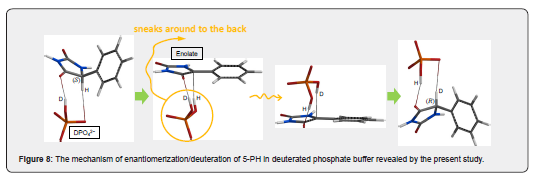
In this present paper, density functional theory (DFT) computational evidence is provided for a novel mechanism which can explain the reported experimental findings for racemization and deuteration of 5-PH in phosphate buffer. In this mechanism, the HPO42- (or DPO42-) ion first abstracts the proton from the C5 position and yields an interanionic complex between the enolate intermediate and an H2PO4- (or HDPO4-) ion. Then, the H2PO4- (or HDPO4-) ion “sneaks around” to the back of the enolate plane with a very small energy barrier, and donates a proton (or a deuteron) to the C5 atom resulting in its inversion.
Methods
The DFT calculations were performed for enantiomerization of (S)-5-PH by using Spartan’20 (Wavefunction, Inc., Irvine, CA). Here, the term “enantiomerization” is used instead of “racemization”, because the calculations were performed for a single molecule; racemization is a macroscopic phenomenon and racemization of a single molecule is impossible [15]. Geometries were optimized for all-hydrogen (i.e. non-deuterated) species because electronic energies are not dependent on isotopes. The catalytic HPO42- ion was supposed to abstract the proton from the C5 atom to form an enolate ion and an H2PO4- ion. In the present study, no counter-cations were included in the calculations. This is based on the fact that the racemization of a related hydantoin derivative in phosphate-buffered aqueous media was not influenced by the ionic strength (addition of NaCl) [10].
As in a recent related study [26], the ωB97X-D functional [27] and the 6-311+G(d,p) basis set were employed in the DFT calculations. This present paper deals with systems having hydrogen bonds of various types (including interanionic hydrogen bonds). Although hydrogen bond interactions are dominated by electrostatic interactions, it is required to include dispersion interactions to obtain accurate energetics. The ωB97X-D functional includes empirical atom–atom dispersion corrections and is known to perform well for hydrogen bond interactions [28].
The equilibrium and transition state (TS) geometries were fully optimized including solvent effect by the conductor-like polarizable continuum model (C-PCM) implemented in Spartan’20. The dielectric constant was set to be 74. This value was estimated for the 1:1(v/v) mixture of water and DMSO at 25°C from the molarity dependence of dielectric constants of water/DMSO mixtures [29]. As in the previous study [26], no scaling was applied for van der Waals radii used in the C-PCM model although a scaling by 1.2 is used by the default. This is because the hydration Gibbs energy of the divalent HPO42- ion, which is larger than 1000 kJ mol-1, is well reproduced with no scaling [26].
Vibrational frequency calculations were performed for the optimized geometries by a numerical differentiation of analytical gradients to verify them as an energy minimum (with no imaginary frequency) or a TS (with one imaginary frequency). Intrinsic reaction coordinate (IRC) calculations were attempted from all TSs. However, except for TS1 (see below), IRC calculations were not successful because the TSs are located on an extremely flat region of the potential energy surface. Typically, the calculations proceeded extremely slowly, or were terminated prematurely. In such cases, switching to a usual geometry optimization was applied at the very early stage of IRC, or geometry optimizations were performed from a geometry which was generated by a slight displacement of nuclei from the TS along its transition vector (i.e., the vibration of imaginary frequency).
Moreover, thermal corrections to the Gibbs energy at 50 °C (323.15 K) were performed by the standard ideal gas/rigid rotor/harmonic oscillator approximations in order to compare with the reported experimental results at 50 °C [6]. A correction term of 8.8 kJ mol-1 was added to the Gibbs energies to account for the change of reference state from gas phase to 1 M solution [30]. These calculations were performed both for the non-deuterated and deuterated species, where deuterated species mean DPO42-, the reactant complex between a non-deuterated (S)-5-PH molecule and DPO42-, and the corresponding species in the reaction course.
Results and Discussion
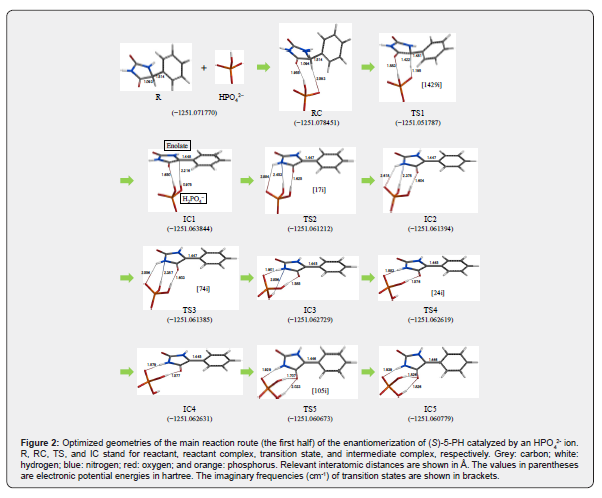
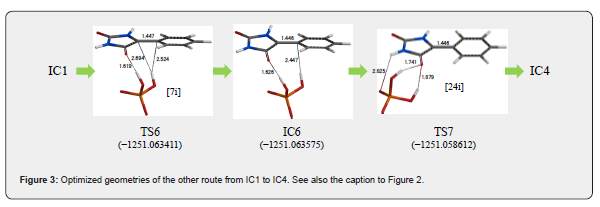
Figures 2 & 3 show the optimized geometries and their electronic potential energies, where R stands for the reactant, i.e., (S)-5-PH, and RC stands for the reactant complex, i.e., the complex between R and an HPO42- ion; TS and IC stand for transition state and intermediate complex (complex between the enolate intermediate and an H2PO4- ion), respectively. There are many energy minima for IC (IC1 to IC6). IC5 has a Cs symmetry (within a very small computational error) and is the very midpoint of the enantiomerization. Figure 2 shows a five-step pathway from RC to IC5 (RC → TS1 → IC1 → TS2 → IC2 → TS3 → IC3 → TS4 → IC4 → TS5 → IC5). Figure 3 shows another pathway (with somewhat higher energy) from IC1 to IC4 (IC1 → TS6 → IC6 → TS7 → IC4). After passing through IC5, the reaction proceeds via geometries corresponding to the mirror images of the geometries in the first half shown in Figures 2 & 3.
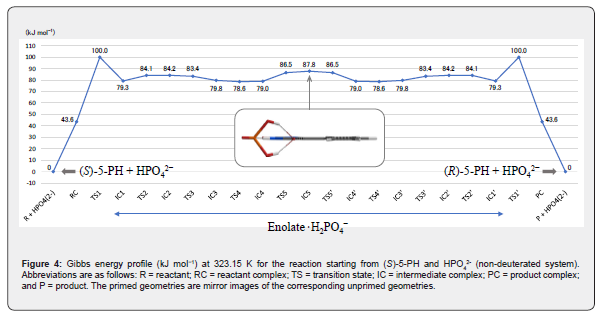
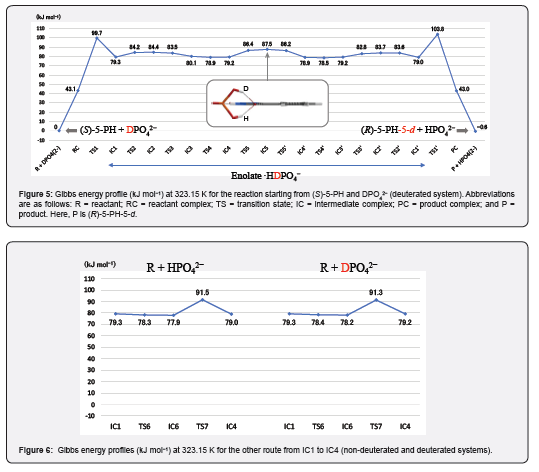
Figures 4-6 show Gibbs energy profiles at 323.15 K. The values are relative to the separated starting species. In Figure 4, which is for the non-deuterated reaction system ((S)-5-PH + HPO42-), the primed geometries are the mirror images of the corresponding unprimed geometries, respectively; for example, IC1’ corresponds to the mirror image of IC1. P stands for the product, i.e., (R)-5-PH, and PC stands for the product complex between P and an HPO42- ion. Figures 5 is for the deuterated reaction system ((S)-5-PH + DPO42-). It should be noted that Figure 4 is symmetrical (i.e., the left and right halves are mirror images of each other), but Figure 5 is not. In Figure 5, the product P is the deuterated (R)-enantiomer, i.e., (R)-5-PH-5-d, and PC involves a non-deuterated HPO42- ion instead of DPO42-. Figure 6 shows the Gibbs energy profiles of the other route from IC1 to IC4 for non-deuterated and deuterated systems.
6.1. Deprotonation (proton abstraction)
There is only one type of conformer for the reactant (R), in which the phenyl ring is close to perpendicular to the hydantoin five-membered ring; the two H–C5–Cipso–Cortho dihedral angles are −17° and 165°. In the reactant complex (RC), a complex between R and an HPO42- ion, the two H–C5–Cipso–Cortho dihedral angles are −25° and 157°. The distance between the hydrogen atom bonded to C5 and one of the anionic oxygen atoms of the HPO42- ion (CH⋅⋅⋅O interaction) is 2.593 Å. This oxygen abstracts the proton from C5. The OH group of the HPO42- ion forms a hydrogen bond to the carbonyl oxygen at position 4 (1.955 Å). On the electronic potential energy surface, RC lies 17.5 kJ mol-1 below the separated species (R + HPO42-). However, in the Gibbs energy profile Figure 4, RC is higher than the separated species by 43.6 kJ mol-1. Such a large change on going from electronic energy to Gibbs energy, which is common for association processes [31,32], can be ascribed to the entropy loss by the loss of translational and rotational degrees of freedom.
The HPO42- ion in RC abstracts the proton from the C5 atom to form a complex (IC1) between an enolate ion and an H2PO4- ion via the transition state TS1. It should be noted that the HPO42- ion becomes an H2PO4- ion as a consequence of proton abstraction. In this step, the C5–H covalent bond is broken, and a new covalent bond is formed between this hydrogen atom and the phosphate oxygen atom. In TS1, the C5⋅⋅⋅H distance is 1.422 Å while the hydrogen atom is close to the phosphate oxygen atom (1.195 Å); the distance of the hydrogen bond between the oxygen at position 4 and the phosphate hydrogen is 1.883 Å. The relative Gibbs energy of TS1 with respect to the separated species is 100.0 kJ mol-1. This corresponds to the activation Gibbs energy for the overall reaction Figure 4. The relative Gibbs energy of IC1 with respect to the separated species is 79.3 kJ mol-1. In IC1, the five-membered ring is close to coplanar with the phenyl ring; the two C4–C5–Cipso–Cortho dihedral angles are 13° and −167°. This implies the anion-stabilizing effect of the phenyl group by resonance (charge delocalization). The shorter C5–Cipso distance (1.448 Å) in IC1 than in RC (1.514 Å) is consistent with this stabilization.
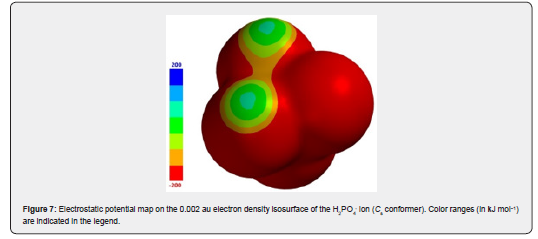
The interaction between the enolate ion and the H2PO4- ion in IC1 is worth noting. This is an attractive interaction between two monoanions by two hydrogen bonds. It has been shown that hydrogen bonds between monoanions (interanion or interanionic hydrogen bonds) are not rare [33-37], and interanionic hydrogen bonds involving the H2PO4- ion are known [33-35,37]. In IC1, the H2PO4− ion has a pseudo-Cs symmetry and two eclipsed O–H bonds. These two O–H bonds can act as hydrogen bond donors despite of the total negative charge of the H2PO4-ion. In Figure 7, an electrostatic potential map of the H2PO4- ion (optimized in Cs symmetry) is shown. It can be seen that there are positive regions (i.e., regions with depleted electron density) on the extensions of the two O–H bonds. These are examples of σ-holes [38-40] and existence of such a σ-hole is a prerequisite for a hydrogen bond donor [38,39]. Thus, in IC1, the H2PO4- ion forms two hydrogen bonds, one to the anionic C5 atom (2.216 Å) and the other to the enolate oxygen at position 4 (1.650 Å). The latter is considerably shorter than the corresponding distances in RC (1.955 Å) and TS1 (1.883 Å).
6.2. H2PO4- sneaks around to the back of the enolate plane
As may be seen from Figure 4, IC1 can easily be converted to its mirror-image geometry (IC1’). In other words, from IC1, the H2PO4− ion can “sneak around” to the back of the enolate plane. There are seven energy minima (IC2, IC3, IC4, IC5, IC4’, IC3’, and IC2’) and eight transition states (TS2, TS3, TS4, TS5, TS5’, TS4’, TS3’, and TS2’) between IC1 and IC1’ (the primed geometries are the mirror images of the corresponding unprimed geometries, respectively). IC5 has a Cs symmetry as may be well seen from the inset of Figure 4. Thus, IC5 is the very midpoint between RC and PC, and Figure 4 is symmetrical with respect to IC5. The geometries from IC1 to IC1’ are located on a very flat region of the potential energy surface, and the Gibbs energy barrier from IC1 to IC1’ is only 8.5 kJ mol-1. This value is even lower than the well-known C–C rotational barrier of ethane (ca. 12 kJ mol-1) [41]. Thus, IC1 can easily be converted to IC1’ by passing through this very flat region. The flatness of the potential energy surface may be seen from the electronic potential energies shown in Figure 2, and is reflected in the very small imaginary frequencies of TS2, TS3, TS4, and TS5 (17i, 74i, 24i, and 105i cm-1, respectively). On the other hand, the imaginary frequency of TS1 is 1429i cm-1.
It should be noted that, throughout this phosphate sneaking, attractive interaction between the enolate ion and the H2PO4− ion is maintained as may be seen from the hydrogen bond distances shown in Figure 2. As mentioned above, there are two interanionic hydrogen bonds in IC1 (1.650 and 2.216 Å). IC1 is converted to IC2 via TS2, and IC2 have three interanionic hydrogen bonds involving the carbonyl oxygen at the C4 position, N3, and the hydrogen atom bonded to N3 (1.604, 2.378, and 2.618 Å, respectively) although the last one seems to be weak. The distances of these three hydrogen bonds become 1.585, 2.856, and 1.901 Å, respectively in IC3, which is connected to IC2 via TS3. IC3 is converted to IC4 via TS4, and IC4 has two interanionic hydrogen bonds involving the enolate oxygen and the NH hydrogen atoms (1.577 and 1.879 Å, respectively). IC4 is converted to IC5, the midpoint of the overall reaction, where there are two equivalent hydrogen bonds (1.826 Å) between the enolate oxygen at the C4 position and the two OH hydrogen atoms in the H2PO4− ion. After passing through IC5, the reacting system reaches IC1’ by passing through TS5’, IC4’, TS4’, IC3’, TS3’, IC2’, and TS2’ in this sequence. IC1’ is converted to PC (the mirror image of RC) via TS1’ (the mirror image of TS1) by proton donation from H2PO4− to the C5 atom, thus completing the inversion of this carbon atom. The energy of TS1 is equal to that of TS1’ because they are mirror images of each other. PC is dissociated to (R)-5-PH (P) and an HPO42- ion, thus closing a catalytic cycle.
When the HPO42- ion in the reactant system was replaced by a DPO42- ion, the Gibbs energy profile shown in Figure 5 was obtained. This profile is not symmetrical with respect to IC5. The sneaking-around ion is HDPO4− in this case. The energy of TS1’ is 4.1 kJ mol-1 higher than TS1. This is because a deuteron is being transferred in TS1’, while a proton is being transferred in TS1. The product in this case is the (R)-5-PH molecule deuterated at C5, (R)-5-PH-5-d. The relative Gibbs energy of TS1’ with respect to the separated initial state, (S)-5-PH + DPO42-, is 103.8 kJ mol-1. This value can be compared to the experimental Gibbs energy of activation for deuteration of (S)-5-PH in deuterated phosphate buffer (94.6 ± 11.7kJ mol-1) [6]. This supports the claim by Reist et al. [6] that the deuteration and racemization share a common mechanism and the presently found mechanism of enantiomerization by “phosphate’s sneaking around”.
Figures 3 & 6 show the other pathway from IC1 to IC4 (IC1 → TS6 → IC6 → TS7 → IC4). This pathway is energetically less favorable than that shown in Figures 2, 4 & 5. In IC6, the enolate ion interacts with the H2PO4- (or HDPO4-) ion at the Cipso atom (2.447Å) and at the enolate oxygen (1.626 Å).
A consideration on the observed deuterium isotope effect
A minute deuterium isotope effect was observed when the racemization of 5-PH was investigated in a mixture of deuterated phosphate buffer and DMSO-d6 [6]. Racemization became slightly slower in the deuterated environment (kH/kD = 1.12 at 50 °C, where kH and kD are the pseudo-first-order rate constants in non-deuterated and deuterated environments, respectively). This minute isotope effect is difficult to explain because both the catalyst and solvent are deuterated; nevertheless, it can be qualitatively interpreted by the geometry of TS1’ (of the rate-determining step). In TS1’ of the non-deuterated system, an O–H bond in H2PO4- is being broken, and the reaction is expected to become slower if the catalytic HPO42- ion replaced by DPO42- because the O–H bond is replaced by an O–D bond (kinetic isotope effect). Indeed, the activation Gibbs energy increases by 3.8 kJ mol-1 on going from non-deuterated to deuterated system. This increase is mainly ascribed to the increase in the zero-point energy (ZPE) difference between “R + HPO42-” and TS1’ upon deuteration. Indeed, the ZPEs of HPO42- and TS1’ decrease by 8.4 and 4.9 kJ mol-1, respectively, when the HPO42- ion is replaced by a DPO42- ion. However, this increase in the activation Gibbs energy is much larger than that expected from the experimental kH/kD value (ca. 0.3 kJ mol-1). One possible explanation is that the pKa value of 5-PH (8.28 at 37 °C [3]) becomes larger when the solvent is deuterated (solvent isotope effect) [11]. This decreases the extent of the N3-deprotonated form of 5-PH, which is inert to deprotonation at C5 [3], and thus has an increasing effect on the rate constant.
Conclusion
Figure 8 summarizes the novel mechanism of enantiomerization/deuteration of 5-PH in deuterated phosphate buffer revealed from the present computational study. A DPO42- ion abstracts the proton from the C5 position of 5-PH providing an interanionic complex between the enolate intermediate and an HDPO4- ion. In this complex, the two anions are bound together by interanionic hydrogen bonds. Then, the HDPO4- ion “sneaks around” to the back of the enolate plane through a very flat region of the potential energy surface and donates its deuteron to the C5 atom. Thus, the reported finding that deuteration (H/D substation) at the C5 position occurs with inversion of the C5 atom can be explained. Since many drug and related molecules have an asymmetric CH carbon atom α to a carbonyl group in a heterocyclic ring like hydantoin, it is very interesting whether the “phosphate’s sneaking around” mechanism of racemization found here is general or not. This will be clarified in future work.
References
- Cho S, Kim SH, Shin D (2019) Recent applications of hydantoin and thiohydantoin in medicinal chemistry. Eur J Med Chem 164: 517-54
- Wadghane S, Bhor R, Shinde G, Kolhe M, Pooja R (2023) A review on some biological activities of the hydantoin derivatives. J Drug Deliv Therap 13(1): 171-
- Dudley KH, Bius, DL (1976) Buffer catalysis of the racemization reaction of some 5-phenylhydantoins and its relation to the in vivo metabolism of ethotoin. Drug Metabol Dispos 4(4): 340-
- Lazarus RA (1990) Chemical racemization of 5-benzylhydantoin. J Org Chem 55(15): 4755-
- Lickefett H, Krohn K, König WA, Gehrcke B, Syldatk C (1993) Enantioseparation of 5-monosubstituted hydantoins by capillary gas chromatography—investigation of chemical and enzymatic racemization. Tetrahedron Asymm 4(6): 1129-
- Reist M, Carrupt PA, Testa B, Lehmann S, Hansen JJ (1996) Kinetics and mechanisms of racemization: 5-substituted hydantoins (= imidazolidine-2,4-diones) as models of chiral drugs. Helv Chim Acta 79(3): 767-
- Lee CK, Fan CH (1999) Enzymatic synthesis and subsequent racemization rates determination of optically active d-5-phenylhydantoin and d-5-hydroxylphenylhydantoin. Enzyme Microb Technol 24(10): 659-
- Kahn K, Tipton PA (2000) Kinetics and mechanism of allantoin racemization. Bioorg Chem 28(2): 62-
- Reist M, Testa B, Carrupt PA (2003) Drug racemization and its significance in pharmaceutical research. In: Eichelbaum M, Testa B, Somogyi A (Eds.), Stereochemical Aspects of Drug Action and Disposition. Springer-Verlag, Berlin, Germany, 91-112.
- Cabordery AC, Toussaint M, Azaroual N, Bonte JP, Melnyk P, et al. (2011) Kinetics and mechanism of racemization of Tic-hydantoins, potent sigma-1 agonists. Tetrahedron Asymm 22(2): 125-
- Narduolo S (2011) The mechanism of racemization of 5-substituted hydantoins in aqueous solution. Ph D. Thesis, Cardiff University, Wales.
- Ahmad HO (2015) Kinetics and mechanism of racemisation reactions of configurationally liable stereogenic centres in drug-like molecules in aqueous solutions; thiohydantoins and related compounds. Ph D. Thesis, Cardiff University, UK.
- Ballard A, Ahmad HO, Narduolo S, Rosa L, Chand N, et al. (2018) Quantitative prediction of rate constants for aqueous racemization to avoid pointless stereoselective syntheses. Angew Chem Int Ed 57(4): 982-
- Ballard A, Narduolo S, Ahmad HO, Cosgrove DA, Leach AG, et al. (2019) The problem of racemization in drug discovery and tools to predict it. Expert Opin Drug Discov 14(6): 527-
- Ballard A, Narduolo S, Ahmed HO, Keymer NI, Asaad N, et al. (2020) Racemisation in chemistry and biology. Chem Eur J 26(17): 3661-
- Dinelli D, Marconi W, Cecere F, Galli G, Morisi F (1978) A new method for the production of optically active aminoacids. In: Pye EK, Weetall HH (Eds.), Enzyme Engineering. Springer, Boston, USA, pp. 477-
- Syldatk C, Wagner F (1990) Biotechnological production of d- or l-amino acids from 5-monosubstituted hydantoins. Food Biotech 4(1): 87-
- May O, Nguyen PT, Arnold FH (2000) Inverting enantioselectivity by directed evolution of hydantoinase for improved production of l-methionine. Nature Biotech 18(3): 317-
- Pietzsch M, Syldatk C (2002) Hydrolysis and formation of hydantoins. In: Drauz K, Waldmann H (Eds.), Enzyme Catalysis in Organic Synthesis. Wiley-VCH Verlag GmbH, Weinheim, Germany, pp. 761-
- Leuchtenberger W, Huthmacher K, Drauz K (2005) Biotechnological production of amino acids and derivatives: current status and prospects. Appl Microbiol Biotechnol 69(1): 1-
- Ogawa J, Horinouchi N, Shimizu S (2012) Hydrolysis and formation of hydantoins. In: Drauz K, Gröger H, May O (Eds.), Enzyme Catalysis in Organic Synthesis. Wiley-VCH Verlag GmbH & Co. KGaA, Weinheim, Germany, pp. 651-
- Joshua M, Erum E, Godspower HN, Ajeje SB, Shao M, et al. (2024) Challenges and solutions in d-amino acid production methods. Int J Environ Agric Biotech 9(2): 183-
- Voet D, Voet JG (2011) Biochemistry. (4th edn), John Wiley & Sons,, Hoboken, USA, pp. 45-69.
- Reist M, Christiansen LH, Christoffersen P, Carrupt PA, Testa B (1995) Low configurational stability of amfepramone and cathinone: mechanism and kinetics of chiral inversion. Chirality 7(6): 469-
- Mey B, Paulus H, Lamparter E, Blaschke G (1998) Kinetics of racemization of (+)- and (−)-diethylpropion: studies in aqueous solution, with and without the addition of cyclodextrins, in organic solvents and in human plasma. Chirality 10(4): 307-
- Takahashi O (2024) A computational DFT study of the stereoinversion of succinimide residues formed in proteins and peptides catalyzed by a hydrogen phosphate ion: an unsymmetrical SE1 mechanism. Symmetry 16(10): 1369.
- Chai JD, Head Gordon M (2008) Long-range corrected hybrid density functionals with damped atom–atom dispersion corrections. Phys Chem Chem Phys 10(44): 6615-
- Thanthiriwatte KS, Hohenstein EG, Burns LA, Sherrill CD (2011) Assessment of the performance of DFT and DFT-D methods for describing distance dependence of hydrogen-bonded interactions. J Chem Theory Comput 7(1): 88-
- Luzar A (1990) Dielectric behaviour of DMSO–water mixtures. A hydrogen-bonding model. J Mol Liq 46: 221-
- Jensen JH (2015) Predicting accurate absolute binding energies in aqueous solution: thermodynamic considerations for electronic structure methods. Phys Chem Chem Phys 17(19): 12441-
- Colominas C, Teixidó J, Cemelí J, Luque FJ, Orozco M (1998) Dimerization of carboxylic acids: reliability of theoretical calculations and the effect of solvent. J Phys Chem B 102(12): 2269-
- Besora M, Vidossich P, Lledós A, Ujaque G, Maseras F (2018) Calculation of reaction free energies in solution: a comparison of current approaches. J Phys Chem A 122(5): 1392-
- Steiner T (1999) Inter-anion O–H∙∙∙O interactions are classical hydrogen bonds. Chem Commun (22): 2299-
- Mata I, Alkorta I, Molins E, Espinosa E (2012) Electrostatics at the origin of the stability of phosphate–phosphate complexes locked by hydrogen bonds. Chem Phys Chem 13(6): 1421-
- Chen L, Feng Q, Wang C, Yin S, Mo Y (2021) Classical electrostatics remains the driving force for interanion hydrogen and halogen bonding. J Phys Chem A 125(48): 10428-
- Martín Fernández C, Montero Campillo MM, Alkorta I (2024) Hydrogen bonds are never of an “anti-electrostatic” nature: a brief tour of a misleading nomenclature. J Phys Chem Lett 15(15): 4105-
- Kim P, Kang R, Carter Fenk K, Wilson KR, Head Gordon M, et al. (2025) Structural evidence of interanionic hydrogen bonding in phosphoric acid solutions. J Am Chem Soc 147(49): 44916-
- Politzer P, Murray JS (2015) A unified view of halogen bonding, hydrogen bonding and other σ-hole interactions. In: Scheiner S (Ed.), Noncovalent Forces. Springer, Cham, Switzerland, pp. 291-
- Murray JS, Politzer P (2020) Hydrogen bonding: a Coulombic σ-hole interaction. J Indian Inst Sci 100(1): 21-
- Pizzi A, Dhaka A, Beccaria R, Resnati G (2024) Anion∙∙∙anion self-assembly under the control of σ- and π-hole bonds. Chem Soc Rev 53(13): 6654-
- Quijano Quiñones RF, Quesadas Rojas M, Cuevas G, Mena Rejón GJ (2012) The rotational barrier in ethane: a molecular orbital study. Molecules 17(4): 4661-

























