




 OAJELS Home



Abstract
Background/Objectives: Dyslexia is commonly viewed as a neurobiological disorder characterized by difficulties in word recognition and decoding, often associated with genetic and neurological abnormalities. This study seeks to critically examine the evidence supporting the genetic and neurological basis of dyslexia and proposes a reevaluation of its classification, arguing that the condition may be a result of educational practices rather than an inherent disorder.
Methods: A comprehensive review of the literature on genetic linkage studies, neuroimaging data, and educational interventions related to dyslexia was conducted. Key sources include family-based longitudinal studies and functional MRI assessments of brain activity in individuals diagnosed with dyslexia.
Results: Findings suggest that while some studies have identified potential genetic markers and neurological patterns associated with dyslexia, these results are inconsistent and often lack replication. Moreover, many individuals with dyslexia develop compensatory mechanisms that allow them to overcome reading challenges. The study also highlights how educational approaches, particularly multisensory interventions, may be more effective in addressing reading difficulties than a reliance on genetic or neurological diagnoses.
Conclusion: The evidence supporting dyslexia as a neurological disorder remains inconclusive.
The current literature does not converge on a single, individual-level neurobiological signature of dyslexia that is robust across samples, tasks, and analytic choices. In light of this uncertainty—and the demonstrated effectiveness of instructional interventions—we recommend shifting to an educational-needs framework and removing DSM classification, conditional on equity and outcome criteria.
Keywords:Dyslexia; Genetic Association; Compensatory; Sensory Stimuli; language disability; Graphogame; digital storytelling; PATH; GQLM; virtual reality; artificial intelligence
Introduction and Background
The necessity for humans to communicate in a form less limited by time and space led to drawings or markings on objects of any solid material. Communication involves transmission of verbal and non-verbal messages [1]. It consists of a sender, a receiver and channels of communication. Early humans could express thoughts and feelings by means of speech or by signs or gestures [2]. Fire, smoke, drums, or whistle were used as a means of communications of ideas and location. Humans have been using tools for millions of years but reading and writing are relatively new abilities which our brains were not meant to perform [3]. Further, the use of systematic languages with grammatical structure started about a hundred thousand years ago while reading and writing is only a few thousand years old [4].
Figure 1
The invention of writing offers humanity to keep all information from being lost to annals of time. It is a tool that provides society with a way to unswervingly record information in greater detail than what was possible with spoken words. Earliest forms of writing are found in prehistoric cave paintings which were artistic and realistic representations of the primitive human world [5]. These representations offered a visual form of communication intended to record events or convey vital messages. Symbolic communication systems are of two forms: petrograms - if they are drawn or painted, and petroglyphs - if they are carved. Both are different from writing systems in that they do not require prior knowledge of the spoken language. Such drawings have been found in the western mountains of the United States and Canada [6], but the earliest were found in Mesopotamia and Egypt [7-10]. Maspero (1887) illustrated the evolution of written language (Fig. 1) from proto writing (realistic representation [12,13]) to modern writing (abstract representation recording the language of the writer [14]) [11].
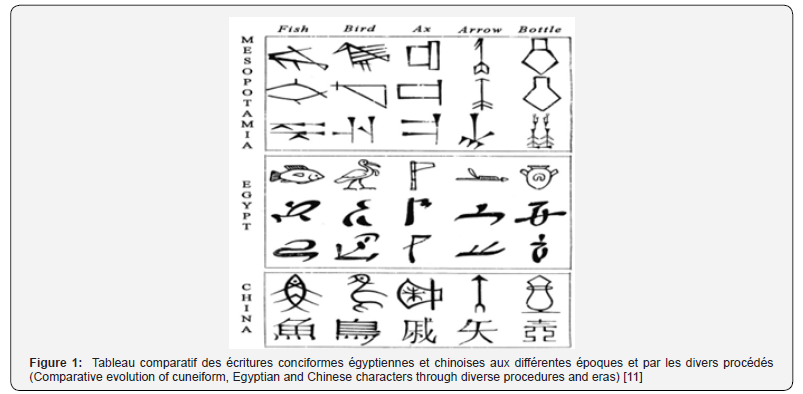
Every human community possesses language, a feature regarded by many as an innate and defining condition of humanity. It was not until recently that the Kalahari San people were forced to accept a modern way of life, but their way of communication is still of that early hunter and gather societies of the past. For that they are judged as more primitive and less advanced than societies using modern writing. In its most general terms, writing is a method of recording information and is composed of graphemes (smallest units of writing that correspond with sounds), which may, in turn, be composed of glyphs (a specific shape, design, or representation of a character) [15]. This means that humans must learn how to use this tool encoded in the form of reading and writing. Writing allows societies to transmit information and share knowledge through the reading task [16].
Human communities over 5000 years of illiteracy transcended to highly technological ones in which reading is the functionality prerequisite. As such, reading transformed humanity’s intellectual development. Yet, some are found able to code and decode very easily while and others struggle. Those who perform with difficulty at coding or decoding are then labeled as dyslexic. Hearing the word “dyslexia” often reminds us of people reversing letters, especially children, who labeled as dyslexics, to the least have trouble with reading. That said, many children experience some difficulty with reading; in individuals labeled with dyslexia, the delay is typically more prolonged relative to age expectations.
The problem is that Dyslexia is not a well–defined set. It is defined as a specific learning disability that is neurobiological in origin and characterized by difficulties with accurate and/or fluent word recognition and poor spelling and decoding abilities. There is somewhat of a consensus that dyslexia results from a deficit in the phonological language component that is unexpected in relation to other cognitive abilities and effective classroom instruction [17-21].
This definition stems from a biological causal perspective on dyslexia, which begs the question: in what way/s does dyslexia causes the brain to function poorly or improperly? The way we view dyslexia comes from our understanding of people with neurological injuries, such as stroke or traumatic brain injury, who experience speech and language arrears due to the left side of the brain being affected [22,23]. An injury that affects the left side of the brain results in an impairment in language referred to as aphasia. Thus, these individuals struggle with several language skills such as speaking, listening, reading, and writing skills. For example, a stroke tends to affect the parts of the brain controlling the muscles needed for speech (tongue, mouth, lips), which often slows or slurs speech [23,24]. This is unlike dyslexia even though reading and writing in both groups is poor. In other words, in the stroke victim’s brain these linking areas are damaged but not in the dyslexic brain. This only indicates what parts of the brain are involved in language skills but observe individuals with dyslexia do not struggle with speaking or listening.
There are many speculations as to the cause of dyslexia which is considered a disorder. Several studies have reported causal genetic links. Scientists have claimed to find gene markers or mutations responsible for dyslexia on several chromosomes and thus jumpstarted the search within family structures for gene candidates. The Jyväskylä Longitudinal Study of Dyslexia (JLD) is a family risk study started in 1993 following a cohort of 200 Finnish children, from birth to college with half at familial risk for dyslexia. The first candidate gene DYX1C1 was identified (first by Smith et. al. (1983) [25] and later confirmed based on the JLD data Taipale et al., 2003[26]). This reinforced the speculation that dyslexia runs in families (i.e. parents with dyslexia being likely to have affected children), but is genetics really at fault? More than 150 articles and three dissertations were published from the JLD. This study assumes genetic linkage and creates measures to identify at risk children and predict their future difficulties in literacy development [27].
This review considers an alternative explanation: that widespread instructional approaches may contribute to observed reading difficulties. The idea of Whole language was first proposed by Jan Comenius in 1720, a few decades after John Hart proposed his phonics instruction that emphasized sounds as the tiniest units of language that can be learned and manipulated [28,29]; Whole Language instead focuses on words as the basic units for comprehension. In the 1800s, Horace Mann, the father of the public-school movement in the United States, believed and pushed for teaching children whole-words and skip the idea that letters are represented by their sounds. The theories of linguist pioneers such as Noam Chomsky, Jean Piaget, and Lev Vygotsky were used to strengthen the debate against phonics in 1980s [30]. In the 80s and 90s, a debate between Whole Word and Phonics to Reading emerged forcing the United States Congress to convene a commission on reading [31]. The result of the commission was that there was no evidence for the Whole Word theory [32].
Researchers are now convinced that the main problem in struggling readers is phonological in nature [33,34]. However, although the phonics approach to teaching won the debate, it did not incur in depth change because most of those responsible for children’s reading development still held that word sounding would distract children from comprehending the meaning of words being read. Thus, the theory of balancing approaches was born where Whole Words theory was sprinkled with some phonics (a recent study recommended a balanced approach with more phonics as the solution of America’s reading problem [35]). The question is, what result did this new approach have on our children’s reading?
The context in which dyslexia has been and is still viewed makes it difficult for diagnosed individuals to engage in the activity of reading. “Dyslexia is a reading disorder that is characterized by slow and inaccurate reading. It affects a significant portion of school age children, who have a higher likelihood for poorer academic performance and lowered self-esteem when suffering from dyslexia. Currently, the diagnosis of dyslexia lacks objective criteria, which can decrease treatment efficacy. Diagnosis relies on a discrepancy between reading ability and intelligence, a measure which can be unreliable.” [36]. This label sends the message that something is cognitively wrong. Mainly, dyslexia is viewed as a ‘glitch’ in neurological wiring and is thus treated accordingly.
Scientists have progressed in the diverse technologies used to discover the cause of dyslexia. For example, in using brain imaging technologies, researchers hope to scientifically determine what sorts of reading pedagogies and interventions will most likely aid children with dyslexia. Other groups using biology, are looking at the presence of how certain immune proteins in the brain might be responsible for the wiring disruption in hopes to gain further understanding. Thus, understanding the role of hormones, proteins and neurotransmitters (chemicals messages transport between nerve cells) in the reading process may shed light on what is happening in a brain with dyslexia.
Further, such labels and views naturally result in implying genetic causation used as evidence to support dyslexia as a neurological disorder. This provides the mechanism by which dyslexia is placed in the Diagnostic and Statistical Manual (DSM). Protopapas and Parrila (2018) point out that this means that dyslexia can be legitimately viewed as a mental health issue, which comes with a broad set of ideological issues, controversies and a sense of negative urgency and alarmism [37].
The goal of this article is to show how the label dyslexia and its symptoms may have come to be, what far reaching impact its introduction into human communities a century ago may have had on millions of individuals, and to directly question its genetic causation. To bring clarity, the discussion starts by defining what is meant by “Is Dyslexia A thing” to set the groundwork for how we should classify dyslexia. This is followed by a discussion on brain anatomy in relation to association areas that are responsible for reading, and what happens in the brain to bring about reading ‘disability’. Then follows a presentation of evidentiary interpretation of brain imaging for dyslexia and genetic causation. The article then explores and challenges the use of the evidence for abnormal brain through brain imaging, and questions also the evidence used for genetic causation. Exploring our reading system and its impact on children diagnosed with dyslexia becomes the next step to overturn the stigma of dyslexia. The final two sections attempt to close the discussion on removing dyslexia as neurological disorder in favor of considering brain-based views that require better systematic instructional modalities.
Methods
This study employed a comprehensive theoretical and narrative review methodology to examine the foundations of dyslexia, with particular focus on its neurological, genetic, and educational interpretations. The objective was to evaluate whether current definitions and interventions for dyslexia are empirically supported or socially constructed, and to propose a conceptual shift toward instructional and pedagogical frameworks. Throughout, this review distinguishes methodological limitations (e.g., small samples, analytic flexibility, inconsistent tasks) from ontological claims about neurobiological contributions, to avoid over-generalizing from replication challenges to disease status.
Literature Selection and Review Strategy
Peer-reviewed empirical studies, meta-analyses, and theoretical papers were sourced from databases such as PubMed, Google Scholar, ERIC, and PsycINFO. Search terms included: “dyslexia,” “reading disability,” “phonological deficit,” “genetics of dyslexia,” “neuroimaging and reading,” “educational interventions for dyslexia,” and “cultural models of reading.” Literature was selected based on its relevance to one or more of the following domains: (1) the genetic or neurological basis of dyslexia, (2) theoretical models of reading acquisition and difficulty, (3) diagnostic frameworks and subgroup classifications, (4) empirical evaluations of educational interventions, and (5) sociocultural perspectives on literacy.
Thematic and Comparative Analysis
Thematic analysis was employed to organize findings into two overarching frameworks: the biomedical model, which attributes dyslexia to structural brain or genetic anomalies, and the educational model, which considers reading difficulty as an outcome of language exposure, instructional quality, and environmental context. Studies from neuroimaging (e.g., fMRI, ERP), genetics (e.g., DYX1C1, DCDC2), and longitudinal family risk cohorts (e.g., the Jyväskylä Longitudinal Study of Dyslexia) were critically compared with research on phonics instruction, multisensory learning, and sociolinguistic development. Methodological rigor, reproducibility, and explanatory power were key criteria in evaluating sources.
Evaluation of Diagnostic Models
Diagnostic practices were reviewed, including assessments of phonological decoding, orthographic coding, rapid automatic naming, and listening comprehension. Subgroup classifications, such as those proposed by Catts, Hogan, and Fey, were examined to assess overlap between dyslexic and non-dyslexic poor readers. This analysis aimed to highlight inconsistencies in the classification of dyslexia and its intersection with broader educational and cognitive factors.
Review of Pedagogical and Technological Interventions
The study analyzed the effectiveness and theoretical underpinnings of various instructional tools designed for reading remediation. These included GraphoGame (GG), Perception Attention Therapy (PATH), the Generated Question Learning Model (GQLM), and emerging technologies such as Virtual Reality (VR) and Artificial Intelligence (AI). Interventions were evaluated based on their ability to improve phonological awareness, fluency, and decoding skills, and were considered in terms of their alignment with educational rather than medical models.
Conceptual Synthesis
Findings were synthesized to propose a conceptual model that reframes dyslexia as a variable reading trajectory shaped more by pedagogical and sociocultural conditions than by fixed biological deficits. This model advocates for moving beyond medicalized diagnostic frameworks toward a flexible, evidence-based instructional paradigm that accommodates learner diversity and emphasizes educational design.
Results and Discussion
Reframing Dyslexia as Instruction-Sensitive Variation
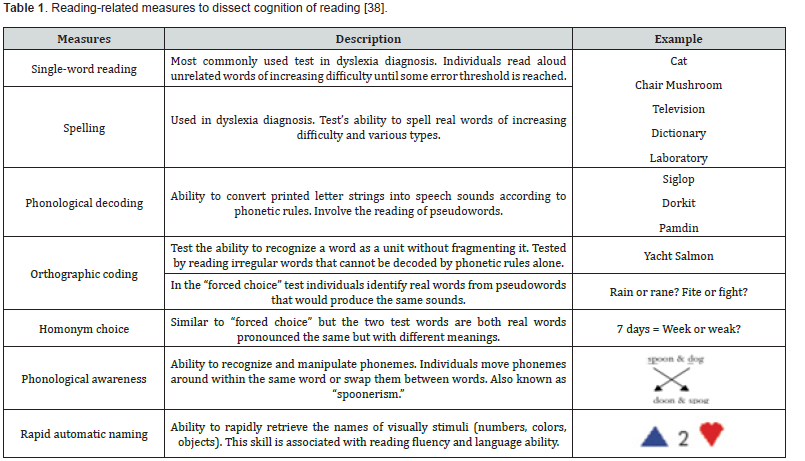
The question - “Is dyslexia a thing?” stems from the reality that dyslexia is seen as a problem when maybe it is not a learning disability but failure of our instructional tools and systems to understand and address the learning differences of the brains of every individual on the spectrum. Brains are not designed to read or write, nor are children born with these abilities, as such, they must learn and be formed through instruction. By classifying reading and writing as language skills, we, in essence, create the problem that we impose a solution for. Saying that dyslexia is a language learning dysfunction indicates that one has a problem with learning. There is a plethora of educational, research-based, and biological challenges encountered with detection, measure, and diagnosis of dyslexia. One central question is – “how are the dyslexic populations samples chosen within research participants, be it academically based or biologically chosen (i.e. genetics)?” Understanding how dyslexia is diagnosed will create a pathway to better define it. Table 1 below, designed by Paracchini and colleagues (2007) provides the major ways dyslexia is identified [38].
Take for instance Orthographic Coding (Table 1), if children are given “rain” to spell, a sizable portion of them might spell it as “rane”. However, repetition helps differentiate words, pronunciations, and whether they are real or not. Good readers require fewer repetitions, but poor readers may have delays for certain reasons. Maybe here is where good, appropriate and tailored instruction might make a difference.
From the literature, it seems that a single mechanistic cause for dyslexia has fueled the debate, yet this may be unlikely. It is well accepted that the core deficit in dyslexia is phonological, but it remains uncertain whether this phonological processing deficit is the primary etiology or that it might be secondary to impairment. The Auditory Processing Theory (APT) [39-43], the Visual Processing Theory (VPT) [44,45], and the Phonological Deficit Theory (PDT), [46-49], are touted as competing mechanisms for dyslexia. APT resulted from the finding that dyslexics display poor performance on several auditory tasks including frequency discrimination. Researchers found abnormal neurophysiological responses to various auditory stimuli [45], and a failure to accurately characterize short sounds and fast transitions used as phonemic contrasts [50]. VPT is a visual impairment that occurs as the processing difficulties of letters and words on a page which may also include phonological deficit. A growing body of evidence shows deficits in rapid perceptual and motor learning on nonverbal tasks for dyslexia [51-56].
Many of both APT and VPT studies replication attempts failed to find these deficits, or such deficits were found only on small subgroups; there were also inconsistencies between predictions and empirical results, which renders these two theories as inconclusive for mechanisms underlying or causing dyslexia [57,58]. It was suggested that APT predicts the PDT, but this was shown to be incorrect [50]. Casini and colleagues (2018) contend that “the temporal sampling theory, has put temporal processing back in the center of attention” [39]. This new theory proposed by Goswami [59], assumes that phonological coding of speech depends on how auditory cortical network sample speech at different oscillatory frequencies [60,61]. In a recent study, it was found that their data supports “that basic sensory abilities are significant longitudinal predictors of growth in phonological awareness in children”, while the same time acknowledge, “whether impaired auditory processing underlies these phonological difficulties is debated” [40]. This means that their results are limited to the set of participants being studied at the time. Similar conclusion can be reached in the case of Perrachione and colleagues (2016), who found evidence for deficits in rapid perceptual and motor learning [62].
Nevertheless, many educators and researchers still cling onto APT and VPT, which could indicate a perception that these mechanisms might work in tandem with PDT. Therefore, it can be reasoned that this leaves the PDT as the cognitive foundation for dyslexia [49,63]. It is more widely accepted that poor reading is more likely a result of phonological issues. The set of poor readers contains two groups: the dyslexics and the garden-variety poor readers as coined by Stanovich [64]. A recent study shows that dyslexics display poorer implicit learning than the controls and garden-variety poor readers [56]. A meta-analysis suggested that dyslexics have shown inferiority in phonological processing, but later studies contradicted these findings [65]. Neither APT, VPT, nor PDT established any real mechanisms to explain effective differences between a poor reader and a dyslexic which leaves it all to speculation. Research has shown that PDT also accounts for phonological issues in language other than English [66,67]. Valtin (2010) argues that dyslexics and poor readers “both experience the same weakness in spelling and reading”, supporting the fact that these distinctions are still in need of a true difference definition [68]. The choice of these tests (Table 1) clearly indicates an incapability of researchers to provide the field with any basis for identifying and differentiating dyslexics from poor readers. What criterion should be used to parse out these two ‘brains’ when there exists no real test of any anatomical differences?
Protopapas and Parrila argue that existing evidence supports difference rather than disorder, cautioning against inferring pathology from group contrasts alone [37,69]. Such studies [70,71] that found abnormalities in dyslexic brains are flawed and have been criticized. They had too small sample sizes and claimed evidence for participants with neurological or psychiatric conditions and impairments which were not limited to written language [69]. Ramus and colleagues (2018) reported that evidence was lacking for structural differences between the brains of persons with dyslexia and typically developing readers [72]. These differences are also plagued with inconsistent results, and fundamental methodological issues [72]. The lack of noticeable anatomical difference between dyslexic and non-dyslexic brains, or between poor and good readers warrants better psychometric techniques. Table 1 shows the various psychometric techniques used to diagnose dyslexia, but with these standards, anyone with a reading difficulty could be classified with dyslexia based on these tests. For example, poor readers may present similar phonological deficits as dyslexic readers. Tallal (1980) proposed that children labeled as poor readers (including the set of dyslexia) may have trouble processing brief or rapid changing aural events even if used in speech or not [44]. An explanation in UK Essays (2018) attempts to bring such differentiable clarity in arguing that “genuine dyslexics are those who despite having average intelligence struggle with reading while ‘poor readers’ are those who struggle with reading because of intellectual weakness and other demographic and sociocultural factors” [73]. In other words, this suggests that those suffering with dyslexia have reading disorders without any measurable signs of intellectual weakness.
The work of Stanovich (1991) provides discrepancy criterion by assuming that poor readers with a high aptitude were neurologically and cognitively different from poor readers with a low IQ [65]. The problem with this differential criterion is that it uses IQ tests which are flawed and plagued with racial biases [74-81]. Elliot and Gibbs (2008) contend that “attempts to distinguish between categories of ‘dyslexia’ and ‘poor reader’ or ‘reading disabled’ are scientifically unsupportable, arbitrary and thus potentially discriminatory”[82]. Rice and Brooks (2004) also suggest that the task of differentiating these readers fell short because it may be diagnosed under one method but not another, and the lack of solid definition renders it a construct [83]. The point is that the classification between poor readers and dyslexics readers is so far subjective and needs work.
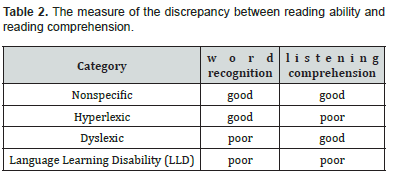
If IQ fails as a measure of intelligence, how would it then be measured? Humans existed long before reading and writing was invented, but they were more than capable of problem solving. In some sense, intelligence in these communities was measured based on listening comprehension and problem solving. I grew up in a community where story telling was the central means of communication due to most of the older folks in the village being illiterate. My father could not read or write because he never went to school; it was luxury in that time, but he ran his household in a very intelligent way. Thus, a starting point could be to determine the effective differences between reading comprehension and reading ability. Catts, Hogan, and Fey (2003) classified the set of poor readers into four categories (Table 2) by measuring such a difference [84].
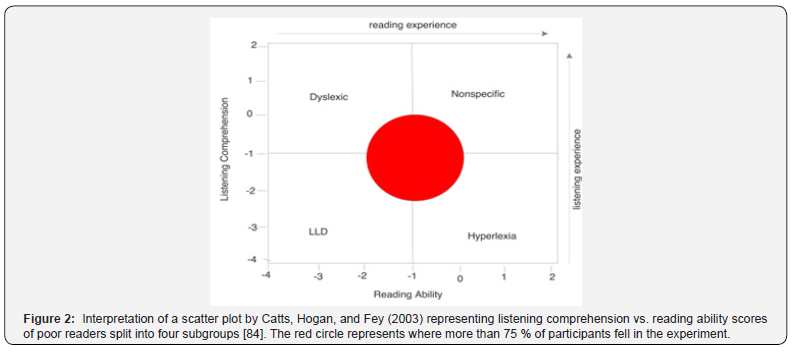
The two-dimensional spectrum shown in Figure 2 clearly
shows that the majority of the participants’ data congregate toward
the center [84]. This indicates that these categorical distinctions
are questionable [84]. I proposed to define intelligence as the
discrepancy between reading ability and listening comprehension
coupled with the capacity to complete a task in a reasonable time.
Reasonable time means the time response for an experienced
person to complete a task multiplied by a factor of 5 [85]. Low
intelligence could be attributed to an individual who would
underperform in all three areas however, this still might not be
enough of a criterion to parse out dyslexics from poor readers.
Without evidence for clear anatomical difference, I argue that it is
nearly impossible to distinguish the dyslexic reader from the poor
reader [83].
Figure 2
One major problem that social research methodologies face is repeatability in the same sample sets and in the same time frame, as well as simply replicating studies across several samples to confirm findings. In most natural sciences, experiment repeatability does not change the experience of the sample as it does with experimentation in social sciences. Repeatability changes outcomes because participants experience a learning effect which could skew the experiment’s results. So then, a person that appears dyslexic in one trial may improve with the next trial run. Coding and decoding are just tasks and cannot be the basis for a judgement of one’s intelligence. To decipher language depends on experience and training, just as with any other task. It could be argued that poor performance on a task does not means low intelligence. Everyone functions at different levels on the task spectrum that goes from nonlanguage-based (NLB) tasks to language-based (LB) tasks [16].
From Fig 2. we see that a person suffering from attention deficit disorder is a person that lacks ability to focus which causes them not to gain experience in listening or reading; but in the case of dyslexia or hyperlexia, what would be that factor preventing them from gaining experience in reading (dyslexic) or gaining experience in listening (hyperlexia)? If dyslexia or hyperlexia do exist, then these individuals’ learning is limited by their environment. Siegel (1992) asserts that there is absolutely no scientific data to suggest that only intelligent people have dyslexia or that people considered of low intelligence cannot suffer from dyslexia, which brings this IQ criterion or listening comprehension theories to their knees [86].
The time has come for the community and the field to rethink what it is to really classify dyslexic traits as part of a disorder at all. All children have problems with reading and need to be coached, some simply more or differently than others.
Human Brain and Spoken Language
To understand how reading difficulty develops in a human brain means that we must have good sense of brain anatomy and the associated regions that are involved in reading processes. The cerebrum is the largest section of the brain, divided into two hemispheres (the left and the right: the outer grey matter covering the surface of the cerebrum called the cerebral cortex and the inner medullary region called the white matter). Each has four lobes: the frontal cortex (blue), the parietal cortex (yellow), the temporal cortex (green), and the occipital cortex (red) (Fig. 3). The frontal lobe processes learning, planning, and problem solving, and controls personality, behavior, body movement, and speech. The occipital lobe receives stimuli input from the eyes and controls eye movement as well as associations of visual information with other lobes. The parietal lobe is responsible for the sense of self/other and orientation of ourselves in space, in relation with our five senses. The temporal lobe receives and processes auditory and smell stimuli, recognizes speech, and deals with short term memory. These four areas are correlated to the way humans perform visual, auditory and kinesthetic tasks. The parietal-temporal-occipital association cortex is specifically necessary for identifying the nature of the stimuli, and the frontal association cortex is crucial for planning apposite behavioral responses to the stimuli.
The surface of the brain is occupied mostly by the association
cortices, which are generally in charge of the complex processing
that happens between the arrival input in the primary sensory
cortices and the generation of behavior. All stimuli responses
are perceived through one or a combination of these lobes. The
sensory inputs to the brain are sight, hearing, taste, smell, and
touch. Projections from the primary and secondary sensory,
motor cortices, the thalamus, and the brainstem are inputs to
the association areas. For example, the things our eyes see are
processed in the visual system that is inside of the occipital cortex
and in parts of the temporal and parietal cortices. Outputs from
the association areas reach the hippocampus, the basal ganglia
and cerebellum, the thalamus, and other association areas.
Figure 3
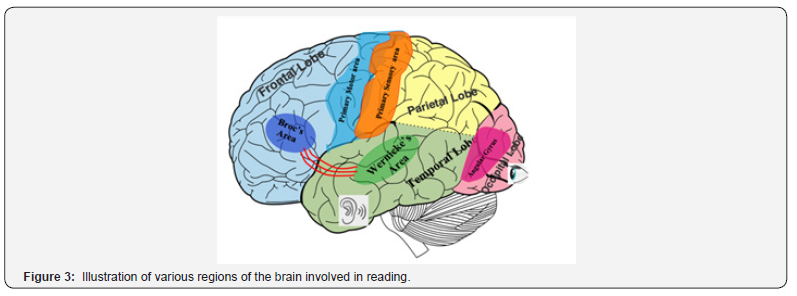
These association regions of the human brain are specialized for processing language information. The classic model for handling language concentrates on two important brain regions of the left hemisphere, which work together to comprehend and produce language: Wernicke’s area (green) alongside the posterior superior temporal gyrus for the reception and comprehension of language, while the Broca’s area (blue) alongside the posterior inferior frontal gyrus deals with expression/articulation of speech (Figure 3). Modern empirical research shows that language is engaged and fully integrated with many neural processes [87,88]. The superior and middle temporal gyri are in the left hemispheric area (path from auditory cortex to temporal pole and temporoparietal junction), areas where words are processed [89]. Most language-related brain activities occur in the left side of the brain, yet in some people both sides are used nearly equally, and in a small number, this dominance for language is on the right side.
There is a neural connection between Wernicke’s and Broca’s regions that process and exchange information. Further, in the white matter areas there are many neuronal connections between the sections of the brain embroiled in language and vision [90]. The visual word form area (VWFA) located in the left ventral occipito-temporal cortex is used for distinguishing the shapes of the words we see and behaves as a decipherer between the visual system and the language regions. There is plethora of evidence from dyslexia and normal reading development studies that suggest the VWFA is a core function in skilled reading [91,92]. It is believed to be associated in the acquisition of literacy in diverse writing systems [93]. The nerve fibers that make up these connections develop and change during infancy and childhood and provide a growing underpinning for the ability to understand and use language [94].
The combinatory nature of language provides the learner with a basic level for decoding and fluency, and higher order processes for drawing inferences and deriving meaning [95]. Meaning that the learner must retain in a luxuriant vocabulary, oral language skills, and reading skills [96]. Learners must also connect concepts born within their environment with more global concepts to comprehend and acquire knowledge on broader ideas. Language is responsible for how humans categorize objects, apportion visual attention, encode smells and musical tones, construe and remember events, stay oriented in spacetime, execute mental mathematics, reason about time, decides financial matters, experience and express emotions, etc... Individuals who have had hindrance to the acquisition of language (e.g. deafness from birth and no access to other tools of communication) show radically alternate neurological activations and cognitive processes [75,97].
In reading, brain areas such as the visual and speech neural systems activate. Neural connections are formed in the brain between the VWFA and language areas responsible for speech processing as we learn to read [98]. Vision assesses the word form encountered and associates with language areas to give meaning. Both the phonology-to-semantics and orthographyto- phonology pathways are activated when reading and have been shown to depend on individual experience [99-101]. Thus, the act of practicing, training and learning reading solidifies exchanges between the pathways involved in writing and speech. This engagement modifies and shapes the brain functionality and modularity for the systems involved in language processing [3,102,103], and reinforces the connections between the VWFA and spoken language regions including Broca’s and Wernicke’s areas [104]. fMRI studies show that training support in reading increases brain activation in speech neural pathways compared to controls [103]. Some researchers have suggested that difficulties in the process of language development are linked to foreseeable neurological and comprehension upcoming challenges [105]. Neural connections are created from our experience (even from the womb) throughout our development. Plasticity, the ability of the brain to heal and continue to grow, is responsible for the dramatic reshaping of neural pathways from different experiences throughout our development.
The brain’s reading circuitry is composed of cortical centers channeling reading data from vision, auditory, and language areas. If hindered, these pathways may display unusual activation patterns resulting in reading skill challenges [106]. Wandell and Le (2017) suggest that extensively assessing reading circuitry instead of focusing solely on pathways highly specialized for reading, reveals other areas not unique to reading which are also impaired [107]. In learning to read, successful outcomes will manifest in efficient integration of vision signals with speech and language centers. Therefore, an appropriate evaluation of reading impairment should be using encompassing assessments of function and dysfunction of vision, audition, and language pathways as they interact.
Evidentiary Support for Brain Abnormality and Dyslexia’s Genetic Causation through Genetic Association
Our understanding about dyslexia soared since brain imaging and genetic technologies emerged in the 1990s. Imaging tools allowed researchers to obtain specific images of the brain statically or live while performing and processing diverse language or nonlanguage- based tasks.
Functional magnetic resonance imaging (fMRI) is a tool believed, among many applications, to have the potential to identify those children who are at-risk for dyslexia.
fMRI has illuminated group-level differences in reading networks; however, current evidence does not support its use to identify at-risk children at the individual level.
fMRI allows gathering and overlapping brain images from tested participants and extracting and standardizing rules for doing so. Brain imaging results in dyslexia research are obtained in several ways. Researchers can either have participants perform a series of standardized test measures of phonemic awareness, then decide of a threshold under which any participant will be considered ‘dyslexic enough’ to be assigned to the dyslexic group. After these tasks, participants undergo fMRI scanning, and their brain activities recorded while doing specific tasks. Lastly, researchers average the visible areas highlighted under these tasks, compound them across all participants in that group, and then compare these images to the aggregated ones of nonstruggling readers. An alternative design is to assign the said brain imaging session to all participants first, study the activation areas of each participant and assign them to groups based on a certain threshold of activity. The next step is to assess whom the participants are, based on their profile, and see if those of a ‘dyslexic profile’ (e.g., as having parents with dyslexia, having low phonemic awareness scores and so forth), have patterns of activations that correlate to the profile. Then the final step is to aggregate the findings to see if there are any differences between those with a dyslexic profile and others. This is evidently not exhaustive of all the ways researchers have treated brain imaging results but are the most common approaches.
Huber and colleagues (2018) suggest that changes in the white matter predict a host of reading abilities in children who have not yet learned to read [108]. The implication is that these unique signatures might indicate alternative patterns in anatomy that could lead to challenges in learning to read. Hoeft and colleagues (2011) showed that fMRI and DTI results, highlighting brain functions associated with reading in dyslexic children, were better predictors of reading performance after 2.5 years than standardized behavioral measures [109]. These findings come from small samples and require cross-site replication and out-of-sample validation before any clinical use. They suggested that their findings isolate prefrontal brain regions as critical regions for processing reading, which researchers must specially focus on. Saygin and colleagues (2013) showed a strong relationship between the left arcuate activation and structural volume (connecting anterior and posterior language region), and phoneme blending performance in pre-reading kindergartners [110]. This region has been found to be smaller in at-risk kindergartners. Further, Perrachione and colleagues (2016) posit that the brain plasticity which determines our ability to learn new things is reduced in dyslexics [62].
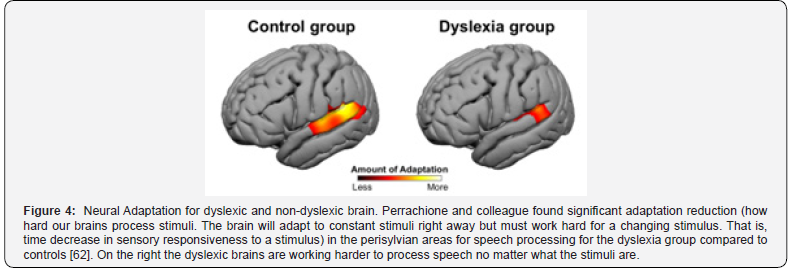
Figure 4 shows that dyslexics display less neural adaptation, which Perrachione and colleagues’ reason as an impairment which shows up mainly in reading as in deciphering letters and mapping them to sounds [62]. They qualify reading as a daunting cognitive task which requires much plasticity. These results show reduced neural adaptation during speech processing at the group level; they neither establish abnormality nor isolate a necessary neurobiological cause. Other researchers have classified the differences observed in the dyslexic population as support for brain abnormalities [37]. For example, the earliest evidence for anatomical anomalies came from the brain of a few postmortem subjects (4 men & 3 women) with reading difficulties [70,71]. These groups observed the absence of the typical leftward asymmetry of the planum temporal and found ectopias in the left hemisphere perisylvian regions. It is believed these microstructural differences gave rise to gross anatomical differences which cause a reduction in gray matter volume [111]. Disorder as hinted to in this context implies defect in a ‘dyslexic’ brain. Such findings highlight group differences in anatomy in some studies, but sampling and comorbidity concerns limit causal interpretation for dyslexia per se.
The use of fMRI techniques is broad and allowed to gather very diverse results and information about dyslexia, yet this system and its use have major flaws, and the challenges experienced with fMRI motivates complementary use of ERPs (excellent temporal resolution) alongside fMRI, while recognizing each method’s limitations.
fMRI takeaway. Convergent fMRI work identifies group-level differences within reading-related networks and shows that instruction is associated with neural change, but current evidence does not yield a sensitive or specific individual-level biomarker for dyslexia. Small samples, task heterogeneity, and analytic flexibility limit generalization; thus, fMRI is valuable for theory and mechanism, not diagnosis or gatekeeping.
ERPs permit direct observation of information processing by real-time imaging of the neural system’s responses to sensory stimulation [112,113]. ERPs data average brain responses to a few equivalent trials obtained from electroencephalogram (EEG) data [113]. The system collects polarity data (P-positive evoke potential, N-negative evoke potential) mapped out to time in milliseconds and corresponding to sensory and cognitive processes which highlight cortical activity while doing a task (e.g., reading). Research usually classifies these components in the following format: P100-N100, P200, N200, P300, N400, P600 and MMN. Each of these codes relates to specific activation brain profiles while reading over a given period. P100-N100 are the process-regions the most studied by researchers and believed to distinguish between dyslexic and non-challenged readers. N100 data particularly is used as evidence to separate dyslexic, from regular, and poor readers [114]. ERP studies commonly report atypical timing/amplitude for phonological processing (e.g., N1/ MMN/N400) in groups with reading difficulty, consistent with phonological accounts, but these effects remain group-level rather than diagnostic [115–118].
ERP takeaway. ERP studies consistently reveal group-level timing differences in phonological and lexical processing among poor readers and those labeled with dyslexia. However, current evidence shows insufficient classification accuracy for reliable individual diagnosis or for cleanly distinguishing dyslexia from other forms of poor reading. Because ERP components are taskmodulated and can overlap, and because ERPs have limited spatial specificity, they are best used to test mechanisms and track training effects at the group level—not for diagnosis or gatekeeping of services.
Other approaches to figuring out a cause to dyslexia are biological approaches. Social sciences have connected and contrasted fMRI images with variations in behavior and candidate genes [119]. Researchers have pushed further into the realm of genetics to find additional singularities and unique profiles for dyslexia. Several research groups [105,120] concluded that people presenting dyslexic traits showed different processing patterns in language areas of the brain while performing letter/sound encoding and decoding tasks. These types of studies support such ideas as dyslexic traits being hereditary. For example, DeFries and colleagues (1987) believed that finding inheritance patterns could reveal causation and facilitate diagnosis and risk assessment [121]. Some family risk studies have been done in attempt to establish a genetic link such as the JLD longitudinal study [27], or the Colorado twin study (CTS) [121,122]. The CTS reports evidence that genetic influence outweighs the environmental one for phonological and orthographic deficits [122]. Thus, this finding was used to establish the etiological comorbidity of a genetic and an environmental basis or the interaction of several different genes in the appearance of dyslexic traits.
Figure 5. Illustration of Genome-Wide Association: “The first steps of a GWAS are: 1/ identifying the disease or trait to be studied and selecting an appropriate study population (for example, cases and controls for a disease, or an unselected population sample for a trait). 2/ Genotyping can be performed using single nucleotide polymorphism (SNP) arrays combined with imputation or wholegenome sequencing (WGS). 3/Association tests are used to identify regions of the genome associated with the phenotype of interest at genome-wide significance, and meta-analysis is a common step to increase the statistical power to detect associations. 4/ Causal variants are usually not directly genotyped but are in linkage disequilibrium with the genotyped SNPs.” [123].
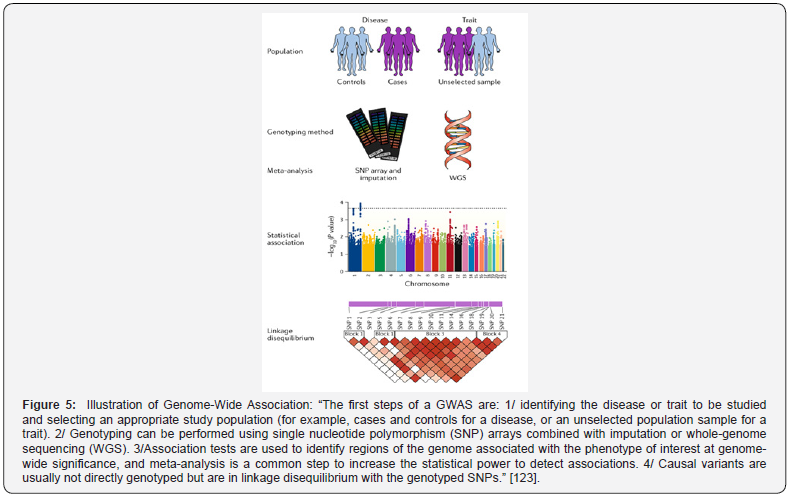
Geneticists developed techniques to connect genes mutations to traits. Single gene disorders (disorders associated to one isolated gene and its mutations) are identified successfully by Linkage Analysis and Quantitative trait locus (QTL) linkage studies which have highlighted the first gene-trait connection on chromosome 6 for reading challenge [124]. Genetic linkage analyses have been applied to the entire human genome and discovered candidate genome loci that appear connected to reading disabilities. That said, linkage approaches have been found to fail to detect linkage for groups of genes exerting a small effect such as what exists in complex disorders (disorders expressed through several genes influences). It is here that this type of methods also carries issues that put it in question.
With further advancement in the field of genetics, researchers have claimed the discovery of regions and corresponding processes patterns appearing in the presence of specific genetic markers (i.e., mutations). This opened the way to speculating as to why dyslexia seems to be inherited in families, with high concordance between oral and written language disorders [38]. Several candidate genes for dyslexia have consequently been reported in the literature of which DYX1C1, DYX5, DCDC2 and KIAA0319 are the most prominent. DYX1C1 was isolated on chromosome 15[25] (Smith et. al., 1983), but findings lack consistent replication [38]; DYX5 on chromosome 3 (ROBO1 gene on DYX5 region believed to be responsible[125], but one family with severe dyslexia lacked this mutation[126]; DCDC2 and KIAA0319 on chromosome 6 [127], replicated within several studies[128,129], however, a number of studies show that the diminution in these genes’ expressions is not enough to cause dyslexia [130-132]. Further, Raskind and colleagues (2013) posited that certain reading disabilities with decoding challenges (real or fake words) have connections with such gene markers [133]. Some effects observed (in connection with reading challenges) were replicated with chromosomes 6 and 18 [134].
The central genetic tool used in genetic linkage analysis is a statistical approach called Genome-Wide Association Study (GWAS) (Fig. 5). However, GWAS with its vast impact on Biology, Neuroscience, and Psychology is not without controversy and limitations, which brings into question our understanding of the role genetics plays in complex traits such as dyslexia. Its limitations include: 1/ high rates of false positives, 2/ only a small part the heritability observed for reading skills, 3/ no identification of the causal variants and genes, 4/ failure to isolate complex traits’ gene expression of origin, 5/ inability to detect epistasis in humans, 5/ the signals observed may be due to cryptic population stratification, and 6/ has only small clinical predictability [123].
Besides, the evidence from GWAS seem to really suggest that effects within the whole genome are diffusely responsible for dyslexic traits. Goldstein (2009) became the first to argue that in pointing to everything, there is the danger that GWAS could be pointing at “nothing” [135]. Schumacher and colleagues (2007) made the point that linkage findings for dyslexia do not completely overlap in the various independent studies [136]. In specific GWAS studies about 20 candidate loci have related to dyslexia traits [133]. Critics argue that GWAS will eventually find connections with the human genome in its entirety when it comes to this set of traits; also, many of the correlations highlighted in disorders may not necessarily have a one-to-one correspondence with biological substrates. Further, most of the regions highlighted correspond to genetic loci which do not code for protein-making processes, and this creates a new genetic challenge, because proteins express traits [133]. These numerous logistic, statistical, and ideological problems make any inference about the true existence of a full “disorder” called dyslexia very difficult.
Challenging Current Views
Individuals labeled and/or diagnosed as dyslexic differ in fact in behavior, cognition, and biological aspects, and their place on the spectrum of dyslexic symptoms is extremely varied. For instance, several studies found strong correlations between dyslexia and mathematical disabilities [137,138]; and yet others do find close to giftedness on these same aspects. Some studies have connected the difference between genders (in matters of science for example) to genetics [138]; It was also not long ago that Noble prize winner Dr. James Watson made a connection between genetics, intelligence and race [139]. A fact that is largely refuted when conditions are reversed between genders or race. These genetic-based finding are effectively rejected by the majority now. “Genetics influence on political attitudes correlates with genetic influence on traditional personality traits but longitudinal analysis suggests that personal traits are not causal [139].” In the same way, longitudinal studies show that by age 10 mathematical difficulties are outgrown in more than half of the children considered [140]. A similar effect is observed with dyslexia participants in the JLD study [141-143] showing that adults (who were thought genetically bound to dyslexia) tend to overcome reading difficulties later in life [140].
Our current methodologies in neuroimaging or genetics, within their designs and outcome interpretations, suffer from questionable associations that can often lead to incorrect conclusions. Indeed, the neuroimaging community has seen emerging evidence that the results presented in studies of brain imaging are weak [37,91,92,144-149]. Unlike what has been portrayed, findings that highlight under-activation and activation ‘atypicality’ (occipitotemporal area, inferior parietal lobule and others) in specific commonly accepted areas of dysfunction in dyslexia are actually quite average and not necessarily in higher number in these groups than the general population.
Many of the reported neural differences in dyslexia have emerged from small sample studies and remain unreplicated. Structural and functional findings often diverge across research groups, and the statistical practices in fMRI research—such as reliance on peak-threshold clusters without full unthresholded maps—make it difficult to detect consistent weak effects. As Protopapas and Parrila (2018) explain, these methodological issues hinder meta-analyses and undermine the claim of a consistent neurobiological ‘signature’ of dyslexia [37]. While Ramus (2004) advocates for a reinterpretation of neurobiological data in dyslexia, the evidence still falls short of supporting the notion of a disrupted neurodevelopmental process [150].
Additionally, an fMRI session costs on average $1,000 per session, causing replicability and sample representativeness issues. Issues may also be caused by equipment manufacture differences, differences in software used to analyze and interpret data, diversity of statistical thresholds to determine neural activity, or even ill-designed studies with weak theoretical base for design, research questions, and predicted outcomes. Data suggests that only 39% of psychological studies are replicable, quite an austere limitation for fMRI study reliability [151- 154]. Also, because fMRI signals are partly understood, results generalization cannot be trusted, neither should it be used on an individual basis for diagnostics [155]. Additionally, the claims of anatomical differences found in dyslexic participants were refuted [69]. The study design was flawed with too small a sample size and participants had neurological or psychiatric conditions and impairments that were not limited to language. It is true that some patterns do seem to be repeated in a portion of the studies available (e.g., occipitotemporal cortex issues), but again, the conclusions made do not match the results. Although Perrachione and colleagues’ findings (Fig. 4) might more likely be for dyslexia, this in no way supports dyslexia as a neurological disorder [62]. Given heterogeneous tasks, small single-site samples, and analytic flexibility, many reported contrasts may not generalize; accordingly, current fMRI evidence should not be used for individual diagnosis.
These results are consistent with differences in neural adaptation during language tasks, but they neither establish abnormality nor isolate a necessary neurobiological cause. [62]. Further, their experiment is testing neural adaptation in LB activities which is already difficult for dyslexics. Fig. 2 demonstrates that the dyslexic group tends to be associated with improved listening comprehension [84], which means that the result of Perrachione and colleagues is limited to their small sample group (26 dyslexics and 25 controls) [62]. However, it is well demonstrated individuals with dyslexia develop compensatory systems that improve their neural plasticity [105, 156]. Nonverbal learning processes in young and older dyslexics showed that the learning gain of the dyslexic group after a three-day long visuospatial training was larger than non-dyslexics especially for the younger group [157]. Dyslexics in general took more time and did not surpass non-dyslexics, but they started from a much lower place and came to a similar level in their problem-solving accuracy.
There is still the issue of being able to present a clear explanation for what the differences observed really mean, especially when it comes to fundamental developmental questions such as studying children’s pre- vs. post reading problems arising as compensatory behaviors and training happen. Some have pointed to how little research is available in that realm, much less fMRI studies [157]. As Protopapas and Parrila (2018) argue very clearly, “all relevant findings are correlational, and typically concern group differences”; thus, so far, the issue is simply an issue of differences which leads us to another dilemma [37]. Mainly, that demonstrating difference does not have a one-to-one correspondence with disorder. Take for example as mentioned before, the fact that what is recorded in fMRI studies are signals that are transformed into pixels and associated with neuron activity (these two elements are completely unrelated), and that the individuality of each brain is then lost in the averaging of these pixels between the groups observed. Then that average is associated (again without any direct relation) with the time spent and cognitive processes on a task.
The brains of every individual are like faces. That is, take two random people on the street, their brains’ anatomies and functions will not be identical. These kinds of variations have to be well understood before it becomes clear how different the ‘dyslexic brain’ truly is. When it comes to dyslexia, there is still too important of a lack of consistency between individual patterns of activation in reading tasks. Protopapas and Parrila (2018) argue that there is a lack of evidential basis for the “typical” dyslexic pattern. As such, any difference can be classified as “atypical” [37]. They looked at activation in the VWA and found no evidence with which to classify participants with reading difficulties as “atypical”. The takeaway is “that the existing fMRI findings, suggesting that the area’s most consistently activated among a group of good readers are not entirely identical with the area’s most consistently activated among a group of poor readers, do not imply that any of the good or any of the poor readers do in fact exhibit overall similar or different patterns of activation, typical or atypical” [37]. Protopapas and Parrilla (2019) have further argued that “if one wishes to demonstrate abnormality, then a completely different type of work is necessary to establish that well-specified brain properties are outside of some independently established, brain-based and brain-specific criteria” [69]. The abnormality must be determined before the onset of acquisition of such, or else whatever is discovered will likely be an outcome rather than a cause of the skill level.
Researchers have simultaneously turned to genetics but understanding how genetic traits are passed on from parent to children raises the question: how does dyslexia’s genetic transmission compare with, for example, Huntington’s disease or sickle cell disease? Genetic diseases are generally a result of a mutation or alteration in DNA sequence. This can be hereditary or somatic (caused by environmental factors).
Classical monogenic disorders provide a useful contrast: Huntington’s disease (autosomal-dominant CAG expansion in HTT) and sickle-cell disease (autosomal-recessive HBB variant with heterozygote protection against malaria) show highpenetrance variants with predictable inheritance patterns [158]. By contrast, developmental dyslexia is not a single-gene disorder: convergent evidence indicates polygenic liability— many common variants of very small effect interacting with environment. Consequently, even statistically reliable loci and polygenic scores show low individual-level predictive value and limited transportability across populations; they are not suitable for diagnosis or for gatekeeping access to services [123,134,135]. Practically, this implies prioritizing instructional supports: welldesigned teaching improves reading outcomes [16,159].
Mutations in the genome are really just noise for the for most part and are on average harmless (meaning: most common genetic variants have small effects and are typically benign at the individual level) [158]. Observe that in complex traits these mutations work in tandem with whole genome with very small effects. This is why GWAS is implicating the whole genome. Dyslexia is believed to be due to polymorphisms in certain genes. The prevalent nature of dyslexia itself, in the population, does not imply that it is a disorder with genetic determinism. For an illustrative parallel, in our society, left-handedness was thought to be an ailment but now, the perspective on handedness has evolved and it is just seen as a less frequent trajectory of normal developmental routes [37]. In the context of dyslexia, the LRRTM1 gene was tagged for taking part in the development of lefthandedness but was also associated to dyslexia [160]. As it stands today, several research groups found no evidence nor were able to replicate these results, confirming the gene connections studied [161-163]. At best, results are weak or debatable based on their sample sizes, populations sampling, and choice of statistical tools or power.
Such gene associations in complex trait are quite difficult and speculative. For example, a prior connection was made between visceral laterality, hand preference and dyslexia but was later discounted [164]. Similarly, in the dyslexia specific genes/ language traits (CMIP and ATP2C2), associations were identified in both a cohort with Specific Language Impairment, and a sampled group with low language skills from the Avon Longitudinal Study of Parents and Children (ALSPAC) [165]. The latter had the same profiles except for the CMIP association. However, when looking at the entire ALSPAC sample, which is more representative of the general population, no such associations emerged. Therefore, associations findings of this nature must be questioned when results appear in small samples but not in more representative ones.
In the JLD, children were classified as familial-risk based on parental dyslexia, not on ERPs. ERPs were used within this cohort— beginning at birth—to reveal group-level timing differences in speech/auditory processing and to examine associations with later language and reading; however, current evidence does not support ERPs as a reliable individual-level diagnostic tool. To study reading abilities in potentially at-risk pre-reading children, very little brain imaging techniques are available [166,167]. Yet, an ability to predict propensity for reading challenges development is important for children to alleviate their associated struggles. Findings in neonates and prereaders show associations between early ERP patterns and later language/reading outcomes [114, 166], yet predictive performance remains group-level; ERPs have not yielded a robust, individual-level biomarker for diagnosis [27,113].
Genetics takeaway. Evidence to date supports a polygenic, small-effect architecture for reading-related skills. Findings are largely correlational, show limited out-of-sample prediction, and do not specify a necessary neurobiological cause or a clinically useful individual-level test. These facts are compatible with gene– environment interplay and reinforce the primacy of instruction and progress monitoring for improving outcomes.
In other words, the occurrence of specific patterns along with the increased incidence and statistical likelihood of reading impairment recorded after starting to read, forms the basis of these early brain pattern/disorder assumptions. If a high correlation is found between unique pre-reading patterns and post-reading developmental reading problems, then further conjectures are made as to the cause of the issue found. Current ERP evidence identifies group-level differences in the timing of phonological and lexical processing, but classification accuracy is insufficient for reliable individual-level diagnosis or for discriminating dyslexia from other forms of poor reading [168]. As such, a poor reader could be classified as dyslexic or vice versa. As exciting as ERPs results may also be, like fMRIs, its research literature is still mixed and inconsistent [113].
Mainly, the neural activities recorded between the various groups occur on a spectrum and averages are normally reported; thus, each finding only demonstrated differences in how individual brains perform on task not abnormality across brains. Though a good technique, ERP also suffers from component overlap issues which makes different experimental conditions difficult to interpret. Also, some measurements are plagued with noise, and due to the inverse problem (inference of the position of the current sources from electrode potentials), location of neural activities is difficult to pinpoint [169].
Methodologically, ERP components can overlap and are modulated by task parameters; combined with the inverse problem, this complicates interpretation in reading studies [113], echoing broader ERP cautions about component modulation [169]. That is, in most situations the effect of outcome magnitude and outcome probability are not clear, and contradicting evidence is seen between component and behavioral adjustment. Some cases combining fMRI and ERP provide better results and is a possible way to rid these studies of the inverse problem.
Moreover, the JLD findings did not confirm complete separate and unique profiles of both at risk and non-at-risk children, the groups overlapped on their risk and a number of other characteristics [27]. That being said, Lyytinen and colleagues underlined the difference that by second grade, 33% of half of the at-risk children got an official diagnosis of dyslexia versus only 9% of the non-at-risk children. This pattern indicates elevated familial risk alongside substantial overlap between groups, underscoring non-determinism and low individual predictive value; familial risk likely reflects both heritable and environmental factors rather than a singular necessary cause. Current findings are consistent with a polygenic, small-effect architecture: they indicate familial and genetic contributions to some readingrelated skills but do not yield a sensitive or specific diagnostic marker, nor a necessary biological cause of dyslexia in individuals. The alternative conclusion is that dyslexia is more likely due to environment impact with Stanovich’s Matthew Effect as the causal mechanism (i.e. poor reading environment breeds poor readers - good reading environments create good readers which explains the early intervention measures of JLD) [65].
From a different angle in the discussion, most studies fail to address what happens to at-risk children who are adopted at birth into non-at-risk families and vice versa. Twenty percent of adopted kids in 2014 had a learning disability such as dyslexia. Further, children adopted from non-English speaking groups experienced greater rates of dyslexia [170], but since their family histories are often unknown it is hard to say if this phenomenon is genetic or just due to the transition to a new language. There are adoptive parents’ testimonies that seem to suggest that babies are less likely to develop dyslexia even when adopted into families with dyslexic siblings, provided these families have an intervention process already in place [171]. Thus, this likelihood of second language speakers experiencing dyslexia-like symptoms points to environmental factors. Waldman (2017) argues that since a sudden language loss contributes to learning issues, then schooling of second language speakers should be continued in their first language and should be part of the post-adoption plan for adopted children [171].
Another possible way to resolve the causal argument of genetics vs. environment in dyslexia might be to explore monozygotic twin studies. The CTS study showed interesting comparisons between identical and fraternal twins for dyslexia, citing concordances in the ranges of 68% for identical twins and 38% for fraternal twins [172]. This leaves to interpret the rest of the equation to possible influence from the environment (on whether or not individuals with the same genetic code do develop the same disorders) or to possible error in the researchers’ design, tools, or computations. Now should there be an actual error, at any level, such differences between mono and dizygotic twins, and what that entails for genetics, would come into question. A recent study shattered some of these foundational assumptions in Genetics reporting that monozygotic twins are not actually necessarily 100% genetically identical but show DNA methylation differences caused by their cell lineage dissimilar origins [173].
Illustrative thought experiment (not empirical data). Consider a twin/adoption scenario (Table 3) designed to separate polygenic liability from Matthew-effect environments.
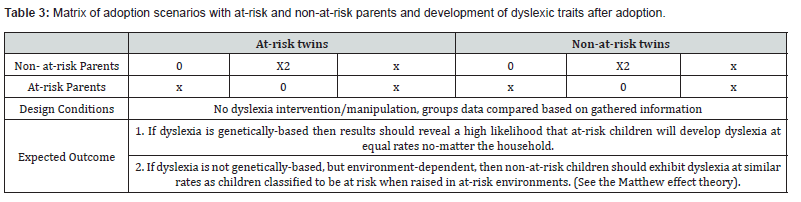
Twin studies models have been used to find correlation between music traits or political attitudes and genetics. Similarly, correlations are being made between genetics and dyslexia traits. Dyslexia, considered a complex trait, has been suggested to have two mechanisms in traits development. Gene mutations involved are both working independently to bring about the trait but may also signal or interact with each other (epistasis) which in turn has an additional effect (besides single mutations’ effects) on forming the trait. If we assume any of these mechanisms to be true, speculative conclusions will point to outcome 1 (Table 3). Results are mixed in the literature. The evidence supports that if we were to run our thought experiment, outcome 2 would be the likely conclusion. Chomsky states that “If a child is placed in an impoverished environment, innate abilities simply will not develop, mature, and flourish. To take an extreme case, a child who wears a cast on its legs for too long will never learn to walk, and a child deprived of appropriate nutrition may undergo puberty only after a long delay, or never, though there is no doubt that walking and sexual maturation are innately determined biological properties. Similarly, a child brought up in an institution may have ample experience and nutrition, but still may not develop normally, either physically or mentally, if normal human interaction is lacking [174]”.
We must remember that reading is decoding and encoding language. America is in a reading crisis, yet we see the same reactionary response to the phenomenon of dyslexia as with the obesity crisis, looking towards finding genetic links. America’s obesity problem is truly behavioral which may have created epigenetic profound transformations that could have then been passed down through genetic means. Dais and Ressler (2014) showed that when rats were shocked as they were expose to acetophenone, they would shudder at the mere smell of it [175]. Not only was this true in the parents but also their offspring which showed the same behavior. The animals had abnormally low sperm counts after exposure to the chemical which also showed in non-chemically exposed offspring [176]. This has far reached implications; it shows that life’s experiential effects can be passed on to offspring even if they occur before they are born. Could then the cause of dyslexia only be epigenetic? I find it interesting that it is supposed that dyslexia is a disorder but that its solution does not require medication.
Another interesting parallel can be drawn between the obesity crisis and dyslexia [177]. Consider the significant difference between causality and propensity. The genetic markers found responsible for the development of obesity have also been shown to change whenever obese parents change their environment and lifestyle. Although “genetically” and phenotypically obese, pregnant mothers can change the phenotypical and epigenetic outcome of their offspring by reducing their own obesity [178]. An environmental change can drastically reverse weight outcome over one single life course. Therefore, generations baring obese gene pools can tip the balance for future generations, and though passing on markers, these could be dormant in new generations that now do not develop obesity. Thus, any environment conducive to obesity can “wake up” these markers in next generations and create a more obese population. In other words, genes ‘responsible’ for obesity may not necessarily be the cause but could be symptoms of obesogenic environments.
Now consider dyslexia. What if, the growth of dyslexia in America was indeed a direct symptom of an enabling and geneinfluencing environment where America finds itself near the bottom of all rankings when it comes to reading proficiency [179]; an America where literacy is a serious educational challenge [180] and connected to endemic poverty [75,181]. Thus, any genetic connections deemed the cause of dyslexia, though indeed real, could in reality be a symptom of a failing reading environment rather than a direct biological cause. Perhaps the education context that we have set for our generations in America has lasted and been impacting enough to be conducive to “shut down” markers acting in the production of proteins involved in cognitive systems that support reading abilities. This question is worth asking and investigating.
As we know, this chicken and egg, nature vs. nurture debate is a hard one. The toggle between genetics and environment, in parsing out which is responsible for what in human behavior, is one gargantuan endeavor, but a worthy one. Here at this ideological junction, I connect nature and nurture, genes and environment in venturing to argue that though activated genes markers may be involved in the development of reading difficulties, these same markers may simply be activated by the environment, and thus the issue could very well be due to how we teach, not how our genotype is made. Development is complex; it evolves at the crossroad of heredity, the pressures of both nature and nurture, cognition and how all these interact within each individual [37]; but this does not mean actual genetic determinism.
We concede that there might be epigenetic factors that could be at play, but in view of the controversies brought up, genetics cannot, at least at this point, be causal as the lack of reading experience can explain the differences between a dyslexic and non-dyslexic brain. Changes due to epigenetics is erasable as its influences are transmitted from a cell to its progeny. Epigenetic tags are placed by acetylation of histones, methylation of DNA, or phosphorylation of proteins that causes genes to be expressed in specific tissues, at specific developmental stages, or in learning and memories. In the JLD study 9% of the non-at-risk children had dyslexia by eighth grade. Here, environment causality can be speculated, and as such, perhaps epigenetics is at work in atrisk children. For example, the search for a culprit causal gene by the Finnish study [125] with DYX5 candidate found that 19 of the 21 participants had an underlying gene mutation, but the most severe dyslexic individuals did not have it. Their conclusion may make sense statistically; however, statistical correlations are not the nail in the coffin either. The absence of the mutation in the most dyslexic person may be hinting that dyslexia does not have a genetic cause. Therefore, if brains are not wired for reading, then corresponding neural pathways cannot have a genetic cause. Brain connectivity in the normal reading experience is created through human experiences, and via the Matthew effect these connections are reduced in dyslexia. Moreover, though technology has greatly advanced, dyslexia is still quite a mysterious question that has not found solid data on which most of the field finds consensus.
Learning to Read
Reading is an elaborate ability or task exclusive to humans that permeates the entire modern society through educational systems and the need to communicate [93]. It is the process that maps written symbols to spoken language. Humans are born hardwired to speak and learn to speak because their environment is immersed in spoken language. They speak by being spoken to and no one must teach them to talk. According to Shafer (1998) Chomsky thought that reading and writing would work the same way [30], however, it is not so easy. This concept of correlating reading to language acquisition is attributed to Kenneth Goodman who claims Chomsky’s work as an inspiration. Craig (1994) reviewing Piaget and Chomsky’s theories concludes that “One cannot read (the development of the cognitive schemata) without having some “feeling for” the material”, such that when student is excited about reading have emotional interaction with text that aloe their cognitive structure to be dynamic [182]. Chomksy, Piaget and Vygotsky set the stage for Smith and Goodman to infer that learning to read is as innate as learning to speak and “developed the theory of a unified single reading process that comprises an interaction between reader, text and language” [183].
Our eyes are used to read but sound is the starting point. To become an avid reader, a child must figure out the pronunciation of the words they hear and know and then connect the sound to letters on the page being read. Writing humans-developed code to denote speech sounds, and which must be cracked for individuals to become readers [184]. A fallacious assumption that typically underlies reading instruction in education is that learning to read is a natural process and with ample exposure to text, readers will ultimately solve how words work [185], much like learning to talk [186]. However, neuroscience has demonstrated that the human brain isn’t wired to read [187]. To become an avid reader, one must excel at decoding five categories of language structures (morphemes, phonemes, syntax, lexemes, context) that must come together to make communication meaningful. It was demonstrated that having less reading experience makes it difficult to excel in reading and thinking critically [188].
The brain’s unique capacity to form new circuits allows it to connect different regions that provide humans with the skill to code and decode. To be able to read, structures in our brain that were designed for things such as object recognition must be rewired. Structures in the brain that were created for such things as object identification have to be rewired to be able to read [184]. Based on Chomsky’s 1950s work, many educators utilize Whole Language approaches suggesting that, at the sight of an unknown word, a teacher advises a child to gaze at the picture and then guess, leading people to use context and visual clues to read words. This approach may work in speaking but not for reading. The key is for the reader to understand the context or the meaning of the story. Let’s say that the child came to the word vehicle, the advice would be to look at the picture (provided one exists) and if the child said car, it would be deemed correct. This approach has been the system used in most American schools for more than a half century [189, 190], and may be responsible for its endemic literacy problems.
Let’s focus on phonics which in their simplest fashion is understanding and using phoneme. This is the smallest unit of phonology and is the basic unit of sound which causes a change of meaning in a language, but that doesn’t have meaning on its own. However, a series of phonemes do have a special meaning: morphemes which are the basic unit of morphology and are the smallest meaningful units of language. Reading requires that symbols map onto speech and meaning. This relationship among visual symbols and writing systems is referred to as the orthographic system of a language [191]. Knowing the sound of each letter and combining sounds of letters by breaking words into syllables is central to reading. When children perform this mapping, their vocabularies come into play to identify the words they are reading. The relationship between symbols and sound are consistent across some languages, such as Finnish, Italian, French, and Spanish, but in other such as Kanji, English, and Danish, this not the case. Thus, such inconsistencies can be puzzling to learners of the English language [192].
In English, words are constructed through vowels (“a,e,i,o, and u”, and “y” and “w”. It includes the diphthongs “oi, oy, ou, ow, au, aw, oo” and others) and consonants (all letters that stop or limit the flow of air during speech: “b, c, d, f, g, h, j, k, l, m, n, p, qu, r, s, t, v, w, x, y, z, ch, sh, th, ph, wh, ng, and gh”). Breaking words into syllables helps with pronunciation. Through instruction, a learner will understand how to count syllables and use stress techniques to know how to pronounce words according to a language’s standards. Thus, learning phonics does allow the reader to decipher new words. To decode a language, one must be familiar with its rules. Splitting up words that have two middle consonants helps to identify the syllable involved, for example hap/pen, bas/ket, let/ter etc., with the only exceptions of the consonant digraphs. This suggests that a “never split up” consonant digraph represents only one sound (“th”, “sh”, “ph”, “th”, “ch”, and “wh”).
Let’s takes the “ph” digraphs, used to make the sound “ph” instead of using “f”; for instance, the word “decipher”, how would a child know how to spell the word with “ph” as he/she would hear the sound “f”, and spell it with “ph”? What rule governs this altered usage? It is not clear how p and h sound put together make an “f” sound either. There is more than 22,000 words using “ph” in English. Word etymology in English creates more confusions than solutions. The usage of “ph” in English was borrowed from Latinbased languages such as French and Spanish. The origin of “ph” itself came from the Greek into Latin.
Now the story is not finished because there is an exception to the exception. Consider the word “shepherd”, it is pronounced “shep/herd” and not “sheferd” like we would expect based on what was explained about that digraph.
Languages’ rules should exist to help a learner navigate through the language and find consistencies, but too many exceptions bring confusion for many. Word stress techniques also lack logic within the English language. Thus, learners are faced with having to rely heavily on rote memorization without a clear understanding of WHY the elements they must learn are constructed the way they are. Contemporary English orthography and usage include numerous irregularities that can challenge learners. For example, what makes the p silent in the word “psychology”; who decided so?
Author reflexivity. I was diagnosed with dyslexia, yet the major issue I faced is the use of tenses, and some specialized usage of plural and singular verbs. We learn that “You” is referencing to a single person, however for some reason you can’t be used with this structure: “you is”; yet one must say, “he/she is”. Further, I learned to say and write, “I was…” and “I have…” which was confusing because the subject “I” is singular. In some cases, we use verbs conjugated to the singular with ‘I’ (was), and in another instance we use a verb conjugated to the plural (have). Why could I not say “I has”? This is confusing and frustrating at least for me. This personal note is anecdotal and not part of the evidence synthesis.
Children constantly would put words together in ways that adults do not do. For children “you is” makes sense based on the rules we have drilled in their mind as they learned to navigate language. Children go on saying hitted or goed for hit and go in the past tense respectively, and many other constructions which are logic but that adults consider erroneous.
Research has shown that the effects for such instructional efforts are more modest than those for first-language learners [192-194]. For example, Spanish speakers do benefit from phonics, but the payoffs are less than what their native English classmates because the speaker of the first language already knows the meaning of the word. However, a baby or very young infant from a non-English speaking country does not have this issue because English becomes their first language.
Another issue that affects how a child learns to read is culture. A child learning to read English but coming from a Hispanic culture would put stress over different syllables than a US-born English speaker. Similar issues are also true even within born English speaking groups. Take for instance how the diagraph “th” is not pronounced in the Black American culture and its use of Ebonics (Negro English - most spoken form of English in that group, coming from the enslaved Africans’ language from the Caribbean, North America, West Africa). For some words such as hand or past, the consonant at the end is dropped (i.e., “han” and “pas” [195,196]. Some varieties of American Ebonics are a mixture of languages associated with Creole formations in the Caribbean. Numerous Creole-speaking slaves were brought from the Caribbean to settle the original thirteen colonies, helping to shape American Ebonics [197, 198]. Thus, should we not consider what impact these shifts would have had on such students’ writing, reading and speaking? The way we decode written word is akin to how we speak our language. The large variety of rules and exceptions in phonics associations and constructions does present a serious challenge for learners, especially those who learn differently, and as such, would influence the need to use alternative approaches.
How might all this influence a child’s reading potential? Some brains see the world around them in a very deductive way, as such the rules learned are applied to continue their progression in reading. When logic fails for these children, they become stuck and disinterested because these exceptions are without logic. Again, what are the fundamental rules for spelling a word with “ph” instead “f”, and why not accept that both as correct? Why is there a “p” in psychology or why does a letter need to be silent? As hinted earlier on how children construct words, my nephew is just learning how to use the past tense, and utilizes expression such as, “he hitted me….”. These constructions are a logical progression and are refined as the child engages more in instruction, but what if the rules also caused disengagement and disinterest in learning as a result? What effect can this have on children’s brain development? Could dyslexia actually be the result of how some children’s brains react to the illogical parts of language?
The Impact of Dyslexia Diagnosis on Children
One of the most common learning and reading disabilities in young populations is dyslexia, the most common language-related learning disability [199,200]. It is estimated that as high as 20% of the population has some form of dyslexia [201], which puts this issue in a crisis mode. Overtime, as the demand for literacy skills increases in school, children suffering with dyslexia often struggle more but this may mainly be because we are forcing instruction to brains that are not wired to process reading in the same way as most of the population. Reading is important and there are terrible consequences for not being able to read, at least that is what society with its experts would have us think.
Reading occurs in the brain as a direct result of instruction [202]. It has been reported that individuals with dyslexia experience negative academic attainments such as dropping out of school [203], and psychosocial development issues like low self-esteem, poor social interaction, behavioral problems, anxieties etc., as compared to non-dyslexics [204-206]. Although there are no national studies conducted regarding prevalence of dyslexia in the prison population, headlines speak loud such as the study that found that 48% of prisoners with dyslexia, and two-thirds of them struggled with reading comprehension. This study sampled 253 prisoners at random from 130,000 prisoners in Texas [201]. Another headline claimed that according to the Bureau of Justice Statistics Special Report on the Educational and Correctional Populations, the percentage of state prison inmates who have not finished high school or obtained their GED includes 66% of inmates with a learning disability and 59% with a speech disability (possible symptom of dyslexia). These issues and implications are less about dyslexia than about a society that makes individuals with differences feel out of place. For instance, children with learning disabilities benefitting from in-class support or inclusive programs are more accepted by their peers, and experience less loneliness than those who went through selfcontained special education instruction [207].
The problem here is that we have built a society that marginalizes individuals who drop out of school or fall behind. Thus, the inequality gap is larger for such individuals. My father was illiterate but was functional and never spent a day in prison because there was trade programs designed to assist such individuals. This is not saying that all children should not be brought at necessary reading level, but that we must build multifaceted pathways that break down the inequality gaps and respond to social bullying in responsible ways. We have created a monolith society on reading. The above statistics and much of the literature on reading disabilities suggest that not being able to read is correlated to incarceration. In 2020, the Federal Bureau of Prisons reported that African Americans make up 38.2% of the prison population. However, Blacks represent only is 13% of the US population. This disparity is a result of racialized discrimination [208]. The incarnation rate of Blacks at least tripled the rates for Hispanic and Whites in every US state [208]. Black males with dyslexia experience more challenges because they face both racial discrimination and are overrepresented in special education. This is due to their misdiagnosis for cognitive or behavioral disorders rather than being placed in remediation programs for dyslexia [209, 210]. This can contribute significantly to the reading gap. There is no evidence that people commit crime because they can’t read, and these correlations are coincidental or spurious at best, while the real culprit is society’s inequality gap and constant bullying of people who exhibit differences.
Dyslexia occurs in people of all backgrounds and intellectual levels. It is considered a language processing disability although the majority of children classified do not have problem with speaking, and many such children are very articulate. If, according to the literature, people suffering from dyslexia are very intelligent and may be gifted in physics, art, design, math, computer science, drama, electronics, sales, mechanics, music, and sports, then it would seem logical that dyslexia is not really a valid diagnosis. In some sense, we can think of a brain with dyslexia as the portion of the population with left handedness, which would (unlike dyslexia) not be classified as a disorder. The response to effective intervention is shown to increase activation of neural pathways which may result in recovery or creation of compensatory neural networks [149]. Compensation has to do with alternative strategies used to improve reading while recovery refers to the normalization of weak component processes of reading [211]. Pathways are created due to compensatory mechanisms which is in line with the notion that dyslexia is not a single phenotype with weakness in one type of neural pathway, but rather that it involves many interacting cognitive and neural processes [212]. So where is the problem?
Further, an additional aspect to consider is the effect of poverty, and its connection to the assumption that dyslexia is a brain disorder. First, there is no concrete evidence that dyslexia is a disorder as many have pointed out. However, poverty does impact literacy. That being said, the literature has made a clear demarcation between dyslexia and literacy. The question is, does difficulty in reading impact human comprehension which in turn affects literacy [and thereby creates the perfect conditions for poverty to emerge]? It has been shown that children in concentrated neighborhoods are at greater risks of failure: low standardized test scores, poor grade retention, and very high dropout rates, meaning that children who grow up in such areas will have lower educational expectations and outcomes [213]. It is also well known that 1/ children from homes of poverty are less exposed to nuances in language [214], 2/ poverty can impact the brain development adversely [215], and 3/ poverty experience heightens children’s stress level which in turn affects learning [216]. Is poverty genetic?
Again, this article is not suggesting that we should not help children who experience a difficulty in reading. Our society depends on literacy, and as such, it is important that all children learn to read at the highest possible level. Developmental dyslexia has been associated with depression, anxiety, lower self-esteem, attention deficits and often, behavioral problems [217], but the question is - is this not a result of failed diagnoses and instruction rather than genes? This association can be found in Black children due to the misunderstandings of their cultural norms in the classroom [75]. It is also a result of frustration, as dyslexic children are forced into a context that does not seem to account for the difference in their brain wiring. The fact is, this is not only true of dyslexic children but for all groups that experience discriminatory shifts.
Tasks, the Brain, and Reading
From cognitive science we’ve learned that our brain allows us, with more or less ease, to maneuver a myriad of spatial and verbal cognitive tasks. We can divide tasks between non-verbal (non-language-based or NLB) and verbal (language-based or LB) [16]. It stands to reason that the brain is a task machine and due to individuality, some brains are better suited for some tasks than others due to both genetic and environmental conditions. All tasks are cognitive and thus require mental processing. The brain performs tasks through the means of small biological computers called neurons which process information and formulate responses. The brain specialized regions are responsible for such tasks as problem solving, decision making, and planning, and other regions to support and interpret the sensory information intake and processing of taste, smell, hearing, seeing and other information (Fig. 3). The brain processes information by using parallel computing, intaking information of a single behavior and splitting it into component parts. By using parallel processing, our brain can intake information and produce a response at great speed. For instance, when eating a banana, there is sensory information that identifies the object (this is a banana), controlled motor information (lifting banana to the mouth & chewing), and involuntary motor information (salivate) for the brain to process.
Reading is a task for the brain just as much as eating banana is one. The eyes are used to scan words and decode them using a combination of brain areas. A skilled reader must crack the code of the written text; some brains do it better than others. Brains were not made for singing, playing chess, or, for reading but more so to manage tasks, and compute how to maneuver about the environment. The fact that two brains are not wired in exactly the same way, we’ve come to understand that different brains perform different tasks differently [37,16]. How well a child learns language is more dependent on their environment than anything else. Take soccer, it is an NLB task that all humans understand requires them to kick a ball around; yet not everyone is a skilled soccer player, and we would not dare label the least ball-kickingtalented individuals as having a faulty brain or some ball-kicking disorder. Like reading, children fall all over the spectrum range of abilities just as anyone would in soccer or for that matter any tasks.
Dyslexia is the result of how humans decode and encode language phonologically [75,219]. LB tasks tend to be more difficult for the brain than spatial-temporal maneuverings. All readers depend on decoding, therefore, say a child comes to a word that is unknown to them, the teacher must guide the child to focus on the letters of the word to decode it. Success in this instance will be grounded on the child’s prior knowledge about how letters and combinations of letters that are represented in speech sounds. There should be no guessing, no getting the gist of it. Trebeau Crogman (2018) found mixed results in LB and NLB task solving abilities between so-call normal children (non dyslexic) and children with reading difficulties. Both groups performed worse of better than the other depending on the type of subtasks. Thus again, there might be a need to rethink how we label children as dyslexic [157]. Crogman (2017) has argued that much of this is due to the failure of finding/providing the right type of instruction. Instruction (tasks given) thus has not accounted for the uniqueness of children’s brains or their cultural – language backgrounds [75]. Systemic instruction tends to force upon all children common sets of rules to get their brain to perform reading and writing tasks, which some brains just outright resist. This resistance is called language-based disorder of phonological processing and phonemic awareness [68]. When a brain becomes disinterested, it is unwilling to expend mental energy on that subject. The question for instruction is - how does one recaptures this interest?
Children are getting a limited exposition to phonics, and as such, generally lack the ability to derive new words they have not come across previously. It is said that 5 to 20 % of the schoolaged children have dyslexia, however, if this method alone did cause dyslexia, much more children should have been diagnosed with it; meaning that the problem of reading has multiple causes. Further, the children we label as dyslexics are those who already experience delays over a longer period, but this may just be due to the environment they exist in. Ignoring these initial facts may compound the problem over time. Spelling for example, requires good proficiency in phonics, and is a skill lacking in most schoolaged children [219,220]. I speculate that many of the children diagnosed as dyslexic are those who already had a lack of interest for reading due to frustrations with essential processes (such as the rules detailed above), practices and instruction styles in the process of their language development. In essence, these children may have built a resistance to mainstream schooling. Therefore, the set of children selected for various genetic studies could be generally flawed from the onset which in turn biases the outcome of these studies.
As I mentioned earlier, tasks fall either within LB or NLB types. LB tasks require the language regions of the brain to process language-based information, and NLB tasks require the brain to process visual and spatial information. Brain imaging science has shown that tasks that are unfamiliar to the brain require increased mental effort. In fMRI studies, as a task gets progressively harder, more activity is present in the brain, the prefrontal cortex in particular. The amount of mental effort decreases with the addition of instructions with sensory stimuli and repetition. Sensory stimuli arouse the brain’s curiosity and launch the initiation or birth of questions. Because of the difference of each individual brains, instruction cannot be a monolith but must be flexible enough to generate questions in the mind of the learner while utilizing their cultural framework [75]. When tasks are performed, neuron pathways are created and later reused to perform tasks with much less mental effort the next time they are invoked. Further, learning interventions help to create new pathways in dyslexic brains. Learning comes through the ability to repeat the process over and over again. Some brains require this repetition more than others.
Shaywitz and colleagues (1999) explains that there is no evidence that poor readers (PR) catch up in their reading skills and estimate that 70% of dyslexic children remain dyslexic as adults [221]. However, this does not address the issue whether dyslexic children can actually compensate to become more functional in an environment that does not accommodate their brain differences. The increases in connectivity patterns within and between deficient reading networks has been identified as compensation mechanisms [222]. Shaywitz and colleagues (2002) show that hyperactivation increases with age which means that dyslexics become more functional in their LB activities [223]. Research has shown that hyperactivation in dyslexic individuals in the frontal regions [224], frontal-subcortical networks [225], and in the right hemisphere regions [227]. Seemingly confirming that compensatory mechanisms are developed overtime in dyslexic individuals. In the subcortical regions in the basal ganglia, including the caudate nucleus, the increase in hyperactivation is statistically significant in adults compared to children with dyslexia, which implies an increased dependence on the articulatory processes for compensatory strategies as they aged [228].
Dyslexic children still do communicate very well in spoken language and with all the problems outlined over the years, so many are successful in various fields as adults; it stands to reason that these children found ways to compensate. For example, dyslexics excel in NLB tasks with sharper peripheral vision, and in seeing the bigger picture [229], finding the odd one out [230], pattern recognition [231], spatial knowledge [232], picture thinking [230], entrepreneurship [233], and are highly creative [230]. Adults with dyslexia frequently describe developing compensatory strategies—for example, occasional word insertion during reading or writing and difficulty fully externalizing ideas in text [16]. Consistent with these reports, the author has at times experienced word insertions and challenges capturing all thoughts on the page and has developed strategies to manage them. Framing dyslexia as evidence of a “faulty brain” risks pathologizing individual differences and can misdirect both research and practice.
Intervention and Sensory Stimuli Learning, The Game Changer
Language has been around long before writing. However, there was a need to code language to preserve human development for its advancement (i.e. encoding language acts as a memory for human development). Humans before language showed excellent craftsmanship and may even have been great thinkers, however, oral traditions often caused shifts and exaggerations. This created drawbacks in how information was passed on. As humans became able to read and write, they then could record their works for the coming generation to build upon with more authenticity. Thus, reading is important because we have made it so. Reading is essential to decode past works which means that literacy is correlated with human progress. It is forced upon all brains, but some do resist the process and demands which is what “dyslexic” brains seem to do. This review contends that many students with dyslexia remain functional in non-literacy domains and often develop compensatory strategies.
Language has existed long before writing, yet there was a growing need to codify language to preserve and advance human development. Encoding language acts as a memory for human progress, allowing for the transmission of knowledge across generations [233]. Even before the development of written language, humans demonstrated impressive craftsmanship and intellectual capacity. However, oral traditions often led to shifts, exaggerations, and distortions over time, creating challenges in the accurate transmission of information [234]. The advent of reading and writing enabled humans to record their knowledge, allowing future generations to build upon these works with greater accuracy and authenticity [235]. Reading has become essential because it allows us to decode and preserve the works of the past, correlating literacy with human progress [236]. Although reading is a skill imposed on all brains, some resist the process, as seen in individuals with dyslexia. Dyslexic students may lack proficiency in reading, but they are often functional and capable, compensating for their challenges in other ways, highlighting the adaptability of the human brain [237].
As such, poor reading is critical enough that special attention is required in the form of assessment and remediation at the earliest possible stages. The quest for any educational structure seeks to understand how to motivate this brain to be interested in the process of learning to read. Looking at adults with dyslexia, nearly all are functional in their NLB/LB tasks because they have learned to compensate and manage essential LB skills (reading, spelling, deciphering…). Acquired skill sets are built through an interaction between the sense and the environment [238, 239], and as such, developing a tool that engages the senses would be effective to improve dyslexia’s functionality. Shaywitz and colleagues (2003) explain that an increased reliance on the right frontal, temporal and anterior cingulate regions is observable in struggling adult readers who have compensated [224]. Some researchers believe that compensation may result from response to reading intervention, since it causes changes in neural patterns [240]. Also, compensation seems to be manifested in the form of enhanced pathway functionality in people with dyslexia, such as coming up to par with control subjects’ left temporo-parietal region activity profile for example [241]. Intervention also seems to affect neural networks which are not typically dedicated to reading to a greater extent in challenged readers than normal readers. There is a movement to explore these pathways as the structures that may allow or support compensatory gains [149,240]].
One hurdle dyslexics face is that much of the remediation approaches focus on LB which only compounds and reinforces dyslexia’s difficulties. NLB approaches are multisensory by nature and have been shown to work more effectively in engaging dyslexic learners [35]. Measuring improvement in reading performance from stimuli outcome, over time, has demonstrated the effectiveness of sensory stimuli-based interventions [27,242].
In coming up with a reasonable solution for reading problems, as early as kindergarten years, several strategies come to mind which have proven effective. These tools are based in a multisensory foundation engaging all senses, which include story-telling, non-language-based strategies with a relief from language-based drilling, engagement and play (Generated Question Learning model (GQLM)), Graphogames (GG), and Perception Attention Therapy (PATH) methods. The PATH approach to reading is NLB while digital storytelling and GG are combining NLB and LB approaches but because they are all multisensory approaches, they serve as effective interventional tools that will combat reading difficulties at all ages. With the advent of artificial intelligence (AI) and virtual reality (VR) more unique and sophisticated methologies are emerging to remedy the problems faced by dyslexics.
Multisensory approaches provide better outcomes with struggling learners [16]. There is a consensus among researchers that interventions such as evidence-based, phonics-based interventions are by far the most effective. Rose (2006) contends that multisensory methodologies (connection building between sound and symbol) can help a struggling student to persevere [243]. In a broader sense, this type of learning must invoke sensory stimuli to draw out learners’ curiosity and capture their attention. It is tantamount to creating a “wow factor” or conceptual conflict through which the learners’ interests are peaked (GQLM). In this newly found perseverance, practice may help where otherwise tedious LB-based drills may fail. At this point the connection between sound and symbol is best realized. The multisensory processing of information is part of daily life, whereby the brain integrates the information from different modalities (senses) into a coherent mental perception [244,245]. Therefore, creating an effective reading system based on multisensory approaches constitutes better pathways to support struggling readers (see Figure 6). It is paramount to relieve the text-heavy demands and instead to focus on the determination of the struggling readers’ language baseline through speech. The first step is to find the oral language intersection (OLI) (finding all words that are common to the group), and using only the words from this baseline to teach writing and spelling of these words could be the foundation of learning to read in a friendlier format for dyslexics. Subsequently, words from this intersection would be used to tell and write stories. This process should be repeated till mastery of this baseline is achieved. Additionally, any new words added would first need to be connected to visible and known objects, mastered and comprehended in oral language before textual exposure. Table 4.
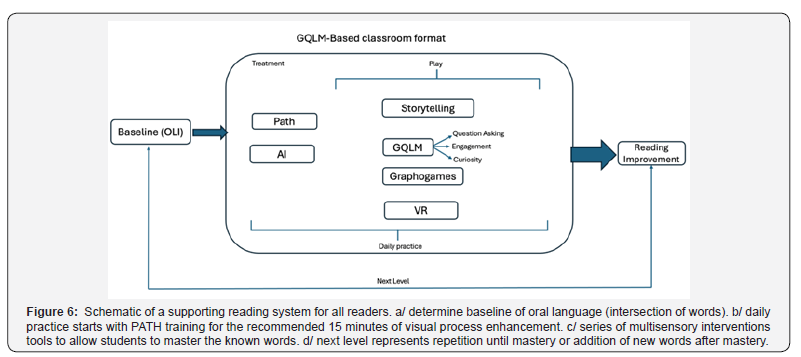
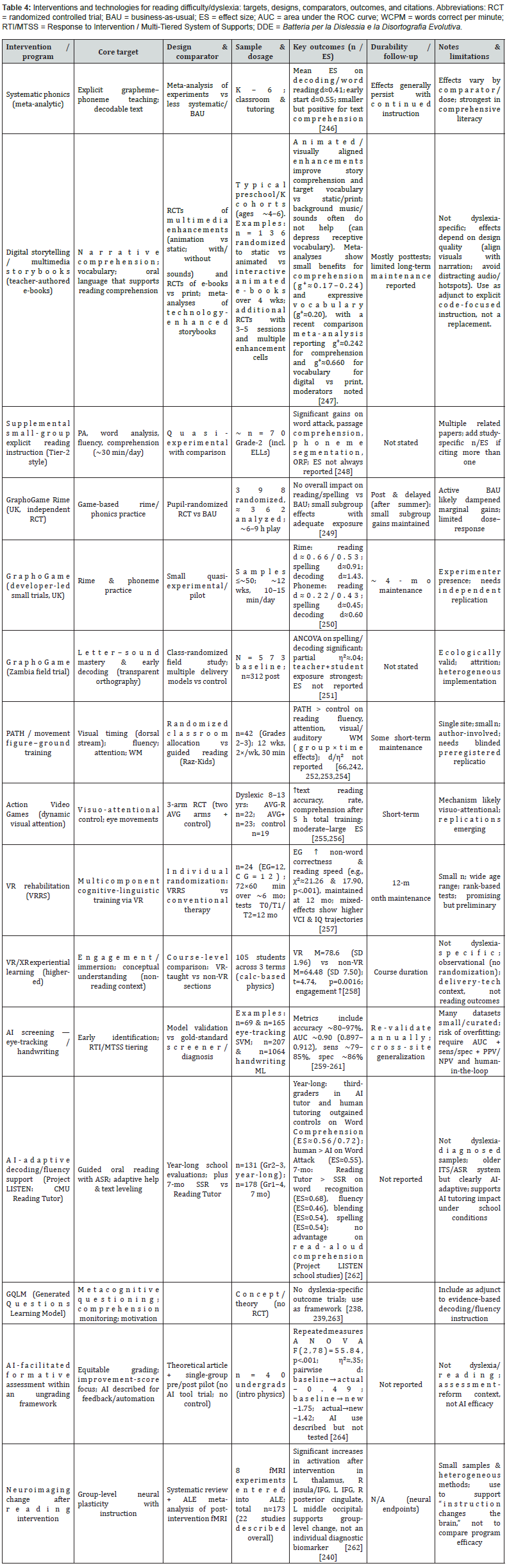
Age constraints are evident for certain technology-mediated interventions: PATH appears most effective from approximately age seven [252,253], whereas GraphoGame has been evaluated beginning around school entry (~5–6 years) with mixed findings across contexts [264,265]. By contrast, storytelling and playbased multimodal activities can begin in the preschool years and may be amplified when combined with code-focused instruction and perceptual training at school age. Complementing these approaches, AI-enabled supports have emerged along two tracks: (a) AI-adaptive oral-reading tutors that adjust text level and feedback in real time [266,267], and (b) AI screeners using eyetracking or handwriting to triage students for human follow-up [259-261]. Taken together, multisensory-structured instruction, targeted perceptual training, narrative-language activities, and AI tools—implemented with attention to cost and access— offer complementary avenues to improve reading fluency and comprehension, particularly when evaluated with transparent outcomes and equitable deployment. Finally, group-level neuroimaging syntheses indicate that instruction is associated with changes in activation in language and attentional circuits, underscoring plasticity rather than a single diagnostic biomarker [240]. This may suggest that using purely sensory stimuli as NLB without any correlation to LB tasks might be a solution to educating and supporting individuals with dyslexia.
Schneps (2014) suggests also that, “neurological difference drives the engine of society to create the contrasts between hot and cold that lead to productive [231]. Impairments in one area can lead to advantages in others, and it is these differences that drive progress in many fields”. Fundamentally, learning is perceptual, which means creating long-term changes in perception and may seem as ruling out short term perceptual changes due to sensory adaptation. However, repetition of sensory stimuli leads to long term changes. It is for this reason that studies show a positive effect of using music with children with dyslexia for example [268- 270]. The repetition-based model proposed here has the potential to help and warrants more empirical application research in support of struggling readers.
Limitations
This review is intentionally theoretical and narrative rather than a registered systematic review or meta-analysis. As such, it synthesizes findings across diverse literatures to advance a conceptual argument, but it does not estimate pooled effect sizes or provide a formal risk-of-bias rating for each study. Below we outline the main constraints on inference.
Scope and methods. We did not preregister a protocol, apply PRISMA/AMSTAR procedures, or conduct a GRADE appraisal. Inclusion relied on iterated database and citation-chaining searches; decisions were made to maximize conceptual coverage rather than exhaustiveness. Grey literature and non-English sources were not systematically searched, raising the possibility of publication and language bias.
Construct and measurement heterogeneity. Studies operationalize reading outcomes variously (decoding accuracy, fluency/WCPM, spelling, comprehension), often with different instruments, timelines, and cut-scores. Cross-study comparisons are therefore approximate, and measurement non-equivalence may inflate or mask apparent differences. Orthographic depth, grade/age, and language status (monolingual vs bilingual) further limit direct comparability.
Study quality and precision. Many primary studies—especially in neuroimaging, VR, visual-timing, and classroom technology— use small, single-site samples, convenience recruitment, and author-developed tasks. Blinding is uncommon; fidelity and dosage reporting are inconsistent; effect sizes and confidence intervals are often missing. Analytic flexibility (multiple outcomes/contrasts without correction) raises the risk of false positives.
Neurobiological inference limits. Imaging findings summarized here are largely group-level and correlational. Reverse inference is a concern, and current evidence does not yield a reliable, individual-level biomarker of dyslexia. Reported post-intervention activation changes demonstrate plasticity, not a unique disease signature or necessary cause.
Genetic evidence limits. Most effects are small and polygenic; early candidate-gene findings have mixed replication. Population stratification, phenotype heterogeneity, and gene–environment interplay constrain strong causal claims about specific variants or pathways.
Intervention evidence maturity. Several approaches discussed (e.g., GraphoGame in some contexts, visual-timing/PATH, VRbased training) include promising but preliminary studies (small n, quasi-experimental designs, developer involvement). Active BAU comparators and limited dosage/follow-up make it difficult to isolate program-specific impacts or generalize to other settings and orthographies.
AI-related evidence. AI screeners (eye-tracking/handwriting) often report high accuracy/AUC on curated datasets; external validity, calibration (PPV/NPV), fairness across demographic groups, and prospective impact on student outcomes remain under-tested. AI-adaptive tutoring studies exist but are not dyslexia-specific and vary in quality; vendor reports are frequently observational. Automation bias and data privacy were outside this review’s scope.
Generalizability and equity. Samples over-represent WEIRD contexts and under-represent multilingual learners, lower-SES communities, and minoritized groups. Because instructional opportunity and school resources vary widely, effect sizes from one context may not translate to another. Implementation costs and access constraints are rarely analyzed.
Policy recommendations. The discussion of DSM categorization is normative as well as empirical. Service access, insurance rules, and educational law differ by jurisdiction; therefore, impacts of reclassification may not be uniform. Our recommendations should be interpreted as hypotheses to be tested in policy and implementation studies, not as settled conclusions.
Data dependence. We did not re-analyze primary datasets and relied on authors’ reported statistics. Any errors or omissions in the original publications propagate to this review.
Time sensitivity. Rapid developments in AI, ed-tech, and reading instruction mean that some findings may be superseded by newer trials or updates after this manuscript’s search window.
Implications for interpretation and future work. Given these limitations, conclusions should be read as weight-of-evidence judgments, not definitive causal claims. Priorities include preregistered, multi-site RCTs with diverse samples; common, standardized outcome batteries (including long-term followup); routine reporting of effect sizes, CIs, fidelity, and costs; open data/materials; prospective impact evaluations for AI tools (with fairness audits); and policy experiments that compare needsbased support models with diagnosis-gated systems on equity and outcomes.
Conclusion
Current findings in genetics, neuroimaging, and longitudinal risk cohorts are heterogeneous and largely correlational: they show group-level differences in reading-related networks but do not yield a reliable, individual-level biomarker suitable for diagnosis or for defining a singular neurobiological disorder. More importantly, the clinical utility of a DSM label for dyslexia is limited when compared with an instructional-needs approach: outcomes are driven chiefly by access to effective, monitored instruction and timely escalation for non-responders. Framing dyslexia as a uniform medical disorder risks gatekeeping support behind a clinical label, introduces inequities linked to insurance and evaluation access, and can distract from the core remedy— evidence-based reading instruction.
Recommendations
This review recommends removing dyslexia from the DSM and adopting an instruction-sensitive educational framework that identifies students through performance and progressmonitoring rather than categorical diagnosis. In practical terms, systems should (i) use RTI/MTSS models with clear entry criteria based on decoding accuracy, fluency, and spelling; (ii) mandate progress-monitoring and rapid intensification for non-responders; (iii) ensure universal access to structured literacy irrespective of medical labeling; and (iv) reserve clinical evaluation for comorbidities (e.g., language disorder, ADHD) that warrant medical management. This policy shift should be evaluated against explicit criteria—reliability, equity of access, and measurable improvements in reading outcomes—so that removing DSM status improves, rather than jeopardizes, the support students receive.
Author Contributions
Conceptualization, H.T.C; methodology, H.T.C.; validation, H.T.C.; formal analysis, H.T.C.; investigation, H.T.C.; resources, H.T.C.; data curation, H.T.C.; writing—original draft preparation, H.T.C.; writing—review and editing, H.T.C.; visualization, H.T.C.; supervision, H.T.C.; project administration, H.T.C.; funding acquisition, H.T.C. All authors have read and agreed to the published version of the manuscript.
References
- Bambaeeroo F, Shokrpour N (2017) The impact of the teachers’ non-verbal communication on success in teaching. Journal of advances in medical education & professionalism 5(2): 51-59.
- Goldin-Meadow S, McNeill D (1999) in The Descent of Mind: Psychological Perspectives on Hominid Evolution (eds Corballis M C, Lea S).
- Dandache S, Wouters J, Ghesquière P (2014) Development of reading and phonological skills of children at family risk for dyslexia: A longitudinal analysis from kindergarten to sixth grade. Dyslexia 20(4): 305-329.
- Kassuba T, Kastner S (2015) The Reading Brain. Front. Young Minds 3: 5.
- Mattessich R (1987) Prehistoric accounting and the problem of representation: On recent archeological evidence of the Middle-East from 8000 BC to 3000 BC. Accounting Historians Journal 14(2): 71-91.
- Steward JH (1937) Petroglyphs of the United States: From the Smithsonian Report for 1936. US Government Printing Office. 3437:405-425.
- Baine J (2004) The earliest Egyptian writing: Development, context, purpose. In The First Writing. Script Invention as History and Process (Cambridge, England: Cambridge University Press) 150-189;
- Bromiley GW (Ed) (1995) The international standard Bible encyclopedia. Wm. B. Eerdmans Publishing.
- Vahanyan G (2010) Volcanic eruptions from Mountains of Ararat till Alps, Indo-European myths, Rock art and iconography. Convegno internazionale, L’arte Rupestre Delle Alpi, Capo di Ponte-Valcamonica, Italy. P: 21-24.
- Woods C (2010) Visible language: the earliest writing systems. Visible Language: Inventions of Writing in the Ancient Middle East and Beyond. The Oriental Institute of the University of Chicago, Chicago pp: 15-25.
- Maspero G (1887) Recueil de travaux relatifs à la philologie et à l'archéologie égyptiennes et Assyriennes. 9. Libr. Honoré Champion.
- Pilcher H (2003) Earliest handwriting found? Nature.
- Robinson A (2009) Writing and Script: A Very Short Introduction. Oxford University Press. P: 4 2009 Gross, M. "The evolution of writing. Current Biology 22 (23): R981–R984.
- Bricker VR, Andrews PA (1992) Epigraphy, University of Texas Press 5.
- Trebeau Crogman, Maryam, and Horace Crogman (2020) Popularizing visuo-spatial training for reading challenges: A call to experts in support of language and non-language-based cognitive skills strengthening. In Frontiers in Education. 5:153.
- Anthony JL, Lonigan CJ, Burgess SR, Driscoll K, Phillips BM, Cantor BG (2002) Structure of preschool phonological sensitivity: overlapping sensitivity to rhyme, words, syllables, and phonemes. J Exp Child Psychol 8: 65.
- Fletcher JM, Shaywitz SE, Shankweiler DP, Katz L, Liberman IY, Stuebing KK, et al. (1994) Cognitive profiles of reading-disability – comparisons of discrepancy and low achievement definitions. J Educ Psychol 86: 6.
- Joanisse MF, Manis FR, Keating P, Seidenberg MS (2000) Language deficits in dyslexic children: Speech perception, phonology, and morphology. Journal of experimental child psychology 77(1): 30-60.
- Morais J, Bertelson P, Cary L, Alegria J (1986) Literacy training and speech segmentation. Cognition 24.
- Ramus F, Marshall CR, Rosen S, Van Der Lely HK (2013) Phonological deficits in specific language impairment and developmental dyslexia: towards a multidimensional model. Brain 136(2): 630-645.
- Damasio AR (1992) Aphasia. New England Journal of Medicine 326(8): 531-539.
- Stahl B, Van Lancker Sidtis D (2015) Tapping into neural resources of communication: formulaic language in aphasia therapy. Frontiers in psychology 6: 1526.
- Manasco MH (2019) Introduction to neurogenic communication disorders. Jones & Bartlett Learning.
- Smith SD, Kimberling WJ, Pennington BF, Lubs HA (1983) Specific reading disability: identification of an inherited form through linkage analysis. Science 219:1345–1347.
- Taipale M, Kaminen N, Nopola-Hemmi J, Haltia T, Myllyluoma B, Lyytinen, H, et al (2003) candidate gene for developmental dyslexia encodes a nuclear tetratricopeptide repeat domain protein dynamically regulated in brain. Proceedings of the National Academy of Sciences 100(20): 11553-11558.
- Lyytinen H, Erskine J, Hämäläinen J Torppa M, Ronimus M (2015) Dyslexia-Early identification and prevention: Highlights from the Jyväskylä longitudinal study of dyslexia. Current developmental disorders report 2(4): 330-338.
- Goodman YM (1989) Roots of the whole-language movement. The Elementary School Journal 90(2): 113-127.
- Smith F (2012) Understanding reading: A psycholinguistic analysis of reading and learning to read. Routledge.
- Shafer G (1998) Whole language: Origins and practice. Language Arts Journal of Michigan, 14(1): 5.
- Hempenstall K (1997) The whole language‐phonics controversy: An historical perspective. Educational Psychology 17(4): 399-418.
- National Institute of Child Health and Human Development (NICHD) (2005). Report of the National Reading Panel. Teaching children toread: An evidence-based assessment of the scientific research literature on reading and its implications for reading instruction: Reports of the subgroups (NIH Publication No. 00-4754). Washington, DC: U.S. Government Printing Office 2000. Retrieved November 11, 2005.
- Dandache S, Wouters J, Ghesquière P (2014) Development of reading and phonological skills of children at family risk for dyslexia: A longitudinal analysis from kindergarten to sixth grade. Dyslexia 20(4): 305-329.
- Frost R (1998) Toward a strong phonological theory of visual word recognition: true issues and false trails. Psychological bulletin 123(1): 71.
- Maddox K, Feng J (2013) Whole Language Instruction vs. Phonics Instruction: Effect on Reading Fluency and Spelling Accuracy of First Grade Students.
- Berman S, Cicchino N, Hajinazarian A, Mescher M, Holland SK, et al. (2014) An fMRI Study of a Dyxlexia Biomarker. Journal of Young Investigators 26(1).
- Protopapas A, Parrila R (2018) Is Dyslexia a Brain Disorder? Brain sciences 8(4): 61.
- Paracchini S, Scerri T, Monaco AP (2007) The genetic lexicon of dyslexia. Annu Rev Genomics Hum Genet 8: 57-79.
- Casini L, Pech‐Georgel C, Ziegler JC (2018) It's about time: revisiting temporal processing deficits in dyslexia. Developmental Science 21(2): e12530
- Goswami U, Huss M, Mead N, Fosker T (2020) Auditory Sensory Processing and Phonological Development in High IQ and Exceptional Readers, Typically Developing Readers, and Children with Dyslexia: A Longitudinal Study. Child Development 92(3):1083-1098.
- Lovegrove WJ, Garzia RP, Nicholson SB (1990) Experimental evidence for a transient system deficit in specific reading disability. Journal of the American Optometric Association.
- Stein J, Walsh V (1997) To see but not to read; the magnocellular theory of dyslexia. Trends in neurosciences 20(4): 147-152.
- Vandermosten M, Boets B, Luts H, Poelmans H, Golestani N, Wouters J, et al. (2010) Adults with dyslexia are impaired in categorizing speech and nonspeech sounds on theb basis of temporal cues. Proceedings of the National Academy of Sciences 107(23): 10389-10394.
- Tallal P (1980) Auditory temporal perception, phonics, and reading disabilities in children. Brain and language 9(2): 182-198.
- Mcanally KI, Stein JF (1373) Auditory temporal coding in dyslexia. Proceedings of the Royal Society of London. Series B: Biological Sciences 263(1373): 961-965.
- Bradley L, Bryant PE (1978) Difficulties in auditory organisation as a possible cause of reading backwardness. Nature 271: 746-7.
- Brady SA, Shankweiler DP (1991) Phonological processes in literacy. Hillsdale, NJ: Lawrence Erlbaum.
- Vellutino FR (1979) Dyslexia: research and theory. Cambridge (MA): MIT Press.
- Snowling MJ (1981) Phonemic deficits in developmental dyslexia. Psychol Res 43: 219-234.
- Mody M, Studdert-Kennedy M, Brady S (1997) Speech perception deficits in poor readers: Auditory processing or phonological coding? Journal of experimental child psychology 64(2): 199-231.
- Braida LD, Lim JS, Berliner JE, Durlach NI, Rabinowitz WM (1984) Intensity perception. XIII. Perceptual anchor model of context‐coding. The Journal of the Acoustical Society of America 76(3):722-731.
- Gabay Y, Holt LL (2015) Incidental learning of sound categories is impaired in developmental dyslexia. Cortex. 73: 131-143.
- Lum JA, Ullman MT, Conti-Ramsden G (2013) Procedural learning is impaired in dyslexia: Evidence from a meta-analysis of serial reaction time studies. Research in developmental disabilities 34(10): 3460-3476.
- Menghini D, Hagberg GE, Caltagirone C, Petrosini L, et al. (2006) Implicit learning deficits in dyslexic adults: An fMRI study. Neuroimage 33(4): 1218-1226.
- Oganian Y, Ahissar M (2012) Poor anchoring limits dyslexics' perceptual, memory, and reading skills. Neuropsychologia 50(8): 1895-1905.
- Stoodley C, Ray N, Jack A, Stein J (2008) Implicit learning in control, dyslexic, and garden-variety poor readers. Annals of the New York Academy of Sciences 1145(1): 173.
- Ramus F (2001) Talk of two theories. Nature 412(6845): 393-394.
- Ramus F, Rosen S, Dakin SC, Day BL, Castellote JM, et al (2003) Theories of developmental dyslexia: insights from a multiple case study of dyslexic adults. Brain 126(4): 841-865.
- Goswami U (2011) A temporal sampling framework for developmental dyslexia. Trends in Cognitive Sciences 15: 3–10.
- Giraud A, Poeppel D (2012) Cortical oscillations and speech processing: emerging computational principles and operations. Nature Neuroscience 18: 511–517.
- Hämäläinen JA, Salminen HK, Leppänen PH (2013) Basic auditory processing deficits in dyslexia: systematic review of the behavioral and event-related potential/field evidence. Journal of learning disabilities 46(5): 413-427.
- Perrachione TK, Del Tufo SN, Winter R, Murtagh J, Cyr A, Chang P et al. (2016) Dysfunction of rapid neural adaptation in dyslexia. Neuron 92(6): 1383-1397.
- Vellutino FR, Fletcher JM, Snowing MJ, Scanlon DM (2004) Specific reading disability (dyslexia): What have we learned in the past four decades? Journal of child psychology and psychiatry 45(1): 2-40.
- Stanovich KE (1998) Explaining the differences between the dyslexic and the garden-variety poor reader: The phonological-core variable-difference model. Journal of learning disabilities 21(10): 590-604.
- Stanovich KE (1991) Discrepancy definitions of reading disability: Has intelligence led us astray? Reading Research Quarterly. Pp: 7-29.
- Mirman D (2020) Aphasia: Acquired Language and Speech Disorder.
- Navas ALGP, Ferraz ÉDC, Borges JPA (2014) Phonological processing deficits as a universal model for dyslexia: evidence from different orthographies. In CoDAS 26(6): 509-519.
- Valtin R (2010) Phonologische Bewusstheit - eine notwendige Voraussetzung beim Lesen- und Schreibenlernen? lesefo-rum.ch.
- Protopapas A, Parrila R (2019) Dyslexia: Still Not a Neurodevelopmental Disorder. Brain sciences 9(1): 9.
- Galaburda AM, Sherman GF, Rosen GD, Aboitiz F, Geschwind N (1985) Developmental dyslexia: Four consecutive patients with cortical anomalies. Ann Neurol. 18: 222-233.
- Humphreys P, Kaufmann WE, Galaburda AM (1990) Developmental dyslexia in women: Neuropathological findings in three patients. Ann Neurol 28: 727-738.
- Ramus F, Altarelli I, Jednoróg K, Zhao J, di Covella LS (2018) Neuroanatomy of developmental dyslexia:Pitfalls and promise. Neuroscience and Biobehavioral Reviews. UKEssays. Differentiation made among poor readers into dyslexics 84: 434–452.
- Borsboom Denny (2006) psychometricians. The attack of the Psychometrika 71 (3): 425–440.
- Tra H (2017) Grasping the interplay between the Verbal Cultural diversity and Critical thinking, and their Consequences for African American education. In Frontiers in Education. Frontiers 2: 64.
- Cronshaw Steven F, Hamilton Leah K, Onyura Betty R, Winston Andrew S (2006) Case for Non-Biased Intelligence Testing Against Black Africans Has Not Been Made: A Comment on Rushton, Skuy, and Bons. International Journal of Selection and Assessment. 14 (3): 278–287.
- Ford DY (2005) Intelligence testing and cultural diversity: Pitfalls and promises. Newsletter of National research Center on Gifted and talented.
- Martschenko D (2018) The IQ test wars: why screening for intelligence is still so controversial. The Conversation (nd).
- Richardson K (2002) What IQ tests test. Theory & Psychology 12(3): 283-314.
- Sternberg RJ, Kaufman SB (Eds.) (2011) The Cambridge handbook of intelligence. Cambridge University Press.
- Turkheimer E, Harden KP, Nisbett RE (2017) There’s still no good reason to believe black-white IQ differences are due to genes.
- Elliott Julian G, Gibbs Simon (2008) Does Dyslexia Exist? Journal of Philosophy of Education 42(3–4): 475–491.
- Rice M, Brooks G (2004) Developmental dyslexia in adults: a research review. National Research and Development Centre for adult literacy and numeracy.
- Catts HW, Hogan TP, Fey ME (2003) Subgrouping poor readers on the basis of individual differences in reading-related abilities. Journal of learning Disabilities 36(2): 151-164.
- Wang A (2009) How to Determine the Best Length for Your Assessment.
- Siegel LS (1992) An evaluation of the discrepancy definition of dyslexia. Journal of learning Disabilities 25(10): 618-629.
- Snowling MJ (2001) From language to reading and dyslexia 1. Dyslexia 7(1): 37-46.
- Nani A, Manuello J, Mancuso L, Liloia D, Costa T, Cauda F (2019) The neural correlates of consciousness and attention: Two sister processes of the brain. Frontiers in neuroscience 13: 1169.
- Stiles J, Brown TT, Haist F, Jernigan TL (2015) Brain and cognitive development. Handbook of child psychology and developmental science. 1-54.
- Davis MH, Johnsrude IS (2003) Hierarchical processing in spoken language comprehension. Journal of Neuroscience 23(8): 3423-3431.
- Kassuba T, Kastner S (2015) The Reading Brain. Front. Young Minds 3: 5.
- Dehaene S, Cohen, L (2011) The unique role of the visual word form area in reading. Trends Cognit Sci 15: 254–262.
- Price CJ, Devlin J (2011) The interactive account of ventral occipitotemporal contributions to reading. Trends Cogn Sci 15: 246-253.
- Li Y, Zhang L, Xia Z, Yang J, Shu H, Li P (2017) The relationship between intrinsic couplings of the visual word form area with spoken language network and reading ability in children and adults. Frontiers in human neuroscience 11: 327.
- Brauer J (2014) The Brain and Language: How Our Brains Communicate. Front. Young Minds. 2: 14.
- Spelke E (2010) Innateness, choice, and language,” in Chomsky Notebook (eds) J Bricmont, and J Franck Pp: 203–210.
- Sparks JR (2012) Language/discourse comprehension and understanding in Encyclopedia of the Sciences of Learning. US: Springer Pp: 1713–1717.
- Boroditsky L (2019) Language and the brain. Science 366 (6461): 13.
- Cao F, Perfetti CA (2016) Neural signatures of the reading-writing connection: greater involvement of writing in Chinese reading than English reading. PloS one 11(12).
- Koyama MS, Di Martino A, Zuo XN, Kelly C, Mennes M, Jutagir DR, et al (2011) Resting-state functional connectivity indexes reading competence in children and adults. Journal of Neuroscience 31(23): 8617-8624.
- Schlaggar BL, Church JA (2009) Functional neuroimaging insights into the development of skilled reading. Curr Dir Psychol Sci 18: 21–26.
- Vogel AC, Miezin FM, Petersen SE, and Schlaggar BL (2012) The putative visual word form area is functionally connected to the dorsal attention network. Cereb. Cortex 22: 537–549.
- Carreiras M, Seghier ML, Baquero S, Estévez A, Lozano A, Devlin JT (2009) An anatomical signature for literacy. Nature 461: 983–986.
- Monzalvo K, Dehaene-Lambertz G (2013) How reading acquisition changes children’s spoken language network. Brain Lang 127: 356-365.
- Thiebaut de Schotten M, Cohen L, Amemiya E, Braga LW, Dehaene S (2014) Learning to read improves the structure of the arcuate fasciculus. Cereb. Cortex 24: 989–995.
- Krishnan S, Watkins KE, Bishop DV (2016) Neurobiological basis of language learning difficulties. Trends in cognitive sciences 20(9): 701-714.
- Rayner K, Pollatsek A, Ashby J, Clifton Jr C (2012) Psychology of reading. Psychology Press.
- Wandell BA, Le RK (2017) Diagnosing the neural circuitry of reading. Neuron 96(2): 298-311.
- Huber E, Donnelly PM, Rokem A, Yeatman JD (2018) Rapid and widespread white matter plasticity during an intensive reading intervention. Nature communications 9(1): 1-13.
- Hoeft F, McCandliss BD, Black JM, Gantman A, Zakerani N, HulmeC, et al (2011) Neural systems predicting long-term outcome in dyslexia. Proceedings of the National Academy of Sciences 108(1): 361-366.
- Saygin ZM, Norton ES, Osher DE, Beach SD, Cyr AB, et al (2013) Tracking the roots of reading ability: white matter volume and integrity correlate with phonological awareness in prereading and early-reading kindergarten children. Journal of Neuroscience 33(33): 13251-13258.
- Krafnick AJ, Flowers DL, Luetje MM, Napoliello EM, Eden GF (2014) An investigation into the origin of anatomical differences in dyslexia. Journal of Neuroscience 34(3): 901-908.
- Bentin S (1987) Event-related potentials, semantic processes, and expectancy factors in word recognition. Brain and Language 31: 308-327.
- Shaul S (2008) Event-related potentials (ERPs) in the study of dyslexia. In Brain research in language. Springer, Boston, MA. Pp: 51-92.
- Molfese DL (2000) Predicting dyslexia at 8 years of age using neonatal brain responses. Brain and Language 72: 238-245.
- Bonte ML, Blomert L (2004) Developmental dyslexia: ERP correlates of anomalous phonological processing during spoken word recognition. Cognitive brain research 21(3): 360-376.
- Bonte ML, Poelmans H, Blomert L (2007) Deviant neurophysiological responses to phonological regularities in speech in dyslexic children. Neuropsychologia 45(7): 1427-1437.
- Jednoróg K, Marchewka A, Tacikowski P, Grabowska A (2010) Implicit phonological and semantic processing in children with developmental dyslexia: Evidence from event-related potentials. Neuropsychologia 48(9): 2447-2457.
- Schulz E, Maurer U, van der Mark S, Bucher K, Brem S, et al. (2008) Impaired semantic processing during sentence reading in children with dyslexia: combined fMRI and ERP evidence. Neuroimage 41(1): 153-168.
- Dubois J, Adolphs R (2016) Building a science of individual differences from fMRI. Trends in cognitive sciences 20(6): 425-443.
- Brice A, Carson C (2009) Neurological aspects of language development. Language Development 2.
- DeFries JC, Fulker DW, LaBuda MC (1987) Evidence for a genetic aetiology in reading disability of twins. Nature 329(6139): 537-539.
- Olson RK (2006) Genes, environment, and dyslexia the 2005 Norman Geschwind memorial lecture. Annals of Dyslexia 56(2): 205-238.
- Tam V, Patel N, Turcotte M, Bossé Y, Paré G, et al. (2019) Benefits and limitations of genome-wide association studies. Nature Reviews Genetics 20(8): 467-484.
- Cardon LR, Smith SD, Fulker DW, Kimberling WJ, Pennington BF, et al. (1994) Quantitative trait locus for reading disability on chromosome 6. Science 266(5183): 276-279.
- Nopola-Hemmi J, Myllyluoma B, Haltia T, Taipale M, Ollikainen V, et al (2001) A dominant gene for developmental dyslexia on chromosome 3. Journal of medical genetics 38(10): 658-664.
- Hannula-Jouppi K, Kaminen-Ahola N, Taipale M, Eklund R, Nopola-Hemmi J, et al. (2005) The axon guidance receptor gene ROBO1 is a candidate gene for developmental dyslexia. PLoS Genet 1(4): e50.
- Smith SD, Kimberling WJ, Pennington BF (1991) Screening for multiple genes influencing dyslexia. Read Writ Interdiscip J. 3:285–98
- Kaplan DE, Gayan J, Ahn J, Won TW, Pauls D, et al. (2002) Evidence for linkage and association with reading disability, on 6p21. 3-22. The American Journal of Human Genetics 70(5): 1287-1298.
- Turic D, Robinson L, Duke M, Morris DW, Webb V, Hamshere M (2003) Linkage disequilibrium mapping provides further evidence of a gene for reading disability on chromosome 6p21. 3–22. Molecular Psychiatry 8(2): 176-185.
- Field LL, Kaplan BJ (1998) Absence of linkage of phonological coding dyslexia to chromosome 6p23-p21.3 in a large family data set. Am J Hum Genet 63:1448–1456.
- Paracchini S, Thomas A, Castro S, Lai C, Paramasivam M, Wang Y (2006) The chromosome 6p22 haplotype associated with dyslexia reduces the expression of KIAA0319, a novel gene involved in neuronal migration. Human molecular genetics 15(10): 1659-1666.
- Schulte-Körne G, Grimm T, Nöthen MM, Müller-Myhsok B, Cichon S, et al. (1998) Evidence for linkage of spelling disability to chromosome 15. American journal of human genetics 63(1): 279.
- Raskind WH, Peter B, Richards TL, Eckert MA, Berninger VW (2013) The genetics of reading disabilities: from phenotypes to candidate genes. Frontiers in psychology 3: 601.
- Raskind WH (2007) Evaluation of candidate genes for DYX1 and DYX2 in families with dyslexia. American Journal of Medical Genetics Part B: Neuropsychiatric Genetics 144(4): 556-560.
- Goldstein DB (2009) Common genetic variation and human traits. N Engl J Med 360: 1696–1698.
- Schumacher J, Hoffmann P, Schmäl C, Schulte-Körne G, Nöthen MM (2007) Genetics of dyslexia: the evolving landscape. Journal of medical genetics 44(5): 289-297.
- Davis OSP, Band G, Pirinen M, Haworth CMA, Meaburn E, et al. (2014) The correlation between reading and mathematics ability at age twelve has a substantial genetic component. Nature Communications 25: 4204.
- Landerl K, Moll K (2010) Comorbidity of learning disorders: Prevalence and familial transmission. Journal of Child Psychology and Psychiatry 51: 287-294.
- Verhulst B, Hatemi PK (2013) Gene-environment interplay in twin models. Political Analysis 21(3): 368-389.
- Desoete A, De Weerdt F, Vanderswalmen R, De Bondt A (2014) How persistent is a diagnosis of mathematical disorder at an early age? A longitudinal study. International Journal for Research in Learning Disabilities 2(1): 42-71.
- Geary DC, Hoard MK, Byrd-Craven J, Nugent L, Numtee C (2007) Cognitive mechanisms underlying achievement deficits in children with mathematical learning disability. Child Development 78: 1343-1359.
- Mazzocco MMM, Myers GF (2003) Complexities in identifying and defining mathematics learning disability in the primary school-age years. Annals of Dyslexia 53: 218-253.
- Shalev RS, Manor O, Gross-Tsur V (2005) Developmental dyscalculia: A prospective six-year follow-up. Developmental Medicine and Child Neurology 47: 121-125.
- Black JM, Xia Z, Hoeft F (2017) Neurobiological bases of reading disorder part II: The importance of developmental considerations in typical and atypical reading. Lang. Linguist. Compass 11: e12252.
- Kronbichler L, Kronbichler M (2018) The importance of the left occipitotemporal cortex in developmental dyslexia. Curr Dev Disord Rep 5: 1–8.
- Martin A, Kronbichler M, Richlan F (2016) Dyslexic brain activation abnormalities in deep and shallow orthographies: A meta-analysis of 28 functional neuroimaging studies. Hum Brain Mapp 37: 2676–2699.
- Norton ES, Beach SD, Gabrieli JD (2015) Neurobiology of dyslexia. Curr Opin Neurobiol 30: 73–78.
- Vandermosten M, Hoeft F, Norton ES (2016) Integrating MRI brain imaging studies of pre-reading children with current theories of developmental dyslexia: A review and quantitative meta-analysis. Curr Opin Behav Sci 10: 155–161.
- Xia Z, Hancock R, Hoeft F (2017) Neurobiological bases of reading disorder part I: Etiological investigations. Lang Linguist Compass 11: e12239.
- Ramus F (2004) Neurobiology of dyslexia: A reinterpretation of data. Trends in Neurosciences 27(12): 720–726.
- Maxwell SE, Lau MY, Howard GS (2015) Is psychology suffering from a replication crisis? What does “failure to replicate” really mean? Am Psychol 70: 487–498.
- Open Science Collaboration (2015) PSYCHOLOGY. Estimating the reproducibility of psychological science. Science 349: aac4716–aac4716.
- van Bavel JJ, Mende-Siedlecki P, Brady WJ, Reinero DA (2016) Contextual sensitivity in scientific reproducibility. Proc Natl Acad Sci USA. 113: 6454–6459.
- Strack F (2017) From data to truth in psychological science. A personal perspective. Front Psychol 8:181–183.
- Specht K (2020) Current challenges in translational and clinical fMRI and future directions. Frontiers in psychiatry 10: 924.
- Doidge N (2007) The Brain That Changes Itself: Stories of Personal Triumph from the Frontiers of Brain Science. London: Penguin Books.
- Trebeau-Crogman M (2018) Visuospatial Learning Differences: A Study of Children and Adults with and Without Dyslexia. UC Merced. 2018, ProQuest ID: TrebeauCrogman_ucmerced_1660D_10364.
- Starr BD (2017) A Handy Guide to Ancestry and Relationship DNA Tests. CreateSpace Independent Publishing Platform.
- Lyytinen H (2014) Children at risk of reading problems – from identification to prevention. International Journal for Research in Learning Disabilities 2(1): 2-17.
- Brandler WM, Paracchini S (2014) The genetic relationship between handedness and neurodevelopmental disorders. Trends in molecular medicine 20(2): 83-90.
- Brkanac Z, Chapman NH, Matsushita MM, Chun L, Nielsen K, et al. (2007) Evaluation of candidate genes for DYX1 and DYX2 in families with dyslexia. American Journal of Medical Genetics Part B: Neuropsychiatric Genetics 144(4): 556-560.
- Carrion-Castillo A, Maassen B, Franke B, Heister A, Naber M, et al. (2017) Association analysis of dyslexia candidate genes in a Dutch longitudinal sample. European Journal of Human Genetics 25(4): 452-460.
- Schumacher J, Anthoni H, Dahdouh F, König IR, Hillmer AM, et al. (2006) Strong genetic evidence of DCDC2 as a susceptibility gene for dyslexia. The American Journal of Human Genetics 78(1): 52-62.
- De Kovel CG, Francks C (2019) The molecular genetics of hand preference revisited. Scientific reports 9(1): 1-9.
- Scerri TS, Morris AP, Buckingham LL, Newbury DF, Miller LL, et al. (2011) DCDC2, KIAA0319 and CMIP are associated with reading-related traits. Biological psychiatry 70(3): 237-245.
- Guttorm TK, Leppänen PH, Poikkeus AM, Eklund KM, Lyytinen P, et al. (2005) Brain event-related potentials (ERPs) measured at birth predict later language development in children with and without familial risk for dyslexia. Cortex 41(3): 291-303.
- Swensen SJ, Duncan JR, Gibson R, Muething SE, LeBuhn R, et al. (2014) An appeal for safe and appropriate imaging of children. Journal of patient safety 10(3): 121-124.
- Plakas A, van Zuijen T, van Leeuwen T, Thomson JM, van der Leij A (2013) Impaired non-speech auditory processing at a pre-reading age is a risk-factor for dyslexia but not a predictor: an ERP study. Cortex 49(4): 1034-1045.
- San Martín R (2012) Event-related potential studies of outcome processing and feedback-guided learning. Frontiers in human neuroscience 6: 304.
- Jones J, Placek P (2017) Adoption: By the Numbers.
- Waldman M, (2017) Dyslexia and Adoption: Let’s Connect the Dots.
- DeFries JC, Alarcon M (1996) Genetics of specific reading disability. Mental Retardation and Developmental Disability Research Review 2: 39-47.
- Jonsson H, Magnusdottir E, Eggertsson HP, Stefansson OA, Arnadottir GA, et al. (2021) Differences between germline genomes of monozygotic twins. Nature genetics 53(1): 27-34.
- Putnam LR (1987) Language, language development and reading (Noam Chomsky interviewed by Lillian R. Putnam). Reading Instruction Journal, Fall.
- Dias BG, Ressler KJ (2014) Parental olfactory experience influences behavior and neural structure in subsequent generations. Nature neuroscience 17(1): 89-96.
- Jirtle RL, Skinner MK (2007) Environmental epigenomics and disease susceptibility. Nature reviews genetics 8(4): 253-262.
- Hurt RT, Kulisek C, Buchanan LA, McClave SA (2010) The obesity epidemic: challenges, health initiatives, and implications for gastroenterologists. Gastroenterology & hepatology 6(12): 780.
- Ideraabdullah FY, Zeisel SH (2018) Dietary modulation of the epigenome. Physiological Reviews 98(2): 667-695.
- Hanford E (2020) What the words say: Why so many kids don't understand what they read [Audio podcast episode]. APM Reports.
- Rea A (2020) How Serious Is America's Literacy Problem? Library Journal.
- Hernandez DJ (2011) Double jeopardy: How third-grade reading skills and poverty influence high school graduation. Annie E. Casey Foundation.
- Craig RP (1984) Developing a philosophy of reading: Piaget and Chomsky. Reading Horizons: A Journal of Literacy and Language Arts 25(1): 7.
- Goodman YM (1990) Roots of the whole-language movement. The Elementary School Journal 90(2): 113-127.
- Kuhl PK (2010) Brain mechanisms in early language acquisition. Neuron 67(5): 713-727.
- Goodman KS (1970) Psycholinguistic universals in the reading process. Visible Language 4(2): 103-110.
- Chomsky N (1957) Logical structure in language. Journal of the American Society for Information Science 8(4): 284.
- Saygin ZM, Osher DE, Norton ES, Youssoufian DA, Beach SD, et al. (2016) Connectivity precedes function in the development of the visual word form area. Nature neuroscience 19(9): 1250-1255.
- Seidenberg M (2017) Language at the Speed of Sight: How we Read, why so Many Can’t, and what can be done about it. Basic Books.
- Altwerger B, Edelsky C, Flores BM (2015) Whole language: What's new? The Reading Teacher 1987. Hempenstall K Part 1: Whole Language! What was that all about? National Institute for Direct Instruction. 41(2) 144-154.
- Seymour PH (2006) Theoretical framework for beginning reading in different orthographies. Handbook of orthography and literacy Pp: 441-462.
- Linan-Thompson S, Vaughn S (2007) Research-based Methods of Reading Instruction for English Language Learners, Grades K-4. Ascd.
- Denton CA, Anthony JL, Parker R, Hasbrouck JE (2004) Effects of two tutoring programs on the English reading development of Spanish-English bilingual students. The Elementary School Journal 104(4): 289-305.
- Linan–Thompson S, Hickman–Davis P (2002) Supplemental reading instruction for students at risk for reading disabilities: Improve reading 30 minutes at a time. Learning Disabilities Research & Practice 17(4): 242-251.
- Shanahan T, Beck IL (2006) Effective literacy teaching for English‐language learners. In D August & T Shanahan (Eds.) Developing literacy in second‐language learners: Report of the national literacy panel on language‐minority children and youth. Mahwah, NJ: Erlbaum. pp. 415–488.
- Bailey G, Thomas E (1998) Some aspects of African-American vernacular English phonology. African American English: Structure, history, and use. Pp: 85-109.
- Rickford R, Rickford RJ (2000) Spoken Soul: The story of Black English. New York: John Wiley.
- Poplack, Shana (ed) (2000) The English history of African American English. Malden, MA, and Oxford, UK: Blackwell.
- Shaywitz SE, Shaywitz BA (2005) Dyslexia (specific reading disability). Biological Psychiatry 57(11): 1301–1309.
- Smith SD, Gilger JW, Pennington BF (2002) Dyslexia and other language/learning disorders. InRimoin, Connor, Pyeritz & Korf (Eds.; 4thedition), Emory and Rimoin's principles and practices in medical genetics. Livingstone Churchill: NY. Pp.2827-2865.
- Moody KC, Roman MJ, Paulsen KA, Freeman DH, Haynes M, James TN (2000) Prevalence of dyslexia among Texas prison inmates. Texas medicine 96(6): 69-75.
- Grizzle KL (2207) Developmental dyslexia. Pediatric Clinics of North America 54(3): 507-523.
- Skinner ME (2007) Faculty willingness to provide accommodations and course alternatives to postsecondary students with learning disabilities. International Journal of Special Education 22(2): 32- 45.
- Doikou-Avlidou M (2015) The Educational, Social and Emotional Experiences of Students with Dyslexia: The Perspective of Postsecondary Education Students. International journal of special education 30(1): 132-145.
- Terras MM, Thompson LC, Minnis H (2009) Dyslexia and psycho‐social functioning: An exploratory study of the role of self‐esteem and understanding. Dyslexia 15(4): 304-327.
- Wiener J (2004) Do peer relationships foster behavioral adjustment in children with learning disabilities? Learning Disability Quarterly 27(1): 21-30.
- Wiener J, Tardif C (2004) Social and emotional functioning of children with learning disabilities: Does special education placement make a difference? Learning Disabilities Research and Practice 19(2): 20-32.
- Nellie A (2016) The color of justice: Racial and ethnic disparity in state prisons. Washington, DC: The Sentencing Project.
- Gardner III R, Hsin Y (2008) Reading and children with emotional/behavioral disorders. Balanced Reading Instruction 15(2): 25-40.
- Robinson SA (2013) Educating Black Males with Dyslexia. Interdisciplinary Journal of Teaching and Learning 3(3): 159-174.
- Peck F, Leong A, Zekelman L, Hoeft F (2018) Compensatory skills and dyslexia: What does the science say. Examiner 7.
- Pennington BF (2006) From single to multiple deficit models of developmental disorders. Cognition 101(2): 385–413.
- Erickson D, Reid C, Nelson L, O'Shaughnessy A, Berube A (2008) The enduring challenge of concentrated poverty in America: case studies from communities across the US. Federal Reserve System.
- Neuman SB (2008) Educating the other America: Top experts tackle poverty, literacy, and achievement in our schools. Baltimore, MD: Paul H Brookes
- Jensen E (2013) How poverty affects classroom engagement. Educational Leadership 70(8): 24-30.
- Risley TR, Hart B (2006) Promoting Early Language Development 2006.
- Arnold EM, Goldston DB, Walsh AK, Reboussin BA, Daniel SS, et al. (2005) Severity of emotional and behavioral problems among poor and typical readers. Journal of abnormal child psychology 33(2): 205-217.
- Crogman H (2019) Students Misconceptions are Falsely Measured by Concept Inventory Tests While Lack of Prior Knowledge is Ignored. Journal of Contemporary Educational Research 3(2).
- Castles A, Rastle K, Nation K (2018) Ending the reading wars: Reading acquisition from novice to expert. Psychological Science in the Public Interest 19(1): 5-51.
- Taylor JSH, Davis MH, Rastle K (2017) Comparing and validating methods of reading instruction using behavioural and neural findings in an artificial orthography. Journal of Experimental Psychology: General 146(6): 826.
- Shaywitz SE, Fletcher JM, Holahan JM, Shneider AE, Marchione KE, et al. (1999) Persistence of dyslexia: The Connecticut longitudinal study at adolescence. Pediatrics 104(6): 1351-1359.
- Richlan F, Kronbichler M, Wimmer H (2011) Meta-analyzing brain dysfunctions in dyslexic children and adults. Neuroimage 56(3): 1735-1742.
- Shaywitz BA, Shaywitz SE, Pugh KR, Mencl WE, Fulbright RK, et al. (2002) Disruption of posterior brain systems for reading in children with developmental dyslexia. Biological psychiatry 52(2): 101-110.
- Shaywitz SE, Shaywitz BA, Fulbright RK, Skudlarski P, Mencl WE, et al. (2003) Neural systems for compensation and persistence: young adult outcome of childhood reading disability. Biological psychiatry 54(1): 25-33.
- Hancock R, Richlan F, Hoeft F (2017) Possible roles for fronto-striatal (frontal–subcortical) circuits in reading disorder. Neuroscience & Biobehavioral Reviews 72: 243–260.
- Hancock R, Pugh KR, Hoeft F (2017) Neural noise hypothesis of developmental dyslexia. Trends in cognitive sciences 21(6): 434-448.
- Démonet JF, Taylor MJ, Chaix Y (2004) Developmental dyslexia. The Lancet 363(9419): 1451-1460.
- Pugh KR, Mencl WE, Jenner AR, Katz L, Frost SJ, Lee JR, Shaywitz BA (2000) Functional neuroimaging studies of reading and reading disability (developmental dyslexia). Mental retardation and developmental disabilities research reviews 6(3): 207-213.
- Geiger G, Lettvin JY (1987) Peripheral vision in persons with dyslexia. New England Journal of Medicine 316(20): 1238-1243.
- Von Karolyi C, Winner E, Gray W, Sherman GF (2003) Dyslexia linked to talent: Global visual-spatial ability. Brain and language 85(3): 427-431.
- Schneps MH (2015) The advantages of dyslexia. Scientific American Mind 26(1): 24-25.
- Zorzi M, Barbiero C, Facoetti A, Lonciari I, Carrozzi M, Montico M, Ziegler JC (2012) Extra-large letter spacing improves reading in dyslexia. Proceedings of the National Academy of Sciences 109(28): 11455-11459.
- Logan RK (2004) The alphabet effect: The impact of the phonetic alphabet on the development of Western civilization. Hampton Press.
- Goody J (1987) The interface between the written and the oral. Cambridge University Press.
- Ong WJ (2002) Orality and literacy: The technologizing of the word (2nd ed.). Routledge.
- Wolf M (2007) Proust and the squid: The story and science of the reading brain. Harper Perennial.
- Shaywitz S (2003) Overcoming dyslexia: A new and complete science-based program for reading problems at any level. Knopf.
- Crogman H, Crogman MT (2018) Modified generated question learning, and its classroom implementation and assessment. Cogent Education 5(1): 1459340.
- Crogman H, Crogman MT (2016) Generated questions learning model (GQLM): Beyond learning styles. Cogent Education 3(1): 1202460.
- Barquero LA, Davis N, Cutting LE (2014) Neuroimaging of reading intervention: a systematic review and activation likelihood estimate meta-analysis. PloS one 9(1): e83668.
- Simos PG, Fletcher JM, Sarkari S, Billingsley RL, Denton C, Papanicolaou AC (2007) Altering the brain circuits for reading through intervention: A magnetic source imaging study. Neuropsychology 21(4): 485–496.
- Lawton T (2019) Increasing visual timing by movement discrimination exercises improves reading fluency, attention span, and memory retention in dyslexics. Neurology and Neurosurgery 2: 1-8.
- Rose J (2006). Independent Review of the Teaching of Early Reading: Final Report. Nottingham, UK: Department for Education and Skills (DfES).
- Ghazanfar AA, Schroeder CE (2006) Is neocortex essentially multisensory? Trends in cognitive sciences 10(6): 278-285.
- Murray AL, Eisner M, Ribeaud D (2016) The development of the general factor of psychopathology ‘p factor’through childhood and adolescence. Journal of abnormal child psychology 44(8): 1573-1586.
- Ehri LC, Nunes SR, Stahl SA, Willows DM (2001) Systematic phonics instruction helps students learn to read: Evidence from the National Reading Panel’s meta-analysis. Review of educational research 71(3): 393-447.
- Bus AG, Sarı B, Takacs ZK (2019) The promise of multimedia enhancement in children’s digital storybooks. In Reading in the digital age: Young children’s experiences with e-books: International studies with e-books in diverse contexts. Cham: Springer International Publishing. Pp. 45-57.
- Linan–Thompson S, Hickman–Davis P (2002) Supplemental reading instruction for students at risk for reading disabilities: Improve reading 30 minutes at a time. Learning Disabilities Research & Practice 17(4): 242-251.
- Styles D, Gonzalez‐Mejia A, Moorby J, Foskolos A, Gibbons J (2018) Climate mitigation by dairy intensification depends on intensive use of spared grassland. Global change biology 24(2): 681-693.
- Kyle F, Kujala J, Richardson U, Lyytinen H, Goswami U (2013) Assessing the effectiveness of two theoretically motivated computer‐assisted reading interventions in the United Kingdom: GG Rime and GG Phoneme. Reading Research Quarterly 48(1): 61-76.
- Jere-Folotiya J, Chansa-Kabali T, Munachaka JC, Sampa F, Yalukanda C, et al. (2014) The effect of using a mobile literacy game to improve literacy levels of grade one students in Zambian schools. Educational Technology Research and Development 62(4): 417-436.
- Lawton T, Shelley-Tremblay J (2017) Training on movement figure-ground discrimination remediates low-level visual timing deficits in the dorsal stream, improving high-level cognitive functioning, including attention, reading fluency, and memory. Front Hum Neurosci 11: 236.
- Lawton T, Huang MX (2019) Dynamic Cognitive Remediation for a Traumatic Brain Injury (TBI) Significantly Improves Attention, Working Memory, Processing Speed, and Reading Fluency, Restorative Neurology and Neuroscience 37: 71–86.
- Lyon GR, Shaywitz SE, Shaywitz BA (2003) Comorbidity, teachers’ knowledge of language and reading: A definition of dyslexia. Ann Dyslexia 53: 1-14.
- Peters JL, Crewther SG, Murphy MJ, Bavin E L (2021) Action video game training improves text reading accuracy, rate and comprehension in children with dyslexia: A randomized controlled trial. Scientific Reports 11: 18584.
- Franceschini S, Gori S, Ruffino M, Viola S, Molteni M, Facoetti A (2013) Action video games make dyslexic children read better. Current biology 23(6): 462-466.
- Maresca G, Corallo F, De Cola MC, Formica C, Giliberto S, et al. (2024) Effectiveness of the use of virtual reality rehabilitation in children with dyslexia: Follow up after one year. Brain Sciences 14(655).
- Crogman HT, Cano VD, Pacheco E, Sonawane RB, Boroon R (2025) Virtual reality, augmented reality, and mixed reality in experiential learning: Transforming educational paradigms. Education Sciences 15(3): 303.
- Rello L, Ballesteros M (2015) Detecting readers with dyslexia using machine learning with eye tracking measures. Proceedings of the 12th International Web for All Conference.
- Asvestopoulou T, Manousaki V, Psistakis A, Smyrnakis I, Andreadakis V, et al. (2019) Dyslexml: Screening tool for dyslexia using machine learning. arXiv preprint arXiv. 1903.06274.
- Liu HW, Wang S, Tong SX (2024) DysDiTect: Dyslexia identification using CNN–Positional-LSTM–Attention modeling with a Chinese dictation task. Brain Sciences 14(5): 444.
- Crogman HT, Eshun KO, Jackson M, Trebeau Crogman MA, Joseph E, et al. (2023) Ungrading: The case for abandoning institutionalized assessment protocols and improving pedagogical strategies. Education Sciences 13(11): 1091.
- Crogman TH, Trebeau Crogman AM, Warner L, Mustafa A, Peters R (2015) Developing a new teaching paradigm for the 21st century learners in the context of Socratic methodologies. British Journal of Education, Society & Behavioural Science 9(1): 62-95.
- Lyytinen HJ, Semrud-Clikeman M, Li H, Richardson U, Pugh K (2021) Supporting acquisition of spelling skills in different orthographies using an empirically validated digital learning environment. Frontiers in Psychology 12: 675.
- Richardson U, Aro M, Lyytinen H (2011) Prevention of reading difficulties in highly transparent Finnish. In P. McCardle, J. Ren, & O. Tzeng (Eds.) Dyslexia Across Languages: Orthography and the Brain-Gene-Behavior Link. Baltimore: Paul H. Brookes Publishers Co Pp. 62-75
- Mostow J, Aist G, Burkhead P, Corbett A, Cuneo A, et al. (2003) Evaluation of an automated Reading Tutor that listens: Comparison to human tutoring and classroom instruction. Journal of Educational Computing Research 29(1): 61–117.
- Mostow J, Nelson-Taylor J, Beck JE (2013) Computer-guided oral reading versus independent practice: Comparison of Sustained Silent Reading to an automated Reading Tutor that listens. Journal of Educational Computing Research 49(2): 249–276.
- Eren B (2017) Music and Dyslexia: The Therapeutic Use of Instrument (Piano) Training with a Child with Dyslexia (A Case Study). Online Submission 8(23): 97-108.
- Habib M, Lardy C, Desiles T, Commeiras C, Chobert J, Besson M (2016) Music and dyslexia: a new musical training method to improve reading and related disorders. Frontiers in psychology 7: 26.
- Reifinger Jr JL (2019) Dyslexia in the Music Classroom: A Review of Literature. Update: Applications of Research in Music Education 38(1): 9-17.

























