




 OAJELS Home



Abstract
The effect of condensed morphology on reading fluency has been tested for elementary school ages with results consistently showing that noncondensed morphology is a factor that promotes students’ reading comprehension. The current study examines the effect of condensed versus non-condensed morphology on reading comprehension among typical versus struggling Arabic-speaking 4th-grade students. The quantitative research design is quasi-experimental. The research population consists of 120 4th- graders, from private Arab schools in the north of Israel, 60 (50%) typical, 60 (50%) struggling, boys and girls. The research tool is two texts, one condensed and the other non-condensed. Findings confirmed the three study hypotheses: students understood a text with uncondensed morphology better than a text with condensed morphology; the reading comprehension ability of typical students for both condensed and uncondensed texts, was higher than for struggling students; the interaction between text type and student type significantly affected the level of reading comprehension. The findings of this study should help elementary schoolteachers teach Arabic in a way that results in a significant improvement in students’ meaningful reading comprehension. The findings can also help curriculum developers recognize the types of morphology that should be included in textbooks.
Keywords:Condensed Morphology; Reading Comprehension; Arabic-speaking 4th-grade Students; Elementary School Curriculum Development
Introduction
The current study addresses the effect of condensed morphology on reading comprehension among typical versus struggling 4th-grade Arabic-speakers. Morphology can be either condensed or uncondensed. The latter refers to words composed of one morpheme, while condensed morphology refers to words composed of multiple morphemes. Differences in reading comprehension between individuals can be explained by the differences in the quality of word representations by the same readers. That is, high-quality representations consist of phonological, orthographic, and semantic features, while lowerquality representations present incomplete relationships in which the most essential information is missing [1,2]. According to this model, recognizing and understanding complex words at the morphological level integrates information from the representations of every one of the morphemes. This combination not only requires high-quality representations of each morpheme, but also a meta-linguistic ability to create (or even change or refine) the coherent semantic feature from the semantic characteristics of the various morphemes [3,4].
Since the process of identifying morphologically complex words can be facilitated through the existence of strong relationships between the representations of these words and the representations of their constituent morphemes, one may predict the degree of accuracy and efficiency of word recognition the understanding of the morphological relationships [5,6]. However, since the morphological operation requires a combination of the semantic characteristics of the lexical representations, it can be assumed that the type of morphology, condensed versus non-condensed, underlies the differences between individuals in terms of their reading comprehension abilities [7]. The effect of condensed morphology on reading fluency in Arabic has been examined for elementary school ages, and for different writing styles, with the results consistently showing that non-condensed morphology promotes students’ reading comprehension [8]. However, the extent to which there is a correlation between condensed versus non-condensed morphology and reading comprehension among Arabic-speaking 4th-grade students, who are defined as typical, is still unclear. Therefore, the importance of the current study stems from the need to provide an adequate a response as possible for optimal bridging of the discussed research gap, by examining the intra- and intergroup consequences of condensed morphology on the reading comprehension of students who attend private schools in Israel, a research site not previously examined, since research emphasis has been on students in state schools.
This study contributes by adding a layer to the theoretical knowledge regarding the relationship between morphology and reading comprehension, with the emphasis being on one of the rarely studied issues, namely the differences in the abilities of typical and struggling Arabic speaking 4th-grade students in reading comprehension of texts written with condensed morphology compared that uncondensed morphology.
Theoretical background
Arabic orthography
The Arabic alphabet system has 28 basic letters. It is a system of consonants, read and written from right to left [9,10]. In literary Arabic, there is a sound-sound notification between the letters and their sounds if the text is punctuated. However, certain irregularities require the mature reader to bring to the text a great knowledge of literary Arabic - syntax, vocabulary, and context interpretations - that is, the root meaning of a pattern, especially if the text is written without vowel diacritics, i.e., when it is orthographically “deep” [11]. Texts are usually written in “shallow” orthography for beginning readers and in deep orthography for more advanced readers. As mentioned, verbs, nouns, and adjectives are a combination of root letters and short vowels. Additions of short vowels (diacritics added to the root) provide specific meanings and specific stimuli [6,12]. Furthermore, diacritics at the end of a noun in a text indicates its grammatical function (subject, direct/indirect object). Without these diacritics, short vowels must be inferred by the reader – a cognitively demanding task. In most modern written and printed literary texts, short vowel signs are not given, so the reader must infer them based on the context or previous linguistic knowledge [2,4], grammar, syntax, and exposure to print. Reading Arabic script without short vowels can be a difficult task for poor readers and/or beginners due to the similarity between words and letters and homographs. Certain letters differ from each other only by one stroke or may be phonologically indistinguishable in the spoken dialect of Arabic language, which may vary considerably from one locality to another [1,2].
As mentioned, Arabic is diglossic, where the spoken language is very different from the literary language. For first-graders, the introduction to literary Arabic undoubtedly constitutes almost a new language for writing, reading, and speaking [3,4]. Moreover, in Arabic script, the form of nearly all the letters changes according to their position in the word (initial, mid-word and final). The recognition of the form of these letters and their diverse writing rules in different roles, and the recognition of the various short vowels, in and above the letters, is critical to the readers’ pronunciation, which may require considerable cognitive attention [5,6]. Furthermore, short vowel diacritics are placed above, and/or below the letters to clarify the vowel sound [7,12]. Therefore, even reading a text containing all the vowel diacritics may be cognitively demanding for a beginning reader, who must simultaneously process many rules to extract meaning from print or read aloud. Even a slight error may lead to incorrect decoding through the confusion of letters of the same shape [8,10].
Reading acquisition in Arabic
Reading is a learned cognitive process beginning with visual decoding of the written signs and ending with the production of the meaning of the words in the mental lexicon in long-term memory, i.e., understanding written words [13]. Reading is considered a complex task, unlike speaking, which is acquired at a very young age and usually without effort. Reading is usually acquired only after the age of six, and its acquisition should not be seen as a natural and simple process; quite the opposite: reading is complex, involving cognitive and environmental processes and requiring the construction of a systematic, consistent, and rational learning whatever the system [14]. Reading acquisition requires a gradual transition through different developmental processes until it becomes efficient and automatic, when rapid and accurate phonological decoding occurs, leading to the production of meaning [2,4].
Reading and recognizing words is a necessary step for reading comprehension. While acquiring reading skills, readers learn the written representation of the phonemes that make up the spoken words, and as they read, they manage to decipher those phonemes according to the graphic aspects that represent [15,16]. That is why many researchers claim that acquiring reading is complex, based on the development of a variety of cognitive processes. Through serial linked processes, the reader manages to arrive at the correct pronunciation of the written word [17,18].
Arabic morphology
Arabic morphology is based on two types of structures: declension and conjugation. All words in Arabic are based on phonological patterns built on consonant roots compos ed of three or four consonants [1,2]. The phonological pattern is built of (1) short vowels built on the root; (2) patterns involving vowels; (3) maintaining the orthographic order of the consonant root letters. In morphological derivation, there are two types of word patterns: nouns and verbs [8]. Arabic has 15 frequent eighth-word patterns, each of which determines the grammatical inflection of the word. The verb pattern conveys the basic semantics through its root letters, and it can change the meaning of the new word based on that root [19,20]. Different verb inflections built on the same root conveys different semantics. In addition, there are nine eighth patterns of the word. There is a semantic consistency in all these eighth patterns, with some found to be more common than others [21].
Arabic has a typical separation between grammatical morphology and derivational morphology. Grammatical morphology deals with the changes that occur in the grammatical functions of the word, without any change in its classification or division [6]. Morphological awareness develops with exposure to spoken language and can be measured in children already at the early age of four years [3,4].
Morphological processing
Morphological processing requires a combination of the lexical knowledge of specifically derived endings and the root of the morphemes, with the introduction of the meta-linguistic ability of the readers for the identification of these units and their analysis [5,6]. This process can be characterized by mixing specific word knowledge with general metalinguistic skills [8,10]. Since this process allows readers maximum access to the meaning of the words they read in a text, it is clear that the same process significantly facilitates the task of reading comprehension [7,12].
The role of morphology in written word recognition
Reading acquisition research emphasizes the contribution and importance of morphology. One of the contributions of morphology is the ability to predict reading mastery through the examination of morphological awareness among preschool children [5]. Researchers tested the contribution of the morphological awareness of 2nd-graders to their reading and when they reach 5th grade via three reading assignments [8,10]: pseudo-words, single words, and reading comprehension. The uncondensed morphology was able to predict mastery in reading plain words and reading comprehension, and it helps in the decoding and understanding of word meanings [21,9]. These findings emphasize the importance of the type of morphology in the acquisition of reading as an independent component in the field of linguistic awareness and not as an appendix to phonological awareness [19,20].
Reading Comprehension
Reading comprehension can be defined as the ability to understand the information in the text and interpret it properly. On the one hand, the very nature of reading can be attributed to development of the language skills for understanding text messages [5,6]. Therefore, knowledge of the text structure is considered less important compared to other elements such as vocabulary, background knowledge, and reading strategies [7,12]. On the other hand, the predominance of language teaching emphasizes the language as a whole, skills, and communication functions occur a bit later and it is necessary to address the issue of the role of grammar (Urguhart & Weir, 1998).
Reading comprehension is also considered complex as it involves many skills and sub-skills that vary among readers [22]. These differences in reading ability are usually related to two different levels of processing [8,10]: reading the word at a lower level and language ability and cognitive understanding at a higher level, such as working memory, integration of information and use of metacognitive strategies. Studies have reported a strong relationship between word recognition skills and reading comprehension [23].
The difficulties of reading and reading comprehension in Arabic
The uniqueness of Arabic orthography is expressed in the visual complexity of the script. There are groups of letters, representing different sounds, which are the same in basic form and differ only in the number of dots above or below them. For example: غع \ ظط \ ضص \ زر \ ذد \ جخح \ شس \ قف \ نثتب . There is also phonological complexity in the similarity of the sounds of certain letters and in how the letters are connected according to the writing rules, as the form of the letter changes according to its position as an initial, mid-word or final letter: [24].
In this context, Arabic script may lead to reliance on visual processing, because beyond the unique system of diacritics, the specificity of the changing letter form may also be a major factor affecting the processing of the written words. In addition, Arabic is a “combination language”, which means that one word can be equivalent to a complete phrase in English because it is possible to add negative endings, tense endings, and person prefixes to the base of the word. All this creates a morphology that is largely derivative and condensed and therefore requires a lot of investment on the part of the reader to reach the exact meaning of the word. Because of this, morphological knowledge is extremely important in learning to read Arabic, as knowledge of related words (derivations) and knowledge of different forms of the same words (inflections) provides key clues. These complexities cause significant difficulty in literacy acquisition [25].
The relationship between morphology and reading skills
Researchers examined the relationship between morphology and reading comprehension skills and found that it strengthens with age [18, 26]. It seems that the students’ morphological awareness is a clear predictor for reading comprehension. Researchers examined the role of the type of morphology and the operation of the smallest significant units or morphemes on reading comprehension, through a longitudinal study among elementary school students and found partial mediation of reading fluency in the correlation between morphology type and reading comprehension [27, 28].
Reading skill as a mediator between morphology and reading comprehension
Despite the hypothesis regarding the causal relationship between morphology type and reading comprehension, where the semantic mechanism is in the middle, there is a counterhypothesis that explains this relationship [15,29]. In other words, since high levels of morphological awareness improve the dimensions of accuracy and efficiency of word recognition, it is very possible that morphological awareness indirectly influences reading comprehension via the influence on word reading [28]. In parallel, speed and accuracy in reading can facilitate performance in the various morphological tasks. Alternatively, since morpheme manipulation includes the manipulation of their phonological representations, morphological awareness tasks can shed light on differences in phonological awareness among individuals [30]. In other words, the relationship between morphology and reading comprehension may not be causal, since the potential influence of phonology, fluency, and reading accuracy must be taken into account, even among older children (grades 4-5). Phonological awareness does not directly affect their reading comprehension, therefore the reference in this age group, which is the object of the current study will only be to reading fluency as a potential mediator [31,32].
Research questions
RQ1: Does the format of text morphology (uncondensed vs
condensed) influence students’ comprehension?
RQ2: How does reading comprehension differ between
typically developing students and those with reading difficulties
when presented with both condensed and uncondensed texts?
RQ3: To what extent does the interaction of text format
(condensed vs. uncondensed) and student type (typical vs.
struggling) affect reading comprehension levels?
Research hypotheses
In reference to the three research questions above, the
following three hypotheses were formulated:
H1: Students will understand a text written in uncondensed
morphology better than a text written in condensed morphology.
H2: The reading comprehension of typical students, for
condensed and uncondensed texts, will be better than for
struggling students.
H3: The interaction between text type and student type will
significantly affect the level of reading comprehension.
Method
The research design is quantitative and quasi-experimental. This is the most suitable research design to realize the purpose of the study, which is to examine the effect of the type of morphology of a text in Arabic (condensed / uncondensed) and reading comprehension among typical and struggling Arabic-speaking 4th graders studying in private schools in the largest Arabic-speaking city in the north of Israel.
Participants
120 children (60 boys and 60 girls) were sampled from four 4th grade classes from private Arab schools in the north of the country, 60 (50%) typical, 60 (50%) struggling. The approximate average age of the students is 10. The sample is probabilistically random.
Measures
The research tool is two texts, one condensed and one
uncondensed, as follows:
Condensed text: “The Old Widow’s Hut” - Taken from the
website of the National Authority for Measurement and Evaluation
(known as RAMA), the text consists of three short paragraphs,
totaling 267 words. The text is followed by 14 four-option multiple
choice reading comprehension questions.
Uncondensed text: “More than one opinion” - Taken from the
RAMA website, the text consists of four short paragraphs totaling
325 words. The text is followed by 13 four-option multiple choice
reading comprehension questions [33].
Procedure
The researcher approached the management of each Arab private school, clarified the purpose of the study and the academic framework in which it was conducted, and asked for permission to sample the participants from it. Initially, a standard reading comprehension test was administered, based on the curriculum as it appears in the 4th-grade Arabic language textbook in order to sort the students into typical and struggling readers according to the median of achievements. Students with achievements below the median were defined as “struggling” while students above the median were defined as “typical”.
In the second stage, the tests were given to the students with one week between the first test (condensed morphology) and the second test (uncondensed morphology). It is worth noting that to avoid biases, each time a completely different test was conducted. In other words, the reading comprehension test following reading a text in condensed morphology is perceived differently from the reading comprehension test in uncondensed morphology. Finally, the researcher then coded the data collected for analysis.
Data analysis
Both descriptive and inferential statistics were employed. The purpose of the descriptive statistics was to report the measures of data centrality and distribution, including averages, standard deviations, and data range, while inferential statistics were designed to confirm or refute the research hypotheses. For this purpose, we conducted a one-way ANOVA analysis of variance in a 2x2 array.
Research Ethics
Rules of ethics were strictly observed in the current study. The research is completely anonymous, where details of the teachers, students, parents, or any other identifying information is not mentioned. Furthermore, it was made clear to the students that this was a study in an academic setting, and that the results in the various tests of reading comprehension tasks would have no negative or positive effect on their school achievement average, and that they were free not to participate in the study. Students were told that choosing not to participate, would not involve any sanctions, but that their participation would contribute greatly to the research.
Results
The purpose of the current study was to examine the effect
of the type of morphology (condensed vs uncondensed) on
reading comprehension among typical and struggling 4th-grade
students who are native speakers of Arabic. To realize this
goal, a quantitative correlative study was conducted, in which
statistical tests were performed to test the research hypotheses.
The tests included descriptive statistics to report the centrality
and distribution measures of the data and inferential statistics
to test the research hypotheses, and they included t-tests for
dependent samples, t-tests for independent samples, and analysis
of variance. The current study seeks to examine differences in
reading comprehension among groups of students emphasizing
different criteria, and not to construct any predictive model, and
therefore no regression test was conducted.
H1: Students will understand a text written in uncondensed
morphology better than a text in condensed morphology.
To test the H1, a t-test was conducted for dependent samples
as shown in Table 1.

The data in Table 1 reveal a significant difference (t=6.02,
p<.001) between the student’s abilities in reading comprehension
of text using condensed vs non-condensed morphology. That is,
the student’s reading comprehension abilities in an uncondensed
morphology text are higher (M=77.11, SD=15.87) than for the
condensed morphology text (M=64.16, SD=21.99). The data shows
that the level of distribution surrounding the average is high, as
expected for a heterogeneous sample population of typical and
struggling students whose achievements are normally distributed.
In light of these findings, it can be claimed that the first research
hypothesis, according to which students will understand a text
with uncondensed morphology better than a text with condensed
morphology, has been confirmed.
H2: The reading comprehension level of typical students, for
condensed and uncondensed texts, will be higher than among
those with difficulty.
To test the H2, a t-test was conducted for independent samples as shown in Table 2.
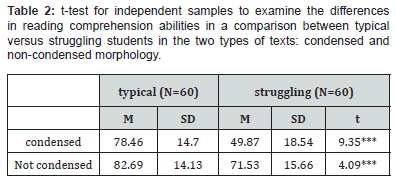
The data in Table 2 indicate a significant difference (t=9.35, p<.001) between those who have difficulty and those who are typical in the reading comprehension of a condensed text. In other words, typical students showed a higher reading comprehension ability (M=78.46, SD=14.70) for the condensed text than the struggling students (M=49.87, SD=18.54). A significant difference (t=4.09, p<.001) was also found between struggling and typical students in the reading comprehension of a condensed text. In other words, typical students showed higher reading comprehension ability (M=82.69, SD=14.13) for the uncondensed text compared to struggling students (M=71.53, SD=15.66). The data shows that the level of distribution of the data surrounding the average is high, as expected for a heterogeneous sample of normally distributed typical and struggling students, whose achievements are normally distributed. The significance of these findings is that the H2, according to which the reading comprehension of typical students for condensed and non-condensed texts will be higher than those who struggle, has been confirmed.
H3: The interaction between text type and student type will significantly affect the level of reading comprehension.
To test H3, an ANOVA test was conducted as shown in Table 3.
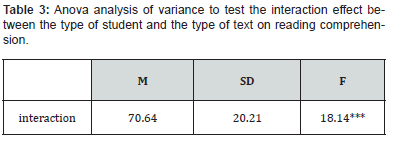
The data in table 3 indicate the existence of a significant effect (F (1, 236) =18.14, p<.001) between student type and text type on reading comprehension (M=70.64, SD=20.21). Thus, H3, according to which the interaction between text type of and student type will significantly affect the level of reading comprehension, has been confirmed. In conclusion, the research findings confirmed the three hypotheses: students understood a text with uncondensed morphology better than a text with condensed morphology; reading comprehension of typical students, for both condensed and uncondensed texts, was better than among those with difficulties; the interaction between text type and student type significantly affected the level of reading comprehension.
Discussion
The purpose of the current study was to examine the effect of condensed versus non-condensed morphology on reading comprehension among typical versus struggling Arabic-speaking 4th-grade students. This section will discuss each of the three confirmed hypothesis.
Hypothesis 1
The first research hypothesis, according to which students will understand a text with uncondensed morphology better than a text with condensed morphology, was confirmed. Studies have shown that 4th-graders tend to have better reading comprehension of morphologically uncondensed texts compared to morphologically condensed ones. This may be due to a number of different factors: (a) uncondensed morphology texts are easier to decode, as they usually consist of shorter words that are easier for young readers to recognize [15,29], while morphologically condensed texts often contain longer words with multiple morphemes, making them harder to decipher; (b) uncondensed morphology texts tend to use more familiar vocabulary, making it easier for students to understand what they are reading [34,35], while condensed morphological texts may include less familiar or higher register vocabulary that can be challenging for young readers; (c) uncondensed morphology texts have simpler sentence structures, making them easier for students to understand [18,26], while morphologically condensed texts may have more complex sentence structures, which may be more challenging for young readers to follow; (d) while condensed morphology texts may have more prefixes, suffixes, and other morphemes that can distract students from the main idea of the text [27, 28], uncondensed morphological texts have fewer distractions, making it easier for students to focus on the main ideas and themes of the text [15,22].
Hypothesis 2
The second research hypothesis that the reading comprehension level of typical students, for both condensed and non-condensed texts, will be higher than those with difficulty was confirmed. This finding is consistent with previous studies that showed that 4th grade is a critical year for the development of reading for Arabic speakers, as students are expected to move from “learning to read” to “reading to learn” [26,28]. At this stage, typical 4th-graders should be mastering the reading skills of decoding, fluency, and comprehension, which enable them to read and understand a wide variety of texts. Conversely, struggling students may not have developed these skills to the same extent, which may hinder their reading comprehension ability. One factor that may contribute to 4th-graders’ higher reading comprehension ability is their greater knowledge of vocabulary [16,22].
Typical 4th- graders are more likely to have developed strong decoding and fluency skills, which can support their reading comprehension level. Decoding refers to the ability to sound out words and recognize them quickly and accurately, while fluency refers to the ability to read quickly, accurately, and expressively. These skills allow typical students to read more complex texts more easily and quickly and allow them to focus on understanding the meaning. However, it should be note that many factors may contribute to a student’s reading comprehension ability, and not all struggling students have the same difficulties. Some students may struggle with decoding or fluency, while others may struggle with vocabulary or reading comprehension strategies. In addition, individual differences in background knowledge, motivation, and interest can also affect reading comprehension [1,2].
In addition to the previously mentioned factors, there are other possible reasons why typical 4th-graders may have higher reading comprehension than struggling students. One factor is the amount of reading experience typical students have had. Generally, these students will have been exposed to a wide variety of texts and had more opportunities to practice their reading skills [3,4]. This exposure and practice can help develop their reading fluency, vocabulary knowledge, and comprehension strategies. Conversely, struggling students may have had less exposure to a variety of texts and may not have had many opportunities to practice their reading skills [7,12]. Another possible factor is the role of background knowledge in reading comprehension. Typical 4th-graders may have more background knowledge on various topics because they have had more time to build this knowledge through reading and other experiences. This prior knowledge can help them better understand and make connections with what they read, which in turn supports their comprehension. Struggling students, on the other hand, may have less background knowledge on certain topics, which can make it harder for them to understand what they read [8,10].
Another factor that can affect the typical reading comprehension ability of 4th-graders is the level of complexity of the texts they read. Generally, they are expected to read more complex texts that require them to apply a variety of reading strategies, such as identifying main ideas (Abu- Rabia, 2021; Wagner et al., 2021). These texts often include academic and domain-specific vocabulary that can challenge students’ comprehension. Conversely, struggling students may receive simpler texts that are more appropriate for their reading level. Although these texts may be easier to read, they may not provide the same level of challenge or opportunities for students to practice and apply reading strategies. This can limit their ability to develop the skills needed to read more complex texts in the future [15,34].
Hypothesis 3
The third research hypothesis, according to which the interaction between text type and student type significantly affects the level of reading comprehension was confirmed. The effect of the interaction between the type of morphology (condensed vs. non-condensed) in Arabic and the type of student (typical vs. struggling) on the reading comprehension abilities of 4th-grade students has several causes. First, typical students tend to have a stronger foundation in Arabic and its grammar rules. However, uncondensed morphology provides more context and information about the words, which can help typical students better understand the meaning of the text [5,7]. Conversely, struggling students may have difficulty with the more complex and unfamiliar words found in texts with condensed morphology, as they may not have a good understanding of Arabic grammar and vocabulary [8,21].
Second, uncondensed morphology can provide more cues that support reading comprehension. For example, prefixes and suffixes can provide important information about the tense, gender, and number of a word, which can help students better understand the sentence and the overall meaning of the text. Struggling students may have difficulty identifying and using these cues to aid their understanding, which may make it harder for them to understand the text [19,20]; Third, uncondensed morphology can provide a more interesting reading experience for students. The increased information and context provided by uncondensed morphology can help create a more engaging mental image for students, which can improve their understanding and interest in the text. Conversely, for struggling students, the condensed morphology used in Arabic texts may result in a less interesting reading experience, which can reduce their motivation to read and make efforts to understand the text [27,33].
The use of uncondensed morphology can also help improve students’ understanding of the root system of Arabic words, where most words derive from a root word that carries a basic meaning. Uncondensed morphology provides additional information about the root of the word, which can help students better understand its meaning and the context in which it is used [29]. This can be especially helpful for typical students who have a stronger foundation in Arabic and can identify the root of the word more easily. Conversely, struggling students may have difficulty identifying the root, which may make it difficult for them to understand the meaning of the word and the text as a whole. This difficulty can be exacerbated by the use of condensedmorphology, which can make it harder to identify the root of the word and understand its particular meaning [2,4].
General discussion
The current study made significant strides in understanding the relationship between the two types of morphology (condensed vs. uncondensed) and reading comprehension among typical and struggling 4th-grade Arabic-speaking students. The confirmation of the three hypotheses has implications for educational practices and further research.
Hypothesis 1 revealed that uncondensed morphology enhanced reading comprehension, probably because it is simpler and more accessible to young readers. This highlights the importance of exposing young readers, especially those still developing their skills, to texts that are more easily decodable and less distracting. This knowledge can be harnessed by educators to create or choose learning materials that facilitate easier and more effective reading comprehension.
Hypothesis 2 indicated that typical students performed better in reading comprehension of both condensed and uncondensed texts compared to their struggling counterparts. This underscores the significance of early intervention and specialized support for struggling students. This finding may motivate the development of tailored educational strategies that identify and assist struggling readers early on. Such support could involve focusing on building the decoding, fluency, and vocabulary skills that the typical students in the study seemed to possess. It also suggests the need for ongoing assessment and individualized instruction to ensure that all students, regardless of their current reading level, are challenged and supported in their development as readers.
Hypothesis 3 showed the importance of considering the interaction between student type and text type. Since the type of morphology had a different impact on typical and struggling students, it emphasizes the need for a more nuanced approach to reading instruction that takes into consideration both the nature of the text and the individual needs of the student. This interaction opens up an avenue for more specialized study materials and curricula that can be adapted to the unique needs and abilities of different student populations. It also draws attention to the rich linguistic structure of the Arabic language, and how understanding the intricate details of this structure can impact comprehension.
In conclusion, this study offers valuable insights that contribute to the ongoing conversation about literacy development among young Arabic-speaking students. It highlights specific factors that influence reading comprehension and provides a robust empirical foundation for future research and educational practice. The findings of this study may inspire educators and curriculum designers to take a more nuanced and responsive approach to literacy education one that recognizes and leverages the complexity and diversity of both language and learners.
The Innovation of the Study
The current study examined the effect of the type of morphology (condensed vs not condensed) on reading comprehension among typical Arabic-speaking 4th-grade students versus those with difficulty. The reason why the reading comprehension of uncondensed morphological texts in Arabic is better than the reading comprehension of condensed morphological texts among typical and struggling students in 4th grade is that uncondensed morphology provides more context and clues to support comprehension [1,2]. Uncondensed morphology highlights the structure of words and how they are formed from smaller units called morphemes [3,4]. Uncondensed morphology provides more information and context about the word and makes it easier for students to recognize and decode complex words [5,6]. In contrast, condensed morphology makes it difficult for students to understand and decipher the meaning of the word. Struggling students may have difficulty identifying and decoding complex words, which may negatively affect their reading comprehension abilities [7,12]. These research findings offer valuable insights into what constitutes desirable teaching strategies, emphasizing the importance of considering morphology types and student capabilities in enhancing reading comprehension for Arabicspeaking 4th-grade students.
Research Limitations and Empirical Implications
One limitation stem from the use of a quasi-experimental research setup, which does not include a control group. Therefore, it is not possible to state unequivocally that the relationship between the type of morphology and reading comprehension is fully causal, since there may be effects of other mediating and moderating variables that were not tested in this framework. Therefore, it is worthwhile conducting another experimental study, which includes the random assignment of experimental and control groups, to provide the causality variable for the findings. Another limitation of the current study is the use of different condensed and uncondensed texts, which might lead to research bias arising from the potential differences in the difficulty levels of each of the texts, and then the findings obtained are not derived from the differences between the types of texts, but from the differences in their difficulty levels and context. Therefore, additional research should be conducted, combining several texts, each presented to the students in two variations, one condensed and the other uncondensed. Lastly, the study was conducted among typical and struggling 4th-grade students only. The findings obtained in the discussed context may be typical for this age group and the developmental level of the students who participated in the study. Therefore, a future study should examine the differences in the achievements of typical students who have difficulty in reading comprehension in Arabic, in a comparison between different levels of study in elementary school, and thus it will be possible to consider the moderating effect of age on the correlation between these variables [].
These research results have implications for the field of education. Uncondensed morphological texts tend to be more accessible and easier for young readers to understand, leading to better reading comprehension compared to condensed morphological texts. However, reading comprehension levels may vary greatly between individual students, and some students may find morphologically condensed texts more comprehensible than others. Therefore, teachers and parents should provide students with a variety of texts that include both uncondensed and condensed morphology to challenge their reading comprehension skills and promote their overall language development. Educators and parents should provide students with a variety of texts that include both uncondensed and condensed morphology. This can help students develop their reading comprehension skills and their understanding of morphology. Educators can also provide explicit instruction in morphology, including instruction on prefixes, suffixes, and other morphemes, to help students better understand and decode complex words. By giving students a strong foundation in morphology, educators can help them become more proficient readers and communicators.
Educators are advised to provide targeted instruction and support to struggling students to help them develop the specific skills they need to improve their reading comprehension. This may include explicit instruction in decoding, vocabulary, or comprehension strategies, as well as opportunities to practice these skills in a supportive and engaging environment. By providing differentiated instruction and support, educators can help struggling students develop the skills they need to become proficient readers. The teaching strategies used in the classroom can affect students’ reading comprehension. Effective reading instruction should be explicit, systematic, and based on evidencebased practices. Educators must provide instruction on a variety of reading strategies, such as decoding, fluency, vocabulary, and comprehension, and ensure that students have many opportunities to practice and apply these skills in a variety of contexts. This can help build students’ reading skills and support their comprehension.
References
- Alqahtani D (2020) Phonology-morphology interaction in Abha Arabic: Vowel processes in stratal optimality theory (Doctoral dissertation, University of Essex).
- Yusef ES (2021) Some difficulty of Arabic morphology. Journal of Babylon Center for Humanities Studies 11(4): 88-104.
- Alqarni M (2020) The morphosyntax of the demonstrative system in Classical Arabic: A distributed morphology account. International Journal of Arabic-English Studies 20(1): 19-50.
- Tibi S, Edwards AA, Schatschneider C, Kirby JR (2020) Predicting Arabic word reading: A cross-classified generalized random-effects analysis showing the critical role of morphology. Annals of Dyslexia 70(2): 200-219.
- Aseri Y (2019) Encoding semantic relations between the predicate and participants through Arabic verbal morphology: A systems interaction approach (Doctoral dissertation, University of Colorado at Boulder).
- Taha J, Stojanovik V, Pagnamenta E (2021) Expressive verb morphology deficits in Arabic-speaking children with developmental language disorder. Journal of Speech, Language, and Hearing Research 64(2): 561-578.
- El Akiki C, Content A (2020) Early sensitivity to morphology in beginning readers of Arabic. Frontiers in Psychology 11(1): 36-51.
- El-Affendi MA, Abuhaimed I, Al-Rajhi K (2021) A simple Galois power-of-two real time embedding scheme for performing Arabic morphology deep learning tasks. Egyptian Informatics Journal 22(1): 35-43.
- Nahli O, Del Grosso AM (2021) Creating Arabic lexical resources in TEI: a schema for discontinuous morphology encoding. In 2020 6th IEEE Congress on Information Science and Technology (CiSt) pp: 178-187.
- Reda L (2022) The effectiveness of the keyword strategy in developing the linguistic ability in morphology among first-stage students - Arabic department. Iraqi Journal of Humanitarian, Social and Scientific Research 2(5): 216-225.
- Abu-Rabia S, Abu-Rahmoun N (2012) The role of phonology and morphology in the development of basic reading skills of dyslexic and normal native Arabic readers. Creative Education 3(7): 1259-1268.
- Shany FK (2020) Processes of mathematical thinking in Arabic morphology. Lark Journal for Philosophy, Linguistics and Social Sciences 3(38): 112-147.
- Ibrahim R (2013) Reading in Arabic: New evidence for the role of vowel signs. Creative Education 4(4): 248-253.
- Perfetti C, Rieben L (1991) Learning to read. Lawrence Erlbaum Associates, Inc.
- Abu-Rabia S (2021) Syntax functions and reading comprehension in Arabic orthography. Reading Psychology 1-30.
- Alseraye AMS (2022) The reading comprehension process of Arabic garden-path sentences: An equivocal effect. Creative Education 13(9): 3026-3052.
- Asadi IA, Khateb A, Shany M (2017) How simple is reading in Arabic? A cross‐sectional investigation of reading comprehension from first to sixth grade. Journal of Research in Reading 40(2): 1-22.
- Barquero LA, Cutting LE (2021) Introduction to the special issue on advances in the understanding of reading comprehension deficits. Annals of Dyslexia 7(4): 1-7.
- Jabir JK (2021) The role of morphology in translation: Arabic semi–active participle adjectives as an example. Adab Al-Basrah, 2(95): 220-234.
- Mashaqba B, Huneety A, Guba MA, Zeidan Z (2022) On morphology-phonology interface: Insights from diminutives in Jordanian Arabic. Theory and Practice in Language Studies 12(6): 1206-1213.
- Foote RK, Saadah E (2021) The processing of adjective agreement morphology in native, heritage, and L2 Arabic. Arab Journal of Applied Linguistics 6(1): 1-31.
- Sweet AP, Snow C (2002) Reconceptualizing reading comprehension. Improving Comprehension Instruction 17-53.
- Perfetti CA, Zhang S, Berent I (1992) Reading in English and Chinese: Evidence for a “universal” phonological principle. In: Advances in psychology 94: 227-248. North-Holland.
- Taouk M, Coltheart M (2004) The cognitive processes involved in learning to read Arabic. Reading and Writing: An Interdisciplinary Journal 17(1-2): 27-57.
- Elbeheri G, Everatt J (2007) Literacy ability and phonological processing skills amongst dyslexic and non-dyslexic speakers of Arabic. Reading and Writing 20: 273-294.
- Hussein TT (2022) Reading comprehension skills and their relationship to generative thinking among teachers of Arabic for the intermediate stage. Iraqi Journal of Humanitarian, Social and Scientific Research 2(4): 17-33.
- Dolean DD, Lervåg A, Visu-Petra L, Melby-Lervåg M (2021) Language skills, and not executive functions, predict the development of reading comprehension of early readers: Evidence from an orthographically transparent language. Reading and Writing 34(6): 1491-1512.
- Humud DJ (2022) The effect of the developed (DKWDLS) strategy on the reading comprehension of second-grade intermediate students in Arabic language subject (reading) AMD Nasaq 34(1): 46-86.
- Wagner RK, Beal B, Zirps FA, Spencer M (2021) A model-based meta-analytic examination of specific reading comprehension deficit: how prevalent is it and does the simple view of reading account for it? Annals of Dyslexia 2(1): 1-22.
- Vaknin-Nusbaum V, Sarid M (2021) The role of morphological awareness in the development of reading comprehension in Hebrew-speaking second-graders. Reading and Writing 2(1): 1-27.
- Abu-Rabia S (2001) The role of vowels in reading Semitic scripts: Data from Arabic and Hebrew. Reading and Writing 14(1-2): 39-59.
- Abu-Rabia S (2007) The role of morphology and short vowelization in reading Arabic among normal and dyslexic readers in grades 3, 6, 9, and 12. Journal of Psycholinguistic Research 36(2): 89-106.
- RAMA (2022). Reading and writing test in Arabic for the 4th grade. Israeli Ministry of Education.
- Asadi IA, Khateb A, Shany M (2017) How simple is reading in Arabic? A cross‐sectional investigation of reading comprehension from first to sixth grade. Journal of Research in Reading 40(2): 1-22.
- Taboada A, Cartwright KB, Hancock GR, Klauda SL (2021) Beyond the simple view of reading: The role of executive functions in emergent bilinguals’ and English monolinguals’ reading comprehension. Reading Research Quarterly 56(2): S45-S64.

























